
Study Guides
OCR A Level Business: Contingency planning and crisis management (H431)
Study guide to contingency planning and crisis management for OCR A Level Business H431: purpose, evaluation, recommending a plan, with worked examples.
- Subject
- Business
- Level
- A LEVELS
- Topic
- Business objectives and strategic decisions
- Author
- Marlbridge Academic Team
- Updated
- Reviewed by
- Salman Ahmad (what this means)
Aligned to OCR A Level Business (H431), Version 2.1 (January 2026), for first assessment in 2017; final assessment summer 2027. Official specification .
Syllabus page (what it covers and how it is assessed): OCR A Level Business.
Syllabus points this page covers
H431
- 1.9 Contingency planning and crisis management
Found an error? Report a correction.
Need help with this topic? Request a free trial class for A Level Business (H431).
This guide covers the content heading Contingency planning and crisis management in the OCR A Level Business (H431) specification, Version 2.1 (January 2026). It sits within the area of study Business objectives and strategy, and Marlbridge numbers it 1.9 in its checklist. H431 is being withdrawn by OCR, with final assessment in summer 2027. The specification says content in one section may be assessed in any context, so expect to use this material alongside risk, stakeholders, change and operations.
The wider topic is in the Objectives and Strategic Decisions guide. For quick recall use the revision notes, then test yourself with the practice questions. The earlier strategy revision notes and strategy practice set touch on the same ideas more briefly. Course pages: OCR A Level Business hub and checklist. To find weak spots first, try the free diagnostics.
What the specification asks you to do
| Specification point | What it means in practice |
|---|---|
| Explain the nature and purpose of contingency planning | Say what a contingency plan is and why a business has one |
| Evaluate the advantages and disadvantages of contingency planning to a business and its stakeholders | Weigh benefits against costs for the firm and for groups affected |
| Evaluate the impact and importance of contingency planning to a business and its stakeholders | Judge how much difference a plan makes, and how far it matters |
| Recommend and justify a contingency plan for a business | Propose specific actions for a given case and defend the choice |
| Explain the nature and purpose of crisis management | Say what managing a crisis involves and why it is done |
| Evaluate a business’ crisis management | Judge how well a business handled a crisis that has happened |
The specification does not name a model or formula for this section. Where this guide uses a calculation or a checklist, it is a standard way of organising the thinking, not an OCR framework.
Nature and purpose of contingency planning
A contingency plan is a set of actions prepared in advance for an unexpected event that could disrupt the business. The event might be a fire, a supplier failure, a cyber-attack, a key person leaving suddenly, a product fault or a sharp rise in costs. The plan is written before anything goes wrong, so that managers are not inventing a response under pressure.
The nature of the plan:
- It is prepared in advance and written down.
- It covers events that are possible but not expected. A normal forecast covers what the business expects to happen. A contingency plan covers what it hopes will not.
- It sets out who does what, what resources are needed and how stakeholders are told.
- It is reviewed from time to time, because the business, its risks and its people change.
The purposes:
- To reduce the damage from an event, in cost, time and reputation.
- To speed up recovery and so protect sales revenue and customers.
- To protect stakeholders, such as employees’ jobs, customers’ orders and suppliers’ payments.
- To give confidence to owners, lenders and insurers that risk is under control.
- To make people calmer and clearer when the event happens.
Contingency planning is linked to risk. A business cannot remove every risk, so it uses a plan to deal with the ones that remain. The specification also lists contingency and crisis among the types of change in the Change area, which is why this topic connects to change management.
Building a plan (a standard approach)
- Identify the events that could seriously disrupt the business.
- Assess each one by how likely it is and how much damage it would do.
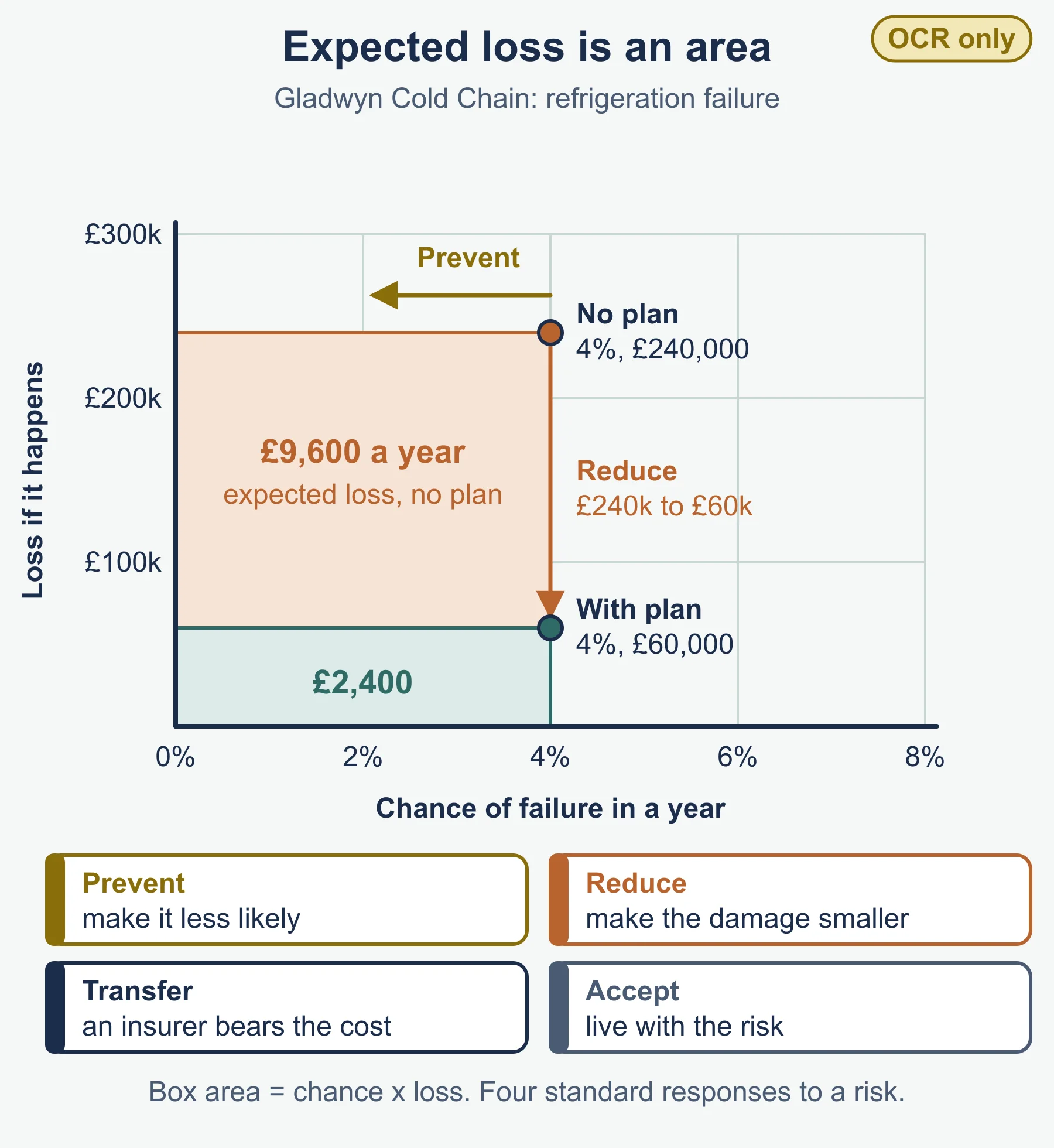
- Choose a response: prevent the event, reduce its effect, transfer the cost (for example by insurance) or accept the risk.
- Assign roles, resources and a way of deciding when to activate the plan.
- Plan communication with employees, customers, suppliers and others.
- Test and review the plan, so that it still works.
Worked example 1: is a plan worth its cost?
Gladwyn Cold Chain delivers chilled food to supermarkets. Its depot refrigeration could fail. Management estimates a 4% chance of a serious failure in any year. Without a plan, a failure would cost £240,000 (spoiled stock, penalties and lost contracts). With a plan (a standby unit hire agreement and an emergency delivery rota) the loss would fall to £60,000. The plan costs £9,000 a year to maintain.
A standard way to compare is expected loss = probability x loss.
- Expected annual loss without a plan: 0.04 x £240,000 = £9,600.
- Expected annual loss with a plan: 0.04 x £60,000 = £2,400.
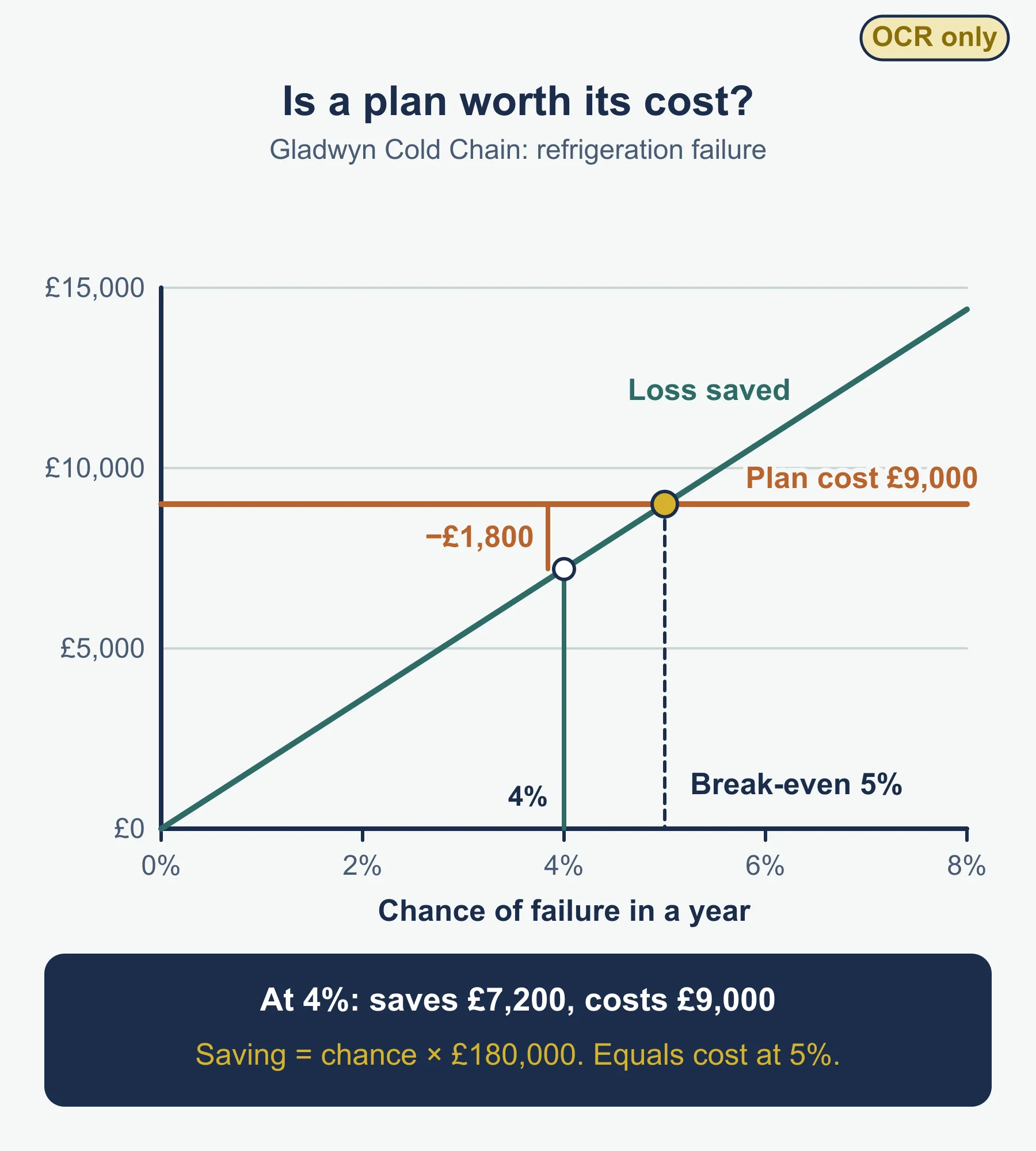
- Expected saving: £9,600 - £2,400 = £7,200.
- Net of the plan’s cost: £7,200 - £9,000 = -£1,800.
On these figures alone the plan costs more than it saves. The plan breaks even if the probability is 5% or higher, because £9,000 divided by the £180,000 reduction in loss is 0.05.
A good evaluation then asks what the numbers leave out. A supermarket might drop a supplier after one failed delivery, and that loss of trust is hard to put a figure on. The 4% is only an estimate, so the result is uncertain. The judgement could still be to adopt a cheaper version of the plan.
Advantages and disadvantages of contingency planning
Advantages to the business
- Faster, calmer response, so less sales revenue is lost.
- Lower cost of the event overall, if the plan works.
- Better chance of keeping customers and contracts.
- Can lower insurance costs or satisfy customers who require evidence of resilience.
- Forces managers to think about weak points, which can reveal avoidable risks.
Disadvantages to the business
- Costs money and management time, even if the event never happens.
- Cannot cover every event, and the actual event may differ from the one planned for.
- Plans can become out of date or stay untested, so they fail when needed.
- May create false confidence, or make managers follow the plan when they should improvise.
- Resources used on planning could have been used elsewhere (an opportunity cost).
Stakeholders
| Stakeholder | Possible advantage | Possible disadvantage |
|---|---|---|
| Owners and shareholders | Protects the value of the business | Costs reduce profit and dividends |
| Employees | Jobs and pay more secure; clear instructions | Extra training, drills or changed duties |
| Customers | Orders and service continue | Higher prices if costs are passed on |
| Suppliers | Payment and orders more stable | May be asked to meet new standards or hold stock |
| Lenders | Lower chance of default | Little direct effect |
| Local community | Less disruption from incidents | Little direct effect |
Impact and importance
Impact is the effect a plan actually has. Importance is how much it matters to the business and stakeholders. Both depend on context. Use these questions in an evaluation.
- How likely and how severe is the event? A rare, small event hardly justifies a detailed plan. A likely, severe one does.
- How dependent is the business on one site, supplier, system or person? The more dependent, the more important the plan.
- Size and resources. A large firm can afford specialist planning. A small firm may find even a simple plan a real cost, though it may have less cushion if it is hit.
- Type of business. A hospital, airline or food producer has stakeholders who could be harmed. A plan matters more where safety or perishable goods are involved.
- Quality of the plan. A tested, communicated plan has more impact than one in a drawer.
- Time frame. Benefits come when the event happens, which could be never. Costs are paid every year.
Recommending and justifying a plan
For a “recommend and justify” question, do not describe planning in general. Take the business in the case and:
- Pick the most serious realistic risk from the information given.
- Recommend specific actions that fit its size and resources.
- Justify with evidence from the case: figures, dependence, customer expectations, cost against likely loss.
- Say what you would not do and why, or what could go wrong.
- Reach a judgement about whether the plan is worthwhile.
Weak answers list “have insurance, have a backup” for any business. Strong answers say which backup, how it would work, who would trigger it and why that is better than the alternatives for this business.
Nature and purpose of crisis management
A crisis is a serious, often sudden event that threatens the survival, reputation or normal running of a business and needs urgent decisions. Crisis management is how a business responds while the crisis is happening and afterwards. These are standard definitions, not quoted from the specification.
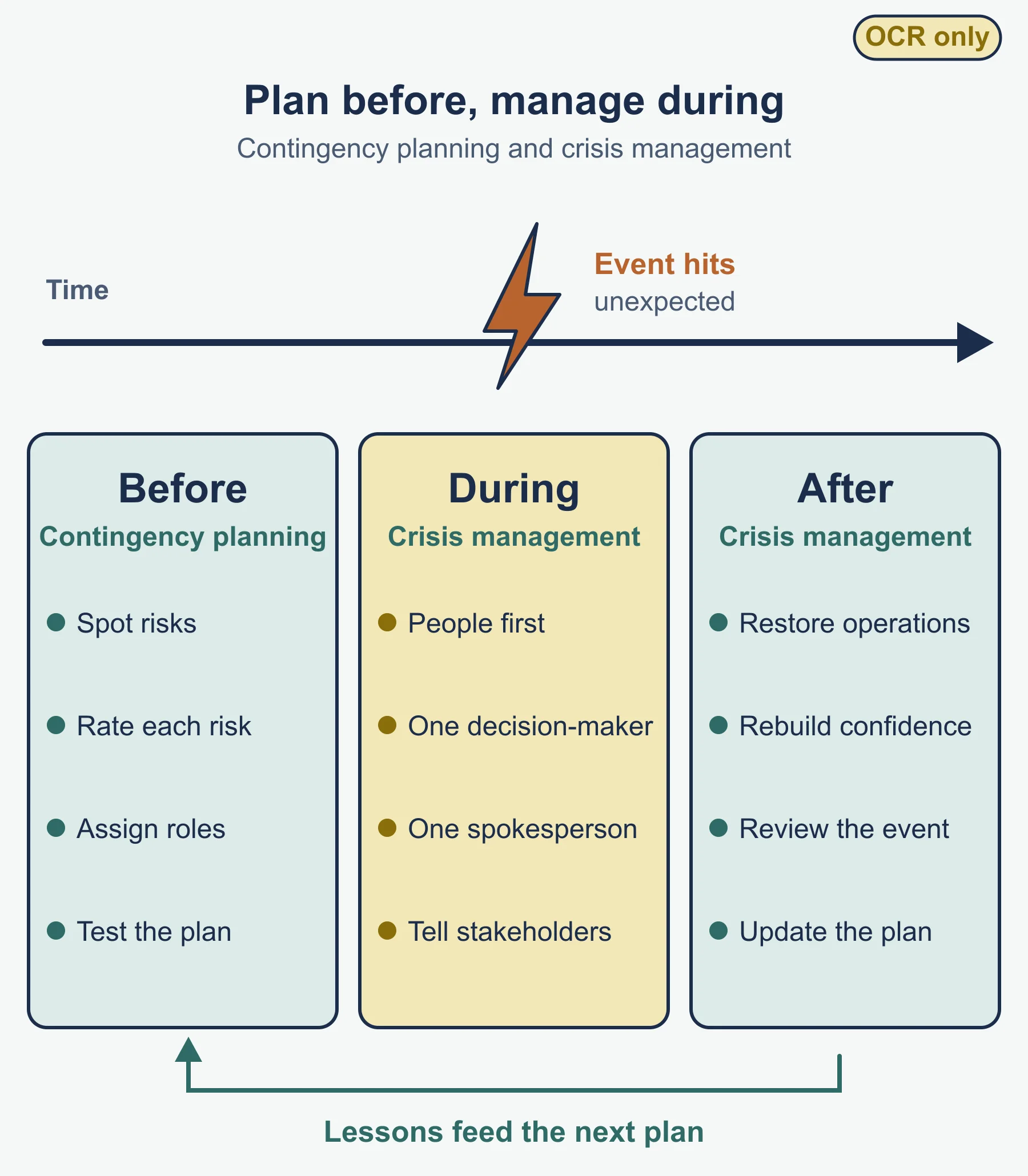
The difference from contingency planning is timing. Contingency planning happens before an event. Crisis management happens during and after it. A good contingency plan makes crisis management easier, but even a business with a plan must still make judgements on the day, because real events never match the plan exactly.
Typical elements of crisis management:
- Protect people first, then assets and operations.
- Take control: name one decision-maker and one spokesperson.
- Communicate quickly, honestly and consistently with employees, customers, suppliers, the media and others.
- Contain the problem, for example by stopping production or recalling products.
- Restore normal operations and rebuild confidence.
- Review what happened and update plans.
The purposes are to limit harm, protect the reputation, keep stakeholder trust, return to normal operations and learn from the event.
Evaluating a business’ crisis management
You judge the response against what was possible. Useful criteria:
- Speed: did the business act when it first knew?
- Honesty and clarity of communication, and whether stakeholders heard from the business first.
- Priorities: were people and safety put first?
- Control: were responsibilities clear?
- Cost of the response against the harm avoided.
- Recovery: how long to return to normal, and what happened to customers and sales revenue?
- Learning: did the business change its plans afterwards?
Be careful with hindsight. An outcome can be poor even when the decisions were sound, and the other way round.
Worked example 2: judging a crisis response
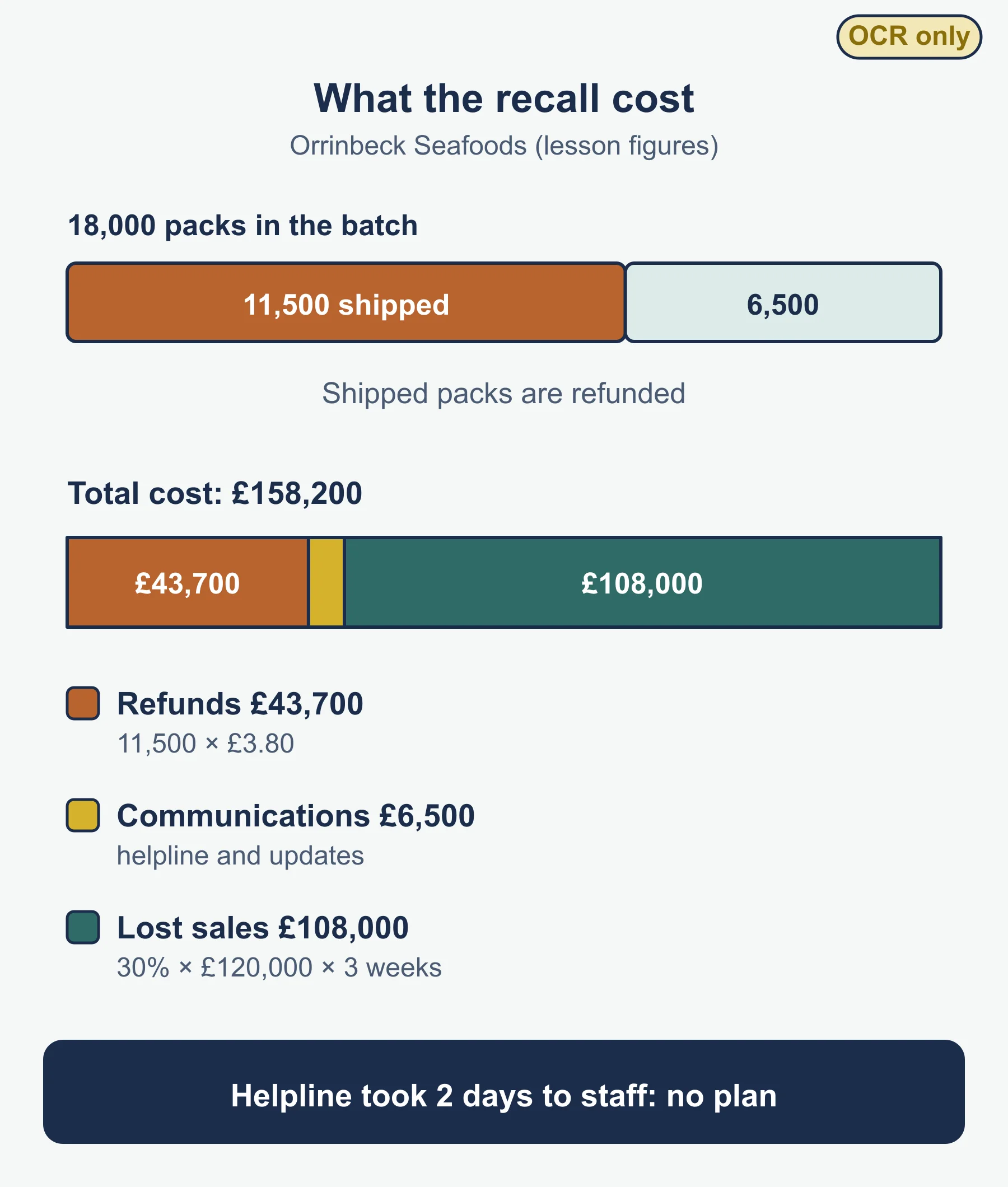
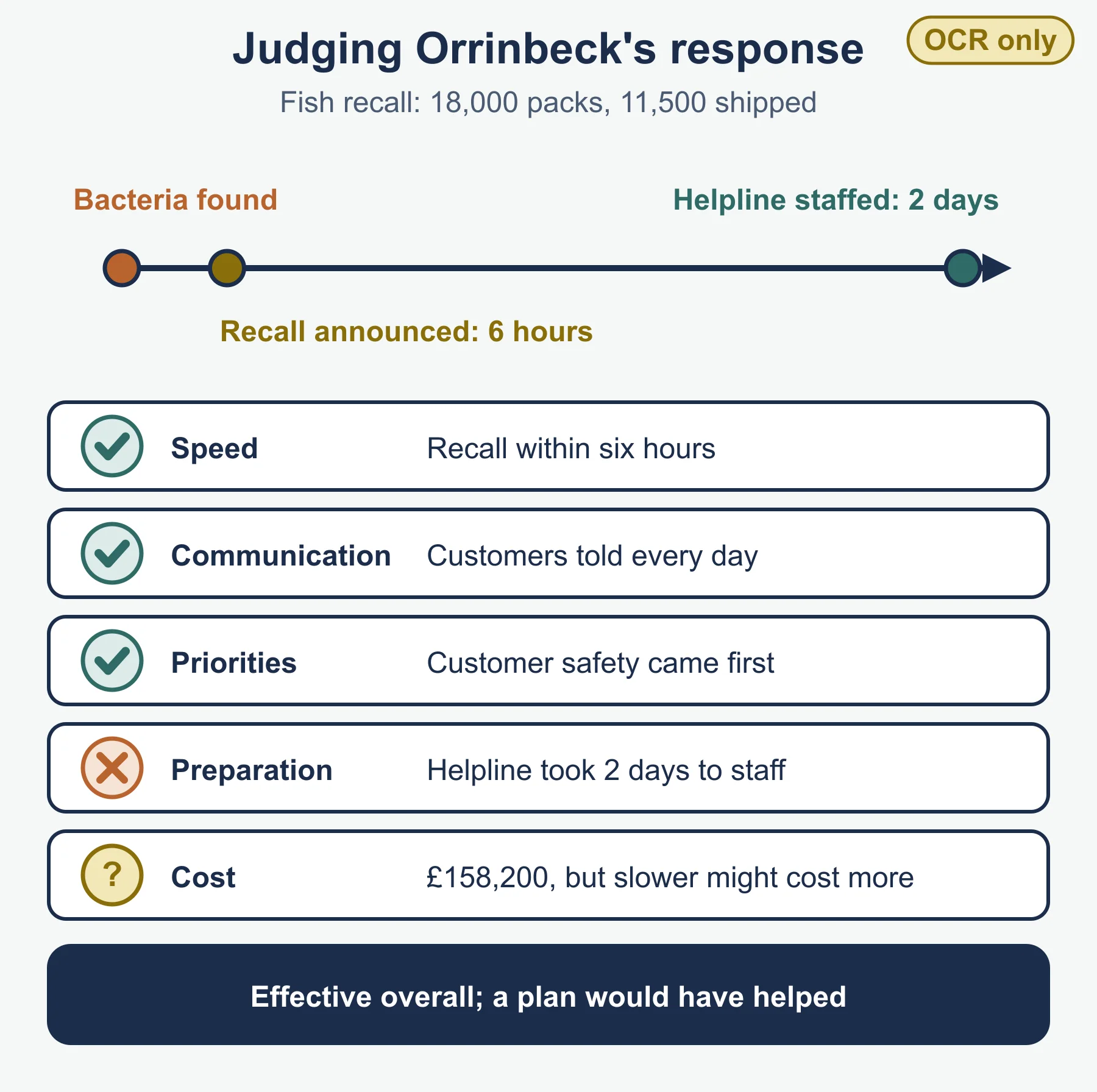
Orrinbeck Seafoods found bacteria in a batch of 18,000 packs of fish. Of these, 11,500 had been shipped. The managing director announced a recall within six hours, set up a refund helpline (though it took two days to get enough staff on the phones) and kept customers informed daily.
The recall cost 11,500 x £3.80 = £43,700 for refunds, plus £6,500 for communications, a total of £50,200. Weekly sales revenue is normally £120,000. It fell by 30% for three weeks, so lost sales revenue was 0.30 x £120,000 x 3 = £108,000. The total cost was £158,200.
Judgement: the speed, the public announcement and the focus on customer safety are strong points. The helpline delay shows missing preparation, which links back to contingency planning. The cost is large, but harm to customers and a possible legal and reputational problem from a slower recall could have cost more. The response was effective overall, and a pre-planned helpline would have made it better.
Common errors
- Describing a contingency plan as something done after the event.
- Writing about planning in general terms instead of the business in the case.
- Treating the plan’s cost as a reason to reject it without comparing it with the loss it prevents.
- Listing stakeholder groups without saying how each is affected.
- Judging crisis management only by the final outcome.
Frequently asked questions
What is the difference between contingency planning and crisis management? The difference is timing. Contingency planning happens before an event, preparing actions in advance, while crisis management happens during and after it, dealing with the event as it unfolds.
Does the OCR H431 specification give a formula for contingency planning? No. The specification does not name a model or formula for this section, so calculations such as expected loss and checklists are standard ways of organising the thinking.
What are the disadvantages of contingency planning? It costs money and management time even if the event never happens, cannot cover every event, can become out of date or untested, and may create false confidence.
Why should you be careful with hindsight when judging crisis management? An outcome can be poor even when the decisions were sound, and the other way round, so judge the response against what was possible at the time.
Official syllabus
This guide follows the OCR A Level in Business (H431) specification, Version 2.1 (January 2026), published by OCR, content heading Contingency planning and crisis management within Business objectives and strategy.
Get free revision emails (optional)
Occasional emails with practice questions, worked explanations and links to free resources for the qualification and subjects you choose. No spam, and you can unsubscribe from any email. The free tools on this site never need an email.
Related resources
-
Practice questions
OCR A Level Business: Contingency planning and crisis management (H431) – Practice Questions
Original practice questions with worked answers on contingency planning and crisis management for OCR A Level Business H431, including short cases.
Business · OCR · A Level
Try questions -
Revision notes
OCR A Level Business: Contingency planning and crisis management (H431) – Revision Notes
Condensed revision notes on contingency planning and crisis management for OCR A Level Business H431, with a quick self-test and common mark losses.
Business · OCR · A Level
Revise topic -
Study guides
OCR A Level Business: Decision making and Decision trees (H431)
Study guide to OCR A Level Business decision making and decision trees: decision types, tools, expected values, worked trees and evaluation.
Business · OCR · A Level
Read guide
Related articles
-
teaching
A Level tuition in Dubai: Cambridge or Pearson Edexcel International A Level?
Schools in Dubai and Abu Dhabi teach either Cambridge International AS & A Level or Pearson Edexcel International A Level. How the two are structured, why it matters for tuition, and how online classes from Lahore work.
9 October 2026
-
curriculum guides
Choosing subjects at IGCSE and A Level
How subject choices at 14 and 16 affect university options later, and how to keep pathways open without overloading a timetable.
28 July 2026
Studying this with a teacher
Working through Business A LEVELS?
This page is free and stays free. If you would rather be taught it, Marlbridge runs Business classes one-to-one, online in your own time zone. One-to-one only for this course: Rs 6,000 per class in Pakistan, with other currencies on the fees page. The first trial class is free. WhatsApp replies within an hour (8am–11pm Pakistan time, every day); email the same day.
OCR Business teachers at Marlbridge
