
Study Guides
OCR A Level Business: Decision making and Decision trees (H431)
Study guide to OCR A Level Business decision making and decision trees: decision types, tools, expected values, worked trees and evaluation.
- Subject
- Business
- Level
- A LEVELS
- Topic
- Business objectives and strategic decisions
- Author
- Marlbridge Academic Team
- Updated
- Reviewed by
- Salman Ahmad (what this means)
Aligned to OCR A Level Business (H431), Version 2.1 (January 2026), for first assessment in 2017; final assessment summer 2027. Official specification .
Syllabus page (what it covers and how it is assessed): OCR A Level Business.
Syllabus points this page covers
H431
- 1.13 Decision making
- 1.14 Decision trees
Found an error? Report a correction.
Need help with this topic? Request a free trial class for A Level Business (H431).
This guide covers sections 1.13 (Decision making) and 1.14 (Decision trees) of the OCR A Level Business (H431) specification, Version 2.1, within the area of study the specification calls Business objectives and strategy. It teaches every bullet the specification lists for both sections. The wider area is covered in the Objectives and Strategic Decisions guide, the strategy revision notes and the strategy practice questions. For this pair of sections, use the revision notes and the practice questions. Track progress on the OCR A Level Business hub and the checklist, and find weak spots with the free diagnostics.
What the two sections ask of you
| Section | You must be able to |
|---|---|
| 1.13 Decision making | Explain nature and purpose; evaluate the impact and importance of effective decisions for the business and stakeholders; evaluate factors to take into account (level of risk, nature of risk, accuracy of forecasts, volatility, potential for bias); explain how aims and objectives relate to decisions; distinguish short-, medium- and long-term decisions; distinguish strategic, tactical and operational decisions; distinguish quantitative and qualitative tools; evaluate financial and non-financial measures of performance; evaluate which course of action to take; evaluate the extent to which a business is a success |
| 1.14 Decision trees | Explain nature and purpose; calculate and interpret probabilities (decimals and percentages); calculate and interpret economic outcomes and expected values; evaluate the outcomes shown; evaluate how a business should respond to the information; assess the importance of that information; assess the usefulness of a decision tree |
Nature and purpose of decision making
A decision is a choice between alternative courses of action. Decision making is the process of identifying a problem or opportunity, gathering information, comparing the options and selecting one. Its purpose is to move the business towards its aims and objectives using limited resources, and to do so with less guesswork than an instinctive choice would involve.
Impact and importance of effective decisions
Effective decisions use resources well, protect cash flow and keep the business pointing at its objectives. The effects reach different stakeholders in different ways.
- Owners and shareholders: a good decision can raise profit and the value of their stake. A bad one can erase both.
- Employees: expansion creates promotion and job security. A poor cost decision can mean redundancies.
- Customers: decisions on price, quality and range decide whether they keep buying.
- Suppliers and lenders: they rely on the business staying solvent and paying on time.
- Local community: a decision to relocate or close affects jobs and local spending.
To evaluate, weigh the size of the impact against its timing. A decision that is slow to take effect may matter most to long-term stakeholders, such as shareholders, while hurting short-term ones, such as staff facing change.
Aims, objectives and decisions
Aims are the broad long-term purposes of the business. Objectives are the measurable targets set to achieve them. Decisions are the choices that turn objectives into action, so the relationship runs in both directions. Objectives set the criteria for judging options: a business with a growth objective will rate an option on how much it adds to market share, while one targeting survival will favour the option that protects cash. The outcome of a decision then shows whether the objective is being met.
A mismatch is a warning sign. A business that aims at premium quality but takes a decision purely to cut cost is working against its own objectives.
Types of decision
By time horizon
Short-term, medium-term and long-term decisions differ in how far ahead their effects run. The specification does not fix exact numbers of months or years, and businesses define them differently, so state the horizon you are using. As the writer’s own rough guide, not specification wording, a short-term decision might concern the next few weeks or months, a medium-term decision the next one to three years, and a long-term decision several years or more. Long-term decisions usually commit more resources and are harder to reverse.
By level and scope
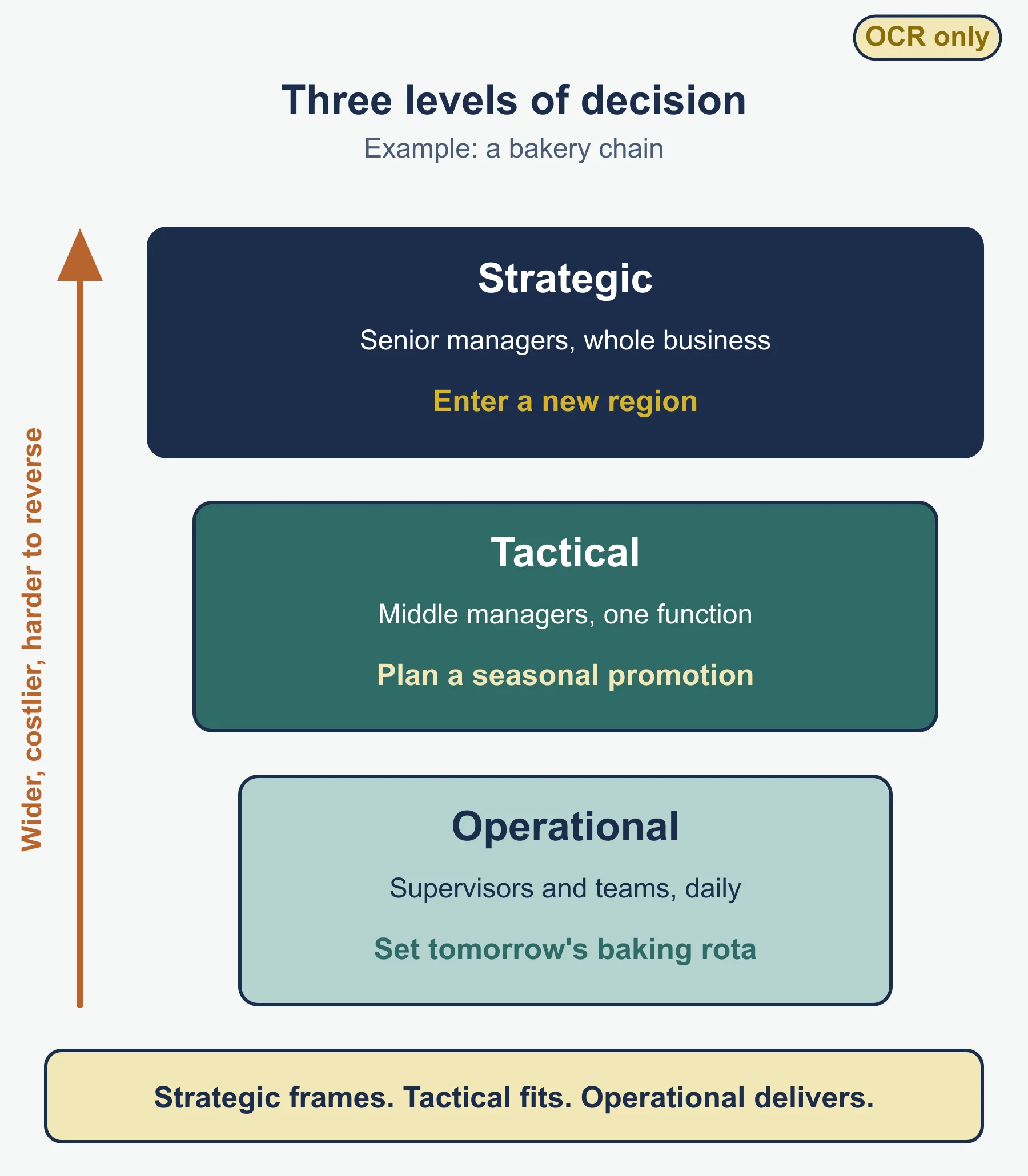
| Type | Level and scope | Example (a bakery chain) |
|---|---|---|
| Strategic | Senior managers or directors; the whole business and its direction; high cost and hard to reverse | Entering a new region |
| Tactical | Middle managers; how to deliver the strategy in one function or period | Planning a seasonal promotion in the new region |
| Operational | Supervisors and teams; day-to-day running | Setting tomorrow’s baking schedule |
Strategic decisions set the frame, tactical decisions fit inside it, and operational decisions carry it out daily. Time horizon and level often line up (strategic with long-term, operational with short-term) but they are different ideas. A cash crisis next week may be a short-term decision that is nevertheless strategic for survival.
Factors to take into account
- Level of risk: how much the business could lose against how much it could gain. A business with thin reserves can accept less risk than one with large reserves.
- Nature of risk: risks differ in kind. Some can be given probabilities (a machine’s failure rate); others cannot be quantified (a rival’s unexpected move). A tool built on probabilities handles the first kind better.
- Accuracy of forecasts: any decision using forecast sales, costs or probabilities is only as sound as the forecast. Inaccurate inputs give a precise-looking but wrong answer.
- Volatility: in fast-changing markets, today’s assumptions can expire before the decision pays off, so flexible options gain value.
- Potential for bias: managers may favour a pet project, ignore evidence against it or over-trust past success. Independent challenge and clear criteria reduce bias.
Decision-making tools
Quantitative tools use numbers: forecasts, costings and expected values. They give objective comparisons but can ignore what cannot be measured. Qualitative tools or information use judgement and non-numerical evidence: staff opinion, brand image, expert views, ethics. They capture context but are subjective. Strong decisions combine both.
Measures of performance
Financial measures (profit, margins, cash flow, return on capital) show whether the business is meeting financial objectives. Non-financial measures (market share, customer satisfaction, quality, staff turnover, environmental impact) show things the accounts miss. Evaluate usefulness by asking: does the measure match the objective, is it reliable, is it timely and does it have a benchmark? Financial figures look backwards. Non-financial figures can warn earlier. Neither is enough alone.
Which course of action, and how successful?
To evaluate which course of action to take, set criteria from the objectives, compare the options on quantitative and qualitative evidence, weigh risk and then recommend with a stated condition (“provided cash reserves cover the first year”). To evaluate the extent of success, compare results with objectives, over time, against competitors and from several stakeholders’ views. A business can hit its profit target and still fail on staff turnover, so judge “to what extent”, not “yes or no”.
Decision trees: nature and purpose
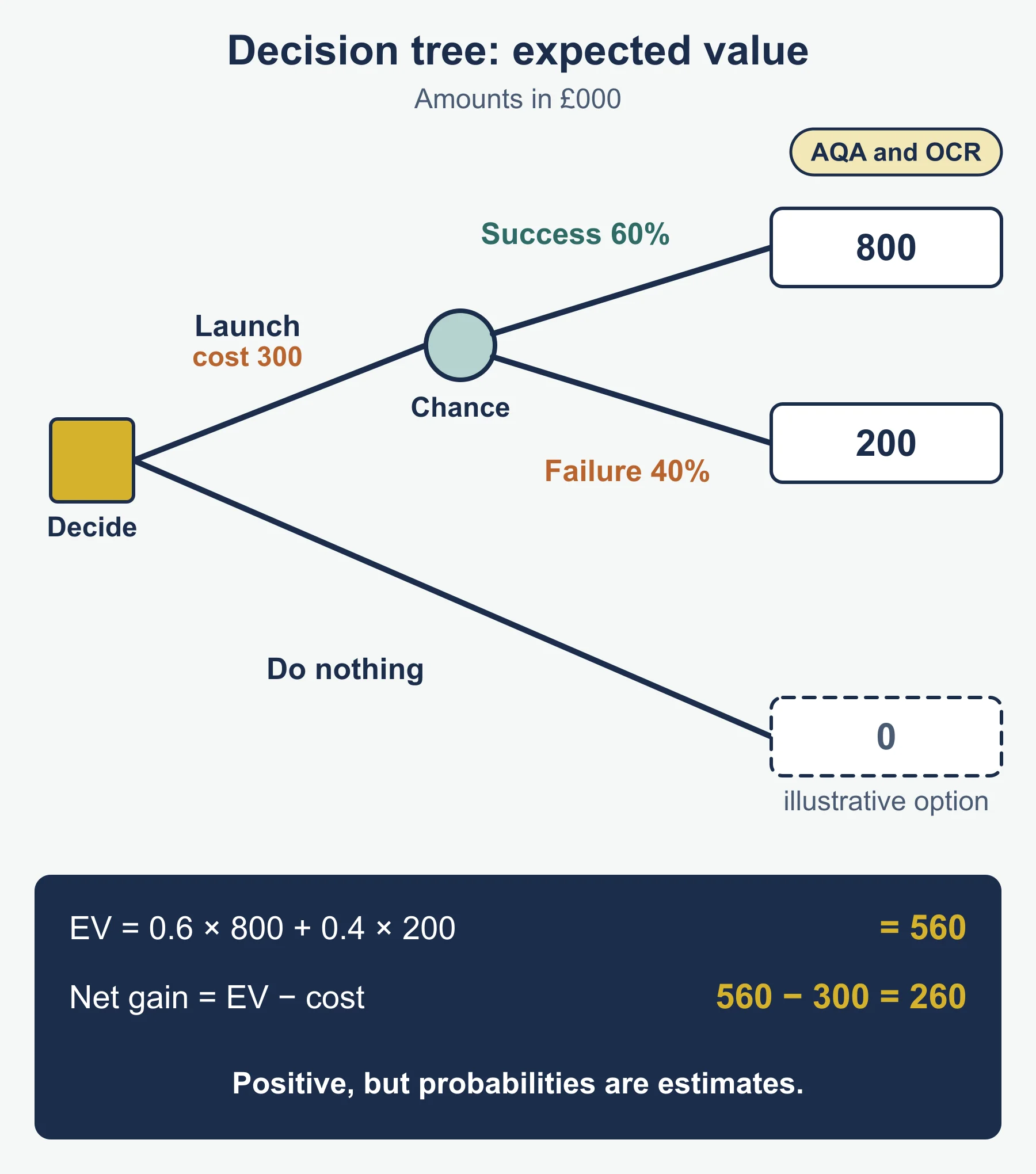
A decision tree diagrams a decision, the choices open, the possible outcomes of each and their probabilities, so the business can compare options on expected value. Its purpose is to make a choice under risk more systematic and to expose the assumptions behind it.
Drawing conventions (standard practice, not specification wording):
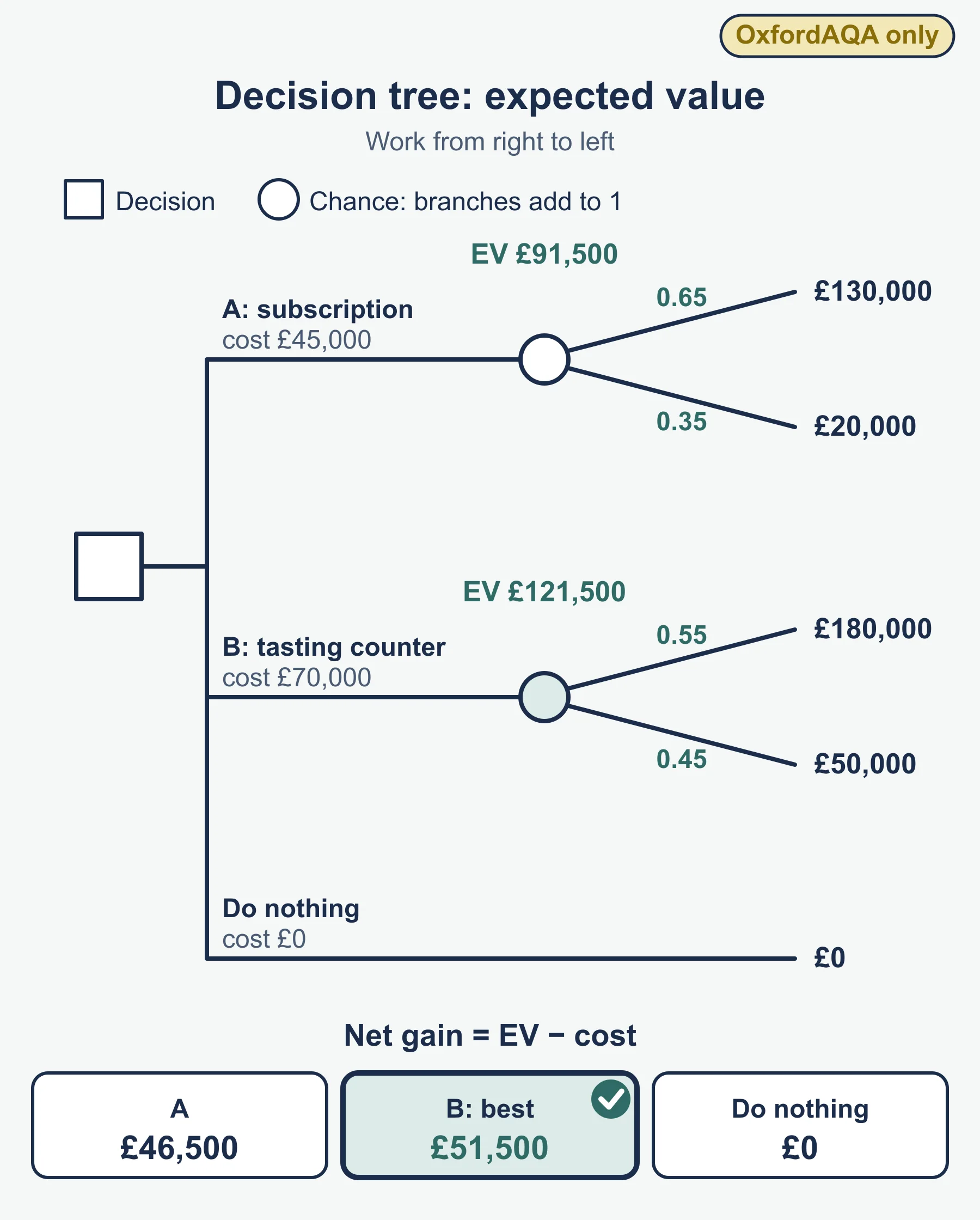
- Decision node: drawn as a square. The business chooses a branch.
- Chance node: drawn as a circle. Chance decides which branch happens.
- Probabilities sit on chance branches and must total 1.0 (100%) at each chance node.
- Costs are shown on the branch where they are incurred. Payoffs sit at the ends of branches.
Probabilities
Probabilities can be written as decimals or percentages: 0.55 is 55%. If two of three branches are 55% and 30%, the third is 100 - 55 - 30 = 15% (0.15). A probability of 0.15 means the outcome is expected in about 15 of 100 comparable cases. It is a judgement, not a promise.
Economic outcomes and expected values
Where the specification does not set a formula, this is the standard form. The economic outcome of a branch is its payoff minus the costs incurred to reach it. The expected value (EV) of a chance node is the sum of probability multiplied by payoff for each branch. The net gain of an option is its EV minus its cost.
EV = sum of (probability x payoff)
net gain = EV - cost of the option
Work from right to left, calculating EVs at chance nodes and choosing the best at decision nodes.
Worked example 1: a single decision
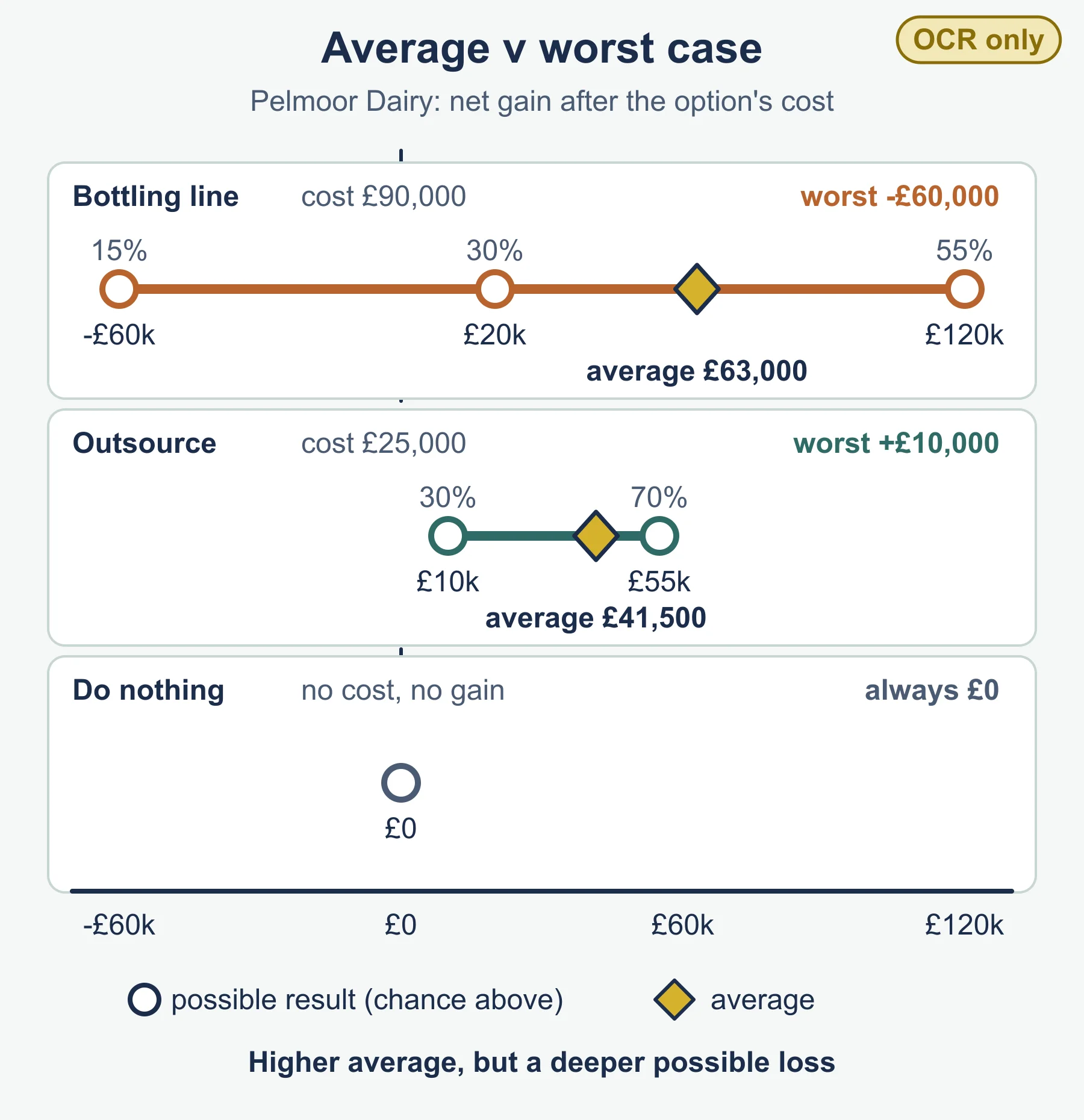
Pelmoor Dairy is choosing between a new bottling line (cost £90,000) and outsourcing bottling (cost £25,000). Do nothing costs and earns nothing.
Bottling line: 55% chance of a £210,000 payoff, 30% chance of £110,000, and the remaining chance of £30,000.
Outsource: 70% chance of £80,000, 30% chance of £35,000.
- Missing probability for the line: 100 - 55 - 30 = 15%.
- Line EV: 0.55 x 210,000 + 0.30 x 110,000 + 0.15 x 30,000 = 115,500 + 33,000 + 4,500 = £153,000.
- Line net gain: 153,000 - 90,000 = £63,000.
- Outsource EV: 0.70 x 80,000 + 0.30 x 35,000 = 56,000 + 10,500 = £66,500. Net gain: 66,500 - 25,000 = £41,500.
- Do nothing: £0.
The line has the higher net gain by £21,500. Interpret: it is the better bet on average, but the worst case is 30,000 - 90,000 = a £60,000 loss, while outsourcing’s worst case is 35,000 - 25,000 = a £10,000 gain. A cautious owner may still outsource.
Worked example 2: a two-stage tree
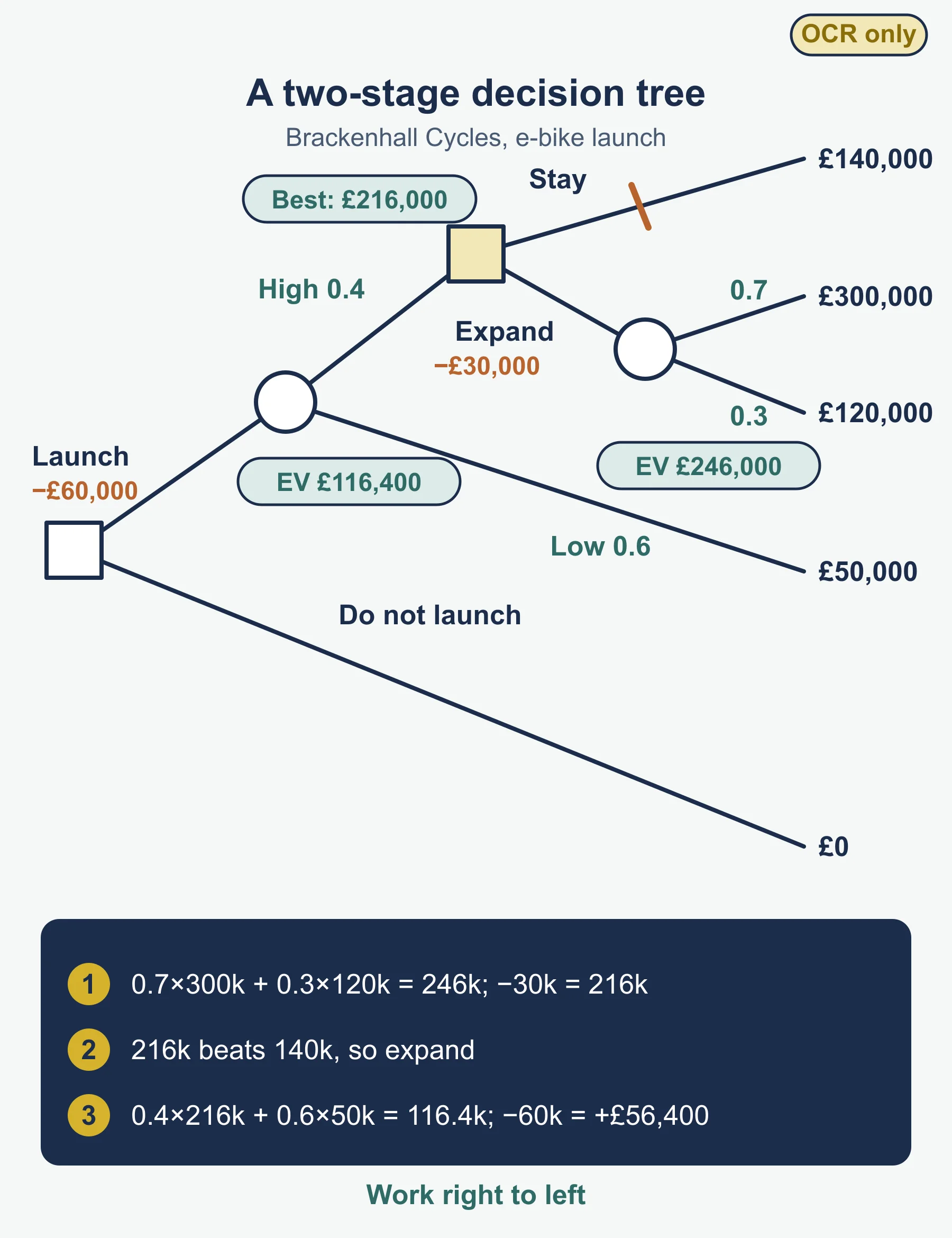
Brackenhall Cycles can launch an e-bike range (cost £60,000). It estimates a 40% chance of high demand and a 60% chance of low demand. Low demand brings £50,000. After high demand it can either stay as it is (£140,000) or expand for a further £30,000, which brings £300,000 with probability 0.7 or £120,000 with probability 0.3.
Launch (60,000) -- chance: High 0.4 -- decision: Expand (30,000) -- chance: 0.7 -> 300,000 / 0.3 -> 120,000
                                                 Stay -> 140,000
                   Low 0.6 -> 50,000
Do not launch -> 0- Right-hand chance node (expand): 0.7 x 300,000 + 0.3 x 120,000 = £246,000. Net of the £30,000: £216,000.
- Decision node: expanding (£216,000) beats staying (£140,000), so expand.
- Launch chance node: 0.4 x 216,000 + 0.6 x 50,000 = 86,400 + 30,000 = £116,400.
- Net gain of launching: 116,400 - 60,000 = £56,400, against £0 for not launching.
The tree recommends launching, then expanding if demand is high.
Evaluating a tree
Evaluate the outcomes: compare EVs, but also the range between best and worst case. Evaluate the response: should the business act on the numbers alone? It should test how the answer changes if a probability falls, check it can survive the worst case and add qualitative factors.
Assess the importance of the information: a tree is most valuable for costly, hard-to-reverse choices under risk, and it shows the stakeholders most exposed to the downside. Assess usefulness:
- Strengths: forces clear thinking, makes assumptions visible, allows comparison, handles risk and sequences of decisions.
- Limits: probabilities and payoffs are estimates, often subjective; it ignores qualitative factors; EV is an average that may never actually occur; it takes no account of the timing of cash flows; and it can give false confidence.
A tree is a decision aid, not the decision. Use it with the tools above.
Common errors
- Forgetting to subtract the cost of the option from the EV.
- Probabilities that do not total 1.0 at a chance node.
- Rolling forward instead of working right to left in a two-stage tree.
- Treating a short-term decision as automatically operational.
- Concluding “it depends” without saying on what.
Frequently asked questions
What is the difference between strategic, tactical and operational decisions? Strategic decisions set the overall frame for the business, tactical decisions fit inside it, and operational decisions carry it out day to day. Time horizon and level often line up, but not always.
What factors should a business consider when making a decision? The level and nature of risk, the accuracy of forecasts, how volatile the market is and the potential for bias among managers, all judged against the business’s objectives.
What are the limitations of decision trees? Probabilities and payoffs are estimates, often subjective; the tree ignores qualitative factors; and the expected value is an average that may never actually occur.
When is a decision tree most useful? A tree is most valuable for costly, hard-to-reverse choices made under risk. It is a decision aid, not the decision, so use it alongside other tools.
Official syllabus
OCR Level 3 Advanced GCE in Business (H431) specification, Version 2.1, sections 1.13 Decision making and 1.14 Decision trees, published by OCR (Oxford Cambridge and RSA).
Get free revision emails (optional)
Occasional emails with practice questions, worked explanations and links to free resources for the qualification and subjects you choose. No spam, and you can unsubscribe from any email. The free tools on this site never need an email.
Related resources
-
Practice questions
OCR A Level Business: Decision making and Decision trees (H431) – Practice Questions
Original OCR A Level Business practice questions with worked answers on decision types, tools, expected values and evaluating decision trees.
Business · OCR · A Level
Try questions -
Revision notes
OCR A Level Business: Decision making and Decision trees (H431) – Revision Notes
Condensed OCR A Level Business revision notes on decision types, decision-making tools, expected values and evaluating decision trees.
Business · OCR · A Level
Revise topic -
Study guides
OCR A Level Business: Different stakeholder and business objectives and Stakeholders (H431)
Study guide to aims, the hierarchy of objectives, SMART objectives and stakeholder conflict for OCR A Level Business H431, sections 1.1 and 1.2.
Business · OCR · A Level
Read guide
Related articles
-
teaching
A Level tuition in Dubai: Cambridge or Pearson Edexcel International A Level?
Schools in Dubai and Abu Dhabi teach either Cambridge International AS & A Level or Pearson Edexcel International A Level. How the two are structured, why it matters for tuition, and how online classes from Lahore work.
9 October 2026
-
curriculum guides
Choosing subjects at IGCSE and A Level
How subject choices at 14 and 16 affect university options later, and how to keep pathways open without overloading a timetable.
28 July 2026
Studying this with a teacher
Working through Business A LEVELS?
This page is free and stays free. If you would rather be taught it, Marlbridge runs Business classes one-to-one, online in your own time zone. One-to-one only for this course: Rs 6,000 per class in Pakistan, with other currencies on the fees page. The first trial class is free. WhatsApp replies within an hour (8am–11pm Pakistan time, every day); email the same day.
OCR Business teachers at Marlbridge
