
Study Guides
OCR A Level Business: Strategy and implementation and Business plan (H431)
Study guide to strategy, implementation, business plans, Plan-Do-Review and strategic review for OCR A Level Business H431, with worked examples.
- Subject
- Business
- Level
- A LEVELS
- Topic
- Business objectives and strategic decisions
- Author
- Marlbridge Academic Team
- Updated
- Reviewed by
- Salman Ahmad (what this means)
Aligned to OCR A Level Business (H431), Version 2.1 (January 2026), for first assessment in 2017; final assessment summer 2027. Official specification .
Syllabus page (what it covers and how it is assessed): OCR A Level Business.
Syllabus points this page covers
H431
- 1.5 Strategy and implementation
- 1.6 Business plan
Found an error? Report a correction.
Need help with this topic? Request a free trial class for A Level Business (H431).
This guide is aligned to the OCR A Level Business (H431) specification, Version 2.1 (January 2026). It covers the “Strategy and implementation” and “Business plan” content within the area of study “Business objectives and strategy”, which sits in the unit Business objectives and strategic decisions. The specification is for first assessment in 2017, with final assessment in summer 2027. Pair it with the revision notes and the practice questions. The wider unit is in the objectives and strategic decisions guide, and the earlier practice set tests Ansoff, Porter and SWOT, which this page does not repeat. Course hub: OCR A Level Business. Printable list: checklist. To find weak spots first, try the free diagnostics.
What you must be able to do
| Content | What the specification asks |
|---|---|
| Strategy and implementation | Explain the relationship between objectives, strategy and tactics; evaluate a current or proposed strategy; recommend and justify how a business could alter its strategy; evaluate the impact and importance of changing strategy; explain why a business needs to plan its implementation strategy; evaluate the impact and importance of a strategy; recommend and justify a strategy |
| Business plan | Explain its purpose; describe its main contents and why they are included; evaluate advantages and disadvantages; evaluate its impact and importance to stakeholders; explain the “Plan-Do-Review” cycle; analyse how it can improve performance; evaluate the impact and importance of a strategic review |
Most of these are “evaluate” and “recommend and justify” statements. That means a definition alone never earns full credit. You need a judgement, backed by evidence from the case.
Objectives, strategy and tactics
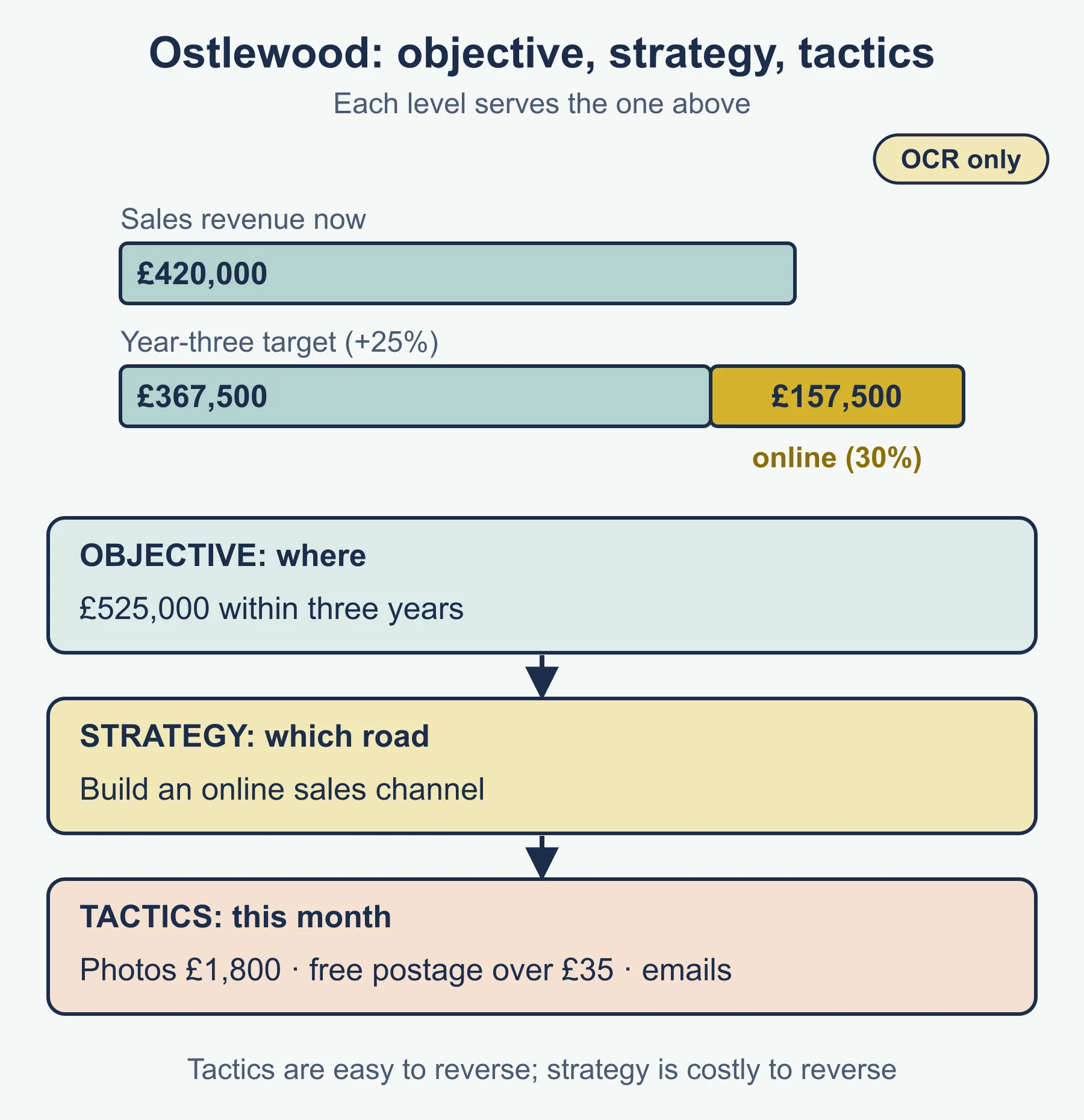
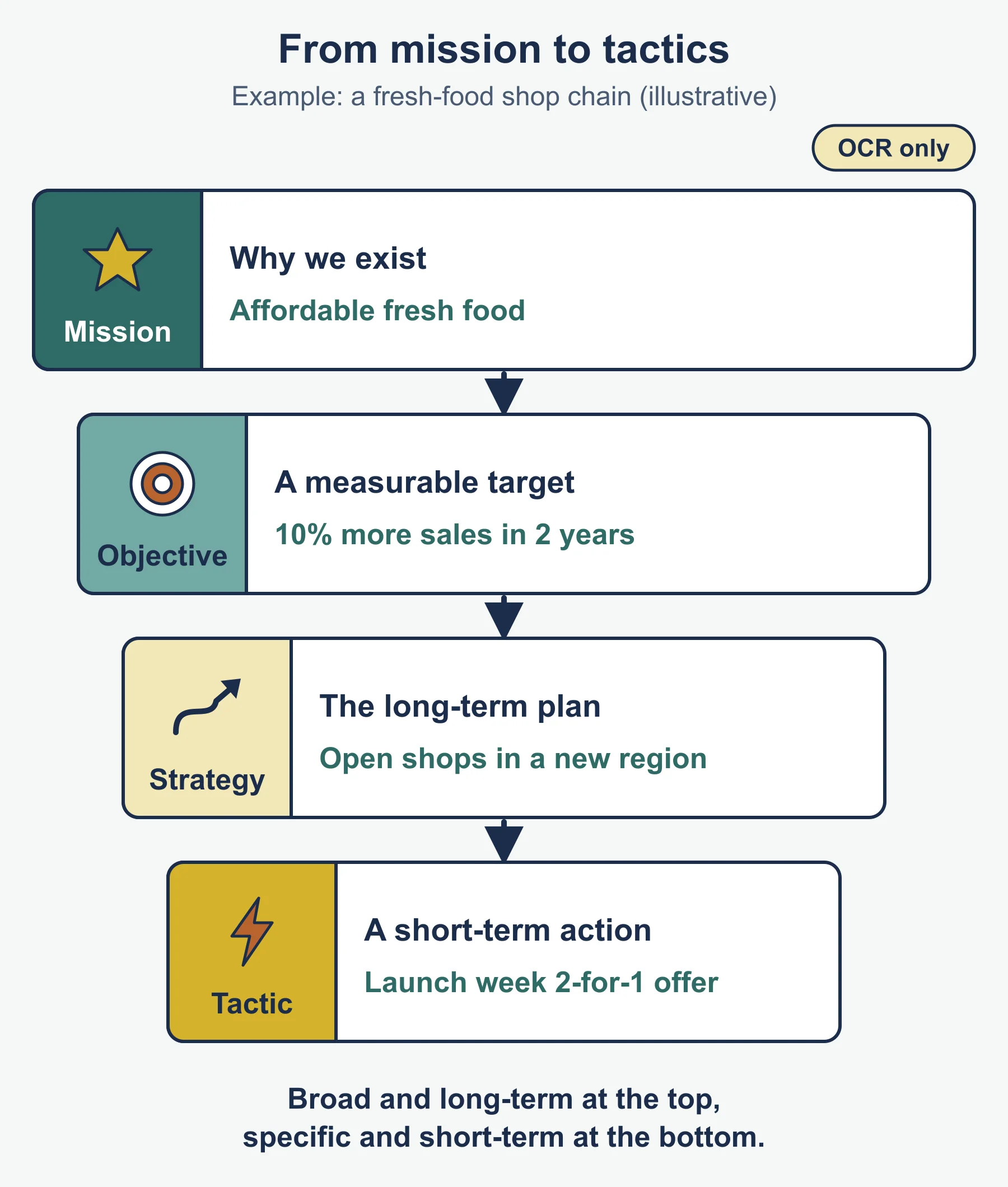
An objective is a target the business wants to reach. A strategy is the long-term plan of how it will get there. Tactics are the shorter-term, more detailed actions that put the strategy into practice. Each level exists to serve the one above it, so a tactic that does not help the strategy, or a strategy that does not help the objective, is wasted effort.
Worked example: Ostlewood Candles. Ostlewood sells hand-poured candles from two craft markets and a small shop. Sales revenue is £420,000 a year.
- Objective: raise sales revenue to £525,000 within three years. That is an increase of £105,000, or 25% (105,000 ÷ 420,000 × 100).
- Strategy: build an online sales channel. By year three, 30% of sales revenue should come online, which is £157,500 (30% of £525,000).
- Tactics: pay £1,800 for product photography; offer free postage on orders over £35 for the first three months; email the existing customer list each month.
Notice the direction. The objective says where, the strategy says which road, and the tactics say what happens this month. Tactics are easier to reverse and are usually decided lower in the business. Strategy is costly to reverse and involves senior managers and owners. If sales stall, the first question is whether the tactics failed or whether the strategy was wrong.
Why a business plans its implementation
A good strategy can fail through poor execution. The specification asks you to explain why a business needs to plan its implementation strategy. The reasons are practical:
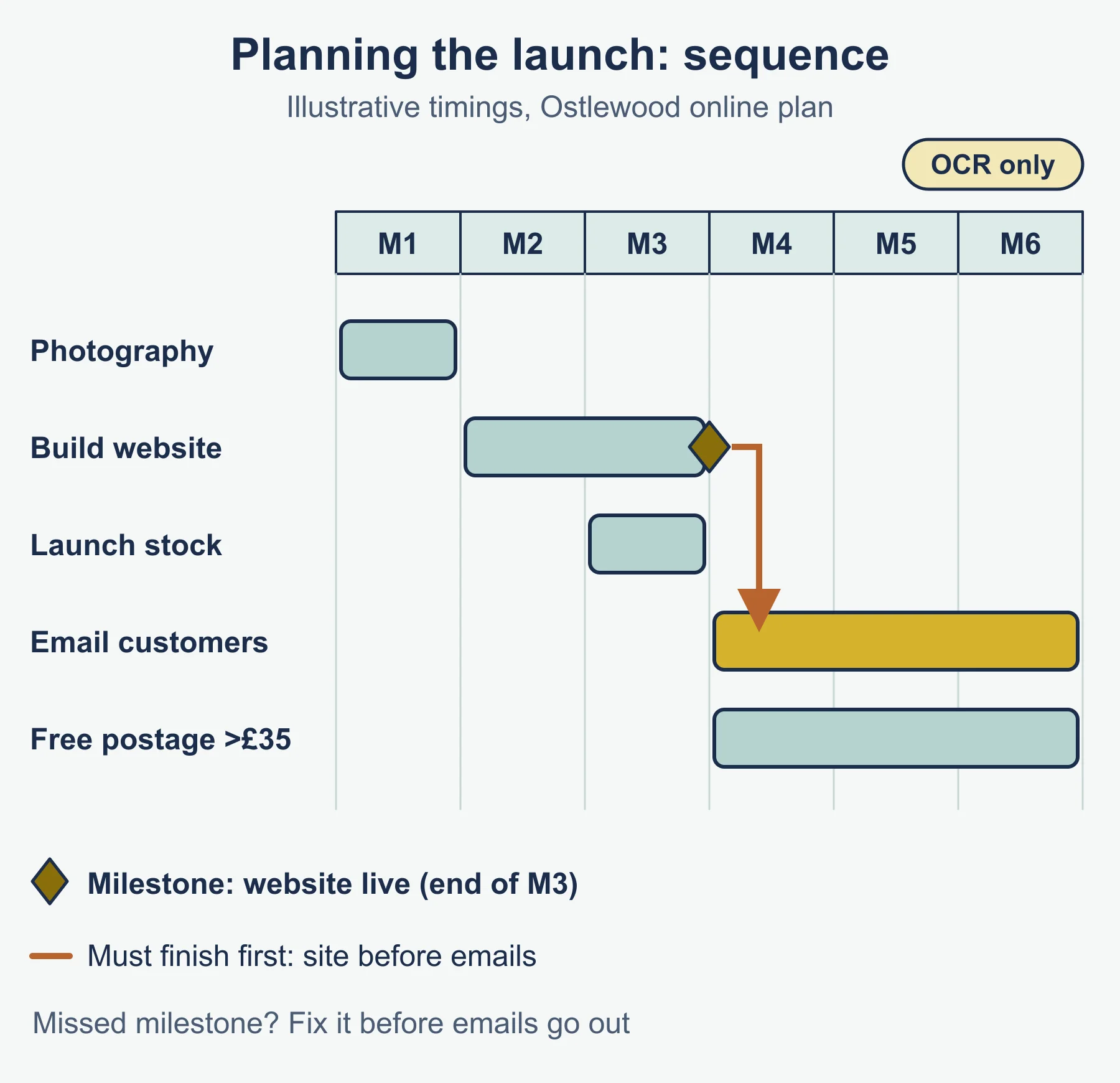
- Resources. Money, staff time and equipment must be available at the right moment. Ostlewood cannot photograph products, build a website and hold extra stock all in the same month without cash.
- Sequence and timing. Some steps depend on others. The website must work before the email campaign sends customers to it.
- Responsibility. Someone must own each task, or it is left undone.
- Communication. Employees who understand why the change is happening are less likely to resist it.
- Milestones. Dated checkpoints show early whether the plan is on course, so the business can correct it.
- Risk. Planning exposes what could go wrong, and a fallback can be prepared.
Planning has a cost. It takes management time, and a rigid plan can delay a quick response to a competitor. In evaluation, say which of these weighs more for the business in the case.
Evaluating a current or proposed strategy
To evaluate a strategy, judge it against criteria and reach a view. Useful criteria are:
- Does it fit the objectives, in scale and timing?
- Can the business afford it and manage it with the skills it has?
- How risky is it, and what is the cost if it fails?
- What does the evidence say about the market, such as demand or competitor behaviour?
- How will each stakeholder group be affected?
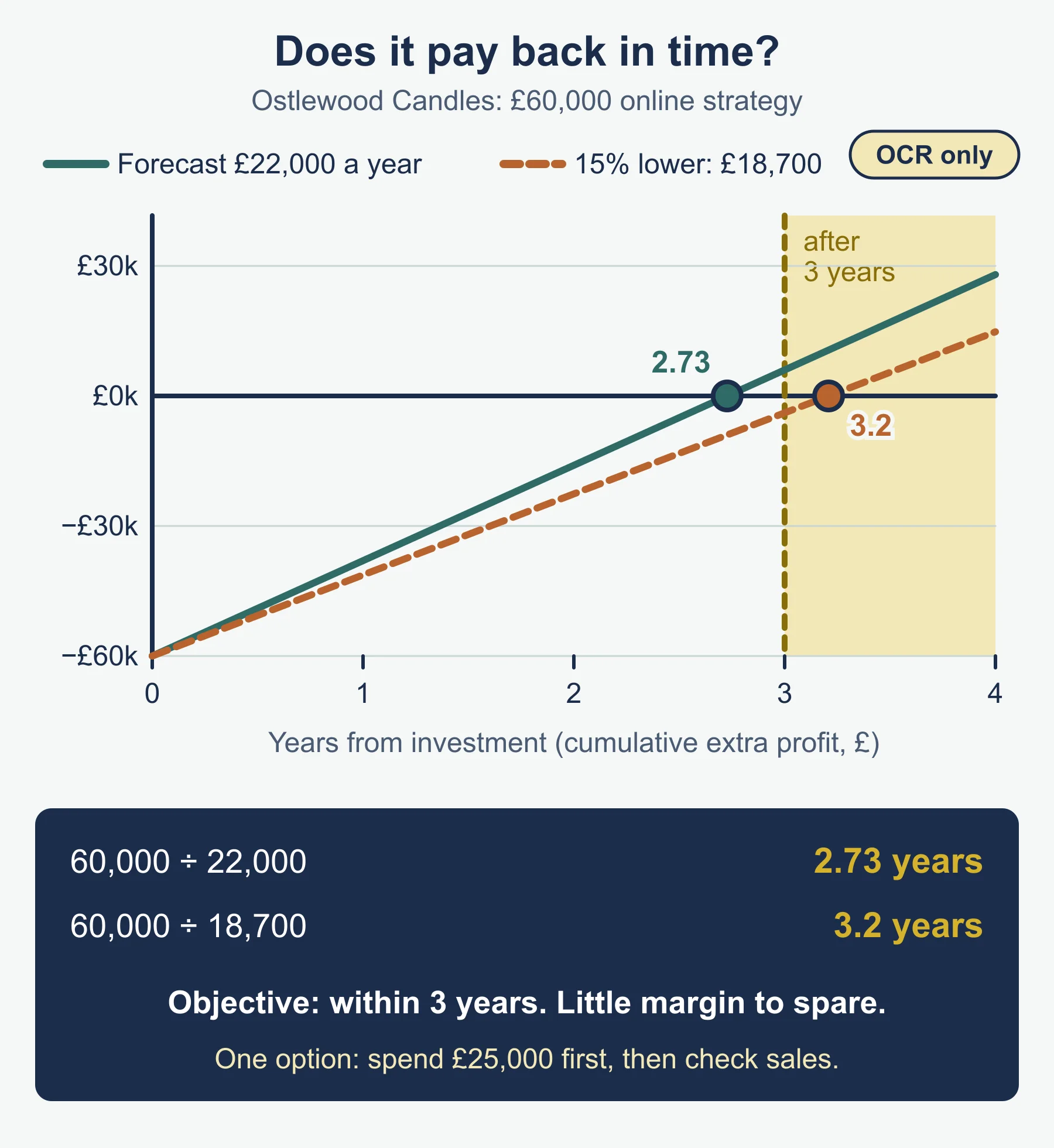
Worked example, continued. The online strategy costs Ostlewood £60,000 for the website, extra stock and launch advertising. The owners forecast extra profit of £22,000 a year.
payback = 60,000 / 22,000 = 2.73 years (about 2 years 9 months)The objective runs over three years, so the investment would only just be recovered inside the period, with little to spare. A fair judgement: the strategy fits the revenue objective and uses a skill the business already has (making and describing products), but the payback leaves little margin: if extra profit came in 15% below forecast, payback would stretch to about 3.2 years, beyond the three-year objective. A reasoned view might be to proceed in stages, spending the first £25,000 and checking sales before releasing the remainder. That judgement relies on the numbers in the case, which is what makes it evaluation.
Altering a strategy
A business may change strategy because of falling sales, a new competitor, a change in customer tastes, new technology, a shortage of cash, or because a review shows the strategy is not working. When you recommend and justify a new direction, give four things: the change, why it suits this business now, a rejected alternative, and the main risk.
Changing strategy has costs:
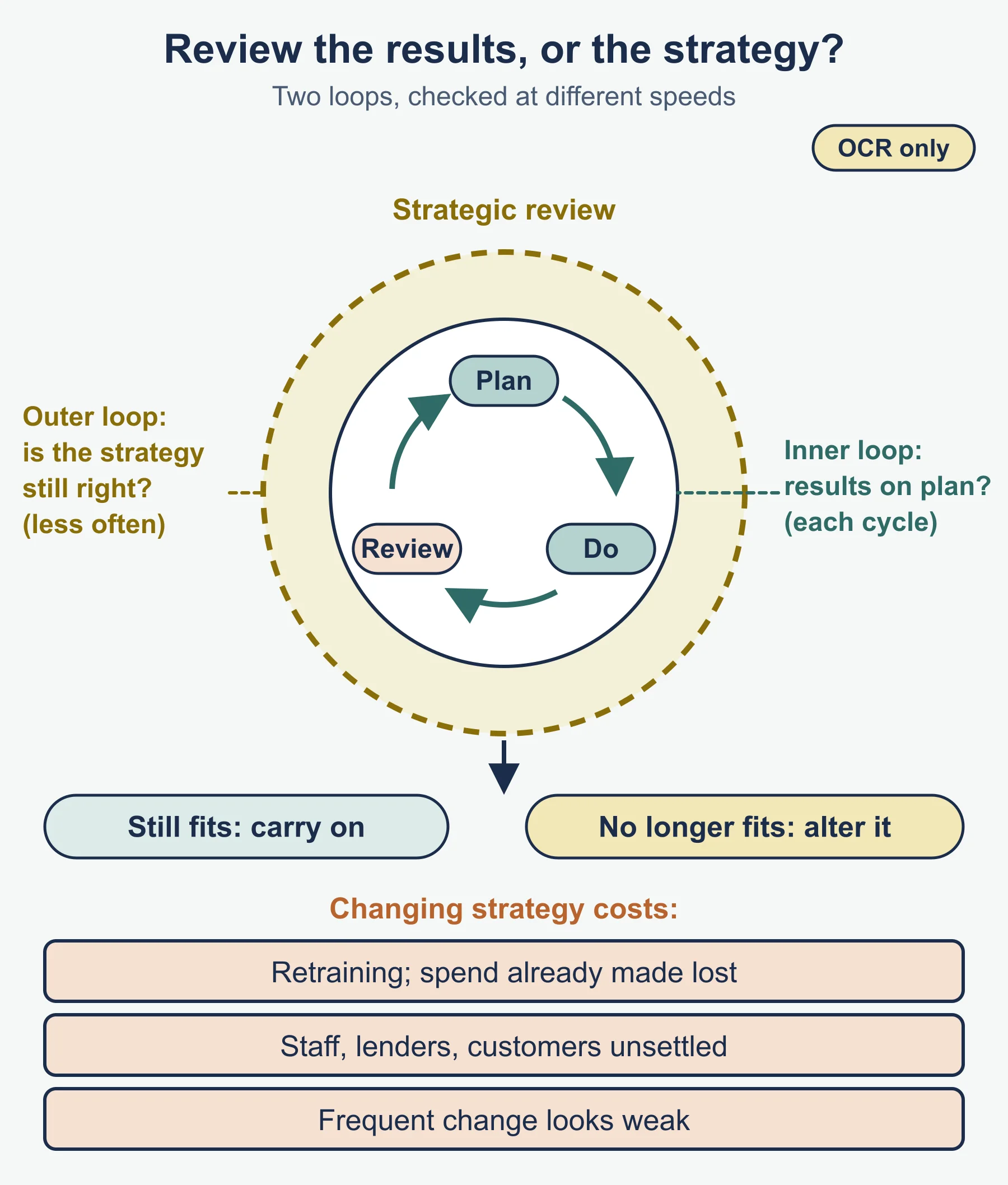
- Cost and disruption. Staff need retraining, supply contracts may change, and money already spent may be lost.
- Stakeholders. Employees may fear job losses. Customers may dislike a changed offer. Lenders may want reassurance. Suppliers may gain or lose orders.
- Credibility. Frequent changes suggest weak leadership and confuse everyone.
Changing too late can be worse. The importance of the change depends on how serious the problem is and how fast the market moves.
The impact and importance of a strategy
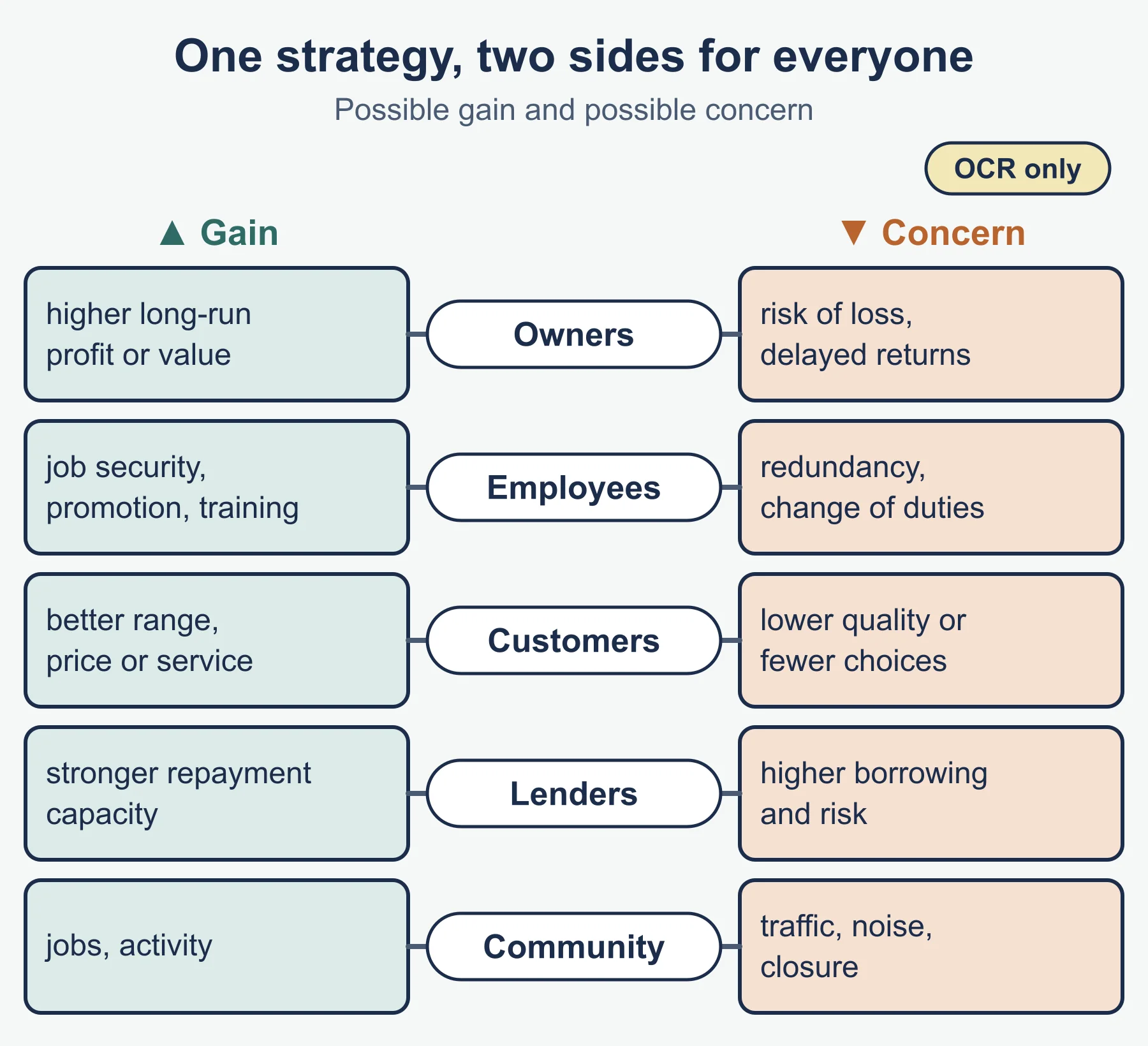
A strategy shapes the whole business: what it sells, where, how it funds growth and what it asks of employees. Weigh its impact on different stakeholders:
| Stakeholder | Possible gain | Possible concern |
|---|---|---|
| Owners | Higher long-run profit or value | Risk of loss, delayed returns |
| Employees | Job security, promotion, training | Redundancy, change of duties |
| Customers | Better range, price or service | Lower quality or fewer choices |
| Lenders | Stronger repayment capacity | Higher borrowing and risk |
| Local community | Jobs, activity | Traffic, noise, closure |
Importance is about scale. A strategy matters more when it commits large sums, is hard to reverse, or affects the survival of the business.
The business plan
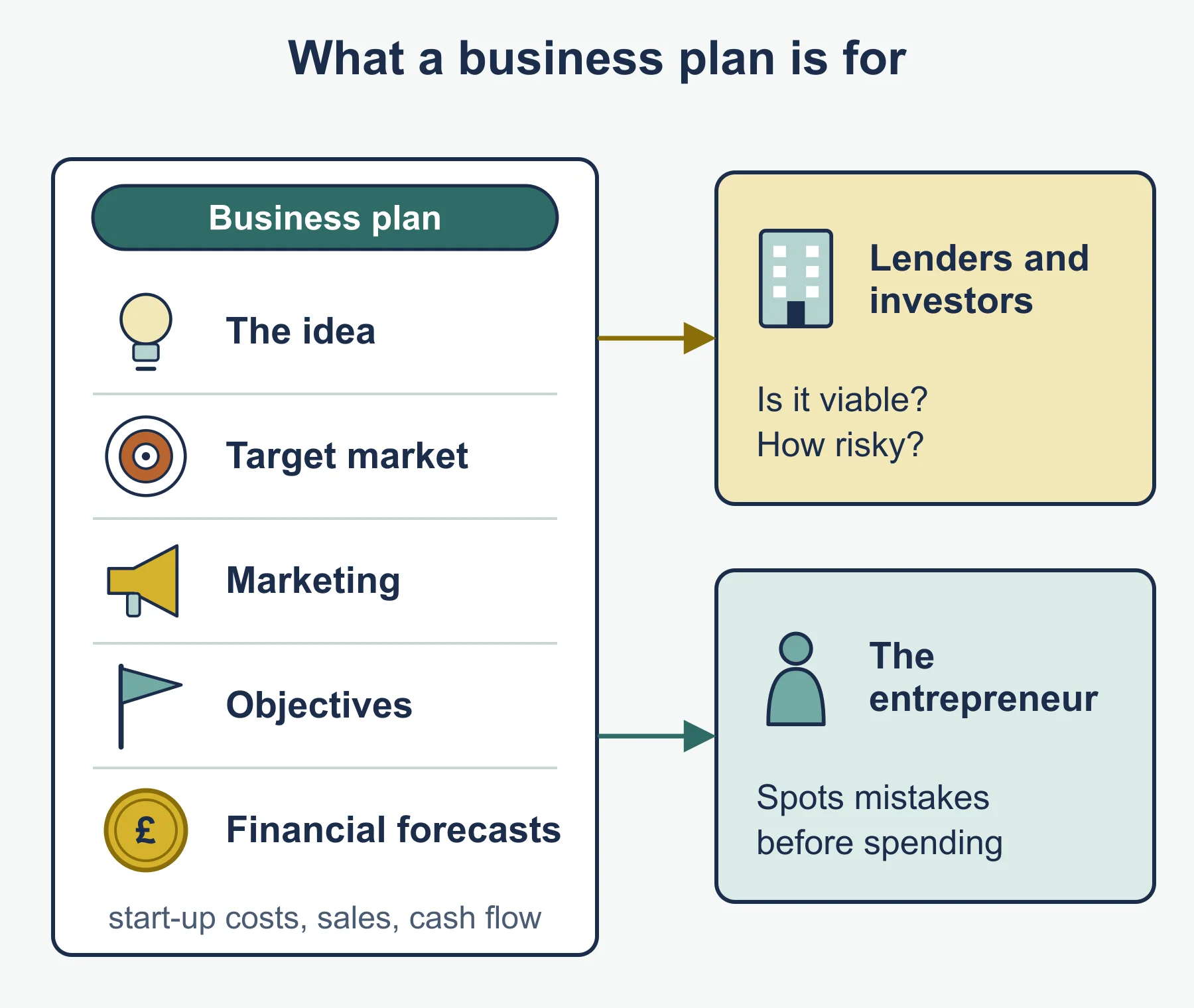
A business plan is a written document that sets out what a business intends to do, how it will do it and what it expects the results to be. Its purposes are to:
- clarify the owner’s thinking and test whether the idea can work;
- persuade lenders and investors to provide finance;
- guide managers day to day and set targets;
- give a benchmark against which actual results can later be compared.
The specification asks you to describe the main contents and say why each is included. The specification does not give a fixed list, so the following is the standard form of a plan.
| Content | Why it is included |
|---|---|
| Executive summary | Lets a busy reader grasp the proposal quickly |
| Business description, aims and objectives | Shows what the business does and what it is aiming for |
| Market research and target market | Gives evidence that customers exist and will pay |
| Marketing plan | Shows how customers will be reached and persuaded |
| Operations and staffing | Shows how products will be made and who will do the work |
| Financial forecasts: sales, costs, profit, cash flow | Shows whether the business can survive and repay finance |
| Sources and use of finance | Shows how much is needed and where it comes from |
| Risks and contingencies | Shows the owner has thought about what could go wrong |
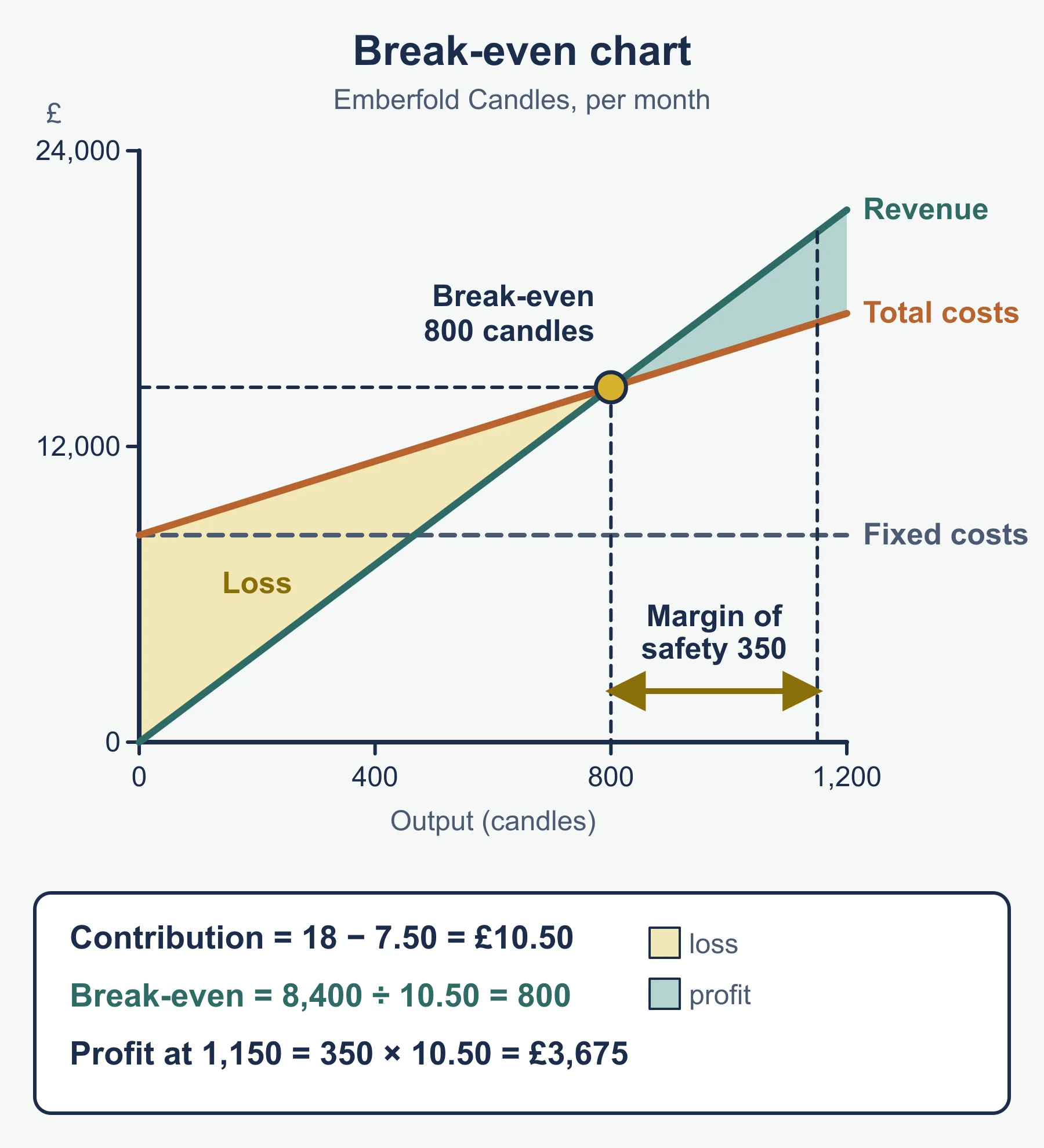
Worked example: Cobbwell Cycles. Two friends plan to refurbish and sell second-hand bikes. They need £60,000: £35,000 from their own savings and a £25,000 bank loan. Average selling price is £240, variable cost per bike is £150 and fixed costs are £3,900 a month.
contribution per bike = 240 - 150 = £90
break-even = 3,900 / 90 = 43.3, so 44 bikes a month
break-even sales revenue = 44 x 240 = £10,560
planned sales = 55 bikes; margin of safety = 55 - 44 = 11 bikes (20% of planned sales)
planned profit = 55 x 90 - 3,900 = £1,050 a month
The bank will look at these numbers. A margin of safety of 20% is some protection, but a profit of £1,050 a month is small beside a £25,000 loan, so the lender may ask for further evidence from market research.
Advantages of having a plan: it forces research, helps win finance, sets targets, improves coordination and shows early if the idea is weak. Disadvantages: it takes time and skill to write, forecasts can be wrong, a plan can become out of date, and a rigid plan can stop managers adapting. The plan is only as good as its assumptions.
For stakeholders, the plan matters differently. Lenders and investors use it to decide whether to lend. Employees see the direction and the likely security of their jobs. Suppliers may judge whether to offer credit. Owners gain a guide and a measure of success.
Plan-Do-Review and strategic review
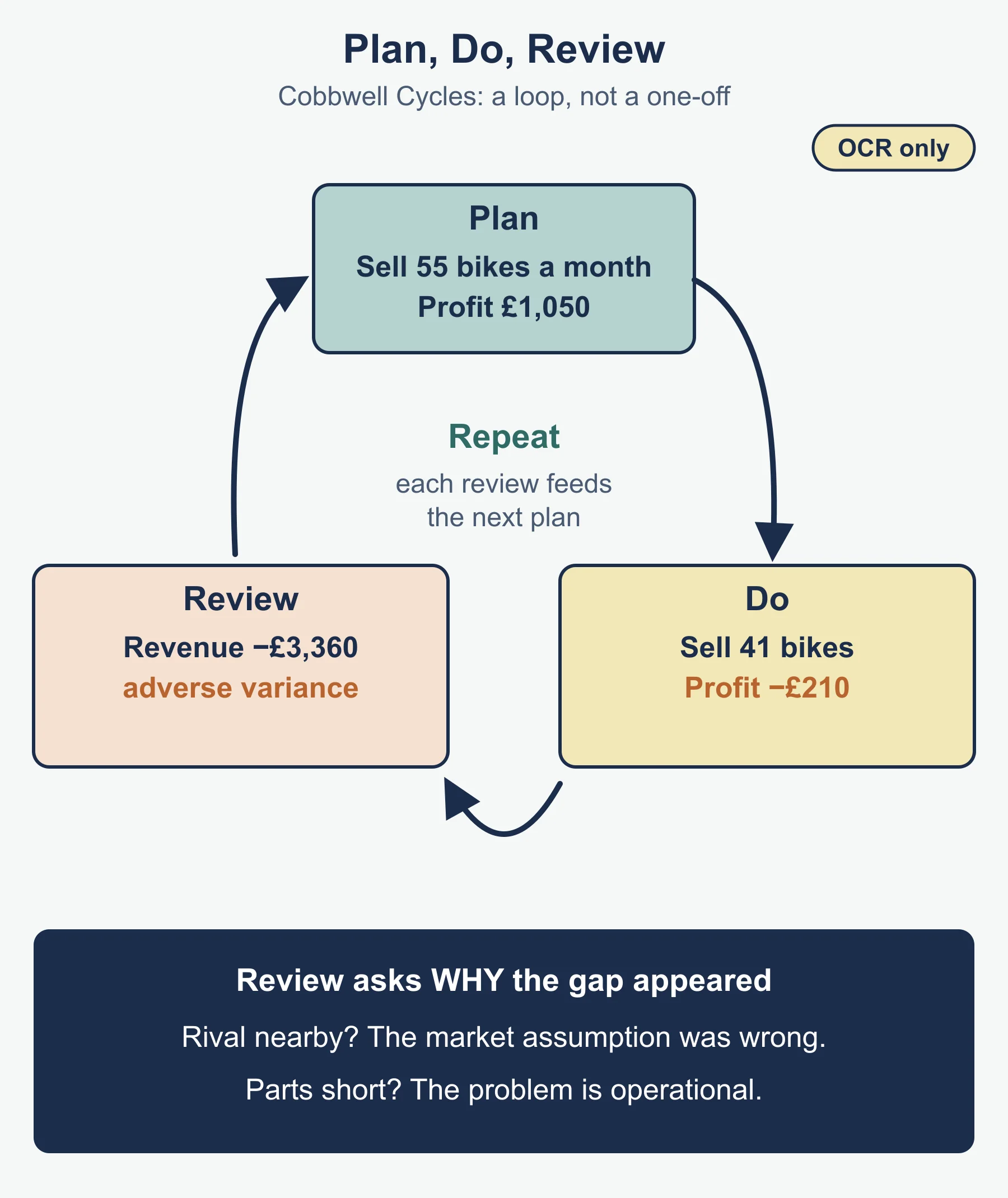
The Plan-Do-Review cycle is a repeating process. Plan: set objectives, targets and a budget. Do: carry out the plan. Review: compare actual results with the plan, find out why they differ and use the lessons to make the next plan better. Because it repeats, it builds learning.
Worked example, continued. After one month Cobbwell sells 41 bikes against a plan of 55.
actual profit = 41 x 90 - 3,900 = -£210 (a loss)
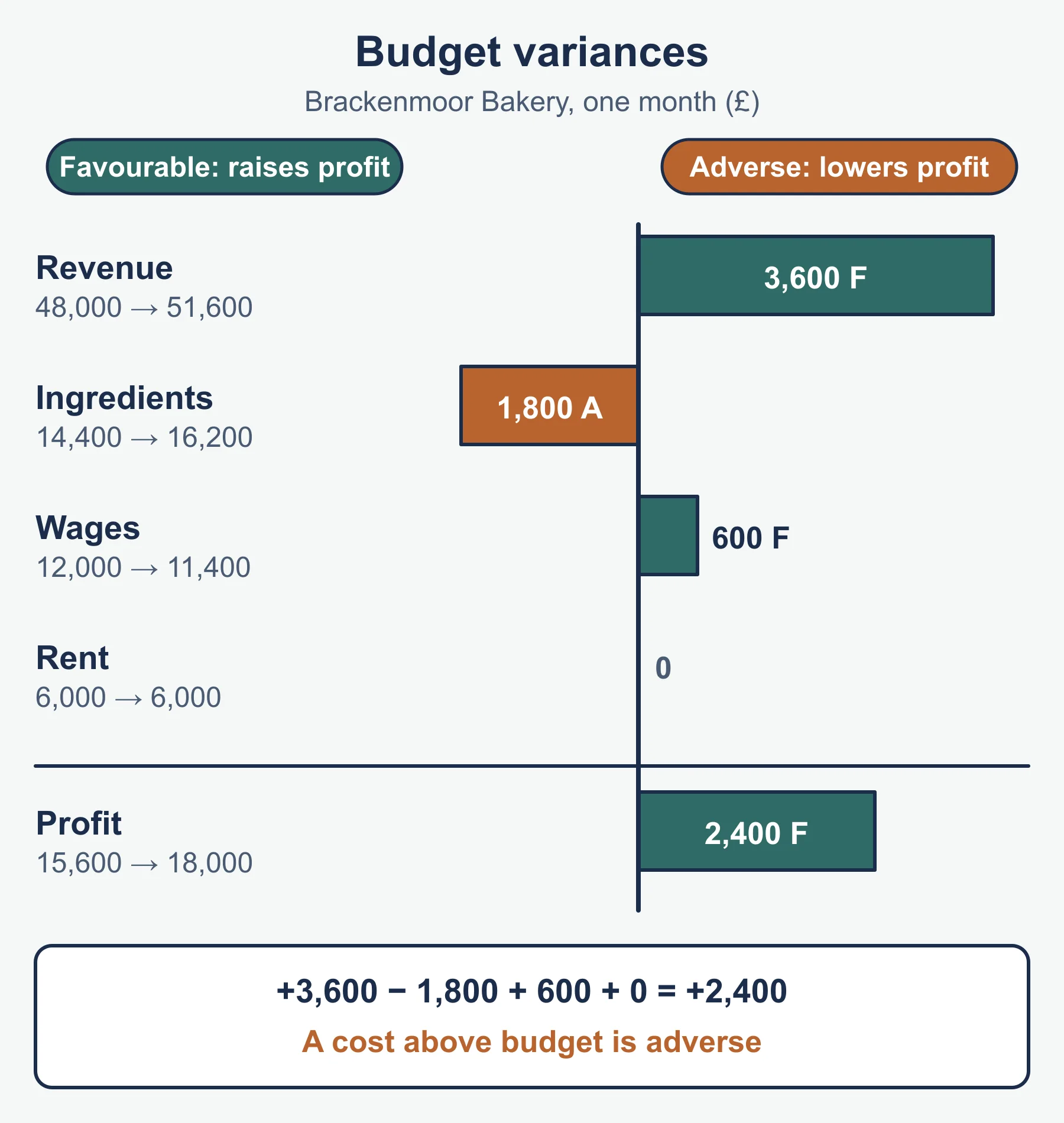
revenue variance = (41 - 55) x 240 = -£3,360 (adverse)
The review asks why. If a competitor opened nearby, the plan’s market assumption was wrong. If the workshop was short of parts, the problem is operational. The next plan can then change the forecast, the supplier or the marketing.
To analyse how the cycle improves performance, link each stage to a result: planning gives clear targets, doing is measured, reviewing finds causes, and acting on them closes the gap. It will not help if the review is skipped, if the data is poor, or if blame replaces learning.
A strategic review is a wider, less frequent look at whether the strategy itself still suits the business and its environment. It asks whether the objectives, markets and resources still fit. Its importance is that it can prevent a business from continuing with a failing strategy. It also has costs: management time, unsettled staff and possible decisions that hurt some stakeholders.
Common errors
- Writing “a strategy is a plan” without separating it from tactics and objectives.
- Giving a tactic, such as a discount, as an example of a strategy.
- Listing business plan contents without saying why each is included.
- Treating Plan-Do-Review as a one-off rather than a repeating loop.
- Evaluating with only advantages, or with no judgement at the end.
- Ignoring stakeholders other than owners and customers.
Frequently asked questions
What is a business plan? A business plan is a written document that sets out what a business intends to do, how it will do it and the results it expects. In OCR A Level Business (H431) you need to describe its main contents and explain why each is included.
What goes in a business plan? A standard business plan includes an executive summary, a description of the business and its aims, market research, a marketing plan, operations and staffing details, financial forecasts, sources and use of finance, and risks and contingencies. The specification does not fix a list, so explain why each content you choose is included.
Why might a business change its strategy? A business may change strategy because of falling sales, a new competitor, a change in customer tastes or new technology. Changing has costs such as retraining and disruption, but changing too late can be worse.
Official syllabus
OCR A Level Business (H431), Version 2.1 (January 2026), published by OCR: the “Strategy and implementation” and “Business plan” content in the area of study “Business objectives and strategy”.
Get free revision emails (optional)
Occasional emails with practice questions, worked explanations and links to free resources for the qualification and subjects you choose. No spam, and you can unsubscribe from any email. The free tools on this site never need an email.
Related resources
-
Practice questions
OCR A Level Business: Strategy and implementation and Business plan (H431) – Practice Questions
Twelve original questions with worked answers on strategy, implementation, business plans, Plan-Do-Review and strategic review for OCR A Level Business.
Business · OCR · A Level
Try questions -
Revision notes
OCR A Level Business: Strategy and implementation and Business plan (H431) – Revision Notes
Condensed revision notes on strategy, implementation, the business plan, Plan-Do-Review and strategic review for OCR A Level Business H431.
Business · OCR · A Level
Revise topic -
Practice questions
OCR A Level Business: Objectives and Strategic Decisions — Practice Questions
Original exam-style practice questions with full worked answers on strategy, Ansoff, Porter, SWOT, contingency planning and decision trees.
Business · OCR · A Level
Try questions
Related articles
-
teaching
A Level tuition in Dubai: Cambridge or Pearson Edexcel International A Level?
Schools in Dubai and Abu Dhabi teach either Cambridge International AS & A Level or Pearson Edexcel International A Level. How the two are structured, why it matters for tuition, and how online classes from Lahore work.
9 October 2026
-
curriculum guides
Choosing subjects at IGCSE and A Level
How subject choices at 14 and 16 affect university options later, and how to keep pathways open without overloading a timetable.
28 July 2026
Studying this with a teacher
Working through Business A LEVELS?
This page is free and stays free. If you would rather be taught it, Marlbridge runs Business classes one-to-one, online in your own time zone. One-to-one only for this course: Rs 6,000 per class in Pakistan, with other currencies on the fees page. The first trial class is free. WhatsApp replies within an hour (8am–11pm Pakistan time, every day); email the same day.
OCR Business teachers at Marlbridge
