
Revision Notes
OCR A Level Business: Strategy and implementation and Business plan (H431) – Revision Notes
Condensed revision notes on strategy, implementation, the business plan, Plan-Do-Review and strategic review for OCR A Level Business H431.
- Subject
- Business
- Level
- A LEVELS
- Topic
- Business objectives and strategic decisions
- Author
- Marlbridge Academic Team
- Updated
- Reviewed by
- Salman Ahmad (what this means)
Aligned to OCR A Level Business (H431), Version 2.1 (January 2026), for first assessment in 2017; final assessment summer 2027. Official specification .
Syllabus page (what it covers and how it is assessed): OCR A Level Business.
Syllabus points this page covers
H431
- 1.5 Strategy and implementation
- 1.6 Business plan
Found an error? Report a correction.
Need help with this topic? Request a free trial class for A Level Business (H431).
Quick recall for the “Strategy and implementation” and “Business plan” content of OCR A Level Business (H431, Version 2.1, January 2026), within the area of study “Business objectives and strategy”. For full explanations and worked examples, read the study guide, then test yourself with the practice questions. The wider topic is in the objectives and strategic decisions revision notes. Course hub: OCR A Level Business. Tick items off on the checklist, and spot gaps with the free diagnostics.
Key terms
| Term | Meaning |
|---|---|
| Objective | A target the business wants to achieve |
| Strategy | The long-term plan for reaching the objectives |
| Tactics | Shorter-term actions that put the strategy into practice |
| Implementation strategy | The plan for carrying out a strategy: resources, timing, responsibility, communication, milestones |
| Business plan | A written document setting out what the business will do, how, and the expected results |
| Plan-Do-Review | A repeating cycle: set a plan, carry it out, compare results with the plan and learn |
| Strategic review | A wider, less frequent check on whether the strategy still suits the business and its environment |
Objectives, strategy, tactics
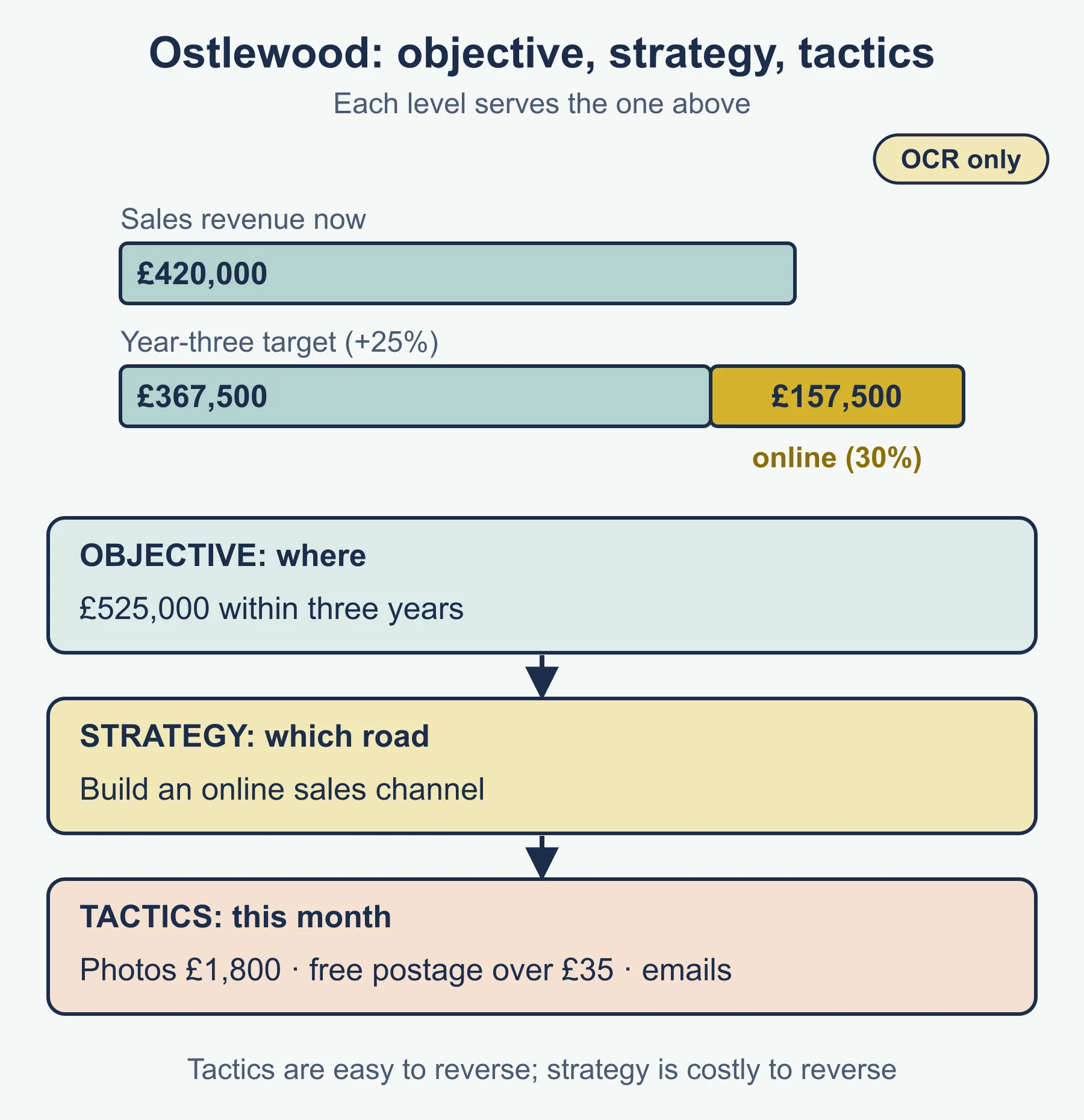
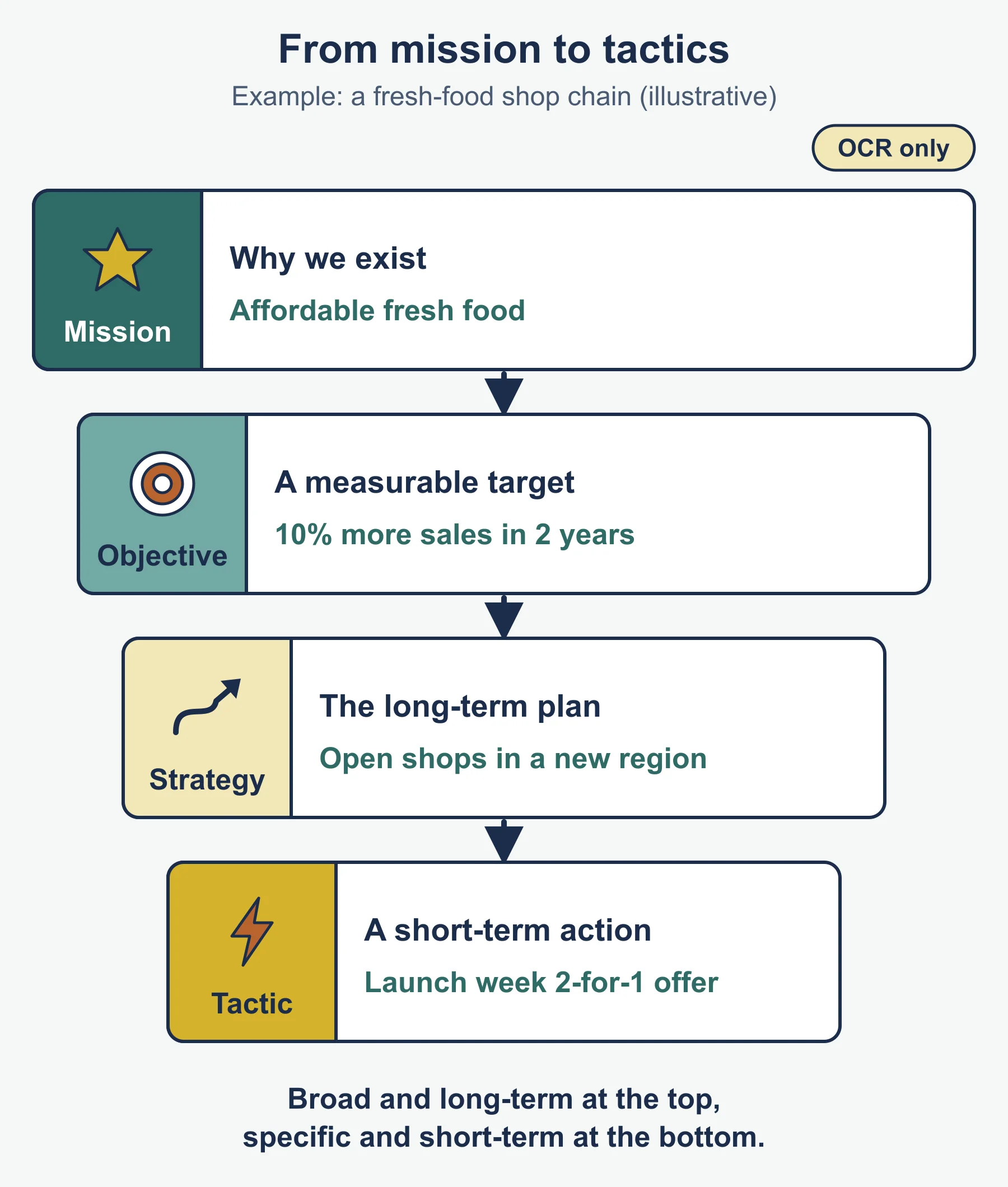
- Objective answers “where?”, strategy answers “which route?”, tactics answer “what do we do this month?”.
- Strategy: long term, costly to reverse, decided by senior managers or owners.
- Tactics: short term, easier to reverse, often decided lower down.
- A tactic that does not serve the strategy, or a strategy that does not serve the objective, wastes resources.
Worked reminder: Hexlow Bakery. Net profit is £40,000 and the target is £46,000.
percentage increase = (46,000 - 40,000) / 40,000 x 100 = 15%Strategy: open a second shop. Tactics: a launch-week free coffee, a hiring advert, a local leaflet drop.
Why plan implementation
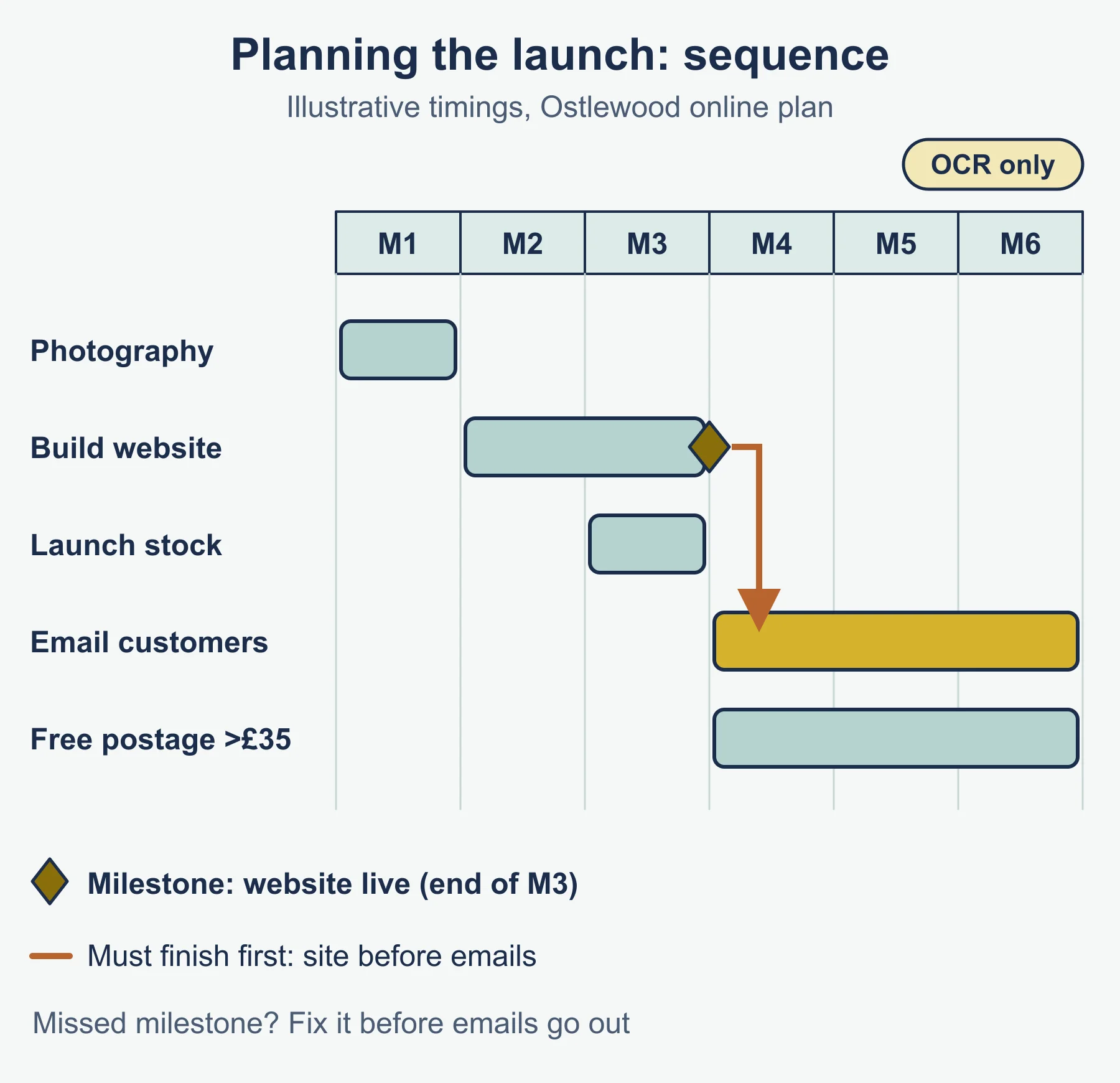
- Resources are ready when needed (cash, staff, equipment).
- Steps happen in the right order.
- Someone owns each task.
- Staff are told what is changing and why.
- Milestones show early whether the plan is on course.
- Risks are spotted and fallbacks prepared.
Cost of planning: management time, and a rigid plan may slow a response to events.
Method: evaluate a strategy
- State the strategy and the objective it serves.
- Test it against criteria: fit with objectives, affordability, risk, market evidence, stakeholder effects.
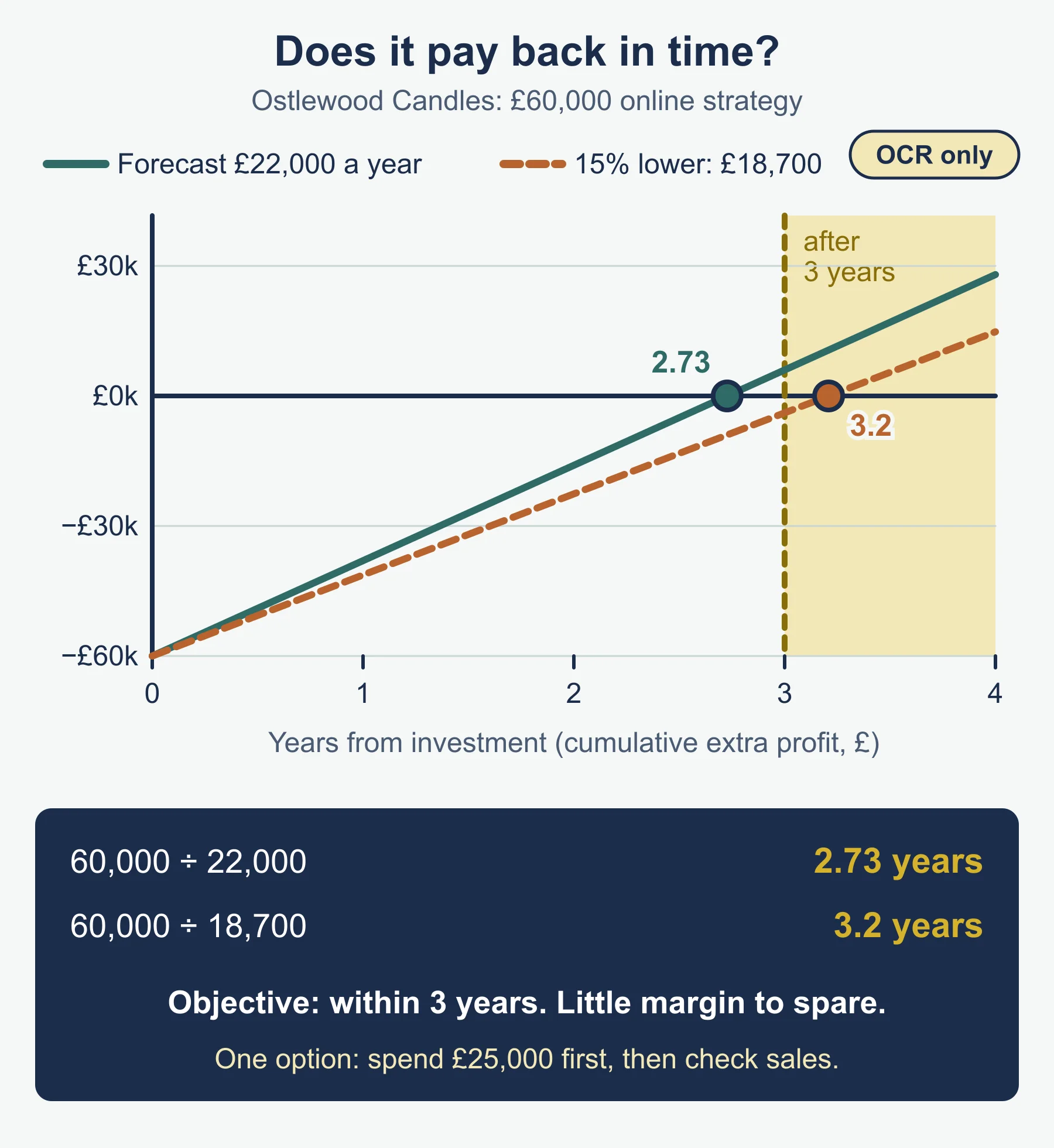
- Use the numbers in the case (cost, payback, forecast sales, margins).
- Weigh strengths against weaknesses for this business.
- Reach a judgement and say what it depends on, such as the accuracy of the forecast.
Method: recommend and justify
- Name the action clearly.
- Link it to the objective and the situation in the case.
- Give evidence for it.
- Reject an alternative and say why.
- State the main risk and how to reduce it.
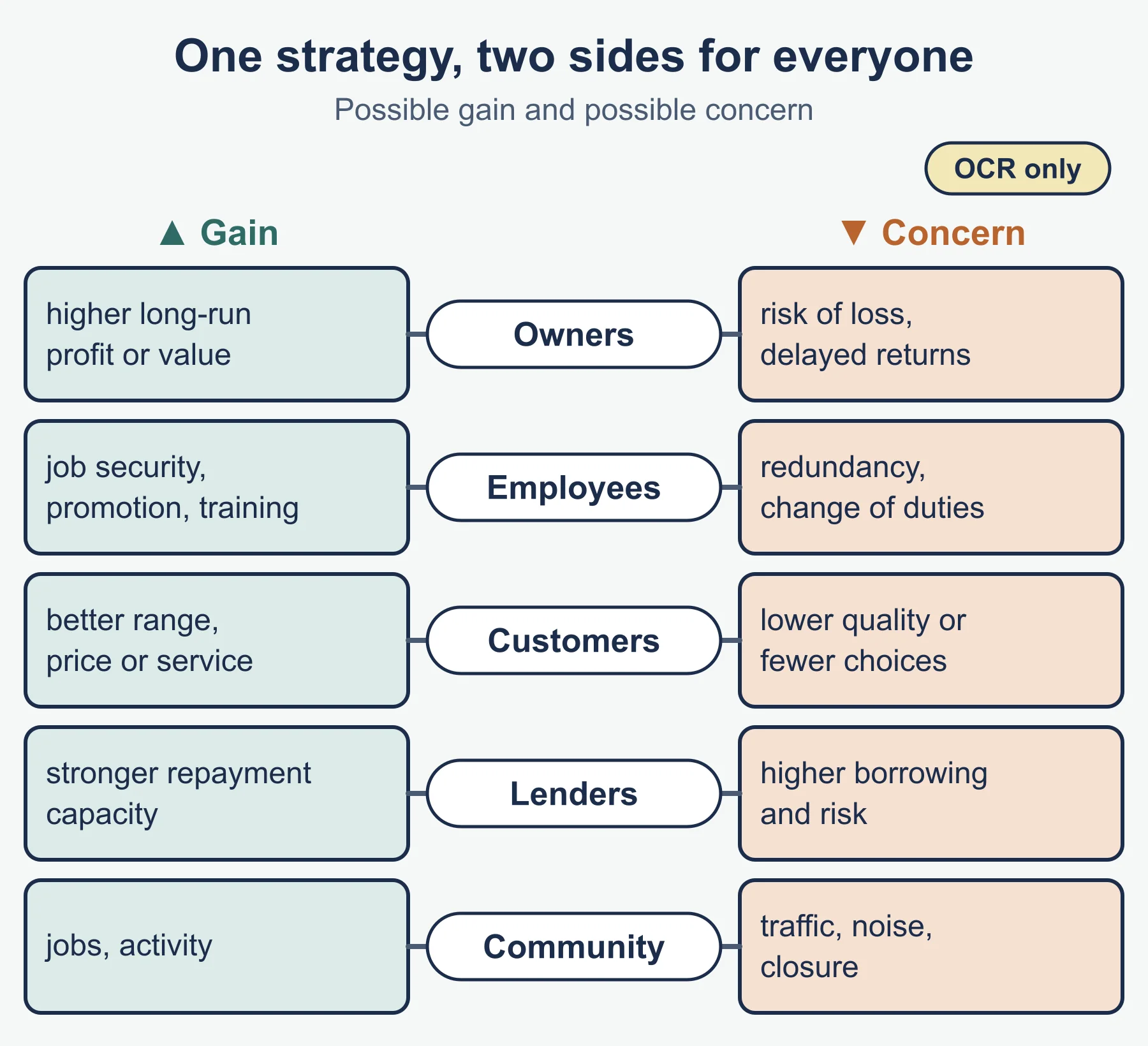
Changing strategy
| Possible causes | Possible costs | Stakeholders to consider |
|---|---|---|
| Falling sales, new competitor, changing tastes, new technology, cash shortage, poor review results | Retraining, lost spending, disruption, confused customers, damaged credibility | Owners, employees, customers, lenders, suppliers, community |
- Importance rises with scale, cost, difficulty of reversal and threat to survival.
- Changing too late can cost more than changing too soon.
Business plan: purposes
- Test whether the idea can work.
- Win finance from lenders or investors.
- Guide managers and set targets.
- Provide a benchmark for later results.
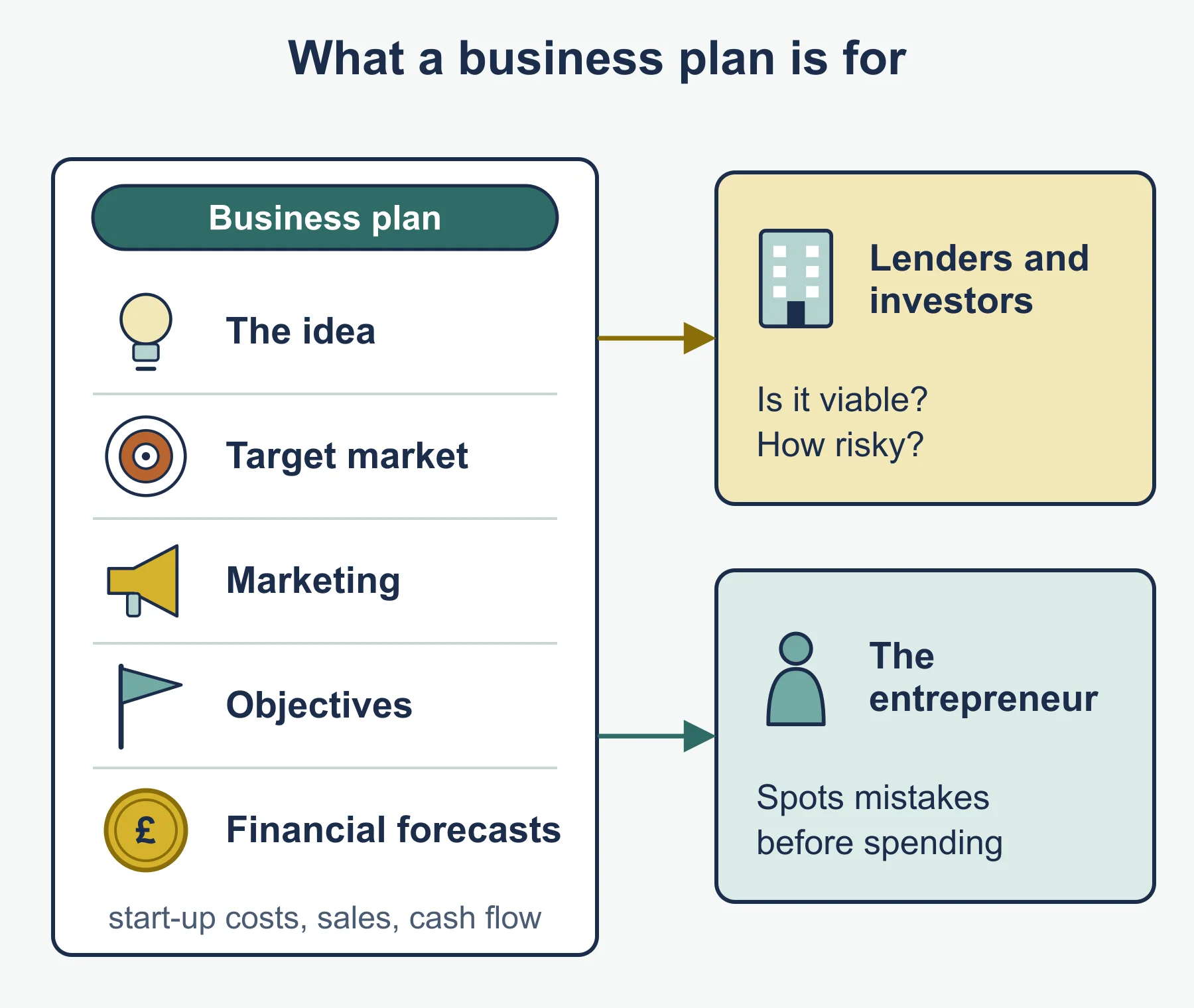
Business plan: main contents
| Content | Why included |
|---|---|
| Executive summary | Quick overview for the reader |
| Description, aims and objectives | Shows direction |
| Market research, target market | Evidence of demand |
| Marketing plan | How customers will be reached |
| Operations and staffing | How the work gets done |
| Financial forecasts | Whether it can survive and repay |
| Finance needed and its sources | How much, from where |
| Risks and contingencies | Shows risk has been thought through |
The specification asks you to describe the main contents but does not fix a list. The table is the standard form.
Business plan: advantages and disadvantages
| Advantages | Disadvantages |
|---|---|
| Forces research and clear thinking | Takes time and skill |
| Helps raise finance | Forecasts can be wrong |
| Sets targets and a benchmark | Can become out of date |
| Improves coordination | May make managers rigid |
| Shows weaknesses early | Quality depends on assumptions |
Stakeholder impact of a plan
- Lenders and investors: decide whether to lend, and on what terms.
- Owners: a guide and a measure of success.
- Employees: show direction and likely job security.
- Suppliers: may judge whether to give credit.
- Customers: may gain from a better-planned offer.
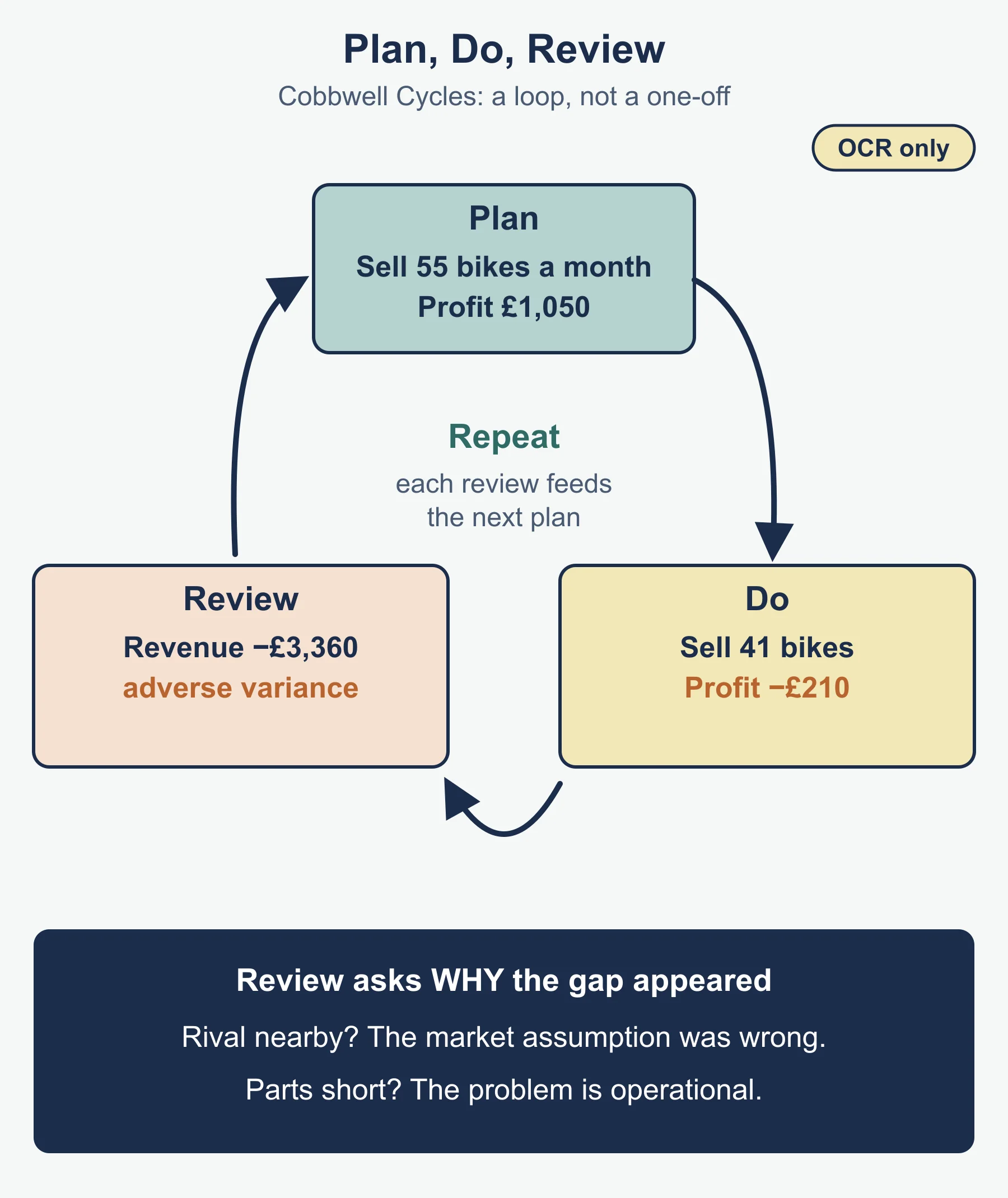
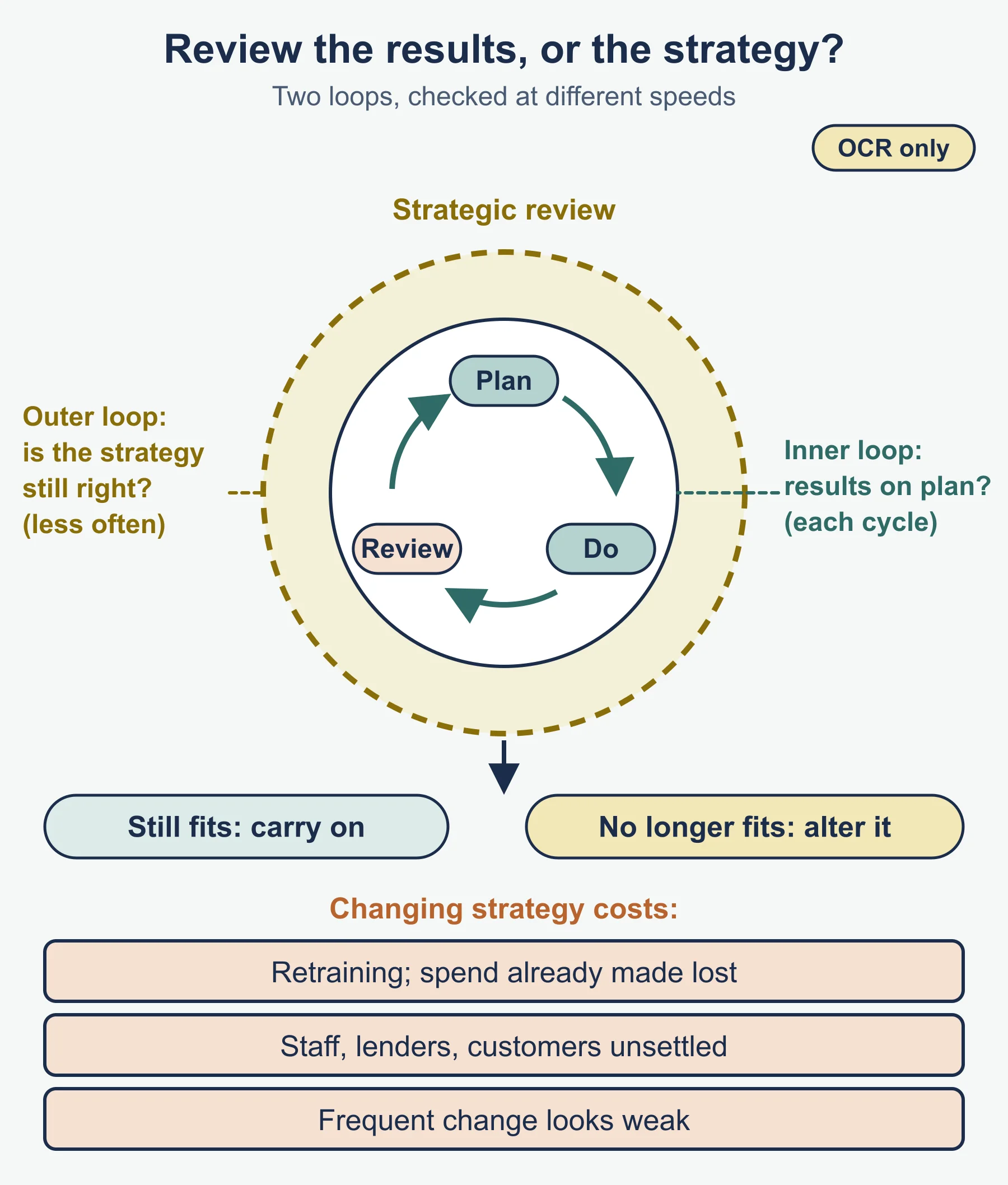
Plan-Do-Review
- Plan: objectives, targets, budget.
- Do: carry out the plan and record results.
- Review: compare actual with plan and find causes.
- Use the lessons in the next plan.
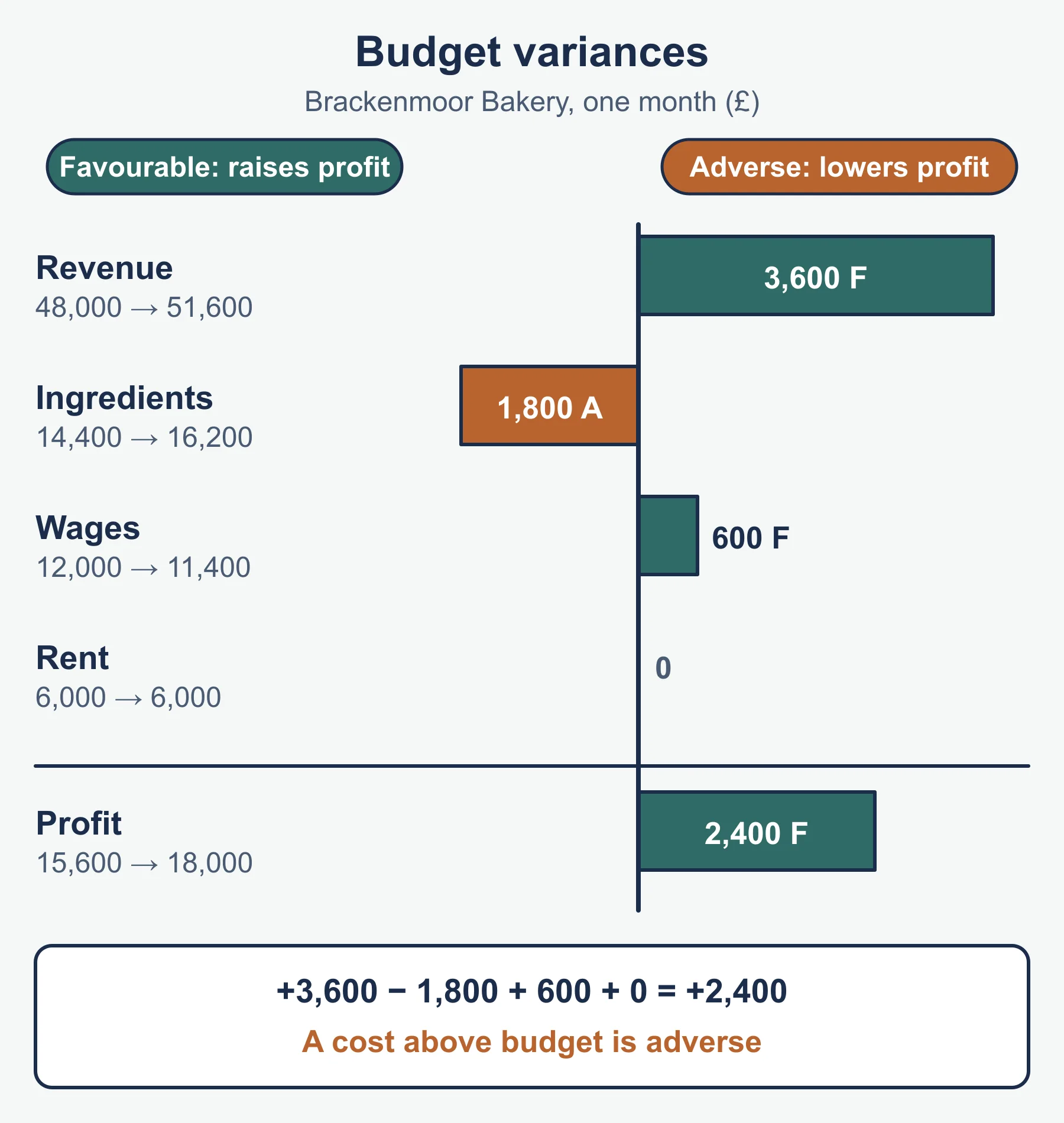
Worked reminder. Budgeted wages £9,000; actual £9,720.
variance = 9,720 - 9,000 = £720 adverse
percentage = 720 / 9,000 x 100 = 8% over budget
How it improves performance: targets give focus, measuring shows gaps, review finds causes, and corrections close the gap. It fails if the review is skipped, the data is poor, or blame replaces learning.
Strategic review
- Wider and less frequent than the cycle above.
- Asks whether objectives, markets and resources still fit.
- Benefit: stops a failing strategy continuing.
- Costs: management time, unsettled staff, decisions that may hurt some stakeholders.
Must-know distinctions
| Pair | Difference |
|---|---|
| Strategy and tactics | Long-term route against short-term actions |
| Objective and strategy | The target against the plan for reaching it |
| Business plan and implementation plan | The plan for the whole business idea against the plan for carrying out one strategy |
| Plan-Do-Review and strategic review | A repeating comparison of results with plan against a wider check on whether the strategy still fits |
| Explain and evaluate | Give reasons against weigh up and reach a judgement |
Command words for this topic
- Explain: give a reason and develop it, for example why a plan helps win a loan.
- Describe: say what the main contents are.
- Analyse: break the cycle into stages and link each to a result.
- Evaluate: weigh advantages against disadvantages, use case evidence, and finish with a judgement.
- Recommend and justify: choose one action and defend it against an alternative.
Worked reminder: numbers in a plan
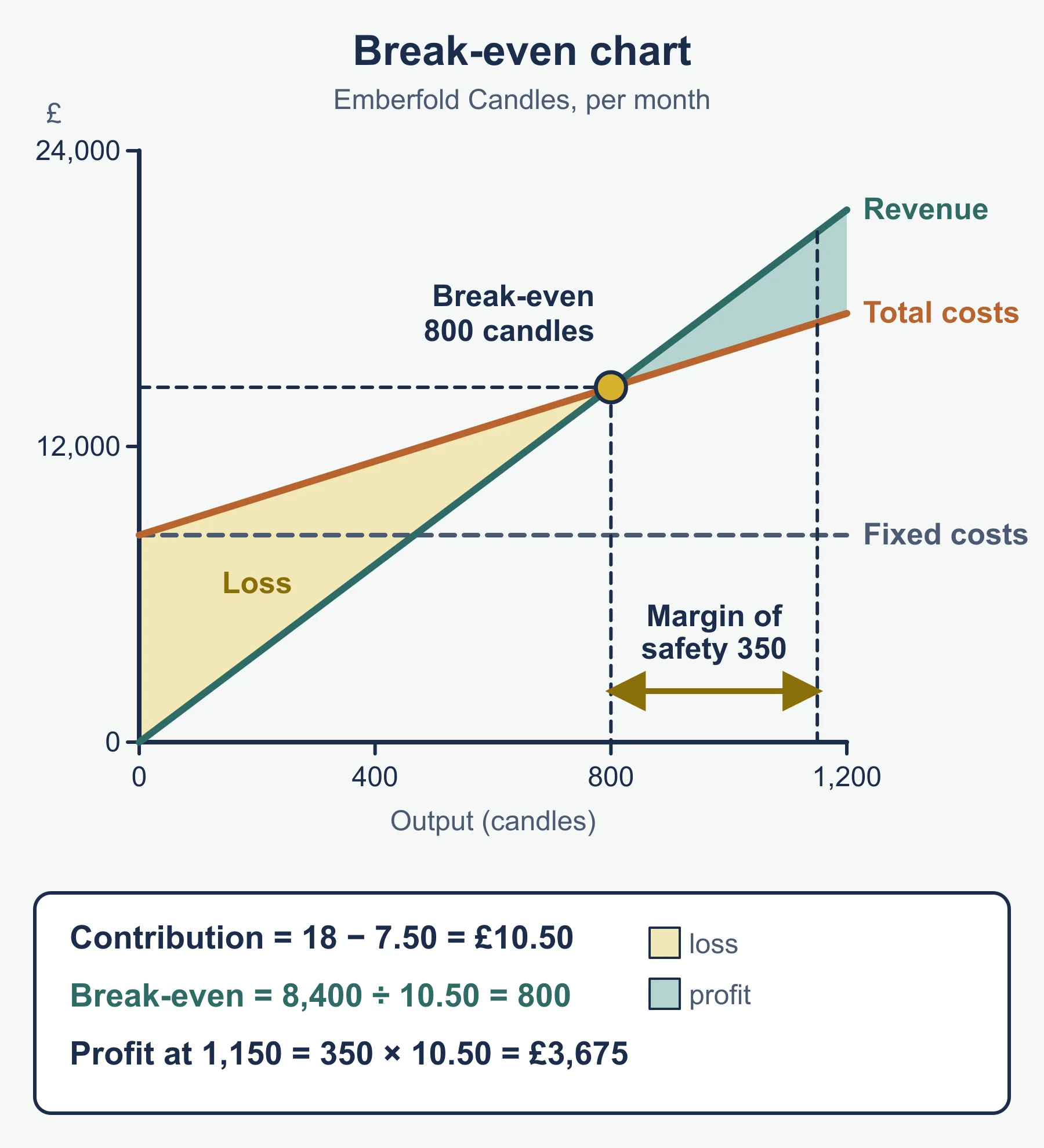
Hexlow’s plan forecasts 1,500 loaves a month. Using the break-even of 1,334 loaves from self-test question 6, the margin of safety is 1,500 - 1,334 = 166 loaves, which is 11.1% of forecast sales. A lender would see that a fall of just over a tenth in sales would wipe out profit, so the plan needs evidence for the 1,500 figure.
profit at forecast = 1,500 x 1.80 - 2,400 = £300 a month
margin of safety = 166 / 1,500 x 100 = 11.1%
Quick self-test
- Distinguish a strategy from a tactic.
- A business has net profit of £40,000 and aims for £46,000. What is the percentage increase?
- Give two reasons a business plans the implementation of a strategy.
- State two purposes of a business plan.
- Give two contents of a business plan and say why each is included.
- Hexlow sells a loaf at £3.20 with variable cost £1.40 and has monthly fixed costs of £2,400. How many loaves must it sell to break even?
- Name the three stages of the Plan-Do-Review cycle.
- Budgeted wages were £9,000 and actual wages £9,720. State the variance and whether it is favourable or adverse.
- Give one advantage and one disadvantage of having a business plan.
- Give one way a strategic review differs from the Review stage of the cycle.
Answers
- A strategy is the long-term plan to achieve objectives; a tactic is a shorter-term action that carries it out.
- 15%.
- Any two: resources are ready when needed; steps are in the right order; staff know their responsibilities; milestones show problems early.
- Any two: test the idea; win finance; guide managers; provide a benchmark.
- For example, financial forecasts (show whether the business can survive and repay) and market research (evidence that customers exist).
- Contribution per loaf = 3.20 - 1.40 = £1.80. Break-even = 2,400 / 1.80 = 1,333.3, so 1,334 loaves.
- Plan, Do, Review.
- £720 adverse.
- Advantage: helps raise finance. Disadvantage: forecasts can be wrong, or it takes time to write.
- A strategic review is wider and less frequent, asking whether the strategy itself still fits; the cycle’s Review compares results with a plan.
Where marks are usually lost
- Using “strategy” and “tactics” as if they meant the same thing.
- Giving a list of business plan contents without a reason for each.
- Describing Plan-Do-Review as a one-off rather than a loop.
- Evaluating a strategy with no figures from the case.
- Recommending an action without rejecting an alternative or naming a risk.
- Forgetting stakeholders other than owners and customers.
- Ending an evaluation with a summary rather than a judgement.
- Stating that a plan guarantees success, when it only improves the odds.
Frequently asked questions
What is the difference between an objective, a strategy and a tactic? An objective says where the business wants to get to, a strategy says which route it will take, and tactics are the short-term actions it takes this month. In OCR A Level Business (H431), using strategy and tactics as if they meant the same thing loses marks.
How do you calculate a budget variance? A variance is the actual figure minus the budgeted figure, and it should be labelled favourable or adverse by its effect on profit. For example, wages of £9,720 against a budget of £9,000 give a £720 adverse variance, which is 8% over budget.
How do lenders and investors use a business plan? Lenders and investors use the plan to decide whether to lend or invest, and on what terms. Figures such as the margin of safety show how far sales could fall before profit disappears.
Official syllabus
OCR A Level Business (H431), Version 2.1 (January 2026), published by OCR: the “Strategy and implementation” and “Business plan” content in the area of study “Business objectives and strategy”.
Get free revision emails (optional)
Occasional emails with practice questions, worked explanations and links to free resources for the qualification and subjects you choose. No spam, and you can unsubscribe from any email. The free tools on this site never need an email.
Related resources
-
Practice questions
OCR A Level Business: Objectives and Strategic Decisions — Practice Questions
Original exam-style practice questions with full worked answers on strategy, Ansoff, Porter, SWOT, contingency planning and decision trees.
Business · OCR · A Level
Try questions -
Revision notes
OCR A Level Business: Objectives and Strategic Decisions — Revision Notes
Condensed recall notes on corporate objectives, SWOT and PESTLE, Ansoff, Porter, decision trees and investment appraisal for A Level Business.
Business · OCR · A Level
Revise topic -
Study guides
OCR A Level Business: Ansoff's matrix and Conflicts in business decision making (H431)
Study guide to Ansoff's matrix and to conflicts between decision making tools for OCR A Level Business, with two fully worked examples.
Business · OCR · A Level
Read guide
Related articles
-
teaching
A Level tuition in Dubai: Cambridge or Pearson Edexcel International A Level?
Schools in Dubai and Abu Dhabi teach either Cambridge International AS & A Level or Pearson Edexcel International A Level. How the two are structured, why it matters for tuition, and how online classes from Lahore work.
9 October 2026
-
curriculum guides
Choosing subjects at IGCSE and A Level
How subject choices at 14 and 16 affect university options later, and how to keep pathways open without overloading a timetable.
28 July 2026
Studying this with a teacher
Working through Business A LEVELS?
This page is free and stays free. If you would rather be taught it, Marlbridge runs Business classes one-to-one, online in your own time zone. One-to-one only for this course: Rs 6,000 per class in Pakistan, with other currencies on the fees page. The first trial class is free. WhatsApp replies within an hour (8am–11pm Pakistan time, every day); email the same day.
OCR Business teachers at Marlbridge
