
Revision Notes
OCR A Level Business: The global environment of business (H431) – Revision Notes
Condensed revision notes on the global environment of business for OCR A Level Business H431, with a quick self-test and a list of common mark losses.
- Subject
- Business
- Level
- A LEVELS
- Topic
- The global environment of business
- Author
- Marlbridge Academic Team
- Updated
- Reviewed by
- Salman Ahmad (what this means)
Aligned to OCR A Level Business (H431), Version 2.1 (January 2026), for first assessment in 2017; final assessment summer 2027. Official specification .
Syllabus page (what it covers and how it is assessed): OCR A Level Business.
Syllabus points this page covers
H431
- 7 The global environment of business (whole topic)
Found an error? Report a correction.
Need help with this topic? Request a free trial class for A Level Business (H431).
Quick recall for the global environment of business in the OCR A Level Business (H431) specification, Version 2.1 (January 2026), final assessment summer 2027. The specification names the topic in its content overview, and one component is titled The global business environment, so these notes gather all the global and international points. For full explanations read the study guide, then try the practice questions.
Also useful: the earlier global context, trade, EU and emerging markets notes, the OCR A Level Business hub, the printable checklist and the free diagnostics.
Topic map
| Section | Content |
|---|---|
| A | Global context: globalisation, facilitators, multinationals, global strategy, global brands |
| B | International trade and free trade: barriers, factors, exchange rates, support, free trade, trading blocs |
| C | The European Union |
| D | Emerging markets and the global environment |
| E | International points elsewhere: markets by scale, competition, political factors, interest rates, marketing contexts, offshoring and re-shoring, international influences |
Key definitions
| Term | Meaning |
|---|---|
| Globalisation | economies and markets becoming more closely linked as goods, money and information cross borders more easily |
| Global strategy | one firm’s deliberate plan to compete in world markets |
| Multinational | business operating in more than one country |
| National business | business operating within one country |
| Global brand | brand sold under a similar identity in many countries |
| International trade | buying and selling across borders (exports out, imports in) |
| Barrier to trade | any measure that makes imports costlier or harder to sell |
| Exchange rate | number of units of one currency that one unit of another buys |
| Free trade | trade with no tariffs, quotas or comparable barriers |
| Trading bloc | countries with a deal to lower barriers on trade between themselves |
| Emerging market | quickly growing, industrialising economy with rising incomes, still developing |
| Offshoring / re-shoring | moving work abroad / bringing it back home |
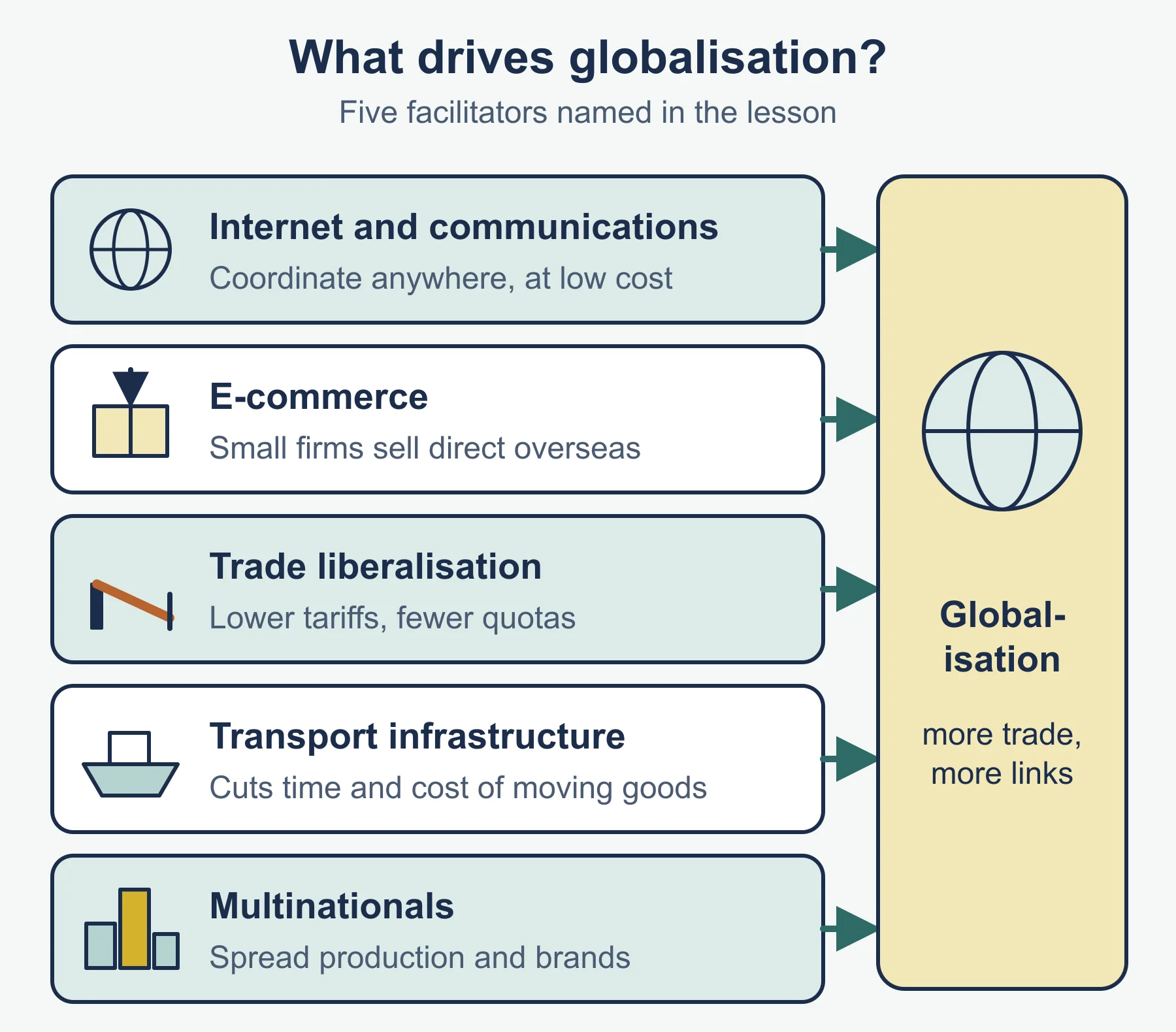
Facilitators of globalisation (all named in the specification)
- Multinationals
- Trade liberalisation
- E-commerce
- Transport infrastructure
- The Internet and communication technologies
Who is more affected? Firms with imported inputs, overseas sales, global rivals and price-aware customers. Firms serving a small local market with local inputs are less affected.
Multinationals: evaluation grid
| Positive | Negative |
|---|---|
| investment, jobs, skills, tax income | local firms squeezed out |
| consumer choice and lower prices | production can move away quickly |
| spreads technology and brands | strong bargaining power over suppliers |
Always finish by saying which side is larger for the stakeholder named in the question.
Must-know distinctions
| Pair | Difference |
|---|---|
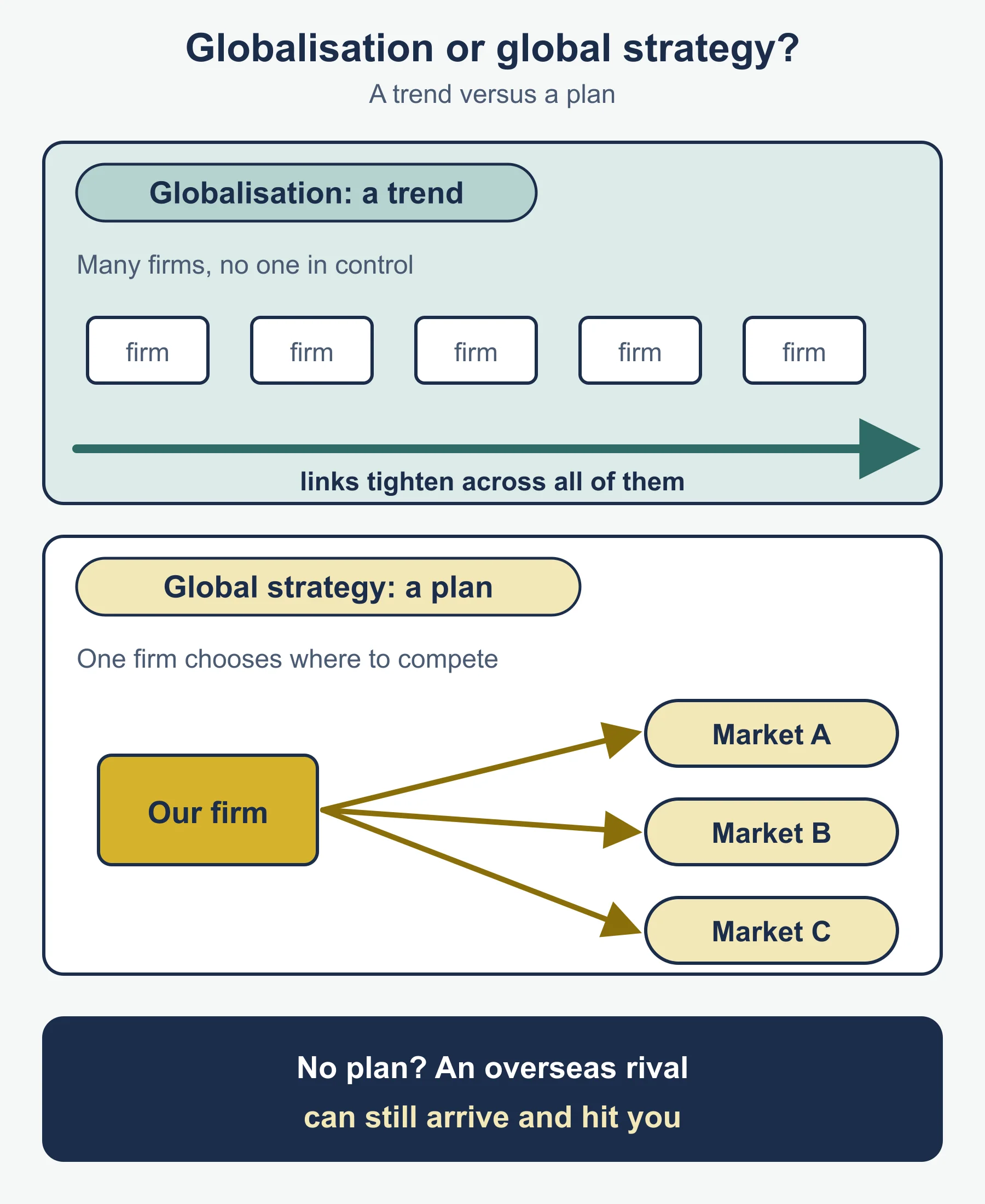
| Globalisation vs global strategy | a trend outside any firm’s control vs a plan made by one firm |
| Nature vs purpose of a barrier | what it is vs why a government uses it |
| Free trade vs trading bloc | no barriers anywhere vs lower barriers among members only |
| Tariff vs quota | tax on imports vs cap on imported quantity |
| Offshoring vs re-shoring | work moved abroad vs work brought home |
| Local vs national vs international/global market | one area, one country, many countries |
| Standardised vs adapted marketing mix | one mix everywhere, cheaper vs tailored to each market, costlier |
Barriers and factors
| Barrier | Nature | Purpose |
|---|---|---|
| Tariff | duty on imported goods | revenue; protect home producers |
| Quota | ceiling on units imported | protect home producers |
| Embargo | complete halt to trade with a country | political or security aims |
| Technical rules | product standards, permits | consumer safety, or slowing imports |
Factors when trading internationally: language, culture and customs, logistics, currency, buying habits. Apply each to the actual product.
Support: financial (credit insurance for exports, bank trade finance, grants) and non-financial (official advice, trade shows, agents, business associations).
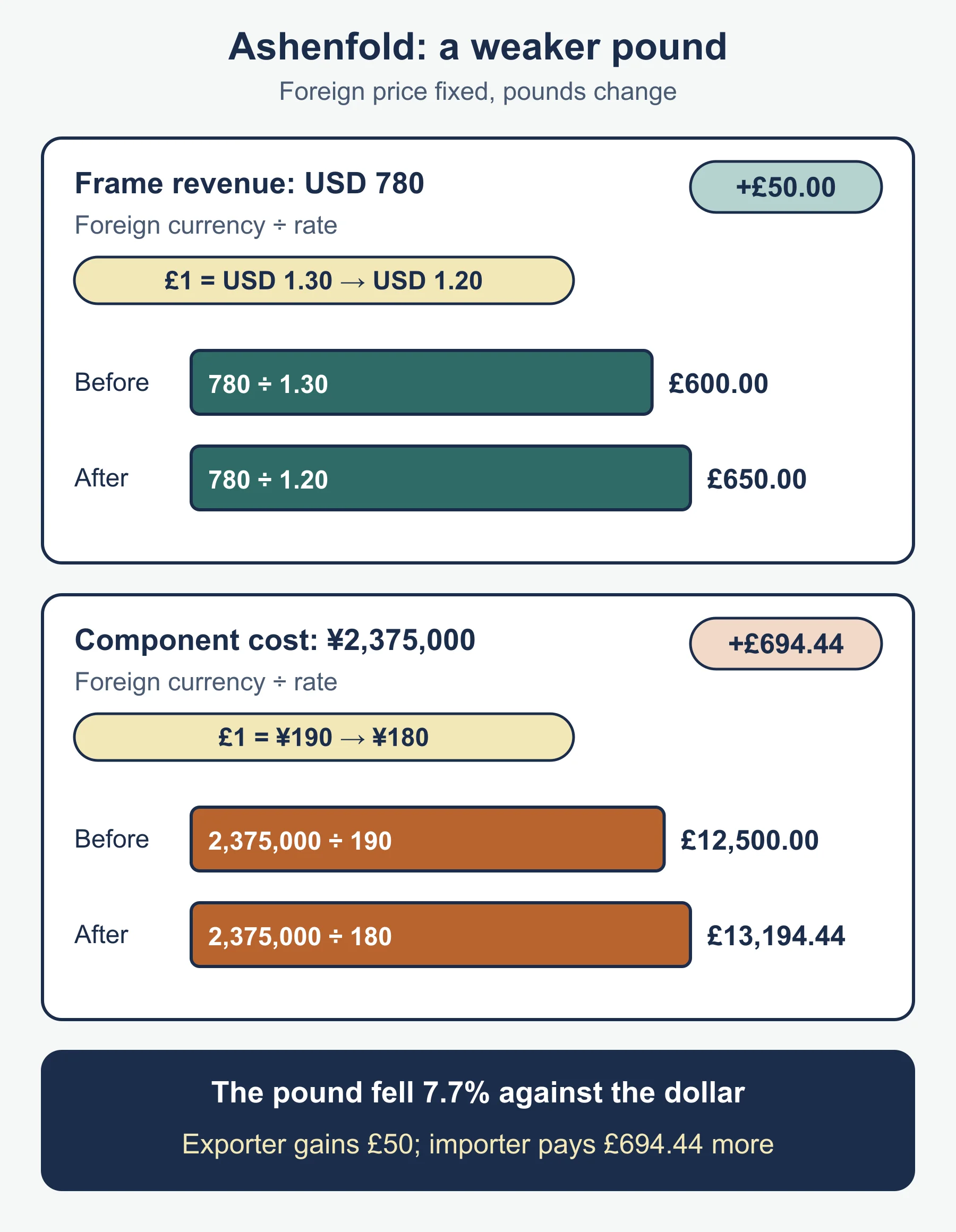
Exchange rate method
- Write the rate as foreign units per £1, for example £1 = USD 1.25.
- Pounds to foreign currency: multiply by the rate.
- Foreign currency to pounds: divide by the rate.
- A rise in foreign units per £1 means the pound has appreciated; a fall means it has depreciated.
- Percentage change in the rate = (new − old) ÷ old × 100.
Small reminders. £250 at £1 = USD 1.25 is 250 × 1.25 = USD 312.50. A USD 400 invoice is 400 ÷ 1.25 = £320. If the rate rises from 1.25 to 1.40, the pound has appreciated by (1.40 − 1.25) ÷ 1.25 × 100 = 12%.
| Pound | Exporter | Importer |
|---|---|---|
| Weaker | earns more pounds per sale, or can cut foreign prices | pays more pounds |
| Stronger | earns fewer pounds, or must raise foreign prices | pays fewer pounds |
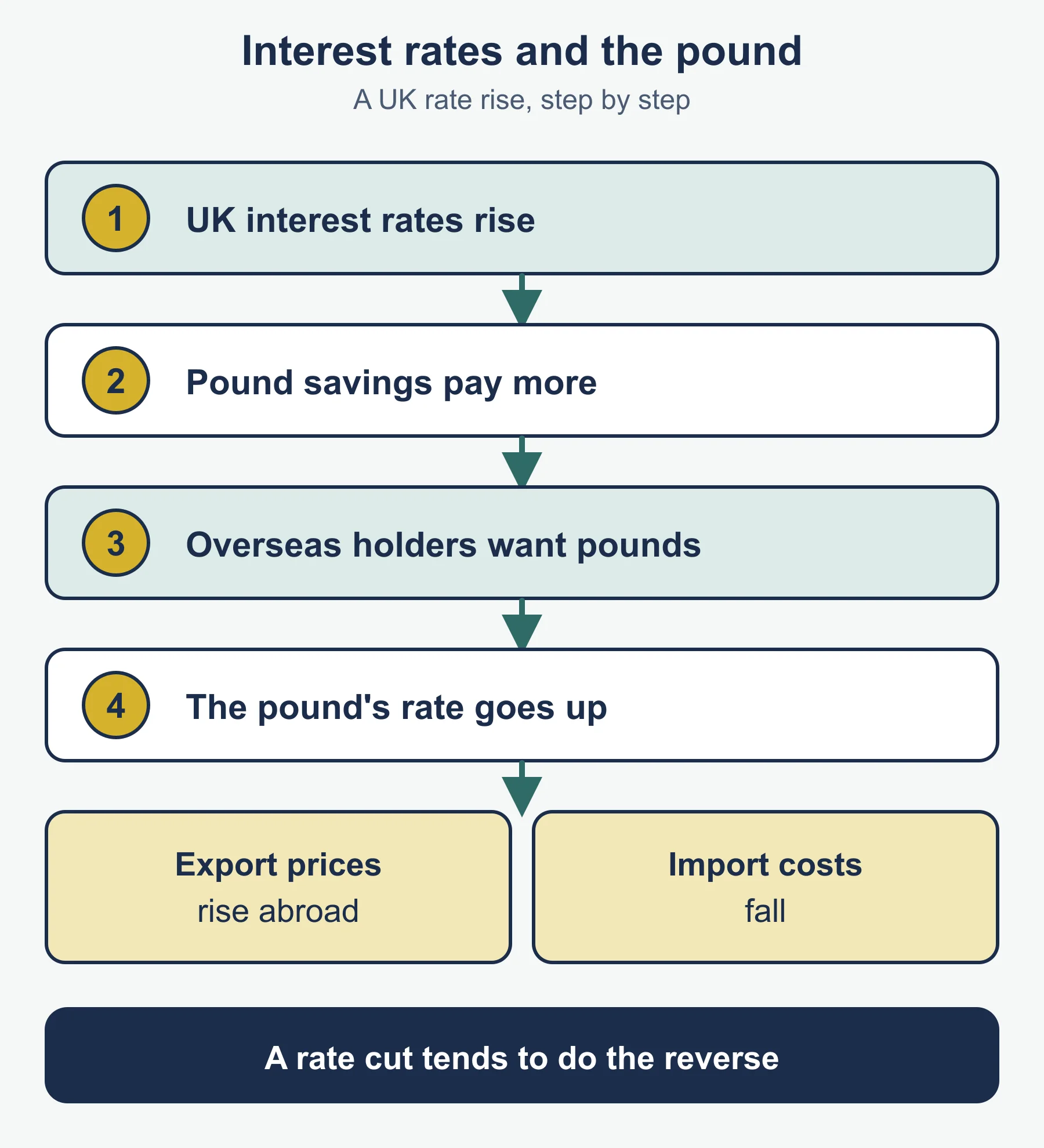
Interest rates and exchange rates: higher UK interest rates attract overseas savers, raising demand for pounds and tending to push the pound up. Lower rates tend to do the reverse.
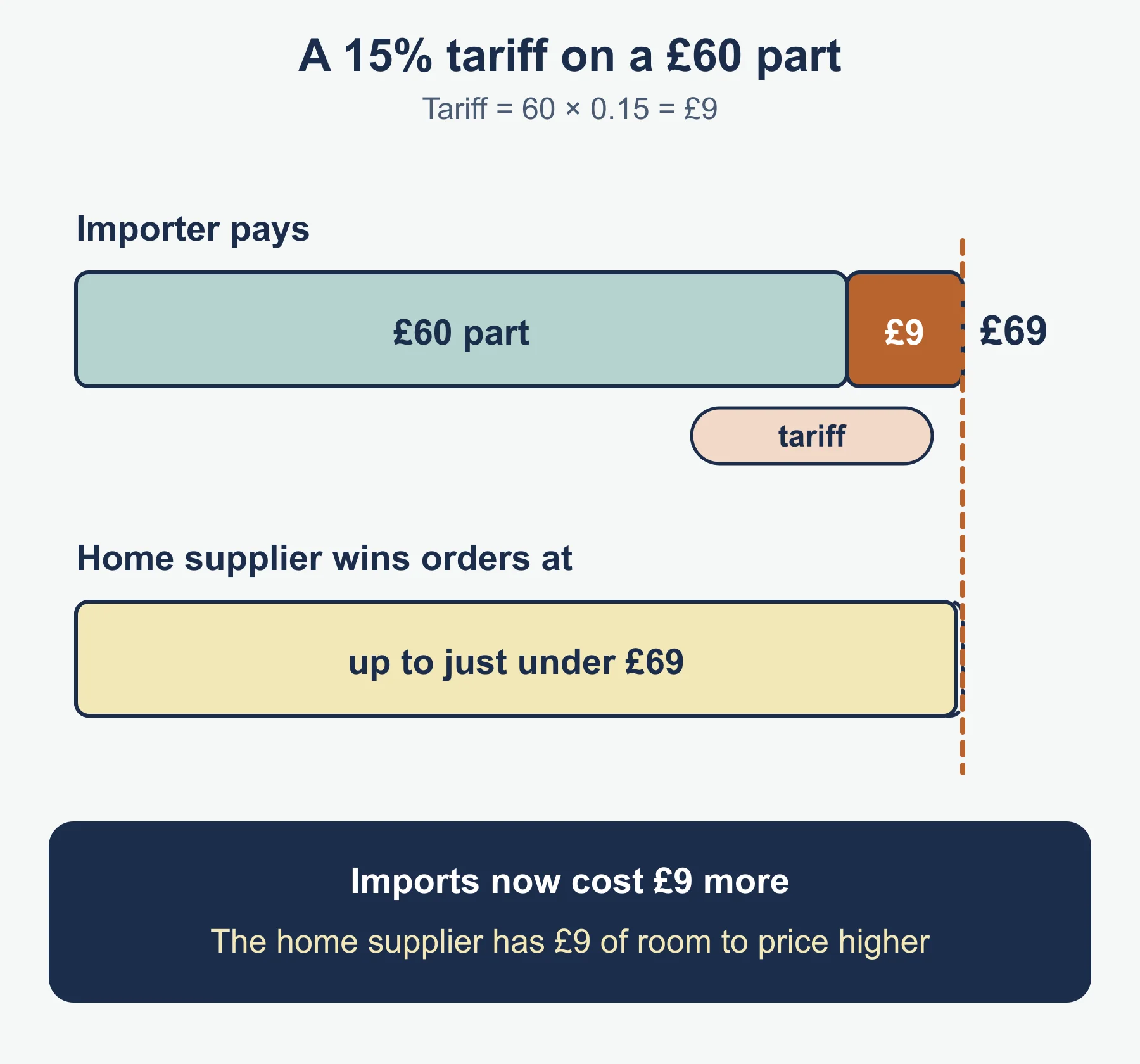
Tariff reminder: a tariff of 8% on an imported item priced at £125 adds 125 × 0.08 = £10, so the cost is £135.
Free trade versus trading blocs
| Advantages to a business | Disadvantages | |
|---|---|---|
| Free trade | wider markets, cheaper inputs, leaner operations | tougher rivals, job losses, reliance on suppliers |
| Trading bloc | smoother access, shared rules, larger market | rivals within the bloc, imposed rules, barriers to outsiders |
The European Union
| Feature | Effect on a business |
|---|---|
| Enlargement | more customers and suppliers; more rivals |
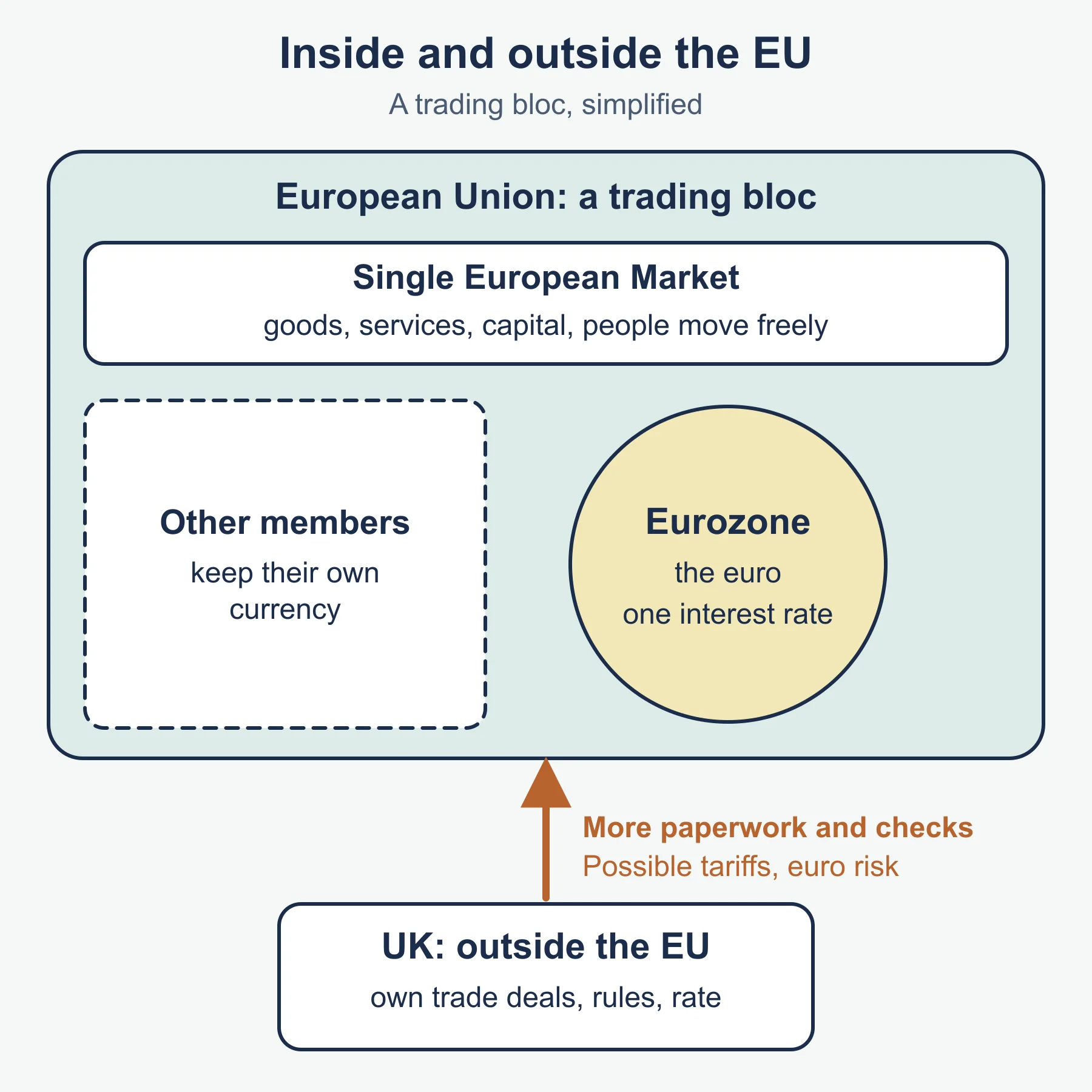
| Single currency | no exchange risk or conversion costs inside the Eurozone; one shared interest rate |
| UK outside EU and Eurozone | own trade deals, rules and interest rate; more paperwork and currency risk when selling to the EU |
| UK outside the Single European Market | own standards; loses frictionless access, may need certification or a local base |
Recommend and justify: compare nearer, similar European markets with distant global ones on growth, risk, cost and fit with the product. State what would change your choice.
Emerging markets and global changes
- Impact: new customers and cheaper production (opportunity); new rivals, price pressure, instability and currency risk (threat).
- Global changes to watch: currencies, trade policy, technology, politics, regulation, tastes, new entrants.
- Responses: diversify markets and suppliers, fix prices in advance, adapt products, innovate. Justify against cost and the alternatives.
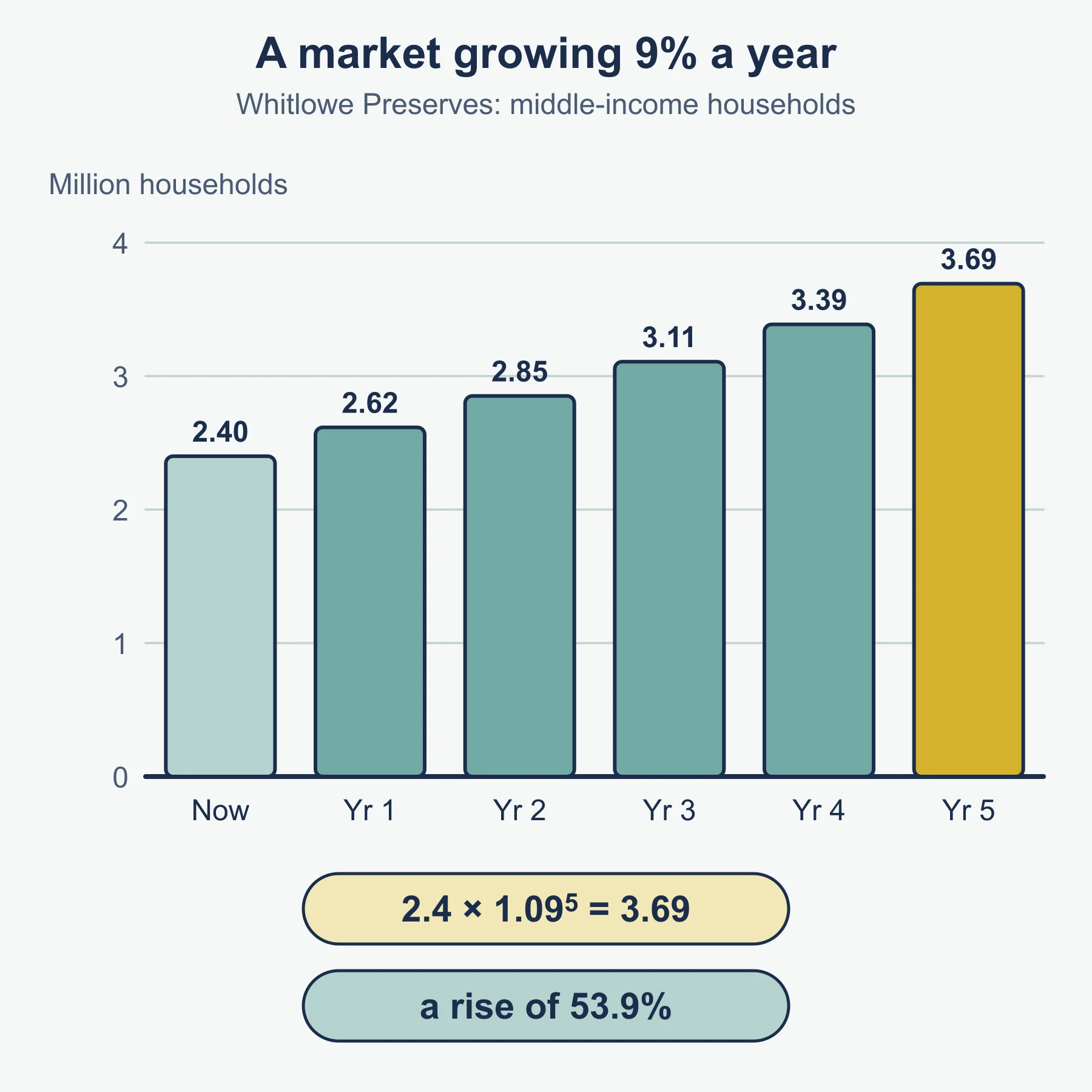
- Growth check: value after n years = start × (1 + rate)ⁿ. Percentage rise = (end − start) ÷ start × 100.
Political and other international points
- Political factors: taxes, regulation, trade policy, elections. Stability supports planning and investment. Uncertainty delays investment. Instability raises risk and can disrupt trade and supply.
- Policies of local, national and international governments affect taxes, rules and trade.
- Competition may be local, national or global; global rivals may have lower costs or stronger brands.
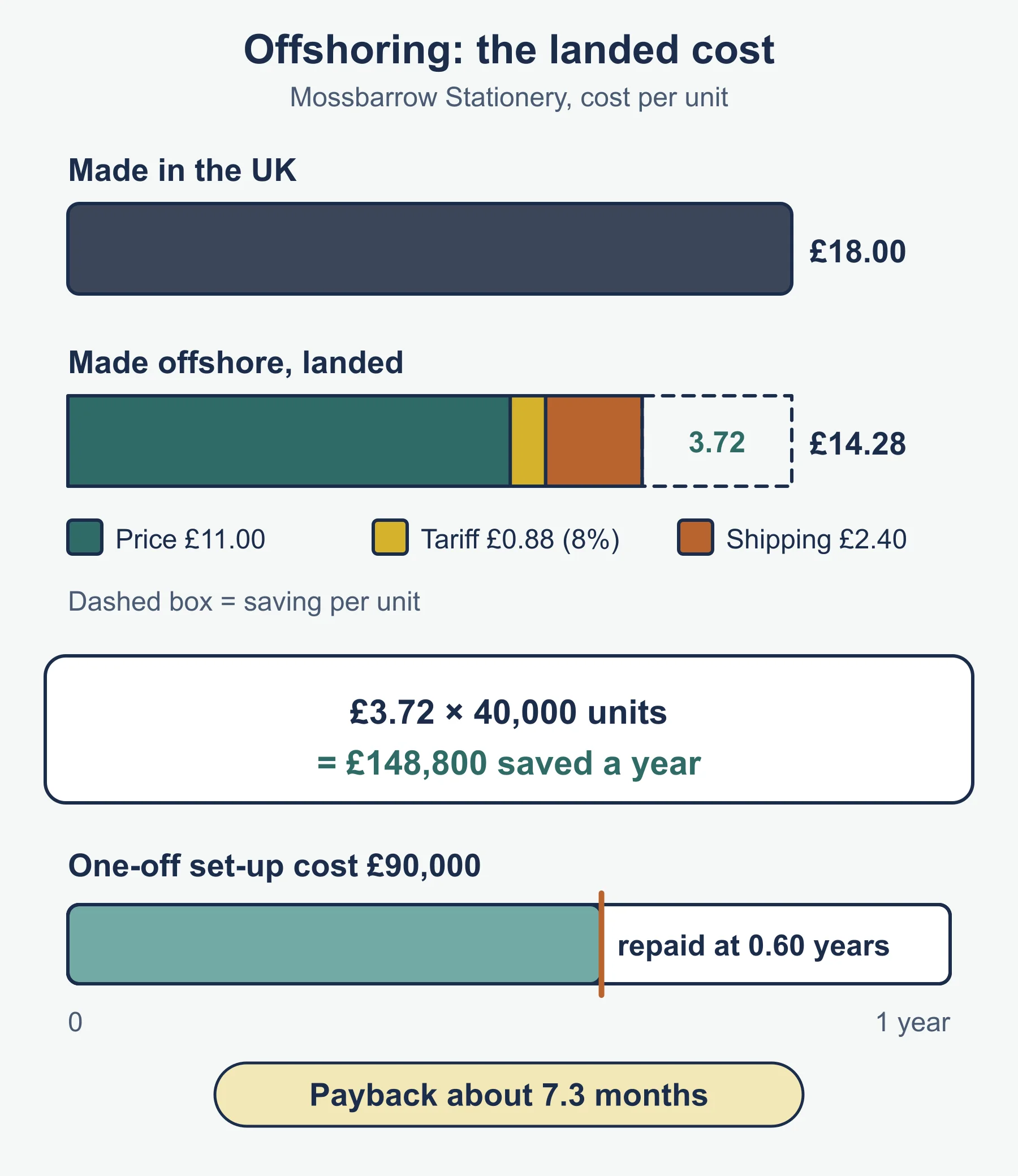
- Offshoring payback: payback (years) = set-up cost ÷ annual saving. Landed cost per unit = unit cost + tariff + shipping.
- International influences appear in the lists of external influences on marketing, operations, finance and people.
Quick self-test
- Define globalisation.
- Name three factors that facilitate globalisation.
- Distinguish between globalisation and a global strategy.
- State the nature and the purpose of a quota.
- At £1 = USD 1.60, convert £85 to US dollars.
- At £1 = USD 1.60, convert USD 640 to pounds.
- The rate falls from £1 = USD 1.60 to £1 = USD 1.40. Has the pound appreciated or depreciated? What happens to the pound cost of a USD 700 invoice?
- Explain how a rise in UK interest rates may affect the value of the pound.
- State one disadvantage to a business of trading within a trading bloc.
- Define emerging market.
- What is re-shoring?
- An 8% tariff applies to an imported item priced at £125. What does it cost the importer?
Answers
- The growing integration of economies and markets across borders, so goods, money and information move more freely.
- Any three of: multinationals, better transport infrastructure, trade liberalisation, e-commerce, the Internet and communications technology.
- Globalisation is a trend outside any one firm’s control; a global strategy is a firm’s own plan to compete in world markets.
- Nature: a ceiling on units of a good allowed in. Purpose: to shield home producers from foreign supply.
- 85 × 1.60 = USD 136.00.
- 640 ÷ 1.60 = £400.
- Depreciated. The invoice costs 700 ÷ 1.40 = £500, up from 700 ÷ 1.60 = £437.50, so £62.50 more.
- Higher rates attract overseas savers, who need pounds to deposit, so demand for pounds rises and the pound tends to appreciate.
- For example more competition from other member firms, or bloc rules the firm cannot change.
- An economy growing fast and industrialising, with rising incomes, that is still less developed than rich economies.
- Bringing work that was done abroad back to the home country.
- 125 × 1.08 = £135.
Where marks are usually lost
- Stating a term without tying it to the business in the case.
- Multiplying instead of dividing in a conversion, or the reverse.
- Saying “exchange rates change” without stating the direction and who gains: exporter or importer.
- Mixing up globalisation and a global strategy.
- Writing only advantages, or only disadvantages, on an “evaluate” question.
- Describing a barrier without both its nature and its purpose.
- Recommending an option without comparing it with the alternative and giving a reasoned judgement.
- Quoting data from the case without using it to support a conclusion.
Frequently asked questions
What are the facilitators of globalisation in OCR A Level Business? The OCR A Level Business (H431) specification names multinationals, trade liberalisation, e-commerce, transport infrastructure, and the Internet and communication technologies as facilitators of globalisation.
Does a weaker pound help exporters or importers? A weaker pound helps exporters, who earn more pounds per foreign sale or can cut their foreign prices, and hurts importers, whose foreign-currency costs rise in pounds. A stronger pound reverses these effects.
What is the difference between globalisation and a global strategy? Globalisation is a trend in the business environment that no single firm controls. A global strategy is a plan a particular business chooses in order to respond to that trend.
Official syllabus
OCR A Level Business (H431), Version 2.1 (January 2026), published by OCR, for first assessment in 2017 with final assessment in summer 2027. Content covered: The global environment of business.
Get free revision emails (optional)
Occasional emails with practice questions, worked explanations and links to free resources for the qualification and subjects you choose. No spam, and you can unsubscribe from any email. The free tools on this site never need an email.
Related resources
-
Study guides
OCR A Level Business: The global environment of business (H431)
Whole-topic study guide to the global environment of business for OCR A Level Business H431: globalisation, trade, exchange rates, EU, emerging markets.
Business · OCR · A Level
Read guide -
Practice questions
OCR A Level Business: The global environment of business (H431) – Practice Questions
Original practice questions with worked answers on the global environment of business for OCR A Level Business H431, from short answers to a 12-mark case.
Business · OCR · A Level
Try questions -
Study guides
OCR A Level Business: The market, market size and growth and Demand and supply (H431)
Study guide to markets, market size and growth, market structures, demand, supply and equilibrium for OCR A Level Business (H431), with worked diagrams.
Business · OCR · A Level
Read guide
Related articles
-
teaching
A Level tuition in Dubai: Cambridge or Pearson Edexcel International A Level?
Schools in Dubai and Abu Dhabi teach either Cambridge International AS & A Level or Pearson Edexcel International A Level. How the two are structured, why it matters for tuition, and how online classes from Lahore work.
9 October 2026
-
curriculum guides
Choosing subjects at IGCSE and A Level
How subject choices at 14 and 16 affect university options later, and how to keep pathways open without overloading a timetable.
28 July 2026
Studying this with a teacher
Working through Business A LEVELS?
This page is free and stays free. If you would rather be taught it, Marlbridge runs Business classes one-to-one, online in your own time zone. One-to-one only for this course: Rs 6,000 per class in Pakistan, with other currencies on the fees page. The first trial class is free. WhatsApp replies within an hour (8am–11pm Pakistan time, every day); email the same day.
OCR Business teachers at Marlbridge
