
Revision Notes
OCR A Level Business: Global context, trade, the EU and emerging markets (H431) – Revision Notes
Condensed revision notes on globalisation, trade barriers, exchange rates, trading blocs, the EU and emerging markets for OCR A Level Business H431.
- Subject
- Business
- Level
- A LEVELS
- Topic
- External influences facing businesses
- Author
- Marlbridge Academic Team
- Updated
- Reviewed by
- Salman Ahmad (what this means)
Aligned to OCR A Level Business (H431), Version 2.1 (January 2026), for first assessment in 2017; final assessment summer 2027. Official specification .
Syllabus page (what it covers and how it is assessed): OCR A Level Business.
Syllabus points this page covers
H431
- 2.4 Global context, international trade, the EU and emerging markets
Found an error? Report a correction.
Need help with this topic? Request a free trial class for A Level Business (H431).
Quick recall for the content headed Global context, International trade and free trade, The European Union, and Emerging markets and the global environment in the OCR A Level Business (H431) specification, Version 2.1 (January 2026). For full explanations read the study guide. Test yourself with the practice questions.
Also useful: the wider External influences revision notes, the OCR A Level Business hub, the printable checklist and the free diagnostics.
Key definitions
| Term | Meaning |
|---|---|
| Globalisation | growing integration of economies, markets and businesses across borders |
| Global strategy | one firm’s deliberate plan to operate in world markets |
| Multinational | a business operating in more than one country |
| Global brand | a brand recognised and sold in many countries |
| International trade | buying and selling goods and services between countries |
| Barrier to trade | anything that makes imports harder or dearer to sell |
| Exchange rate | the cost of a unit of one currency in another currency |
| Free trade | trade without tariffs, quotas or other barriers |
| Trading bloc | countries agreeing to reduce trade barriers between themselves |
| Emerging market | a fast-growing, industrialising economy with rising incomes, not yet fully developed |
Globalisation in one page
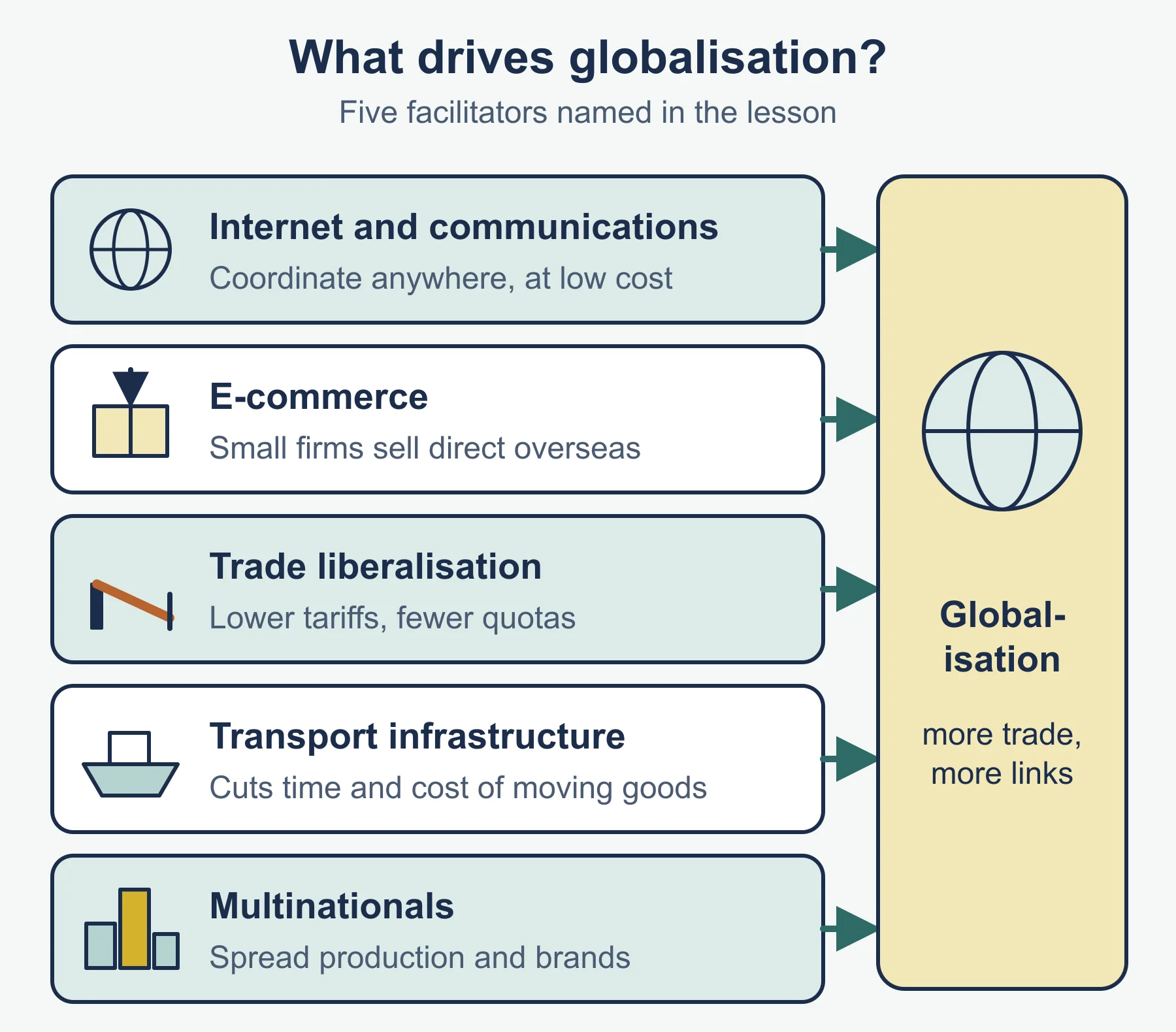
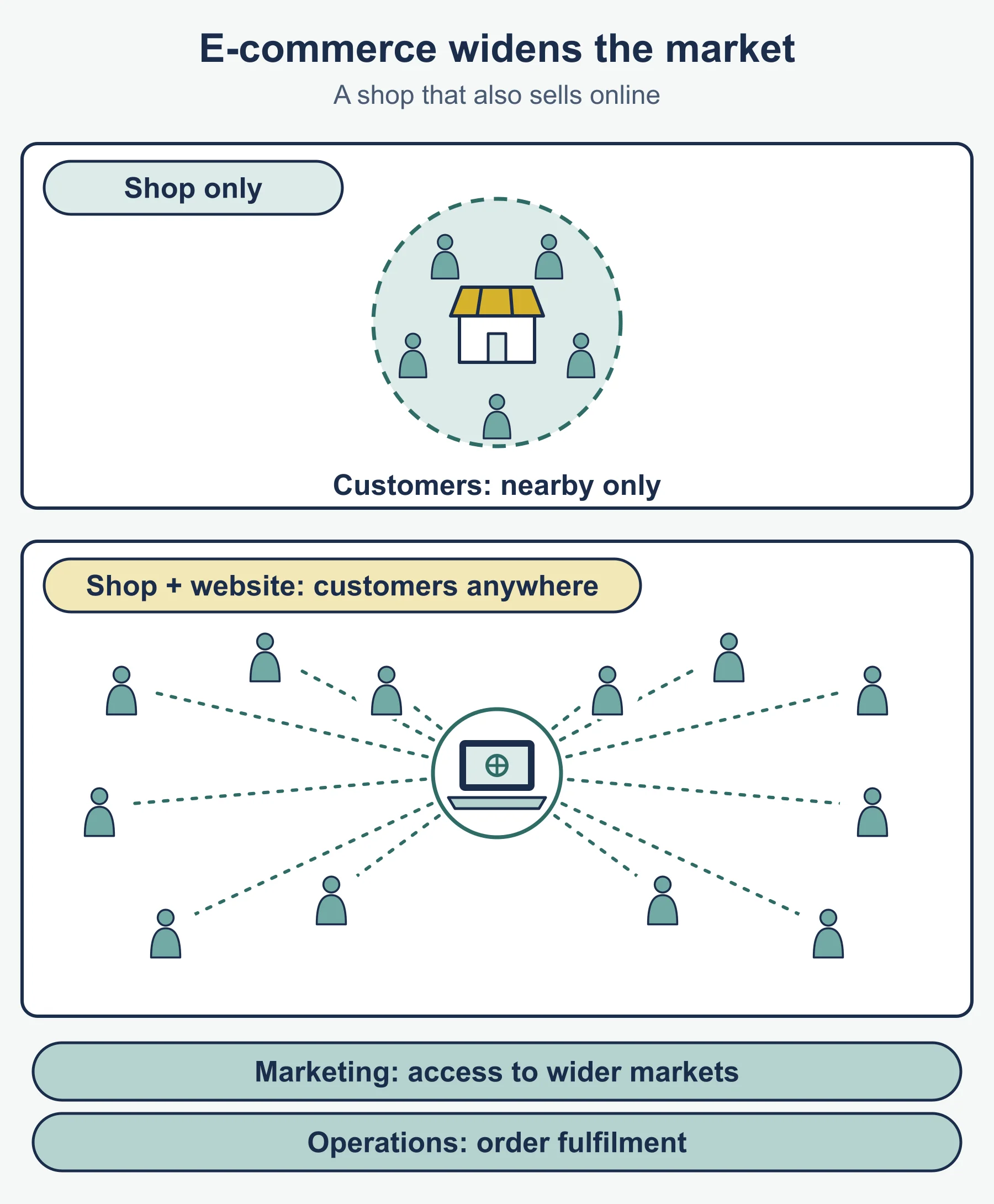
Facilitators: multinationals; transport infrastructure; trade liberalisation; e-commerce; Internet and communication technologies.
Why firms are affected differently: depends on imported inputs, overseas sales, overseas rivals, product tradability, customer price sensitivity and the firm’s resources.
Multinationals: move capital and technology, locate production in low-cost places, spread global brands, link supply chains.
- For: investment, jobs, tax, choice.
- Against: crowding out local firms, mobility, bargaining power over suppliers.
Opportunities and threats
| Opportunities | Threats |
|---|---|
| larger markets | overseas competitors |
| cheaper inputs | exchange rate exposure |
| economies of scale | supply chain disruption |
| risk spread across countries | pressure on prices |
Recommend and justify. Method in steps:
- State your decision in one sentence.
- Give two reasons using the case facts.
- Weigh the best alternative and say why it is weaker.
- Mention a condition that would change your view.
Global brands
- Opportunities from rising global brands: trust and scale to lean on, licensing or supply deals, a “local alternative” position.
- Threats: price cuts through scale, heavy promotion, loss of shelf space and loyalty.
- Judgement: depends on whether the firm competes head-on or in a niche.
International trade
Reasons: missing resources; specialisation; economies of scale; choice; growth when the home market is saturated; spreading risk.
Link to globalisation: more globalisation raises trade; more trade deepens globalisation.
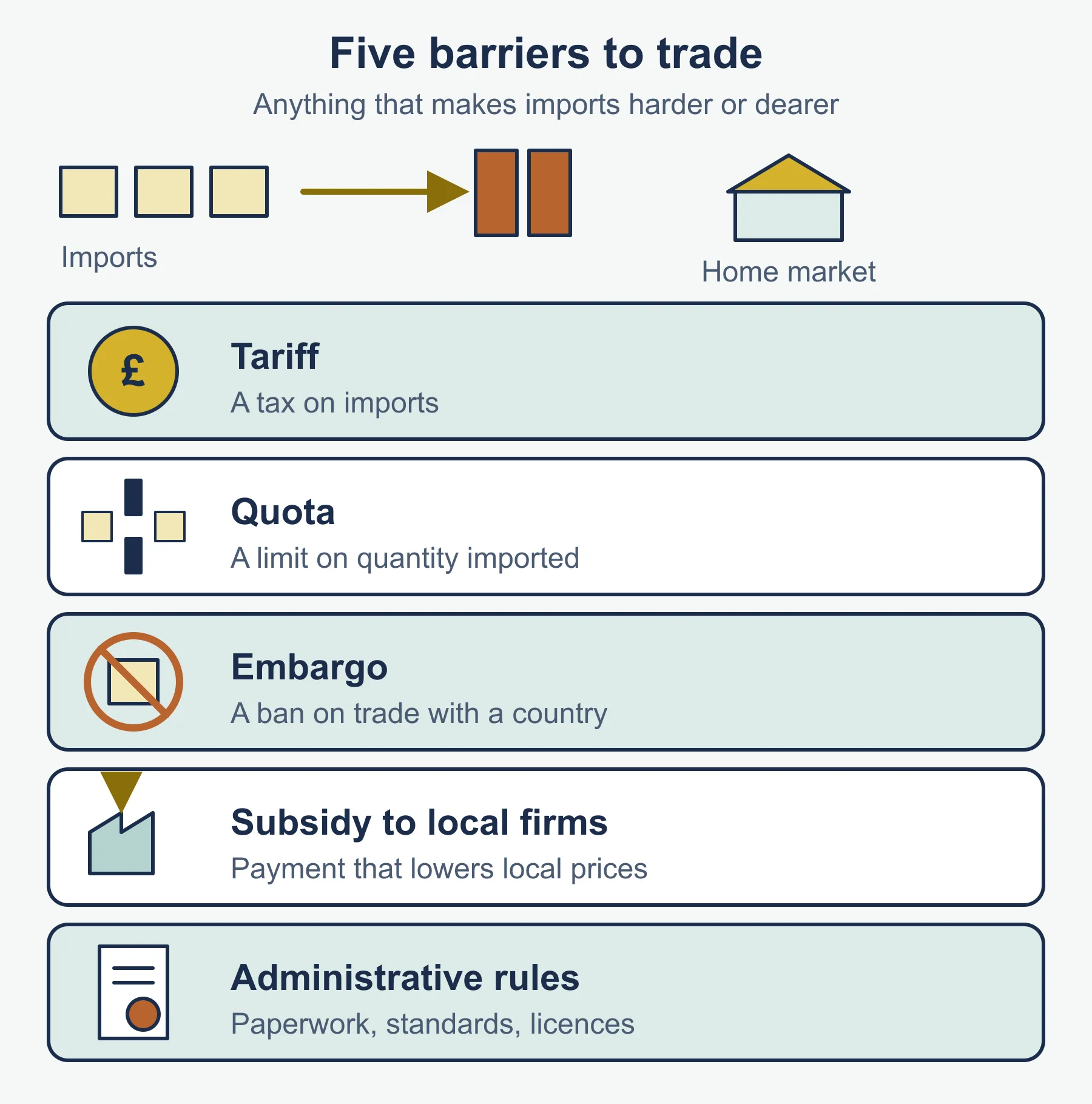
Barriers
| Barrier | Nature | Purpose |
|---|---|---|
| Tariff | tax on imports | revenue, dearer imports |
| Quota | limit on quantity | protect local producers |
| Embargo | ban | political or security aims |
| Subsidy | payment to local firms | undercut imports |
| Rules, paperwork, standards | administrative | protect consumers or slow imports |
Factors when trading abroad
| Factor | Question to ask |
|---|---|
| Language | what must be translated? |
| Culture and customs | what is acceptable or expected? |
| Logistics | how will goods travel, how long, at what cost? |
| Currency | in which currency is the price set? |
| Buying habits | how do customers shop and what do they pay? |
Support for traders: financial (export credit insurance or guarantees, bank trade finance, grants where available) and non-financial (government advice and market information, trade fairs and missions, chambers of commerce and trade associations, agents and distributors).
Exchange rates
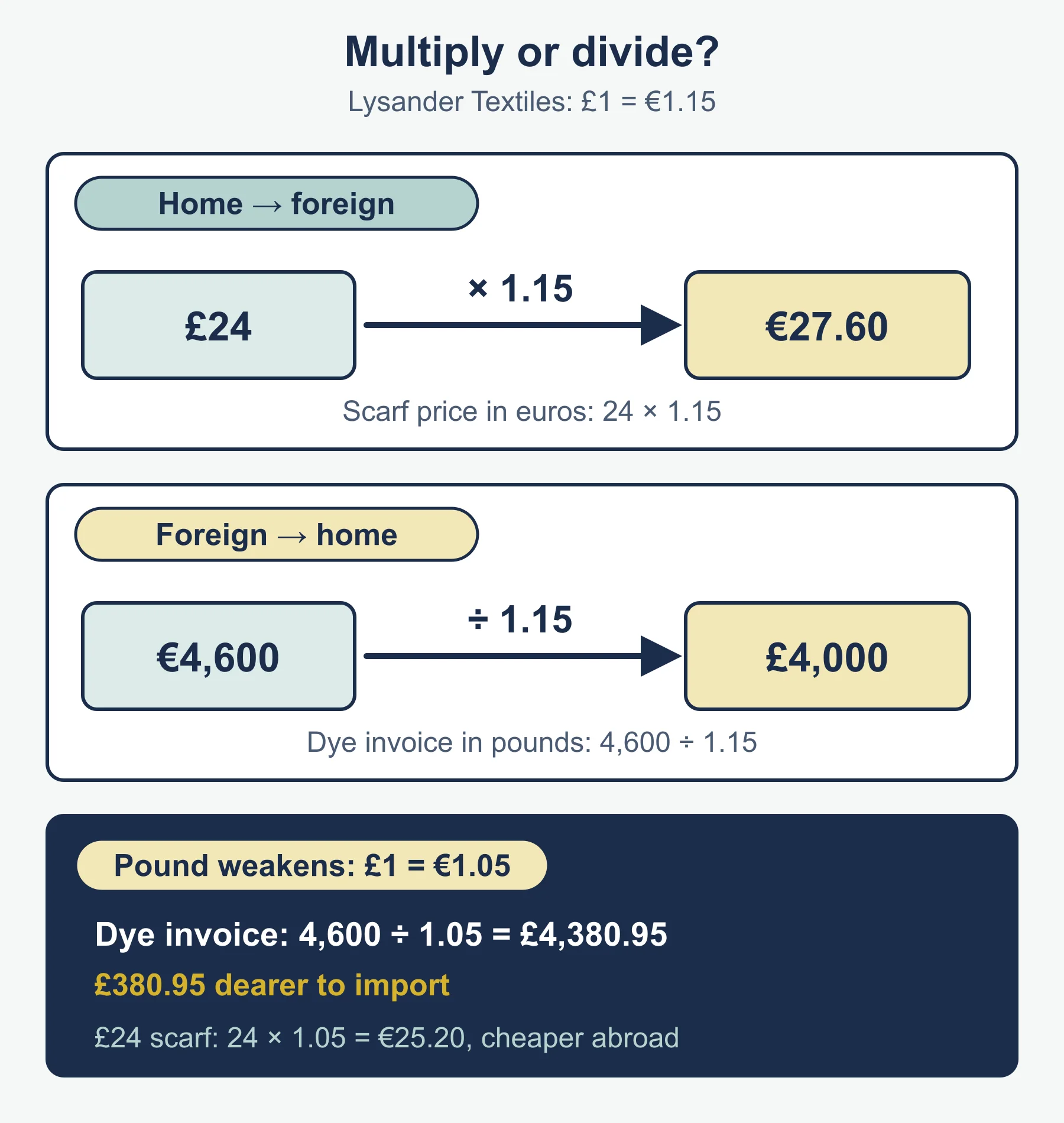
Rate form used here: foreign units per £1.
The conversion rule and the barrier list are standard background, not specification wording; so are the EU and euro descriptions and UK Export Finance.
- Home to foreign: multiply.
- Foreign to home: divide.
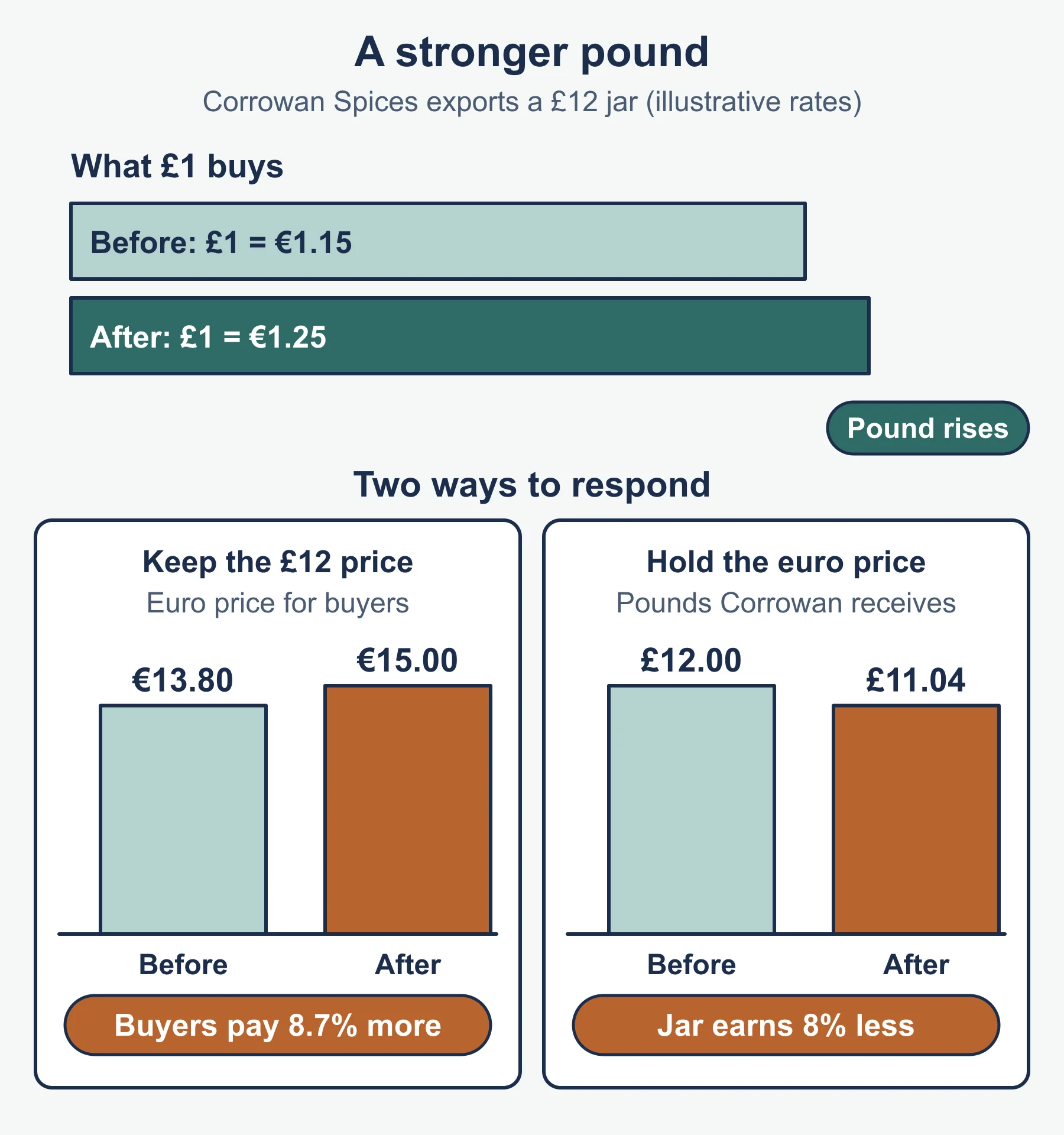
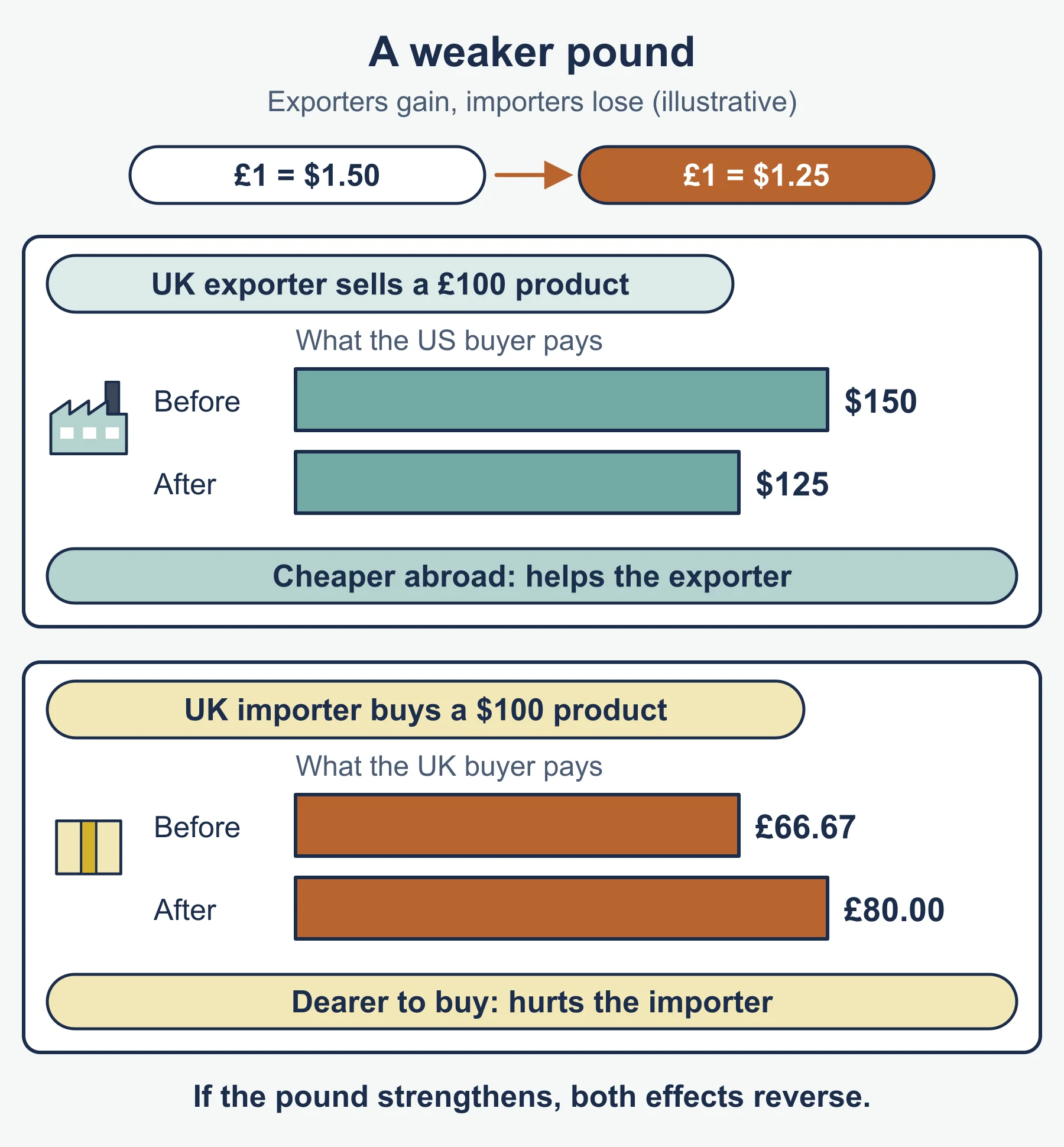
- Pound appreciates: imports cheaper in pounds, exports dearer abroad.
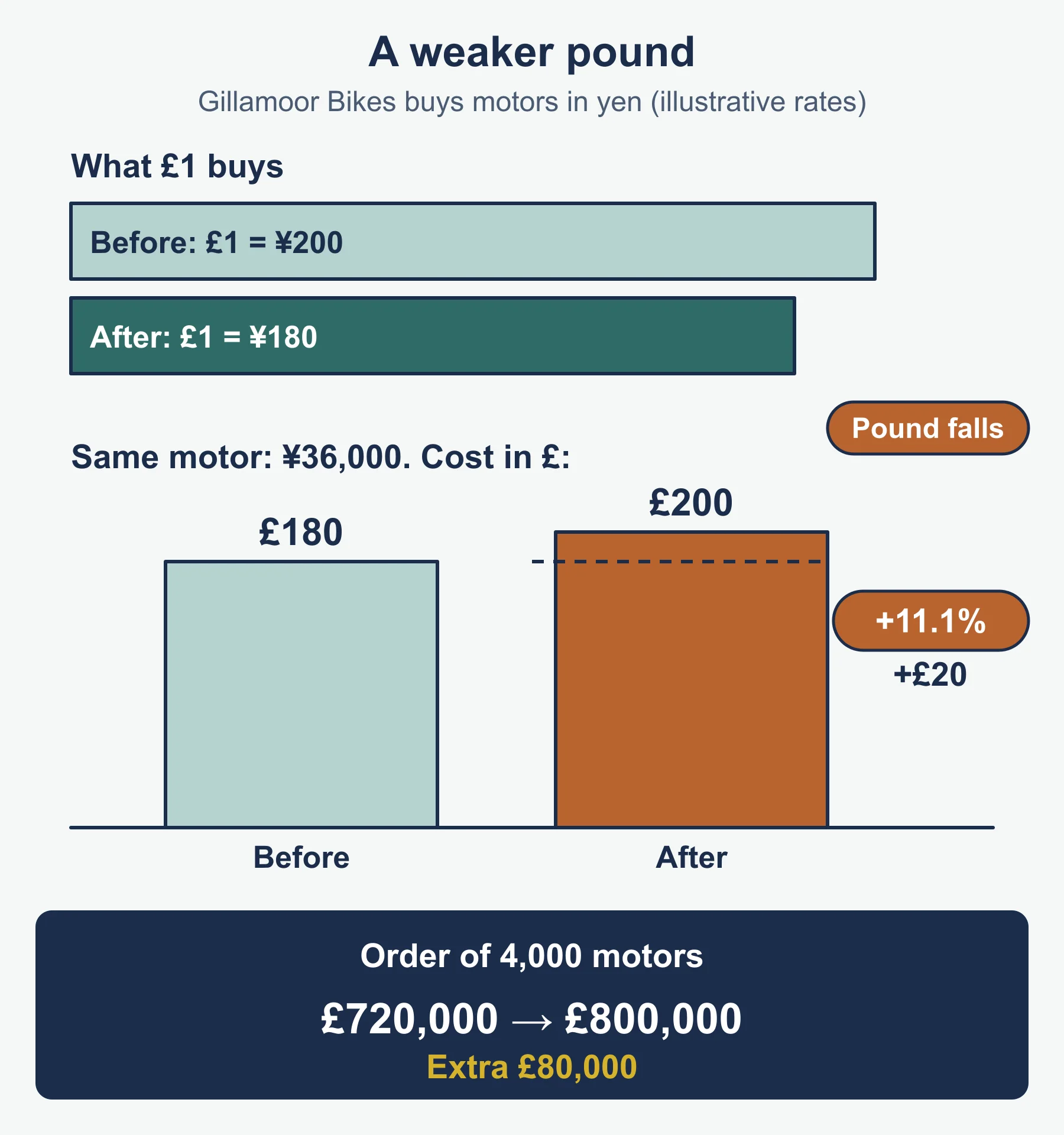
- Pound depreciates: imports dearer, exports cheaper abroad.
Worked reminder (Sandringle Cycles). Sandringle, a UK maker, buys tyres invoiced at USD 3,000, with a rate of £1 = USD 1.25.
- Cost in pounds: 3,000 ÷ 1.25 = £2,400.
- The pound falls to £1 = USD 1.10: 3,000 ÷ 1.10 = £2,727.27.
- Extra cost: £2,727.27 − £2,400 = £327.27.
- A frame priced at £480 sells to a US buyer at 480 × 1.25 = USD 600. At 1.10 the same frame costs 480 × 1.10 = USD 528, so it is cheaper for the buyer.
Evaluating a change in rate:
- Who gains and loses: exporters, importers, shareholders, employees, customers, suppliers.
- Size of the change and how long it lasts.
- Existing contracts or fixed prices that delay the effect.
- Whether costs and sales are in the same currency.
Free trade and trading blocs
| Advantages to a business | Disadvantages to a business | |
|---|---|---|
| Free trade | bigger markets, cheaper inputs, efficiency, scale | stronger rivals, dependence on foreign suppliers, job losses elsewhere in the economy |
| Trading bloc | tariff-free access to members, common rules, bigger market | more competition, rules set by the bloc, barriers to non-members, less national flexibility |
The EU
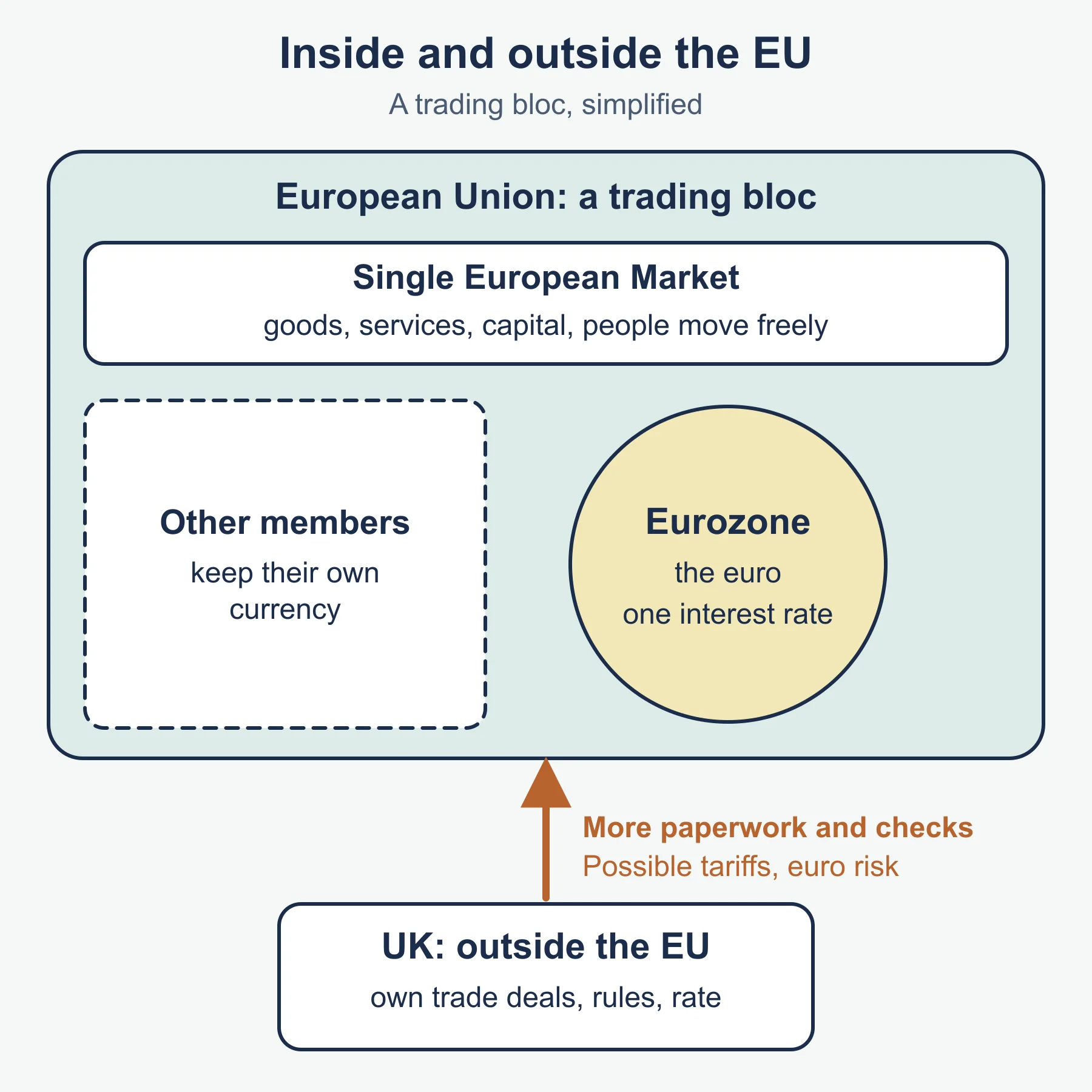
- Single European Market: goods, services, capital and people move largely freely among members.
- Enlargement: more customers, suppliers and workers under common rules, but also more competition.
- Single currency (euro, Eurozone): no currency risk or conversion cost between members; one central interest rate for all members.
- UK outside the EU and the Eurozone: own trade deals, own interest rate, own regulation, but extra checks and paperwork, possible tariffs, exchange rate exposure and less influence over EU rules.
- UK outside the Single European Market: freedom over product and employment rules, but loss of frictionless access and possible extra certification or local operations.
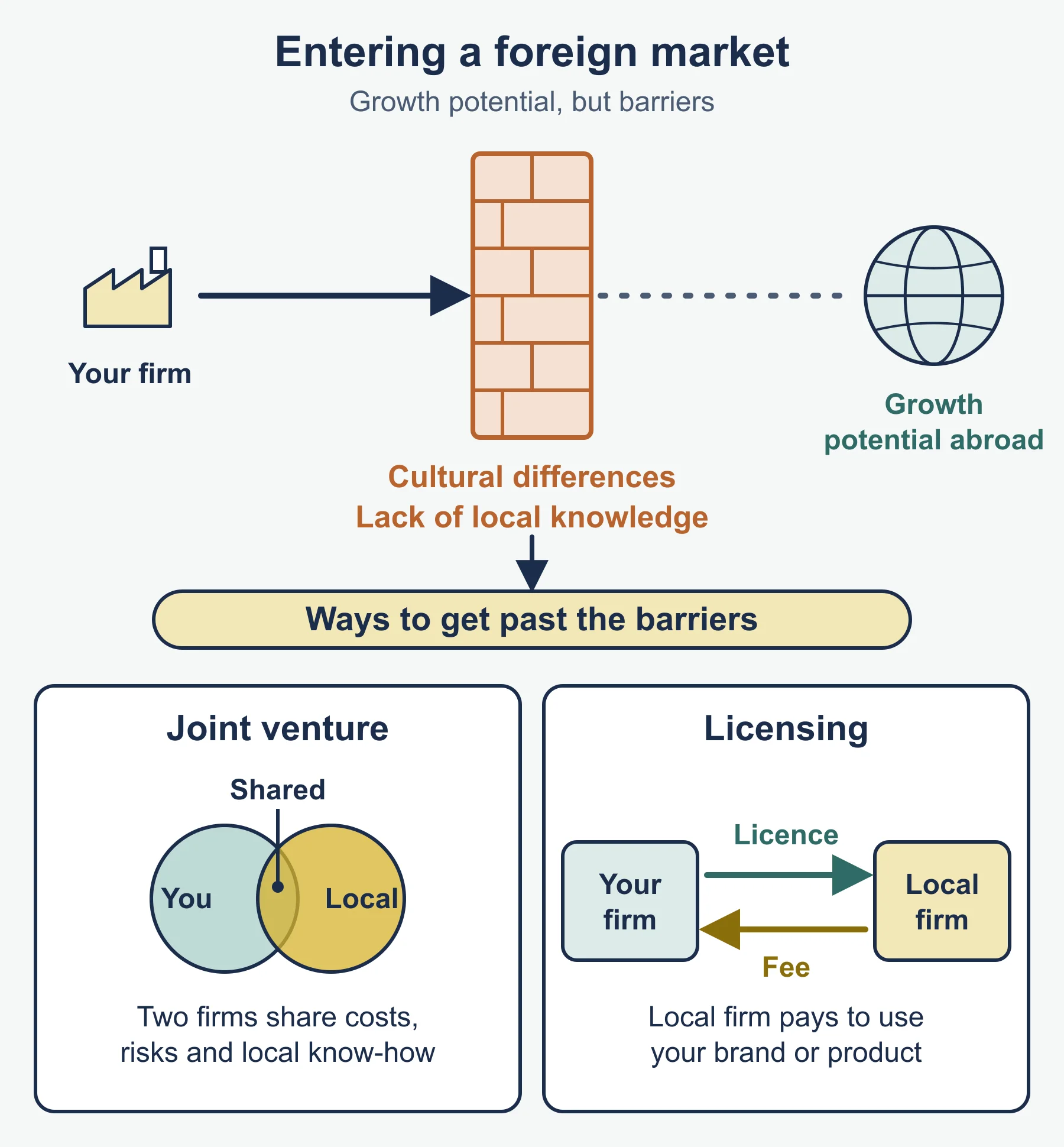
- Expand into Europe and/or global markets? Europe is near and large but now involves more paperwork. Global markets may grow faster but bring distance, culture and currency risk.
Emerging markets and the global environment
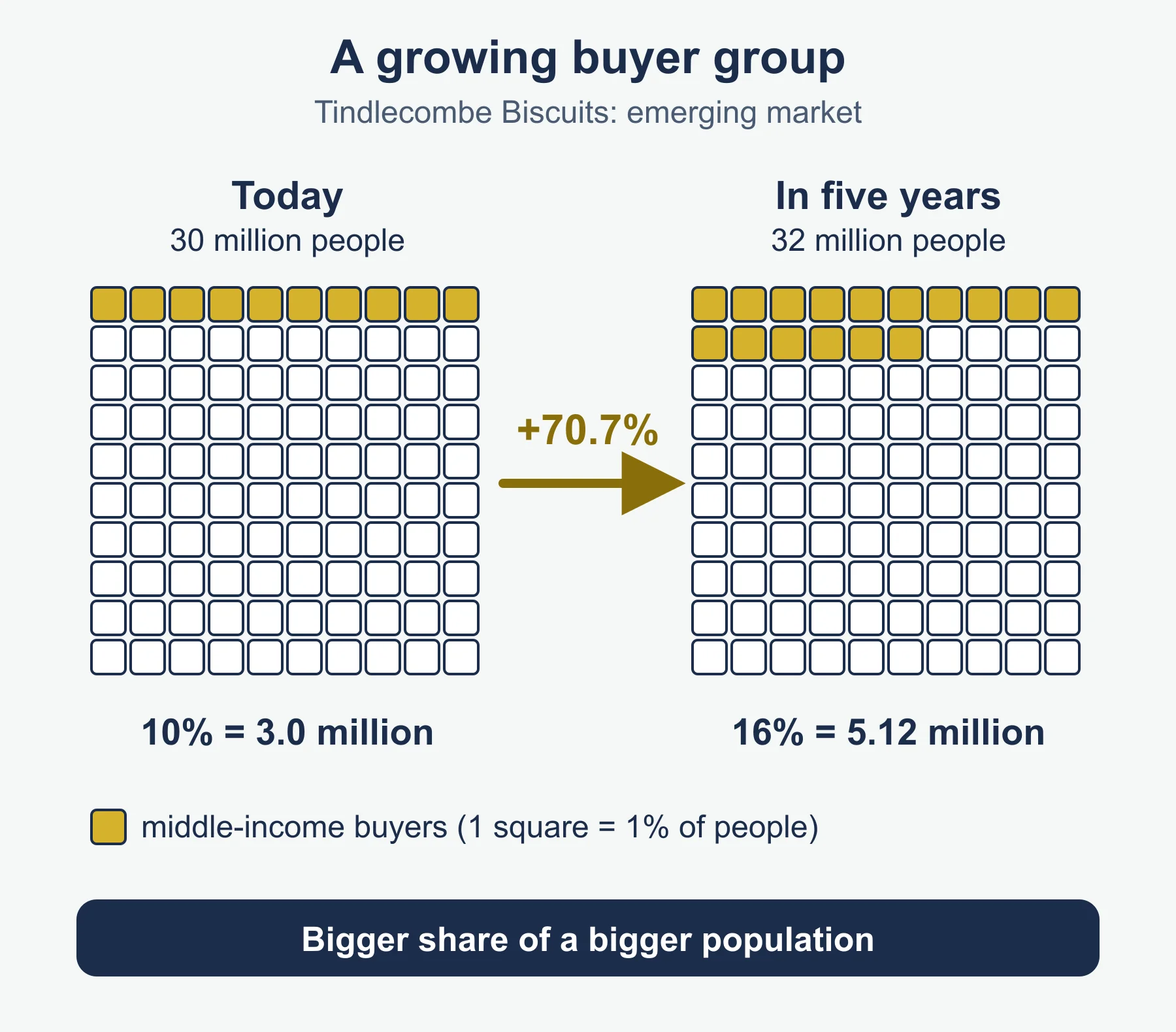
- Features: fast growth, rising incomes, growing middle class, still developing institutions and infrastructure.
- Impact on a business: new customers and cheaper production sites, but also new rivals, price pressure and risk.
- Changes in the global environment: exchange rates, trade policy, technology, political events, regulation, tastes, competitors.
- Responses: diversify markets and suppliers, protect against currency risk, adapt products, invest in innovation, or stay local and differentiate. Justify against alternatives and cost.
Evaluation prompts
Use these to turn a description into an evaluation of opportunities and threats:
- It depends on size: a small exporter has fewer resources to absorb a currency swing than a large multinational.
- It depends on time: a currency fall may help exporters in the short run, but higher import costs can erode the gain later.
- It depends on the product: a distinctive product can carry a higher price abroad; a standard product competes on price.
- It depends on the stakeholder: shareholders, employees, customers and suppliers rarely gain or lose equally.
- Judgement: finish with the factor that matters most for this business and say why.
Must-know distinctions
- Globalisation vs global strategy: one is an environmental trend; the other is a choice by a firm.
- Tariff vs quota: a tax on imports versus a limit on quantity.
- Free trade vs trading bloc: no barriers anywhere versus reduced barriers among members.
- Appreciation vs depreciation: pound buys more versus pound buys less.
- Single market vs single currency: free movement of goods, services, capital and people versus a shared currency used by some members.
- Financial vs non-financial support: money or insurance versus advice and contacts.
Quick self-test
- State two facilitators of globalisation.
- What is the difference between globalisation and a global strategy?
- Convert £250 into euros at £1 = €1.18.
- Convert €590 into pounds at £1 = €1.18.
- Convert 11,400 yen into pounds at £1 = 190 yen.
- Does a falling pound help or hurt an importer, and why?
- Give two purposes of a tariff.
- State one financial and one non-financial source of support for exporters.
- Give one advantage and one disadvantage for a UK business, from the UK being outside the Eurozone.
- The pound rises from £1 = €1.20 to €1.32. What is the percentage rise in the rate?
Answers
- Any two of: the Internet or communication technologies; e-commerce; trade liberalisation; transport infrastructure; multinationals.
- Globalisation is a trend in the environment; a global strategy is one firm’s plan to operate across world markets.
- 250 × 1.18 = €295.
- 590 ÷ 1.18 = £500.
- 11,400 ÷ 190 = £60.
- It hurts, because each unit of foreign currency costs more pounds, so import costs rise.
- Raise government revenue; make imports dearer than local goods; protect local producers.
- Financial: export credit insurance. Non-financial: trade fair or market information (other answers are valid).
- Advantage: it sets its own interest rate. Disadvantage: exchange rate risk when selling in euros.
- (1.32 − 1.20) ÷ 1.20 × 100 = 10%.
Where marks are usually lost
- Giving a definition and stopping, with no application to the business in the case.
- Listing language, culture, logistics, currency and buying habits without linking one to the product.
- Multiplying when the conversion needs dividing, or the reverse.
- Saying “exchange rates affect trade” without a direction, a cost or a price effect.
- Calling every change in the pound good or bad for all firms, instead of separating importers from exporters.
- Mixing up the EU, the Eurozone and the Single European Market.
- Describing emerging markets only as an opportunity and ignoring risk.
- Ending a “recommend and justify” answer without a decision or a reason why the alternative is weaker.
Frequently asked questions
What is the difference between globalisation and a global strategy? Globalisation is a trend in the business environment, outside the control of any one firm. A global strategy is a deliberate plan by one business to operate across world markets, such as selling a standardised product everywhere.
What is the difference between the EU, the Eurozone and the Single European Market? The EU is a trading bloc of European countries, the Eurozone is the group of members using the single currency, and the Single European Market lets goods, services, capital and people move between members largely freely. Mixing them up is a common error.
Is a fall in the pound good or bad for a business? It depends on the firm. A weaker pound helps exporters, whose goods become cheaper abroad, but raises the cost of imports, so separate importers from exporters.
Are emerging markets only an opportunity? No. They offer new customers and cheaper production sites, but also bring new competitors from those economies and pressure on prices, so weigh the risk too.
Official syllabus
OCR A Level Business (H431), Version 2.1 (January 2026), published by OCR, for first assessment in 2017 with final assessment in summer 2027. Content covered: Global context; International trade and free trade; The European Union; Emerging markets and the global environment, within External influences.
Get free revision emails (optional)
Occasional emails with practice questions, worked explanations and links to free resources for the qualification and subjects you choose. No spam, and you can unsubscribe from any email. The free tools on this site never need an email.
Related resources
-
Study guides
OCR A Level Business: Market forces, physical and non-physical markets, competition, dominance (H431)
Study guide to market forces, physical and non-physical markets, competition and market dominance for OCR A Level Business H431, with worked examples.
Business · OCR · A Level
Read guide -
Practice questions
OCR A Level Business: Market forces, physical and non-physical markets, dominance (H431) – Practice Questions
Original OCR A Level Business H431 practice questions with worked answers on market forces, physical and non-physical markets, competition and dominance.
Business · OCR · A Level
Try questions -
Revision notes
OCR A Level Business: Market forces, physical and non-physical markets, dominance (H431) – Revision Notes
Condensed OCR A Level Business H431 revision notes on market forces, physical and non-physical markets, competition, mergers and market dominance.
Business · OCR · A Level
Revise topic
Related articles
-
teaching
A Level tuition in Dubai: Cambridge or Pearson Edexcel International A Level?
Schools in Dubai and Abu Dhabi teach either Cambridge International AS & A Level or Pearson Edexcel International A Level. How the two are structured, why it matters for tuition, and how online classes from Lahore work.
9 October 2026
-
curriculum guides
Choosing subjects at IGCSE and A Level
How subject choices at 14 and 16 affect university options later, and how to keep pathways open without overloading a timetable.
28 July 2026
Studying this with a teacher
Working through Business A LEVELS?
This page is free and stays free. If you would rather be taught it, Marlbridge runs Business classes one-to-one, online in your own time zone. One-to-one only for this course: Rs 6,000 per class in Pakistan, with other currencies on the fees page. The first trial class is free. WhatsApp replies within an hour (8am–11pm Pakistan time, every day); email the same day.
OCR Business teachers at Marlbridge
