
Study Guides
OCR A Level Business: Market forces, physical and non-physical markets, competition, dominance (H431)
Study guide to market forces, physical and non-physical markets, competition and market dominance for OCR A Level Business H431, with worked examples.
- Subject
- Business
- Level
- A LEVELS
- Topic
- External influences facing businesses
- Author
- Marlbridge Academic Team
- Updated
- Reviewed by
- Salman Ahmad (what this means)
Aligned to OCR A Level Business (H431), Version 2.1 (January 2026), for first assessment in 2017; final assessment summer 2027. Official specification .
Syllabus page (what it covers and how it is assessed): OCR A Level Business.
Syllabus points this page covers
H431
- 2.3 Market forces, physical and non-physical markets, competition and market dominance
Found an error? Report a correction.
Need help with this topic? Request a free trial class for A Level Business (H431).
This guide covers the External influences content on market forces, physical and non-physical markets, competition and market dominance in the OCR A Level Business (H431) specification, Version 2.1 (January 2026). The final assessment is in summer 2027. The specification says content in one section may be assessed in any context, so expect these ideas to turn up alongside marketing, operations and finance.
Use it with the revision notes and the practice questions. The wider area of study is in the External influences study guide, revision notes and practice set. Check progress on the course hub, the printable checklist or the free diagnostics.
What the specification asks you to do
| Content | Command words in the specification |
|---|---|
| Market forces | evaluate impact on a business and its stakeholders; recommend and justify a response; evaluate the extent a business is affected by the dynamic nature of the market; evaluate competition at local, national and global level |
| Physical and non-physical markets | distinguish between them, including online and digital; explain why firms choose one or both |
| Competition | explain; evaluate how strength of competition affects a business; explain why firms enter or exit; analyse barriers to entry or exit; evaluate impact on business, stakeholders and market |
| Market dominance | explain market dominance, mergers, acquisitions, organic growth, monopoly; explain how growth creates dominant firms; evaluate impact of a dominant firm; explain UK restriction and regulation; evaluate impact and importance of regulation |
The specification lists no calculations here. Market share is still the clearest way to show a business gaining or losing ground, so the examples use it.
Market forces
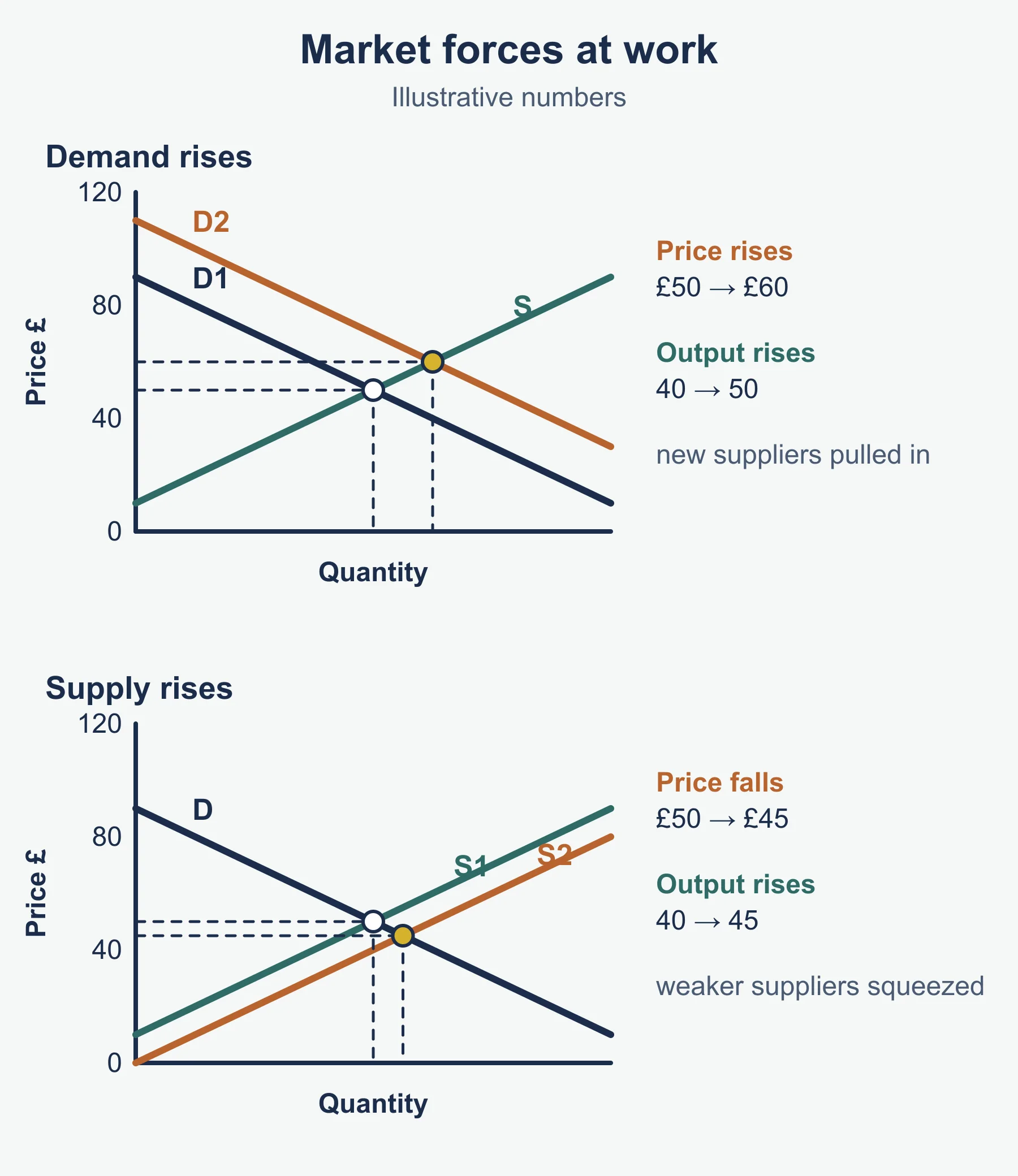
Market forces are the pressures of demand, supply and competition that set prices and output in a market, without a government or single firm deciding them. When demand rises, prices tend to rise and new suppliers are pulled in. When supply rises faster than demand, prices fall and weaker suppliers are squeezed.
Impact on a business. Market forces act on revenue (through price and volume), costs (through supplier prices) and strategy (through what rivals do). Impact depends on how many rivals there are, how different the product is and how easily customers can switch.
Impact on stakeholders. Customers gain from lower prices and wider choice. Employees gain from growth but face redundancy if the firm loses ground. Suppliers may be asked for lower prices. Shareholders gain if the firm adapts. Name the stakeholder and the direction of effect.
The dynamic nature of the market. Markets change: tastes shift, rivals enter, technology cuts costs and prices move. The extent to which a business is affected depends on how fast its market changes and how flexible the business is. A firm tied to a fixed product range is exposed; one that can change its range quickly is less so.
Competition at three levels. Local: a hairdresser competes with nearby salons. National: a supermarket competes with other chains. Global: a manufacturer competes with imports and exporters worldwide. The level that matters most depends on what customers will travel for or switch to.
Recommending a response. The specification asks you to recommend and justify. A sound answer picks one response (for example cutting costs, differentiating the product, entering a new channel or merging), links it to the data in the case, weighs the main risk and reaches a judgement.
Worked example 1: share falling while sales rise
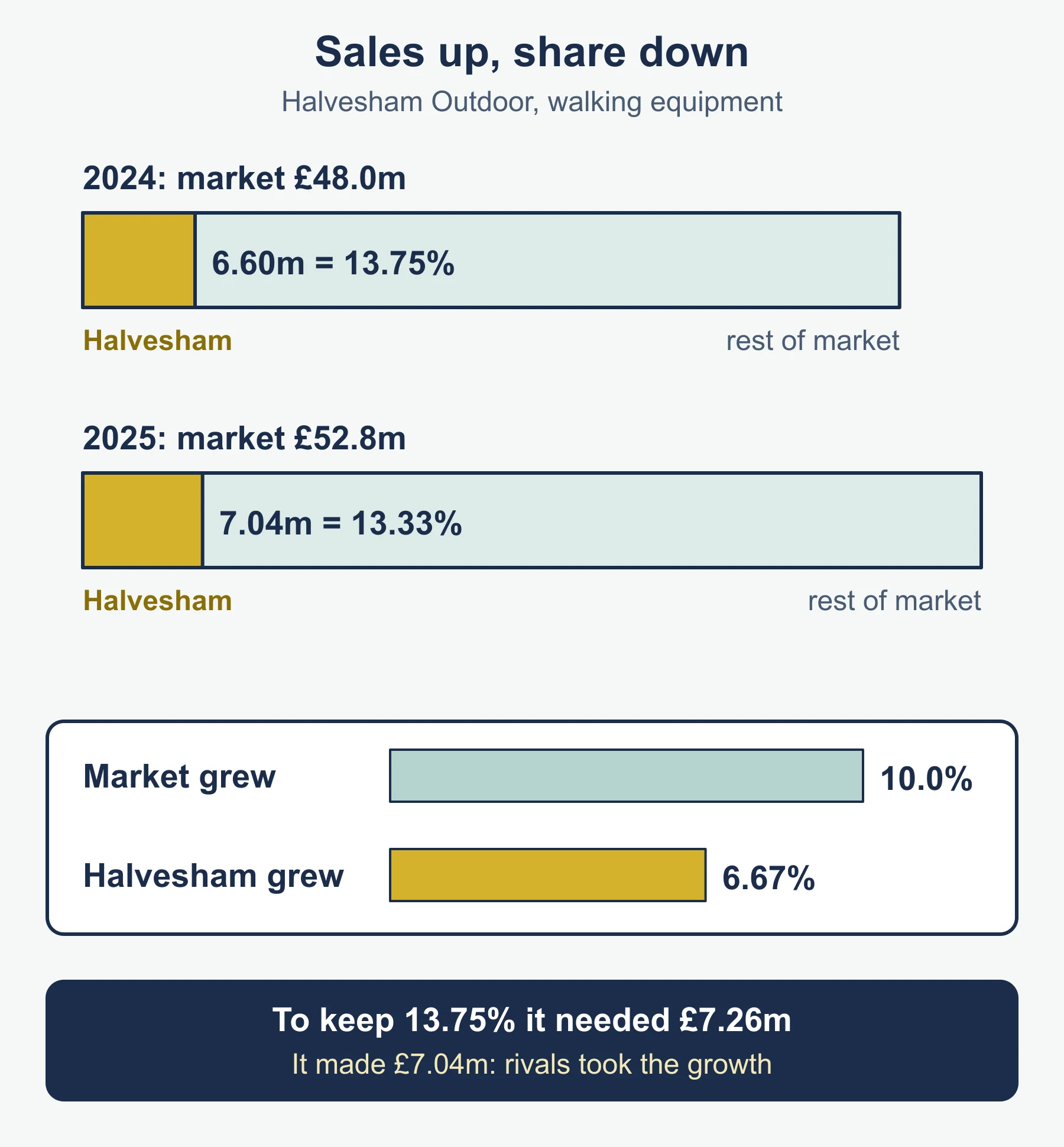
Halvesham Outdoor sells walking equipment. Its market was worth £48.0m in 2024 and £52.8m in 2025. Its own sales revenue was £6.60m then £7.04m.
- Market share = (business sales revenue ÷ total market sales revenue) × 100 (the standard form).
- 2024: 6.60 ÷ 48.0 × 100 = 13.75%.
- 2025: 7.04 ÷ 52.8 × 100 = 13.33% (to 2 d.p.).
- Market growth = (52.8 − 48.0) ÷ 48.0 × 100 = 10.0%. Own sales revenue grew by (7.04 − 6.60) ÷ 6.60 × 100 = 6.67%.
- To hold 13.75% the firm needed sales revenue of 13.75% × £52.8m = £7.26m.
Sales revenue rose, yet the firm lost share, because the market grew faster than the firm. That is a market force at work: rivals took the extra demand. A good answer asks why, and what Halvesham should do.
Physical and non-physical markets
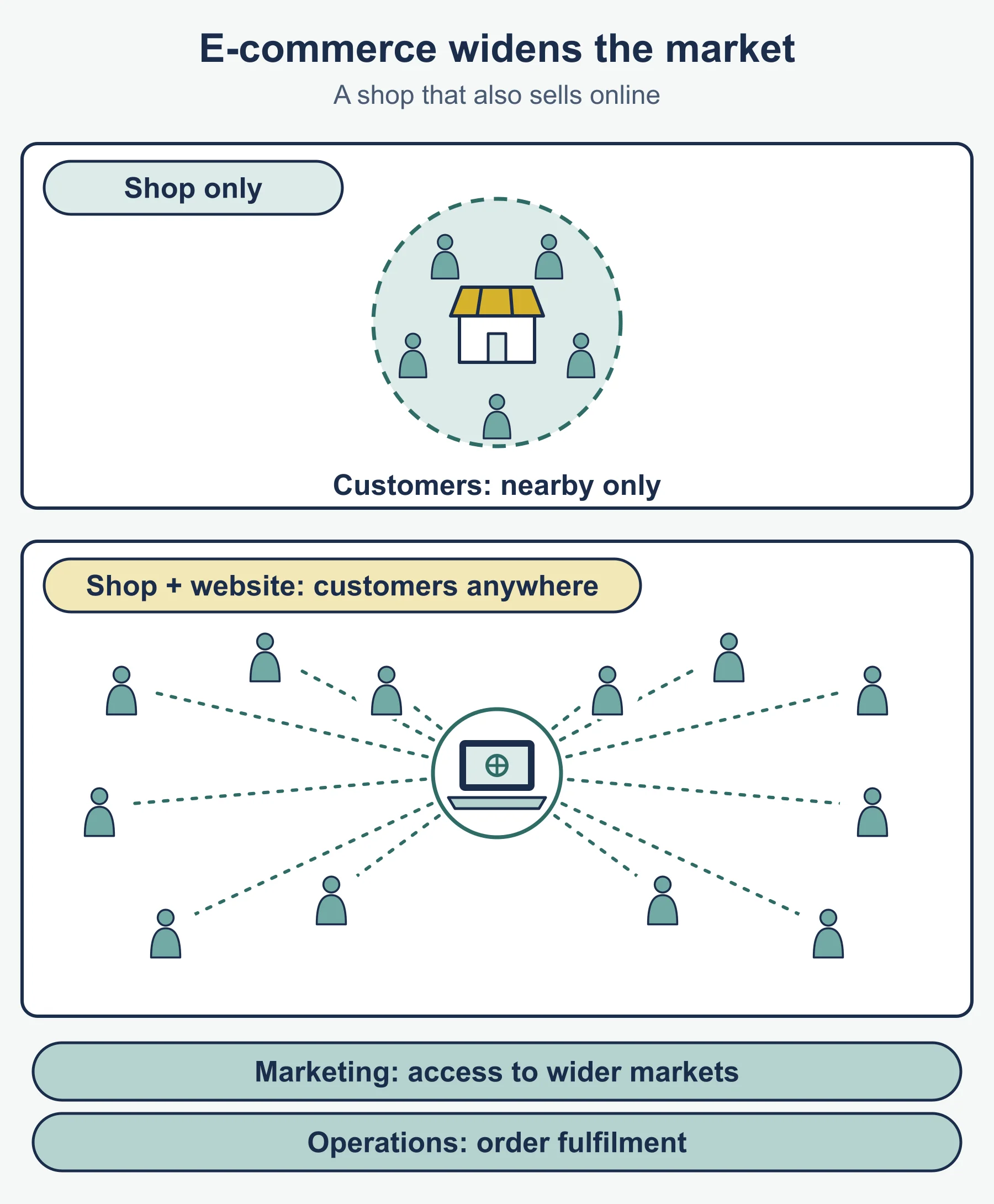
A physical market is one where buyers and sellers meet in a place: a high-street shop, a market stall, a showroom, a restaurant. A non-physical market has no shared place. Buyers and sellers deal by website, app, phone or other digital means. Online means trading through the internet, such as a website or an online marketplace. Digital is wider: it also covers digital products, such as downloads, streaming and software, and trading by app.
| Feature | Physical | Non-physical (online and digital) |
|---|---|---|
| Customer reach | Limited by location and opening hours | Wide, and open at any hour |
| Typical fixed costs | Rent, rates, fit-out, staff on site | Website, hosting, marketing, software |
| Typical variable costs | Stock | Stock plus delivery and returns |
| Customer experience | Touch, try, advice, immediate purchase | Convenience, comparison, wide range |
| Competition | Local rivals mainly | National or global rivals, easy price comparison |
| Risk | Footfall may fall | Weak search visibility, data and security problems |
Why firms choose one, the other or both. A firm may choose a physical market when customers want to see or try the product, when service is part of the offer (a restaurant, a garage) or when it wants a local reputation. It may choose non-physical when it wants a wider market, lower overheads or sells a digital product. Many firms use both, for example browse online and collect in store, but this costs more to manage.
Worked example 2: shop or website?
Keswold Cycles is considering a shop or a website for its flagship bike, priced at £240. The unit cost of the bike is £150.
| Shop | Website | |
|---|---|---|
| Fixed costs per month | £7,800 | £3,100 |
| Variable cost per bike | £150 | £150 + £18 delivery = £168 |
| Contribution per bike | £90 | £72 |
- Break-even output = fixed costs ÷ contribution per unit (the standard form).
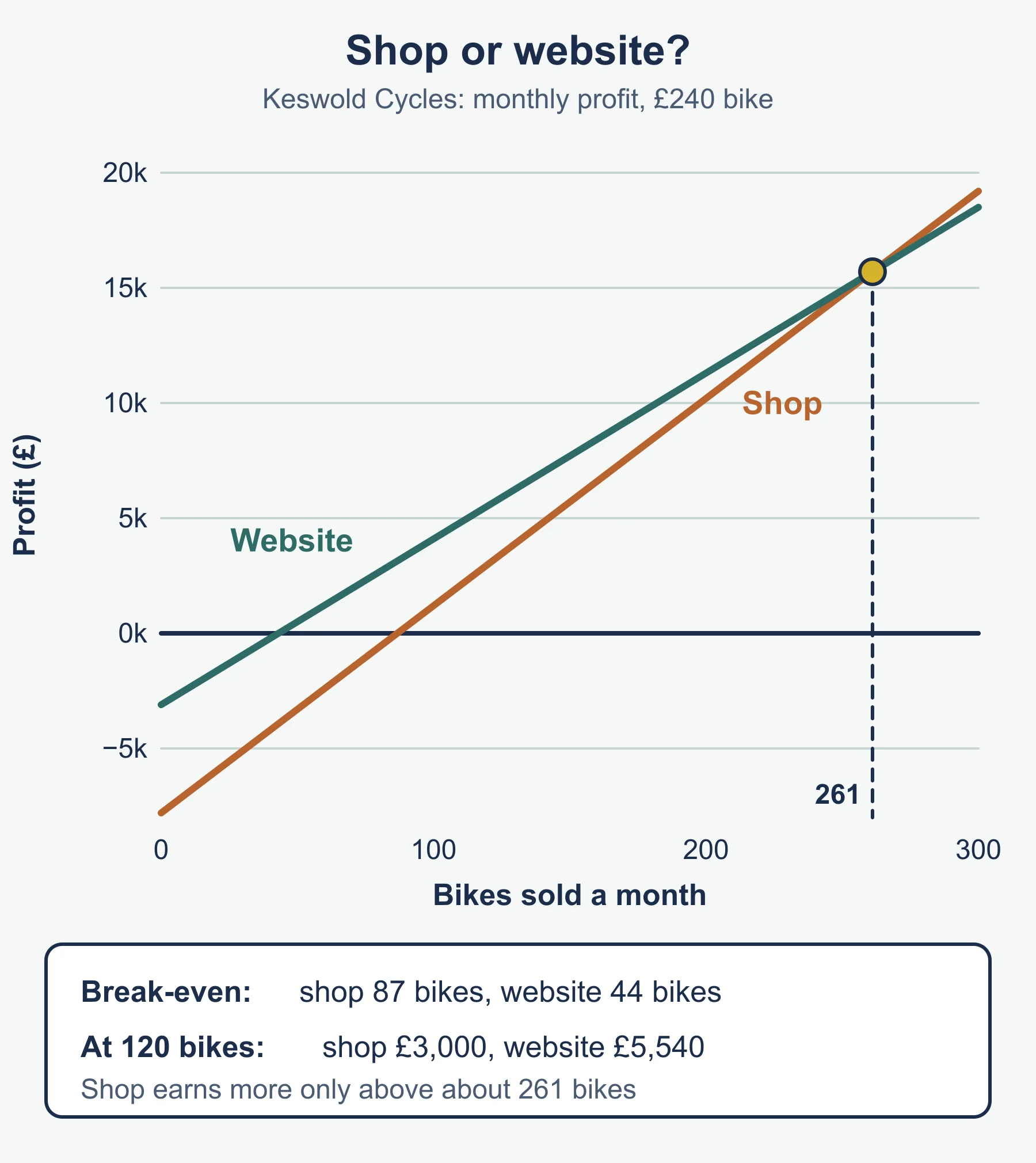
- Shop: 7,800 ÷ 90 = 86.67, so 87 bikes a month.
- Website: 3,100 ÷ 72 = 43.06, so 44 bikes a month.
- At 120 bikes: shop profit = 120 × 90 − 7,800 = £3,000; website profit = 120 × 72 − 3,100 = £5,540.
- The two give equal profit where 90q − 7,800 = 72q − 3,100, so q = 4,700 ÷ 18 = 261 bikes (to the nearest whole bike). Above that volume the shop earns more.
At modest volumes the website wins on cost. But the sum ignores demand: a website needs customers to find it, and a shop might sell more bikes to people who want a test ride. The figures are a starting point for judgement, not the answer.
Competition
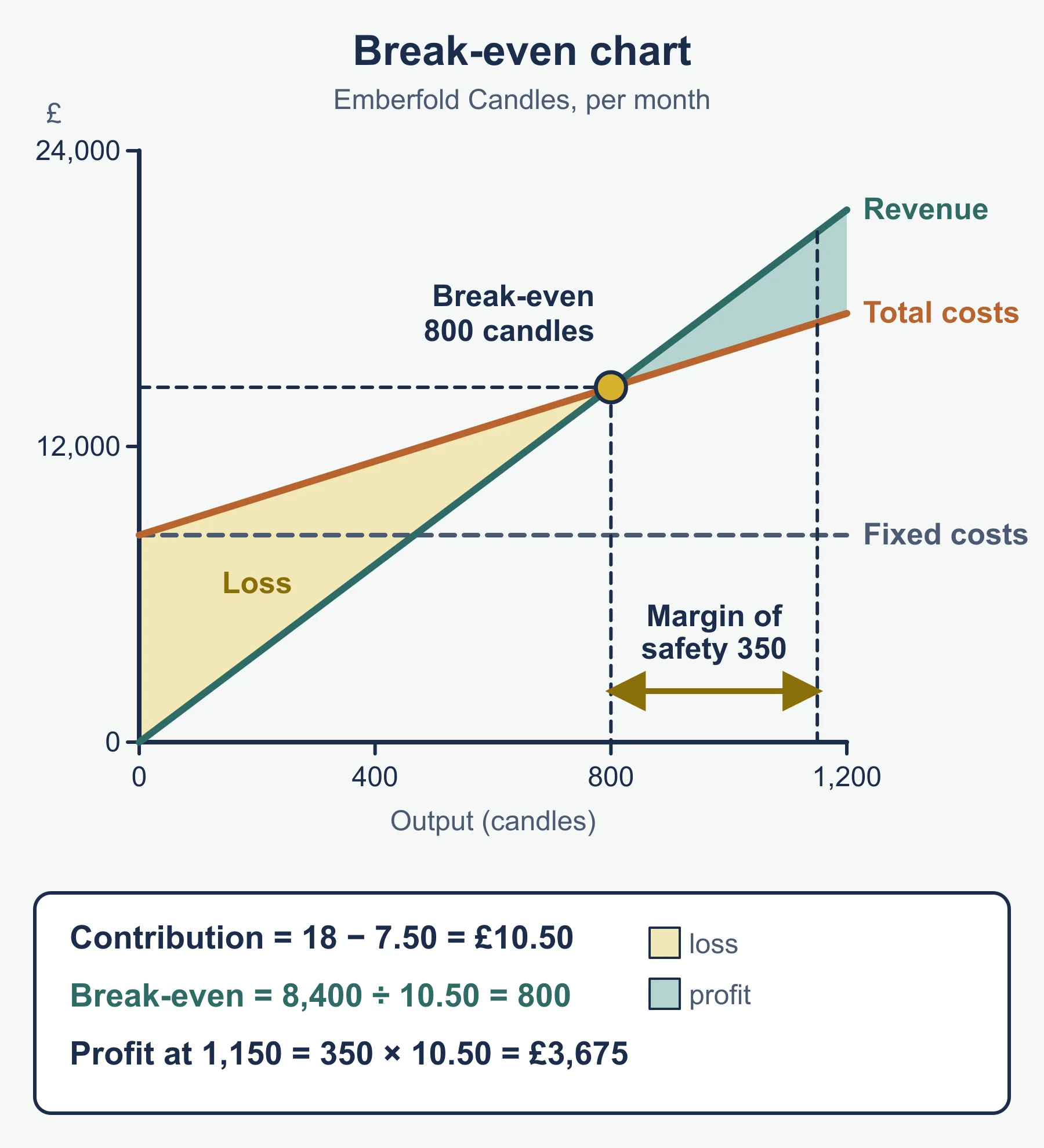
Competition is rivalry between businesses selling similar products to the same customers. It can be on price, quality, service, range, brand or convenience.
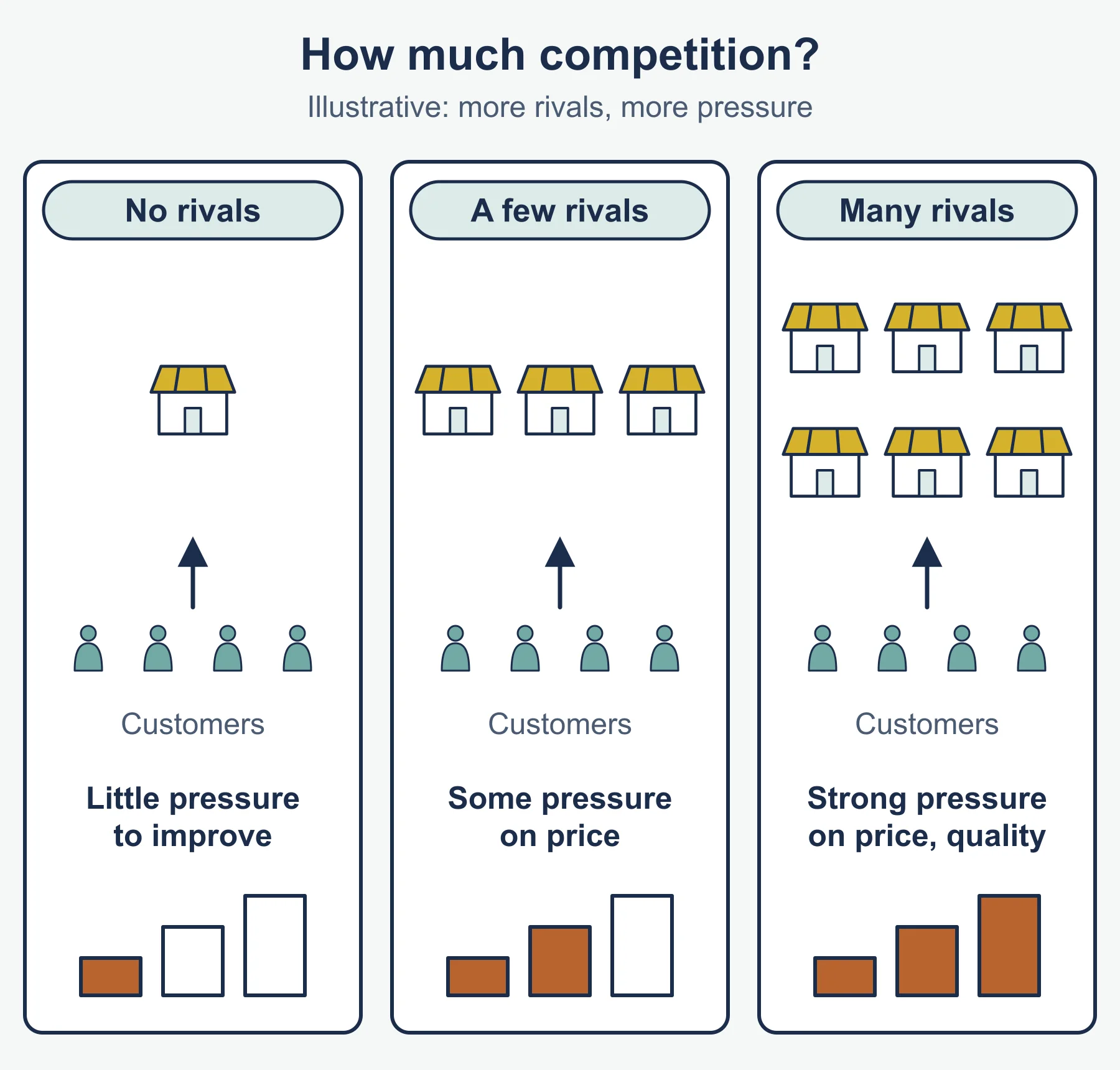
How strength of competition affects a business. Strong competition pushes prices down, raises the need to spend on marketing and innovation, and squeezes profit margins. It may force a business to cut costs or leave the market. Weak competition gives more pricing freedom but can make a firm less efficient. The strength of competition depends on the number and size of rivals, how similar their products are, how easily customers switch, and how easily new firms can enter.
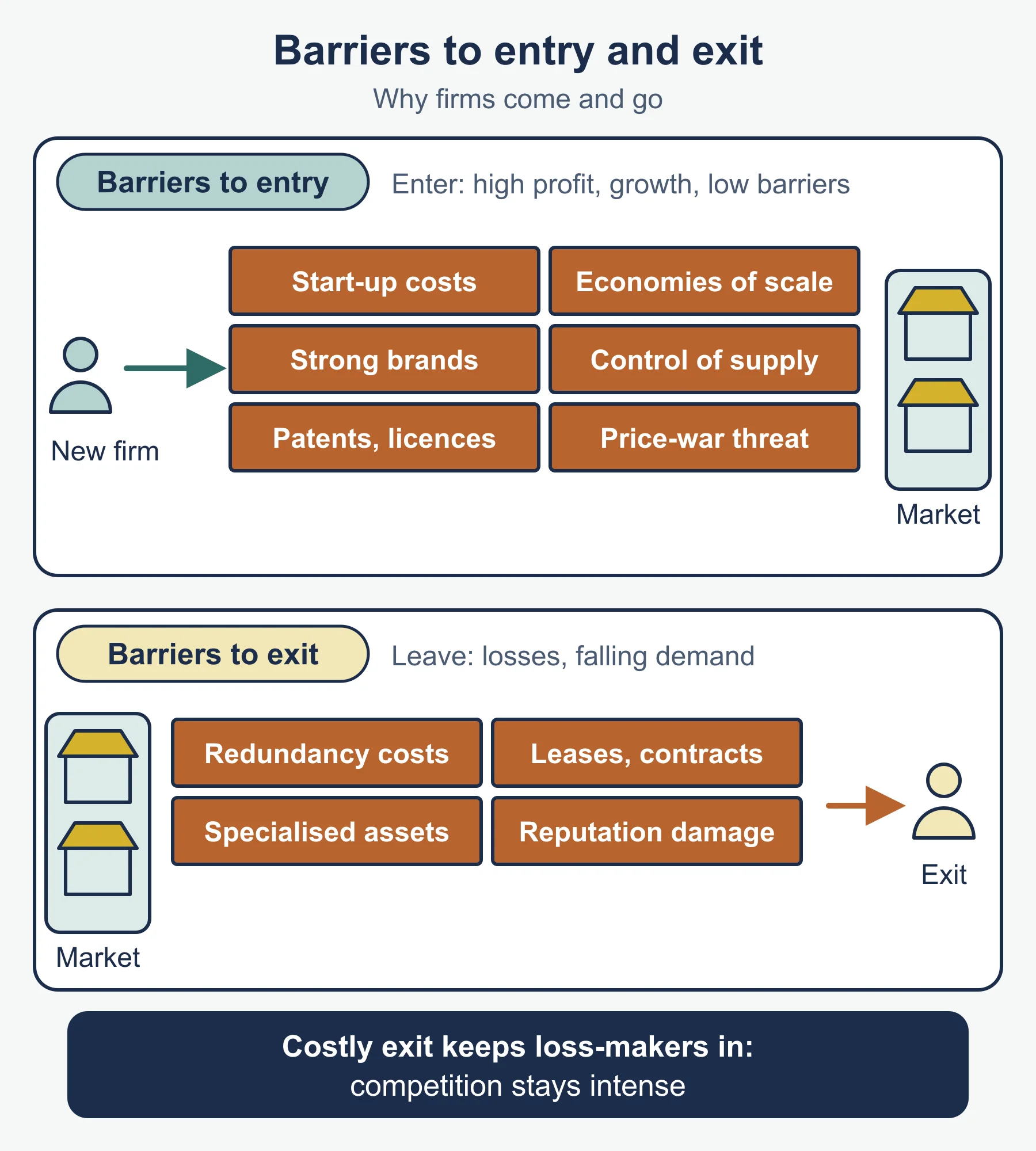
Why firms enter a market. Reasons include high profit levels, fast market growth, low barriers to entry, a new product idea, and spreading risk.
Why firms exit a market. Reasons include losses, falling demand, intense competition, an owner retiring, and a better use of resources elsewhere.
Barriers to entry make it hard for new firms to join a market: high start-up costs, economies of scale enjoyed by existing firms, strong brands and customer loyalty, control of supply or distribution, patents and licences, and the threat of a price war from existing firms. Barriers to exit make it costly to leave: redundancy costs, long leases or contracts, specialised assets that are hard to sell, and the damage to reputation. When exit is costly, firms may stay in a loss-making market and keep competition intense.
Impact of competition. On the business: lower prices, higher costs, pressure to innovate. On stakeholders: customers gain choice and lower prices; employees may face lower pay or job loss in losing firms; suppliers may be squeezed; shareholders see profit shift. On the market: more innovation and efficiency, but also possible failures and fewer firms over time.
Market dominance
Market dominance exists when one firm (or a very small group) holds so large a share of a market that it has real power over prices, output and rivals’ options. A monopoly is a market with a single supplier, or in practice a firm with a very large share. Size alone is not dominance: a large firm in a market with low barriers to entry may have little power.
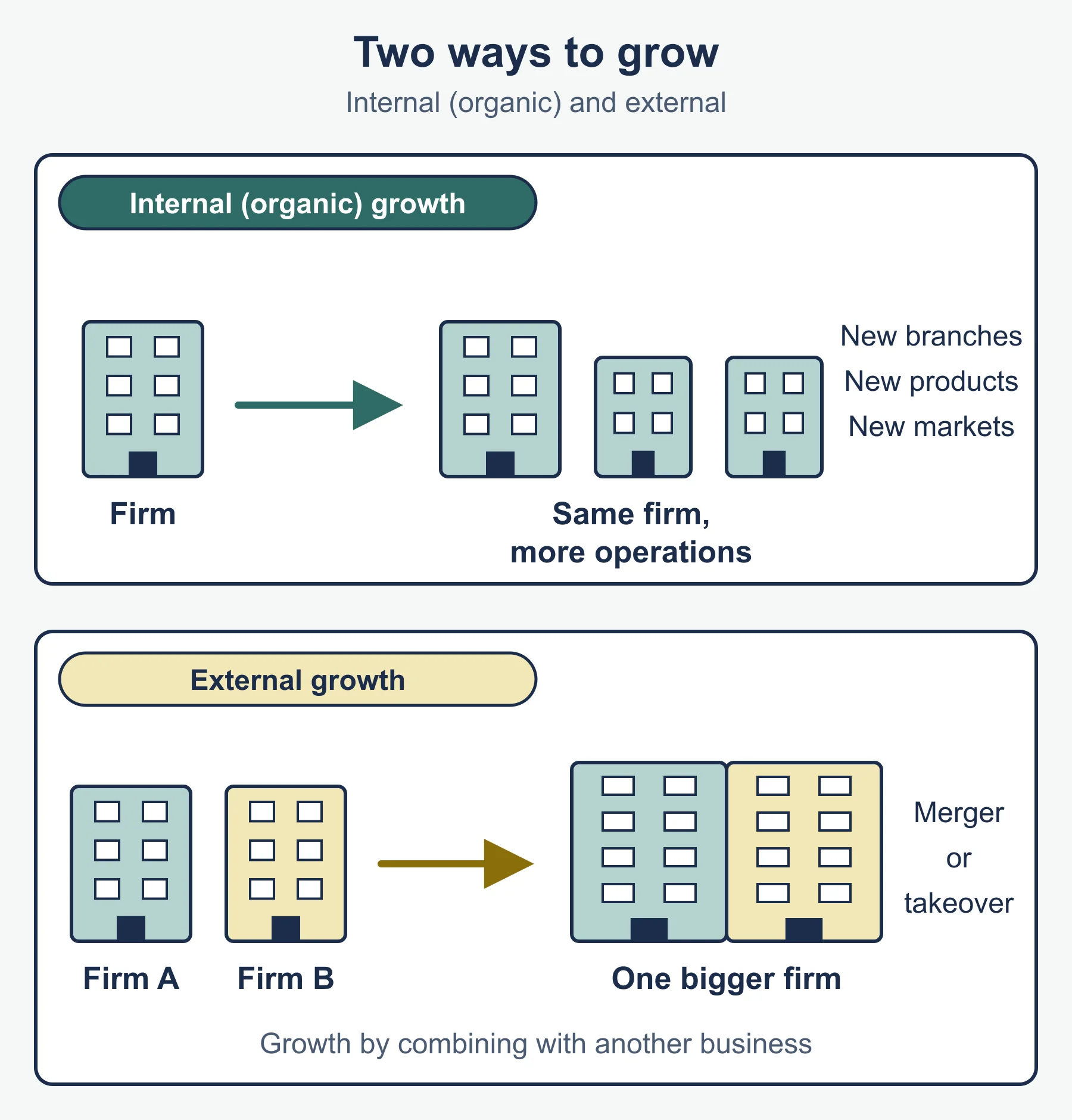
Ways to grow:
- Organic growth is growth from a firm’s own resources: new products, new outlets, more customers, reinvested profit. It is slower but avoids integration problems.
- A merger is an agreed joining of two firms into a single business.
- An acquisition (or takeover) is when one firm buys control of another. It may be agreed or opposed by the target’s board.
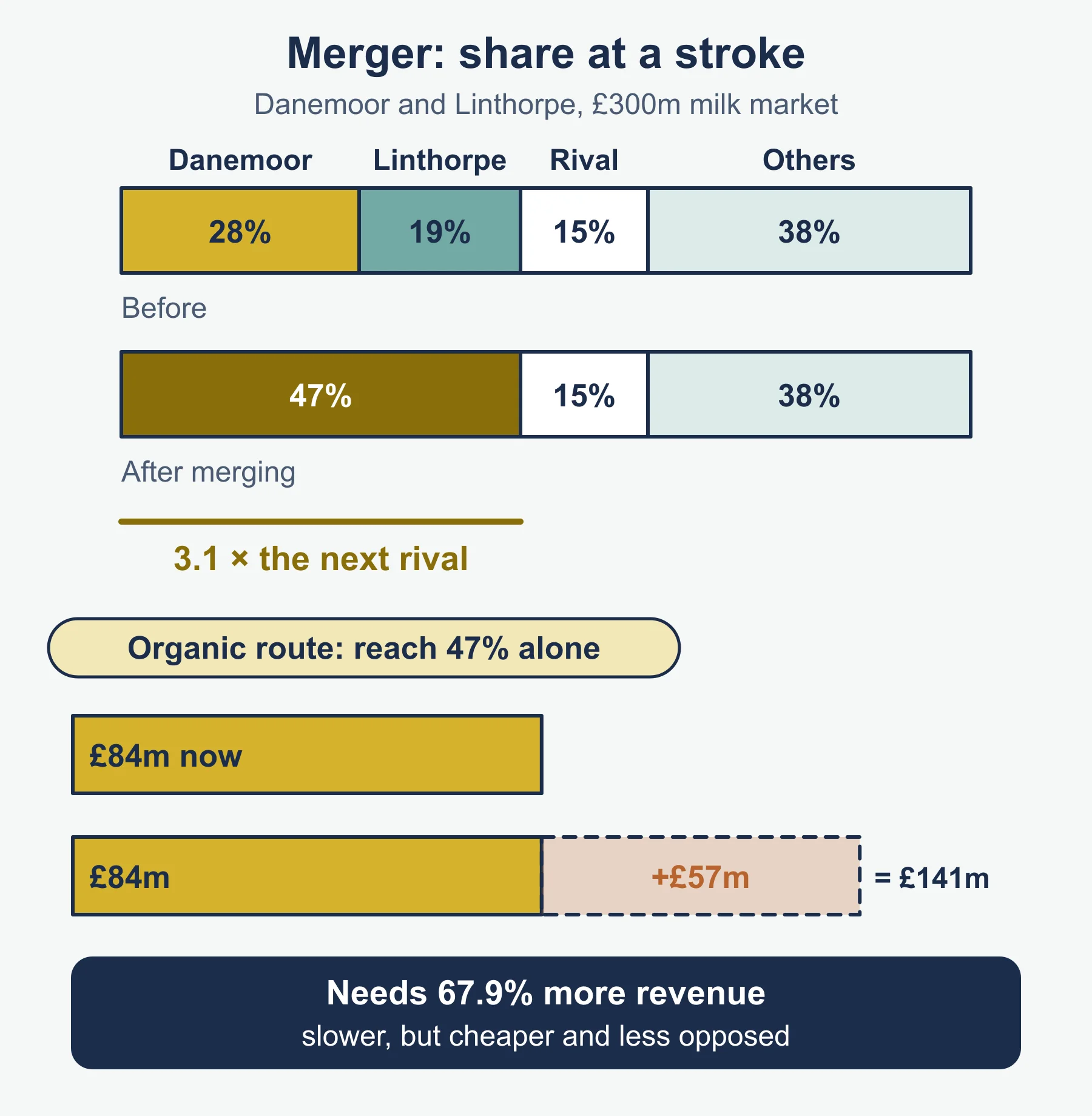
How growth creates dominant firms. Organic growth builds share steadily through a strong product, brand and efficiency. Mergers and acquisitions create share at a stroke, because the combined firm takes both shares and removes a rival. They can also bring economies of scale.
Worked example 3: merger or organic growth?
Danemoor Dairy has 28% and Linthorpe Dairy 19% of a regional milk market worth £300m. The next largest rival has 15%.
- Combined share = 28% + 19% = 47%, which is about 3.1 times the next rival (47 ÷ 15 = 3.13).
- Danemoor’s sales revenue now is 28% × £300m = £84m. A 47% share would be £141m.
- To reach that organically it would need extra revenue of £57m, a rise of 57 ÷ 84 × 100 = 67.9%, assuming the market stays at £300m.
The merger gives immediate scale, but the firm faces integration costs and possible regulatory attention, because the combined share is large. Organic growth is slower, but cheaper and less likely to be opposed.
Impact of a dominant firm on other businesses. Rivals may face price pressure or a threat of price cutting. Suppliers may depend on one buyer, which can force prices down. Customers may face higher prices and less choice, but sometimes gain from lower prices thanks to scale economies. Small firms may be driven out or find a niche.
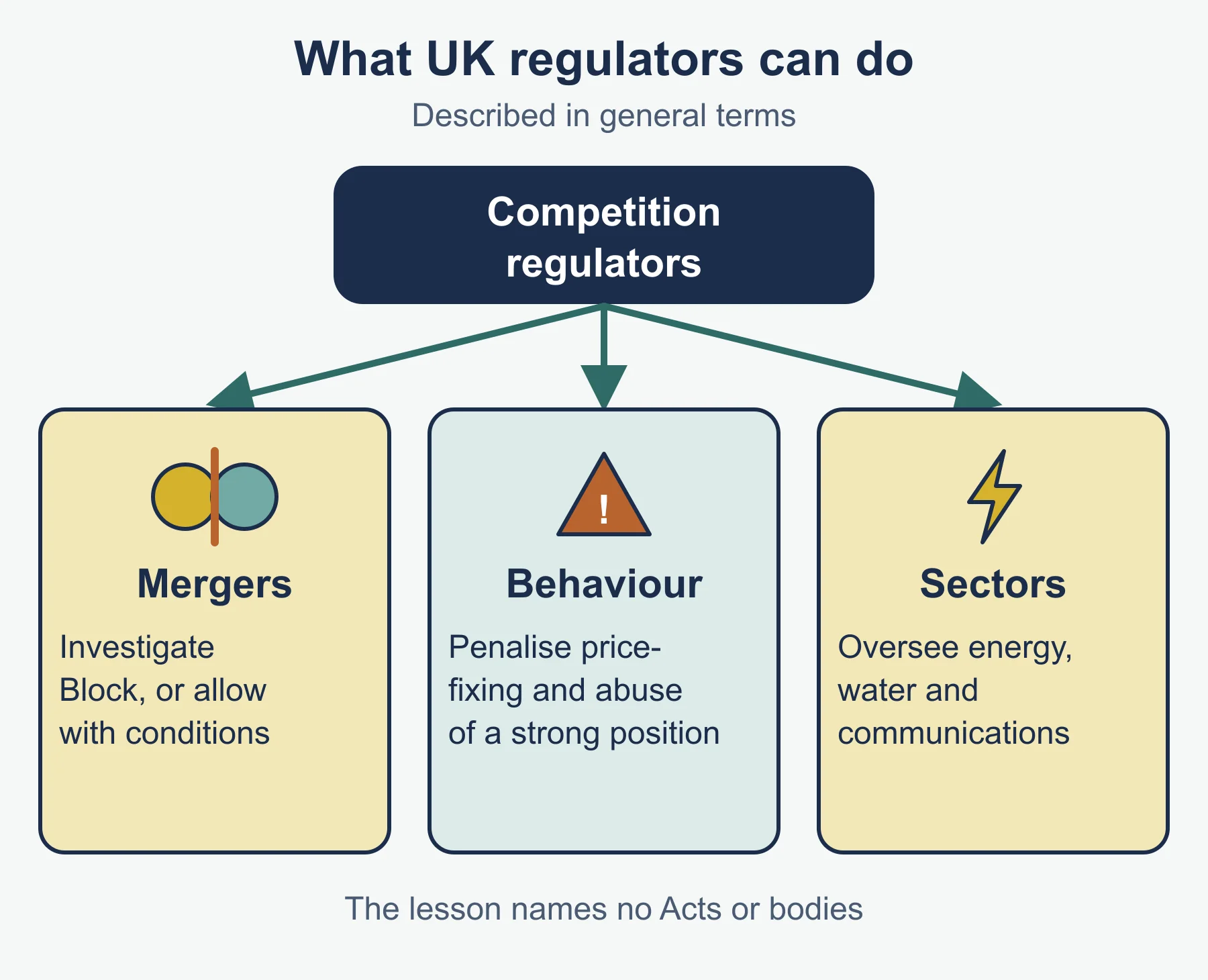
How dominance is restricted and regulated in the UK. In general terms, the government and independent regulators set the competition rules. The specification does not name bodies or Acts, so you need not. As general knowledge outside the specification, the main UK competition authority is the Competition and Markets Authority (CMA). Regulators can investigate mergers and block them or allow them with conditions; investigate and penalise anti-competitive behaviour such as price-fixing or abusing a strong position; and sector regulators oversee industries such as energy, water and communications. Keep your description general.
Impact and importance of regulation. For a dominant firm: limits on growth by merger, compliance costs and fines. For smaller rivals: protection and fairer access. For customers: protection from unfair prices, but possibly higher prices if useful mergers are blocked. Regulation can also slow decisions and add cost, so judge its importance by the harm it prevents.
Common errors
- Treating online as the same as digital, or assuming non-physical is always cheaper.
- Saying barriers to entry only mean “high costs”.
- Treating dominance as simply being big.
- Describing regulation by inventing Acts or limits. Describe it in general terms.
- Describing impact without a judgement.
Frequently asked questions
What are market forces? Market forces are the pressures of demand, supply and competition that set prices and output in a market, without a government or single firm deciding them.
What is the difference between a physical and a non-physical market? A physical market is one where buyers and sellers meet in a place, such as a shop or showroom. A non-physical market has no shared place: buyers and sellers deal by website, app, phone or other digital means.
What is the difference between a merger and an acquisition? A merger is an agreed joining of two firms into a single business. An acquisition, or takeover, is when one firm buys control of another, which may be agreed or opposed by the target’s board.
Why do firms enter or exit a market? Firms enter for reasons such as high profits, fast market growth, low barriers to entry or spreading risk. They exit because of losses, falling demand, intense competition, an owner retiring or a better use of resources elsewhere.
Does the OCR H431 specification require calculations for market forces? No calculations are listed for this content. Market share is still the clearest way to show a business gaining or losing ground, so it is often used in examples.
Official syllabus
OCR, OCR Level 3 Advanced GCE in Business (H431) Specification, Version 2.1 (January 2026), External influences: Market forces; Physical and non-physical markets; Competition; Market dominance.
Get free revision emails (optional)
Occasional emails with practice questions, worked explanations and links to free resources for the qualification and subjects you choose. No spam, and you can unsubscribe from any email. The free tools on this site never need an email.
Related resources
-
Practice questions
OCR A Level Business: Market forces, physical and non-physical markets, dominance (H431) – Practice Questions
Original OCR A Level Business H431 practice questions with worked answers on market forces, physical and non-physical markets, competition and dominance.
Business · OCR · A Level
Try questions -
Revision notes
OCR A Level Business: Market forces, physical and non-physical markets, dominance (H431) – Revision Notes
Condensed OCR A Level Business H431 revision notes on market forces, physical and non-physical markets, competition, mergers and market dominance.
Business · OCR · A Level
Revise topic -
Study guides
OCR A Level Business: Political, economic, social and technological factors and related topics (H431)
Study guide to political, economic, social, technological, digital, ethical, legal and environmental factors for OCR A Level Business H431.
Business · OCR · A Level
Read guide
Related articles
-
teaching
A Level tuition in Dubai: Cambridge or Pearson Edexcel International A Level?
Schools in Dubai and Abu Dhabi teach either Cambridge International AS & A Level or Pearson Edexcel International A Level. How the two are structured, why it matters for tuition, and how online classes from Lahore work.
9 October 2026
-
curriculum guides
Choosing subjects at IGCSE and A Level
How subject choices at 14 and 16 affect university options later, and how to keep pathways open without overloading a timetable.
28 July 2026
Studying this with a teacher
Working through Business A LEVELS?
This page is free and stays free. If you would rather be taught it, Marlbridge runs Business classes one-to-one, online in your own time zone. One-to-one only for this course: Rs 6,000 per class in Pakistan, with other currencies on the fees page. The first trial class is free. WhatsApp replies within an hour (8am–11pm Pakistan time, every day); email the same day.
OCR Business teachers at Marlbridge
