
Study Guides
OCR A Level Business: Global context, international trade, the EU and emerging markets (H431)
Study guide to globalisation, global brands, international trade, exchange rates, free trade, the EU and emerging markets for OCR A Level Business H431.
- Subject
- Business
- Level
- A LEVELS
- Topic
- External influences facing businesses
- Author
- Marlbridge Academic Team
- Updated
- Reviewed by
- Salman Ahmad (what this means)
Aligned to OCR A Level Business (H431), Version 2.1 (January 2026), for first assessment in 2017; final assessment summer 2027. Official specification .
Syllabus page (what it covers and how it is assessed): OCR A Level Business.
Syllabus points this page covers
H431
- 2.4 Global context, international trade, the EU and emerging markets
Found an error? Report a correction.
Need help with this topic? Request a free trial class for A Level Business (H431).
This guide covers the content headed Global context, International trade and free trade, The European Union and Emerging markets and the global environment in the OCR A Level Business (H431) specification, Version 2.1 (January 2026), within the area of study External influences facing businesses. Read the wider External influences study guide first.
Related: revision notes, practice questions, the general External influences revision notes, the External influences practice set, the OCR A Level Business hub, the printable checklist and the free diagnostics.
What the specification asks for
| Content heading | You must be able to |
|---|---|
| Global context | globalisation, facilitators, multinationals, global strategy, global brands, opportunities and threats, a recommended response |
| International trade and free trade | trade, barriers, factors, exchange rates and conversion, support, free trade, trading blocs |
| The European Union | enlargement, single currency, the UK outside the EU, Eurozone and Single European Market, where to expand |
| Emerging markets and the global environment | emerging markets, global changes and a response |
The specification says content may be assessed in any context, so link these ideas to marketing, operations and finance.
Background, not specification wording: the barrier list, UK Export Finance, the EU and euro descriptions, and the conversion rule.
Globalisation
Globalisation is the growing integration of the world’s economies, markets, cultures and businesses, so that goods, services, money, information and people move across borders more freely and what happens in one country affects others.
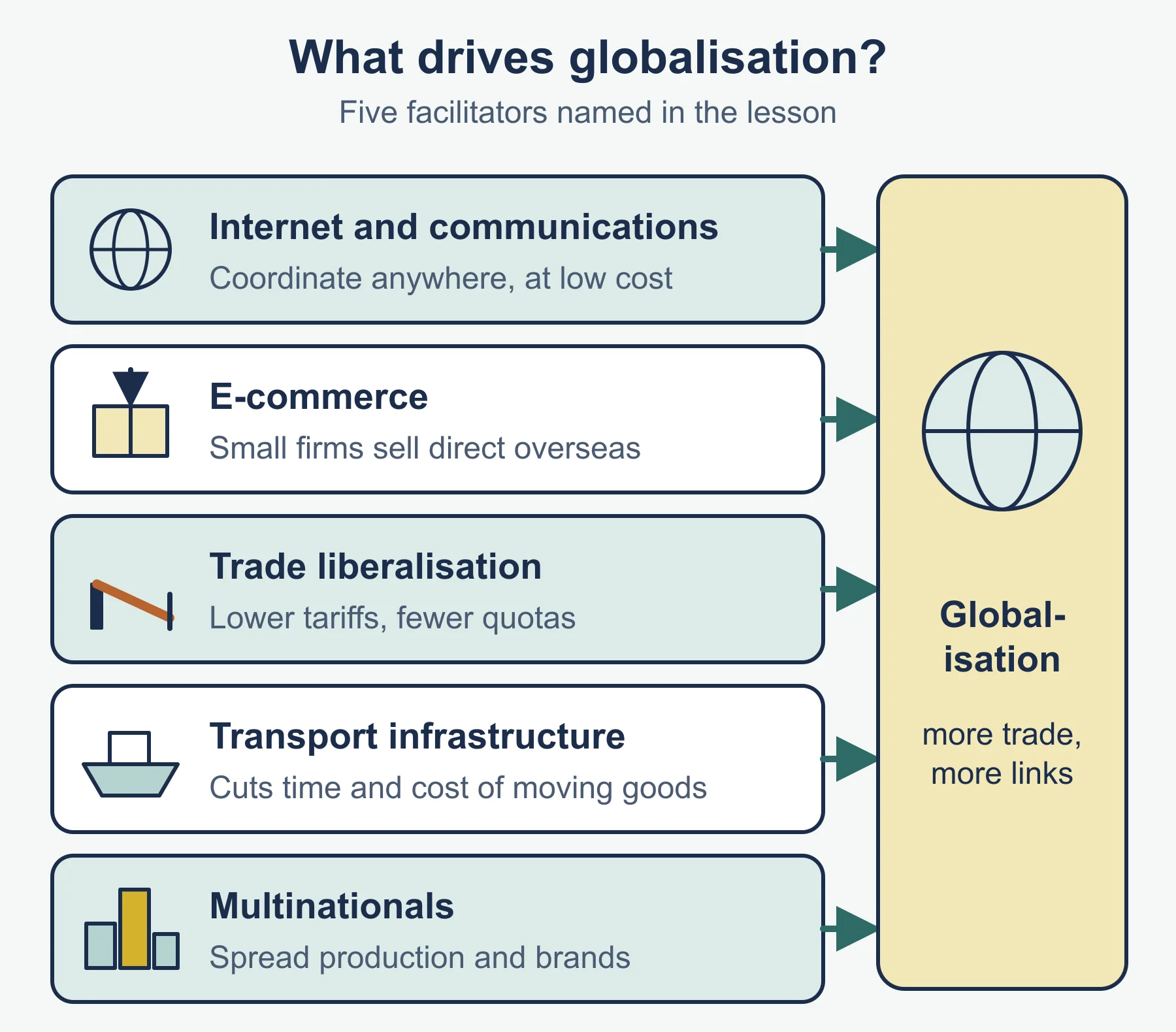
Factors that facilitate globalisation (all six are named in the specification):
- The Internet and communication technologies let firms coordinate suppliers, staff and customers anywhere at low cost.
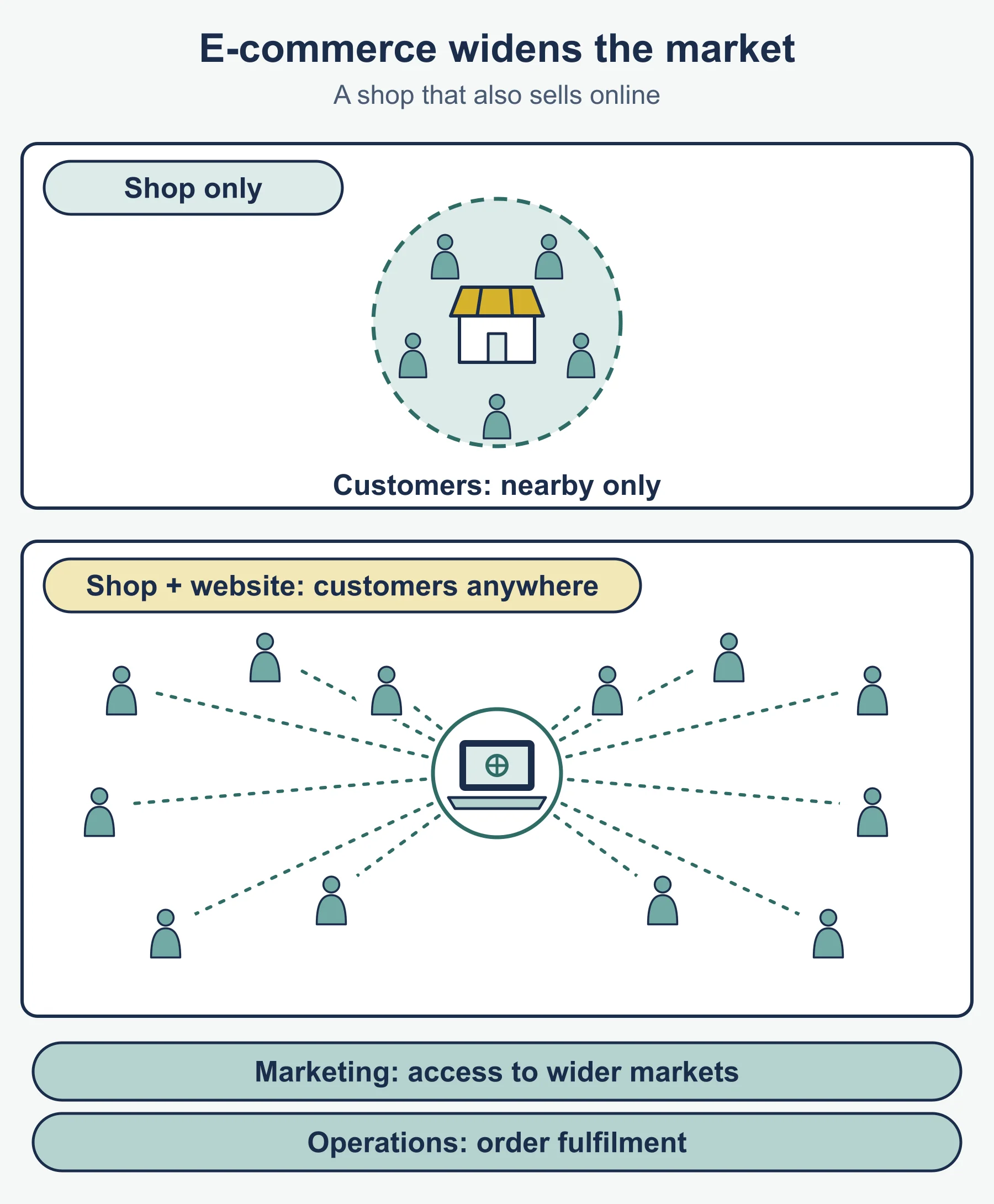
- E-commerce lets even a small firm sell directly to overseas buyers without a shop or local distributor.
- Trade liberalisation means lower tariffs and fewer quotas, which makes imports and exports cheaper to arrange.
- Transport infrastructure cuts the time and cost of moving goods.
- Multinationals operate in several countries, spreading production, brands and technology.
Why some businesses are more affected than others. The effect depends on how much a firm buys from abroad, sells abroad or competes with overseas rivals. A bakery buying local flour for local customers is less exposed than a clothing retailer sourcing fabric from three continents. Size, resources, price-sensitive customers and imported inputs also matter.
The role of multinationals. A multinational (multinational company) is a business with operations in more than one country. They drive globalisation by moving capital and technology, locating production where costs are lowest, spreading global brands and creating supply chains that tie countries together. Evaluation: they bring investment, jobs, tax revenue and choice to host countries, but they can drive out small local firms, move production when conditions change, and use their bargaining power against suppliers and governments.
Global strategy versus globalisation. Globalisation is something that happens in the business environment, outside any one firm’s control. A global strategy is a deliberate plan by one business to operate across world markets, for example selling a standardised product everywhere or entering several countries in sequence. A firm can be affected by globalisation without any global strategy.
Opportunities and threats.
- Opportunities: bigger markets, cheaper inputs, economies of scale, spread of risk.
- Threats: stronger overseas competitors, exchange rate exposure, supply chain disruption, copying and pressure on prices.
Recommending a response. A “recommend and justify” answer chooses one course and defends it against alternatives. Typical responses: stay local and differentiate, source globally, export, adapt products, or build a global strategy.
Global branding
A global brand is one recognised and sold under the same or a similar identity in many countries, such as a sportswear or soft-drink brand.
Opportunities from the rise in global brands (for a business): a global brand can lend its owner scale, lower marketing cost per customer and trust that helps entry into new markets.
Threats: global brands may offer lower prices through scale, spend heavily on promotion, win shelf space and customer loyalty, and push local firms into niches. Local firms can respond with authenticity and personal service.
International trade
International trade is the buying and selling of goods and services between countries: exports are sold abroad, imports are bought from abroad.
Reasons for international trade: countries and firms lack some resources and products; specialising lowers cost; larger markets give economies of scale; buyers get more choice; firms find growth when the home market is saturated.
Relationship with globalisation. Globalisation increases international trade (cheaper transport, communication and e-commerce, lower barriers), and more trade in turn deepens globalisation by linking supply chains and consumers.
Barriers to international trade
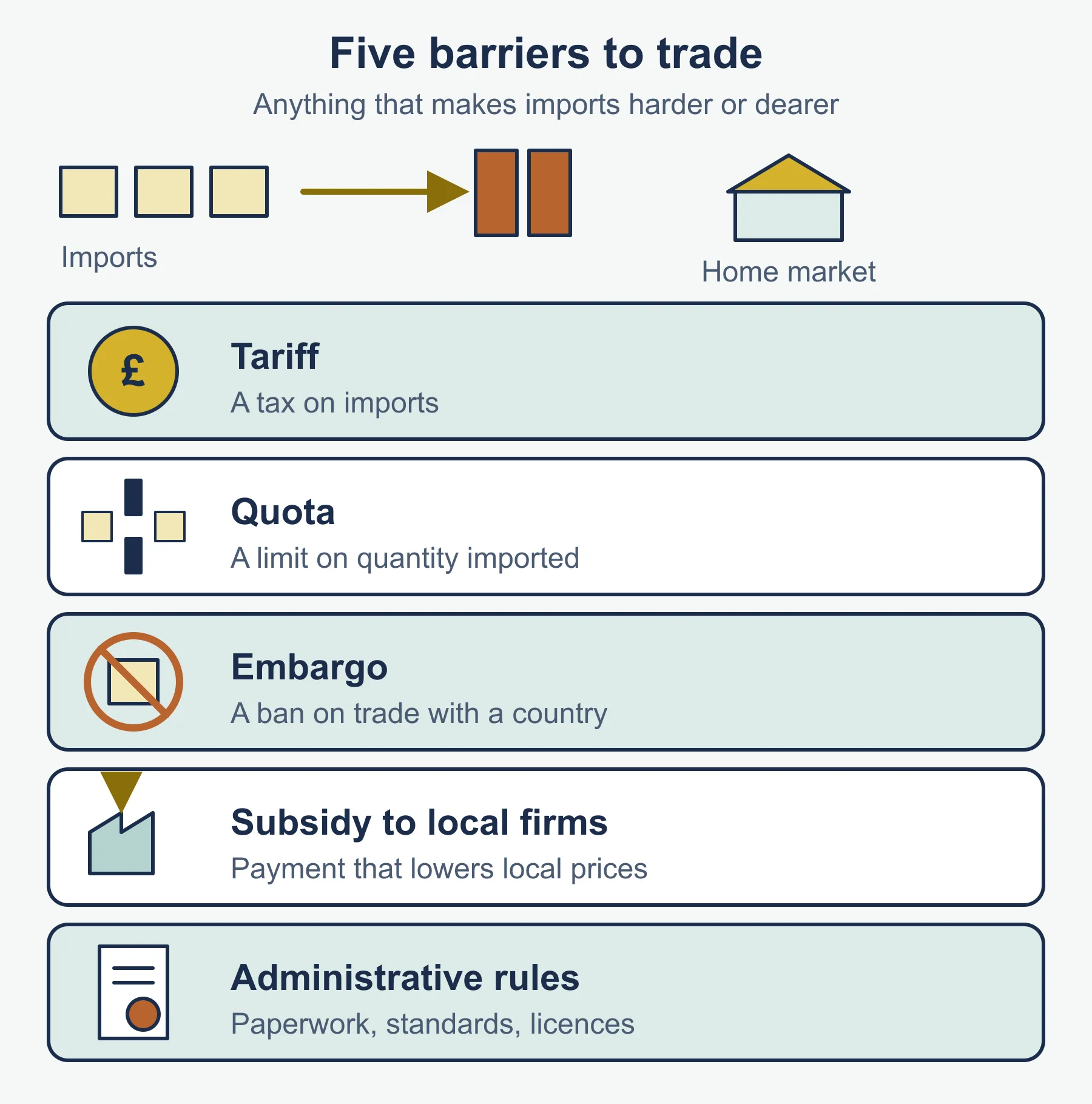
A barrier to trade is anything that makes imports harder or dearer to sell in a country. Their nature is the form they take; their purpose is why a government uses them.
| Barrier | Nature | Typical purpose |
|---|---|---|
| Tariff | a tax on imports | raise government revenue; make imports dearer than local goods |
| Quota | a limit on the quantity imported | protect domestic producers and jobs |
| Embargo | a ban on trade with a country | political or security aims |
| Subsidy to domestic firms | payment that lowers local prices | help local firms undercut imports |
| Administrative or technical rules | customs paperwork, product standards, licences | protect consumers, or slow imports |
Factors when trading internationally
Evaluate each for the specific product and country:
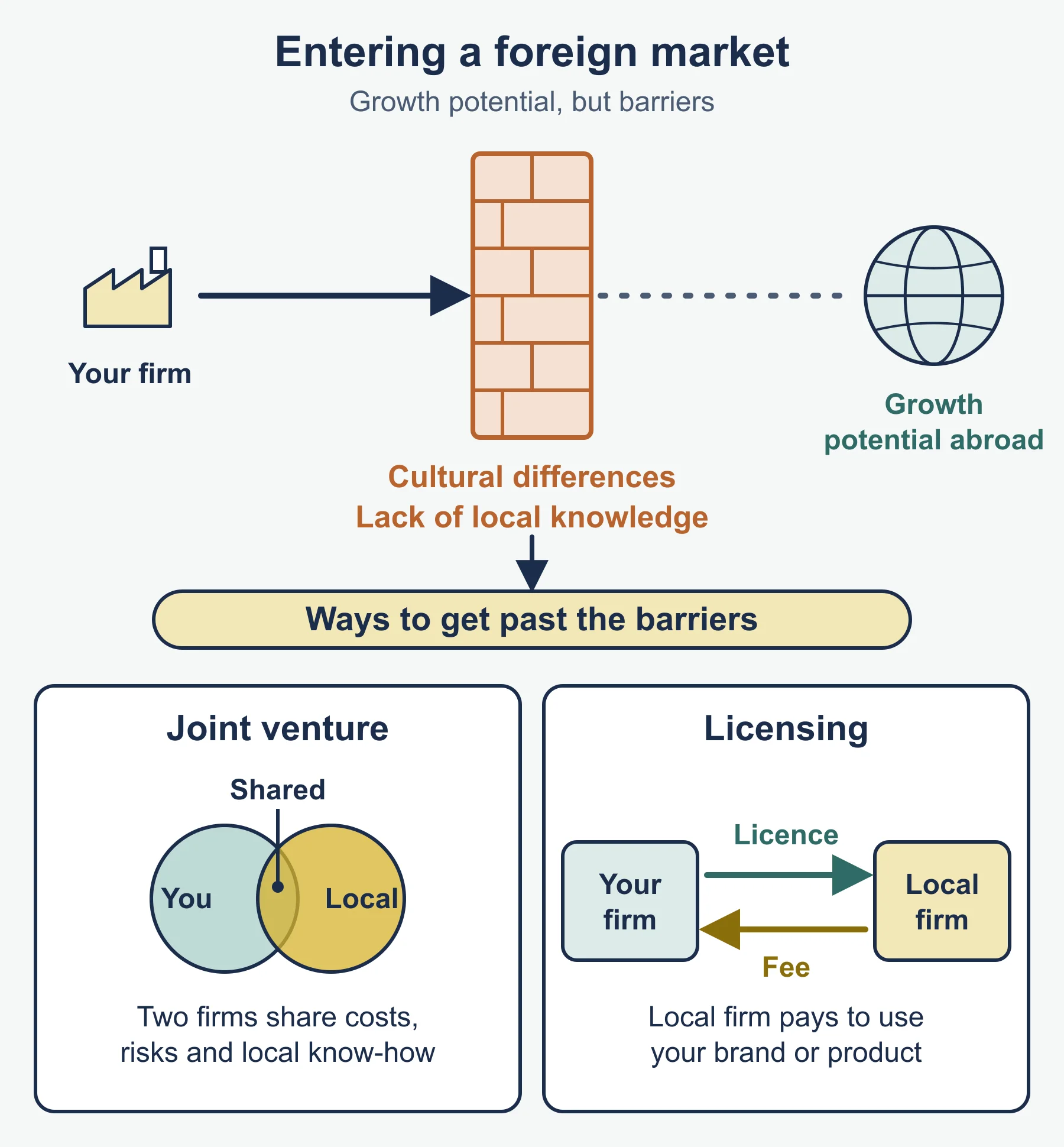
- Language: translated packaging, website and contracts.
- Culture and customs: attitudes to colour, religion, gifts, negotiation style and business etiquette.
- Logistics: transport mode, time, cost, insurance, customs clearance and storage.
- Currency: pricing in which currency, and exposure to exchange rate movements.
- Buying habits: how people shop (online, markets, supermarkets), what they pay, and seasonal or brand preferences.
Sources of support for international traders
Financial: export credit insurance or guarantees (the UK government’s export credit agency is UK Export Finance), bank trade finance such as letters of credit and overdrafts, and government grants where available.
Non-financial: government trade advice and market information, trade missions and fairs, chambers of commerce and trade associations, market research, and local agents and distributors.
Exchange rates
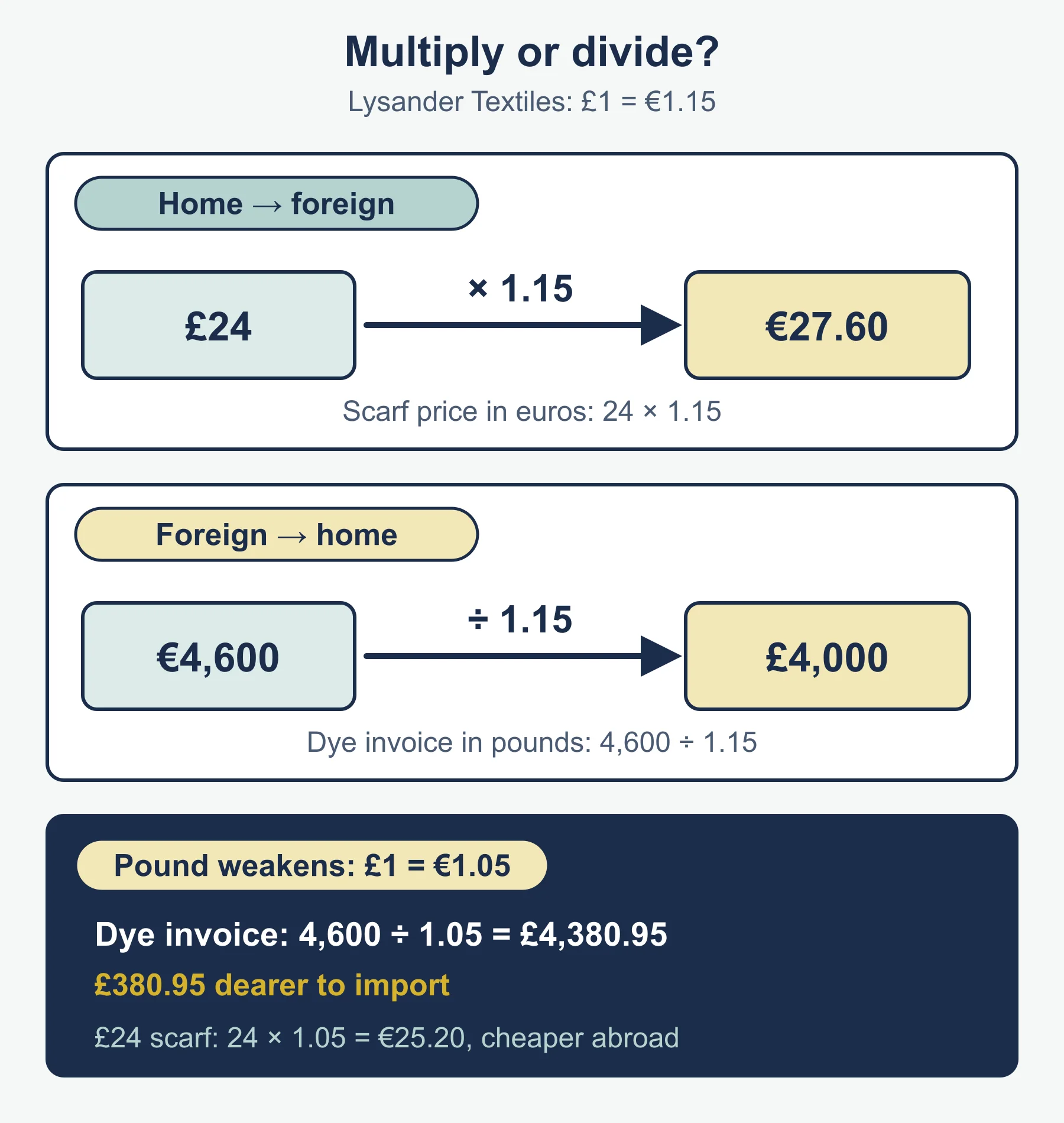
An exchange rate is what one unit of a currency costs when paid for in another currency. If £1 = €1.15, one pound buys 1.15 euros.
- To convert from home currency to foreign currency: multiply by the rate (foreign units per £1).
- To convert from foreign currency to home currency: divide by the rate.
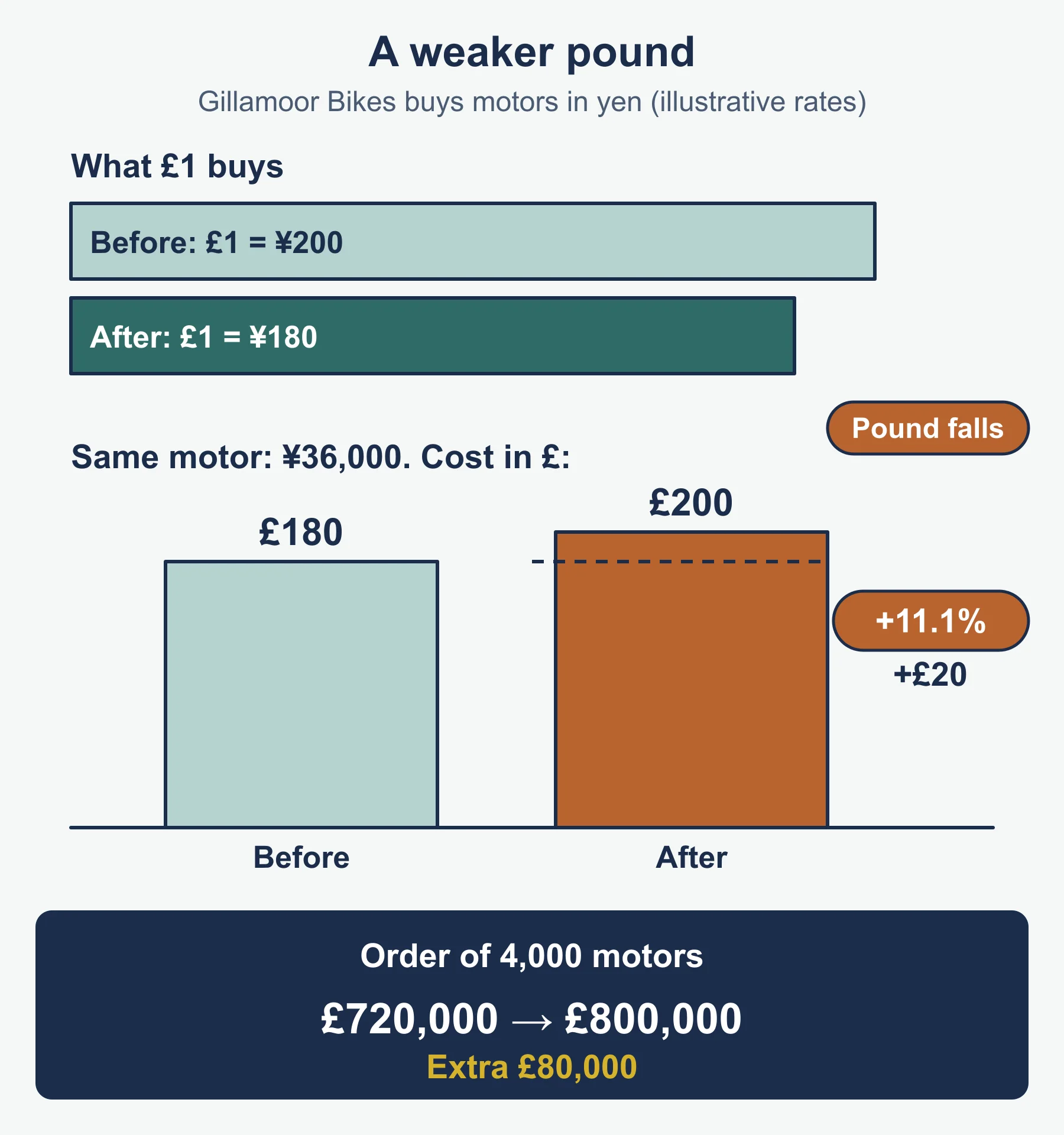
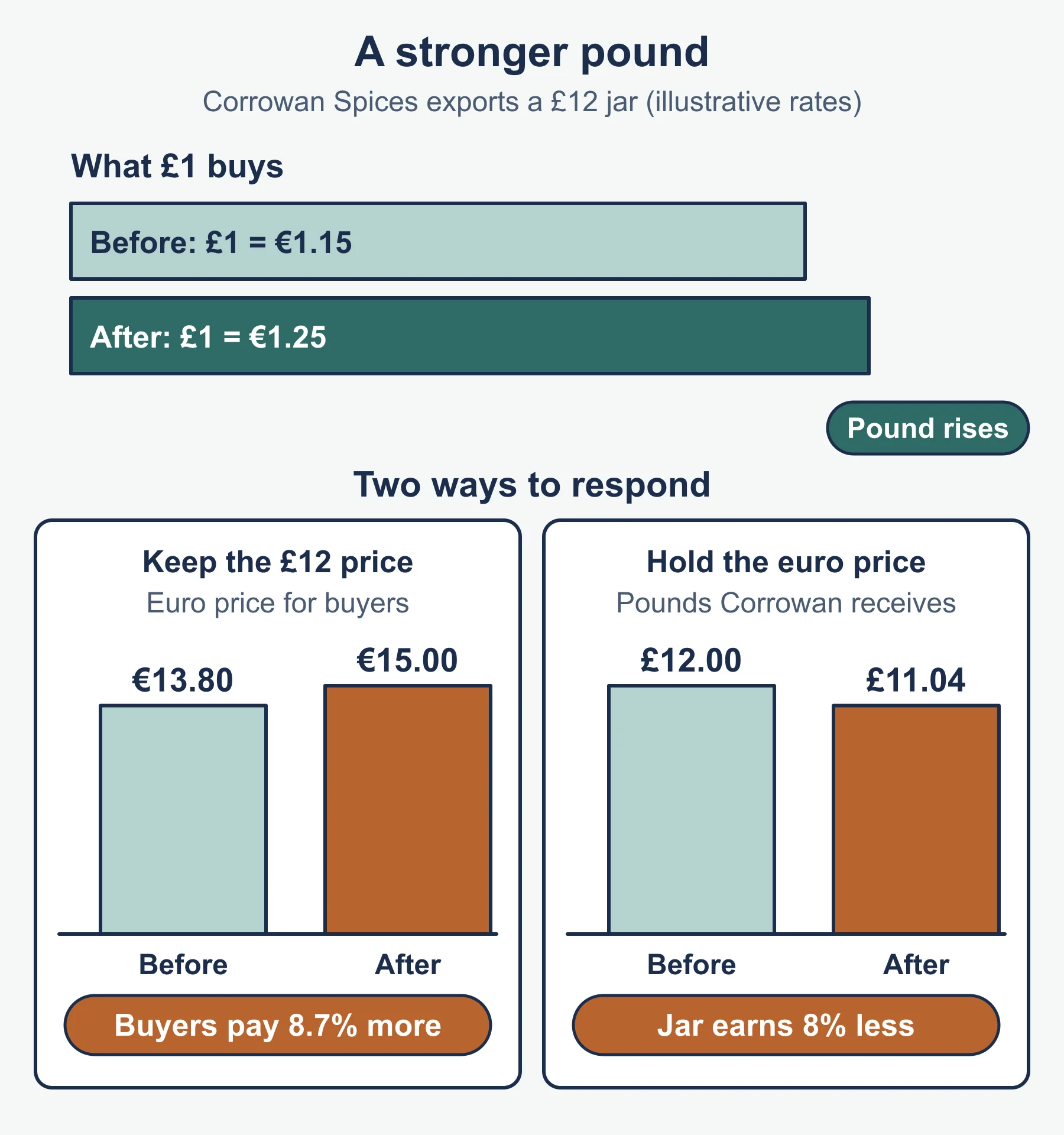
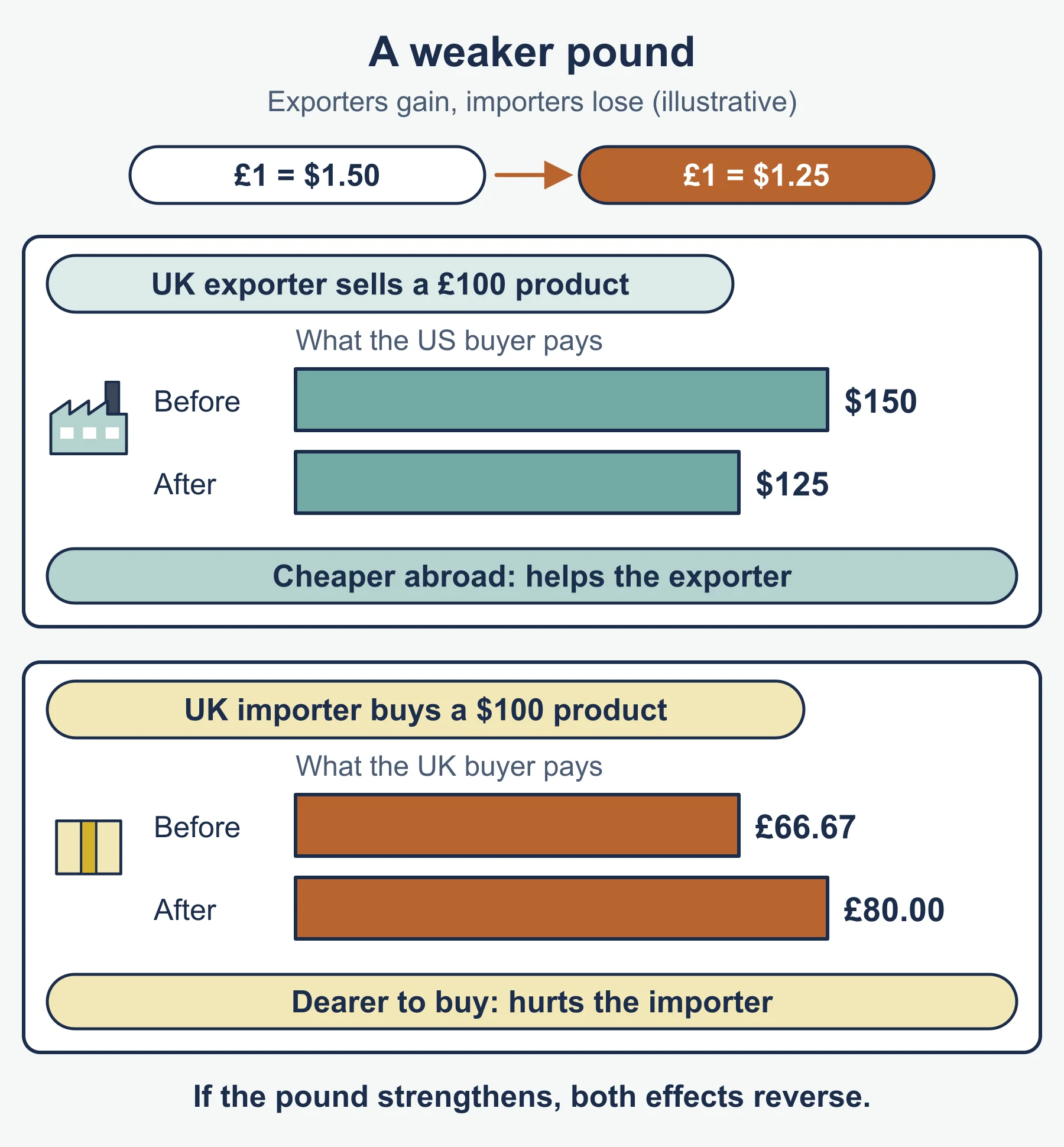
- When the pound rises (appreciation), it buys more foreign currency; when it falls (depreciation), it buys less.
Worked example (Lysander Textiles). Lysander, a UK firm, sells scarves in the Eurozone and buys dye from a supplier invoicing in euros. The rate is £1 = €1.15.
- A scarf priced at £24 sells for 24 × 1.15 = €27.60.
- A dye invoice of €4,600 costs 4,600 ÷ 1.15 = £4,000.
- A €50,000 export contract is worth 50,000 ÷ 1.15 = £43,478.26.
The pound weakens to £1 = €1.05.
- The dye invoice now costs 4,600 ÷ 1.05 = £4,380.95, which is £380.95 more.
- The €50,000 contract is now worth £47,619.05, which is £4,140.79 more.
- If the scarf stays at £24, its euro price falls to 24 × 1.05 = €25.20, so it is cheaper for EU buyers. To keep earning €27.60, Lysander could charge £26.29 (27.60 ÷ 1.05).
Impact on a business and its stakeholders. A weaker home currency helps exporters (cheaper abroad, more revenue in home currency) but raises import costs. A stronger currency does the opposite. Shareholders see profit change, employees may gain or lose jobs, customers see price changes, foreign suppliers gain or lose volume. Evaluate by size and timing: contracts agreed in advance cushion short-term changes.
Free trade and trading blocs
Free trade is trade between countries without tariffs, quotas or other barriers.
- Advantages to a business and stakeholders: bigger markets, cheaper imports and inputs, more competition that pushes efficiency, more choice for consumers, and economies of scale.
- Disadvantages: stronger overseas rivals, job losses in unprotected industries, pressure on wages and standards, dependence on foreign suppliers.
A trading bloc is formed when countries agree to lower or scrap trade barriers among members, and often share common rules or a common external tariff.
- Advantages to a business trading within a bloc: tariff-free access to members, simpler rules and paperwork, bigger market and more secure supply chains.
- Disadvantages: more competition from member firms, rules set by the bloc, possible higher costs of buying from non-members because of the shared external barriers, and loss of national flexibility.
The European Union
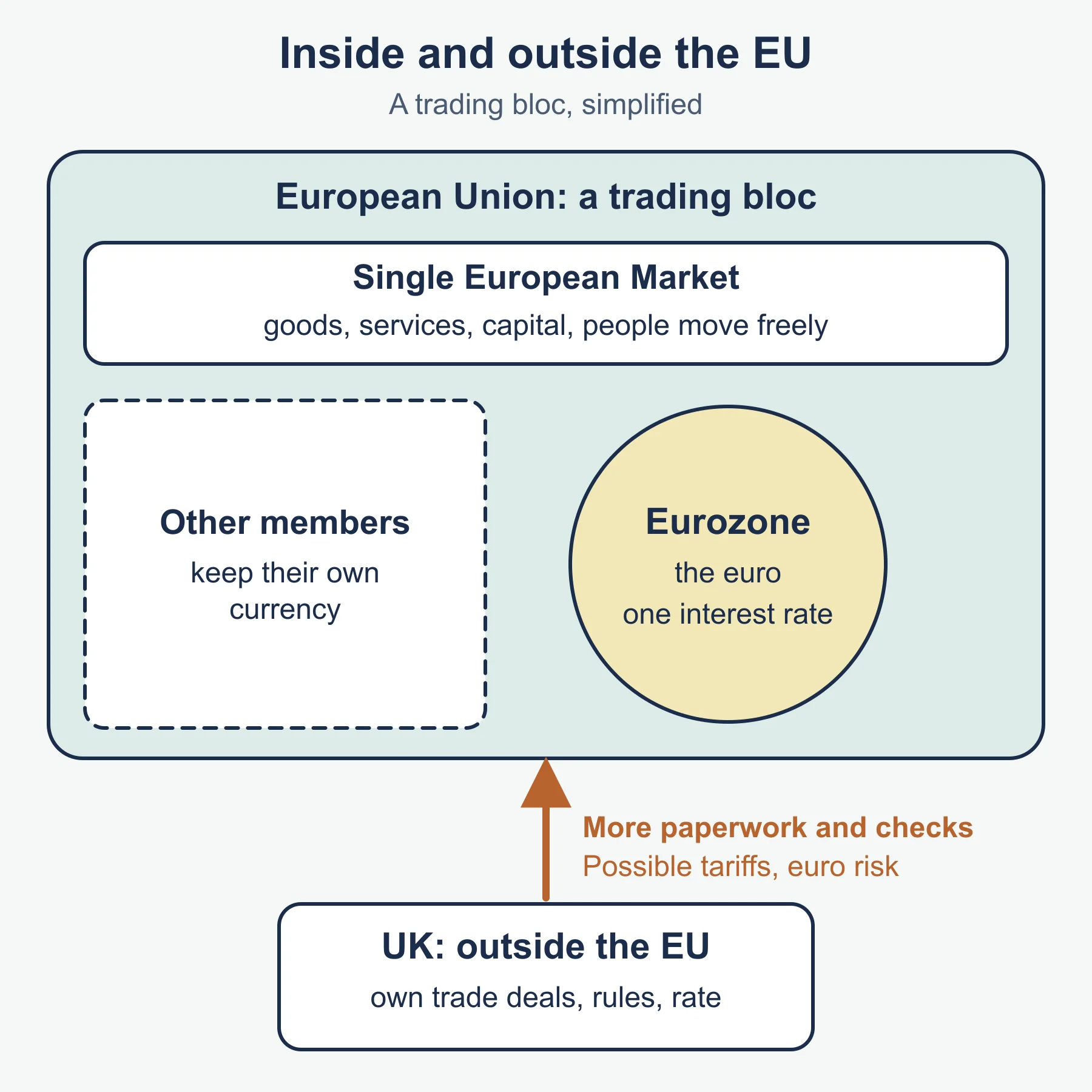
The European Union (EU) is a trading bloc of European countries. Its Single European Market allows goods, services, capital and people to move between members largely freely. Some members use a single European currency, the euro, and together form the Eurozone.
Influence on a business. For a business inside the market, enlargement (new members joining) adds customers, labour and suppliers and extends the same rules to more countries, but it also adds competitors, often with lower costs. The single currency removes exchange rate risk and conversion costs between members and makes prices easy to compare, but members share one central interest rate, which may not suit every economy, and a firm cannot gain from its own currency weakening.
The UK not in the EU and the Eurozone. Advantages: freedom to set its own trade deals, its own regulations and its own interest rate; no obligation to follow Eurozone monetary policy. Disadvantages: more paperwork and checks when selling to EU members, possible tariffs, exchange rate risk when selling in euros, and less influence over EU rules. Current UK-EU arrangements change, so check your teacher’s materials.
The UK not in the Single European Market. Advantage: choice over rules, such as product standards and employment rules. Disadvantage: the firm loses frictionless access and may need separate documentation, certification or local subsidiaries for sales into the EU.
Recommend and justify: expand into European and/or global markets? Compare the nearby EU market (close, large, similar standards, but more paperwork than before) with global markets (potentially faster growth but greater distance, cultural difference and currency risk). Base the choice on product, resources and customers.
Emerging markets and the global environment
An emerging market is a country whose economy is growing fast and industrialising, with rising incomes and a growing middle class, but which is not yet as developed or stable as advanced economies.
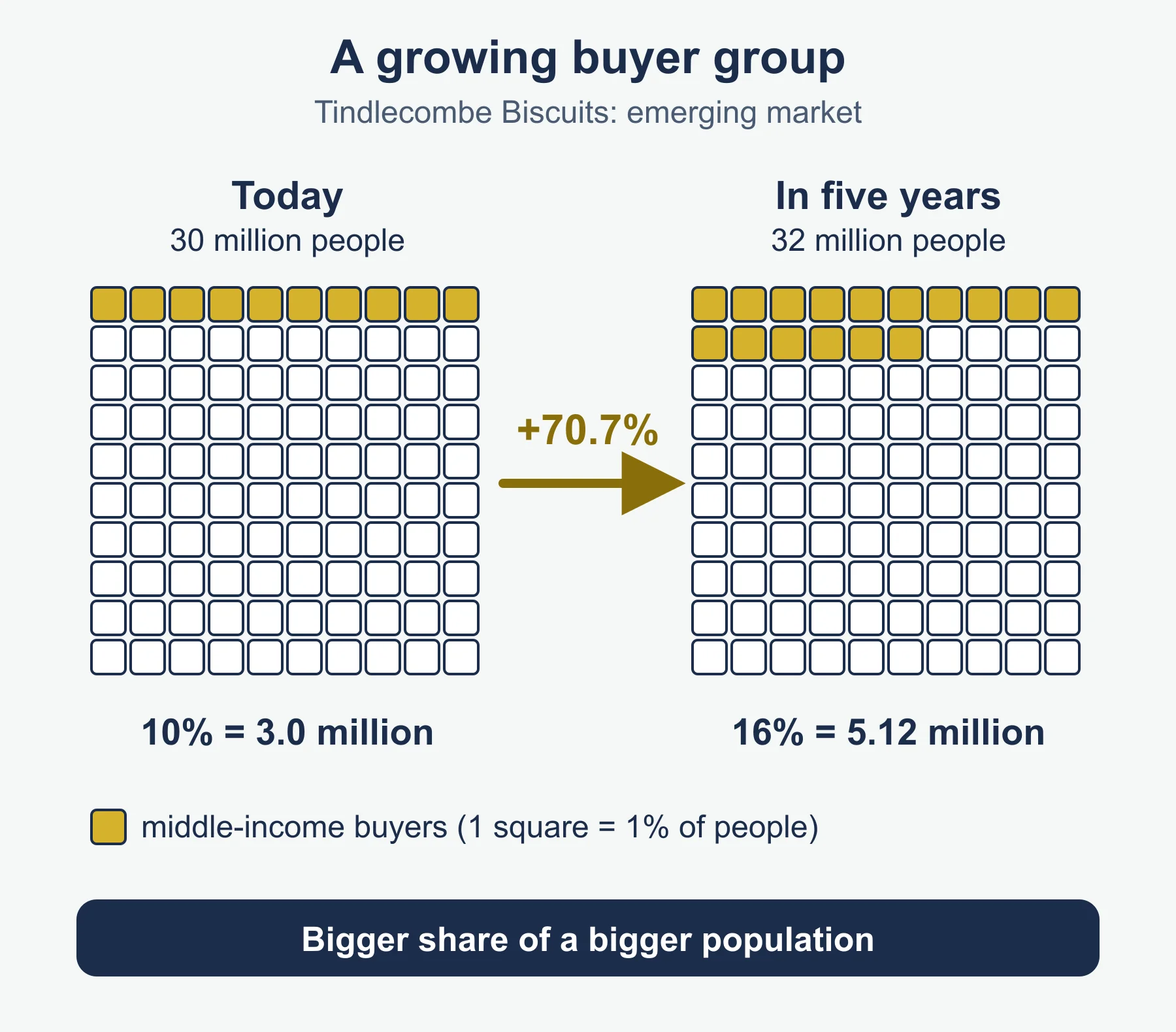
Worked example (Tindlecombe Biscuits). An emerging market has 30 million people, 10% of whom are middle-income buyers: 30 × 0.10 = 3.0 million. In five years the population is 32 million and 16% are middle-income: 32 × 0.16 = 5.12 million. Growth in this buying group = (5.12 − 3.0) ÷ 3.0 × 100 = 70.7%. Evaluate the risks too: unstable politics, currency swings, weak infrastructure and local competitors.
Impact on a business: new customers and cheaper production sites (an opportunity), but also new competitors from those economies and pressure on prices (a threat).
Changes in the global environment include changes in exchange rates, trade policy, technology, political events, regulation, consumer tastes and the spread of competitors. Evaluate the impact on a business by size, speed and the firm’s flexibility. A recommended response might include diversifying markets and suppliers, hedging currency risk, adapting products, or investing in innovation. Justify the choice against the alternatives and its cost.
Common errors
- Treating globalisation as wholly good or wholly bad. Evaluation needs both sides applied to the case firm.
- Writing “exchange rate” generally without a direction or an effect on costs, prices or profit.
- Dividing when you should multiply in a conversion. Check the starting currency.
- Listing language, culture, logistics, currency and buying habits without applying them to the product.
Next: the practice questions and the revision notes.
Frequently asked questions
What factors facilitate globalisation in OCR A Level Business H431? The specification names the Internet and communication technologies, e-commerce, trade liberalisation, transport infrastructure and multinationals as factors that facilitate globalisation.
How do you convert between currencies? With a rate quoted as foreign currency per £1, multiply to convert pounds into the foreign currency and divide to convert the foreign currency into pounds.
What is the difference between a tariff and a quota? A tariff is a tax on imports that makes them dearer than local goods. A quota is a limit on the quantity of a good that may be imported.
What is a trading bloc? A trading bloc is formed when countries agree to lower or scrap trade barriers among members, often sharing common rules or a common external tariff.
What should a business consider when trading internationally? Language, culture and customs, logistics, currency and buying habits, each evaluated for the specific product and country rather than listed in general.
Official syllabus
OCR A Level Business (H431), Version 2.1 (January 2026), published by OCR, for first assessment in 2017 with final assessment in summer 2027. Content covered: Global context; International trade and free trade; The European Union; Emerging markets and the global environment, within External influences.
Get free revision emails (optional)
Occasional emails with practice questions, worked explanations and links to free resources for the qualification and subjects you choose. No spam, and you can unsubscribe from any email. The free tools on this site never need an email.
Related resources
-
Practice questions
OCR A Level Business: Global context, trade, the EU and emerging markets (H431) – Practice Questions
Original practice questions with worked answers on globalisation, exchange rates, trade barriers, the EU and emerging markets, OCR Business H431.
Business · OCR · A Level
Try questions -
Revision notes
OCR A Level Business: Global context, trade, the EU and emerging markets (H431) – Revision Notes
Condensed revision notes on globalisation, trade barriers, exchange rates, trading blocs, the EU and emerging markets for OCR A Level Business H431.
Business · OCR · A Level
Revise topic -
Study guides
OCR A Level Business: Market forces, physical and non-physical markets, competition, dominance (H431)
Study guide to market forces, physical and non-physical markets, competition and market dominance for OCR A Level Business H431, with worked examples.
Business · OCR · A Level
Read guide
Related articles
-
teaching
A Level tuition in Dubai: Cambridge or Pearson Edexcel International A Level?
Schools in Dubai and Abu Dhabi teach either Cambridge International AS & A Level or Pearson Edexcel International A Level. How the two are structured, why it matters for tuition, and how online classes from Lahore work.
9 October 2026
-
curriculum guides
Choosing subjects at IGCSE and A Level
How subject choices at 14 and 16 affect university options later, and how to keep pathways open without overloading a timetable.
28 July 2026
Studying this with a teacher
Working through Business A LEVELS?
This page is free and stays free. If you would rather be taught it, Marlbridge runs Business classes one-to-one, online in your own time zone. One-to-one only for this course: Rs 6,000 per class in Pakistan, with other currencies on the fees page. The first trial class is free. WhatsApp replies within an hour (8am–11pm Pakistan time, every day); email the same day.
OCR Business teachers at Marlbridge
