
Study Guides
OCR A Level Business: The global environment of business (H431)
Whole-topic study guide to the global environment of business for OCR A Level Business H431: globalisation, trade, exchange rates, EU, emerging markets.
- Subject
- Business
- Level
- A LEVELS
- Topic
- The global environment of business
- Author
- Marlbridge Academic Team
- Updated
- Reviewed by
- Salman Ahmad (what this means)
Aligned to OCR A Level Business (H431), Version 2.1 (January 2026), for first assessment in 2017; final assessment summer 2027. Official specification .
Syllabus page (what it covers and how it is assessed): OCR A Level Business.
Syllabus points this page covers
H431
- 7 The global environment of business (whole topic)
Found an error? Report a correction.
Need help with this topic? Request a free trial class for A Level Business (H431).
This guide covers the global environment of business in the OCR A Level Business (H431) specification, Version 2.1 (January 2026), for first assessment in 2017 with final assessment in summer 2027. The specification names “The global environment of business” in its content overview, and one of its three components is titled The global business environment, but no content table carries that name. This guide therefore gathers every global and international point from the tables, covering global context, trade, the EU and emerging markets, plus the international points under other headings.
Related pages: revision notes, practice questions, the earlier global context, trade, EU and emerging markets guide, the OCR A Level Business hub, the printable checklist and the free diagnostics.
Map of the topic
| Section | Specification content | Where in this guide |
|---|---|---|
| A | Global context: globalisation, facilitators, multinationals, global strategy, global brands | Sections 1 to 3 |
| B | International trade and free trade: barriers, factors, exchange rates, support, free trade, trading blocs | Sections 4 to 7 |
| C | The European Union: its growth in membership, the euro, and the UK’s position outside the EU, Eurozone and Single Market | Section 8 |
| D | Emerging markets and the global environment | Section 9 |
| E | International points elsewhere: local, national and international markets; national and multinational business; competition; political factors; interest rates and exchange rates; marketing contexts; offshoring and re-shoring; international influences | Section 10 |
The specification adds that any listed content may turn up in other contexts, so connect these ideas to marketing, operations and finance.
1. Globalisation
Globalisation is the process by which national economies and markets become more closely linked, making cross-border movement of goods, services, money, ideas and people easier.
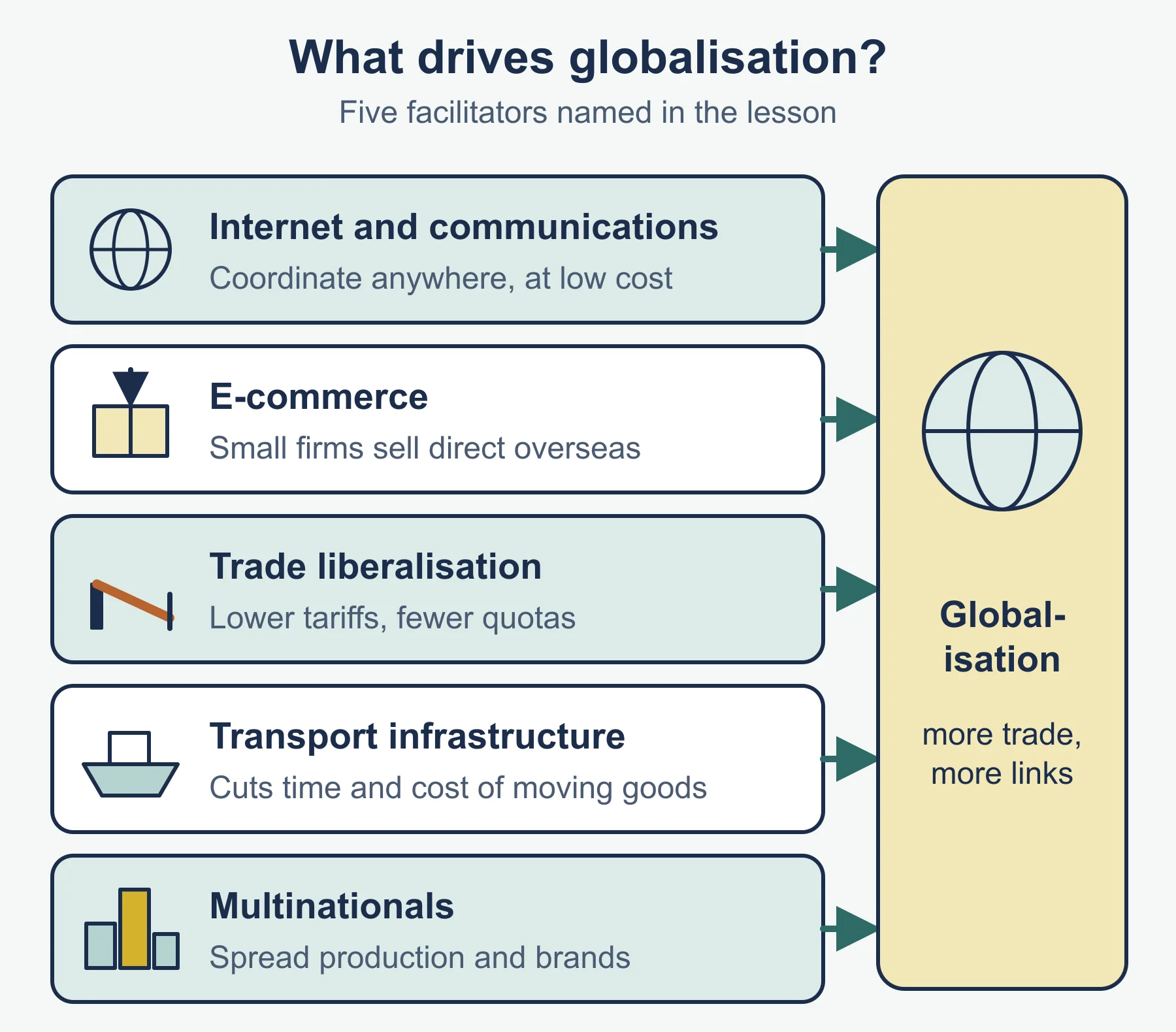
Facilitators of globalisation (the five the specification lists):
- The Internet and communication technologies cut the cost of coordinating staff, suppliers and customers in different countries.
- E-commerce lets a small firm take orders from abroad without a local shop.
- Trade liberalisation lowers the barriers imposed on imports.
- Transport infrastructure (ports, airports, container shipping, motorways) lowers the time and cost of moving goods.
- Multinationals spread production, brands and technology across countries.
Why some businesses are more affected than others. Exposure depends on imported inputs, sales abroad, overseas rivals and price comparison. A local joinery buying timber nearby feels little; a firm assembling electronics from imported parts and selling online feels a lot.
2. Multinationals and global strategy
A multinational is a business with operations in more than one country, as opposed to a national business that operates in one. Its role in globalisation: it moves capital, technology and management across borders, places each stage of production where it is cheapest or best, builds global supply chains and spreads brands.
Evaluating multinationals. Host countries gain investment, jobs, skills and tax income, and consumers gain choice. Against that, local firms may be driven out, production can move away quickly, and a large firm bargains hard with suppliers. Say which effect is larger for the stakeholder named.
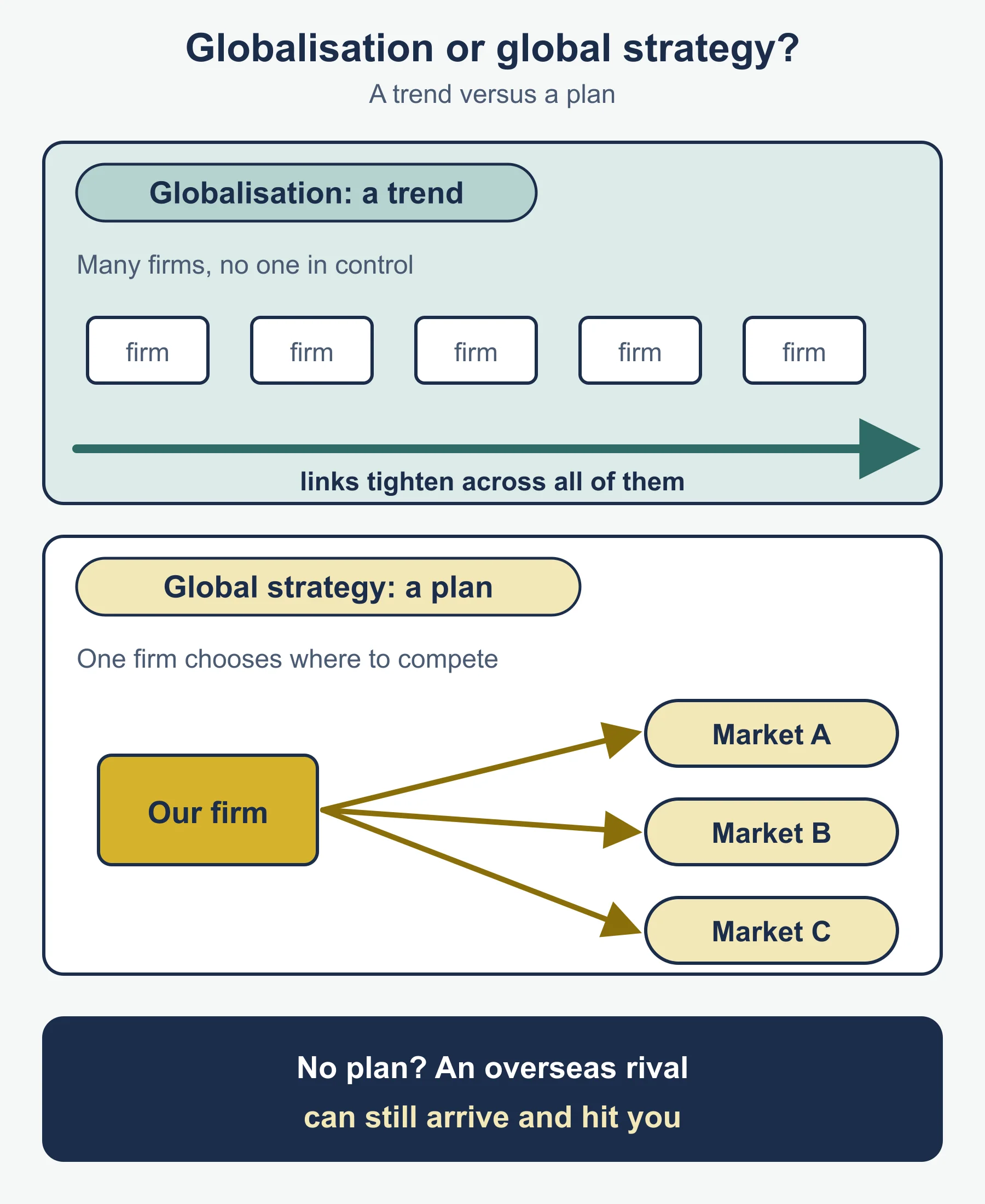
Global strategy versus globalisation. Globalisation is a trend in the environment that no single firm controls. A global strategy is a firm’s own plan to compete across world markets, for example one standardised range sold everywhere. A firm with no global plan can still be hit by globalisation, for instance when an overseas rival arrives.
Recommend and justify a response to increasing globalisation. Choose one and defend it against alternatives: staying local and stressing provenance, sourcing abroad, exporting, adapting products, or building a full global strategy.
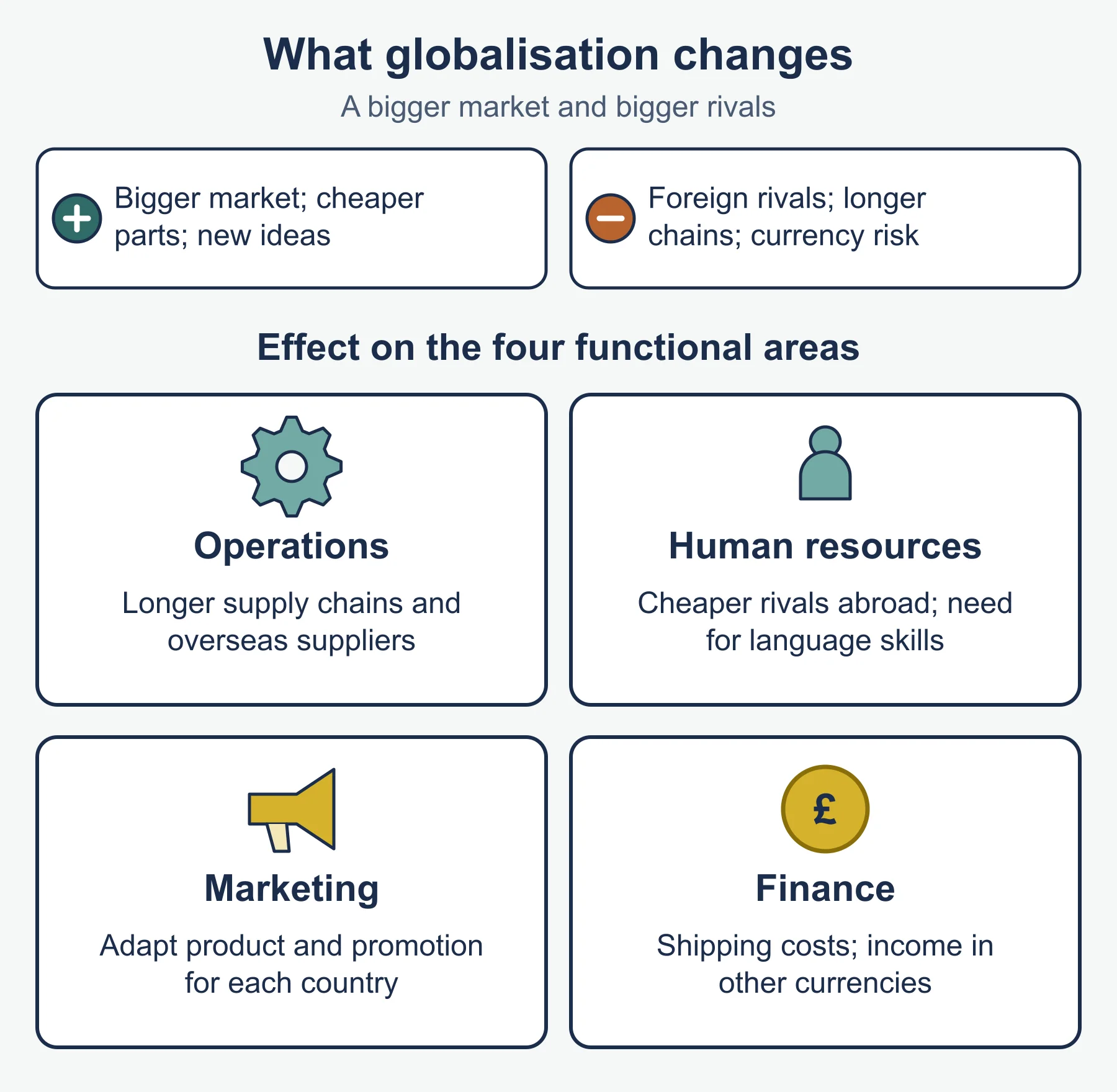
Opportunities and threats. Opportunities: larger markets, cheaper inputs, economies of scale, spread of risk. Threats: cheaper entrants, currency exposure, supply disruption and squeezed margins.
3. Global branding
A global brand is sold under a similar identity in many countries. A rise in the number of global brands gives a business owning one the chance to spread marketing cost over many customers and to carry trust into new markets. For a smaller rival it is a threat: price competition, large promotional budgets and lost loyalty. Local firms can respond with provenance and service. Evaluate by asking how far customers value the brand over price.
4. International trade and why firms do it
International trade means buying and selling goods and services between countries: exports go out, imports come in. Reasons to trade: no country has every resource; specialising lowers cost; a bigger market allows economies of scale; customers gain choice; and a saturated home market pushes firms abroad.
Relationship with globalisation. Globalisation makes trade easier and cheaper, so trade grows. Growing trade then ties economies and supply chains closer, deepening globalisation.
5. Barriers to trade
A barrier to trade makes imports harder or dearer to sell. The nature is what it is; the purpose is why a government uses it.
| Barrier | Nature | Purpose |
|---|---|---|
| Tariff | a duty charged on imported goods | raise revenue; make imports dearer than home products |
| Quota | limit on imported quantity | shield home producers |
| Embargo | a total stop to trade with a named country | political or security aims |
| Technical or administrative rules | standards, licences, paperwork | protect consumers, or slow imports |
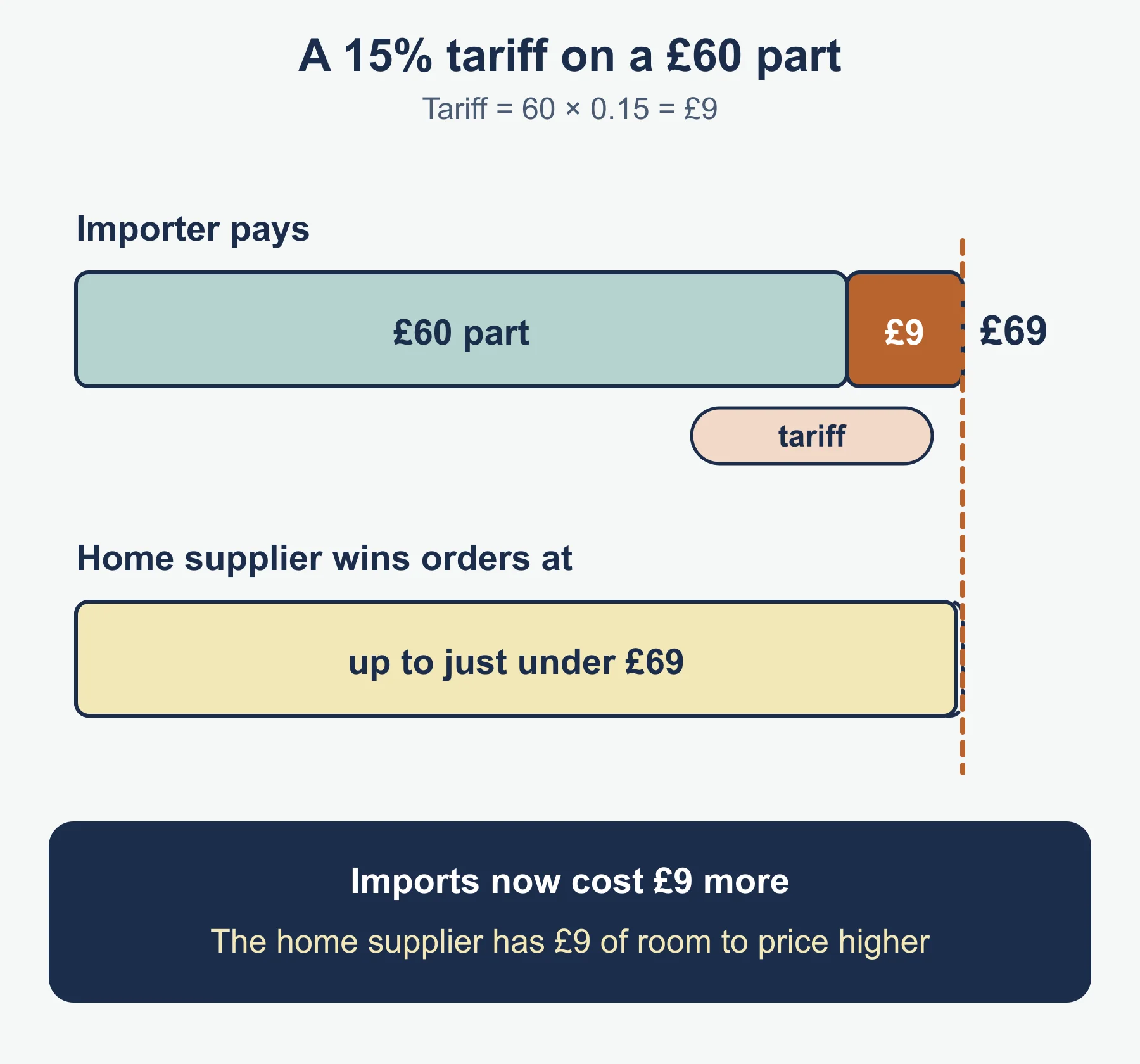
Worked example (tariff). A 15% tariff on an imported machine part priced at £60: tariff = 60 × 0.15 = £9; cost to the importer = £69. The home supplier can now charge up to just under £69 and still win orders. The specification asks for the nature and purpose of barriers.
6. Factors when trading internationally
Evaluate each factor for the product and the target country.
- Language: packaging, websites and contracts may need translation.
- Culture and customs: attitudes to colour, religion and negotiation can make a product unwelcome.
- Logistics: transport mode, delivery time, insurance, customs clearance and storage change cost and reliability.
- Currency: the price currency decides who carries exchange rate risk.
- Buying habits: online or in-store, income and price sensitivity.
Support for international traders. Financial: export credit insurance or guarantees, bank trade finance such as letters of credit, government grants where offered. Non-financial: official advice and market data, trade fairs and delegations, local business associations, market research, agents and distributors.
7. Exchange rates, free trade and trading blocs
An exchange rate tells you how many units of one currency one unit of another will buy. If £1 = USD 1.30, one pound buys 1.30 US dollars. To change pounds into the foreign currency, multiply by the rate. To change foreign currency into pounds, divide.
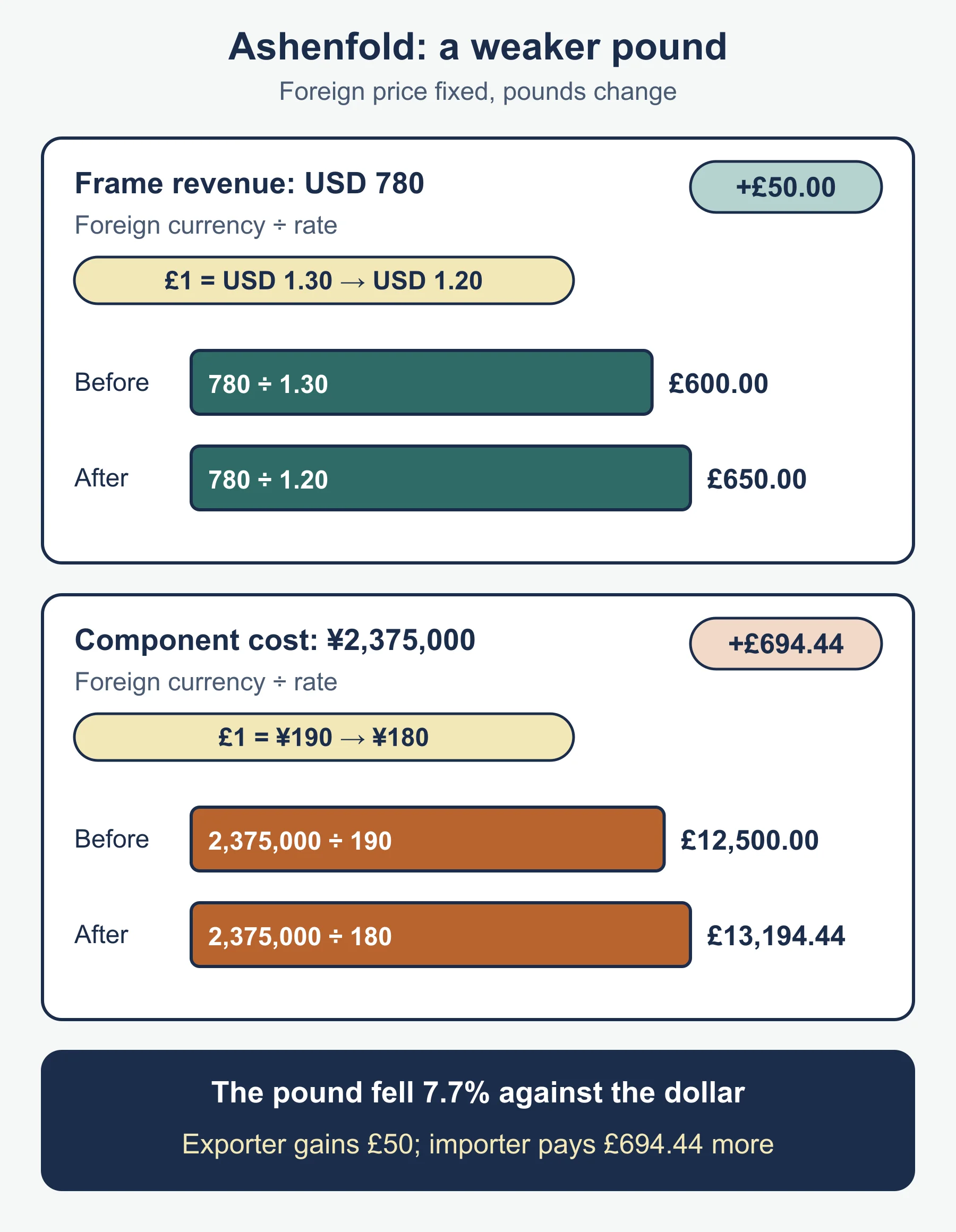
Worked example (Ashenfold Cycles). Ashenfold, a UK maker, sells a frame for USD 780 and buys a component batch for ¥2,375,000. The rates are £1 = USD 1.30 and £1 = ¥190.
- Frame revenue: 780 ÷ 1.30 = £600.
- Component cost: 2,375,000 ÷ 190 = £12,500.
The pound weakens to £1 = USD 1.20 and £1 = ¥180.
- Frame revenue: 780 ÷ 1.20 = £650, which is £50 more.
- Component cost: 2,375,000 ÷ 180 = £13,194.44, which is £694.44 more.
- The pound fell by (1.30 − 1.20) ÷ 1.30 = 7.7% against the dollar.
A weaker pound helps exporters and hurts importers. A stronger pound reverses this. Shareholders see profit move, employees may gain or lose work and customers see price changes. Evaluate by contract length, the share of costs and sales in each currency, and whether prices can change.
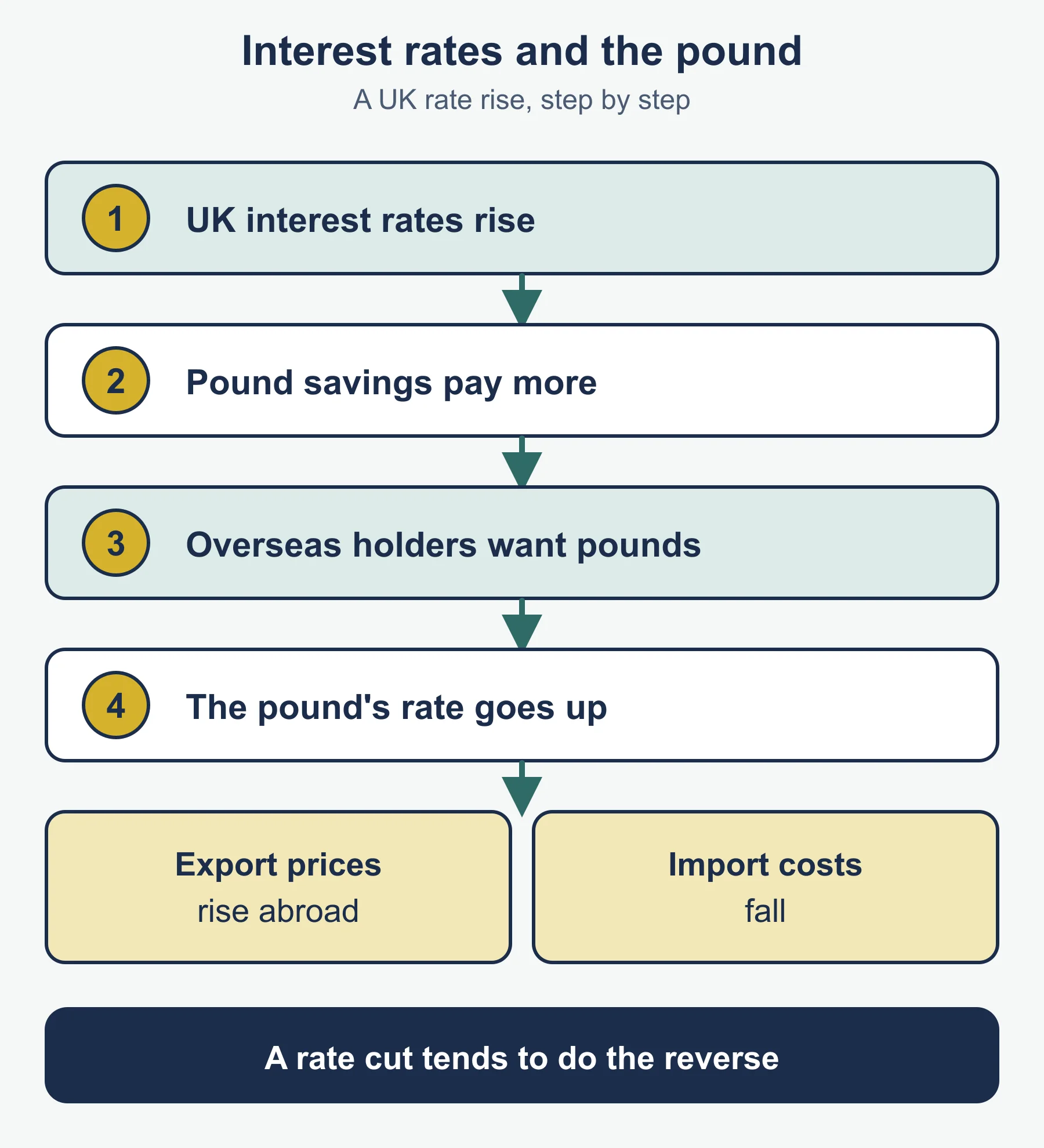
Interest rates and exchange rates. Higher UK interest rates make pound savings more attractive to overseas holders, raising demand for pounds and pushing the rate up; lower rates tend to do the reverse. A change in UK interest rates can therefore alter a firm’s export prices and import costs.
Free trade is trade without tariffs, quotas or similar barriers. Advantages to a business: bigger markets, cheaper inputs, efficiency under competition. Disadvantages: stronger overseas rivals, job losses in unprotected sectors, dependence on foreign suppliers. A trading bloc is a set of countries with an agreement to lower barriers on trade between themselves. Advantages: easier access, common rules, a bigger market. Disadvantages: more member competition, rules set by the bloc, and barriers against outsiders that may raise input costs.
8. The European Union
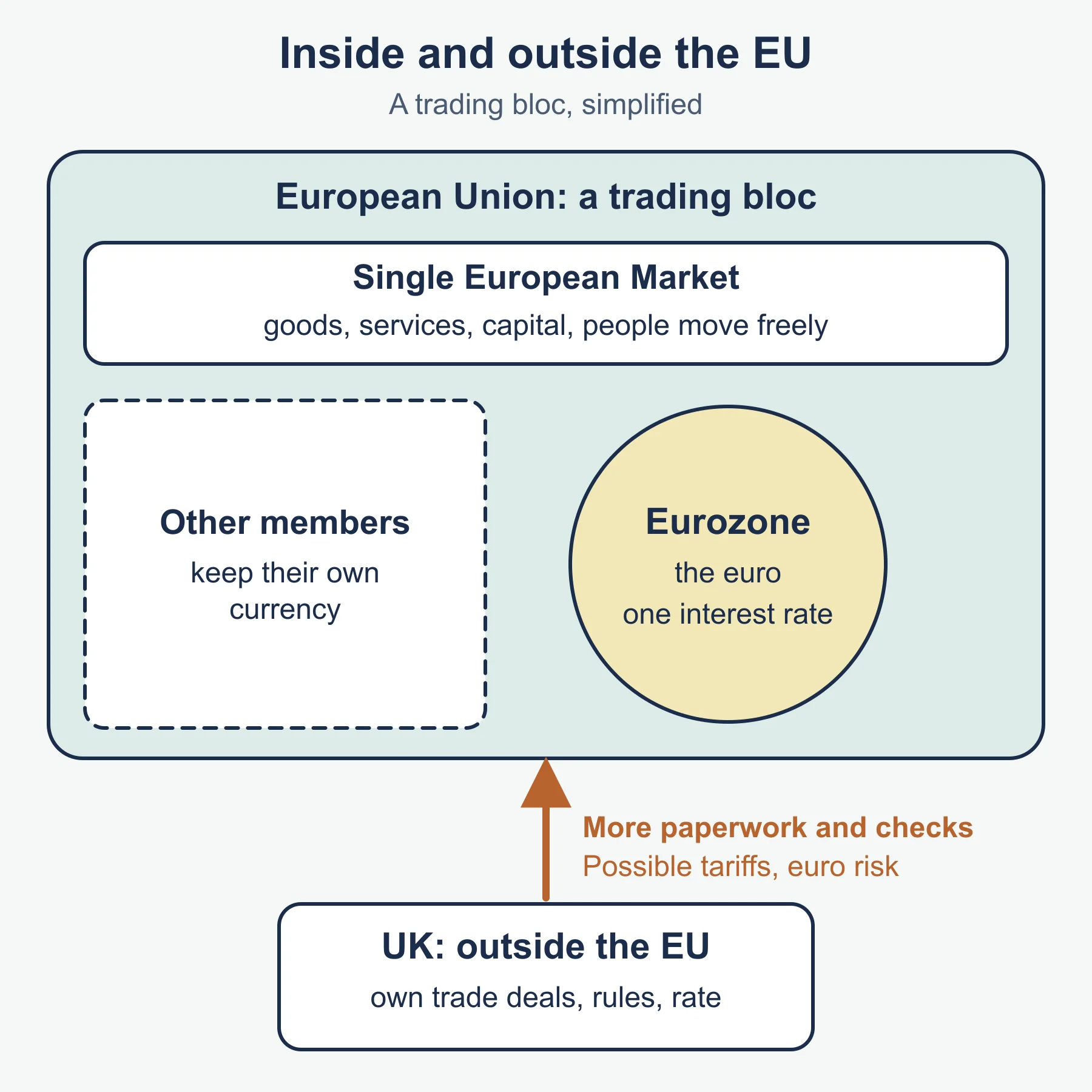
The EU is a trading bloc. Its Single European Market lets goods, services, capital and workers circulate among members with few restrictions, and the members using the euro make up the Eurozone (background description).
- Enlargement: adds customers, labour and suppliers under common rules, but also rivals.
- Single currency: removes exchange rate risk and conversion costs inside the Eurozone and makes price comparison easy, but members share one interest rate and cannot gain from their own currency falling.
- The UK outside the EU and the Eurozone: the UK chooses its own trade deals, rules and interest rates, but its firms may face extra paperwork, checks and currency risk when selling to the EU.
- The UK outside the Single European Market: the UK sets its own standards, but loses frictionless access, so a firm may need extra documents, certification or a local base.
Recommend and justify: Europe and/or global markets? Compare nearer, similar markets with distant ones that may grow faster but carry more cultural, logistical and currency risk. Decide by product, resources and customers.
9. Emerging markets and the global environment
Emerging market: an economy that is growing quickly, industrialising and seeing incomes rise, yet is less developed or less stable than the richest economies. For a business it offers new customers and cheaper production, and also new competitors and risk.
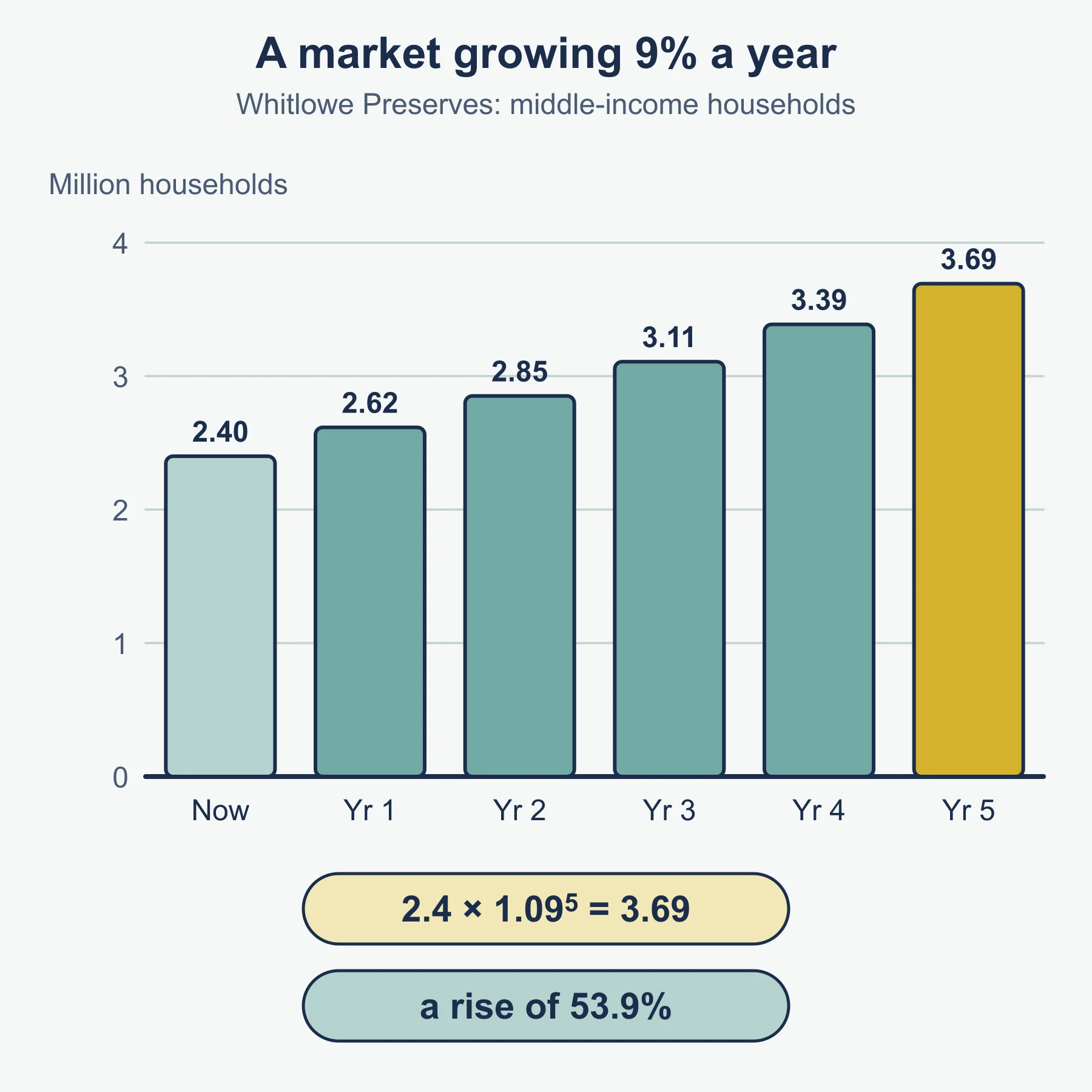
Worked example (Whitlowe Preserves). An emerging market has 2.4 million middle-income households, growing 9% a year. After five years: 2.4 × 1.09⁵ = 3.69 million (to 3 s.f.), a rise of 53.9%. Weigh local rivals and currency risk too.
Changes in the global environment include exchange rate shifts, trade policy, technology, political events, regulation, shifting tastes and new competitors. Evaluate their impact by speed, size and the firm’s flexibility. A response might be diversifying markets and suppliers, fixing prices in advance, adapting products or investing in innovation, justified against its cost.
10. International points elsewhere in the specification
- Local, national and international/global markets, and national versus multinational business (Business sectors). A one-shop bakery is local; a chain across Britain is national; a firm trading in many countries is international or global.
- Competition at local, national and global levels (Market forces). Global rivals may have lower costs or stronger brands.
- Marketing contexts and the marketing mix. Distinguish local, national and international/global contexts, then evaluate a mix for each. A standardised mix saves cost and builds one brand image; an adapted mix suits local tastes, language and price levels but costs more.
- Political factors. Political factors include taxes, regulation, trade policy and elections. Stability supports planning and investment. Political uncertainty, such as unclear future rules, leads firms to delay investment. Instability can disrupt supply, raise risk and hold back trade. Local, national and international governments affect firms through taxes, rules and trade policy.
- Offshoring and re-shoring (Operations). Offshoring moves work abroad; re-shoring brings it home.
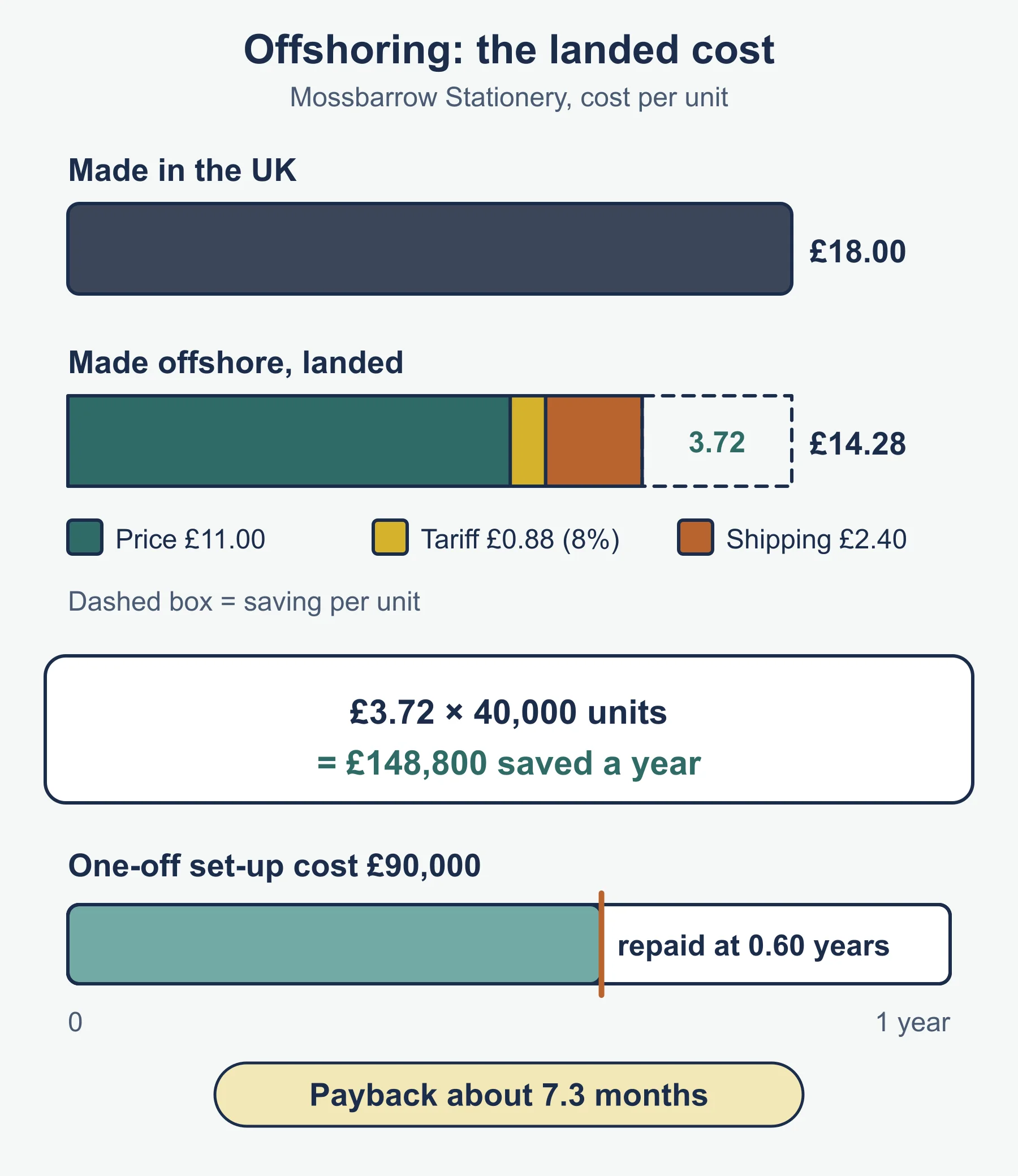
Worked example (Mossbarrow Stationery). UK unit cost is £18.00. Offshore, the unit costs £11.00 plus a tariff of 8% of £11.00 (£0.88) and shipping of £2.40, a landed cost of £14.28. Saving = 18.00 − 14.28 = £3.72 a unit. At 40,000 units, saving = £148,800 a year. With a one-off set-up cost of £90,000, payback is 90,000 ÷ 148,800 = 0.60 years, about 7.3 months. Weigh this against quality control, longer supply lines and currency risk.
- International influences on marketing, operations, finance and people. Evaluate how overseas rules, costs and currencies shape each function.
Common errors
- Multiplying when you should divide in a conversion. Check which currency you start with.
- Confusing globalisation (a trend) with a global strategy (a plan).
- Ending an “evaluate” or “recommend” answer with no reasoned judgement.
Next: the revision notes and the practice questions.
Frequently asked questions
What is globalisation? Globalisation is the process by which national economies and markets become more closely linked, so goods, money and information move more easily across borders. Businesses with imported inputs, overseas sales or global rivals are more affected by it than purely local firms.
What is a tariff and why do governments use one? A tariff is a duty charged on imported goods. Governments use tariffs to raise revenue and to make imports dearer, which protects home producers.
What is an emerging market? An emerging market is an economy that is growing quickly, industrialising and seeing incomes rise, but is less developed or less stable than established markets. It offers new customers and cheaper production but also brings new rivals, instability and currency risk.
How do UK interest rates affect the value of the pound? Higher UK interest rates make pound savings more attractive to overseas savers, which raises demand for pounds and tends to strengthen the pound. A stronger pound helps UK importers and makes UK exports dearer abroad.
Official syllabus
OCR A Level Business (H431), Version 2.1 (January 2026), published by OCR, for first assessment in 2017 with final assessment in summer 2027. Content covered: The global environment of business, using the global and international points in the content tables.
Get free revision emails (optional)
Occasional emails with practice questions, worked explanations and links to free resources for the qualification and subjects you choose. No spam, and you can unsubscribe from any email. The free tools on this site never need an email.
Related resources
-
Practice questions
OCR A Level Business: The global environment of business (H431) – Practice Questions
Original practice questions with worked answers on the global environment of business for OCR A Level Business H431, from short answers to a 12-mark case.
Business · OCR · A Level
Try questions -
Revision notes
OCR A Level Business: The global environment of business (H431) – Revision Notes
Condensed revision notes on the global environment of business for OCR A Level Business H431, with a quick self-test and a list of common mark losses.
Business · OCR · A Level
Revise topic -
Study guides
OCR A Level Business: The market, market size and growth and Demand and supply (H431)
Study guide to markets, market size and growth, market structures, demand, supply and equilibrium for OCR A Level Business (H431), with worked diagrams.
Business · OCR · A Level
Read guide
Related articles
-
teaching
A Level tuition in Dubai: Cambridge or Pearson Edexcel International A Level?
Schools in Dubai and Abu Dhabi teach either Cambridge International AS & A Level or Pearson Edexcel International A Level. How the two are structured, why it matters for tuition, and how online classes from Lahore work.
9 October 2026
-
curriculum guides
Choosing subjects at IGCSE and A Level
How subject choices at 14 and 16 affect university options later, and how to keep pathways open without overloading a timetable.
28 July 2026
Studying this with a teacher
Working through Business A LEVELS?
This page is free and stays free. If you would rather be taught it, Marlbridge runs Business classes one-to-one, online in your own time zone. One-to-one only for this course: Rs 6,000 per class in Pakistan, with other currencies on the fees page. The first trial class is free. WhatsApp replies within an hour (8am–11pm Pakistan time, every day); email the same day.
OCR Business teachers at Marlbridge
