
Revision Notes
OCR A Level Chemistry A: Atomic structure, compounds, formulae and equations, 2.1.1-2.1.2 (H432) – Revision Notes
Revision notes for OCR A Level Chemistry A 2.1.1 and 2.1.2: isotopes, relative masses, mass spectra, ionic formulae, balanced and ionic equations.
- Subject
- Chemistry
- Level
- A LEVELS
- Topic
- Foundations in chemistry
- Author
- Marlbridge Academic Team
- Updated
- Reviewed by
- Nouman Ahmed (what this means)
Aligned to OCR A Level Chemistry (H432), Version 3.1 (May 2026), for first assessment in 2017. Official specification .
Syllabus page (what it covers and how it is assessed): OCR A Level Chemistry.
Syllabus points this page covers
H432
- 2.1.1 Atomic structure and isotopes
- 2.1.2 Compounds, formulae and equations
Found an error? Report a correction.
Need help with this topic? Request a free trial class for A Level Chemistry (H432).
Read the 2.1.1 study guide and the 2.1.2 study guide for the full explanations. These notes are the short version for the final weeks.
They cover sections 2.1.1 (Atomic structure and isotopes) and 2.1.2 (Compounds, formulae and equations) of Module 2, Foundations in chemistry, in the OCR A Level Chemistry A (H432) specification, Version 3.1 (May 2026), for first assessment in 2017. H432 is the full A level. The assessment overview places Module 2 in all three written components (01, 02 and 03), so this content can appear in any of them.
Course hub: OCR A Level chemistry. Progress tracker: printable checklist. Gap finder: free diagnostics. Exam-style questions: practice set.
Outcome map
| Outcome | What you must be able to do |
|---|---|
| 2.1.1(a) | Explain isotopes: same element, different numbers of neutrons, different masses |
| 2.1.1(b) | Give protons, neutrons and electrons for atoms and ions from atomic number, mass number and charge |
| 2.1.1(c) | Define relative isotopic mass and relative atomic mass |
| 2.1.1(d) | Use mass spectrometry data to find isotopic masses, abundances and relative atomic mass |
| 2.1.1(e) | Use relative molecular mass, Mr, and relative formula mass; calculate both |
| 2.1.2(a) | Write ionic formulae from charges, including charges predicted from the periodic table and the named ions |
| 2.1.2(b) | Construct balanced equations, including ionic equations, with state symbols |
2.1.1(a) and (b): isotopes and particles
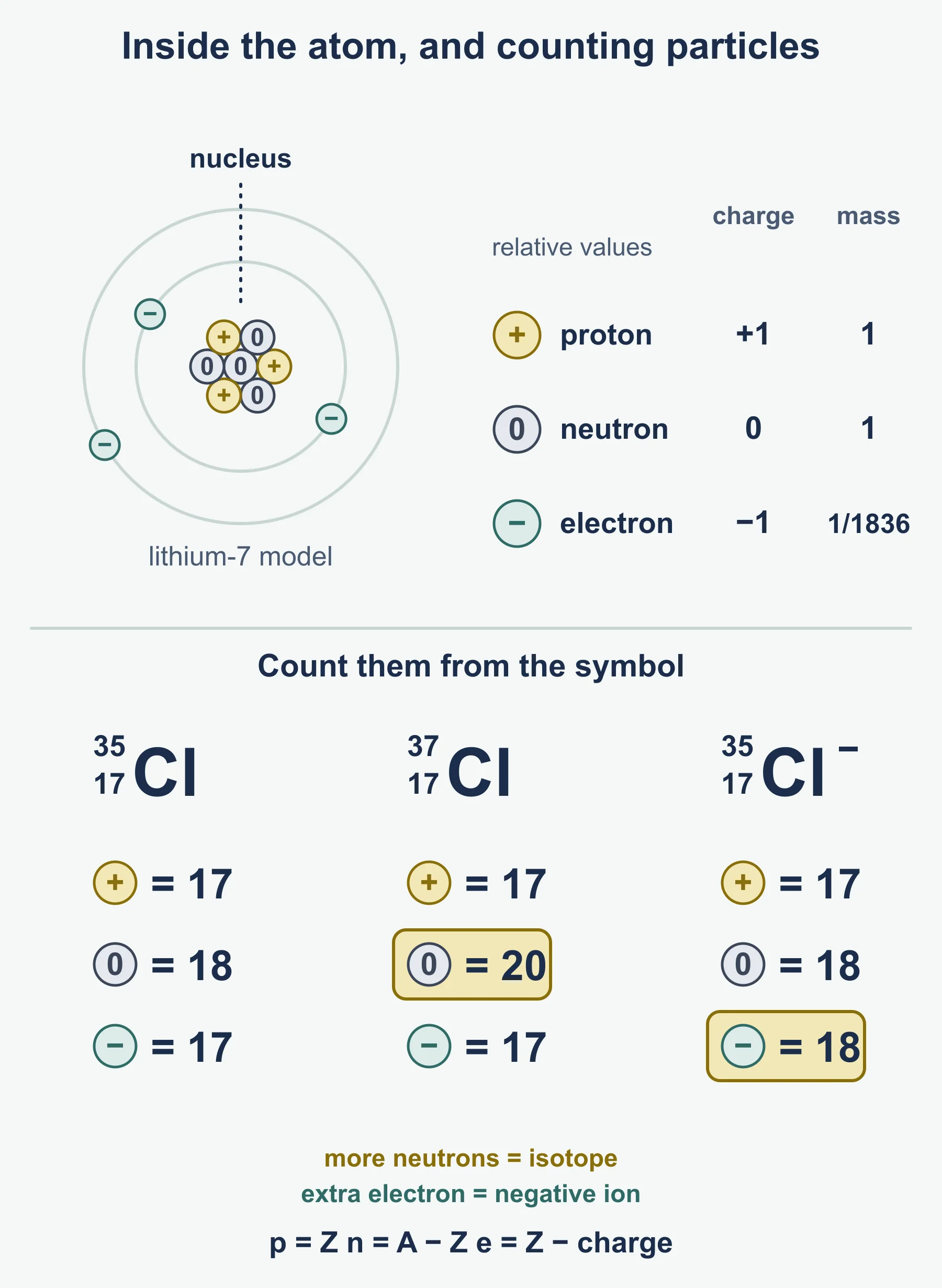
Isotopes of an element are atoms that share a proton number but contain different numbers of neutrons, giving them different masses. Same proton number means same element. Same electron arrangement means the same chemistry. Properties that depend on mass, for example density, are not identical.
| Quantity | Rule |
|---|---|
| Protons | atomic number |
| Neutrons | mass number minus atomic number |
| Electrons, neutral atom | atomic number |
| Electrons, positive ion | atomic number minus the charge |
| Electrons, negative ion | atomic number plus the charge |
Worked reminders:
- ⁵⁶Fe³⁺ (atomic number 26): 26 protons, 56 − 26 = 30 neutrons, 26 − 3 = 23 electrons.
- ³²S²⁻ (atomic number 16): 16 protons, 32 − 16 = 16 neutrons, 16 + 2 = 18 electrons.
Changing the charge changes only the electron count. It never changes protons or neutrons.
Models of the atom (HSW1 and HSW7)
The specification links this section to two ideas about how science works:
- Different models explain different phenomena. The Bohr model, with electrons in shells, explains periodic properties.
- Accepted models change as evidence is used to accept or reject them.
A short story you can use: the plum-pudding picture had electrons embedded in a positive sphere. Alpha-particle scattering evidence, where most particles went straight through and a few were deflected strongly, supported a small, dense, positive nucleus surrounded by mostly empty space. Shell models then explained patterns across the periodic table.
2.1.1(c): the two definitions
Learn both. The specification says definitions are required.
| Term | Definition |
|---|---|
| Relative isotopic mass | The mass of an atom of an isotope compared with 1/12th the mass of an atom of carbon-12 |
| Relative atomic mass | The mean mass of an atom of the element, weighted by the abundance of each isotope as it occurs, compared with 1/12th the mass of an atom of carbon-12 |
Carbon-12 is the standard for atomic masses. Both quantities are ratios, so they have no units. The phrase “weighted mean” is what separates the second definition from the first. Say which isotope or element you are describing.
2.1.1(d): mass spectrometry calculations
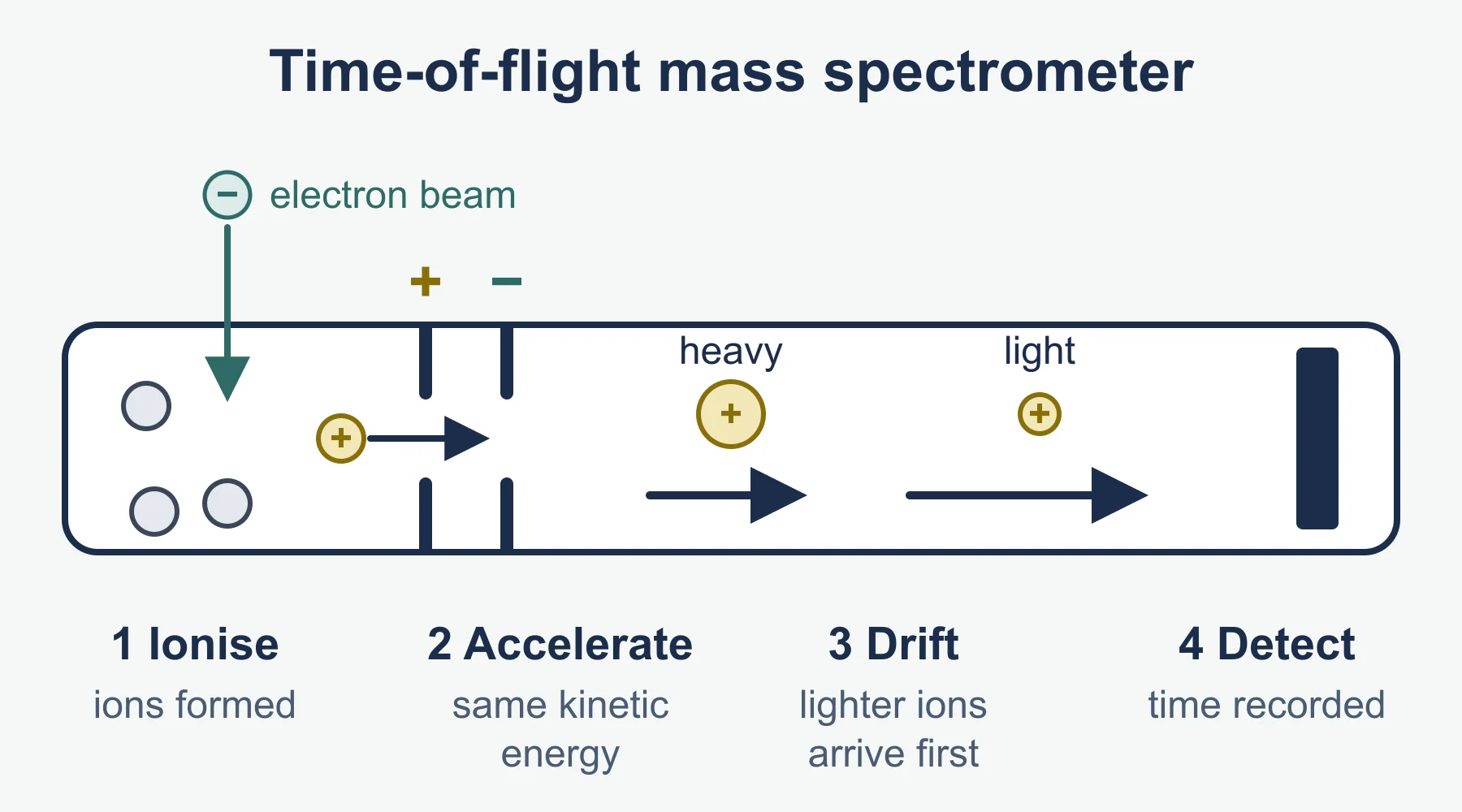
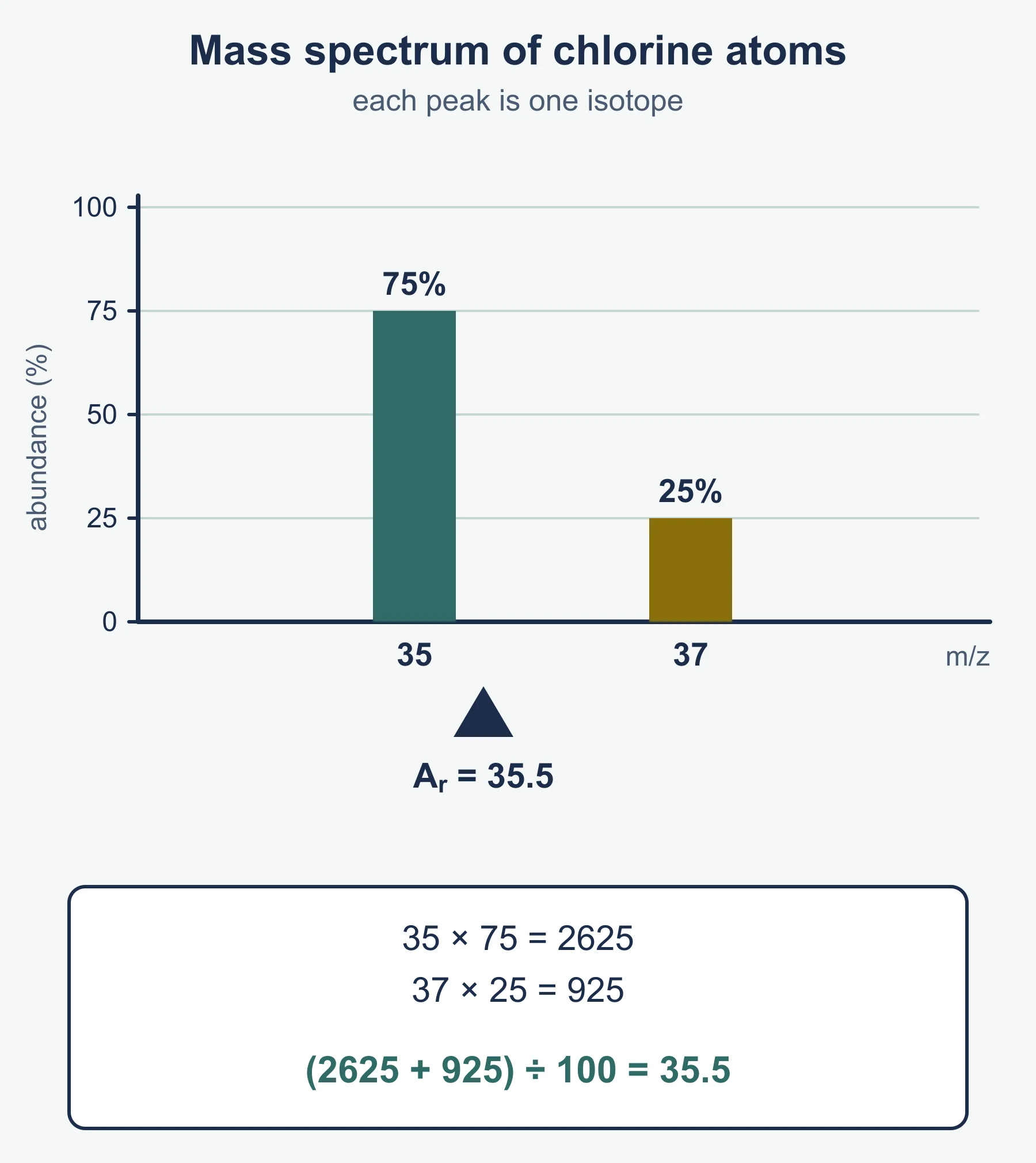
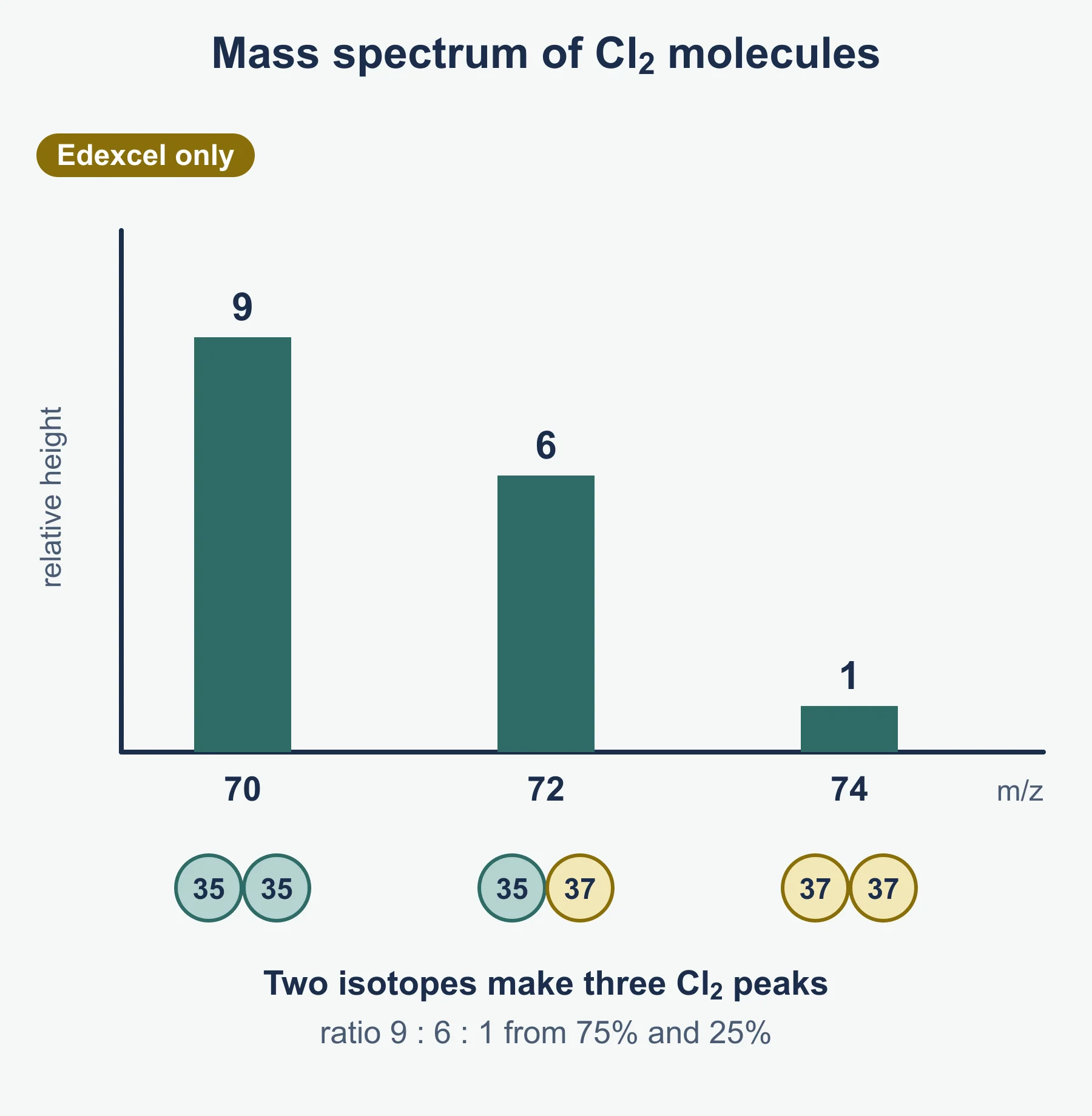
You do not need to know how a mass spectrometer works. You do need to read the data. The specification limits this to ions with single charges, so the m/z value of a peak can be taken as the relative isotopic mass of that isotope.
- Peak position (m/z) gives the relative isotopic mass.
- Peak height (or the percentage or relative abundance given) tells you how much of that isotope there is.
Method in steps:
- List each m/z value with its abundance.
- Multiply each mass by its abundance.
- Add up all the products.
- Divide that sum by the combined abundance (100 when the figures are percentages).
- Give the answer to a sensible number of significant figures. Relative atomic mass has no unit.
Worked reminder, using invented data for an element Y: peaks at m/z 46, 47 and 48 with abundances 12.0%, 28.0% and 60.0%.
(46 × 12.0 + 47 × 28.0 + 48 × 60.0) / 100
= (552 + 1316 + 2880) / 100
= 4748 / 100
= 47.48, which is 47.5 to 3 s.f.
The result must fall between the smallest and largest isotopic mass, closer to the most abundant isotope. If not, recheck the arithmetic.
Working backwards: if only two isotopes exist, let one abundance be x and the other 100 − x, then solve. The relative atomic mass must lie between the two isotopic masses.
2.1.1(e): Mr and relative formula mass
| Substance type | Term to use | Example |
|---|---|---|
| Simple molecules | Relative molecular mass, Mr | SO₂, P₄ |
| Giant structures, including ionic compounds | Relative formula mass | Ca(NO₃)₂ |
The specification says the definitions of these two terms are not required. Knowing which term goes with which type of substance is what is expected. Either one is found by summing the relative atomic masses of every atom shown in the formula.
Worked reminders, with Ar values supplied: Ca = 40.1, N = 14.0, O = 16.0, H = 1.0, C = 12.0.
- Ca(NO₃)₂: 40.1 + 2 × (14.0 + 3 × 16.0) = 40.1 + 124.0 = 164.1.
- (NH₄)₂CO₃: 2 × (14.0 + 4 × 1.0) + 12.0 + 3 × 16.0 = 36.0 + 12.0 + 48.0 = 96.0.
Multiply everything inside a bracket by the number outside it.
2.1.2(a): ionic formulae
Charges from the periodic table
| Group | Typical ion |
|---|---|
| 1 | 1+ |
| 2 | 2+ |
| 13 | 3+ |
| 15 | 3− |
| 16 | 2− |
| 17 | 1− |
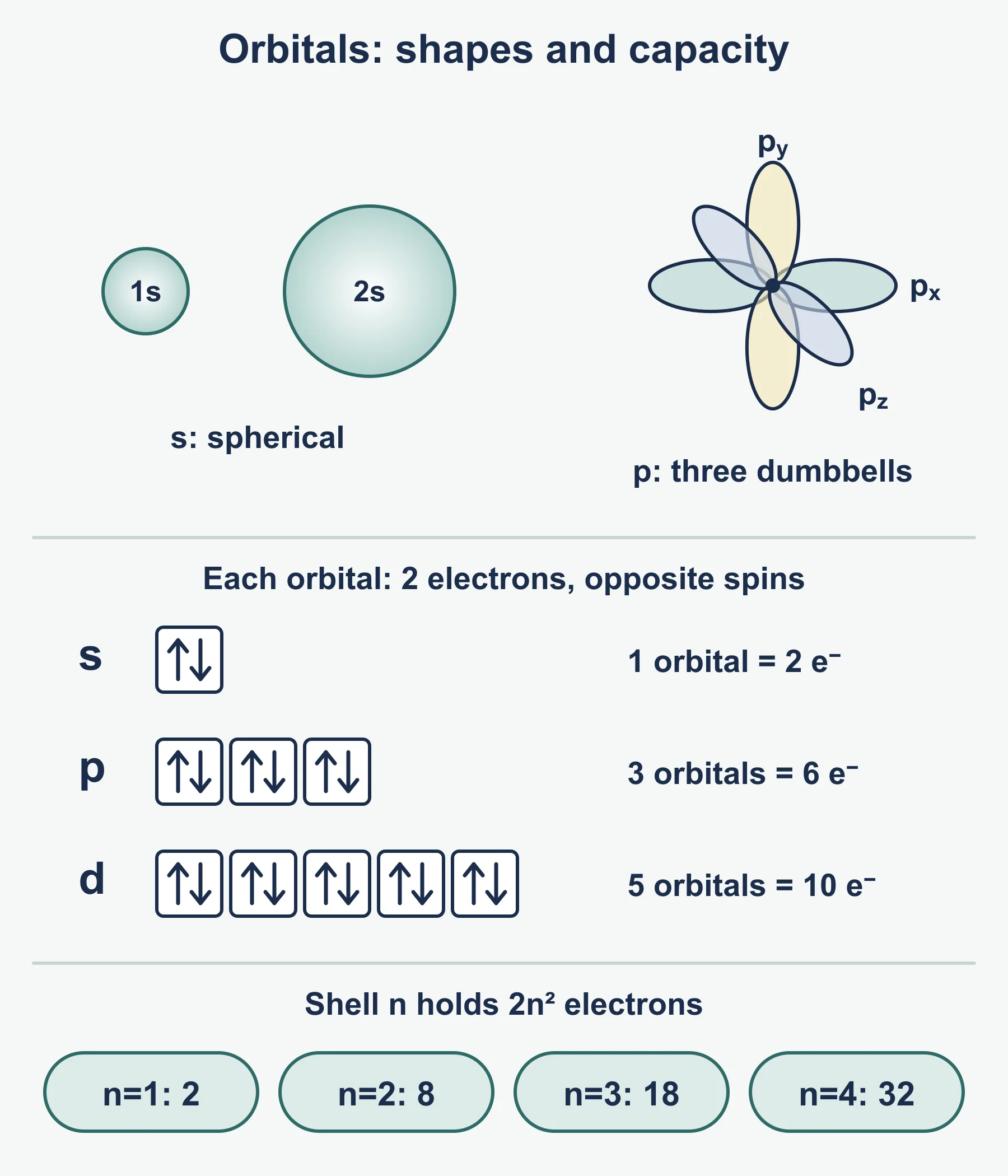
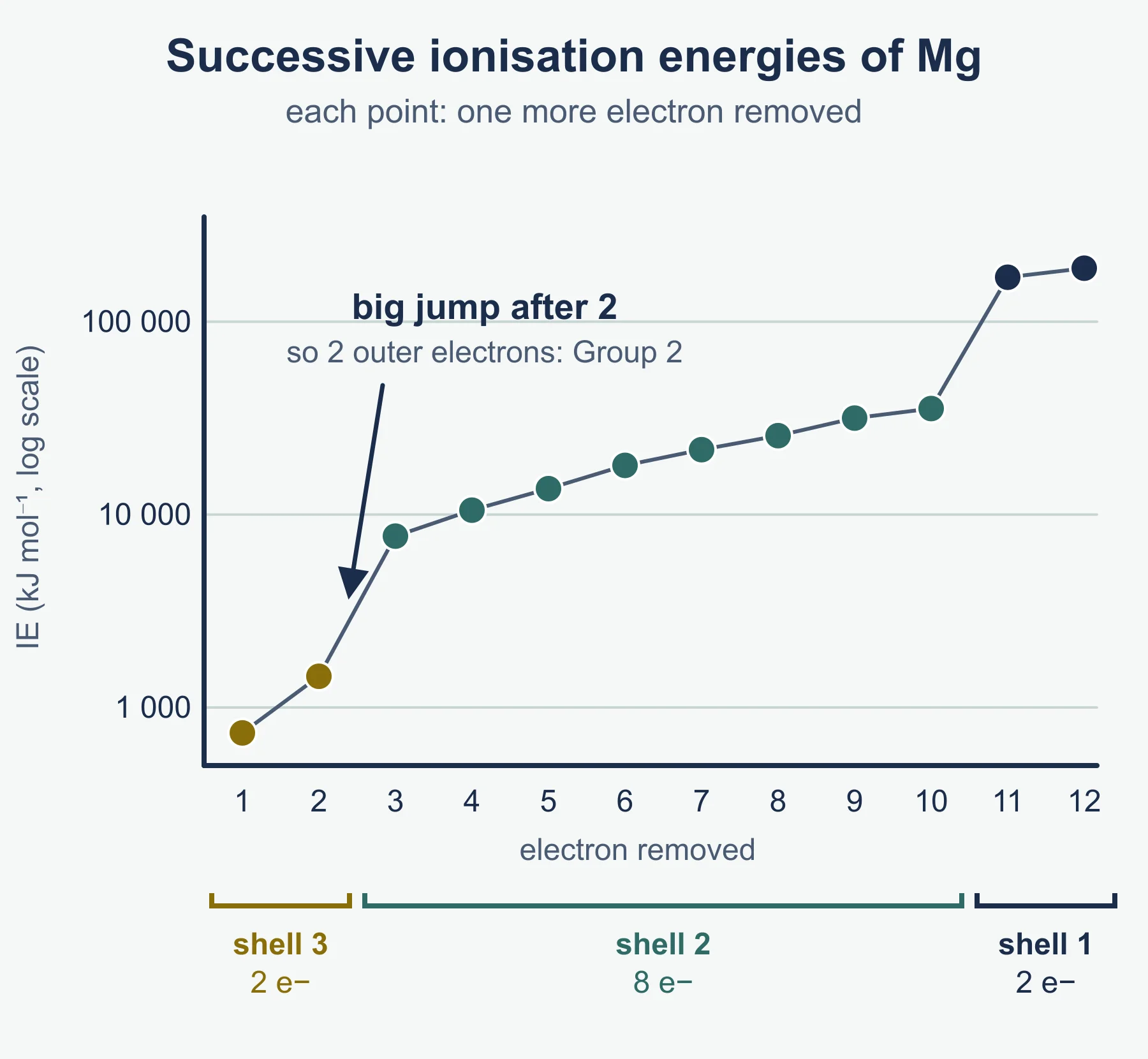
Metals lose electrons to form positive ions. Non-metals gain electrons to form negative ions. The size of the charge matches the electrons an atom must lose or gain to end up with a full outer shell. The specification says charges on ions other than the ones above and the named ions below will be provided.
Named ions to recall
| Name | Formula |
|---|---|
| Nitrate | NO₃⁻ |
| Carbonate | CO₃²⁻ |
| Sulfate | SO₄²⁻ |
| Hydroxide | OH⁻ |
| Ammonium | NH₄⁺ |
| Zinc | Zn²⁺ |
| Silver | Ag⁺ |
The specification adds that “nitrate” and “sulfate” should be assumed to mean NO₃⁻ and SO₄²⁻.
Method in steps:
- Note the formula and charge of the cation and of the anion.
- Choose the lowest whole-number amounts of each so that positive and negative charges cancel.
- Show those amounts as subscripts; a subscript of 1 is not written.
- Enclose a polyatomic ion in brackets when more than one is needed.
Worked reminders:
- Magnesium nitride: Mg²⁺ and N³⁻. Three Mg²⁺ give +6 and two N³⁻ give −6, so Mg₃N₂.
- Ammonium sulfate: NH₄⁺ and SO₄²⁻. Two NH₄⁺ balance one SO₄²⁻, so (NH₄)₂SO₄.
2.1.2(b): balanced and ionic equations
A complete equation has correct formulae, balanced atoms and charges, and state symbols: (s), (l), (g) or (aq).
Method in steps:
- Write the correct formula for every species. Do not change a formula to make the equation balance.
- Balance by changing only the large numbers in front.
- Leave hydrogen and oxygen until last if they appear in several species.
- Add state symbols.
Ionic equations:
- Start from the full equation, state symbols included.
- Show each dissolved strong electrolyte, (aq), as separate ions.
- Delete any ion that appears unchanged on both sides: these are the spectator ions.
- What remains is the ionic equation; confirm that atoms and charges both balance.
Worked reminder, with an unfamiliar reaction given in words: aqueous barium chloride and aqueous sodium sulfate form a white precipitate of barium sulfate.
BaCl₂(aq) + Na₂SO₄(aq) → BaSO₄(s) + 2NaCl(aq)
Ba²⁺(aq) + SO₄²⁻(aq) → BaSO₄(s)
Spectator ions: Na⁺ and Cl⁻. Charge on the left is 2+ plus 2−, which is 0, matching the neutral solid on the right.
Other patterns to know how to apply: acid plus base gives salt plus water; acid plus carbonate gives salt, water and carbon dioxide; ammonium ions with hydroxide ions on warming give ammonia and water.
Must-know distinctions
- Relative isotopic mass is for one isotope. Relative atomic mass is a weighted mean for the element.
- Relative molecular mass is for simple molecules. Relative formula mass is for giant structures.
- Mass number is protons plus neutrons. Atomic number is protons only.
- A coefficient changes the amount. A subscript changes the substance.
- A full equation shows everything. An ionic equation shows only what changes.
Quick self-test
- State the numbers of protons, neutrons and electrons in ²⁷Al³⁺ (atomic number 13).
- Why do isotopes of one element have the same chemical behaviour?
- Define relative atomic mass.
- A sample has two isotopes: 10 with abundance 20.0% and 11 with abundance 80.0%. Calculate the relative atomic mass.
- Which term, relative molecular mass or relative formula mass, applies to P₄O₁₀? Which applies to Ca(NO₃)₂?
- Calculate the relative formula mass of (NH₄)₂SO₄ (N = 14.0, H = 1.0, S = 32.1, O = 16.0).
- Predict the ion formed by an atom of a Group 16 element.
- Write the formula of aluminium hydroxide.
- Balance: C₆H₁₄(g) + O₂(g) → CO₂(g) + H₂O(l).
- Balance, with state symbols: aluminium and aqueous hydrochloric acid form aqueous aluminium chloride and hydrogen gas.
Answers
- 13 protons, 27 − 13 = 14 neutrons, 13 − 3 = 10 electrons.
- Their atoms contain identical numbers of protons, so the electron arrangement is identical.
- The mean mass of an atom of the element, weighted by isotope abundance, compared with 1/12th the mass of an atom of carbon-12.
- (10 × 20.0 + 11 × 80.0) / 100 = (200 + 880) / 100 = 10.8.
- P₄O₁₀ is a simple molecule: relative molecular mass. Ca(NO₃)₂ is ionic and giant: relative formula mass.
- 2 × (14.0 + 4 × 1.0) + 32.1 + 4 × 16.0 = 36.0 + 32.1 + 64.0 = 132.1.
- A 2− ion.
- Al³⁺ and OH⁻ give Al(OH)₃.
- 2C₆H₁₄(g) + 19O₂(g) → 12CO₂(g) + 14H₂O(l).
- 2Al(s) + 6HCl(aq) → 2AlCl₃(aq) + 3H₂(g).
Where marks are usually lost
- Writing “the average mass” for relative atomic mass instead of “weighted mean”, or leaving out carbon-12.
- Defining relative isotopic mass without saying it is for an isotope.
- Subtracting the charge from the electron count for an anion, instead of adding it.
- Dividing by the number of peaks instead of the total abundance.
- Using relative molecular mass for an ionic compound.
- Missing brackets round a polyatomic ion, so that a subscript applies only to its last atom.
- Balancing an equation by altering a formula.
- Leaving out state symbols, or writing a soluble ionic compound as (s) in an ionic equation.
- Leaving spectator ions in an ionic equation, or writing an ionic equation whose charges do not balance.
Frequently asked questions
Do you need to know how a mass spectrometer works for OCR A Level Chemistry? No. You do not need to know how the instrument works, but you must read the data: peak position (m/z) gives the relative isotopic mass and peak height gives the abundance.
What is the difference between relative molecular mass and relative formula mass? Relative molecular mass is used for simple molecules. Relative formula mass is used for compounds with giant structures, such as ionic compounds.
Can you change a formula to balance an equation? No. A coefficient changes the amount of a substance, but changing a subscript changes the substance itself. Balance only with coefficients.
What should you assume “nitrate” and “sulfate” mean in H432? The specification says “nitrate” and “sulfate” should be assumed to mean NO₃⁻ and SO₄²⁻.
Official syllabus
OCR, OCR Level 3 Advanced GCE in Chemistry A (H432) specification, Version 3.1, May 2026, first assessment 2017. Sections 2.1.1 “Atomic structure and isotopes” and 2.1.2 “Compounds, formulae and equations”.
Get free revision emails (optional)
Occasional emails with practice questions, worked explanations and links to free resources for the qualification and subjects you choose. No spam, and you can unsubscribe from any email. The free tools on this site never need an email.
Related resources
-
Exam preparation
OCR A Level Chemistry A: Mapping Modules to Papers 1, 2 and 3
How OCR A Level Chemistry A H432 Papers 1, 2 and 3 divide the modules, why Paper 3 is synoptic, the Practical Endorsement and a multi-step calculation routine.
Chemistry · OCR · A Level
Read guide -
Study guides
Compounds, Formulae and Equations: Ionic Charges and Balanced Equations
OCR A Level Chemistry A H432 2.1.2: ionic formulae from charges, the named ions to recall, the criss-cross method and balanced and ionic equations.
Chemistry · OCR · A Level
Read guide -
Study guides
Acids, Bases and Neutralisation: Titration Technique and Calculations
OCR A Level Chemistry A (H432) 2.1.4 Acids: common acids and alkalis, strong and weak acids, neutralisation, standard solutions and titration calculations.
Chemistry · OCR · A Level
Read guide
Related articles
-
study skills
How to revise for a science examination
Most science revision fails because it rereads notes instead of retrieving them. A practical method for revising physics, chemistry and biology in the weeks before a paper.
14 July 2026
-
teaching
A Level tuition in Dubai: Cambridge or Pearson Edexcel International A Level?
Schools in Dubai and Abu Dhabi teach either Cambridge International AS & A Level or Pearson Edexcel International A Level. How the two are structured, why it matters for tuition, and how online classes from Lahore work.
9 October 2026
Studying this with a teacher
Working through Chemistry A LEVELS?
This page is free and stays free. If you would rather be taught it, Marlbridge runs Chemistry classes one-to-one, online in your own time zone. One-to-one only for this course: Rs 6,000 per class in Pakistan, with other currencies on the fees page. The first trial class is free. WhatsApp replies within an hour (8am–11pm Pakistan time, every day); email the same day.
OCR Chemistry teachers at Marlbridge

