
Study Guides
OCR GCSE Business: Business activity (J204)
Study guide to section 1 Business activity in OCR GCSE (9-1) Business: enterprise, planning, ownership, objectives, stakeholders and growth.
- Subject
- Business
- Level
- GCSE
- Topic
- Business activity, marketing and people
- Author
- Marlbridge Academic Team
- Updated
- Reviewed by
- Salman Ahmad (what this means)
Aligned to OCR GCSE Business (J204), Version 2.0 (January 2026), for first assessment in 2019. Official specification .
Syllabus page (what it covers and how it is assessed): OCR GCSE Business.
Syllabus points this page covers
J204
- 1 Business activity
Found an error? Report a correction.
Need help with this topic? Request a free trial class for GCSE Business (J204).
This guide covers section 1, Business activity, of the OCR GCSE (9-1) Business specification (J204), Version 2.0 (January 2026). It teaches topics 1.1 to 1.6 and is examined in Business 1, the first of the two components. The wider topic is in the Business activity, marketing and people study guide, and this page goes into more depth on section 1 alone.
Use it with the revision notes, the practice questions, the earlier revision notes for the whole component and the OCR GCSE Business hub. Tick points off on the printable checklist. To find weak spots first, try the free diagnostics.
What section 1 covers
| Topic | You must be able to |
|---|---|
| 1.1 Enterprise and entrepreneurship | Explain the purpose of business activity and enterprise; describe the characteristics of an entrepreneur; explain risk and reward |
| 1.2 Business planning | Explain why businesses plan; judge the role, importance and usefulness of a business plan |
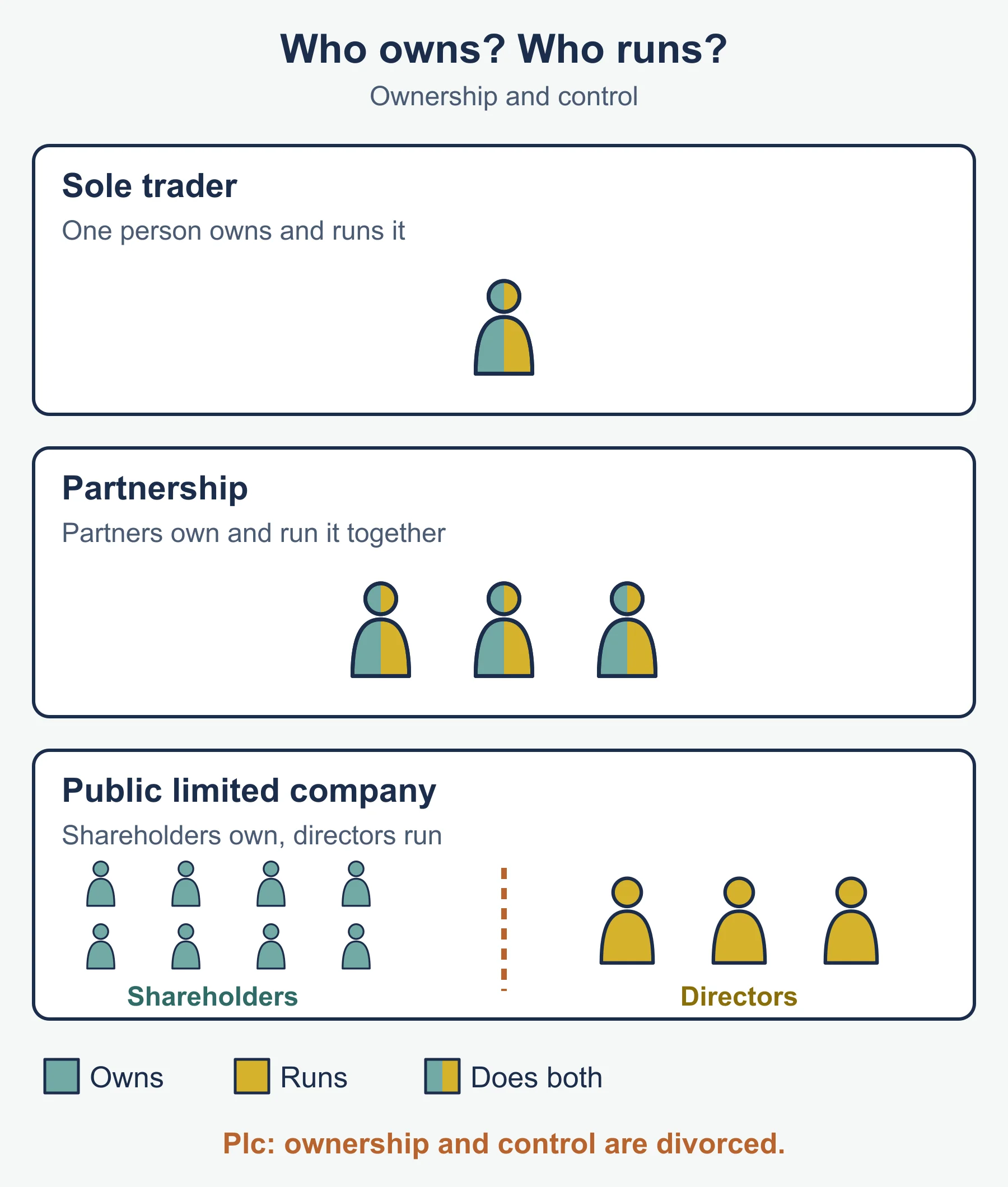
| 1.3 Business ownership | Compare sole traders, partnerships, private and public limited companies; explain limited liability; judge suitability |
| 1.4 Aims and objectives | Explain profit, survival, growth, providing a service and market share; explain why objectives change and differ |
| 1.5 Stakeholders | Explain the roles and objectives of internal and external groups, and the effects in both directions |
| 1.6 Business growth | Explain organic and external growth, including mergers, takeovers, horizontal, vertical and diversification |
The specification also asks you to use business terminology, apply concepts to familiar and unfamiliar contexts, and make decisions from information. Those skills run through every example below.
1.1 Enterprise and entrepreneurship
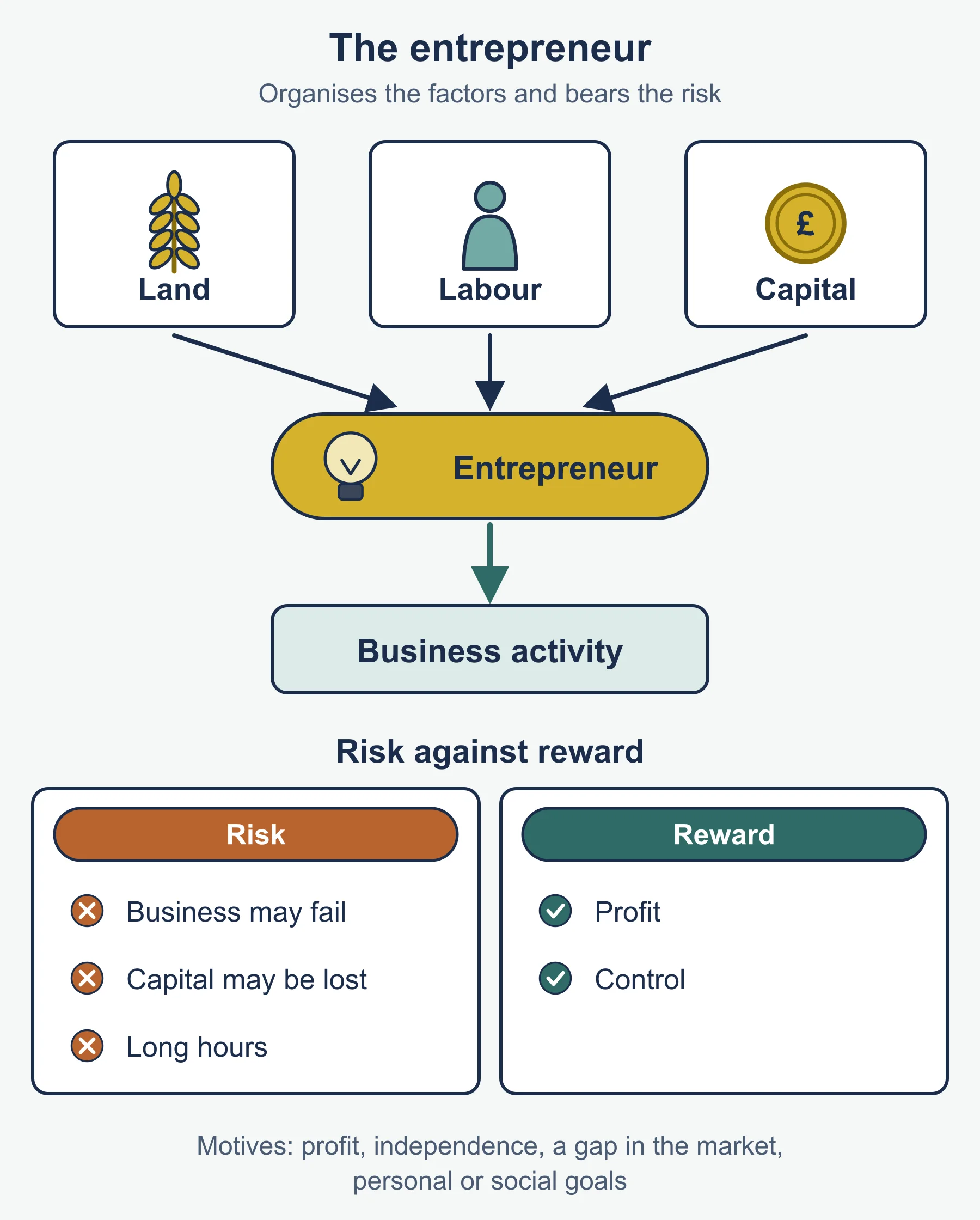
Business activity exists to satisfy the needs of customers. Enterprise is the process of doing this: spotting an opportunity, developing an idea for a business and then turning it into something customers will buy.
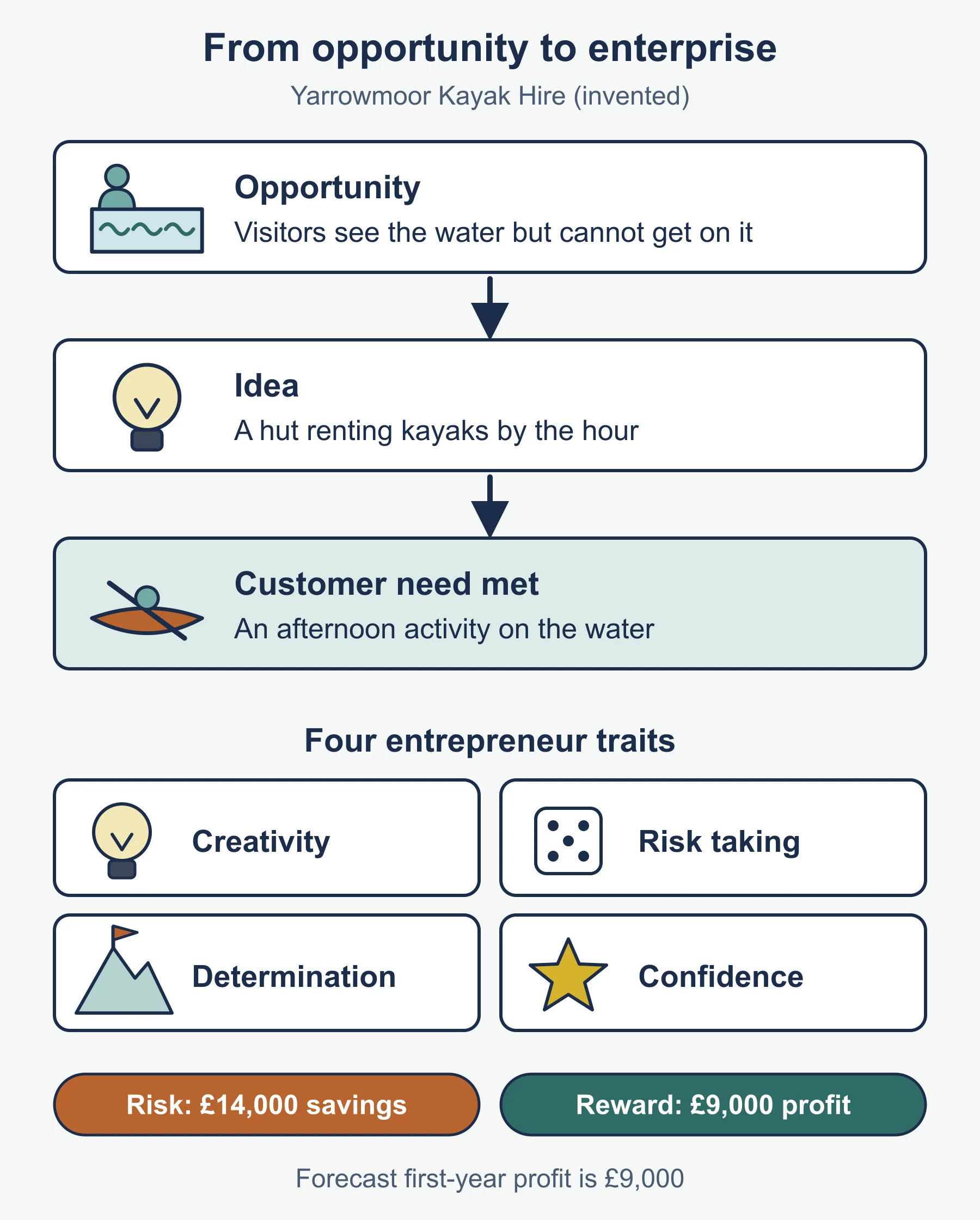
Take Yarrowmoor Kayak Hire, an invented business. Nkechi Adeyemi notices that visitors to a reservoir can watch the water but cannot get onto it. That is the opportunity. Her idea is a hut renting kayaks by the hour. The customer need she satisfies is a wish for an afternoon activity on the water.
The specification lists four characteristics of an entrepreneur.
- Creativity: coming up with an idea or a better way of meeting a need.
- Risk taking: committing money and time without knowing the result.
- Determination: carrying on through slow early sales and setbacks.
- Confidence: believing in the idea and persuading others to back it.
Risk and reward. Nkechi puts in £14 000 of savings. The risk is that visitors are too few and she loses part or all of it, as well as the pay she gave up. The reward is the profit she hopes to make, which she forecasts at £9 000 in the first year, plus being her own boss. The larger the possible reward, the more risk an entrepreneur usually has to accept. A good answer names both sides and links them to the business in the case study.
1.2 Business planning
Planning means deciding in advance what the business will do and how. Its purposes are to reduce risk and to help the business to succeed: problems are found on paper, not after money has been spent.
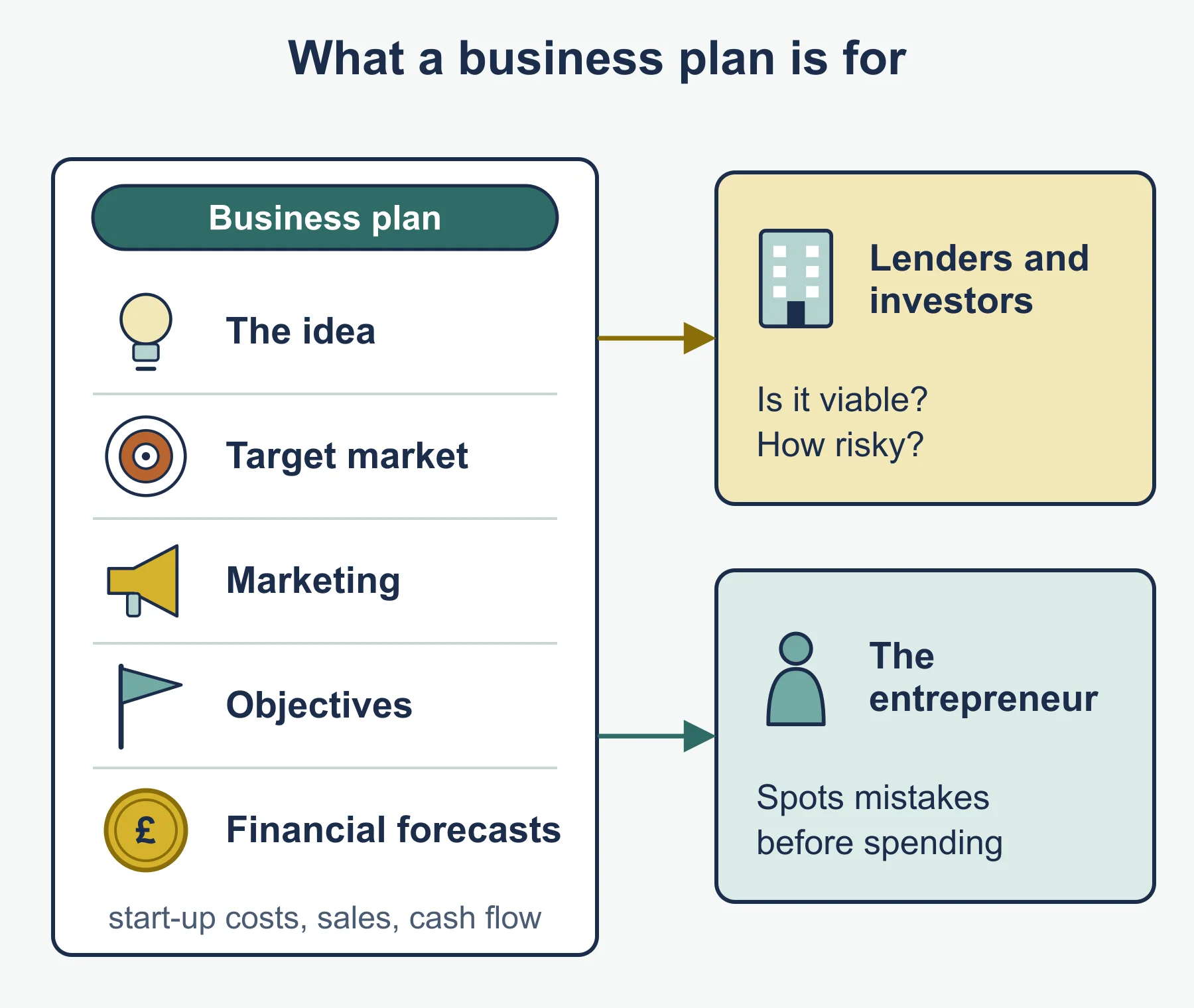
A business plan is a written document setting out the idea and how it will work. The specification names four uses (the first four below); reducing risk is also one of its two purposes of planning.
- Identifying markets. Writing the plan forces Nkechi to say who will rent kayaks, such as families and walking groups, and how many.
- Obtaining finance. A lender or investor can see that the owner has thought it through, which makes backing more likely.
- Identifying the resources needed to operate. The plan lists the kayaks, buoyancy aids, a hut, insurance and staff.
- Achieving aims and objectives. The plan turns a goal such as covering costs by month six into steps and checkpoints.
- Reducing risk. Weak points show up while they are cheap to fix.
How useful is a plan? It does not guarantee success. Forecasts can be wrong, a plan takes time to write, and a rigid owner may ignore a changed market. It is most useful when seeking finance or starting up, and less useful if never revisited. When asked about usefulness, give a benefit, a limit and a judgement.
1.3 Business ownership
| Type | Owned by | Liability |
|---|---|---|
| Sole trader | One person | Unlimited |
| Partnership | Two or more people | Unlimited |
| Private limited company (Ltd) | Shareholders | Limited |
| Public limited company (plc) | Shareholders | Limited |
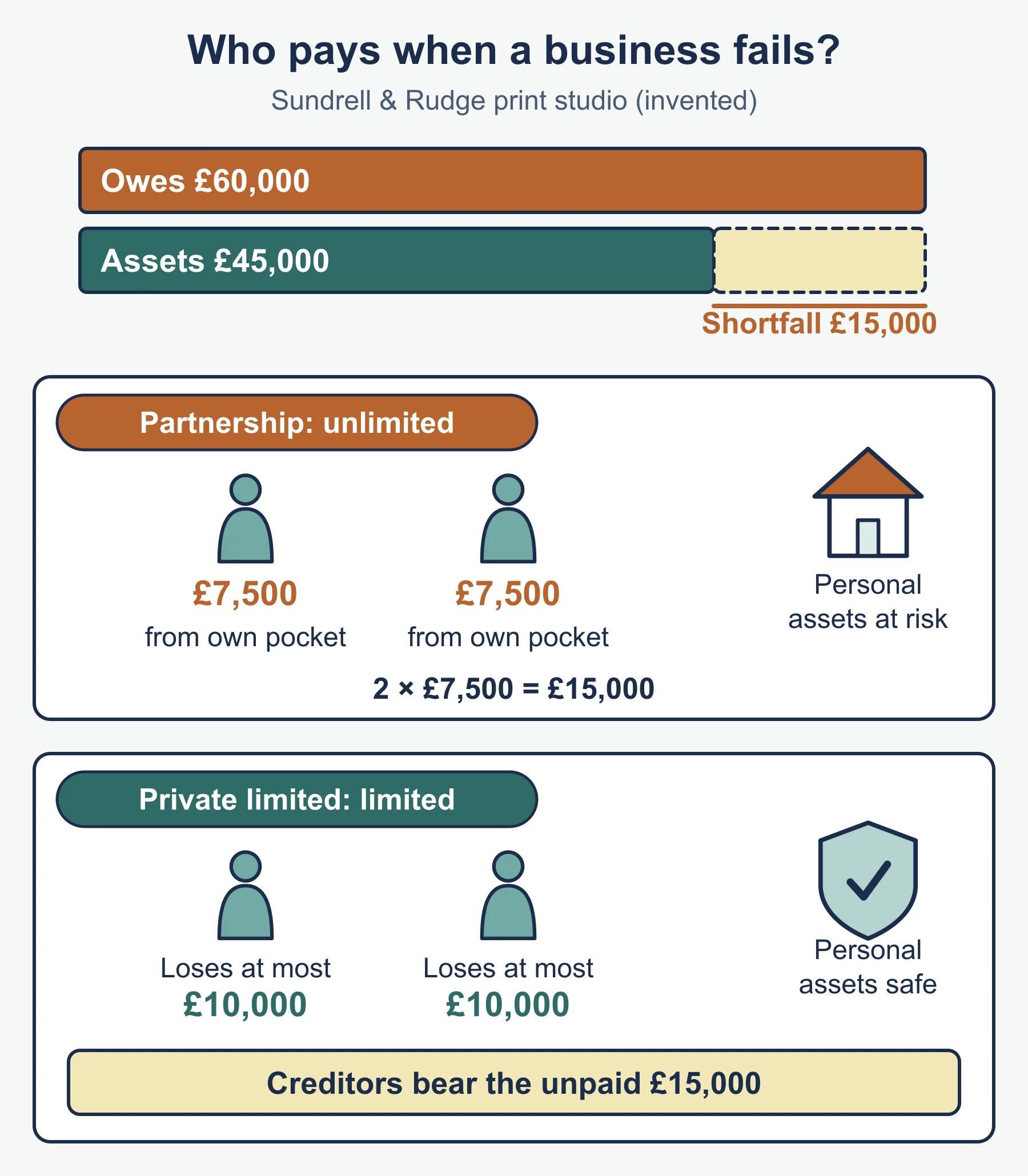
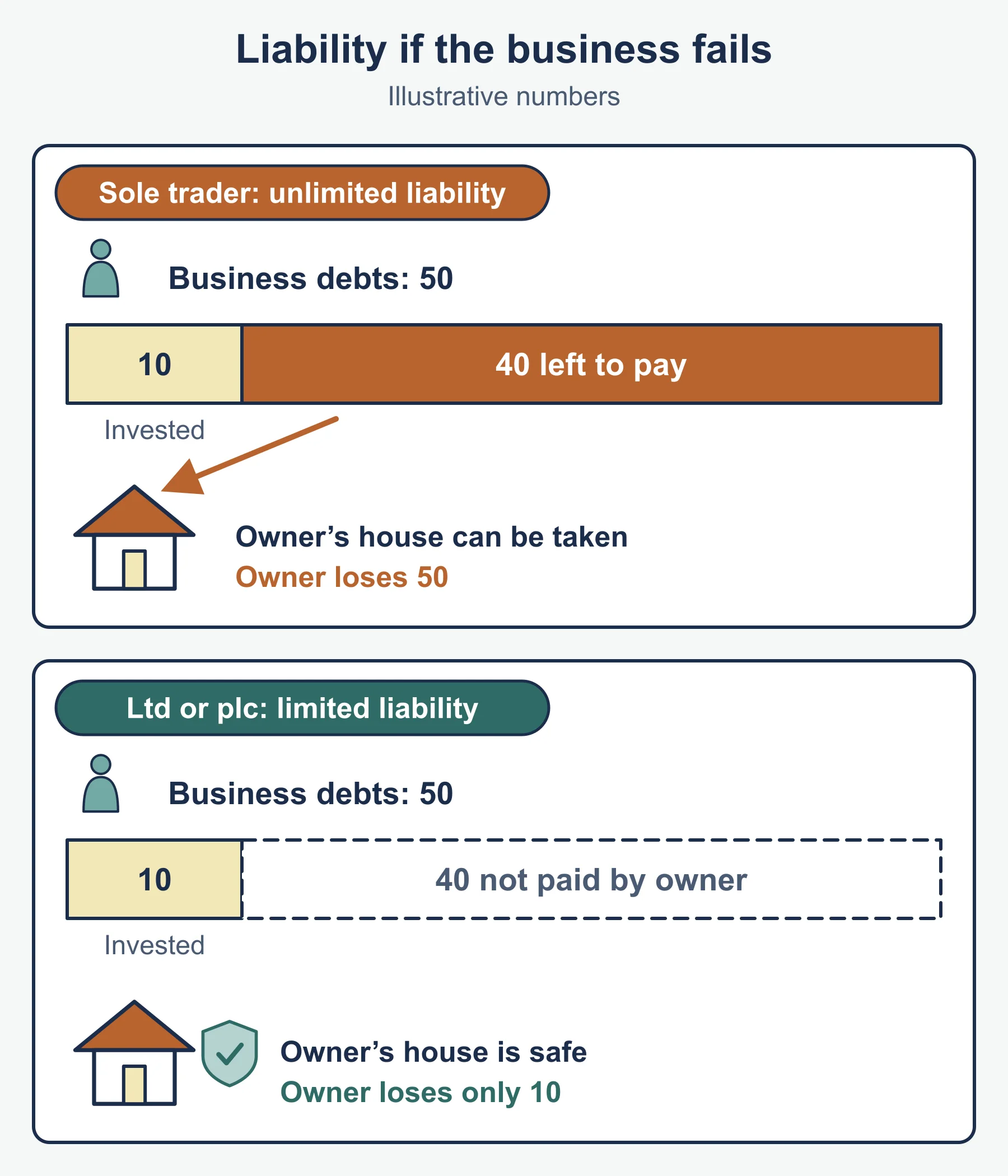
Unlimited liability means the owner’s personal assets can be used to pay business debts. Limited liability means a shareholder can lose no more than the amount they invested.
Sundrell & Rudge is an invented print studio run as a partnership. It owes £60 000 and its assets are worth £45 000. The shortfall is 60 000 - 45 000 = £15 000. Because liability is unlimited, the partners’ personal assets can be called on. If they share equally under their agreement, that is £7 500 each. Had the studio been a private limited company in which each partner invested £10 000, each could lose at most £10 000, and creditors would bear the unpaid £15 000.
Features to compare. The specification names these four types but does not list their features. The points below, and the definitions of merger and takeover in section 1.6, come from general business knowledge, not from the specification text.
- Sole trader: easy to set up, the owner keeps all profit and takes all decisions, but carries unlimited liability and has few sources of finance.
- Partnership: more people bring skills and money, but profit is shared and partners may disagree.
- Private limited company (Ltd): limited liability, shares sold privately, with more rules to follow than a sole trader.
- Public limited company (plc): shares may be sold to the public, so large sums can be raised, but ownership is spread and the business has more reporting to do.
Suitability in context. Nkechi, starting small with her own money, suits a sole trader. A family business wanting protection for its savings may prefer a Ltd. An established manufacturer that needs millions to build a new site may choose to become a plc. In an evaluation, match the type to the stage, size and finance needs, not to a favourite.
1.4 Business aims and objectives
An aim is a long-term goal. An objective is a target that helps reach it. The specification lists five.
- Profit: earning more revenue than costs.
- Survival: staying in business, common for start-ups.
- Growth: becoming larger in sales, output or sites.
- Providing a service: meeting a need for its own sake, as with a charity or community group.
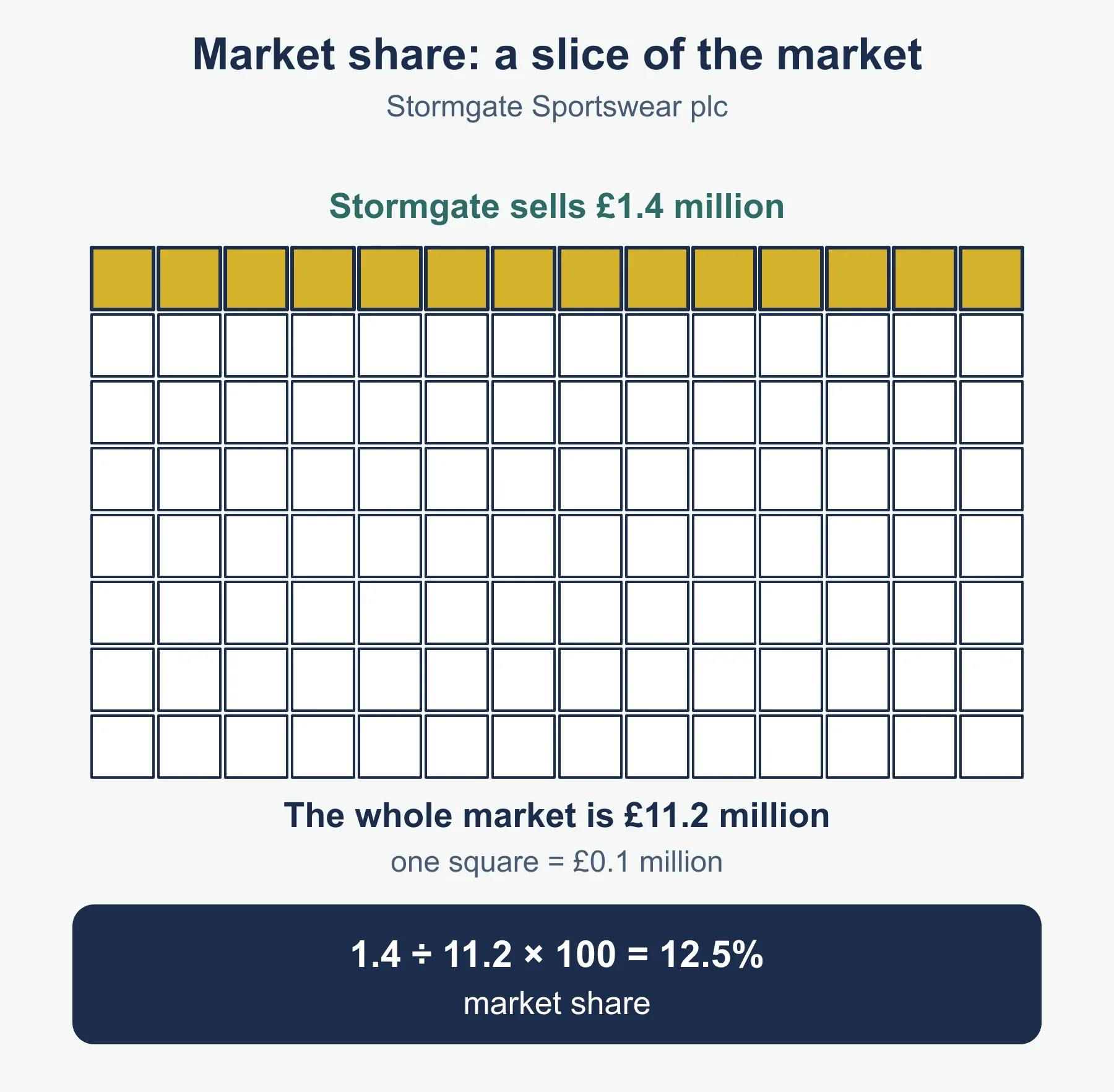
- Market share: the part of total market sales a business wins. In its standard form, market share (%) = firm’s sales ÷ total market sales × 100.
Stormgate Sportswear plc (invented) sells £1.4 million in a market of £11.2 million. Market share = 1.4 ÷ 11.2 × 100 = 12.5%.
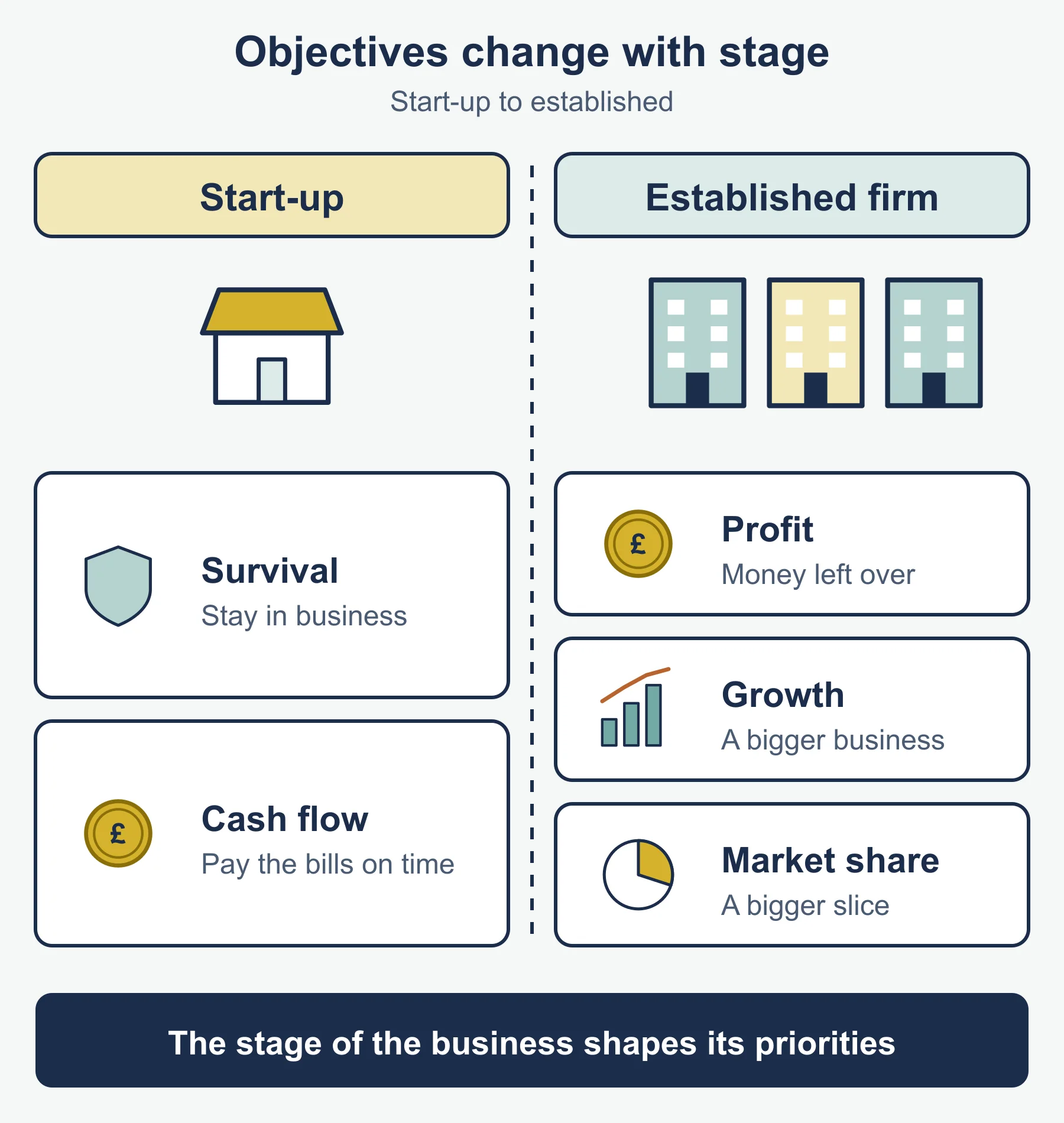
Why objectives change. A business changes as it evolves. Yarrowmoor Kayak Hire will first aim to survive the winter. If it does, it can aim for profit, then for a second hut. Competitors, the economy and the owner’s own ambitions can also move the target.
Why businesses differ. Calder Valley Community Transport (invented) runs minibuses for people without cars. It values providing a service and breaking even, while a plc such as Stormgate answers to shareholders who expect profit and growth. Size, ownership and the owner’s motives all change the objective.
1.5 Stakeholders in business
A stakeholder is someone, or a group, with a stake in a business, either because it affects them or because they can influence it.
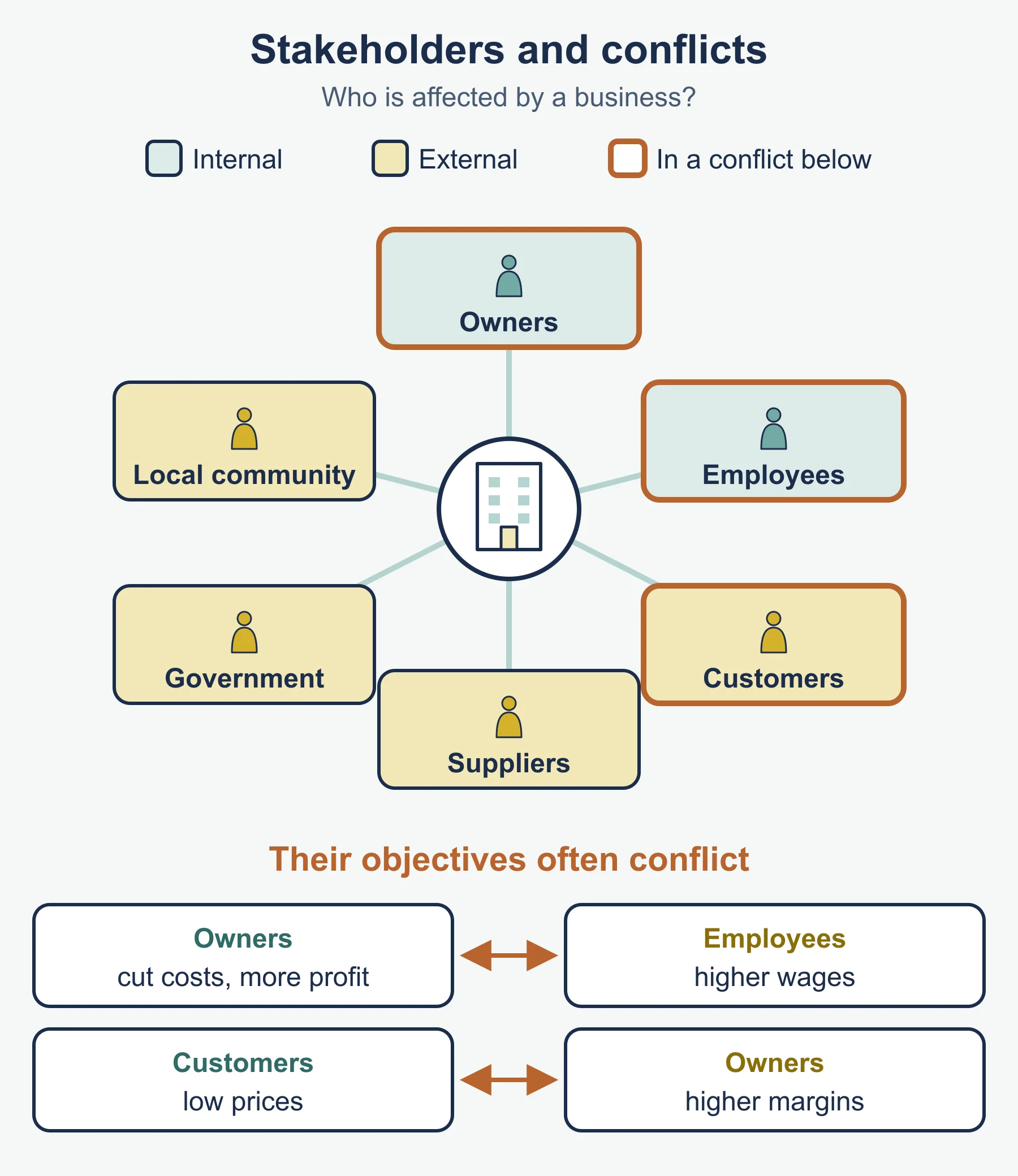
| Group | Type | Role and typical objective |
|---|---|---|
| Owners | Internal | Provide money and take the risk; want profit and growth |
| Employees | Internal | Do the work; want fair pay, security and good conditions |
| Customers | External | Buy the output; want quality, value and service |
| Suppliers | External | Provide inputs; want regular orders and prompt payment |
| Government | External | Sets rules and collects taxes; wants compliance and jobs |
| Local community | External | Lives near the business; wants jobs and minimal disturbance |
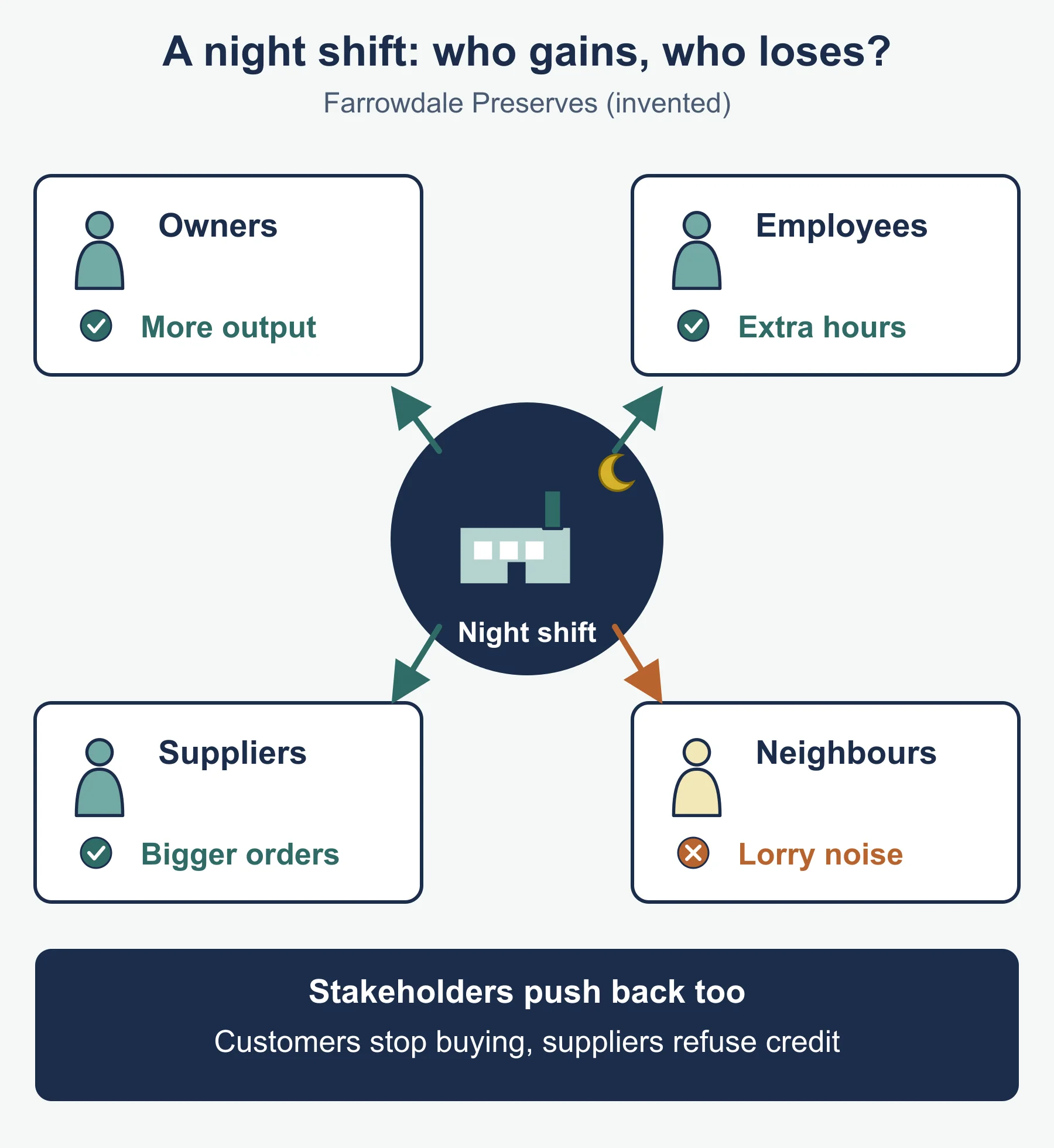
Effect of business on stakeholders. If Farrowdale Preserves (invented) opens a night shift, owners gain output, employees gain extra hours, suppliers gain bigger orders, and neighbours may suffer lorry noise.
Effect of stakeholders on a business. Customers can stop buying after poor service. Employees can leave, or work harder when treated well. Suppliers can refuse credit. The government can change rules. The community can complain and damage the firm’s image.
Conflict. Interests often clash. A pay rise helps employees but cuts profit for owners. Expansion pleases owners but may upset the community. For a high-mark answer, say which stakeholder matters more in this case and why.
1.6 Business growth
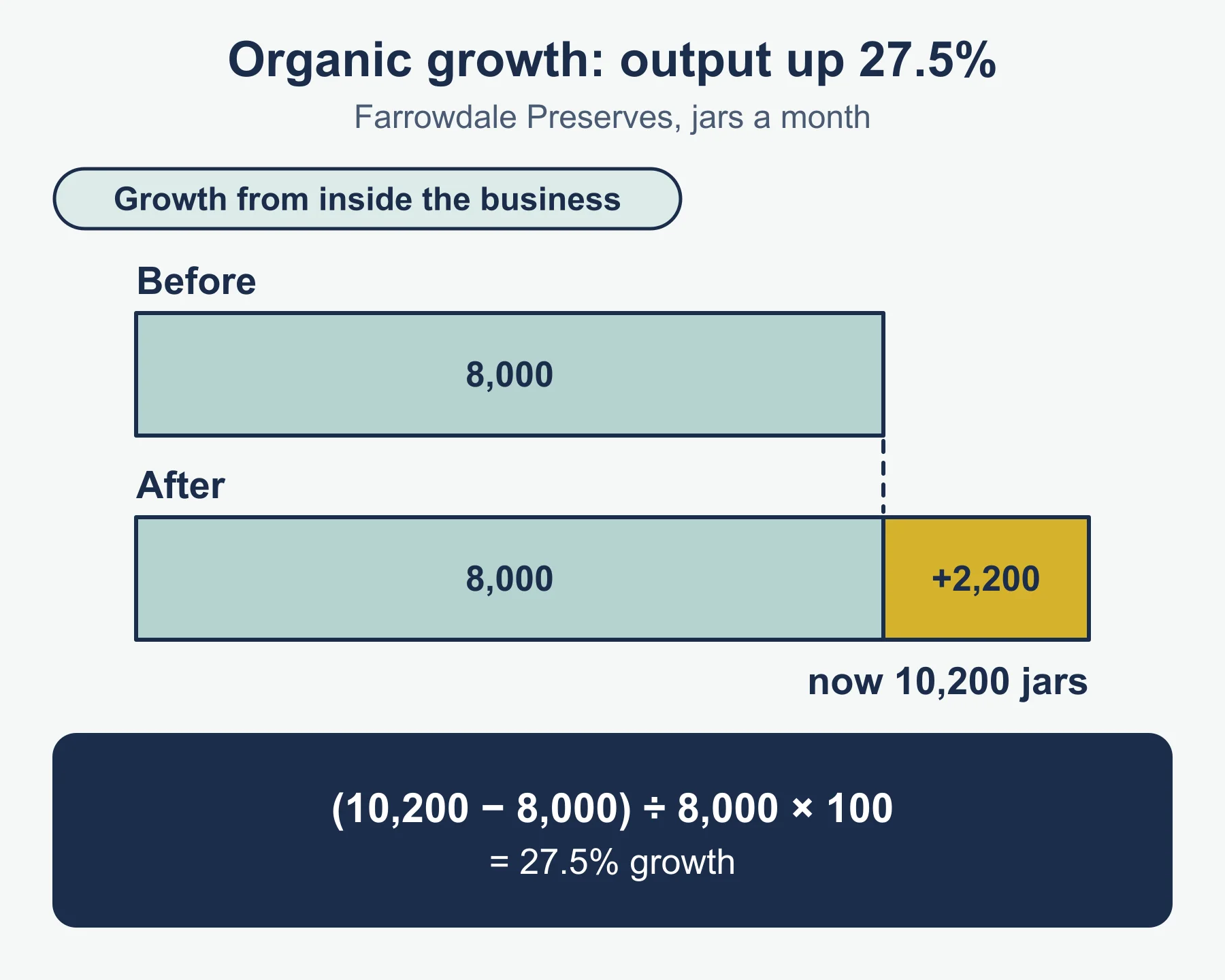
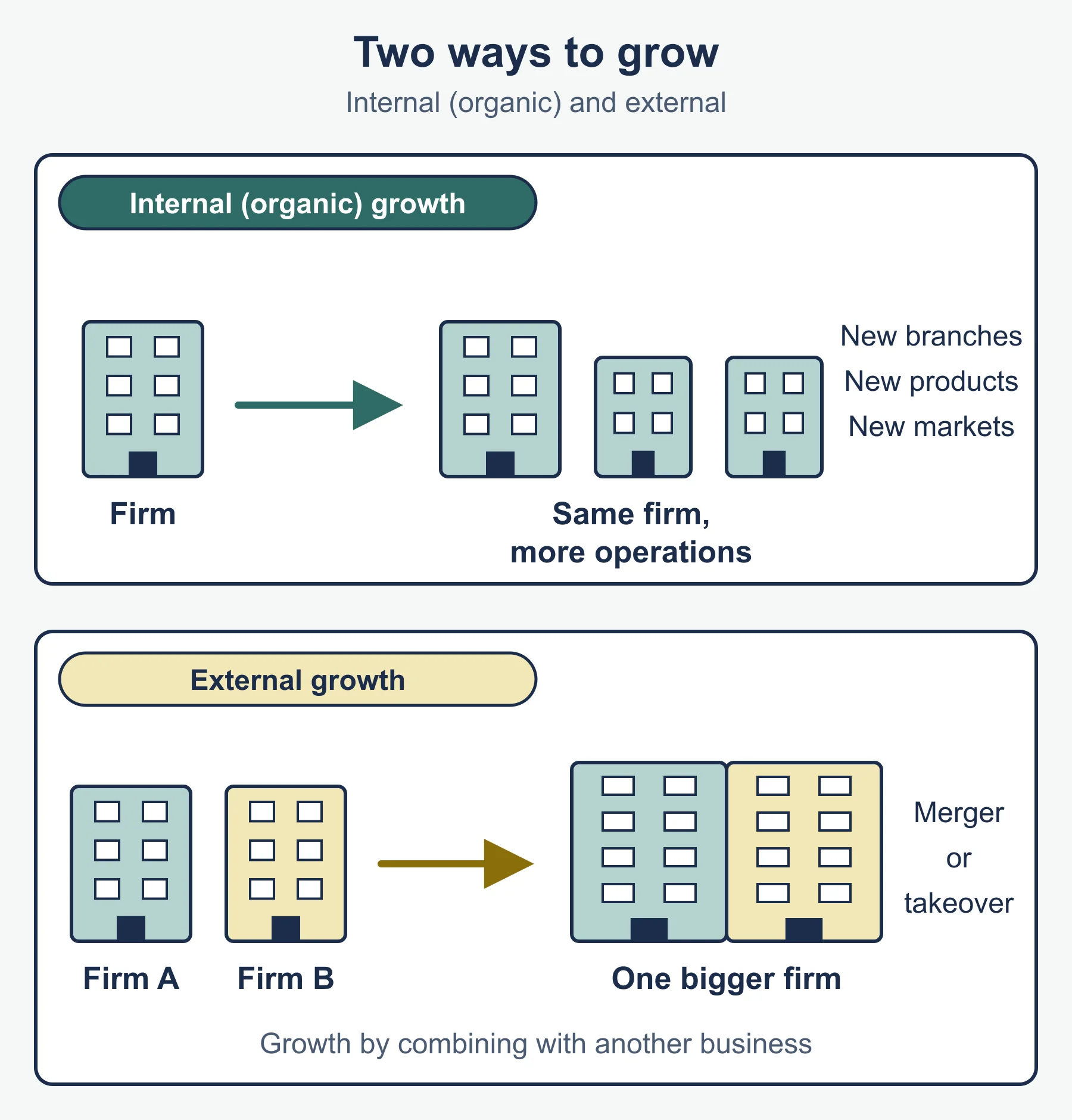
Organic growth comes from inside, using the business’s own resources. The specification lists four forms.
- Increasing output: Farrowdale Preserves lifts production from 8 000 to 10 200 jars a month, growth of (10 200 - 8 000) ÷ 8 000 × 100 = 27.5%.
- Gaining new customers, for example by selling to a new town.
- Developing new products.
- Increasing market share.
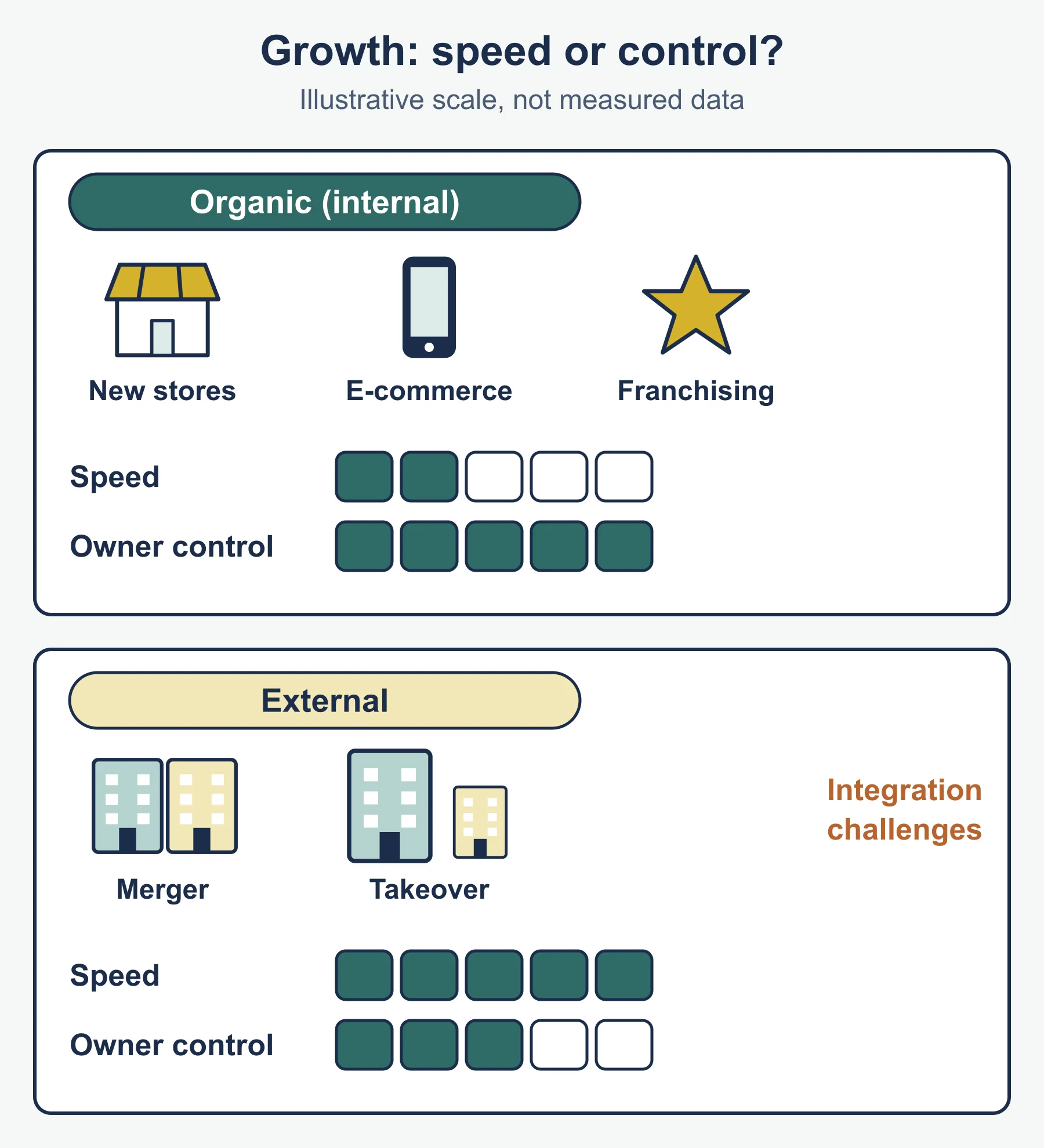
Organic growth is slower but lower risk and easier to control.
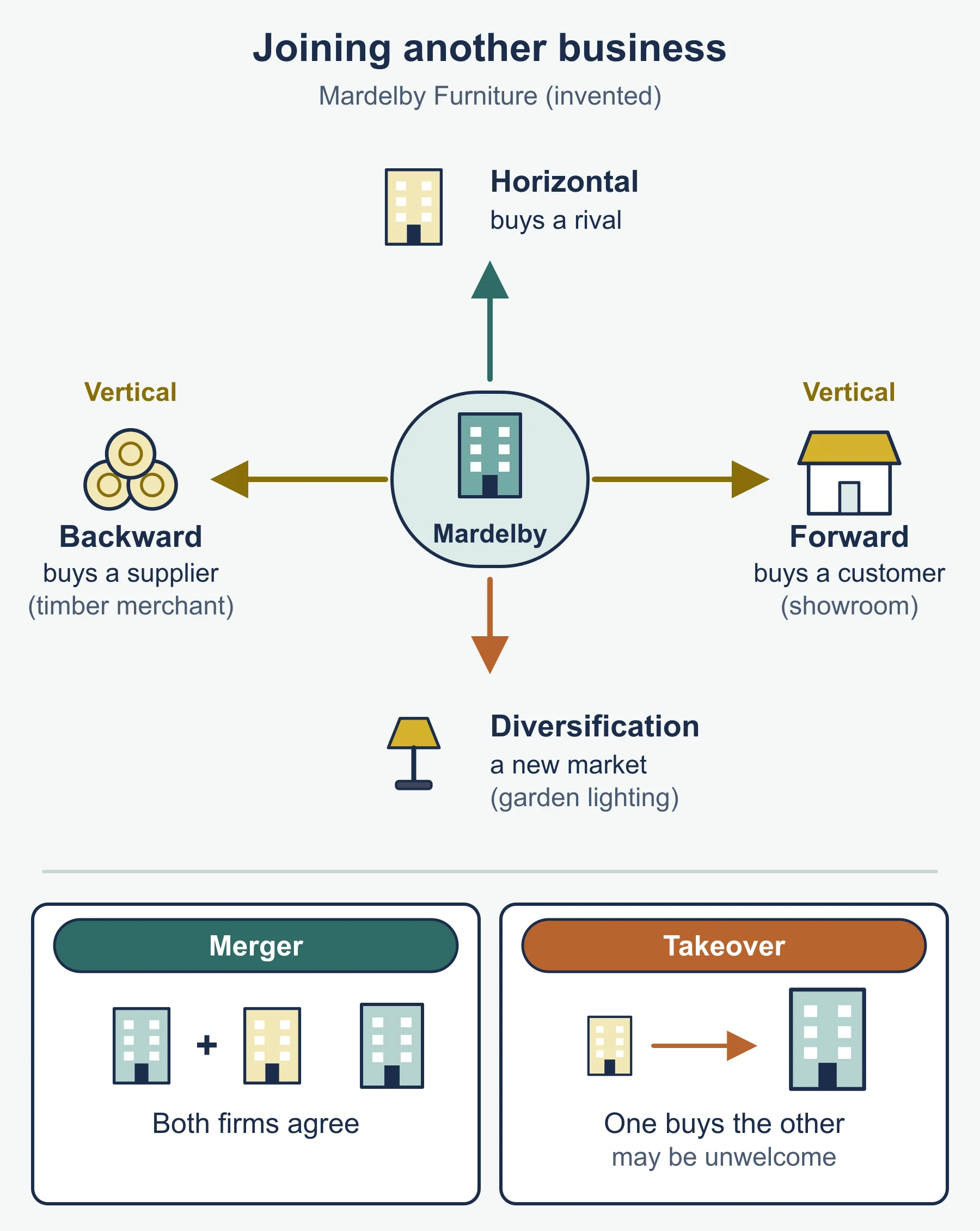
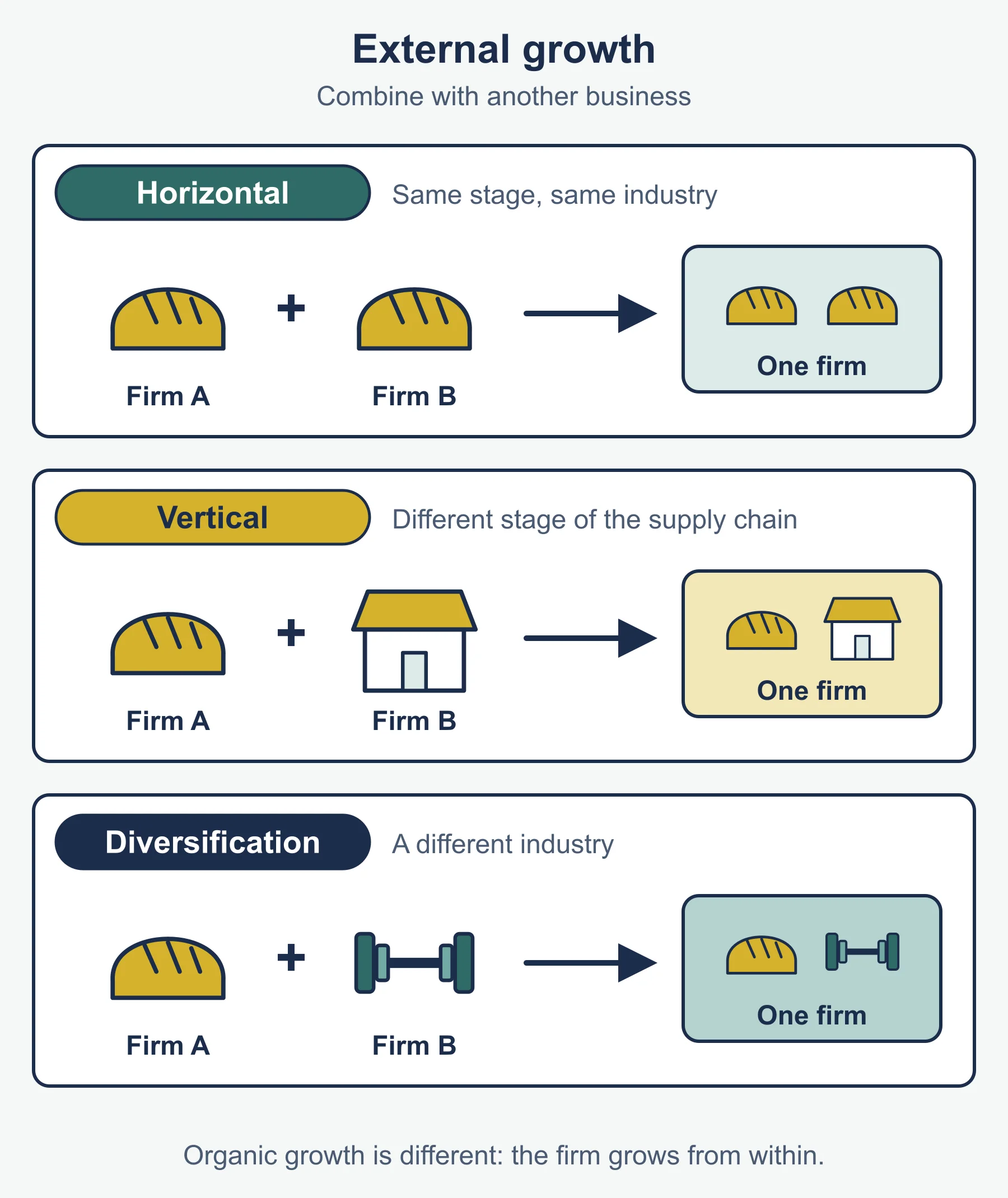
External growth joins with another business. In a merger two firms agree to combine. In a takeover one firm buys another, which may be unwelcome to the target. Three directions are named.
- Horizontal: joining a business at the same stage of production. Mardelby Furniture (invented) buys a rival furniture maker.
- Vertical: joining a business at a different stage in the chain. Backward means buying a supplier, such as a timber merchant. Forward means buying a customer, such as a showroom.
- Diversification: moving into a new market or product, for example the furniture maker buying a garden-lighting firm.
External growth is fast and can win market share or a supply, but it costs money, the businesses may not blend, and staff can resist change. When you evaluate, link the type to the objective.
How to answer section 1 questions
Follow the command words in the specification. Identify and state need knowledge only. Explain needs knowledge applied to the case. Analyse needs a logical chain of reasoning. Evaluate and discuss mean weighing both sides and reaching a supported judgement. Recommend needs a supported judgement. Use the business named in the stimulus and its numbers.
Common errors
- Thinking limited liability cancels the debt. The company still owes it; the shareholder’s own loss is capped.
- Treating a plc as owned by the government.
- Assuming every objective is profit.
- Mixing up merger and takeover, or horizontal and vertical.
- Listing stakeholders without saying how each is affected.
- Describing a business plan without saying why it helps this business.
Frequently asked questions
What is the difference between a merger and a takeover? In a merger, two businesses agree to combine into one. In a takeover, one business buys control of another.
What is the difference between horizontal and vertical growth? Horizontal growth joins a business at the same stage of production, such as buying a rival. Vertical growth joins a business at a different stage in the chain: backward means buying a supplier and forward means buying a customer.
What is the difference between organic and external growth? Organic growth comes from inside the business using its own resources, and is slower but lower risk and easier to control. External growth joins with another business through a merger or takeover, and is faster but costs more and the businesses may not blend well.
How does a business plan help a new business? In OCR GCSE Business (J204), a business plan helps identify markets, obtain finance, identify the resources needed to operate and achieve aims and objectives. Writing it also reduces risk because weak points show up while they are cheap to fix.
Why do business objectives change over time? A business changes as it evolves, so its objectives change too. A start-up usually aims first to survive, then may move on to profit, growth or market share once it is established.
Official syllabus
OCR GCSE (9-1) Business (J204) specification, Version 2.0 (January 2026), section 1 Business activity. Published by OCR.
Get free revision emails (optional)
Occasional emails with practice questions, worked explanations and links to free resources for the qualification and subjects you choose. No spam, and you can unsubscribe from any email. The free tools on this site never need an email.
Related resources
-
Study guides
OCR GCSE Business: Business Activity, Marketing and People (J204)
Business activity, marketing, and people – the three sections of Component 1 (J204/01) for OCR GCSE Business (J204).
Business · OCR · GCSE
Read guide -
Practice questions
OCR GCSE Business: Business activity (J204) – Practice Questions
Original practice questions with worked answers on OCR GCSE Business section 1: enterprise, planning, ownership, objectives, stakeholders and growth.
Business · OCR · GCSE
Try questions -
Revision notes
OCR GCSE Business: Business activity (J204) – Revision Notes
Condensed revision notes on OCR GCSE Business section 1: enterprise, planning, ownership, objectives, stakeholders and growth, with a self-test.
Business · OCR · GCSE
Revise topic
Related articles
-
teaching
A Level tuition in Dubai: Cambridge or Pearson Edexcel International A Level?
Schools in Dubai and Abu Dhabi teach either Cambridge International AS & A Level or Pearson Edexcel International A Level. How the two are structured, why it matters for tuition, and how online classes from Lahore work.
9 October 2026
-
curriculum guides
Choosing subjects at IGCSE and A Level
How subject choices at 14 and 16 affect university options later, and how to keep pathways open without overloading a timetable.
28 July 2026
Studying this with a teacher
Working through Business GCSE?
This page is free and stays free. If you would rather be taught it, Marlbridge runs Business classes one-to-one, online in your own time zone. One-to-one only for this course: Rs 6,000 per class in Pakistan, with other currencies on the fees page. The first trial class is free. WhatsApp replies within an hour (8am–11pm Pakistan time, every day); email the same day.
OCR Business teachers at Marlbridge
