
Revision Notes
OCR GCSE Business: Business activity (J204) – Revision Notes
Condensed revision notes on OCR GCSE Business section 1: enterprise, planning, ownership, objectives, stakeholders and growth, with a self-test.
- Subject
- Business
- Level
- GCSE
- Topic
- Business activity, marketing and people
- Author
- Marlbridge Academic Team
- Updated
- Reviewed by
- Salman Ahmad (what this means)
Aligned to OCR GCSE Business (J204), Version 2.0 (January 2026), for first assessment in 2019. Official specification .
Syllabus page (what it covers and how it is assessed): OCR GCSE Business.
Syllabus points this page covers
J204
- 1 Business activity
Found an error? Report a correction.
Need help with this topic? Request a free trial class for GCSE Business (J204).
Quick recall for section 1, Business activity, of the OCR GCSE (9-1) Business specification (J204), Version 2.0 (January 2026), topics 1.1 to 1.6, examined in Business 1. For full explanations and worked examples, read the Business activity study guide, then test yourself with the practice questions.
Other links: the OCR GCSE Business hub, the printable checklist, the earlier component-level revision notes and the free diagnostics.
Key terms
| Term | Meaning |
|---|---|
| Business activity | Providing goods or services to satisfy customers’ needs |
| Enterprise | Spotting an opportunity and developing an idea for a business |
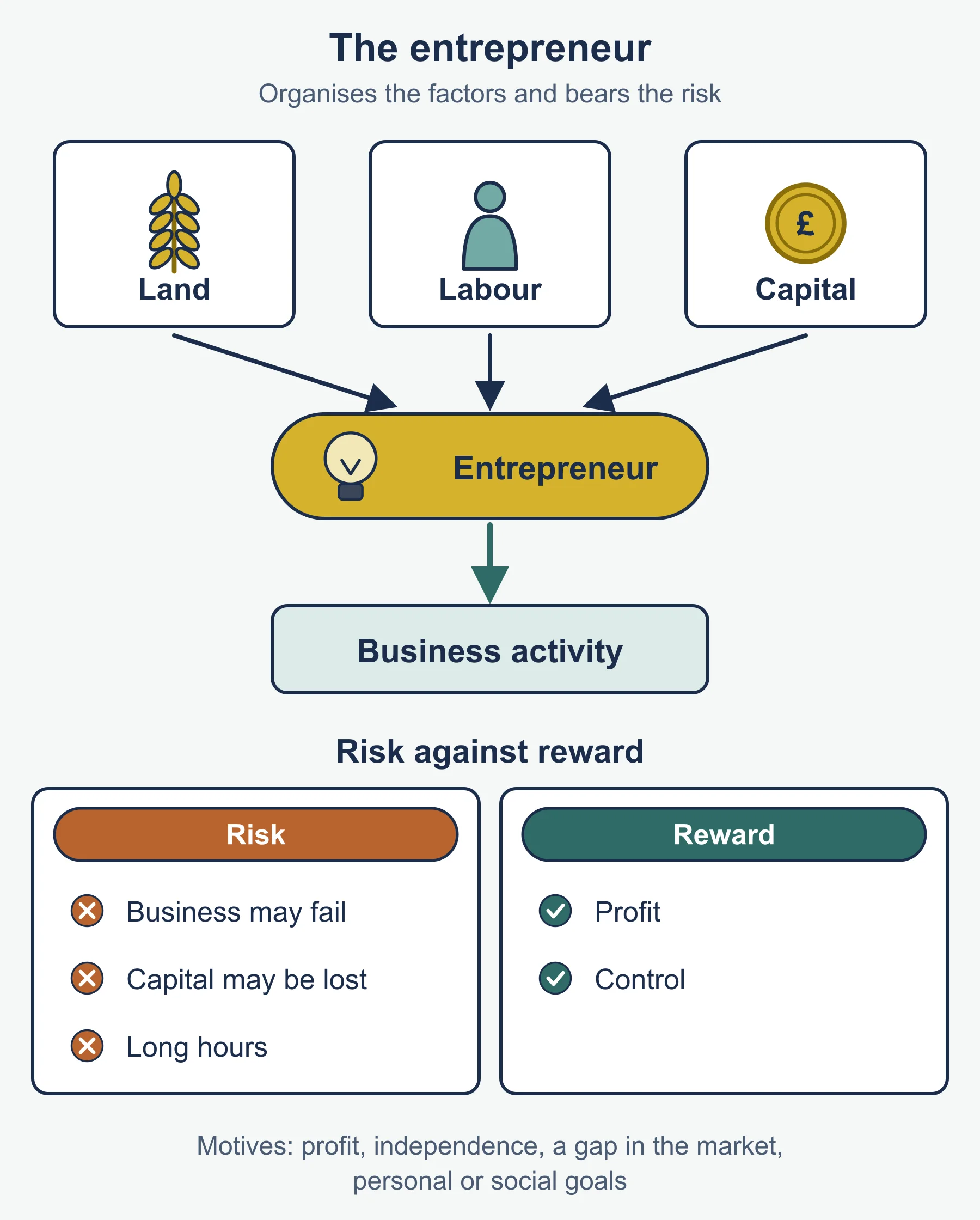
| Entrepreneur | Person who takes the risk of starting and running a business |
| Business plan | Written document setting out the idea, market, resources and finance |
| Liability | Responsibility for business debts |
| Aim and objective | Long-term goal and the target that helps reach it |
| Stakeholder | Someone with a stake in a business, affected by it or able to influence it |
| Organic growth | Growth from within, using the business’s own resources |
| External growth | Growth by joining with another business |
1.1 Enterprise and entrepreneurship
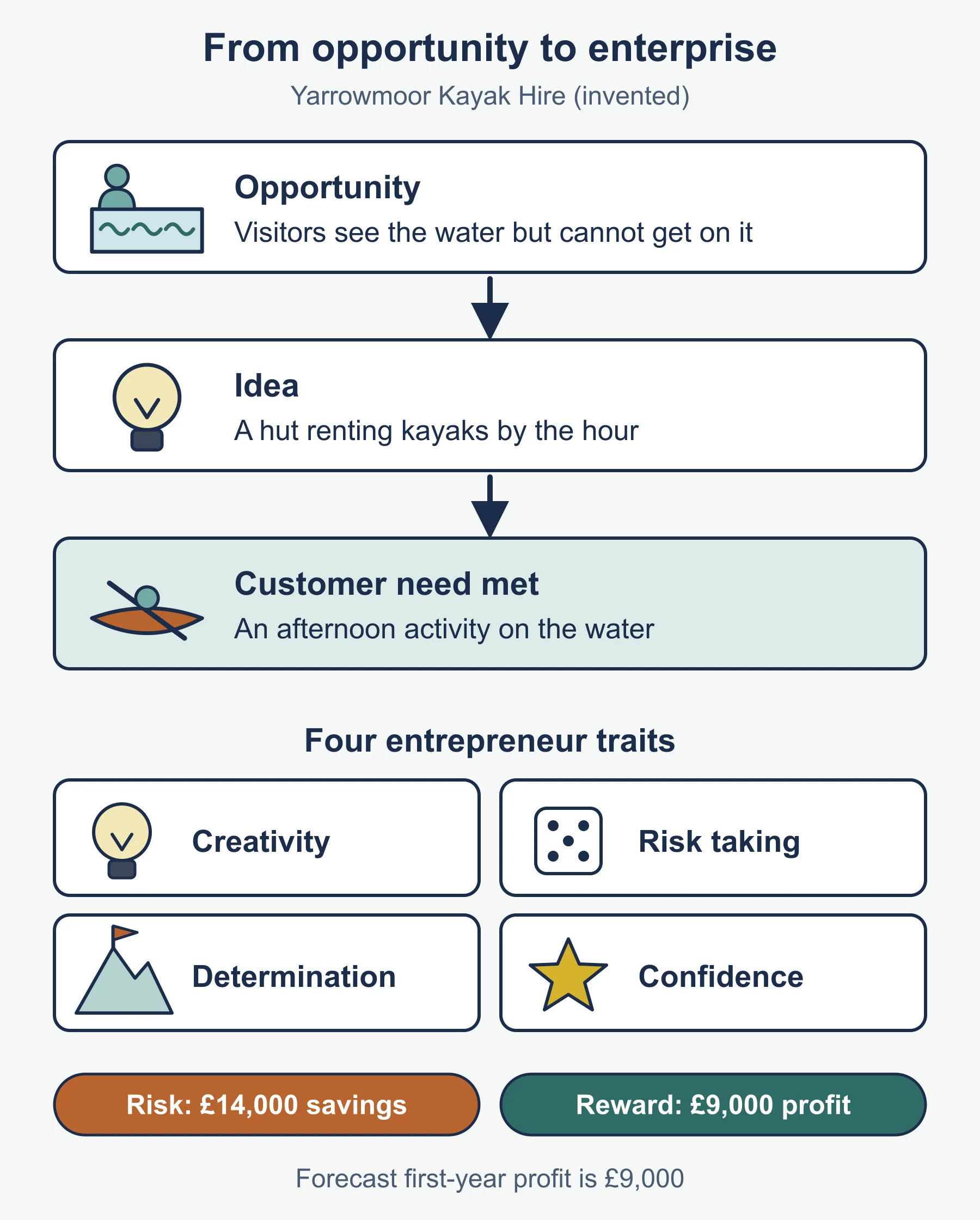
- Purpose: spot an opportunity, develop an idea, satisfy customer needs.
- Characteristics to know: creativity, risk taking, determination, confidence.
- Risk is what may be lost: money, time, income given up. Reward is what may be gained: profit, independence.
Method in steps for a 1.1 case question:
- Name the characteristic.
- Quote the evidence from the case.
- Say why it helps this business to start or survive.
Mini example: Arlo Pennick (invented) leaves a job to sell repaired bicycles at weekend markets. His risk is lost pay and the stock he buys; his reward is profit and being his own boss.
1.2 Business planning
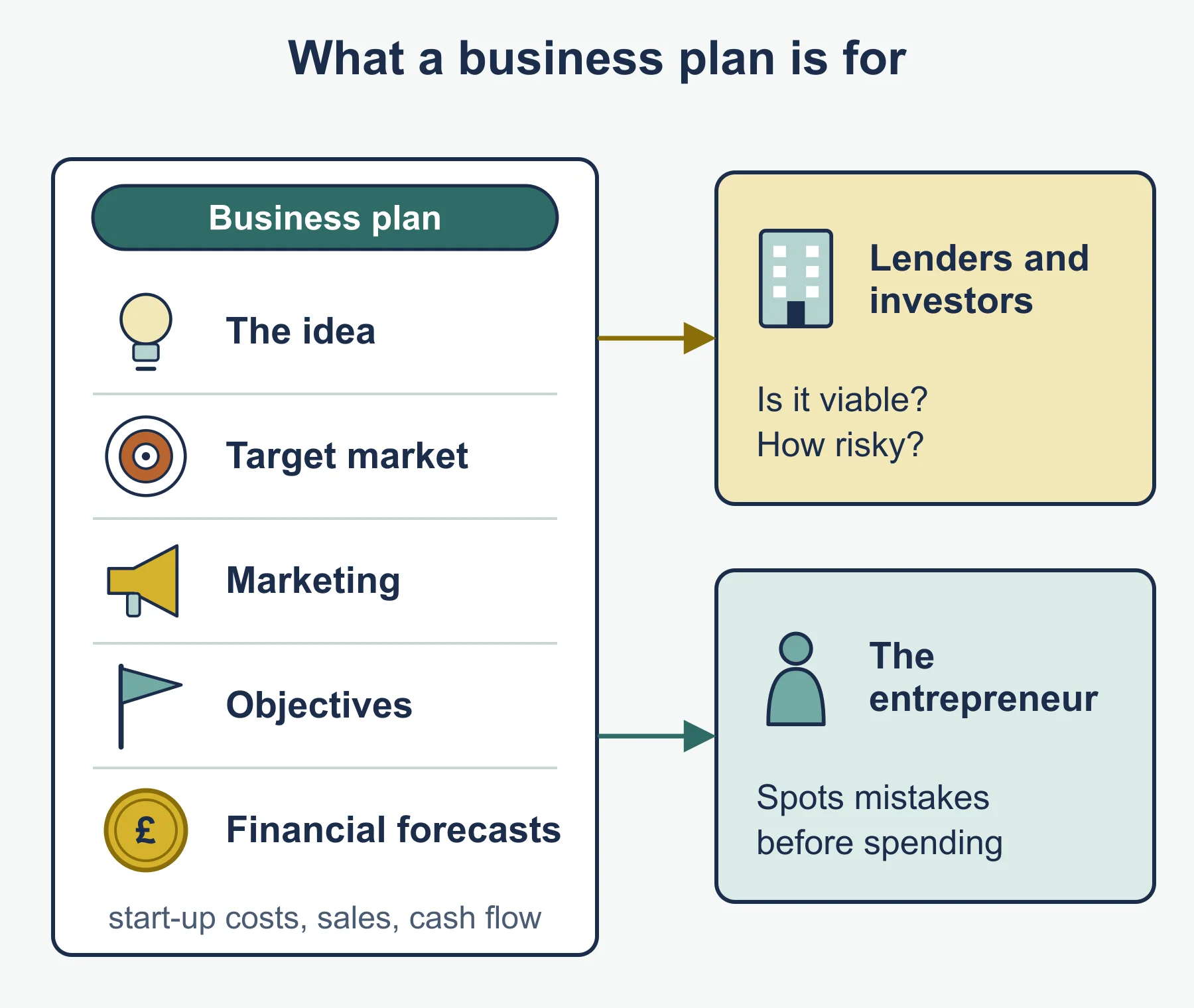
- Purposes of planning: reduce risk, help the business succeed.
- Business plan helps with: identifying markets, obtaining finance, identifying resources needed, achieving aims and objectives.
- Limits: forecasts may be wrong; it takes time; it must be updated.
Must-know distinction: a plan supports success, it does not guarantee it. “Useful because it helps get a loan” is a start; add why a lender wants to see it.
1.3 Business ownership
| Type | Owners | Liability | Key advantage | Key drawback |
|---|---|---|---|---|
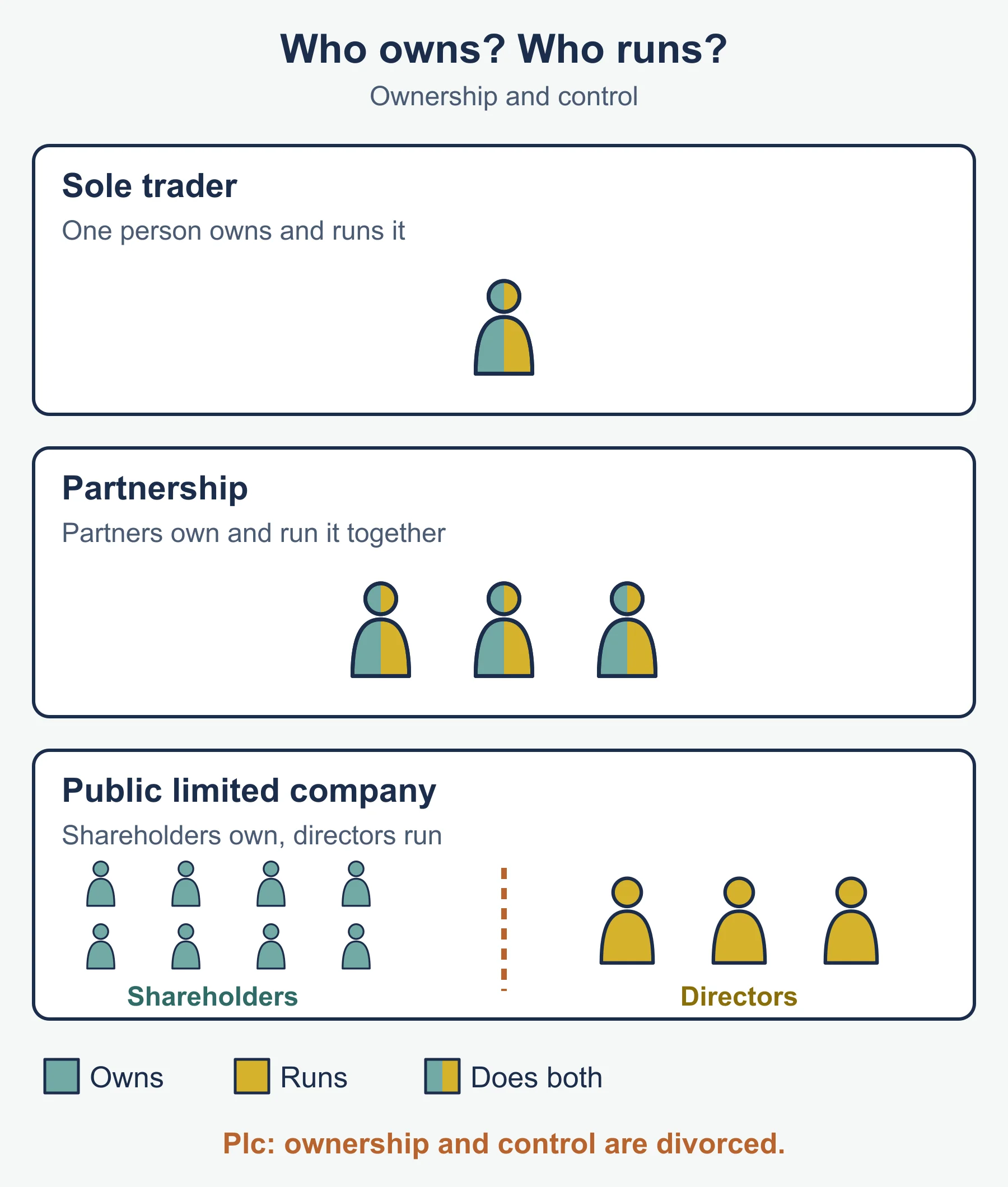
| Sole trader | 1 | Unlimited | Full control and profit | All risk; few sources of finance |
| Partnership | 2 or more | Unlimited | Shared skills and money | Profit shared; disagreements |
| Private limited (Ltd) | Shareholders | Limited | Owners protected | More rules to follow |
| Public limited (plc) | Shareholders | Limited | Shares sold to the public | Ownership spread; more reporting |
Note: the specification names the types and the concept of limited liability; the advantages and drawbacks in the table are general business knowledge, not specification text.
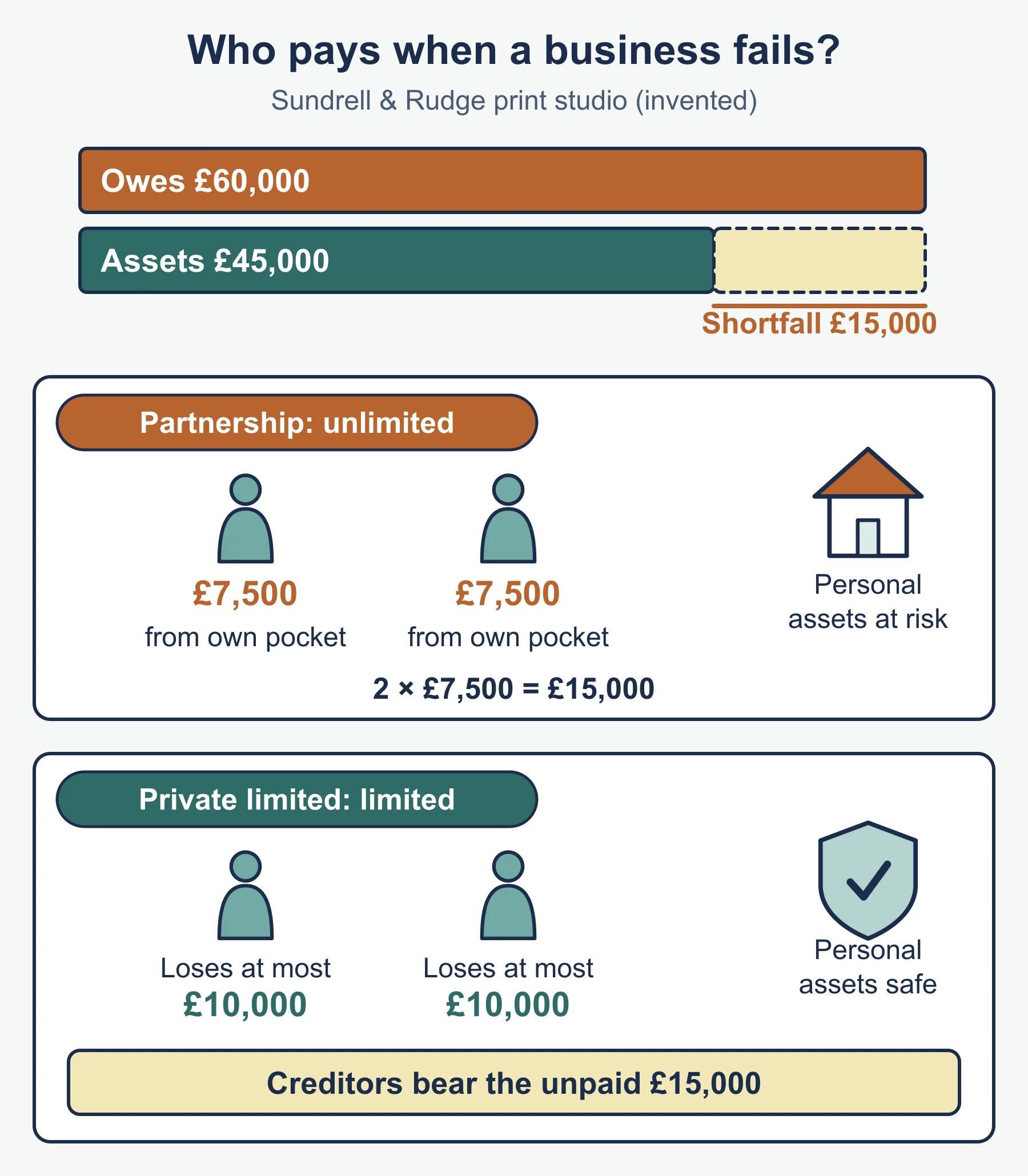
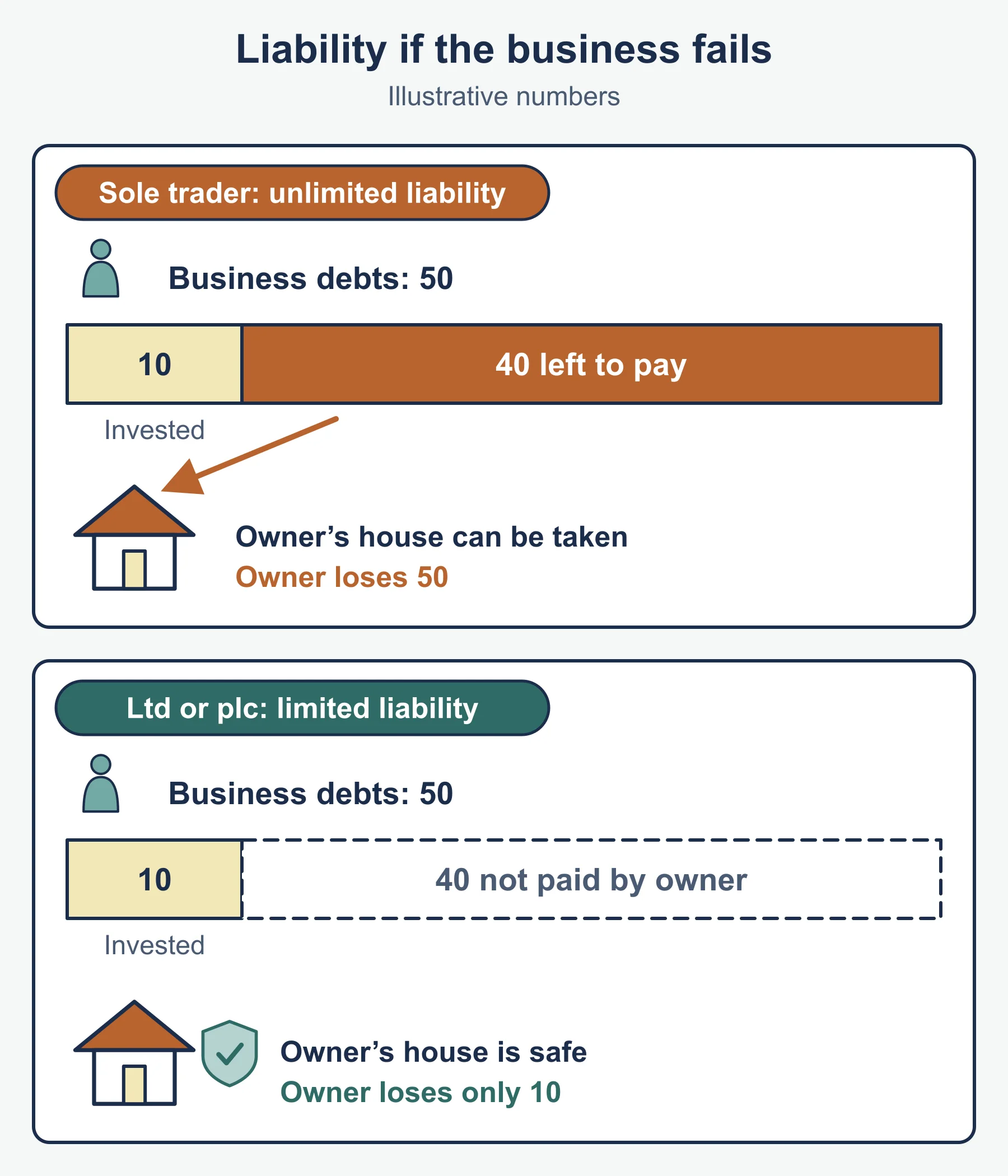
- Unlimited liability: personal assets can be used to pay business debts.
- Limited liability: a shareholder loses no more than they invested.
- Calculation pattern: shortfall = debts - assets. Debts £25 000, assets £18 000 gives a shortfall of £7 000, or £3 500 each for two equal partners.
- Suitability: start-up with small capital often sole trader or partnership; established business needing large funds may become a plc.
Common slip: limited liability does not remove the debt. It limits what the owner personally loses.
1.4 Aims and objectives
- The five to know: profit, survival, growth, providing a service, market share.
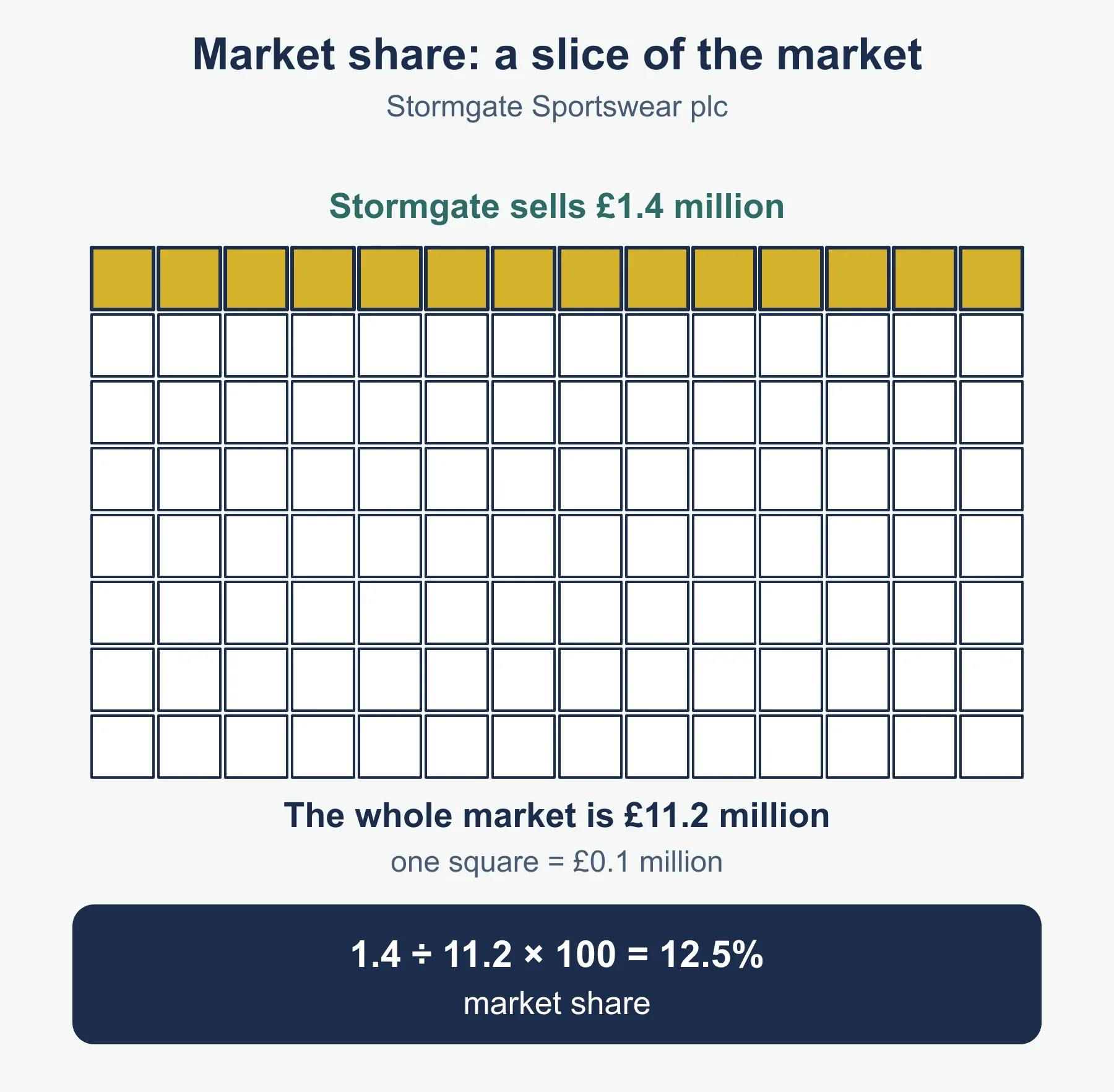
- Standard form: market share (%) = firm’s sales ÷ total market sales × 100. For example £63 000 of £450 000 is 14%.
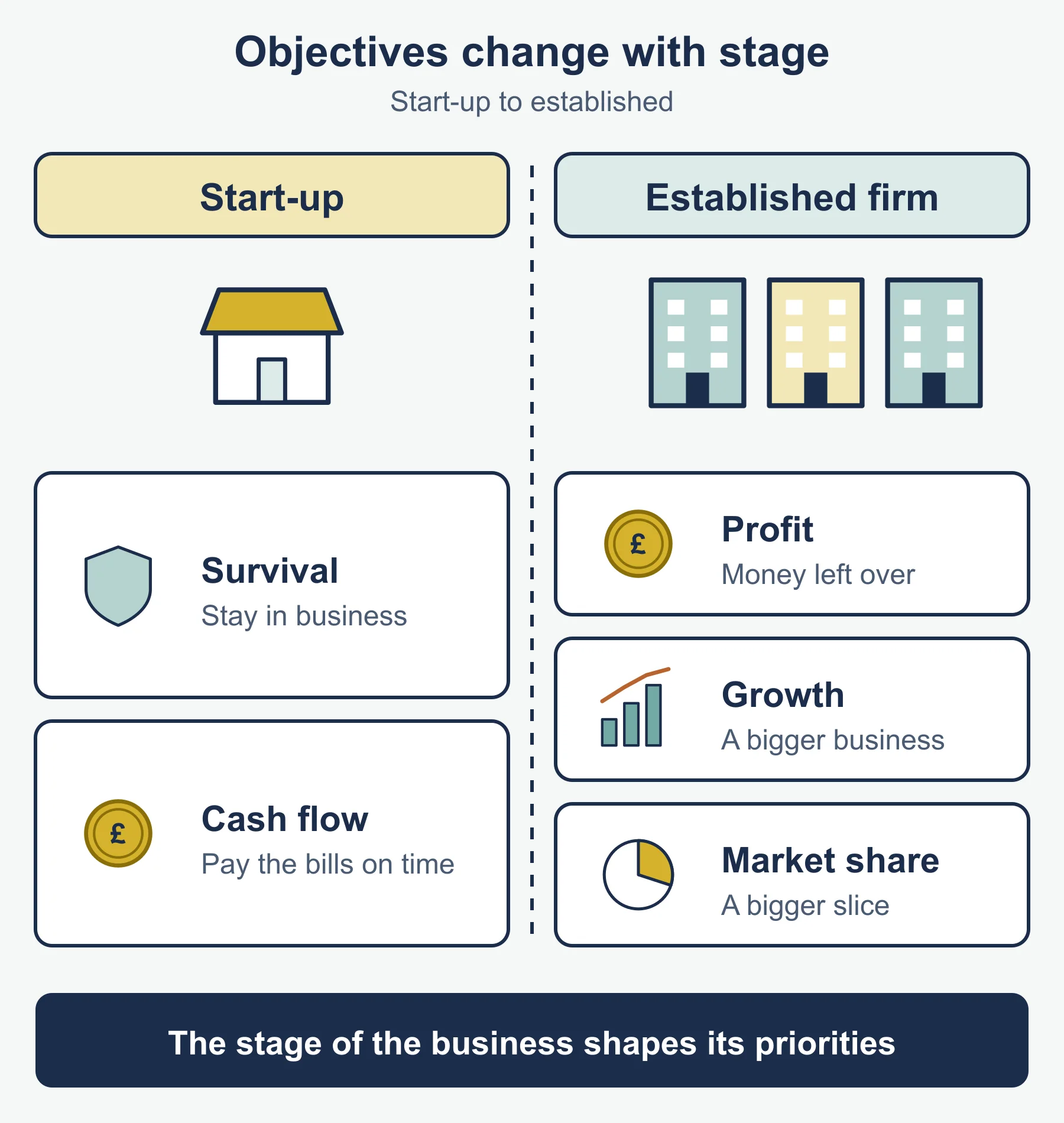
- Objectives change as a business evolves: survival, then profit, then growth.
- Objectives differ between businesses because of size, ownership, motives and the market.
| Business type | Likely objective |
|---|---|
| Brand-new start-up | Survival |
| Plc with shareholders | Profit, growth |
| Charity or community group | Providing a service |
| Challenger in a crowded market | Market share |
1.5 Stakeholders
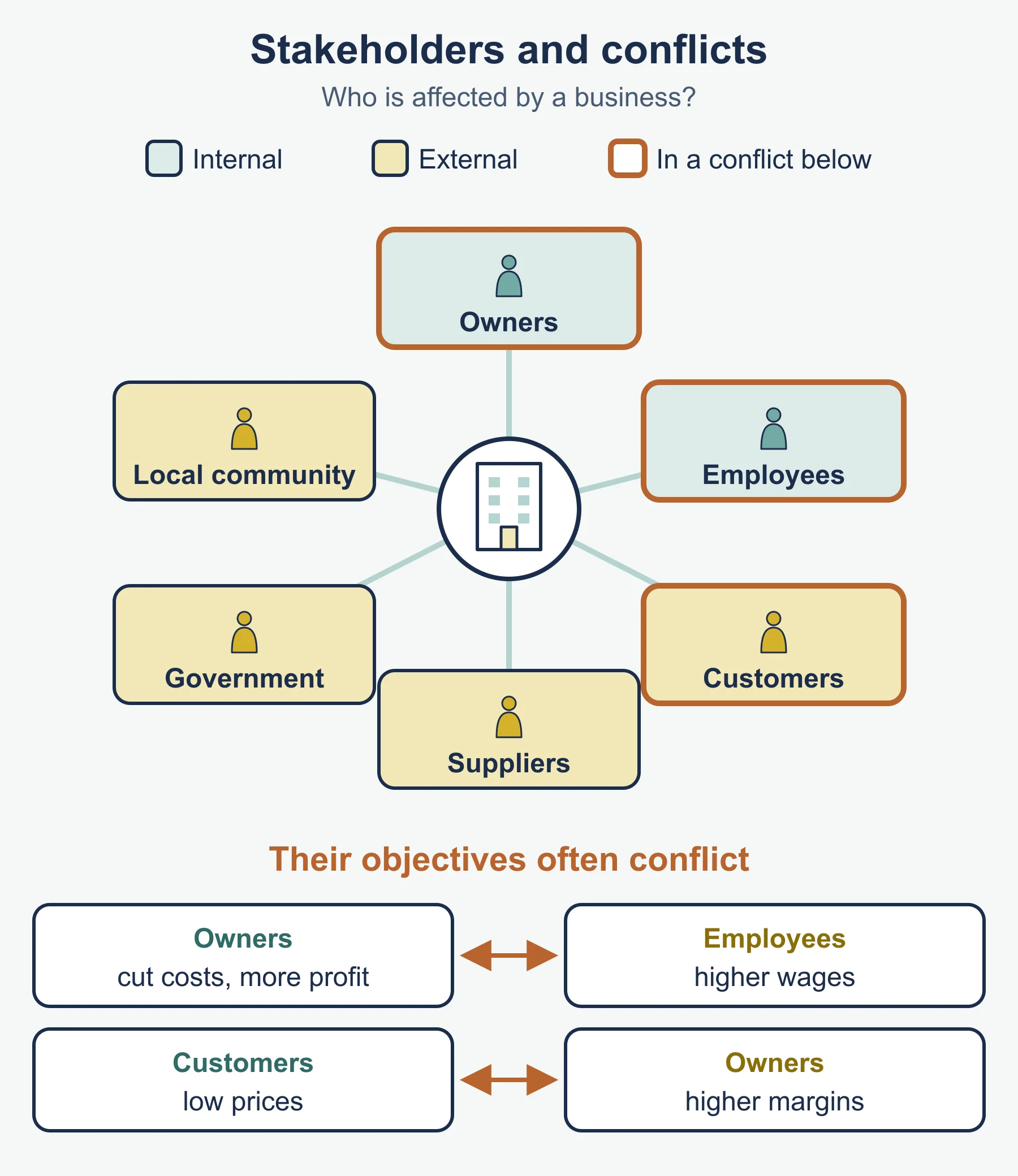
| Group | Internal or external | Wants |
|---|---|---|
| Owners | Internal | Profit, growth |
| Employees | Internal | Pay, security, conditions |
| Customers | External | Quality, value, service |
| Suppliers | External | Orders, prompt payment |
| Government | External | Tax paid, rules followed |
| Local community | External | Jobs, little disturbance |
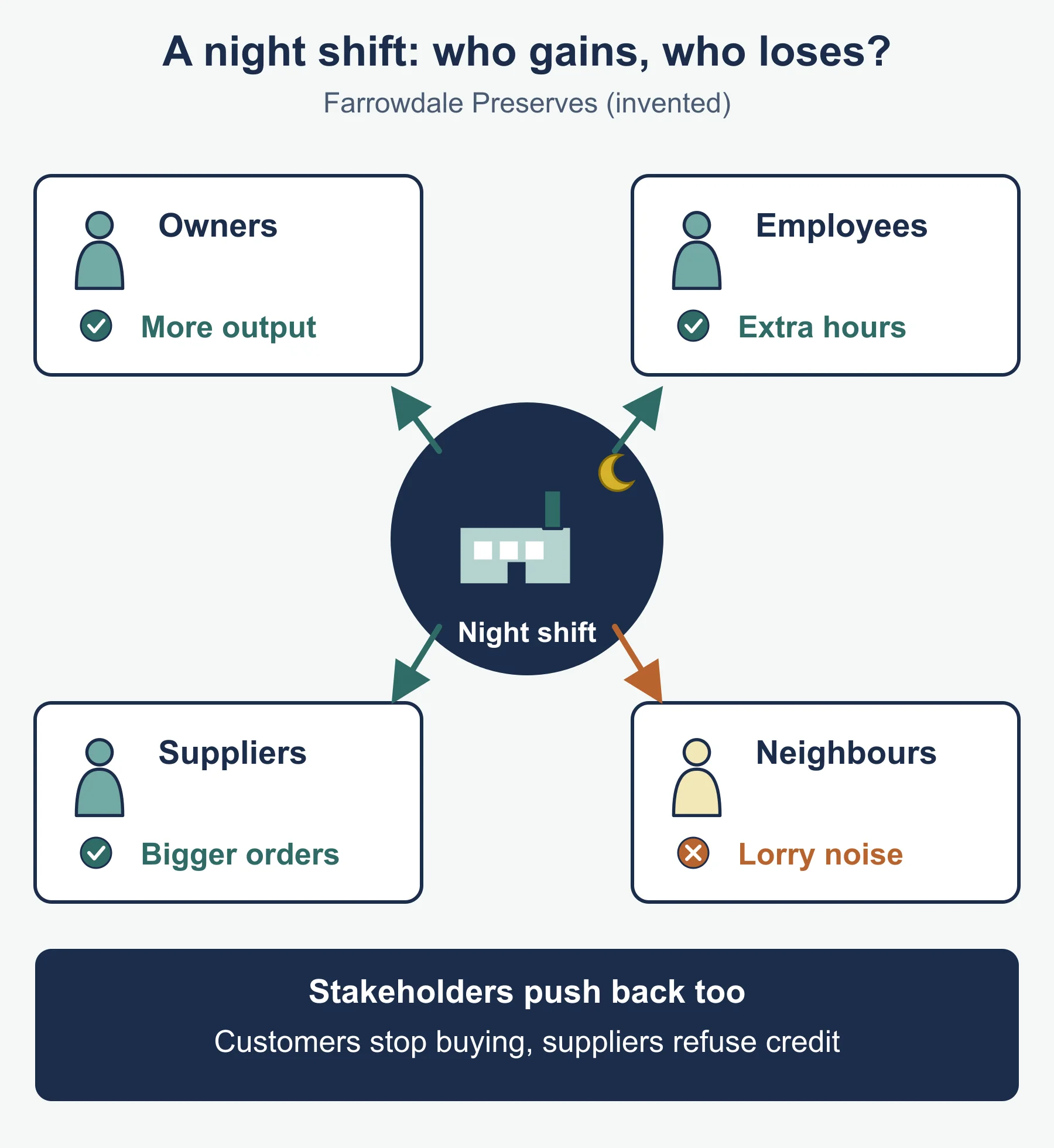
- Business affects stakeholders: a new site gives jobs but adds traffic.
- Stakeholders affect business: customers stop buying, employees leave, suppliers change terms.
- Conflicts are common: wages versus profit; growth versus community peace.
Method in steps for a stakeholder question:
- Choose the stakeholder named.
- State the interest.
- Show how the decision helps or harms it.
- Say which stakeholder matters most here and why.
1.6 Business growth
| Type | What it is | Example |
|---|---|---|
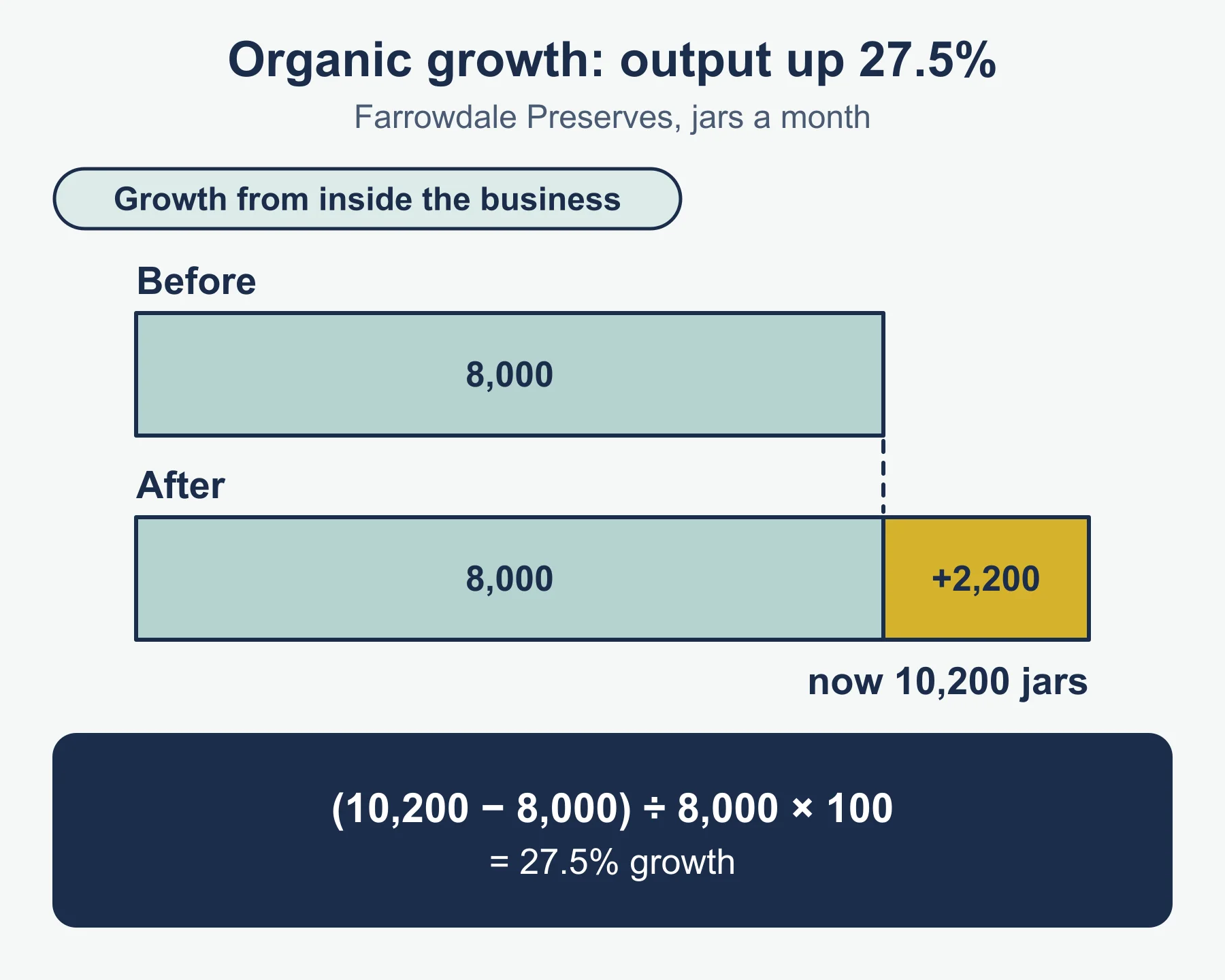
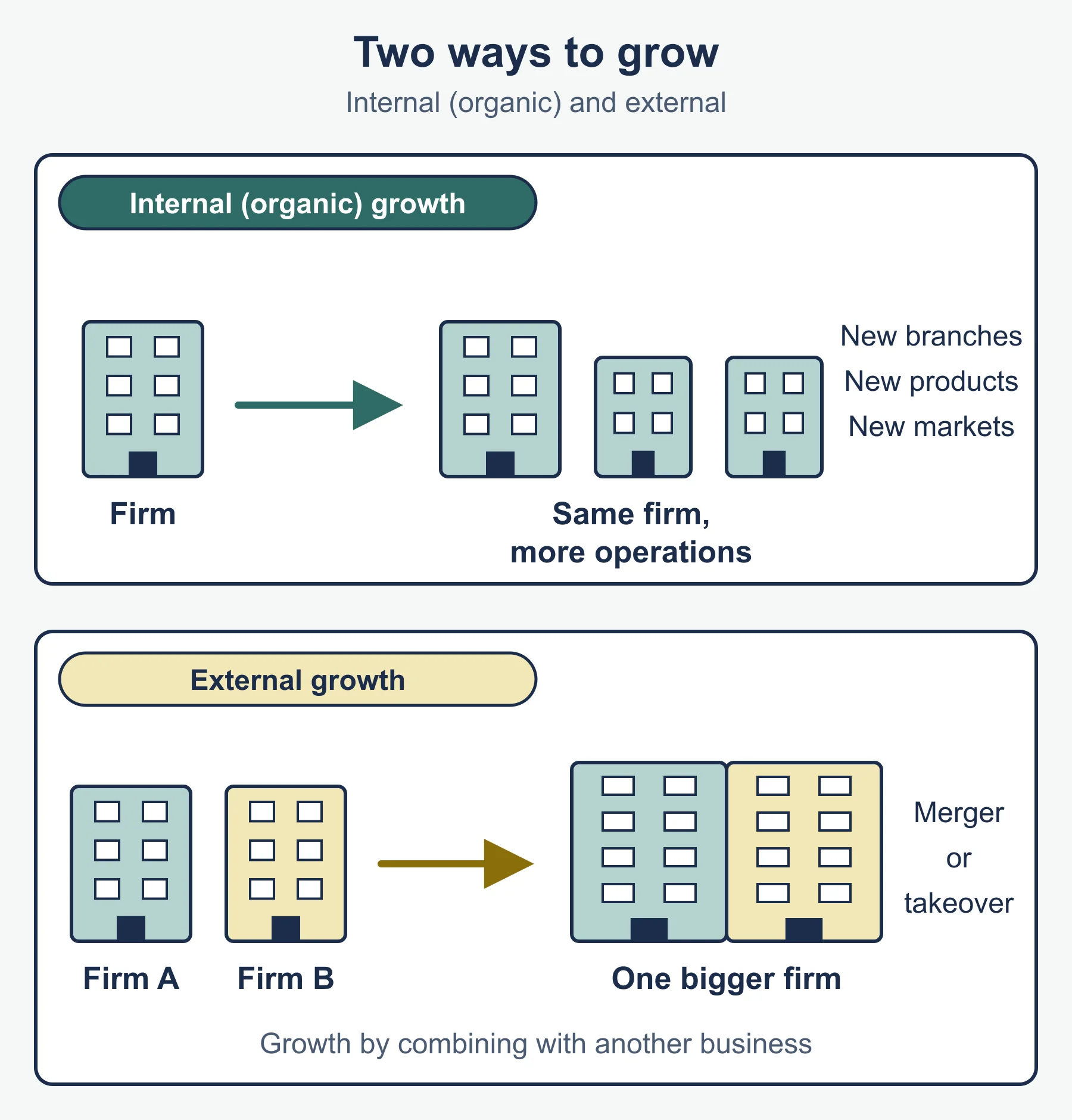
| Organic: increasing output | Produce more with own resources | Run a second shift |
| Organic: new customers | Sell to more people or places | Start online selling |
| Organic: new products | Add to the range | Launch a new flavour |
| Organic: market share | Win a bigger part of the market | Win custom from rivals |
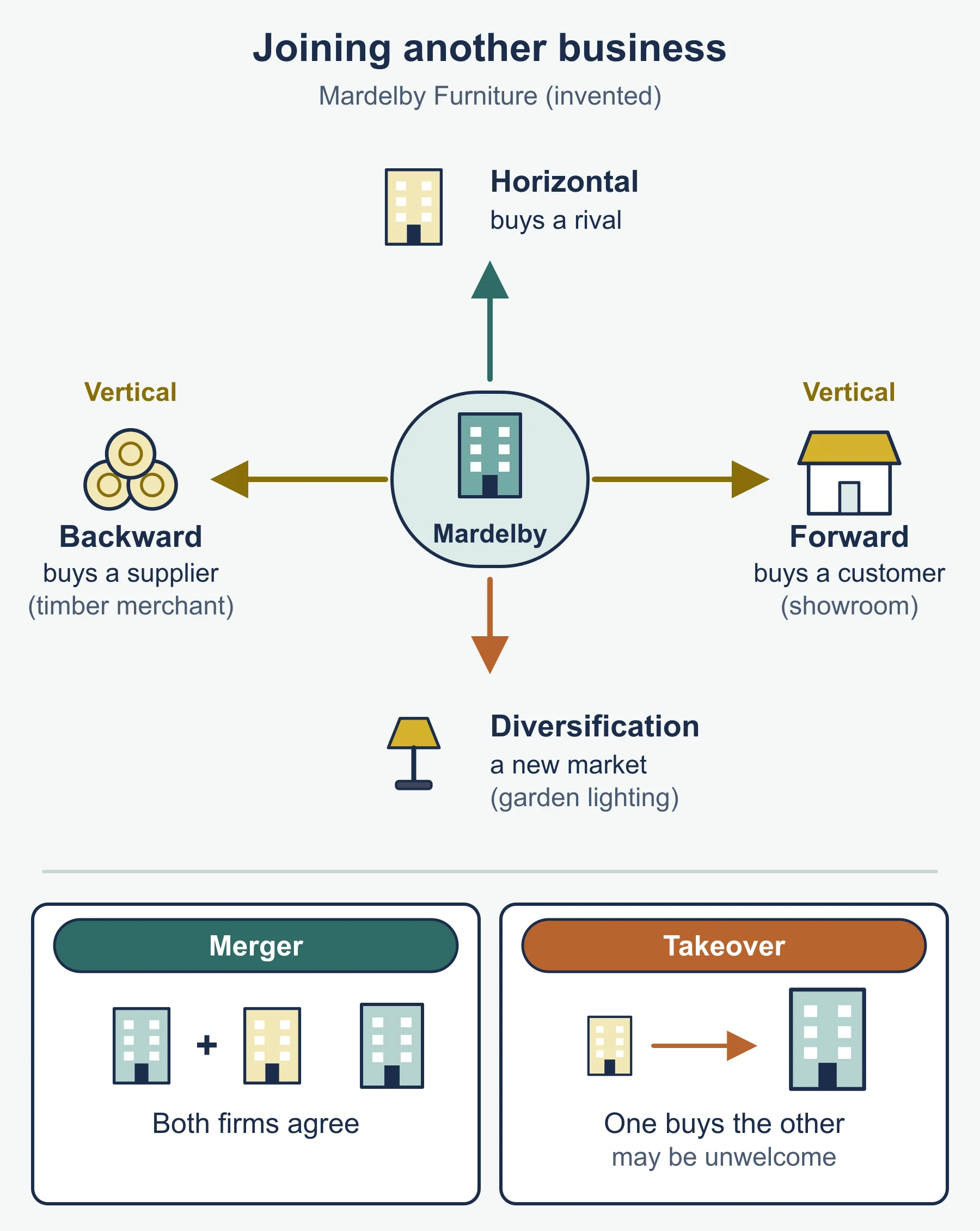
| Merger | Two firms agree to combine | Two local builders join |
| Takeover | One firm buys another | A chain buys a competitor |
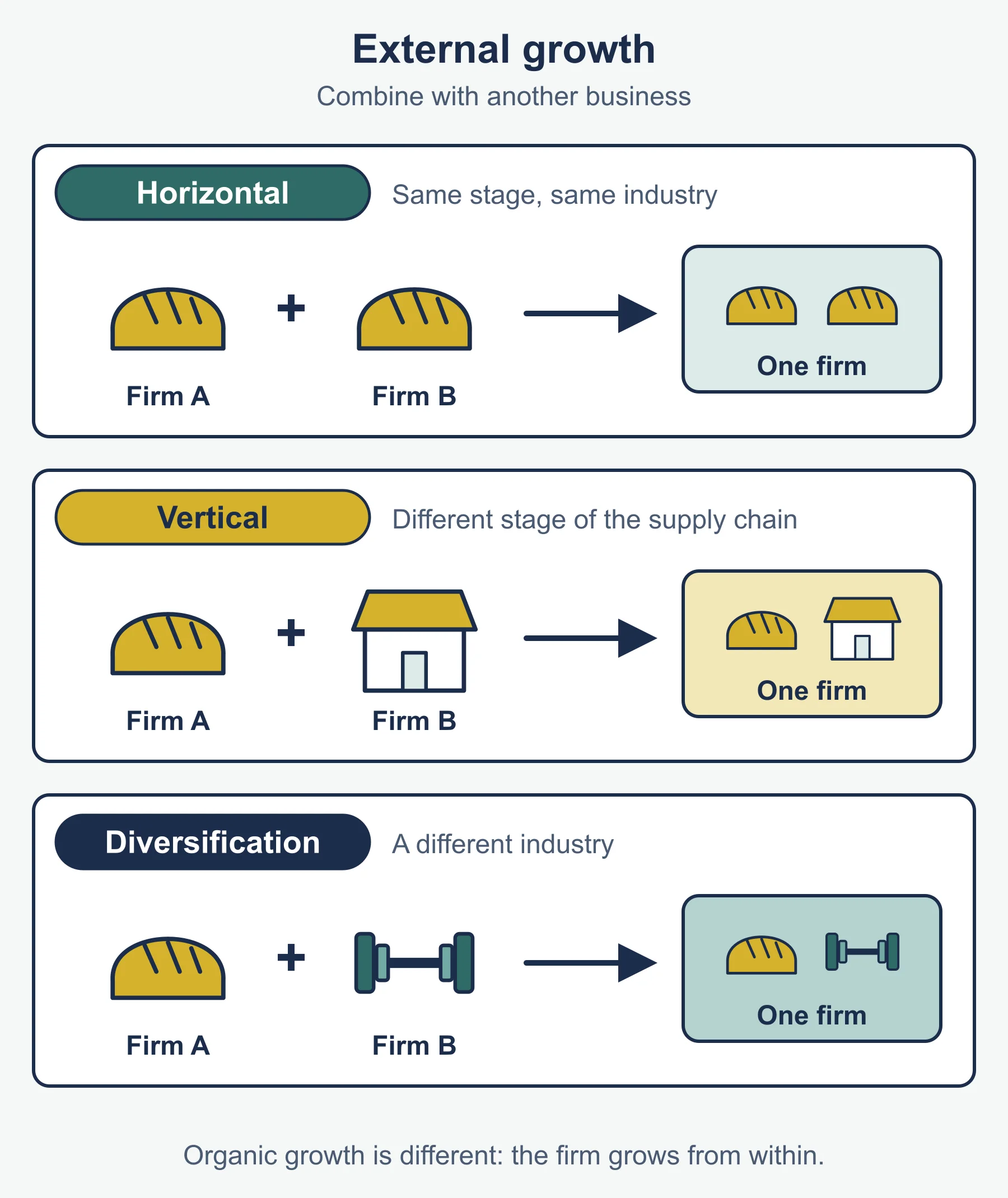
| Horizontal | Same stage of production | Brewer buys another brewer |
| Vertical backward | Buy a supplier | Brewer buys a hop farm |
| Vertical forward | Buy a customer or retailer | Brewer buys a pub |
| Diversification | New market or product | Brewer buys a hotel |
Percentage growth = (new - old) ÷ old × 100. Output rising from 400 to 500 units is 25% growth.
The specification lists merger and takeover; the plain-English meanings in the table are general knowledge, not specification wording.
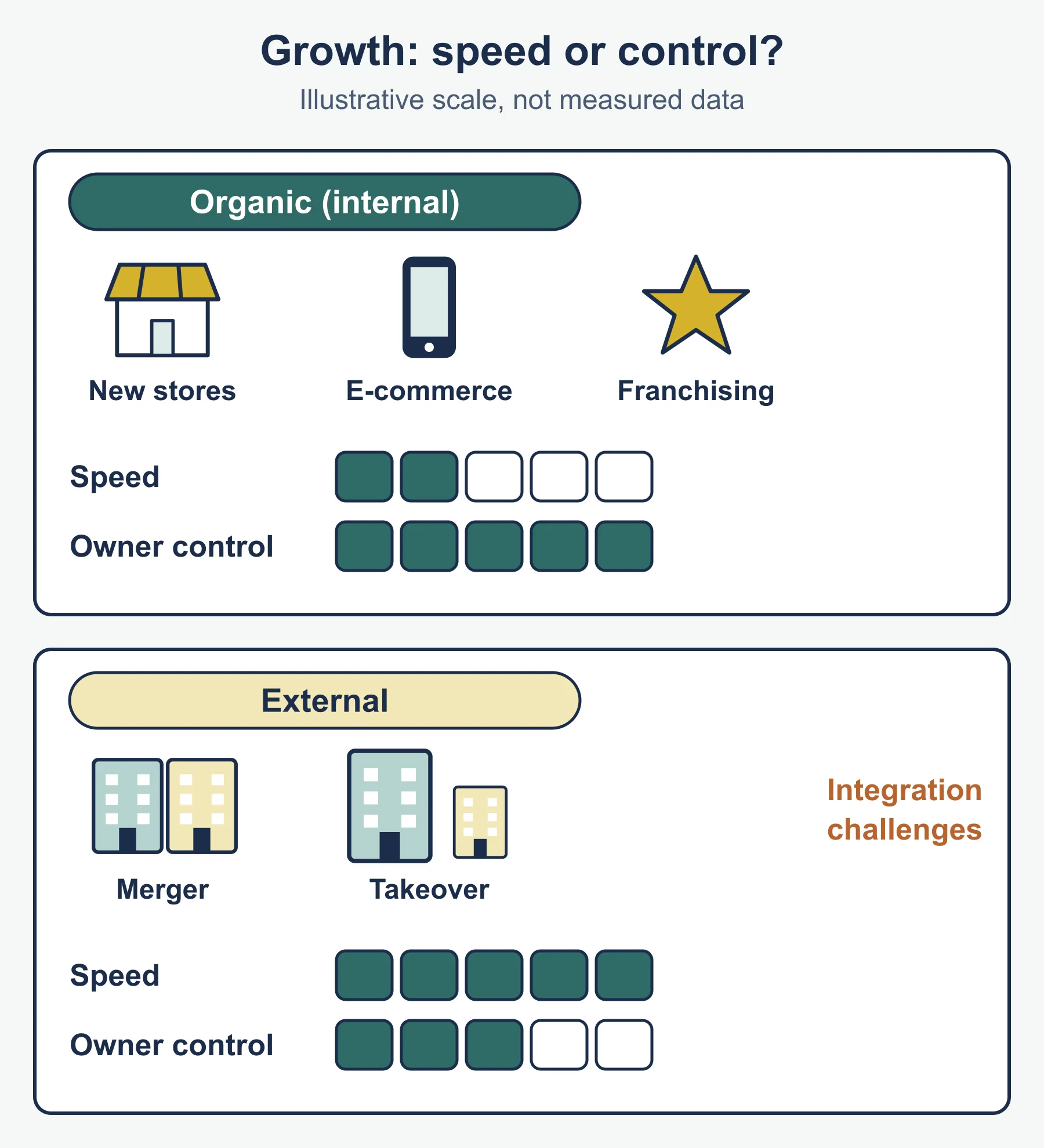
Compare: organic is slower, cheaper and easier to control; external is faster but costs more, and the businesses may not fit together.
Command words and case-study skills
The specification lists the command words used in the longer questions. Link each to what you must write.
| Command word | What the specification says it needs | How to set it out |
|---|---|---|
| Identify, State | Knowledge | One short answer, no development |
| Explain | Knowledge and understanding, applied | Point, reason, link to the business |
| Calculate | Quantitative skill | Formula, substitution, answer with units |
| Analyse | A logical chain of reasoning | Because… which leads to… so… |
| Discuss, Evaluate | Weigh both sides and reach a supported judgement | For, against, judgement with a reason |
| Recommend | A supported judgement | Choose one option and say why |
Case-study habits that help in section 1:
- Underline the business type, its size and its stage (start-up or established).
- Pull out any numbers in the stimulus and use them in the answer.
- Use the right term: liability, objective, stakeholder, horizontal, takeover.
- Finish evaluations with a clear decision, tied to the stage and size of the business.
Evaluation frames
Ownership choice: say what the owners need (control, protection, finance), score each type against it, then recommend.
Growth choice: compare speed, cost, risk and control, then link the answer to the objective, such as market share or survival.
Business plan: give a benefit, a limit, and a judgement on how useful it is at this stage.
Stakeholder conflict: name the two groups, show what each gains or loses, and decide which should take priority in this case.
Five-minute recall grid
Cover the right-hand column and fill it in from memory.
| Prompt | Check yourself |
|---|---|
| Four entrepreneur characteristics | Creativity, risk taking, determination, confidence |
| Two purposes of planning | Reduce risk; help the business succeed |
| Two types with unlimited liability | Sole trader; partnership |
| Two types with limited liability | Private limited; public limited |
| Five objectives | Profit, survival, growth, providing a service, market share |
| Six stakeholder groups | Owners, employees, customers, suppliers, government, local community |
| Four organic routes | Output, new customers, new products, market share |
| Three external directions | Horizontal, vertical, diversification |
Quick self-test
- Name two characteristics of an entrepreneur.
- State two purposes of business planning.
- A partnership owes £40 000 and has assets of £31 000. What is the shortfall?
- Explain why limited liability helps a business raise money from investors.
- Which objective is most likely for a business in its first months?
- A firm has sales of £9 000 in a market of £60 000. Calculate its market share.
- Name two internal stakeholders and two external stakeholders.
- A business buys its main supplier. Identify the type of growth.
- Sales rise from 2 500 to 3 000 units. Calculate the percentage growth.
- Evaluate in one sentence whether a plc is always better than a Ltd.
Answers
- Any two of creativity, risk taking, determination, confidence.
- Reduce risk; help the business succeed (also acceptable: identify the resources needed).
- 40 000 - 31 000 = £9 000.
- Investors can lose only what they put in, so they are more willing to buy shares and the business can raise larger sums.
- Survival.
- 9 000 ÷ 60 000 × 100 = 15%.
- Internal: owners, employees. External: customers, suppliers, government, local community (any two).
- External growth, vertical (backward).
- (3 000 - 2 500) ÷ 2 500 × 100 = 20%.
- No: a plc can raise more money, but it has more reporting and spreads ownership, so a small family business may prefer a Ltd.
Where marks are usually lost
- Naming a characteristic or stakeholder without linking it to the business in the case.
- Treating limited liability as freedom from debt.
- Calling a plc government-owned.
- Writing only “profit” when asked why objectives differ.
- Stating a type of growth without showing how it fits the example.
- Confusing merger with takeover, or horizontal with vertical.
- Giving a percentage without showing the working.
- Evaluating with one side only and no judgement.
Frequently asked questions
What are the four characteristics of an entrepreneur in OCR GCSE Business? The OCR GCSE Business (J204) specification lists creativity, risk taking, determination and confidence. In a case question, name the characteristic, quote the evidence from the case and explain why it helps the business.
What are the five business objectives you need to know for J204? The five are profit, survival, growth, providing a service and market share. A brand-new start-up is most likely to aim for survival, while a plc with shareholders is more likely to aim for profit or growth.
What do the command words analyse and evaluate mean in OCR GCSE Business? Analyse needs a logical chain of reasoning, linking a cause to a consequence for the business. Evaluate and discuss need you to weigh both sides and reach a supported judgement.
Does a business plan guarantee success? No. A plan supports success by reducing risk and helping with finance, markets, resources and objectives, but forecasts can be wrong and it does not guarantee the business will succeed.
Official syllabus
OCR GCSE (9-1) Business (J204) specification, Version 2.0 (January 2026), section 1 Business activity. Published by OCR.
Get free revision emails (optional)
Occasional emails with practice questions, worked explanations and links to free resources for the qualification and subjects you choose. No spam, and you can unsubscribe from any email. The free tools on this site never need an email.
Related resources
-
Study guides
OCR GCSE Business: Marketing (J204)
Study guide to OCR GCSE Business section 2, Marketing: market research, segmentation, the four Ps and market data, with worked examples.
Business · OCR · GCSE
Read guide -
Practice questions
OCR GCSE Business: Marketing (J204) – Practice Questions
Original practice questions with worked answers on OCR GCSE Business section 2, Marketing: research, segmentation, the four Ps and market data.
Business · OCR · GCSE
Try questions -
Revision notes
OCR GCSE Business: Marketing (J204) – Revision Notes
Condensed revision notes for OCR GCSE Business section 2, Marketing: research, segmentation, the four Ps, formulas, a self-test and common errors.
Business · OCR · GCSE
Revise topic
Related articles
-
teaching
A Level tuition in Dubai: Cambridge or Pearson Edexcel International A Level?
Schools in Dubai and Abu Dhabi teach either Cambridge International AS & A Level or Pearson Edexcel International A Level. How the two are structured, why it matters for tuition, and how online classes from Lahore work.
9 October 2026
-
curriculum guides
Choosing subjects at IGCSE and A Level
How subject choices at 14 and 16 affect university options later, and how to keep pathways open without overloading a timetable.
28 July 2026
Studying this with a teacher
Working through Business GCSE?
This page is free and stays free. If you would rather be taught it, Marlbridge runs Business classes one-to-one, online in your own time zone. One-to-one only for this course: Rs 6,000 per class in Pakistan, with other currencies on the fees page. The first trial class is free. WhatsApp replies within an hour (8am–11pm Pakistan time, every day); email the same day.
OCR Business teachers at Marlbridge
