
Revision Notes
OCR GCSE Business (J204): The interdependent nature of business – Revision Notes
Revision notes on OCR GCSE Business J204 section 7: linking operations, finance, marketing and HR, risk and reward, and financial measures, with a self-test.
- Subject
- Business
- Level
- GCSE
- Topic
- Operations, finance and influences on business
- Author
- Marlbridge Academic Team
- Updated
- Reviewed by
- Salman Ahmad (what this means)
Aligned to OCR GCSE Business (J204), Version 2.0 (January 2026), for first assessment in 2019. Official specification .
Syllabus page (what it covers and how it is assessed): OCR GCSE Business.
Syllabus points this page covers
J204
- 7 The interdependent nature of business
Found an error? Report a correction.
Need help with this topic? Request a free trial class for GCSE Business (J204).
Quick recall for section 7, The interdependent nature of business, of OCR GCSE (9-1) Business (J204), Version 2.0 (January 2026). It is assessed through synoptic questions in section B of the J204/02 paper, which can draw on any part of the course. Full explanations and a worked example are in the interdependent nature of business study guide; test yourself with the interdependent nature of business practice questions.
The four specification points
- The interdependent nature of operations, finance, marketing and human resources within a business context.
- How these interdependencies underpin business decision making.
- The impact of risk and reward on business activity.
- The use of financial information in measuring and understanding business performance and decision making.
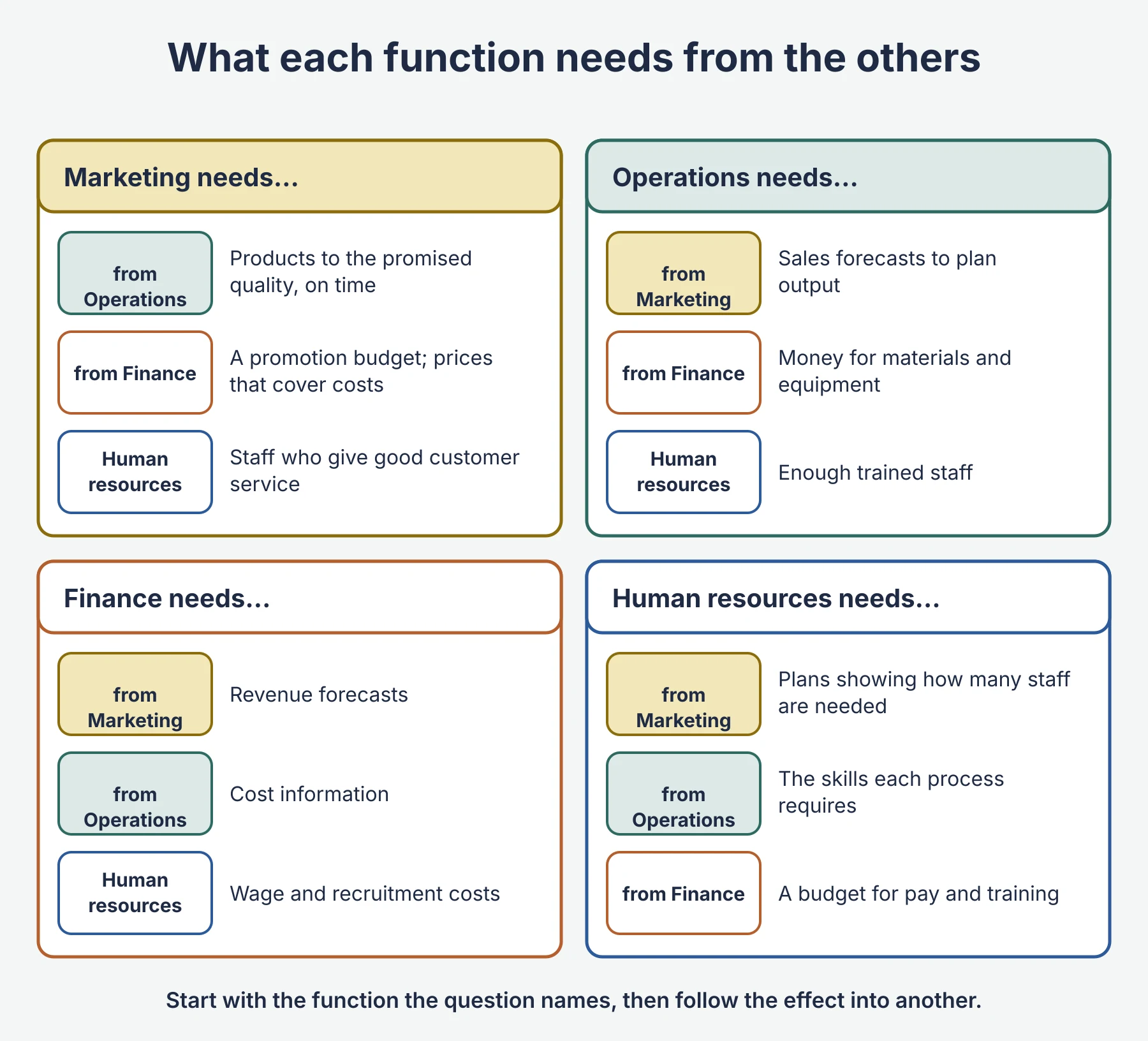
Key terms
| Term | Meaning |
|---|---|
| Interdependent | Each function relies on the others, so a change in one affects the rest |
| Synoptic question | A question that needs knowledge from different parts of the course |
| Business function | One of operations, finance, marketing, human resources |
| Risk | The chance that a decision leads to a loss or fails to meet its aim |
| Reward | The benefit if a decision succeeds: profit, growth, market share, security |
| Financial information | Data such as revenue, costs, profit, margins, cash flow and ARR |
| Average rate of return | Average annual profit as a percentage of the cost of an investment |
| Contribution per unit | Selling price minus variable cost per unit |
Knock-on effects to learn
| Decision | Operations | Finance | Marketing | Human resources |
|---|---|---|---|---|
| Launch a new product | New process or materials; quality checks | Development and launch costs; later revenue | Research, pricing, promotion | Training; possibly new recruits |
| Switch to flow production | Higher output, lower unit cost | Large investment in machinery | Can lower prices; less variety | Fewer, differently skilled staff; morale |
| Start selling online | Packing and delivery | Website costs; faster payment | Wider market; new promotion methods | Staff for online orders and customer service |
| Cut the training budget | Mistakes and lower quality | Saves money now | Service and reputation suffer | Morale and retention fall |
| Raise prices | Possibly lower output | Higher revenue per unit, maybe lower volume | Must justify with quality or brand | Staff may need to deliver better service |
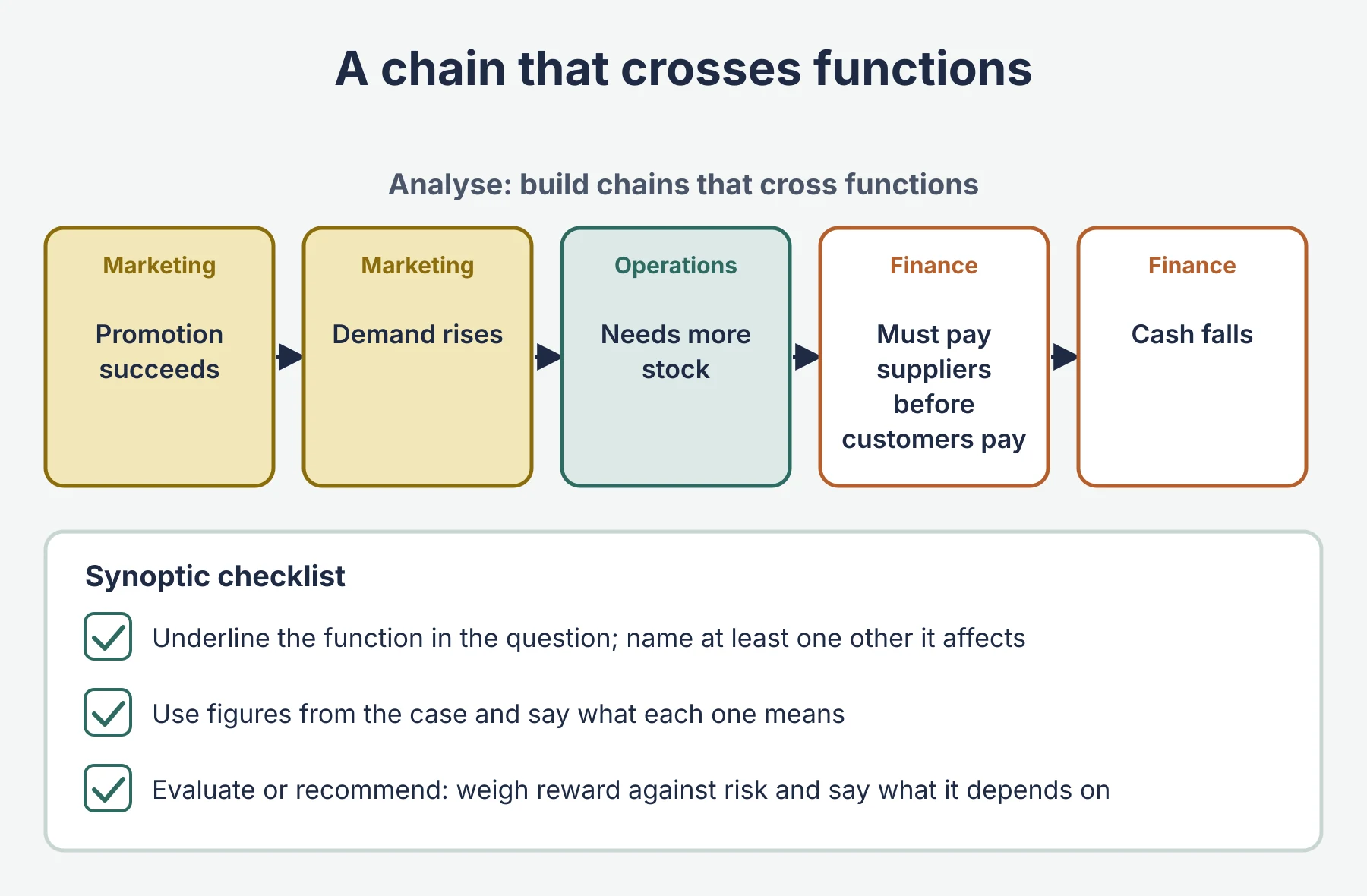
Answer pattern: named function → effect → second function → effect on the business’s objective.
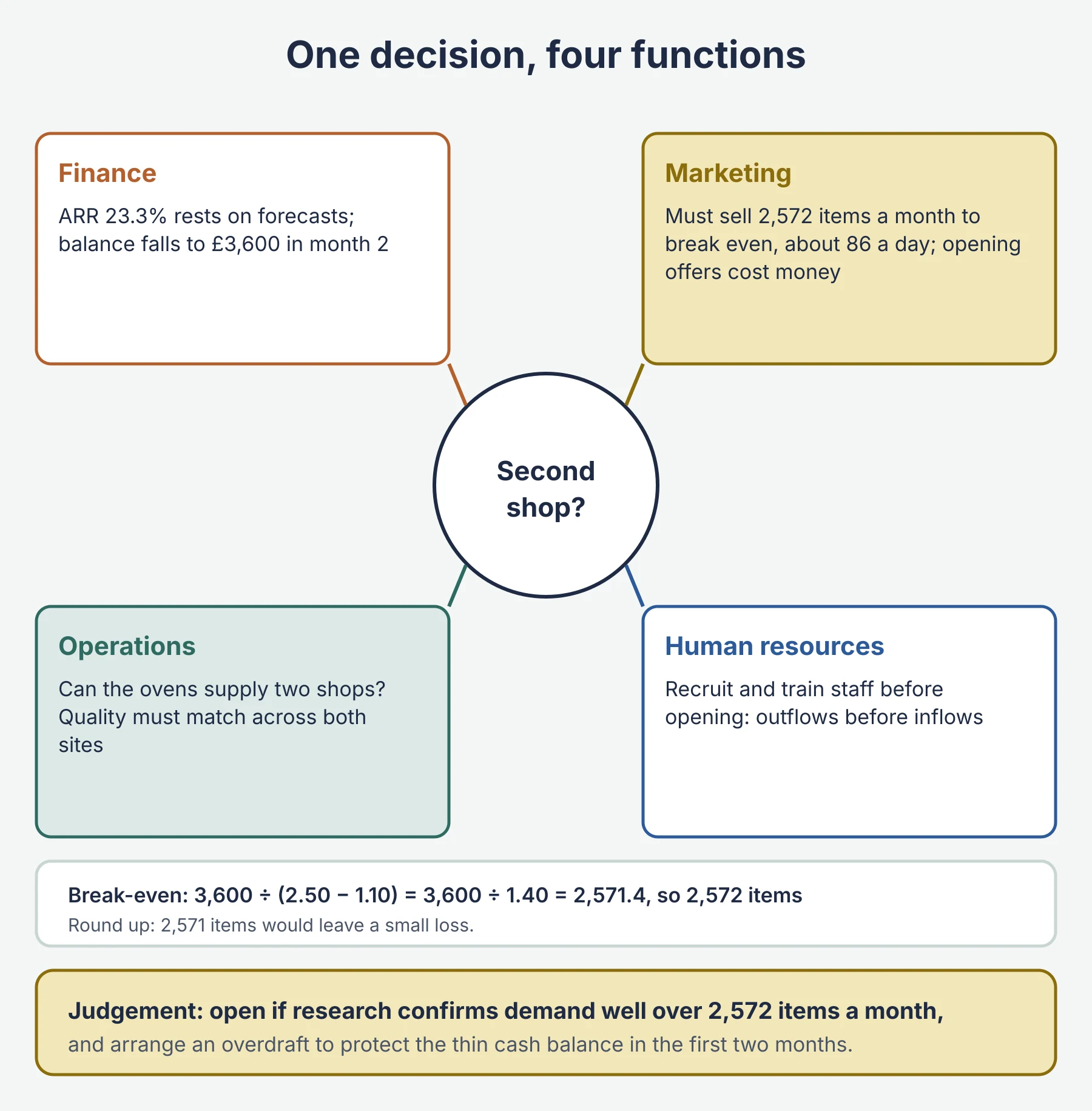
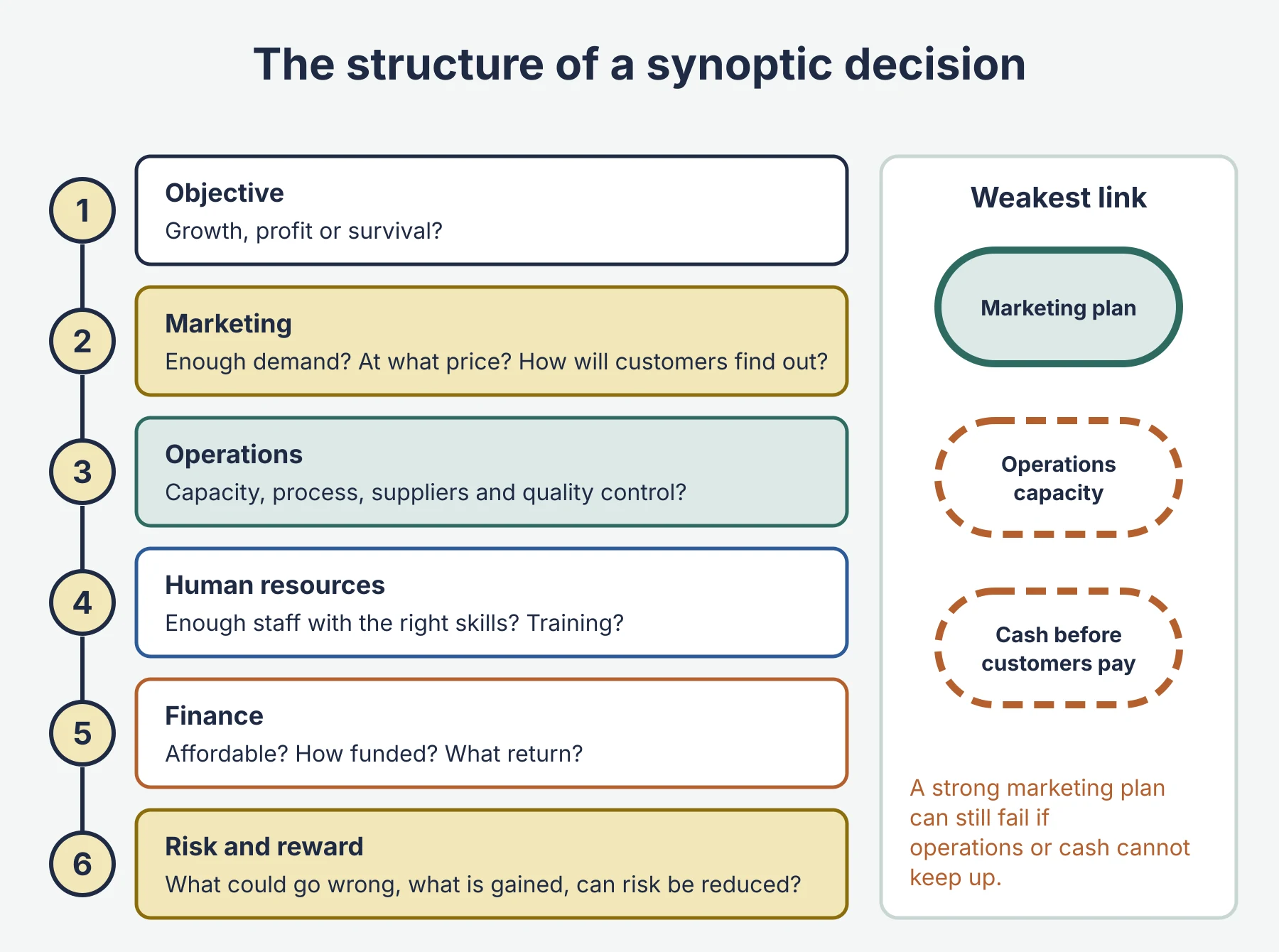
The decision checklist
Objective → marketing (demand) → operations (capacity) → human resources (people) → finance (afford and return) → risk and reward (what could go wrong; can it be reduced?).
Risk and reward in brief
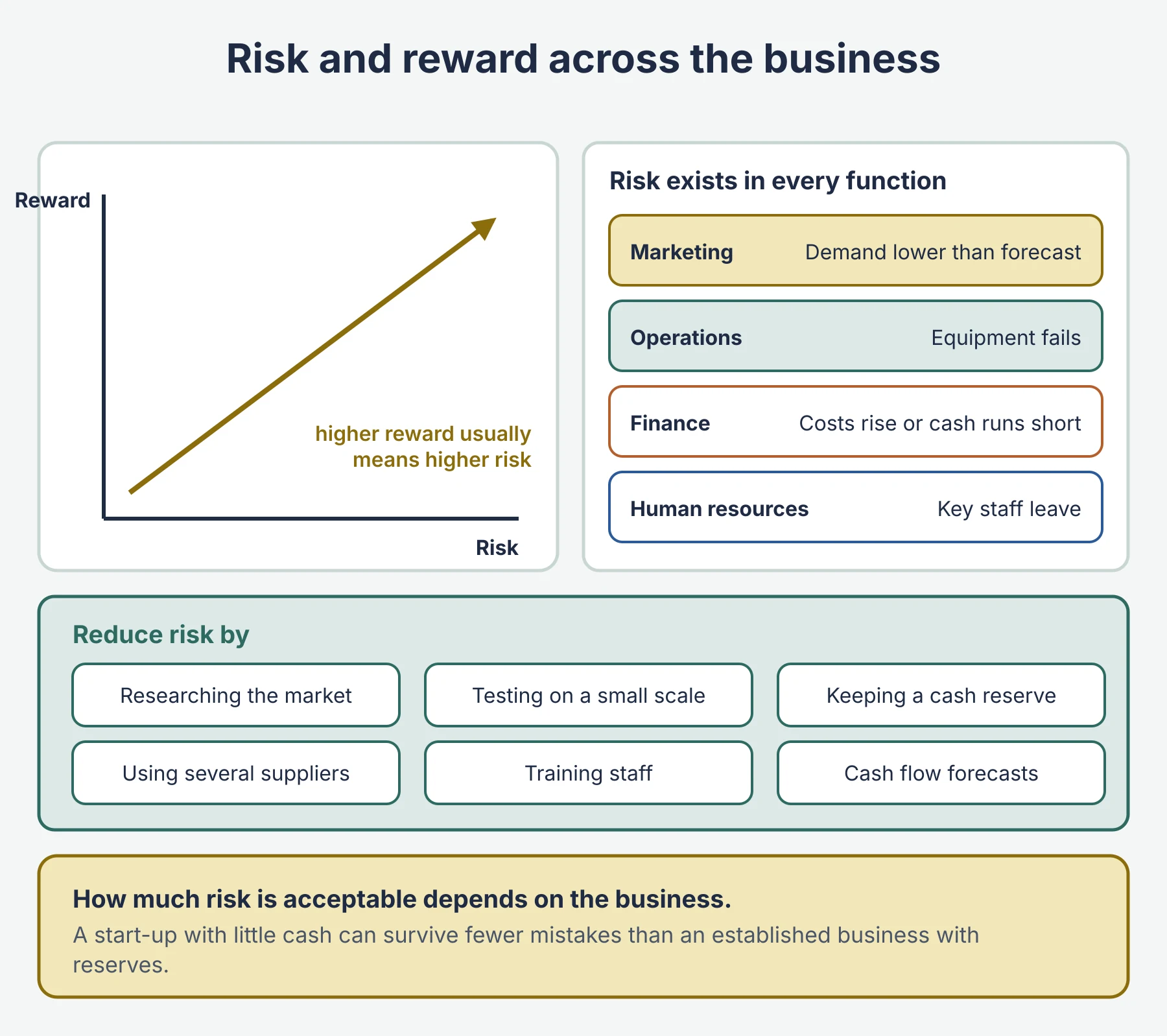
- Bigger rewards usually mean bigger risks.
- Risk can be reduced, not removed: market research, small-scale trials, cash reserves, several suppliers, planning ahead with cash flow forecasts.
- Acceptable risk depends on the business: a start-up with little cash can afford fewer mistakes.
Formulae and what they tell you
| Measure | Formula | What it tells the decision |
|---|---|---|
| Gross profit margin | Gross profit ÷ revenue × 100 | How well the business controls the cost of what it sells |
| Net profit margin | Net profit ÷ revenue × 100 | How much of each £1 of sales is profit after all costs |
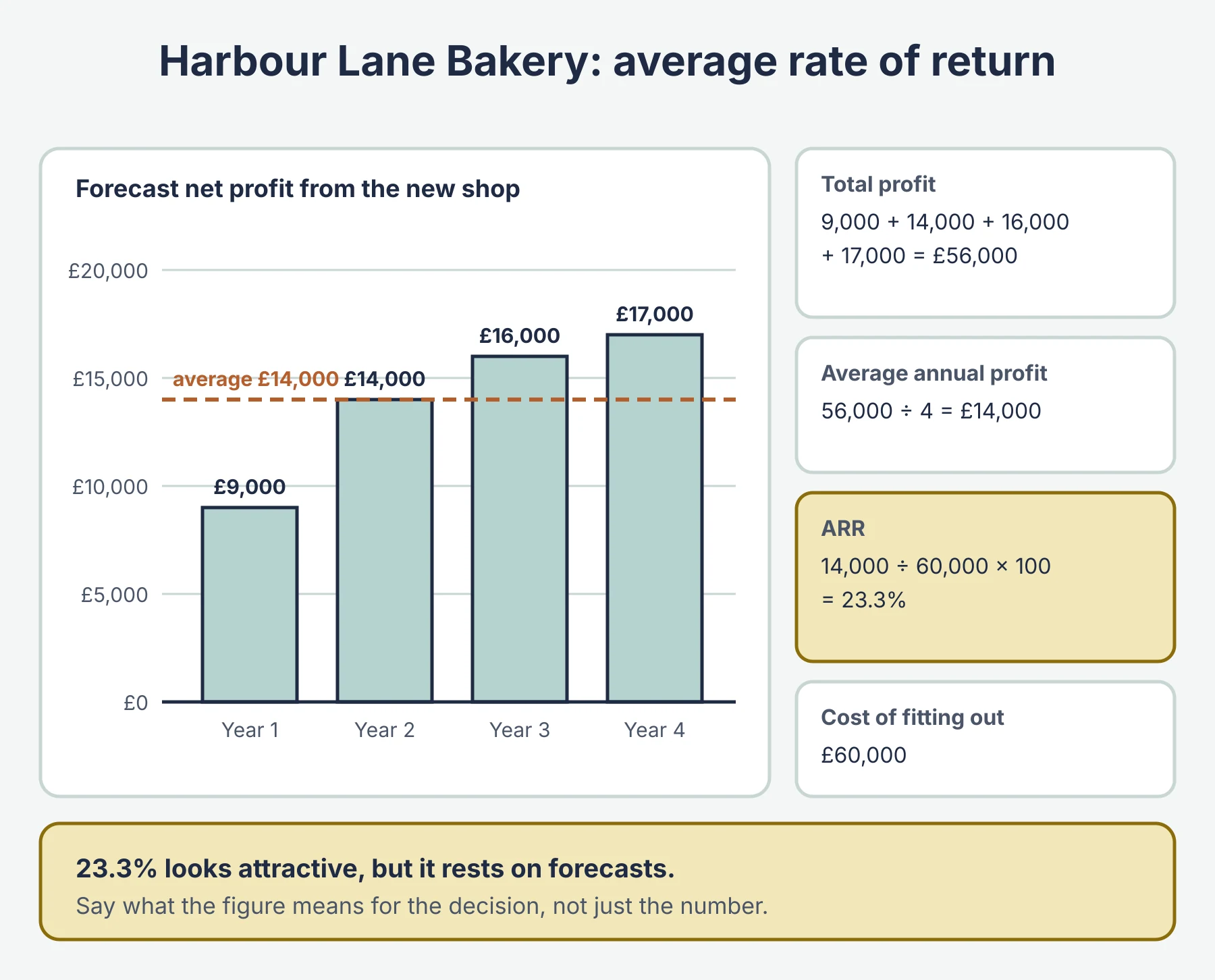
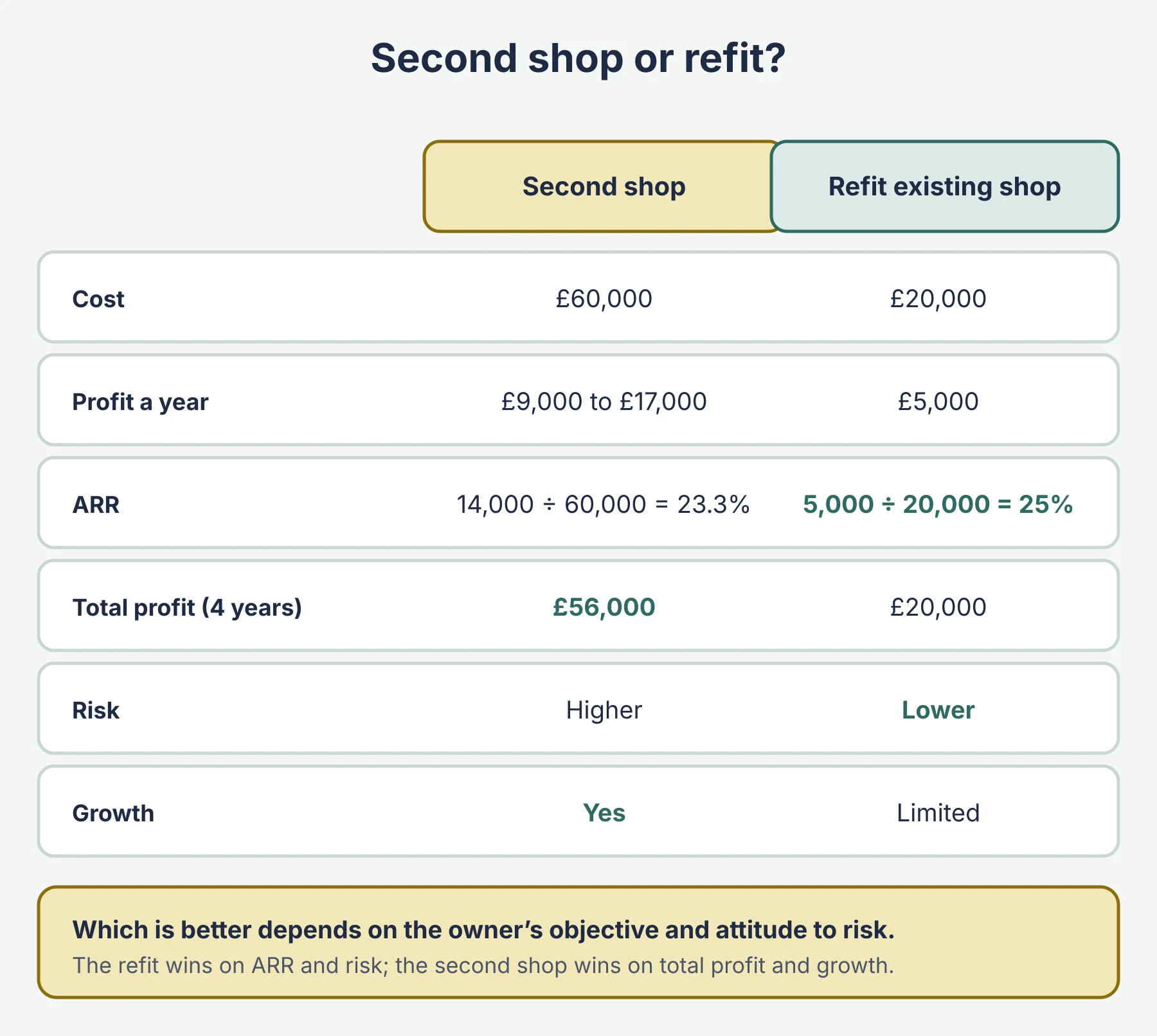
| Average rate of return | Average annual profit ÷ cost of investment × 100 | Whether an investment is worth its cost, compared with alternatives |
| Break-even quantity | Fixed costs ÷ contribution per unit | How many units must be sold before profit is made |
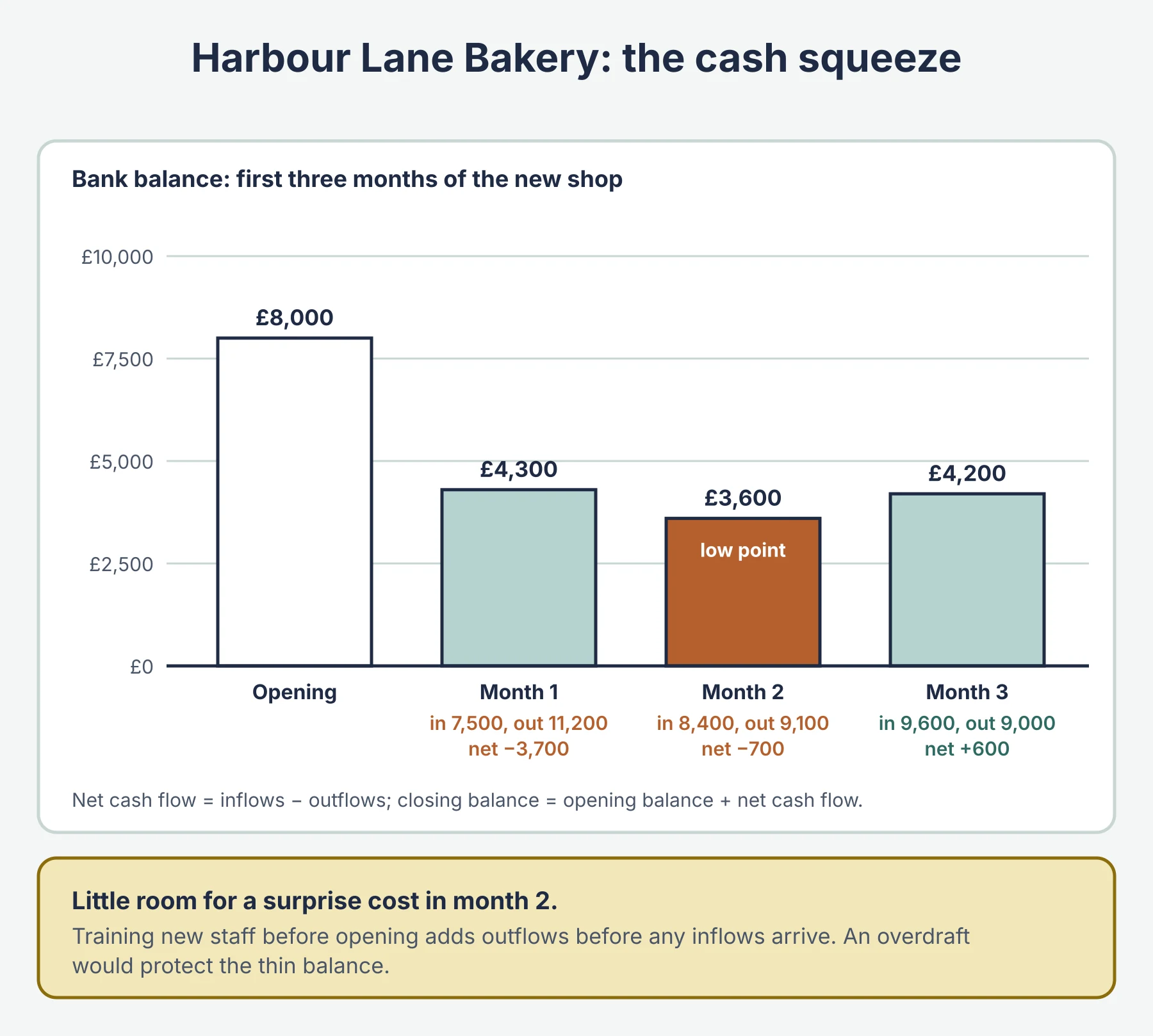
| Net cash flow | Inflows − outflows | Whether cash will run short, and when |
Worked mini-example (invented): a £24,000 van is forecast to add total profit of £18,000 over three years. Average annual profit = 18,000 ÷ 3 = £6,000. ARR = 6,000 ÷ 24,000 × 100 = 25%.
Limits of financial information: forecasts can be wrong; figures describe the past or a guess about the future; they leave out things that cannot be measured, such as morale or reputation.
Exam traps
- Answering a synoptic question with one function only.
- Giving a figure (ARR, margin, break-even) without saying what it means for the decision.
- Treating profit and cash as the same: a profitable plan can still run out of cash.
- Calling a forecast a fact.
- Using contribution per unit with fixed costs per unit by mistake: break-even uses total fixed costs.
- Judging risk without linking it to the business’s objective and cash.
Self-test
- Name the four business functions in the specification.
- What does “interdependent” mean?
- Give one way a marketing decision affects operations.
- Give one way an operations decision affects human resources.
- Define risk and reward.
- State two ways a business can reduce risk.
- A machine costs £40,000 and is forecast to make total profit of £30,000 over five years. Calculate the ARR.
- Fixed costs are £5,400 a month; price £12; variable cost £7.50. Calculate break-even quantity.
- Opening cash is £2,000; inflows £9,000; outflows £11,500. What is the closing balance?
- Revenue £150,000, net profit £12,000. Calculate the net profit margin.
- Give one limitation of using financial information to make decisions.
- Why can a business that makes a profit still run out of cash?
Answers
- Operations, finance, marketing, human resources.
- Each function depends on the others, so a decision in one affects the rest.
- A successful promotion raises demand, so operations must produce more or hold more stock.
- New machinery may need fewer workers or retrained workers.
- Risk: the chance of a loss or of failing to meet an aim. Reward: the benefit if the decision succeeds.
- Any two: market research, small-scale trials, cash reserves, using several suppliers, cash flow forecasting.
- Average profit = 30,000 ÷ 5 = £6,000; ARR = 6,000 ÷ 40,000 × 100 = 15%.
- Contribution = 12 − 7.50 = £4.50; 5,400 ÷ 4.50 = 1,200 units.
- 2,000 + (9,000 − 11,500) = −£500 (an overdraft would be needed).
- 12,000 ÷ 150,000 × 100 = 8%.
- Forecasts may be wrong, or it leaves out non-financial factors such as morale.
- Customers may pay late while suppliers and wages must be paid now, so cash runs out even though sales exceed costs.
Frequently asked questions
How do I recognise a synoptic question? It usually asks about a decision and its effect on the business as a whole, or mentions two functions in the same question.
Do I need Business 1 content for section 7? Yes. The specification says synoptic questions draw on business activity, marketing and people as well as Business 2 content.
Official syllabus
OCR GCSE (9-1) Business (J204) specification, Version 2.0 (January 2026), section 7 The interdependent nature of business. Published by OCR.
Related resources
-
Study guides
OCR GCSE Business: Operations (J204)
Study guide to section 4 Operations in OCR GCSE (9-1) Business J204: production, quality, selling, consumer law, location, suppliers, with worked examples.
Business · OCR · GCSE
Read guide -
Study guides
OCR GCSE Business: Operations, Finance and Influences on Business (J204)
Component 02 of OCR GCSE Business J204 explained: operations, finance and influences on business, from production and quality to break-even and cash flow.
Business · OCR · GCSE
Read guide -
Practice questions
OCR GCSE Business: Operations, Finance and Influences — Practice Questions
Original OCR GCSE Business J204/02 practice with worked answers: a 15-question multiple-choice Section A plus operations, finance and influences questions.
Business · OCR · GCSE
Try questions
Get free revision emails (optional)
Occasional emails with practice questions, worked explanations and links to free resources for the qualification and subjects you choose. No spam, and you can unsubscribe from any email. The free tools on this site never need an email.