
Study Guides
OCR GCSE Business (J204): The interdependent nature of business
Study guide to section 7 of OCR GCSE Business J204: how the four functions depend on each other, risk and reward, and financial information in decisions.
- Subject
- Business
- Level
- GCSE
- Topic
- Operations, finance and influences on business
- Author
- Marlbridge Academic Team
- Updated
- Reviewed by
- Salman Ahmad (what this means)
Aligned to OCR GCSE Business (J204), Version 2.0 (January 2026), for first assessment in 2019. Official specification .
Syllabus page (what it covers and how it is assessed): OCR GCSE Business.
Syllabus points this page covers
J204
- 7 The interdependent nature of business
Found an error? Report a correction.
Need help with this topic? Request a free trial class for GCSE Business (J204).
This guide covers section 7, The interdependent nature of business, of the OCR GCSE (9-1) Business specification (J204), Version 2.0 (January 2026). Section 7 has no new content of its own in the usual sense. The specification says learners “use content from both component 01 and component 02 to make connections between different elements of the subject”, and the J204/02 paper includes synoptic questions in section B that draw on Business 1 as well as Business 2. This is the section that turns separate topics into business decisions.
For a shorter treatment alongside section 6, see the combined study guide to sections 6 and 7. Condense this page with the interdependent nature of business revision notes and practise with the interdependent nature of business practice questions.
What the specification lists
Knowledge and understanding must include:
- the interdependent nature of business operations, finance, marketing and human resources within a business context;
- how these interdependencies underpin business decision making;
- the impact of risk and reward on business activity;
- the use of financial information in measuring and understanding business performance and decision making.
The four functions and what each needs from the others
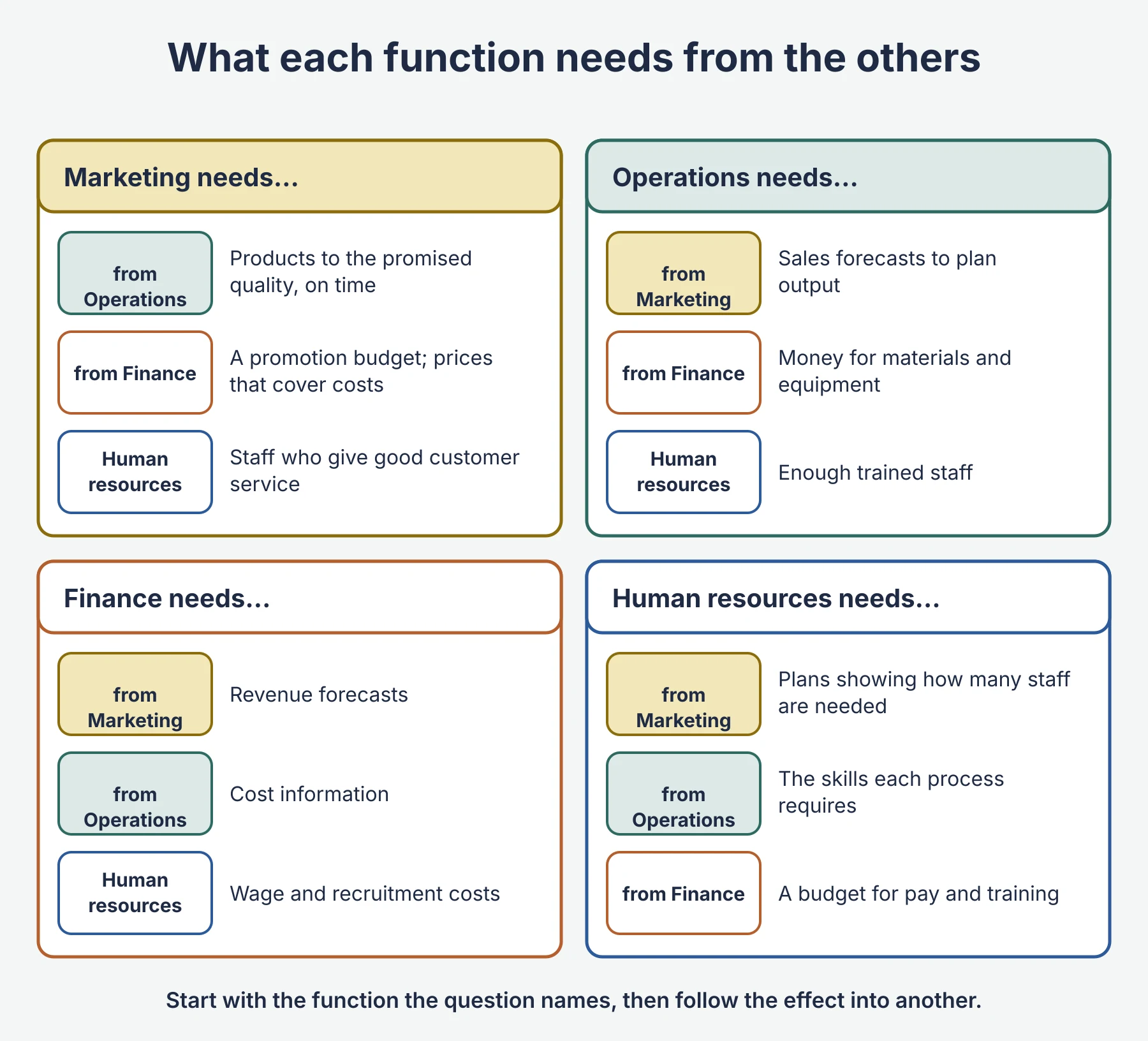
Interdependent means each function relies on the others. A useful way to revise is to ask what each function needs from the rest.
| Function | Needs from marketing | Needs from operations | Needs from finance | Needs from human resources |
|---|---|---|---|---|
| Marketing | — | Products made to the promised quality and on time | A budget for promotion; prices that cover costs | Staff who give good customer service |
| Operations | Sales forecasts to plan output | — | Money for materials and equipment | Enough trained staff |
| Finance | Revenue forecasts | Cost information | — | Wage and recruitment costs |
| Human resources | Plans that show how many staff are needed | Information on the skills each process requires | A budget for pay and training | — |
In an exam answer, start with the function the question names, then follow the effect into at least one other function, using the case.
How interdependencies underpin decisions
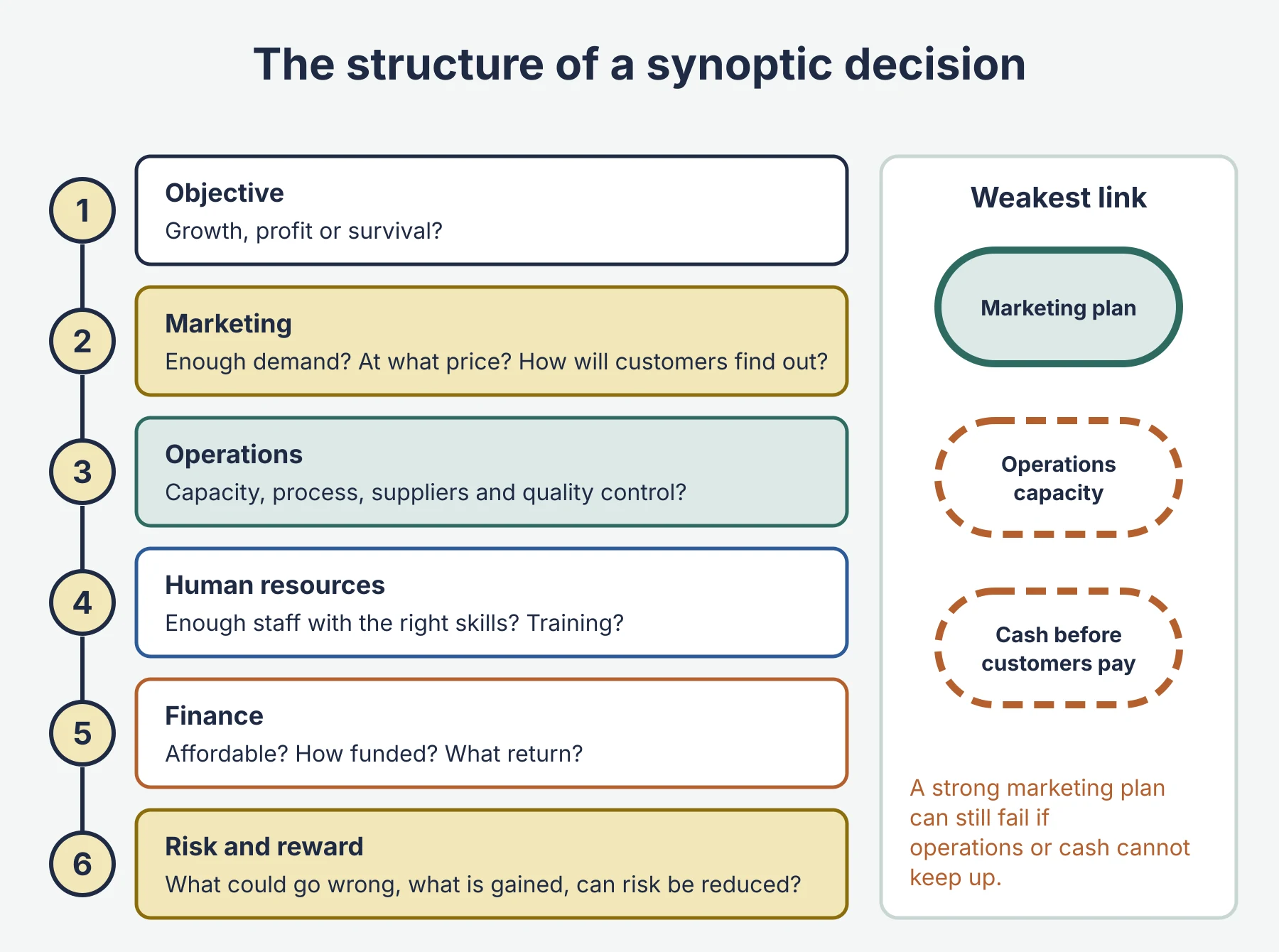
Most large decisions follow the same pattern. Work through it in order and you have the structure of a synoptic answer:
- Objective: what is the business trying to achieve, such as growth, profit or survival?
- Marketing: is there enough demand, at what price, and how will customers find out?
- Operations: is there capacity, the right production process, suppliers and quality control?
- Human resources: are there enough staff with the right skills, and will they need training?
- Finance: can the business afford it, how will it be funded, and what return will it bring?
- Risk and reward: what could go wrong, what is gained if it works, and can the risk be reduced?
A decision is only as strong as its weakest link. A product launch with a strong marketing plan can still fail if operations cannot meet demand or the business runs out of cash before customers pay.
Risk and reward
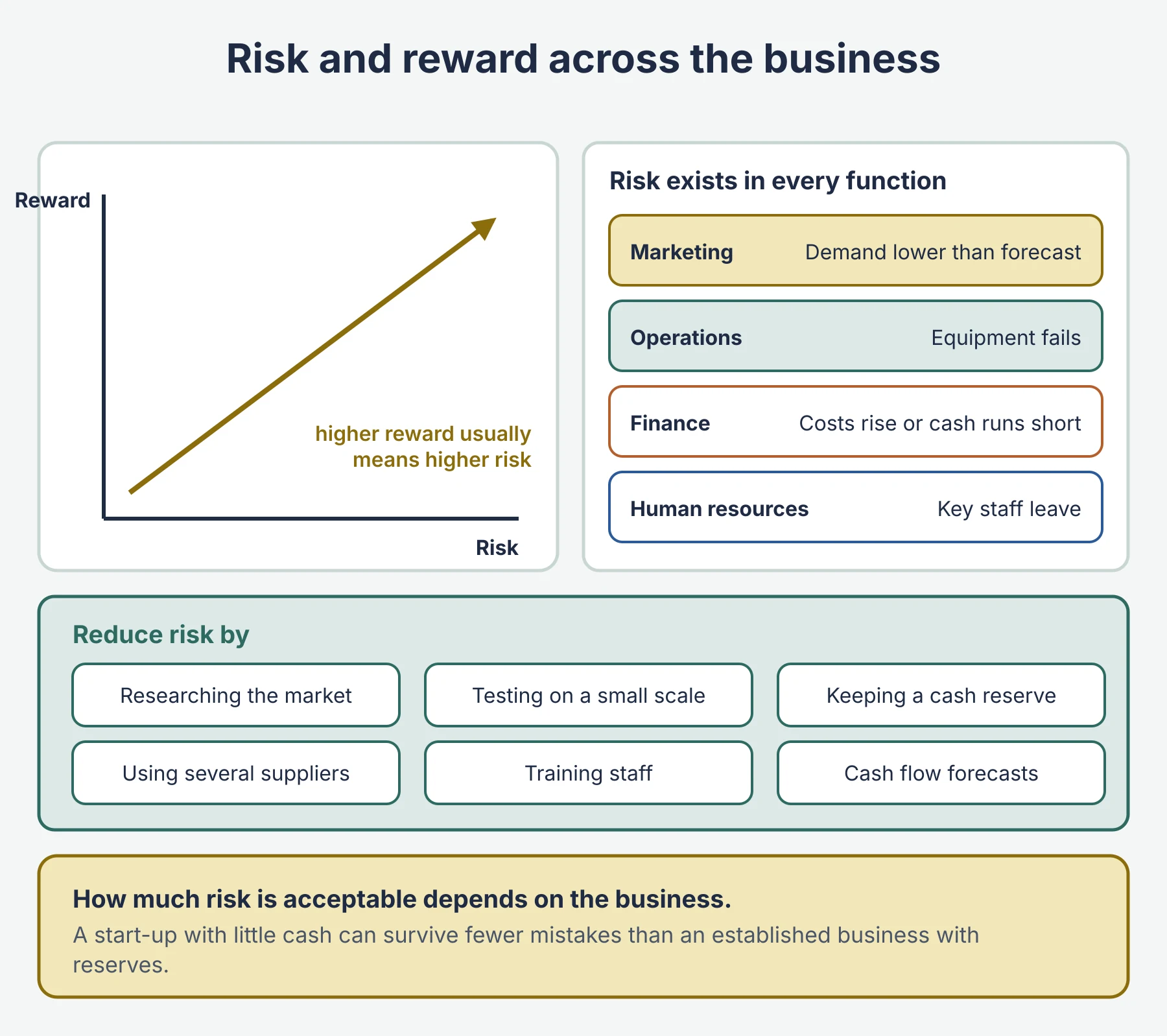
Risk is the possibility that a decision leads to a loss or does not achieve its aim. Reward is the benefit if it succeeds, such as profit, growth, a larger market share or security.
- Higher potential rewards usually come with higher risk.
- Risk exists in every function: demand may be lower than forecast (marketing), equipment may fail (operations), costs may rise or cash run short (finance), key staff may leave (human resources).
- Businesses reduce risk by researching the market, testing on a small scale, keeping a cash reserve, using several suppliers, training staff and planning with cash flow forecasts.
- How much risk is acceptable depends on the business: a new start-up with little cash can survive fewer mistakes than an established business with reserves.
Using financial information
Financial information measures how a business is performing and helps it compare options. The measures from section 5 that you use here:
- gross profit margin = gross profit ÷ revenue × 100
- net profit margin = net profit ÷ revenue × 100
- average rate of return (ARR) = average annual profit ÷ cost of investment × 100, where average annual profit = total profit over the period ÷ number of years
- break-even quantity = fixed costs ÷ (selling price − variable cost per unit)
- cash flow forecast: net cash flow = inflows − outflows; closing balance = opening balance + net cash flow.
If a question gives the total returns from an investment rather than its profit, subtract the cost of the investment first to find the total profit. Whatever the measure, the second step is always to say what it means for the decision.
Worked example: a second shop
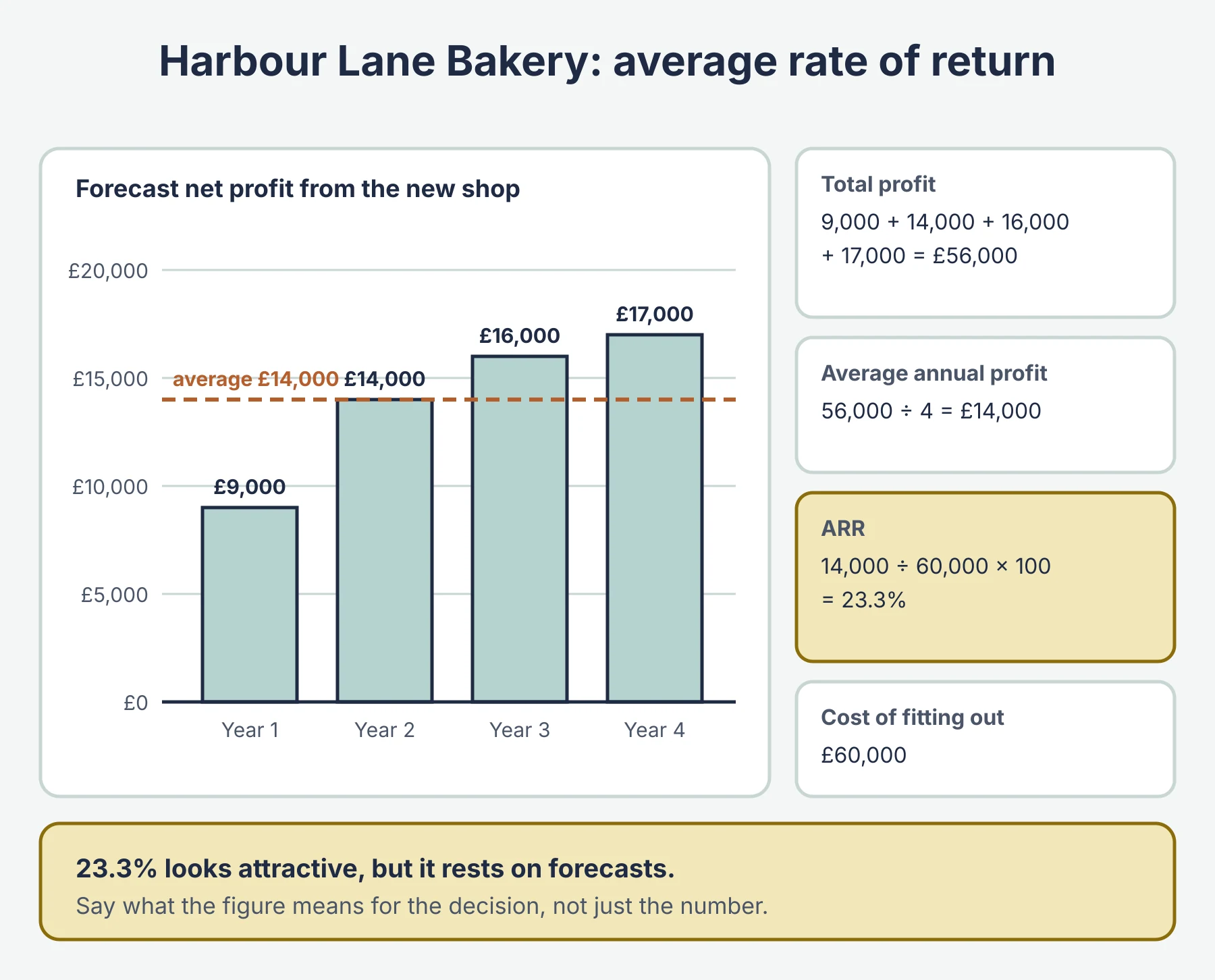
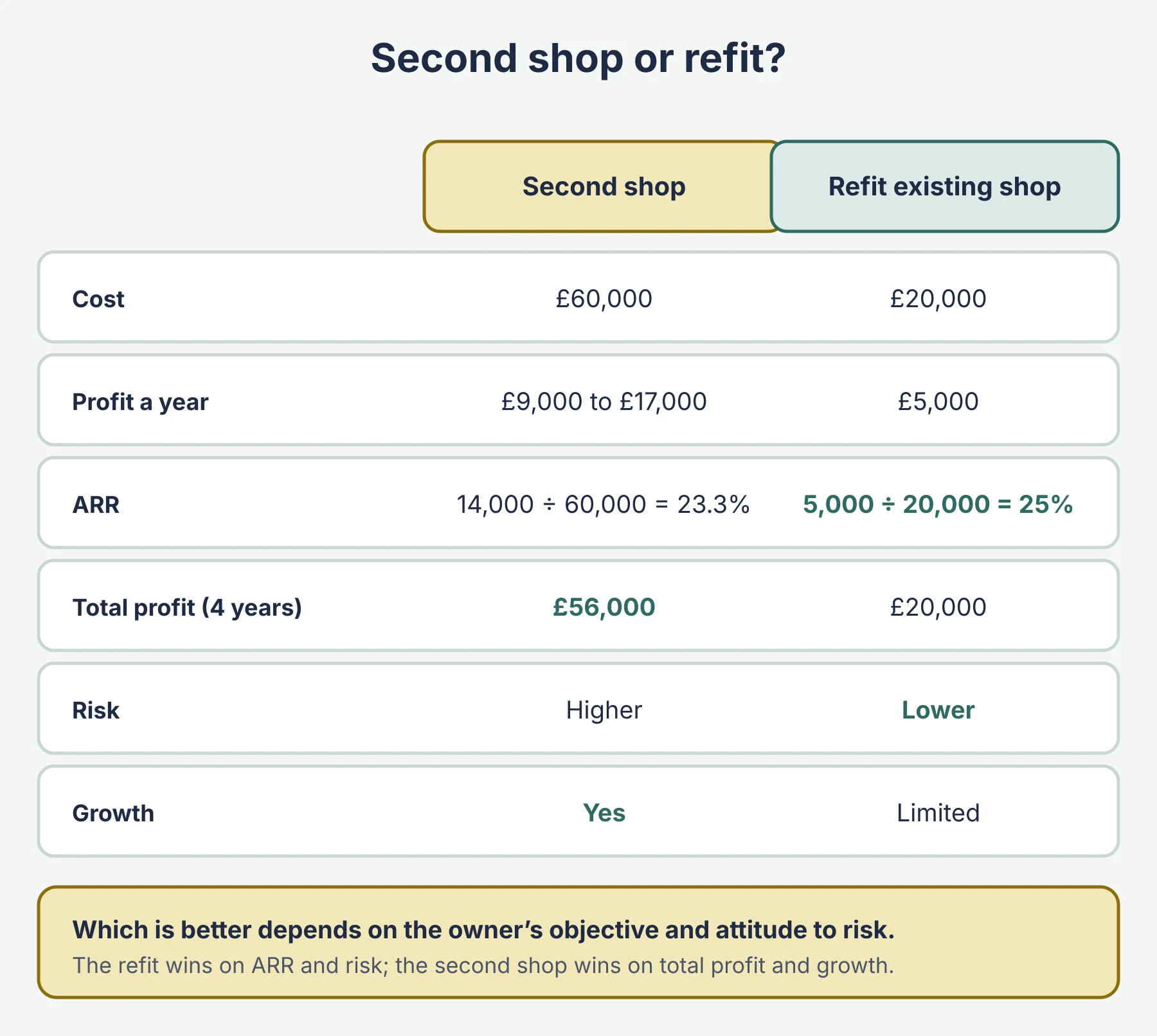
Harbour Lane Bakery (an invented business) is considering a second shop. The cost of fitting it out is £60,000. Forecast net profit from the new shop over four years: £9,000, £14,000, £16,000 and £17,000.
ARR
Total profit           = 9,000 + 14,000 + 16,000 + 17,000 = £56,000
Average annual profit  = 56,000 / 4 = £14,000
ARR                    = 14,000 / 60,000 x 100 = 23.3%

Break-even (new shop, monthly)
Fixed costs £3,600; average price per item £2.50; variable cost per item £1.10
Contribution per item  = 2.50 - 1.10 = £1.40
Break-even quantity    = 3,600 / 1.40 = 2,571.4, so 2,572 items a month

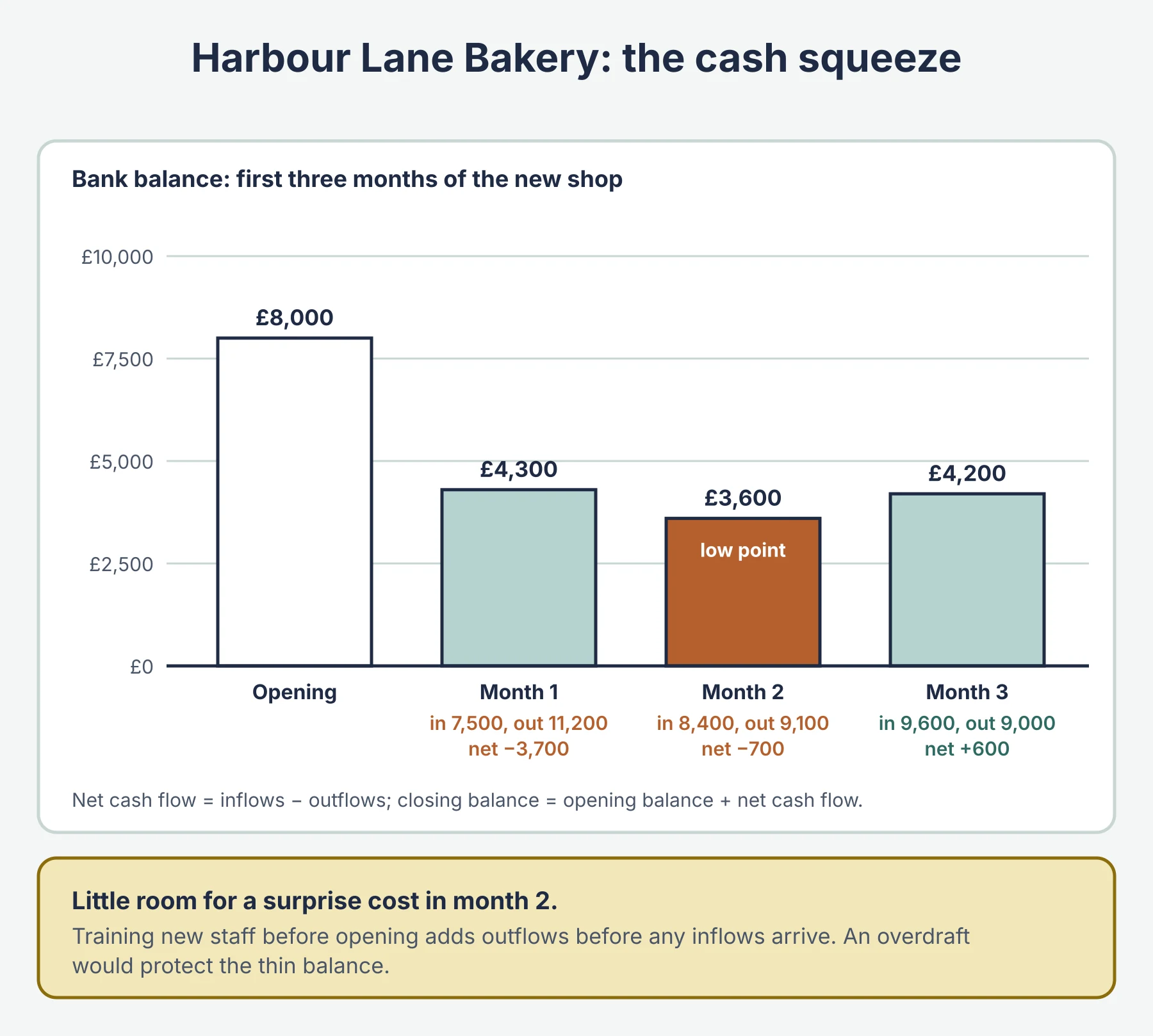
Cash flow (first three months)
             Month 1    Month 2    Month 3
Inflows       7,500      8,400      9,600
Outflows     11,200      9,100      9,000
Net cash     -3,700       -700       +600
Opening       8,000      4,300      3,600
Closing       4,300      3,600      4,200
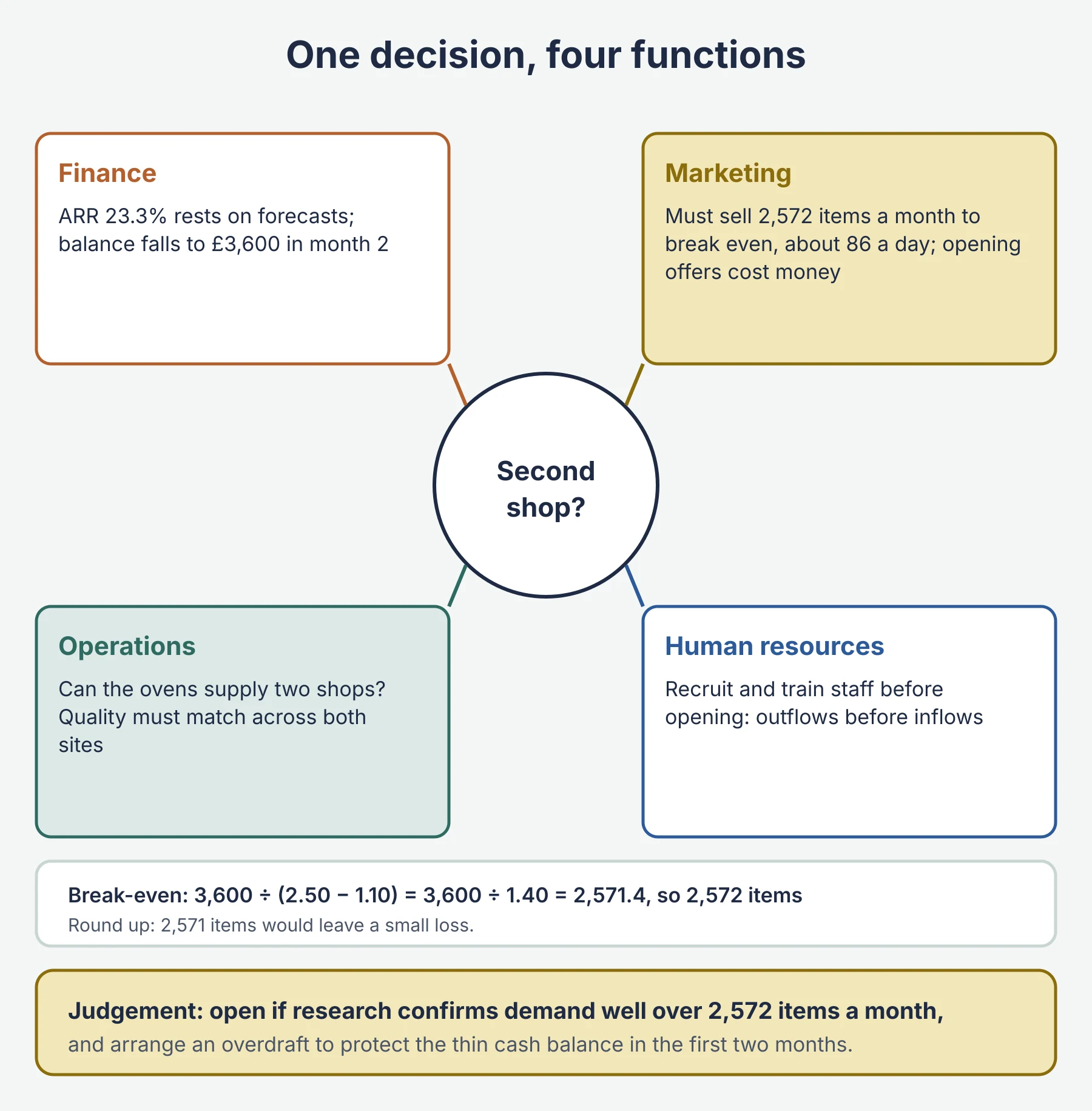
Reading the figures across the functions:
- Finance: the ARR of 23.3% looks attractive, but it rests on forecasts. The bank balance falls to £3,600 in month 2, so there is little room for a surprise cost.
- Marketing: the shop must sell at least 2,572 items a month to break even, about 86 items a day over 30 days. Marketing must show that local demand is there, perhaps with opening offers, which would themselves cost money.
- Operations: can the bakery’s ovens produce enough for two shops, or is extra equipment needed? Consistent quality across both sites matters for reputation.
- Human resources: new staff must be recruited and trained before opening, which adds outflows before any inflows arrive.
A balanced judgement might be: open the shop if research confirms demand of well over 2,572 items a month, and arrange an overdraft to protect the thin cash balance in the first two months.
Comparing two options
The owner’s alternative is to refit the existing shop for £20,000, forecast to add £5,000 profit a year for four years: ARR = 5,000 ÷ 20,000 × 100 = 25%. The refit has the higher ARR and lower risk, but the second shop brings far more profit in total (£56,000 against £20,000) and growth. Which is better depends on the owner’s objective and attitude to risk: exactly the kind of judgement section 7 rewards.
Exam technique for synoptic questions
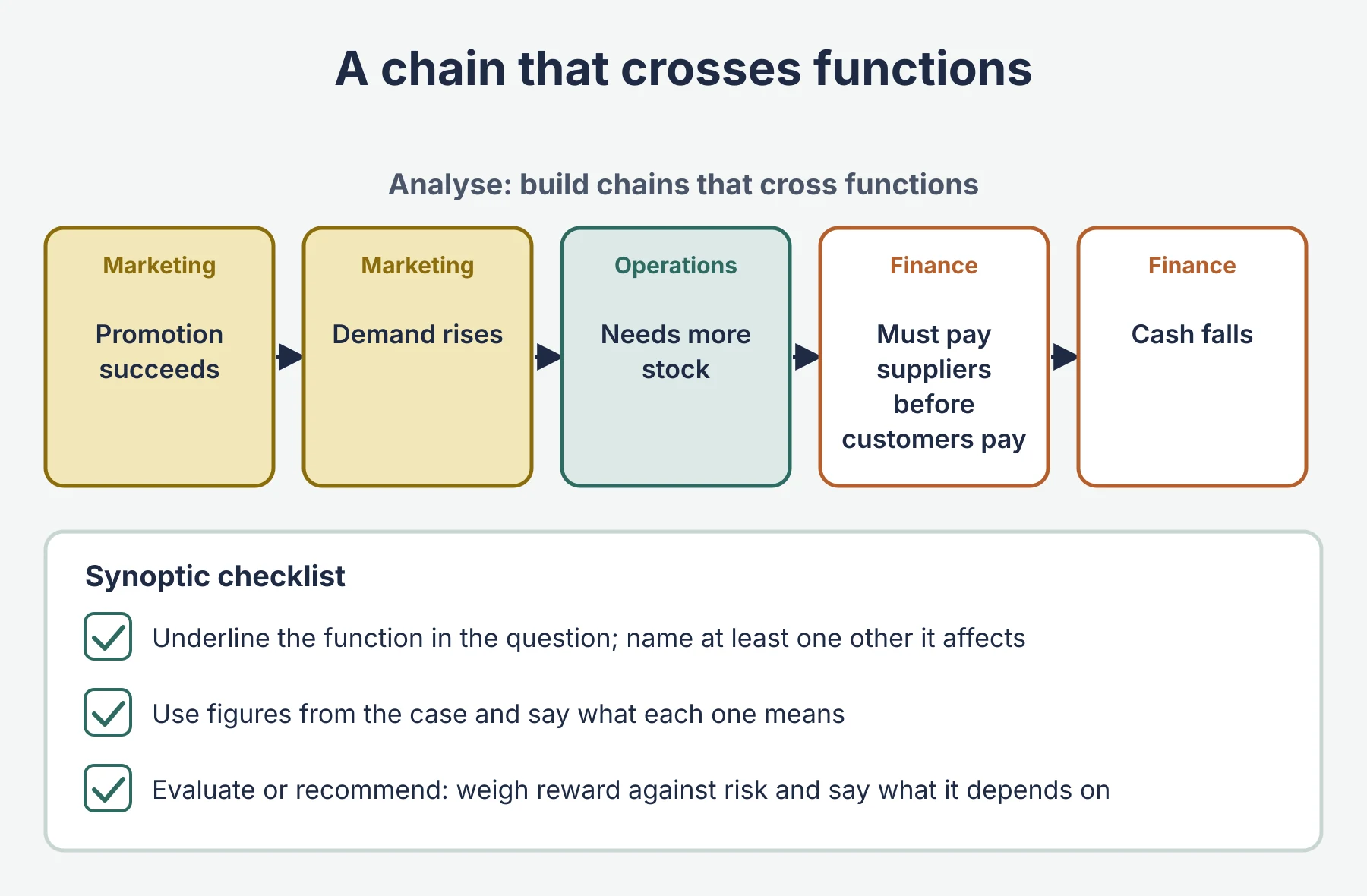
- Underline the function in the question, then name at least one other function your answer affects.
- Use figures from the case, and say what each calculated figure means.
- For analyse, build chains that cross functions: promotion succeeds → demand rises → operations need more stock → finance must pay suppliers before customers pay → cash falls.
- For evaluate and recommend, weigh reward against risk and say what the decision depends on.
Common mistakes
- Writing about one function only when the question is synoptic.
- Calculating ARR or break-even and stopping, without interpreting the answer.
- Treating a forecast as certain.
- Confusing profit with cash: a profitable plan can still run out of cash.
- Ignoring the business’s objective when judging risk and reward.
Frequently asked questions
Is section 7 tested on its own? It is assessed through synoptic questions in section B of the J204/02 paper, which draw on content from both components.
Which formulae do I need? Gross and net profit margin, average rate of return, break-even quantity and cash flow calculations, all from section 5.
Official syllabus
OCR GCSE (9-1) Business (J204) specification, Version 2.0 (January 2026), section 7 The interdependent nature of business. Published by OCR.
Related resources
-
Practice questions
OCR GCSE Business (J204): The interdependent nature of business – Practice Questions
Twelve original synoptic questions for OCR GCSE Business J204 section 7: linked functions, risk and reward, margins, ARR, break-even and cash, with answers.
Business · OCR · GCSE
Try questions -
Revision notes
OCR GCSE Business (J204): The interdependent nature of business – Revision Notes
Revision notes on OCR GCSE Business J204 section 7: linking operations, finance, marketing and HR, risk and reward, and financial measures, with a self-test.
Business · OCR · GCSE
Revise topic -
Study guides
OCR GCSE Business: Operations (J204)
Study guide to section 4 Operations in OCR GCSE (9-1) Business J204: production, quality, selling, consumer law, location, suppliers, with worked examples.
Business · OCR · GCSE
Read guide
Get free revision emails (optional)
Occasional emails with practice questions, worked explanations and links to free resources for the qualification and subjects you choose. No spam, and you can unsubscribe from any email. The free tools on this site never need an email.