
Revision Notes
OCR GCSE Business (J204): Influences on business – Revision Notes
Condensed revision notes on OCR GCSE Business J204 section 6: ethics, the environment, consumer income and unemployment, and globalisation, with a self-test.
- Subject
- Business
- Level
- GCSE
- Topic
- Operations, finance and influences on business
- Author
- Marlbridge Academic Team
- Updated
- Reviewed by
- Salman Ahmad (what this means)
Aligned to OCR GCSE Business (J204), Version 2.0 (January 2026), for first assessment in 2019. Official specification .
Syllabus page (what it covers and how it is assessed): OCR GCSE Business.
Syllabus points this page covers
J204
- 6 Influences on business
Found an error? Report a correction.
Need help with this topic? Request a free trial class for GCSE Business (J204).
Quick recall for section 6, Influences on business, of OCR GCSE (9-1) Business (J204), Version 2.0 (January 2026), assessed in Business 2 (J204/02). For the full explanations and worked examples read the Influences on business study guide, then try the Influences on business practice questions. The combined revision notes for sections 6 and 7 cover both sections more briefly.
Key terms
| Term | Meaning |
|---|---|
| Ethics | Deciding what is morally right, beyond what the law requires |
| Ethical sourcing | Buying materials produced with fair treatment of workers and the environment |
| Sustainability | Using resources in a way that does not use them up for the future |
| Waste disposal | Removing and dealing with unwanted materials, which costs money |
| Pollution | Harm to air, land or water, including noise, from business activity |
| Climate change | Long-term change in weather patterns that affects supply, costs and demand |
| Economic climate | The general state of the economy in which a business trades |
| Consumer income | The money households have available to spend |
| Unemployment | People who want to work but have no job |
| Globalisation | Growing connections between economies, so goods, money, people and ideas cross borders more easily |
| Multinational company | A business that operates in more than one country |
| International branding | Using a brand across many countries, kept the same or adapted locally |
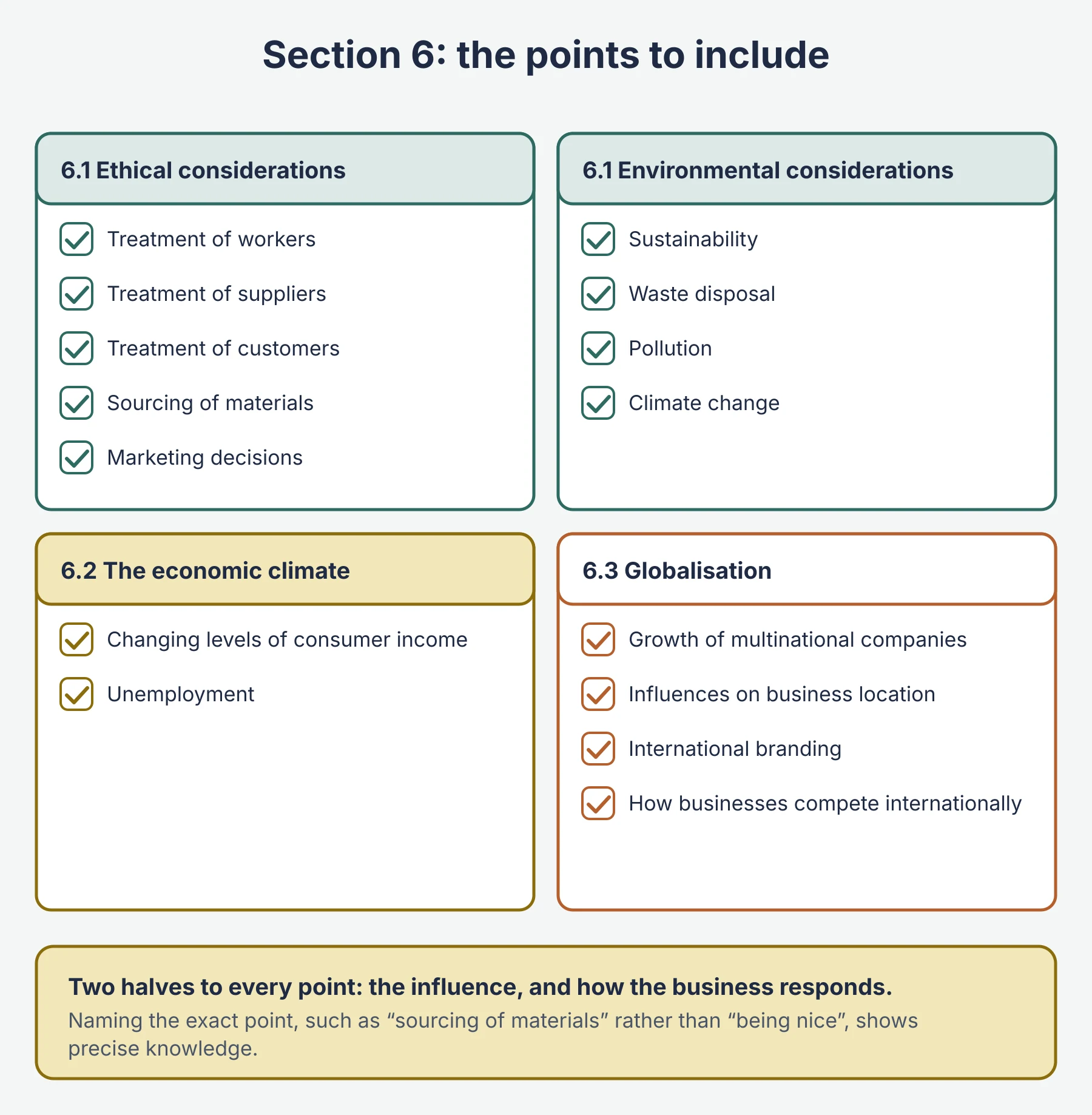
6.1 Ethics in one line each
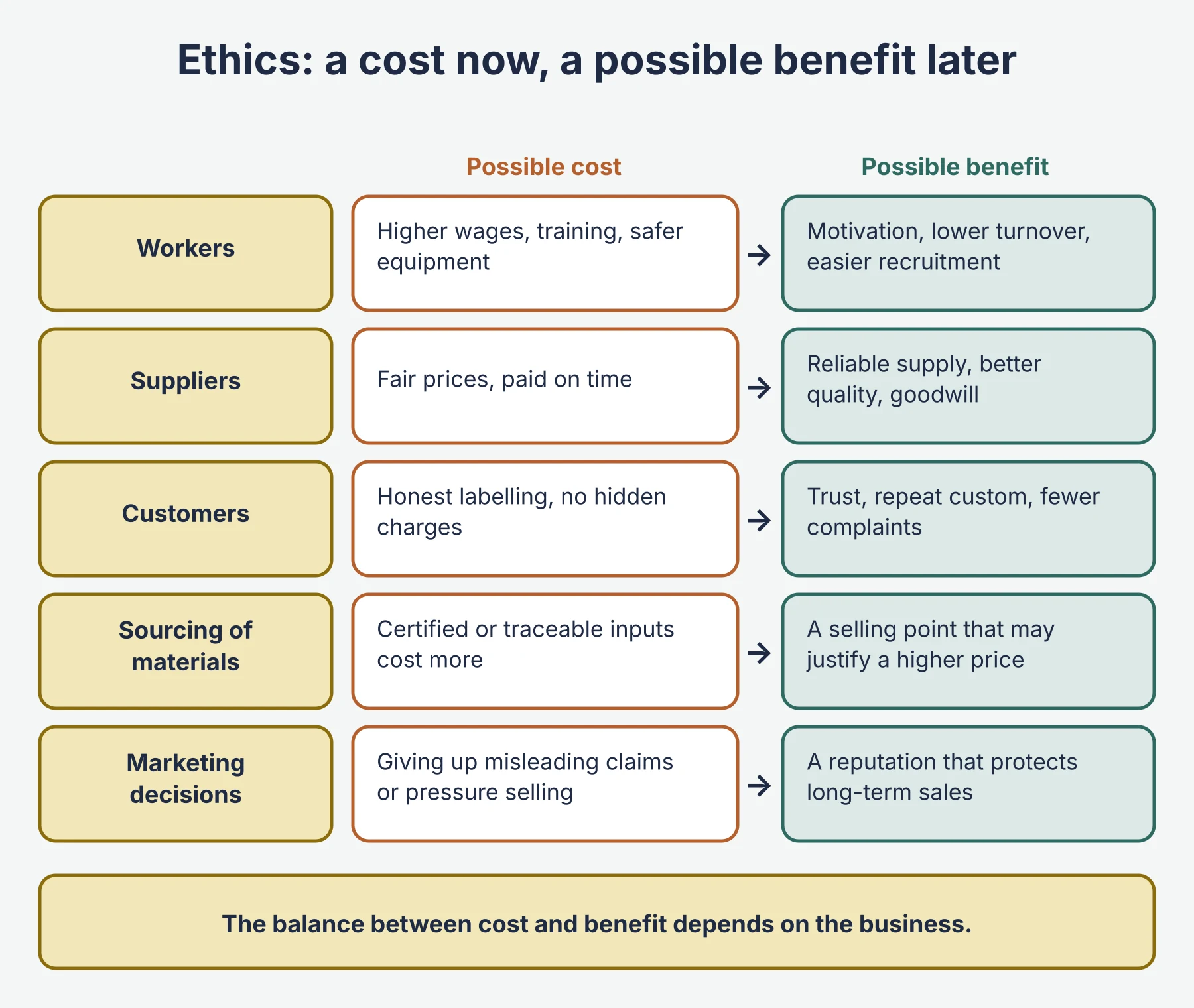
- Workers: fair pay and safe conditions cost more, but cut staff turnover and help recruitment.
- Suppliers: fair prices and prompt payment build reliable supply.
- Customers: honesty builds trust and repeat sales; misleading them risks complaints and lost reputation.
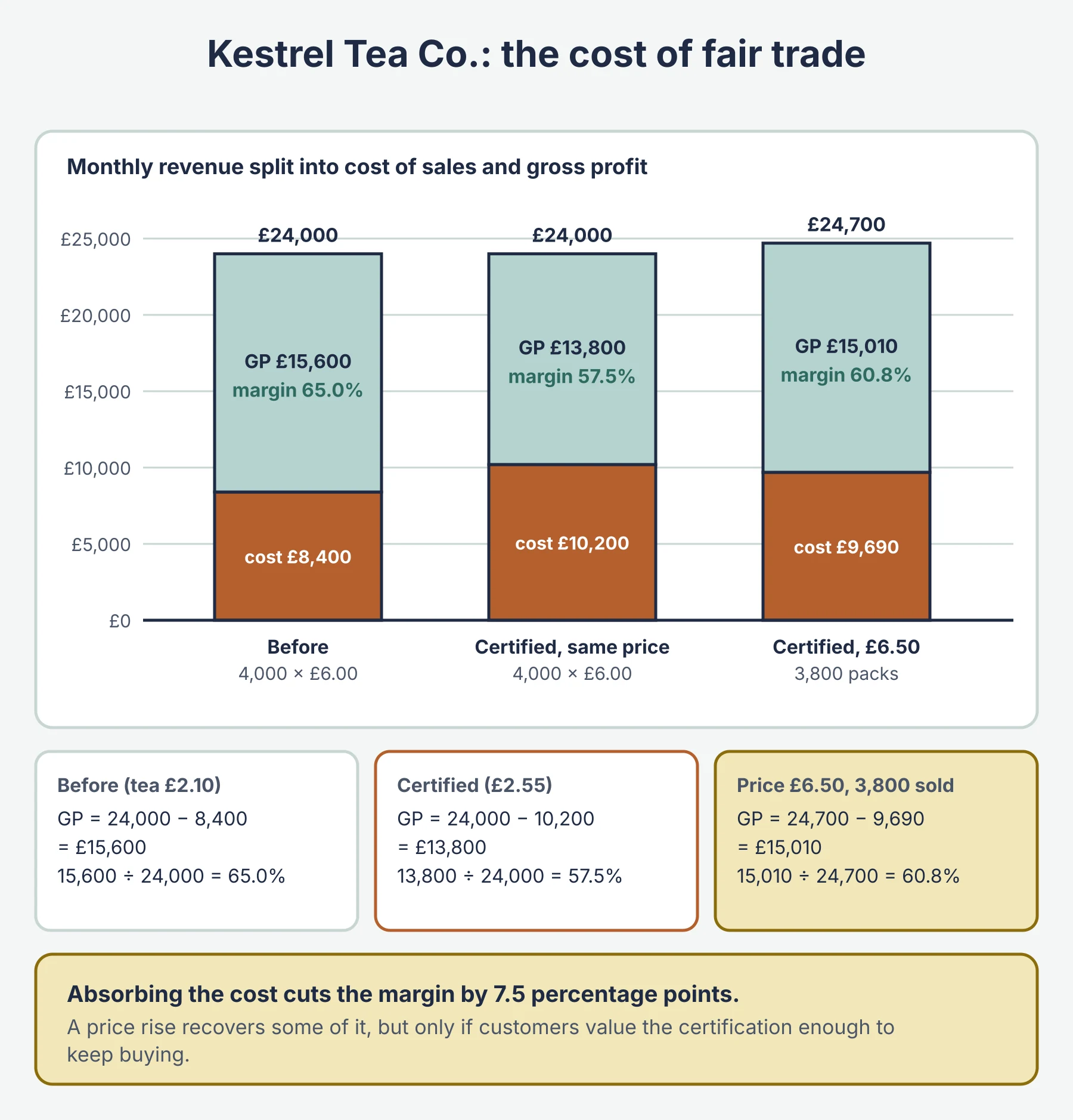
- Sourcing of materials: ethical inputs cost more; they may support a higher price.
- Marketing decisions: avoid exaggerated claims and targeting vulnerable groups.
The formula for any ethics answer: cost now + possible benefit later + “depends on whether customers value it”.
6.1 The environment in one line each
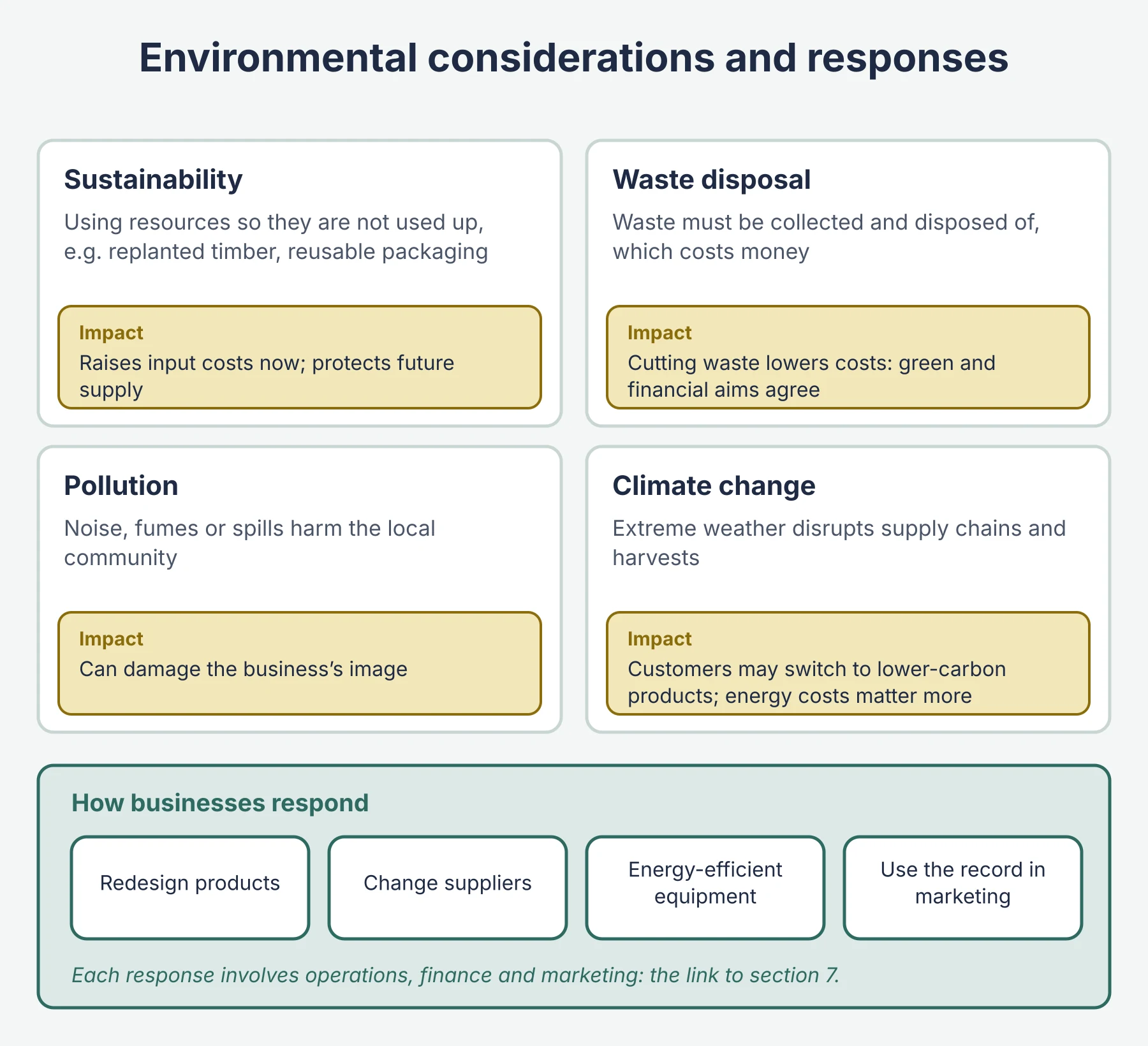
- Sustainability: protects future supply; may raise input costs.
- Waste disposal: less waste usually means lower costs, so profit and the environment can agree.
- Pollution: affects the local community and reputation.
- Climate change: disrupts supply and harvests; changes what customers want.
Responses: redesign products and packaging, change suppliers, invest in efficient equipment, use the record in marketing.
6.2 The economic climate
| Change | Effect on demand | Effect as an employer | Typical response |
|---|---|---|---|
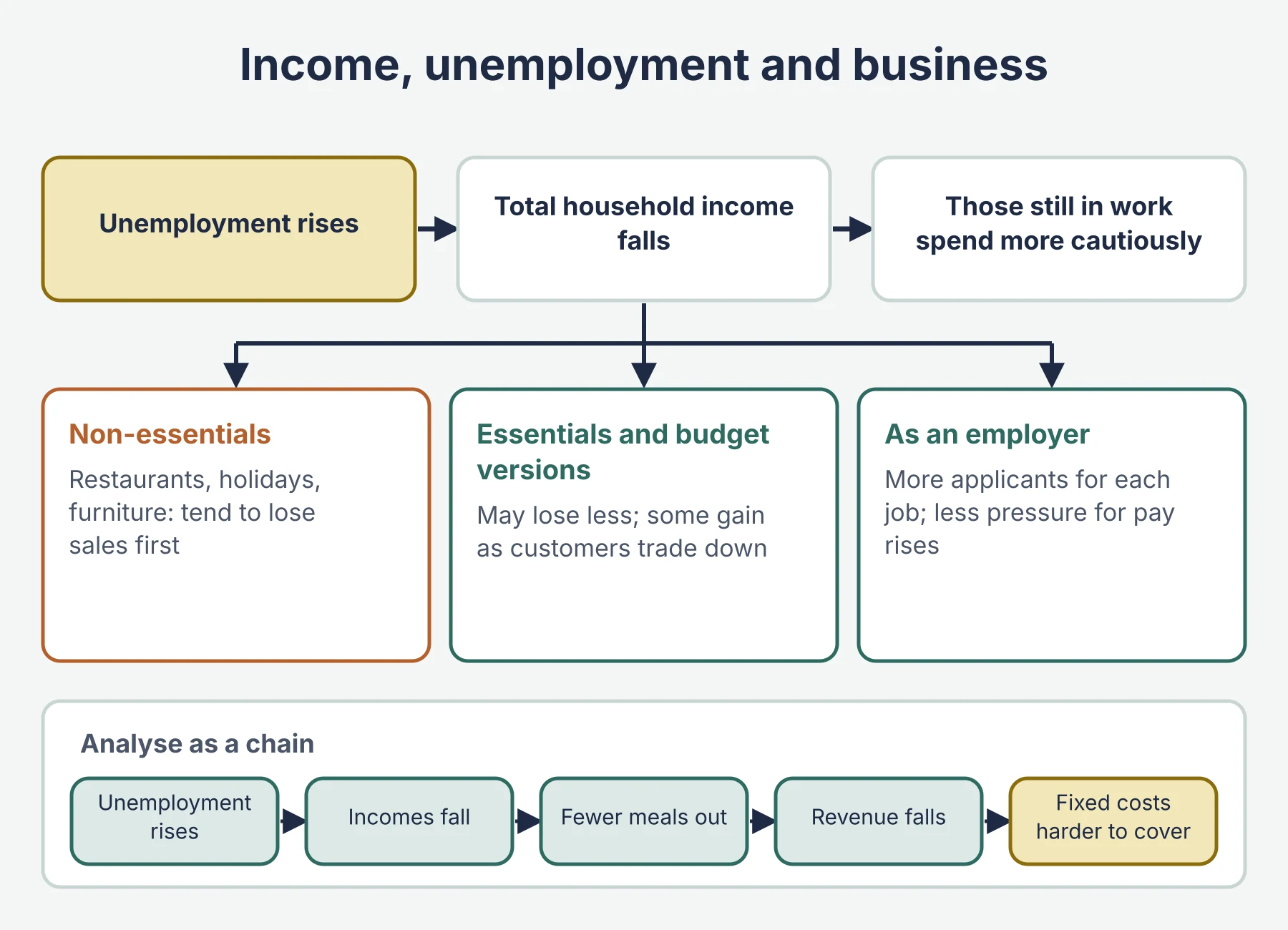
| Consumer incomes rise, unemployment falls | More spending, especially on non-essentials | Harder to recruit; pressure for higher pay | Expand, extend ranges, raise prices on premium lines |
| Consumer incomes fall, unemployment rises | Less spending; customers trade down | More applicants per job; less pay pressure | Cheaper ranges, offers, cost control, protect cash |
Who is hit hardest in a downturn? Sellers of luxuries and non-essentials. Who may gain? Budget sellers that customers trade down to.
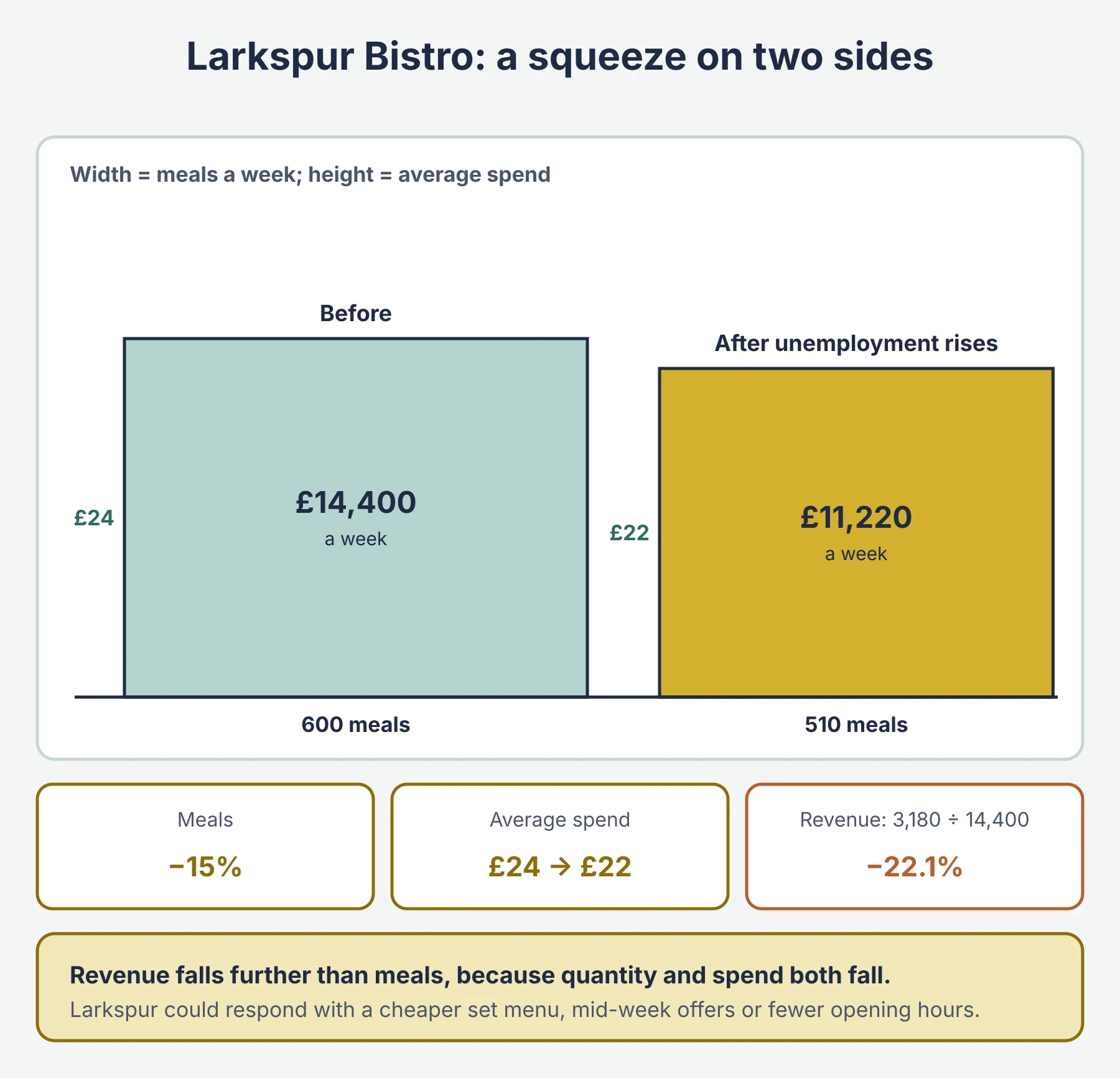
Quick calculation pattern: if both quantity and price per customer fall, revenue falls by more than either. Example (invented): 800 customers at £15 = £12,000; 720 customers at £14 = £10,080, a fall of 16%, although customers fell by only 10%.
6.3 Globalisation
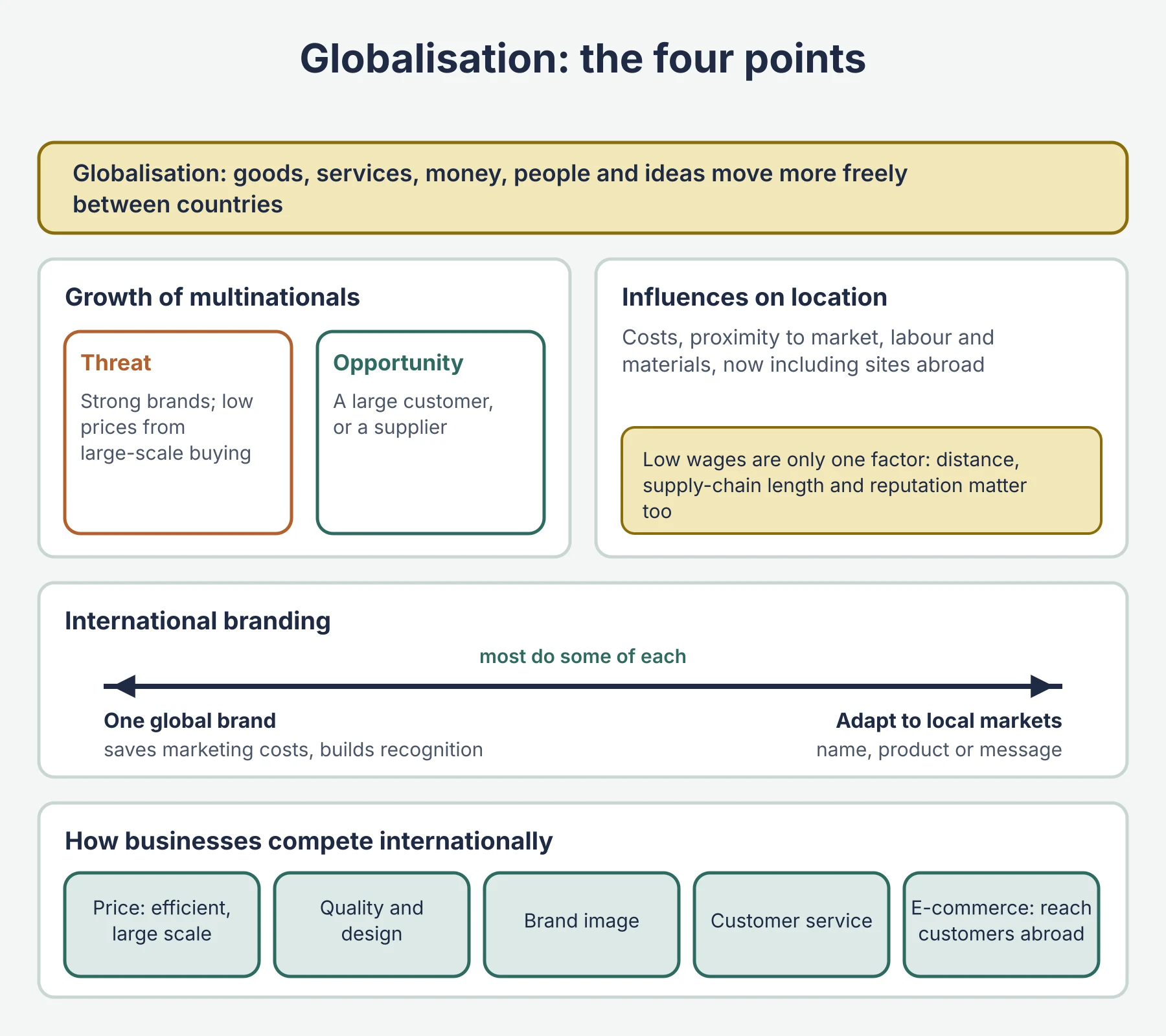
- Multinationals: threat (scale, brands, low prices) or opportunity (customer, supplier).
- Location: costs, proximity to market, labour, materials, now across countries; low wages may be offset by transport, delays and reputation risk.
- International branding: standardise (cheaper, recognisable) or adapt (fits local tastes).
- Competing internationally: price, quality, brand, service, e-commerce.
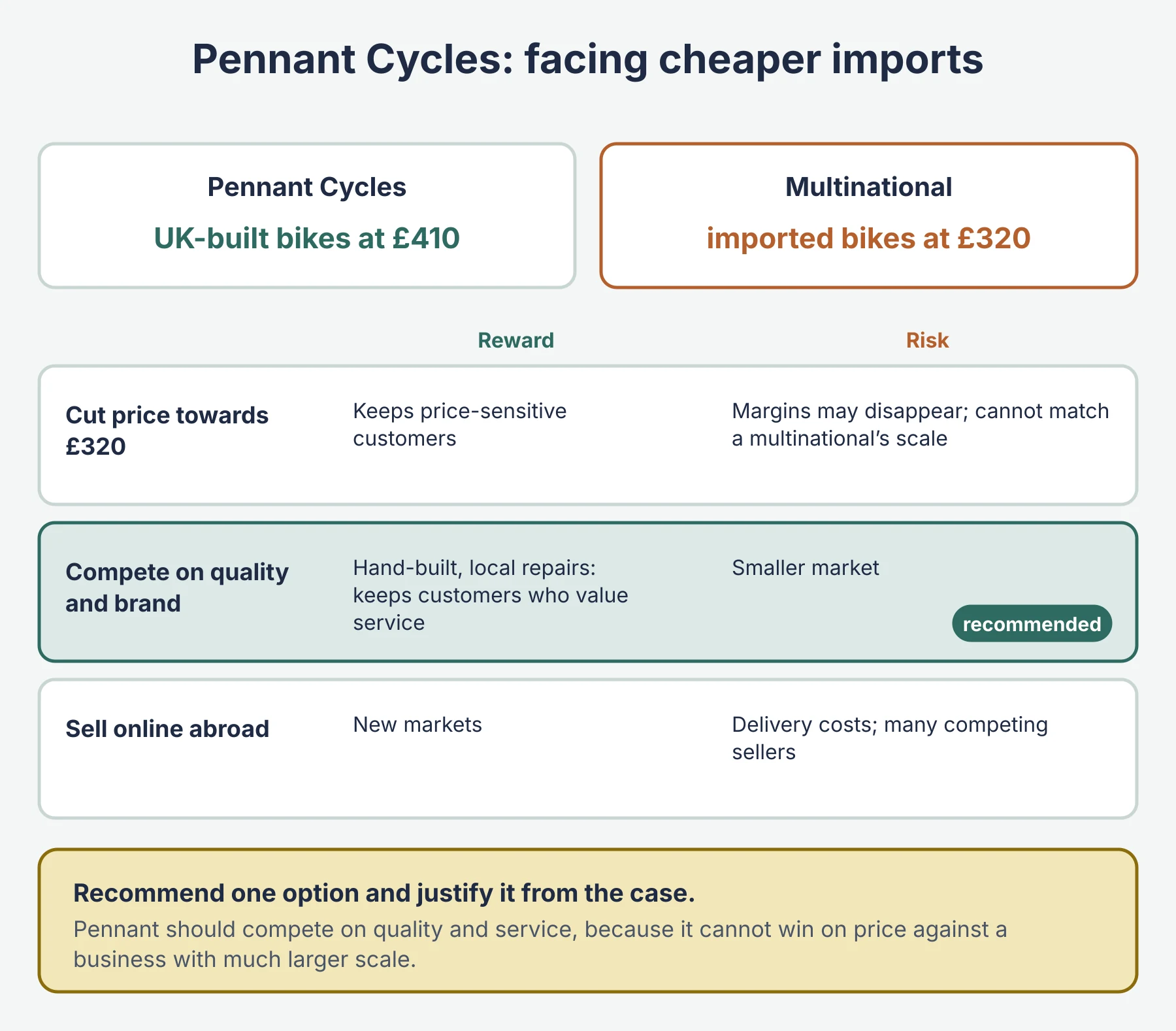
Analysis chain example: multinational opens nearby → customers compare prices → local firm loses sales → it must cut costs or find a point of difference, such as service.
Exam traps
- Writing “ethical” when the action is required by law.
- Forgetting that unemployment affects a business as an employer as well as a seller.
- Treating globalisation only as a threat; it also opens new markets and suppliers.
- Using “multinational” for any large business: it must operate in more than one country.
- Listing environmental points with no impact on costs, sales or reputation.
- Leaving out how the business responds, which the specification includes in this section.
Command words reminder
| Command word | What to do in section 6 |
|---|---|
| Identify / State | Name the point, e.g. “waste disposal” |
| Explain | Point, reason, link to the business in the case |
| Analyse | A chain of three or more linked steps |
| Discuss / Evaluate | Both sides, then a judgement that says “it depends on…” and why |
| Recommend | Choose one option and justify it from the case |
Self-test
- Name the five ethical areas listed in the specification.
- State the four environmental considerations.
- What is the difference between an ethical and a legal requirement?
- Give one way reducing waste can increase profit.
- Which two features of the economic climate does the specification name?
- Why might a budget retailer gain when unemployment rises?
- Give one benefit to a business, as an employer, of higher unemployment.
- A café’s customers fall from 1,000 to 900 a week and average spend from £8 to £7.50. Calculate the percentage fall in revenue.
- Define globalisation.
- State one advantage of keeping a brand the same in every country.
- Give two ways a small business can compete with a multinational.
- Why might moving production abroad not save money overall?
Answers
- Treatment of workers, treatment of suppliers, treatment of customers, sourcing of materials, marketing decisions.
- Sustainability, waste disposal, pollution, climate change.
- A legal requirement must be followed; an ethical choice goes beyond what the law requires.
- Less material is bought and disposal charges fall, so costs fall.
- Changing levels of consumer income and unemployment.
- Customers with less income trade down from dearer shops to cheaper ones.
- More applicants for each job, so it is easier to recruit and pressure for pay rises is lower.
- Before £8,000, after £6,750; fall = 1,250 ÷ 8,000 × 100 = 15.6%.
- The growing connection between economies, so goods, services, money, people and ideas move more freely across borders.
- Lower marketing costs, or the brand is recognised everywhere.
- Any two: better service, higher quality, a local or specialist product, selling online.
- Transport costs, longer supply chains, delays and damage to reputation can outweigh lower wages.
Frequently asked questions
How much of section 6 is calculation? Little of it is calculation in its own right, but you may need margins, percentages or revenue to show the impact of an influence.
What makes an evaluation in section 6 strong? A judgement that names what the outcome depends on, such as the type of product or the business’s cash, and uses the case.
Official syllabus
OCR GCSE (9-1) Business (J204) specification, Version 2.0 (January 2026), section 6 Influences on business. Published by OCR.
Related resources
-
Study guides
OCR GCSE Business (J204): The interdependent nature of business
Study guide to section 7 of OCR GCSE Business J204: how the four functions depend on each other, risk and reward, and financial information in decisions.
Business · OCR · GCSE
Read guide -
Practice questions
OCR GCSE Business (J204): The interdependent nature of business – Practice Questions
Twelve original synoptic questions for OCR GCSE Business J204 section 7: linked functions, risk and reward, margins, ARR, break-even and cash, with answers.
Business · OCR · GCSE
Try questions -
Revision notes
OCR GCSE Business (J204): The interdependent nature of business – Revision Notes
Revision notes on OCR GCSE Business J204 section 7: linking operations, finance, marketing and HR, risk and reward, and financial measures, with a self-test.
Business · OCR · GCSE
Revise topic
Get free revision emails (optional)
Occasional emails with practice questions, worked explanations and links to free resources for the qualification and subjects you choose. No spam, and you can unsubscribe from any email. The free tools on this site never need an email.