
Study Guides
OCR GCSE Business (J204): Influences on business
A study guide to section 6 of OCR GCSE Business J204: ethical and environmental considerations, the economic climate and globalisation, with worked examples.
- Subject
- Business
- Level
- GCSE
- Topic
- Operations, finance and influences on business
- Author
- Marlbridge Academic Team
- Updated
- Reviewed by
- Salman Ahmad (what this means)
Aligned to OCR GCSE Business (J204), Version 2.0 (January 2026), for first assessment in 2019. Official specification .
Syllabus page (what it covers and how it is assessed): OCR GCSE Business.
Syllabus points this page covers
J204
- 6 Influences on business
Found an error? Report a correction.
Need help with this topic? Request a free trial class for GCSE Business (J204).
This guide covers section 6, Influences on business, of the OCR GCSE (9-1) Business specification (J204), Version 2.0 (January 2026). Section 6 is assessed in Business 2: operations, finance and influences on business (J204/02). The specification says learners explore “the importance of external influences on business and how businesses change in response to these influences”, so every point in this section has two halves: what the influence is, and what a business does about it.
It goes deeper than the combined study guide to sections 6 and 7, with new worked examples on margins, falling demand and international competition. When you have read it, condense it with the Influences on business revision notes and test yourself with the Influences on business practice questions.
What the specification lists
| Topic | Content | Points to include |
|---|---|---|
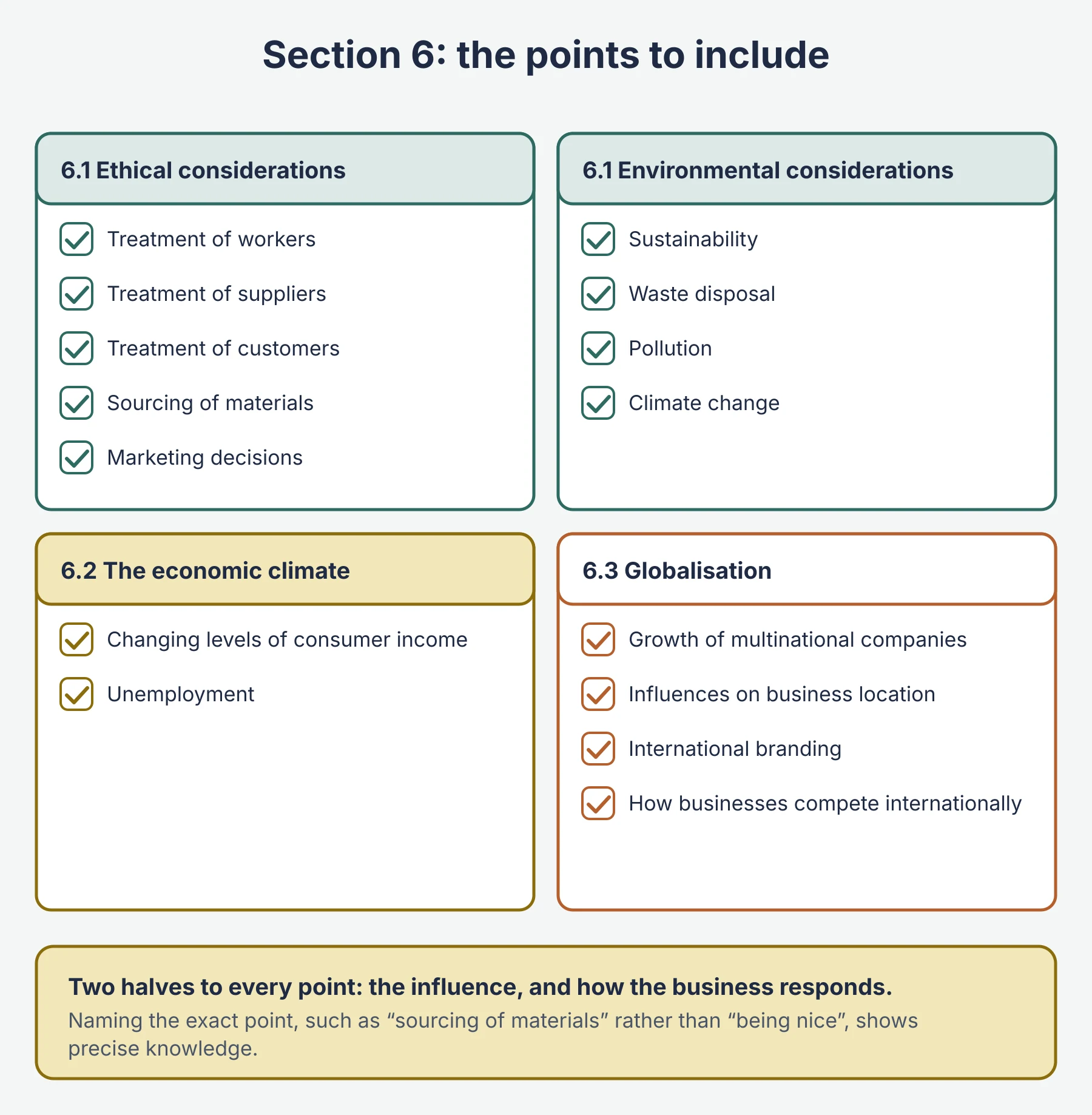
| 6.1 Ethical and environmental considerations | Ethical considerations and their impact on businesses | Treatment of workers, suppliers and customers; sourcing of materials; marketing decisions |
| Environmental considerations and their impact on businesses | Sustainability, waste disposal, pollution, climate change | |
| 6.2 The economic climate | The economic climate and its impact on businesses | Changing levels of consumer income and unemployment |
| 6.3 Globalisation | The concept of globalisation; its impact on businesses | Growth of multinational companies, influences on business location, international branding, how businesses compete internationally |
Learn the “points to include” as a checklist. Examiners build questions around them, and an answer that names the right point, such as “sourcing of materials” rather than “being nice”, shows precise knowledge from the start.
6.1 Ethical considerations: the trade-off with profit
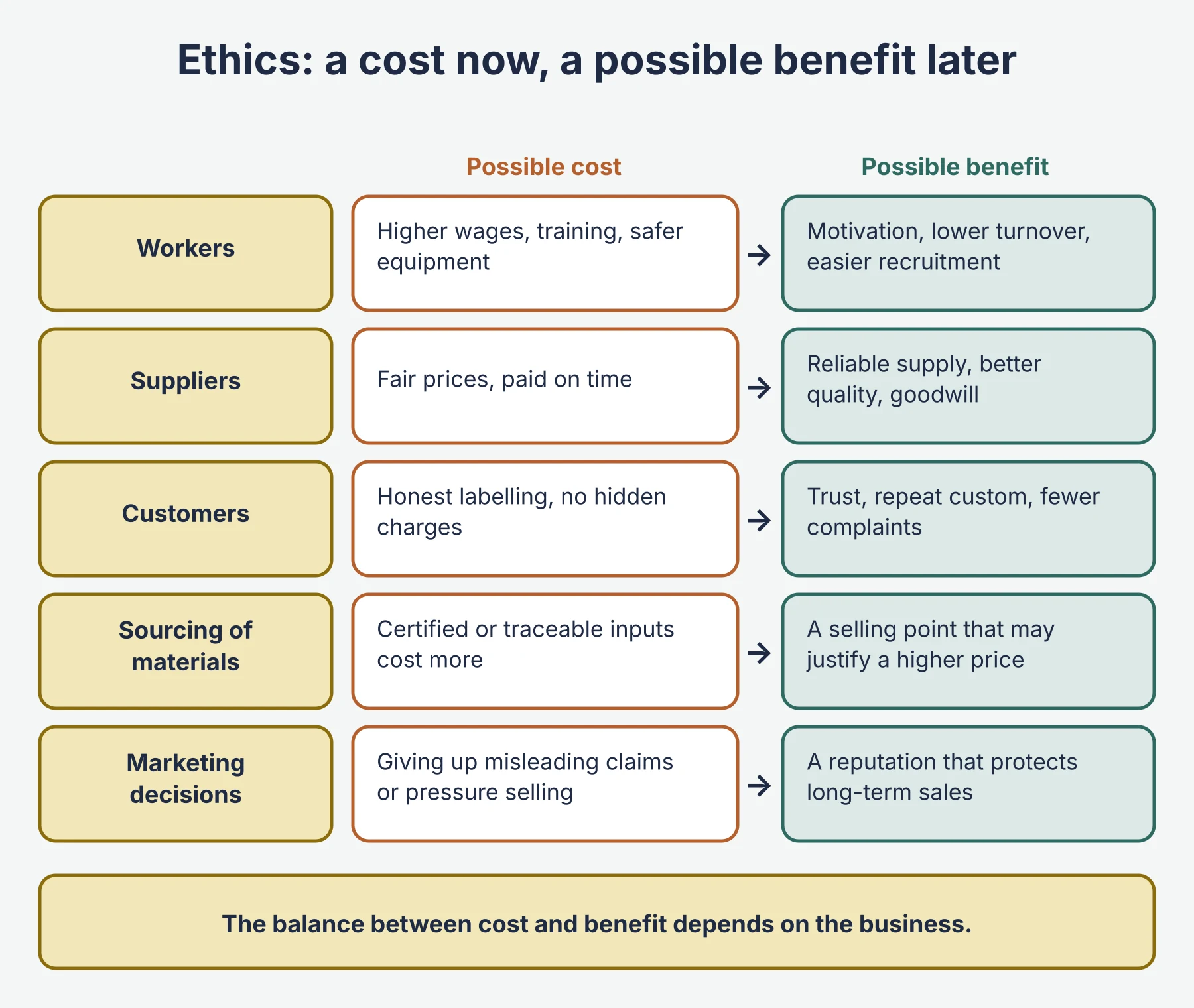
An ethical decision is one judged by what is right, not only by what is legal or profitable. The key exam skill is to show that ethics has a cost and a possible benefit, and that the balance depends on the business.
| Area | Possible cost | Possible benefit |
|---|---|---|
| Treatment of workers | Higher wages, training, safer equipment | Better motivation, lower staff turnover, easier recruitment |
| Treatment of suppliers | Paying fair prices and paying on time | Reliable supply, better quality, goodwill when the business needs help |
| Treatment of customers | Honest labelling, no hidden charges | Trust, repeat custom, fewer complaints |
| Sourcing of materials | Certified or traceable inputs cost more | A selling point that may justify a higher price |
| Marketing decisions | Giving up misleading claims or pressure selling | A reputation that protects long-term sales |
Worked example: ethical sourcing and the gross profit margin
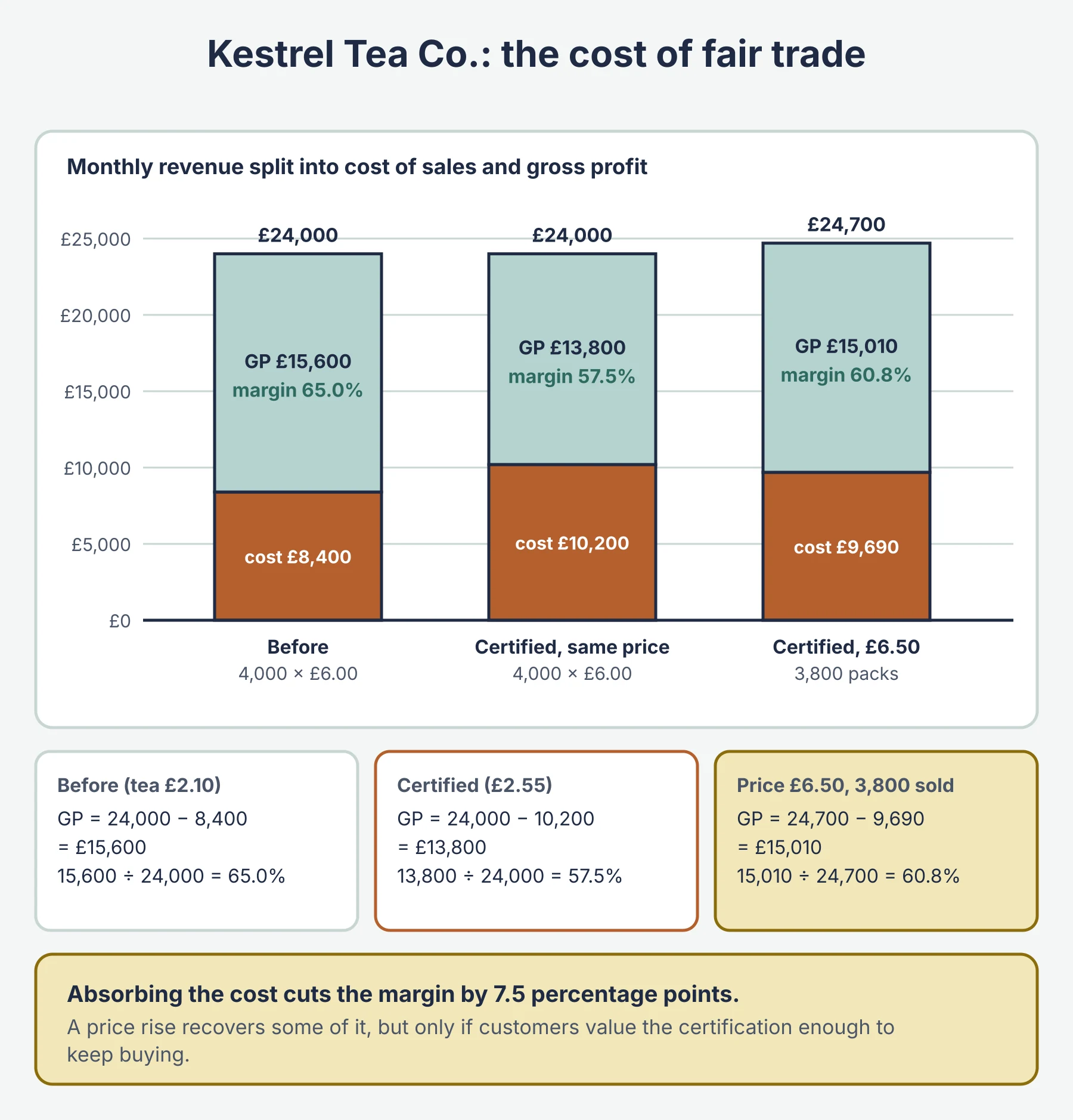
Kestrel Tea Co. (an invented business) sells 4,000 packs of tea a month at £6.00. The tea in each pack costs £2.10. The owner is considering tea certified as fairly traded, which costs £2.55 a pack.
Before:   revenue = 4,000 x 6.00 = £24,000
          cost of sales = 4,000 x 2.10 = £8,400
          gross profit = £15,600   gross profit margin = 15,600 / 24,000 x 100 = 65.0%

Same price, certified tea:
          cost of sales = 4,000 x 2.55 = £10,200
          gross profit = £13,800   gross profit margin = 13,800 / 24,000 x 100 = 57.5%

Price raised to £6.50, sales fall to 3,800 packs:
          revenue = £24,700   cost of sales = £9,690
          gross profit = £15,010   gross profit margin = 15,010 / 24,700 x 100 = 60.8%
If Kestrel absorbs the cost, the margin falls by 7.5 percentage points. Raising the price recovers some of it, but only if customers value the certification enough to keep buying. A good answer uses the figures to show the cost, then judges whether the target customers are likely to pay more.
6.1 Environmental considerations
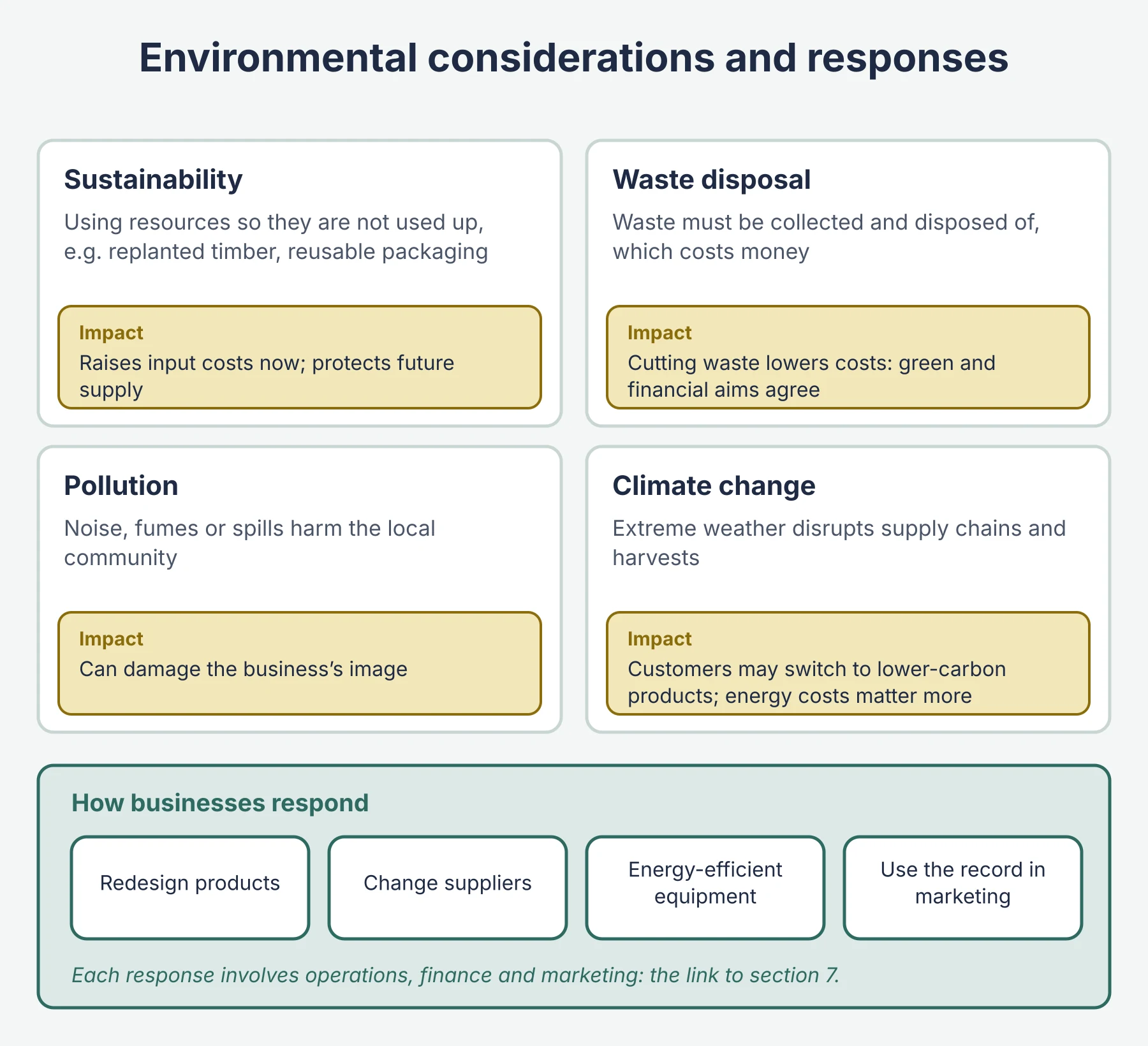
The four points to include each affect a business in a different way:
- Sustainability: using resources so that they are not used up, for example timber from replanted forests or reusable packaging. It can raise input costs now but protects future supply.
- Waste disposal: waste must be collected and disposed of, which costs money. Cutting waste lowers costs, so this is where environmental and financial aims often agree.
- Pollution: noise, fumes or spills harm the local community, a key external stakeholder, and can damage the business’s image.
- Climate change: extreme weather can disrupt supply chains and harvests; customers may switch to lower-carbon products; energy costs matter more.
How businesses respond is the second half of the specification point. Typical responses are redesigning products, changing suppliers, investing in energy-efficient equipment and using an environmental record in marketing. Each response involves operations, finance and marketing, which links section 6 to section 7.
6.2 The economic climate
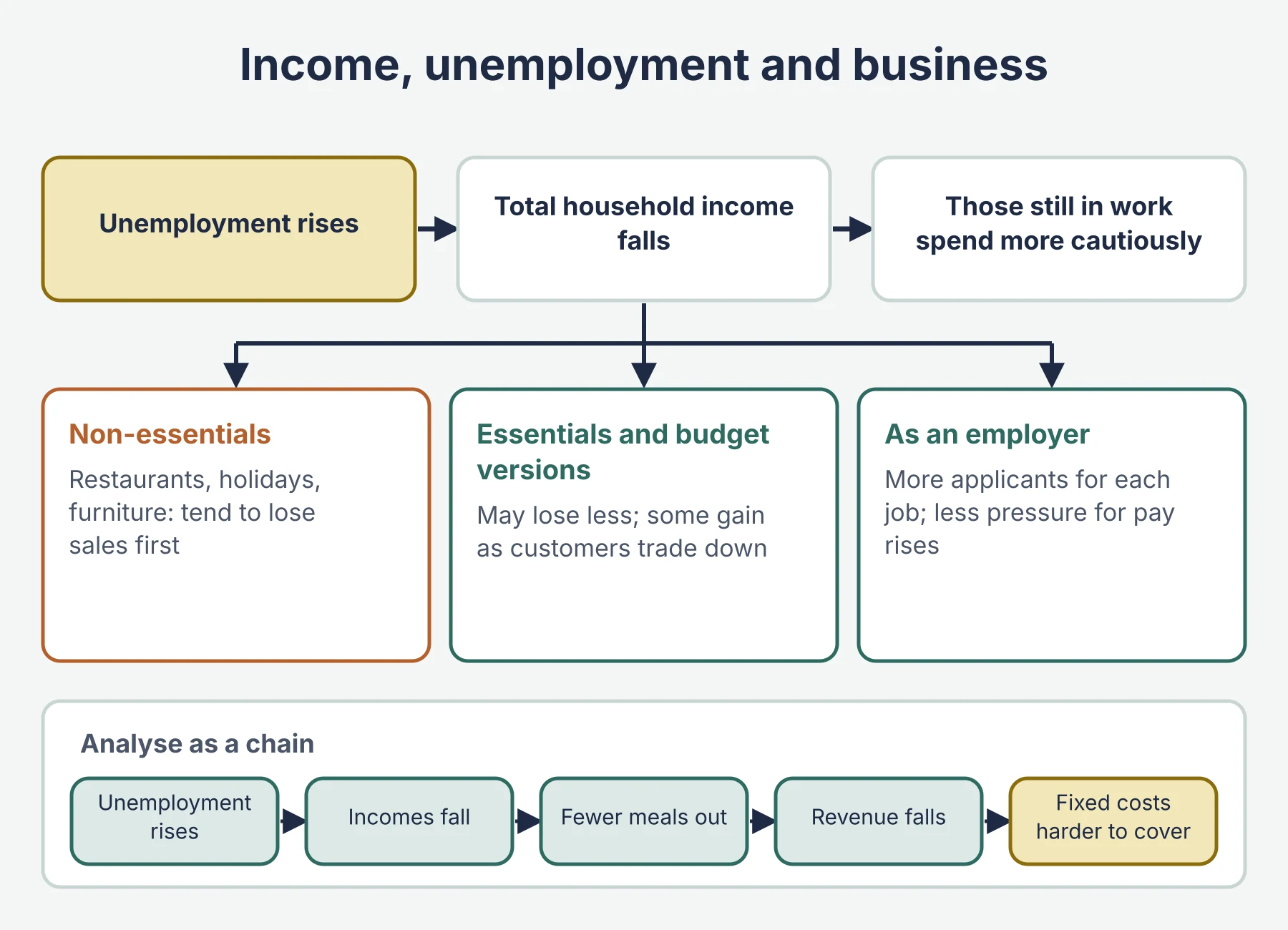
The specification names two features: changing levels of consumer income and unemployment. They are linked: when unemployment rises, total household income falls, and people who still have jobs often spend more cautiously.
The effect is not the same for every business:
- Businesses selling non-essential products, such as restaurants, holidays and furniture, tend to lose sales first.
- Businesses selling essentials or budget versions may lose less, and some gain as customers trade down.
- Higher unemployment also affects a business as an employer: more people apply for each job, so recruitment can be easier and pressure for pay rises lower.
Worked example: a fall in spending at a restaurant
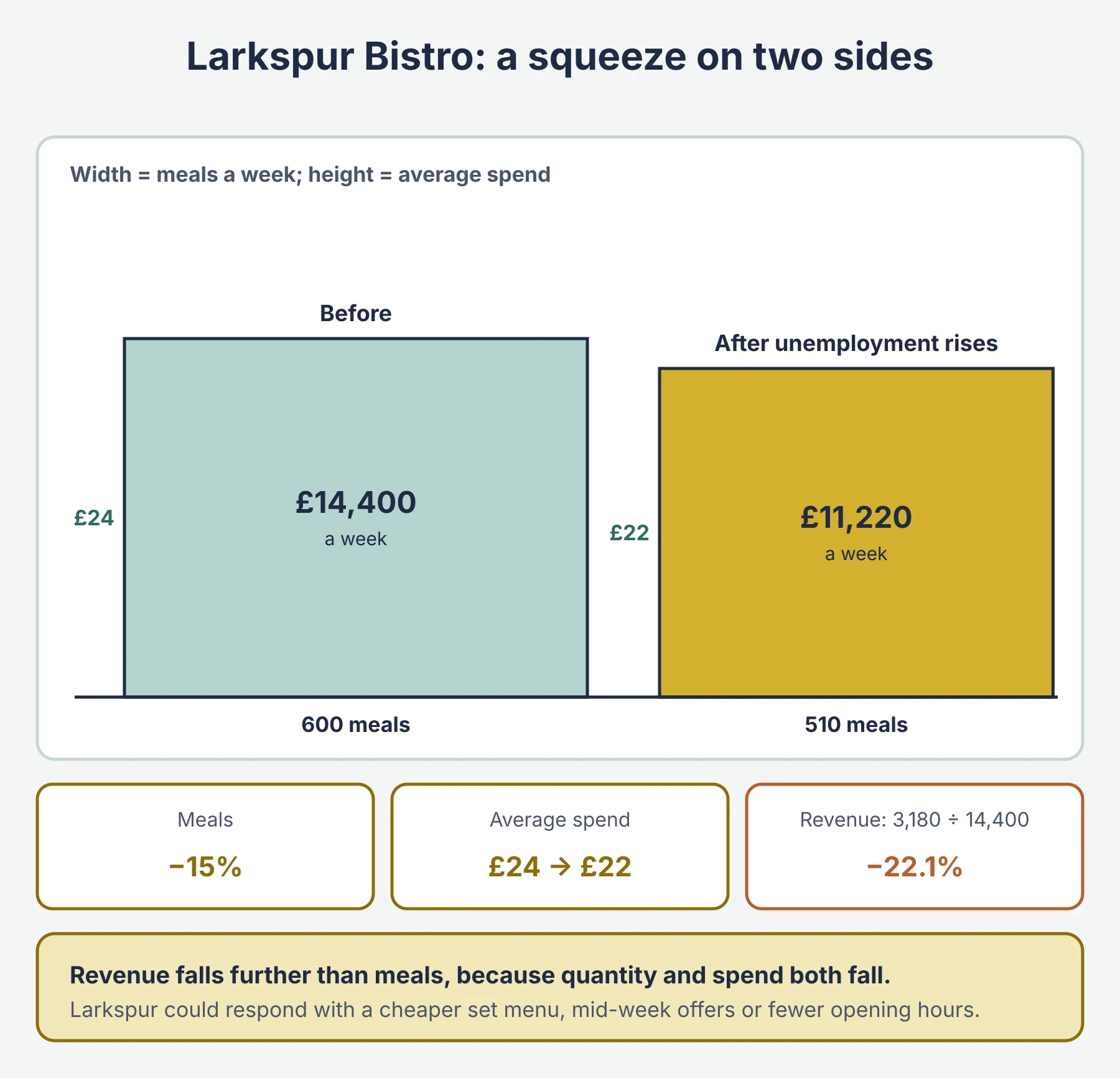
Larkspur Bistro (invented) serves 600 meals a week with an average spend of £24. Unemployment in the town rises. Meals fall to 510 a week and the average spend falls to £22 as customers skip desserts and drinks.
Revenue before = 600 x 24 = £14,400 a week
Revenue after  = 510 x 22 = £11,220 a week
Fall = 3,180 / 14,400 x 100 = 22.1%
The number of meals fell by 15%, but revenue fell by over 22%, because both quantity and spend per customer fell. Larkspur could respond with a cheaper set menu, mid-week offers or fewer opening hours. A nearby discount supermarket (invented) might see the opposite: more customers cooking at home. That contrast is exactly what “impact on businesses” questions reward.
6.3 Globalisation
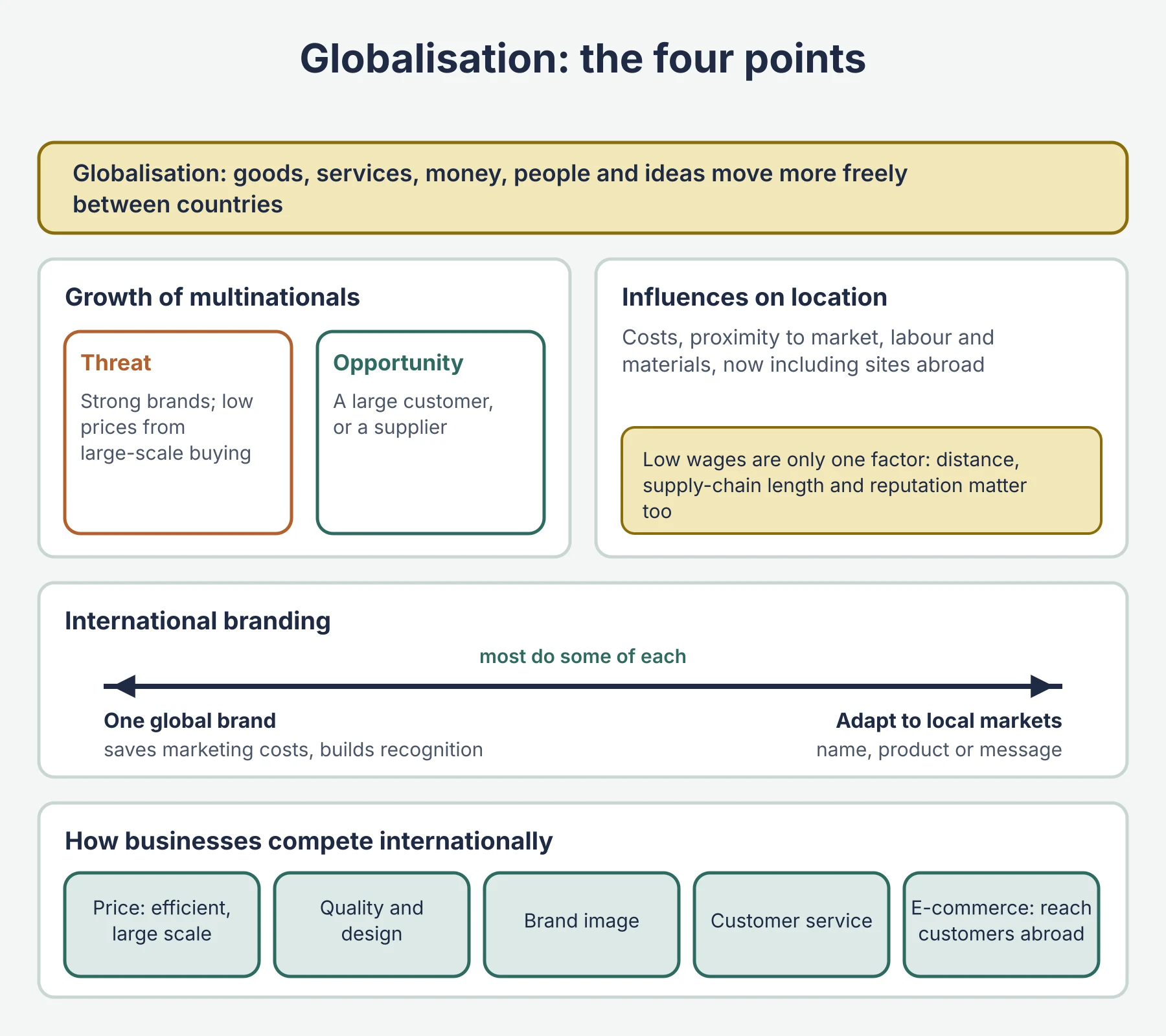
Globalisation is the growing connection between countries’ economies, so that goods, services, money, people and ideas move more freely across borders. The specification’s four points:
- Growth of multinational companies. Multinationals operate in more than one country. For a local business they can be a threat (strong brands, low prices from large-scale buying) or an opportunity (a large customer, or a supplier).
- Influences on business location. Costs, the proximity to market, and labour and materials (the same factors as section 4.5) now include sites abroad. Low wages are only one factor: distance from customers, supply-chain length and reputation matter too.
- International branding. A business can keep one global brand, which saves marketing costs and builds recognition, or adapt the name, product or message to local tastes and languages. Most do some of each.
- How businesses compete internationally. On price (efficient production, large scale), on quality and design, on brand image, on customer service, and through e-commerce, which lets a small business reach customers abroad.
Worked example: a small business facing imported competition
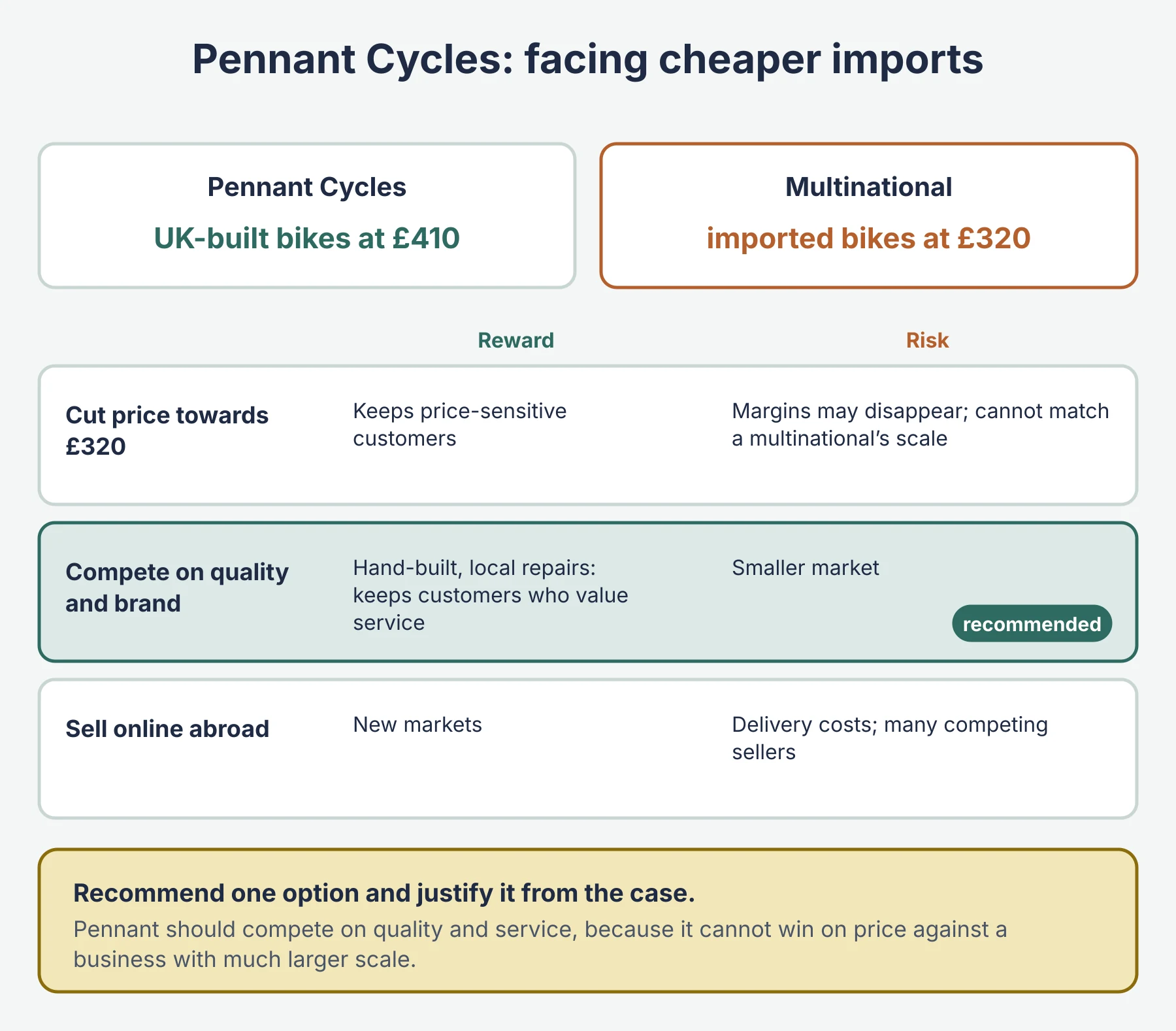
Pennant Cycles (invented) builds bicycles in the UK and sells them at £410. A multinational now sells imported bikes at £320. Pennant’s options:
| Option | Reward | Risk |
|---|---|---|
| Cut price towards £320 | Keeps price-sensitive customers | Margins may disappear; Pennant cannot match a multinational’s scale |
| Compete on quality and brand: hand-built, local repairs | Keeps customers who value service | Smaller market |
| Sell online to customers abroad | New markets | Delivery costs; competing against many sellers |
A strong answer recommends one option and justifies it from the case, for example: Pennant should compete on quality and service, because it cannot win on price against a business with much larger scale.
Exam technique
Business 2 has a multiple-choice section worth 15 marks and a section worth 65 marks with short, medium and extended questions using stimulus material from real business contexts. The specification’s command words tell you the skill:
- Identify / State: knowledge only, such as “pollution”.
- Explain: a point developed and applied to the business in the case.
- Analyse: a logical chain, for example unemployment rises → incomes fall → fewer meals out → revenue falls → fixed costs harder to cover.
- Discuss / Evaluate: weigh both sides and reach a supported judgement.
- Recommend: choose an option and justify it.
In section 6, judgements usually turn on “it depends on”: the type of product, the target customers, the size of the business and how much cash it has.
Common mistakes
- Treating ethics as free: always show the cost as well as the benefit.
- Confusing ethical with legal: paying the legal minimum wage is a legal duty, not an ethical choice.
- Saying an economic downturn harms every business equally.
- Defining globalisation and then never applying it to the business in the case.
- Assuming moving production abroad is always cheaper overall.
- Forgetting the second half of the specification point: how the business responds.
Frequently asked questions
Are interest rates or exchange rates in section 6 of J204? No. The economic climate in this specification names changing levels of consumer income and unemployment, so focus on those.
Do I need to know real multinationals? No. Questions use stimulus material, so apply the ideas to the business you are given.
How do I evaluate an ethical decision? Show the cost, show the benefit, then judge which is larger for this business and its customers.
Official syllabus
OCR GCSE (9-1) Business (J204) specification, Version 2.0 (January 2026), section 6 Influences on business. Published by OCR.
Related resources
-
Practice questions
OCR GCSE Business (J204): Influences on business – Practice Questions
Twelve original questions with worked answers on OCR GCSE Business J204 section 6: ethics, environment, economic climate and globalisation.
Business · OCR · GCSE
Try questions -
Revision notes
OCR GCSE Business (J204): Influences on business – Revision Notes
Condensed revision notes on OCR GCSE Business J204 section 6: ethics, the environment, consumer income and unemployment, and globalisation, with a self-test.
Business · OCR · GCSE
Revise topic -
Study guides
OCR GCSE Business (J204): The interdependent nature of business
Study guide to section 7 of OCR GCSE Business J204: how the four functions depend on each other, risk and reward, and financial information in decisions.
Business · OCR · GCSE
Read guide
Get free revision emails (optional)
Occasional emails with practice questions, worked explanations and links to free resources for the qualification and subjects you choose. No spam, and you can unsubscribe from any email. The free tools on this site never need an email.