
Revision Notes
OxfordAQA A-Level Business: Segmentation, targeting and positioning (9625/9725) – Revision Notes
Condensed revision notes on segmentation, targeting and positioning for OxfordAQA International AS and A-level Business, with a quick self-test.
- Subject
- Business
- Level
- AS LEVEL
- Topic
- Marketing
- Author
- Marlbridge Academic Team
- Updated
- Reviewed by
- Salman Ahmad (what this means)
Aligned to OxfordAQA A Level Business (9625, 9725), 9625: first teaching September 2018 (current cohorts). 9725: first teaching September 2026 (AS) / September 2027 (A2), the successor specification.. Official specification .
Syllabus page (what it covers and how it is assessed): OxfordAQA A Level Business.
Found an error? Report a correction.
Need help with this topic? Request a free trial class for A Level Business (9625 / 9725).
Quick recall for section 3.1.2.3, Segmentation, targeting and positioning, in the OxfordAQA International AS and A-level Business specification. The 9625 text lists five segmentation methods (including income) and international markets; the 9725 successor (International AS exams from May/June 2027, A-level from May/June 2028) lists four methods and adds value of targeting, premium and budget positioning, and changing positioning. Points found in one only are marked below. For fuller explanations and worked examples, use the study guide. Then test yourself with the practice questions. Wider Marketing notes are in the topic revision notes. Also useful: the course hub, the checklist and the diagnostics. Money figures are in dollars.
The content points
| Point from the specification | One-line reminder |
|---|---|
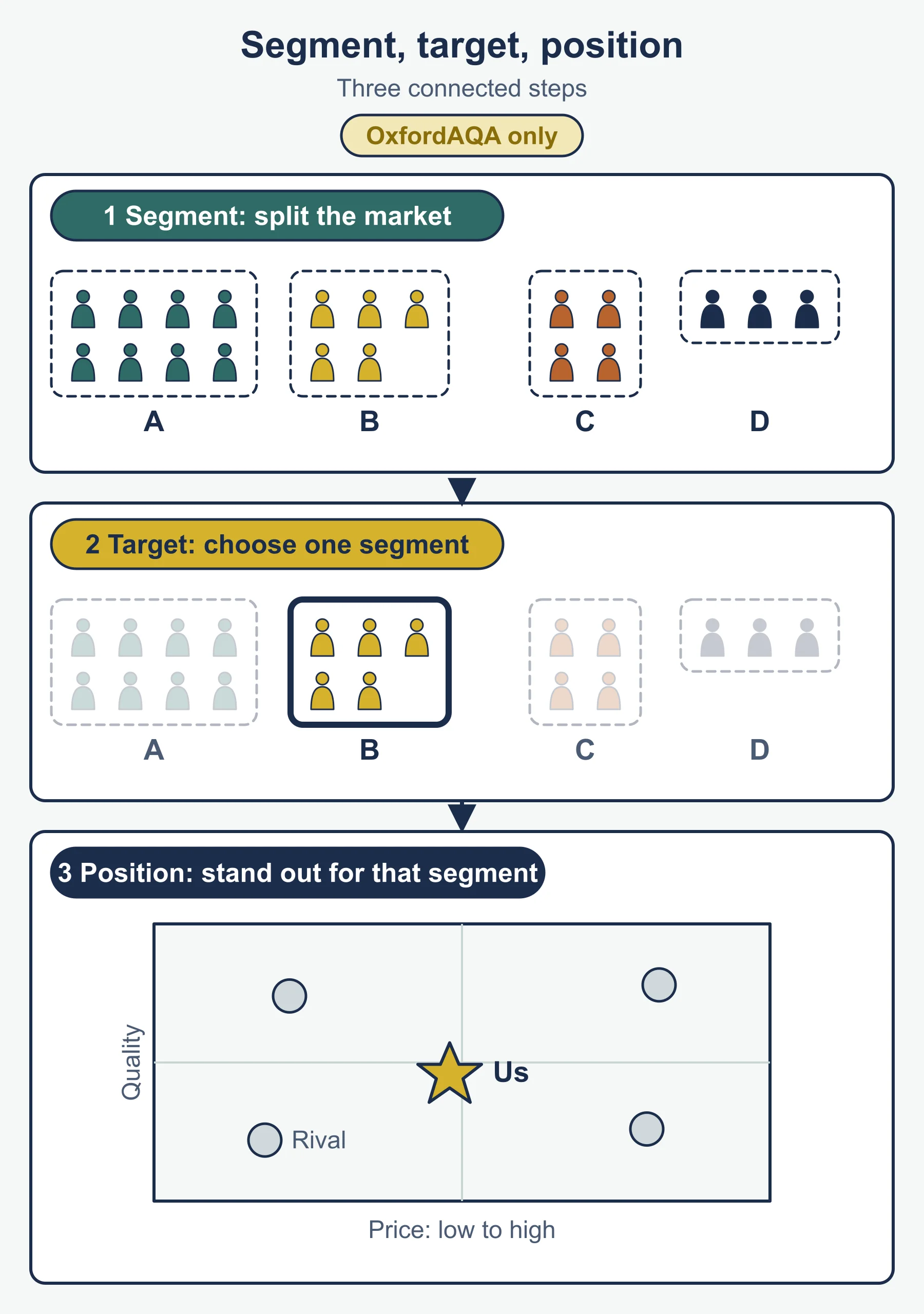
| Process and value of segmentation, targeting and positioning | Segment, then target, then position. Each follows from the last |
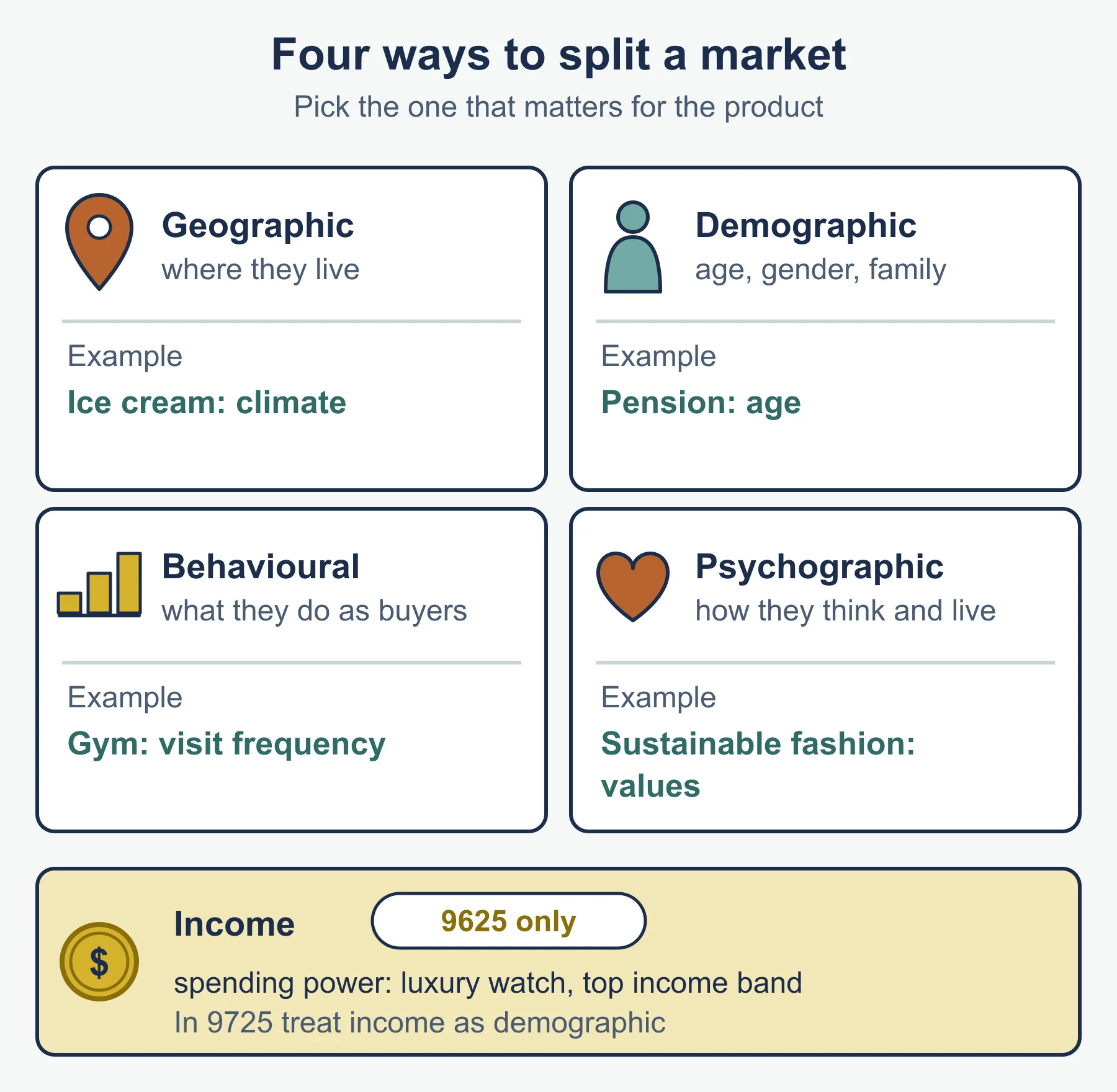
| Segmentation methods | Demographic, geographic, psychographic, behavioural; income as a fifth (9625 only) |
| Influences on target market and positioning | Segment size and growth, profit, competition, resources, objectives, research, perceptions |
| Value of targeting (9725 wording) | Focus spend, specific message, loyalty, measurable results |
| Niche and mass marketing | Small specialised group versus a broad market |
| Meaning of positioning, premium and budget (9725 only) | The place in customers’ minds relative to rivals |
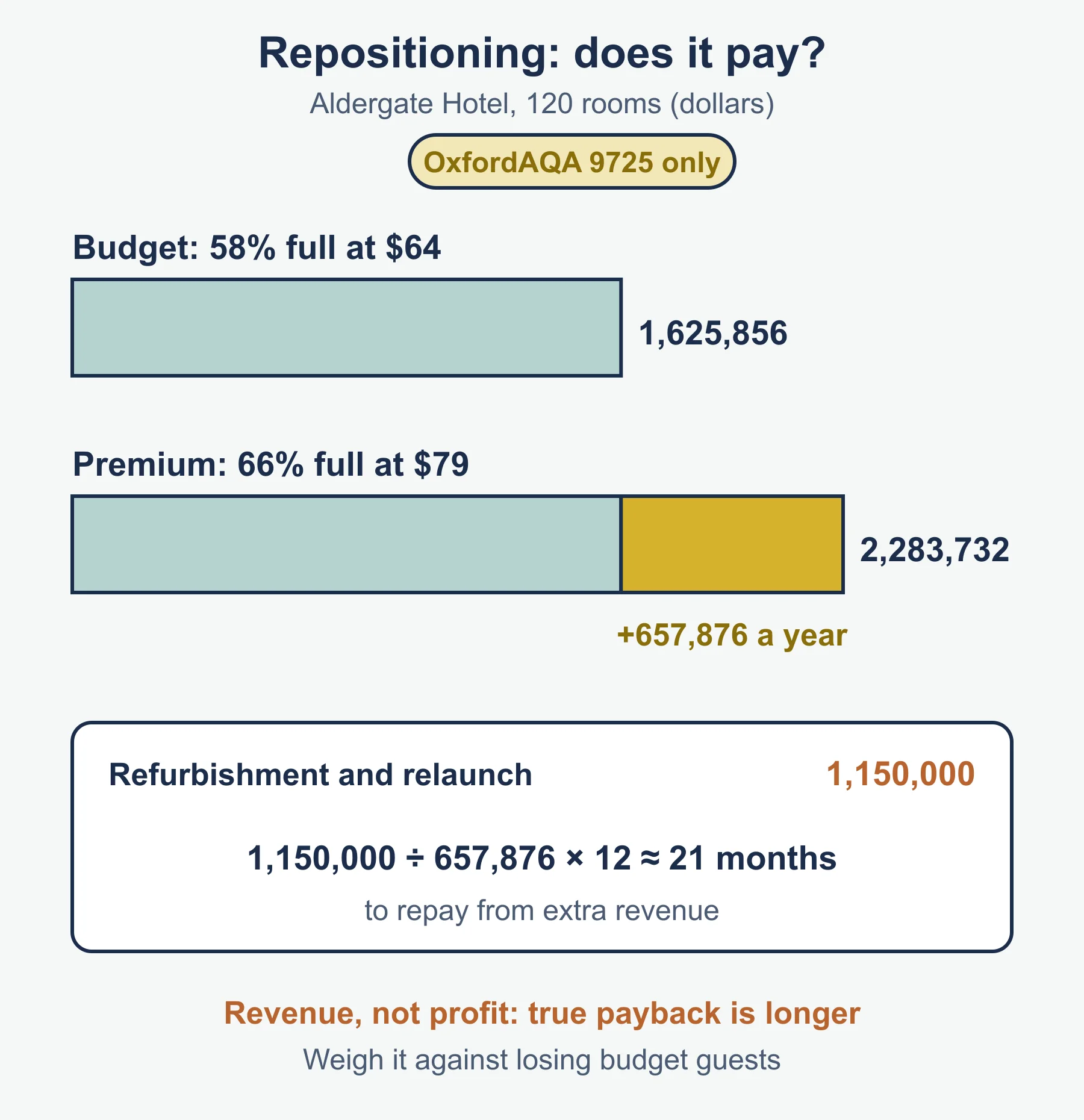
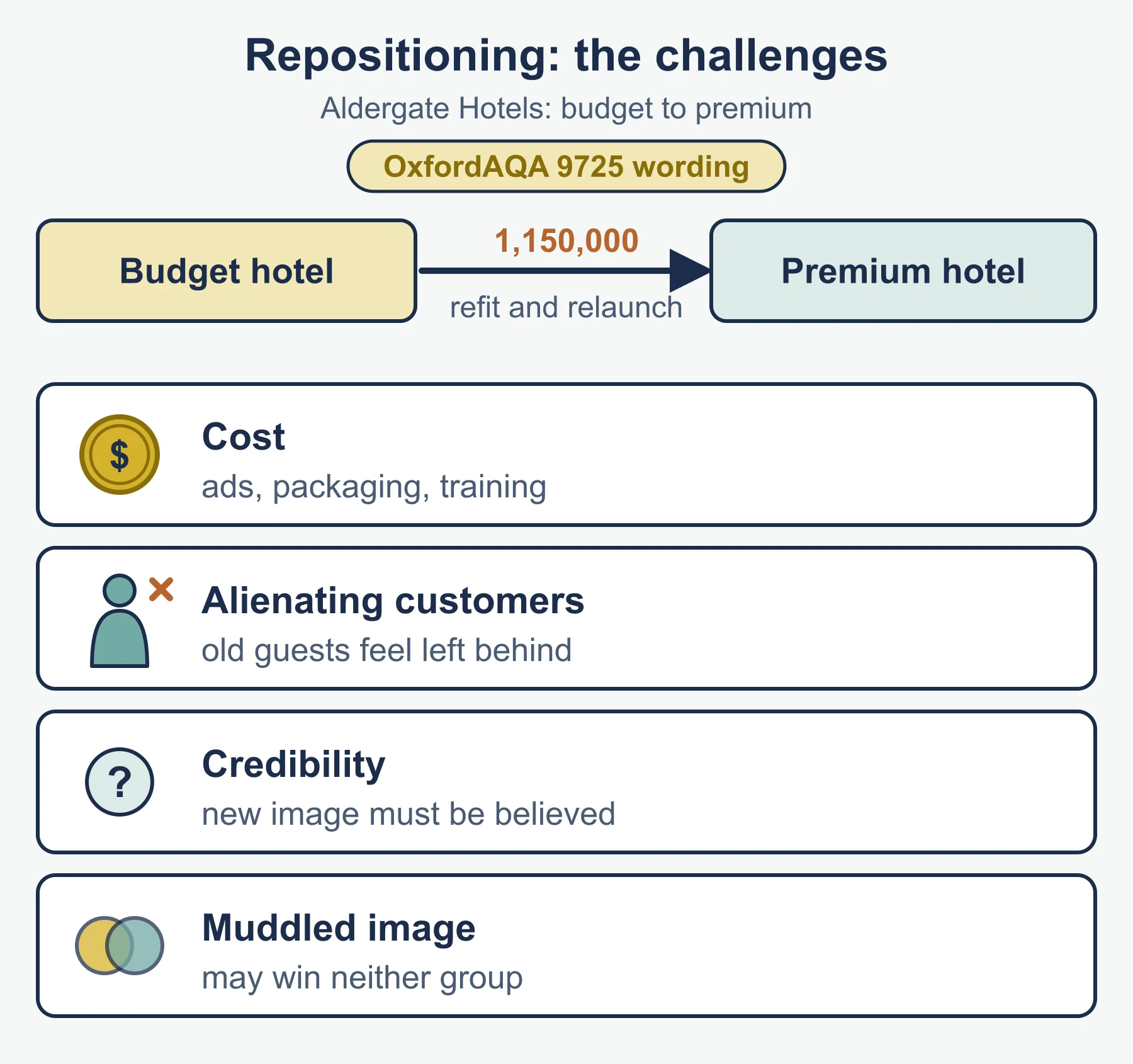
| Reasons for, and challenges of, changing positioning (9725 only) | Why move; what it costs and risks |
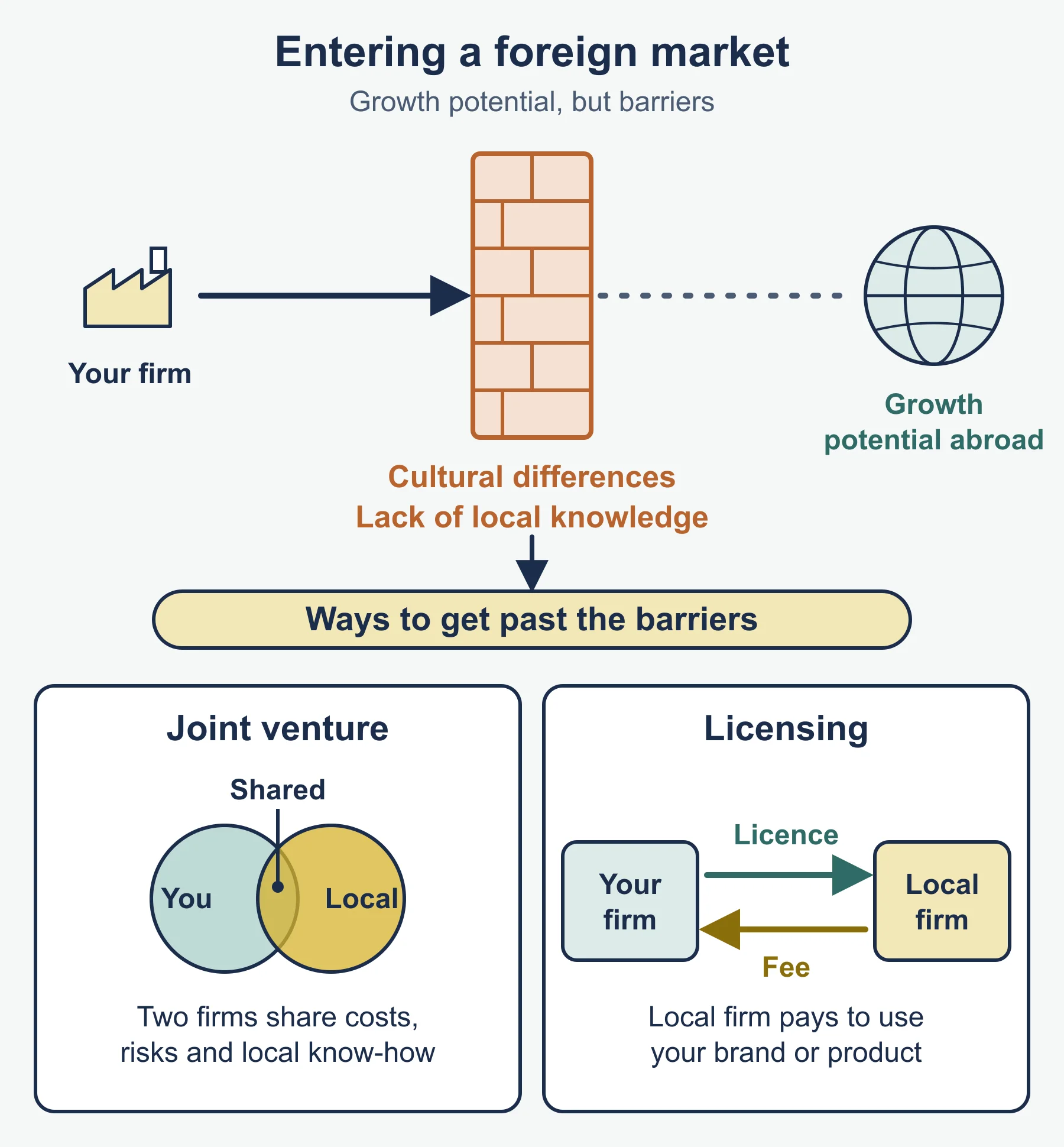
| International markets (9625 only) | Benefits and potential difficulties of selling abroad |
Key definitions
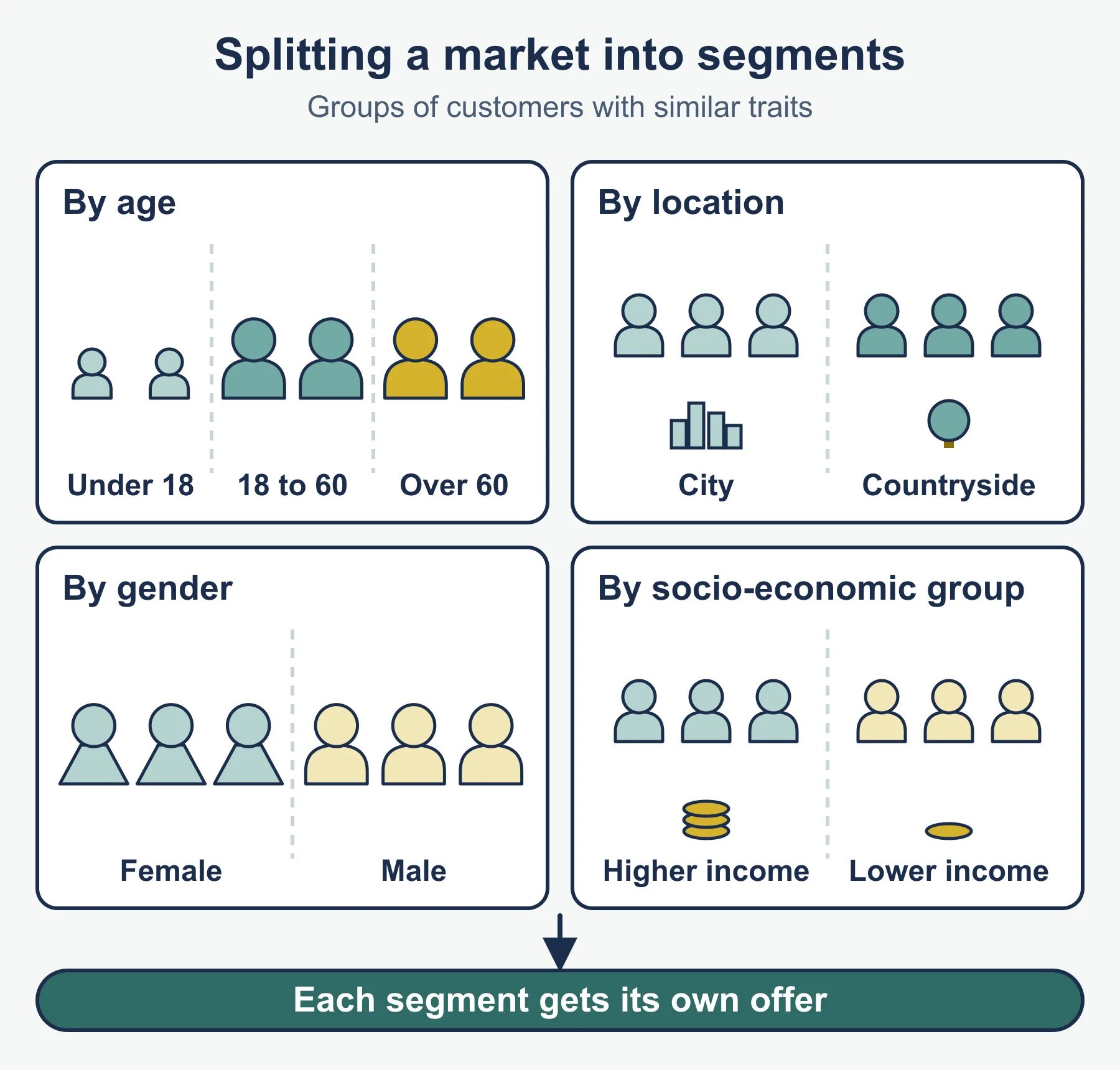
- Market segmentation: splitting a market into customer groups that share features or wants.
- Targeting: choosing the segment or segments to serve.
- Positioning: the place a product holds in customers’ minds compared with competing products.
- Niche marketing: aiming at a small, specialised segment.
- Mass marketing: aiming one broadly similar offer at a large part of the market.
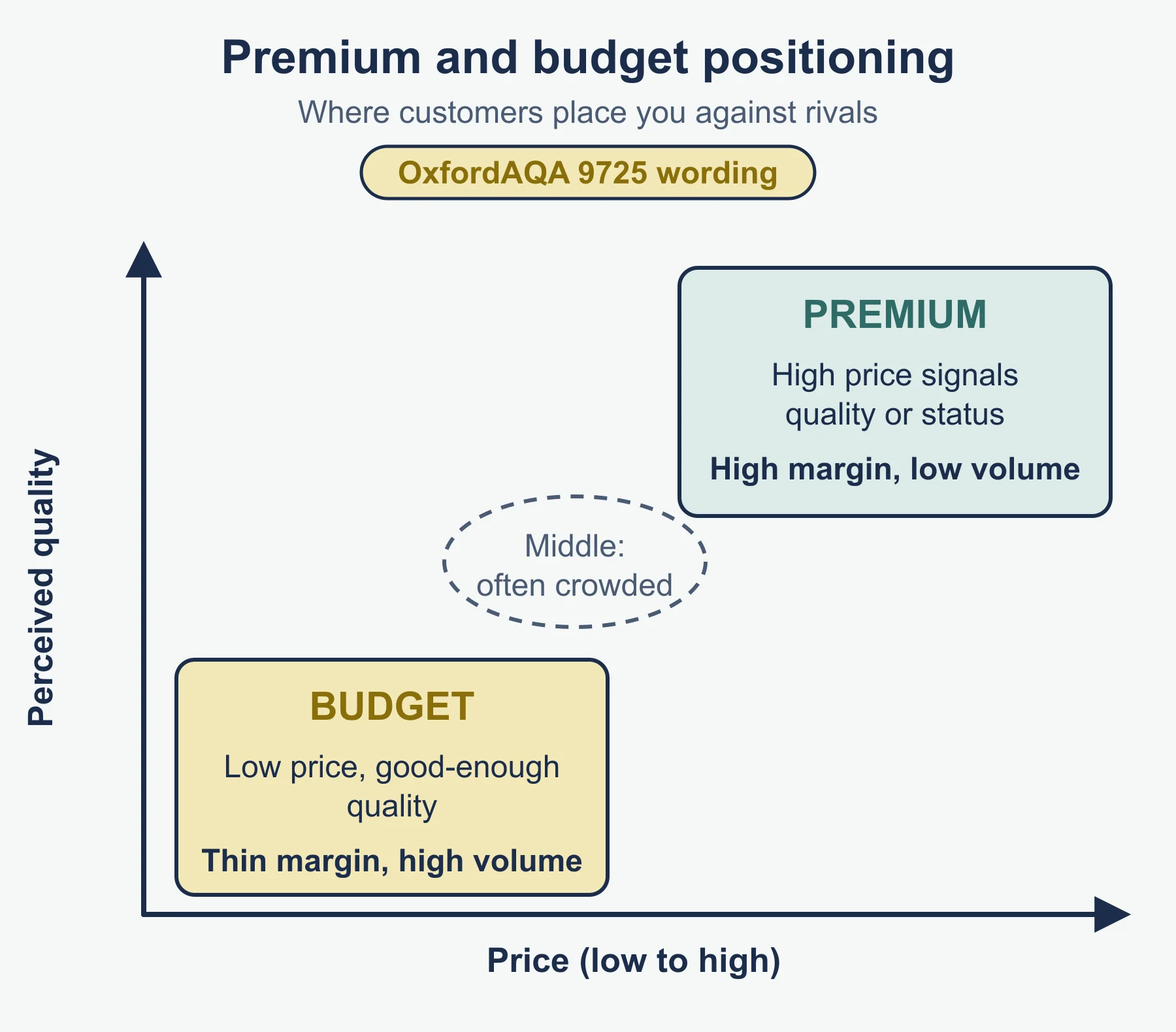
- Premium positioning: high price, high quality or status image.
- Budget positioning: low price, seen as good value.
- Repositioning: changing the place a product holds in customers’ minds.
Segmentation methods at a glance
| Method | Based on | Examples of variables | Fits products where… |
|---|---|---|---|
| Demographic | Measurable facts about people | Age, gender, income, occupation, family size | Needs depend on life stage or income |
| Geographic | Location | Country, region, urban or rural, climate | Place changes demand, such as weather |
| Income (9625 only) | Money to spend | Income bands, disposable income, spending power | Price level decides who can buy |
| Psychographic | Lifestyle and attitudes | Values, interests, personality, aspirations | Buying reflects identity or beliefs |
| Behavioural | Buying and usage behaviour | Frequency of use, loyalty, occasion, benefits sought | Use pattern matters more than who the buyer is |
Under 9625, name income as its own method. Under 9725, treat it as a demographic variable.
Method in steps: answering “analyse how a business could segment its market”
- Name two methods from the specification that suit this product (four to choose from in 9725, five in 9625).
- Give the variables you would use (for example, age bands or how often customers buy).
- Link each to the business in the case with one fact.
- Explain what the business would do differently for each group.
- State one limit, such as cost of research or a segment that is too small.
Mini worked reminder: sizing a segment
Doveridge Mills, an invented cereal maker, sells to 2,500,000 households. Research finds 18% are health-focused families who read nutrition labels (psychographic and behavioural). The firm expects to win 12% of that segment at 3.20 per pack, one pack per household per year.
- Segment size: 2,500,000 x 18% = 450,000 households.
- Packs sold: 450,000 x 12% = 54,000.
- Revenue: 54,000 x 3.20 = 172,800.
Interpret the figure. Revenue of 172,800 from one segment is worth pursuing only if the cost of reaching those households leaves a surplus.
Premium and budget side by side
Doveridge Mills also compares two lines. The budget line sells 150,000 packs at 1.40 each. The premium line sells 40,000 packs at 4.10 each.
- Budget revenue: 150,000 x 1.40 = 210,000.
- Premium revenue: 40,000 x 4.10 = 164,000.
- Premium packs are 40,000 out of 190,000 packs sold, which is 21.1% of volume.
| Premium | Budget | |
|---|---|---|
| Price | High | Low |
| Volume | Usually lower | Usually higher |
| Margin per unit | Usually higher | Usually lower |
| Needs | Quality, brand, selective distribution | Cost control, scale |
| Risk | Quality slip, small market | Easy to copy, thin margins |
Higher volume at the budget line gave higher revenue here, but revenue is not profit. Costs per pack decide which line earns more.
Niche versus mass: must-know distinctions
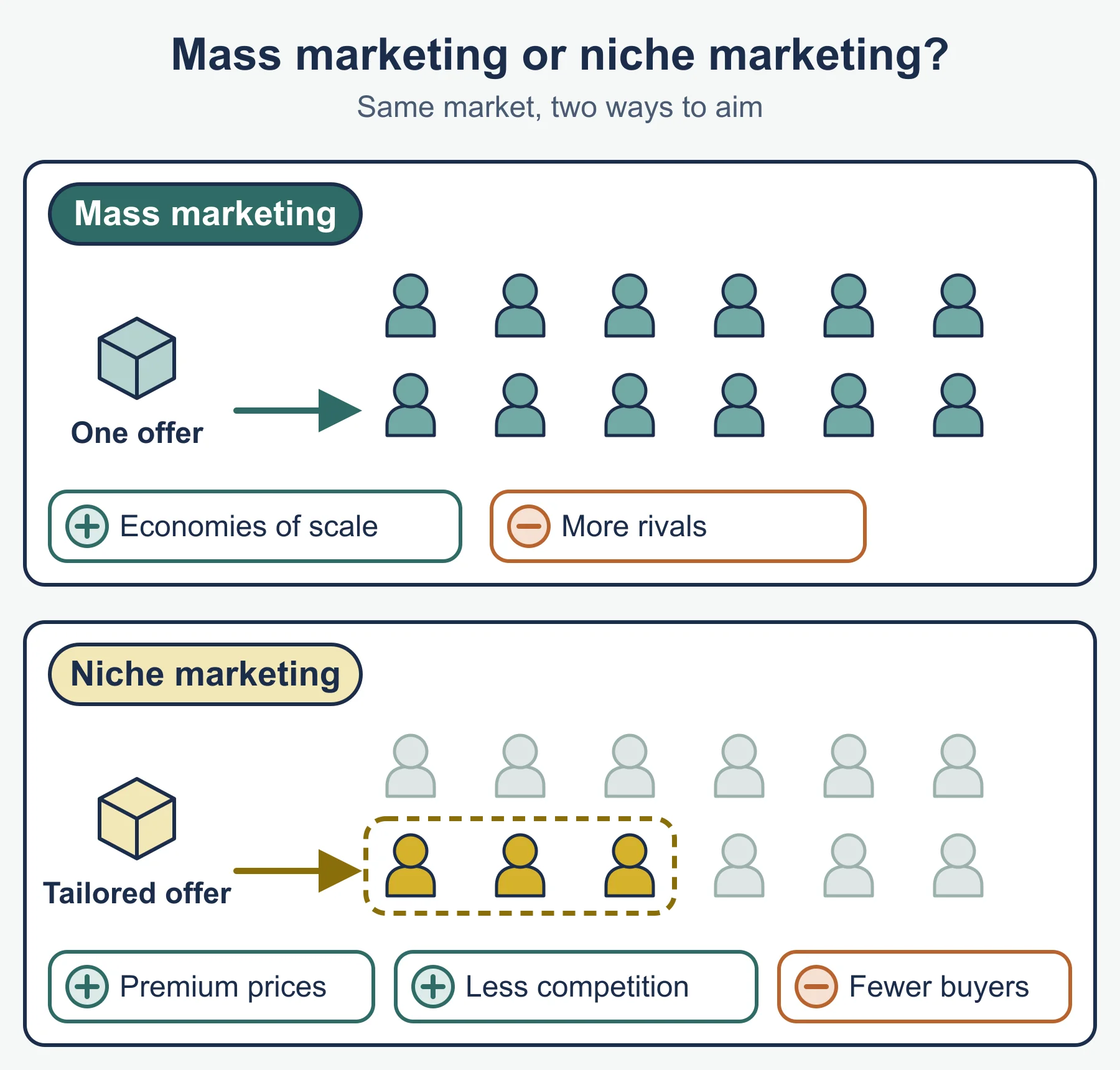
| Niche | Mass | |
|---|---|---|
| Segment size | Small | Large |
| Competition | Often less from big firms | Usually heavy |
| Unit price | Can be higher | Often lower |
| Growth | Limited by size | Higher potential |
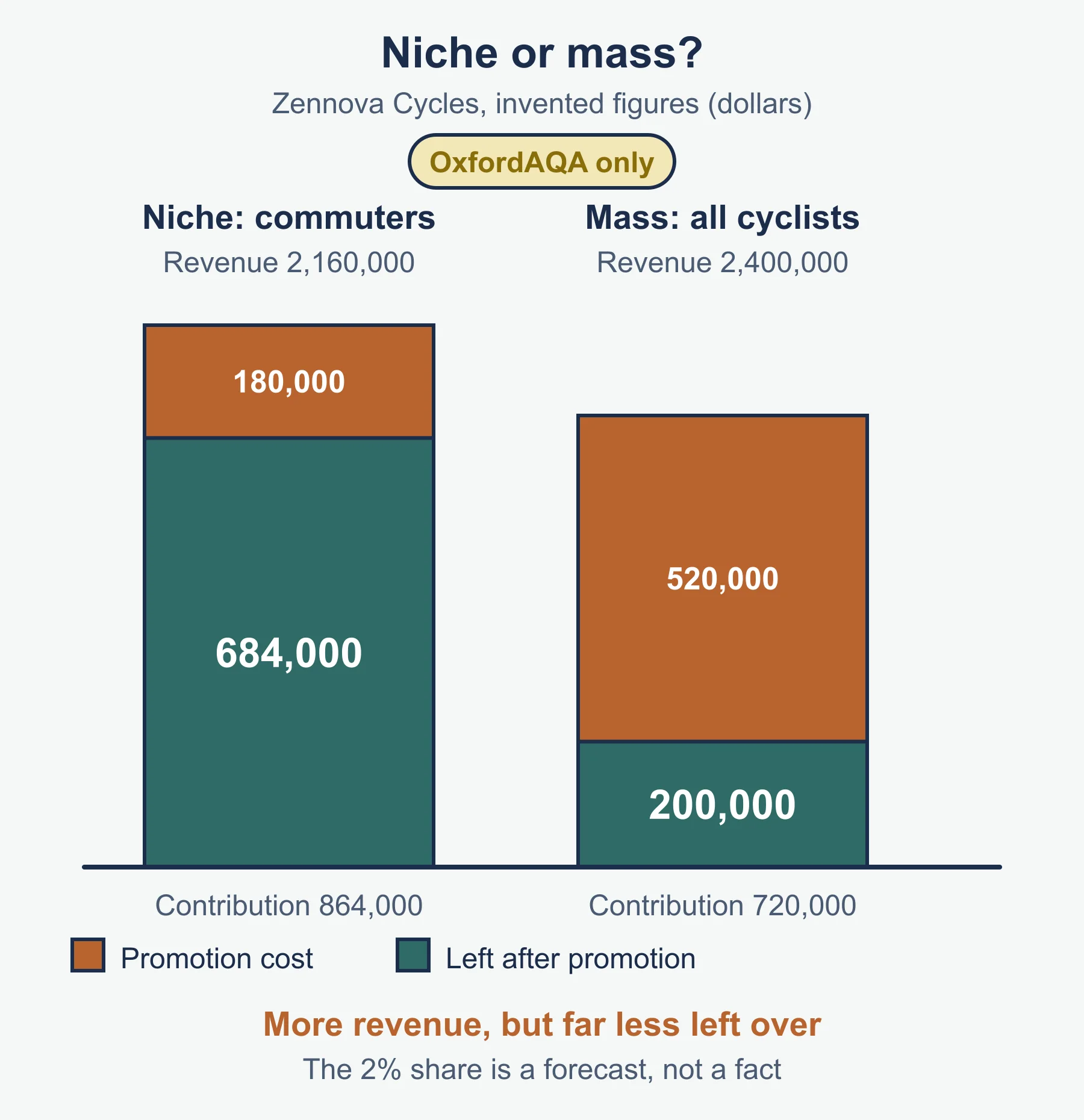
| Main risk | Reliance on one group; large rivals may enter | Costly promotion; product pleases nobody fully |
Influences on choice of target and positioning
This list is our own judgement, not specification wording. Use it as a prompt, then pick the two or three that matter most in the case:
- Size and growth of the segment
- Likely profit after cost of reaching it
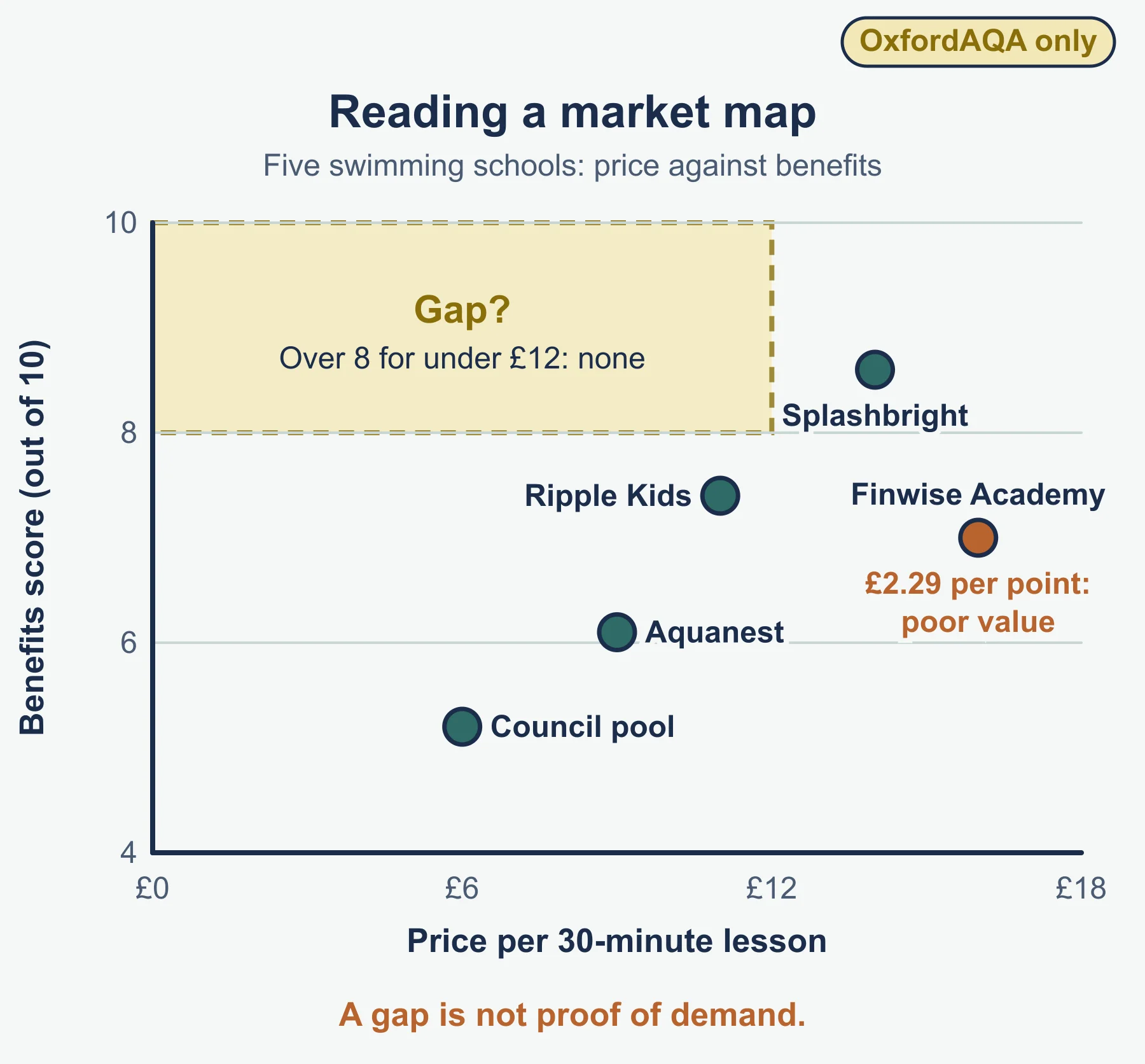
- Competitors and where they are positioned
- The firm’s resources, skills and brand
- Business objectives
- Market research findings
- The product’s quality and cost
- How customers see the brand now
- Changes in income, technology, laws and fashion
International markets (9625 only)
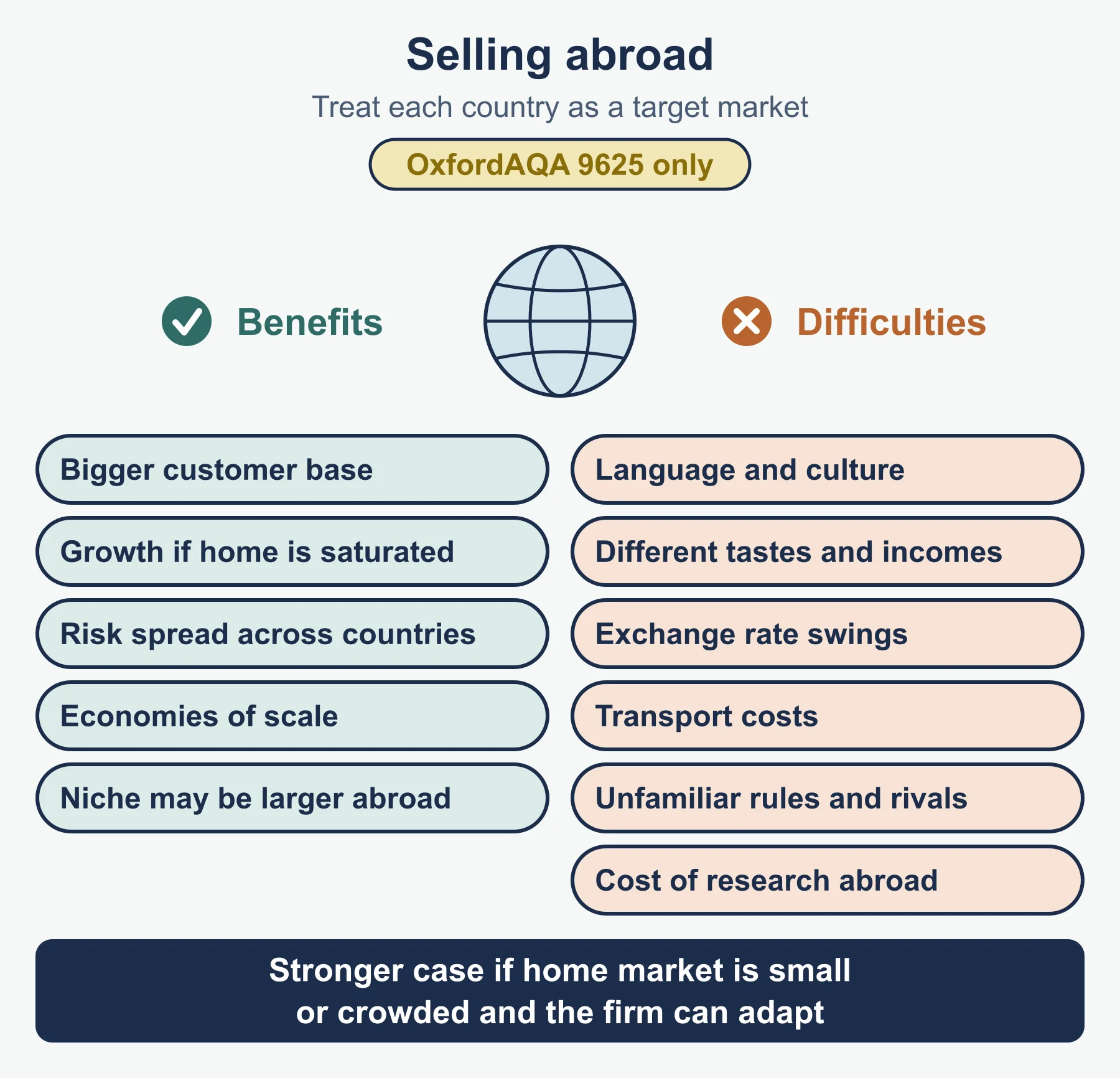
| Benefits | Potential difficulties |
|---|---|
| Larger customer base | Differences in language, culture and tastes |
| Growth when home market is saturated | Exchange rate movements |
| Risk spread across countries | Transport and distribution costs |
| Possible economies of scale | Unfamiliar rules and rivals |
| A niche may be bigger abroad | Costly research in an unknown market |
Treat each country as a possible target market and segment it in the usual ways. A judgement weighs the size of the prize against the cost of adapting the product.
Changing positioning
| Reasons | Challenges |
|---|---|
| Tastes or incomes have shifted | Cost of new promotion, packaging and product changes |
| Sales falling or brand looks dated | Existing customers may feel left behind |
| Rival has taken the position | New image may not be believed |
| A new growing segment appears | Perceptions change slowly |
| Current segment is shrinking | Mixed messages leave a muddled image |
| Bad publicity | May win neither old nor new customers |
Must-know links between the steps
- The target must be reachable and large enough to be profitable.
- The positioning must match what the target wants and the firm can deliver.
- The marketing mix must be consistent with the positioning, for example a premium price with matching packaging and outlets.
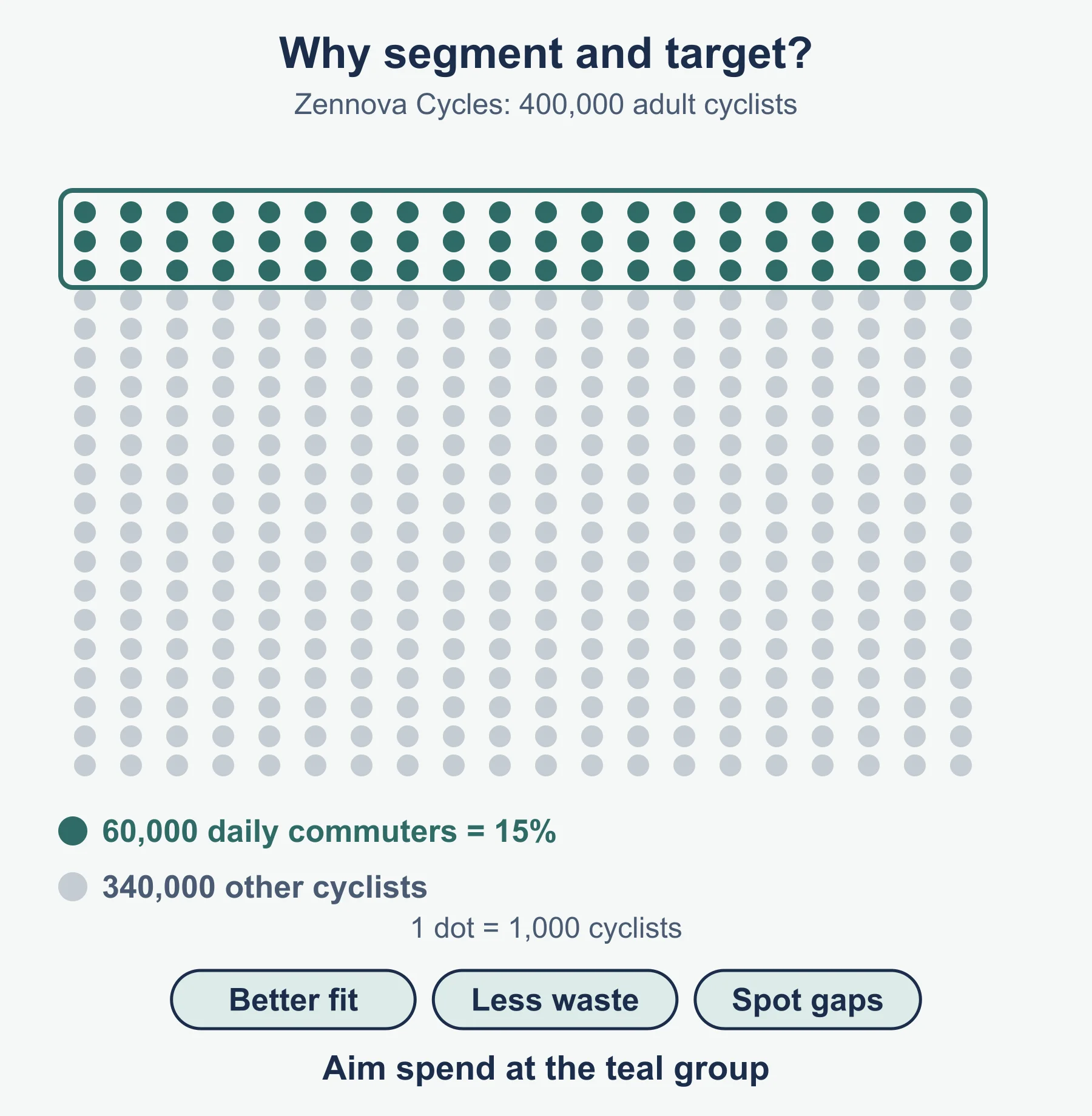
The value of segmentation and targeting: recall list
Value of segmentation:
- Offer, price and message can match each group.
- Promotion reaches the right people, so less is wasted.
- Unserved groups become visible as opportunities.
- Targeting and positioning have evidence to build on.
Value of targeting:
- Spend is concentrated where a sale is most likely.
- The message can be specific, which can build loyalty.
- Results can be measured against a defined group.
Both have limits. Research costs money, a segment may be too small, and customers outside the target may be lost.
Applying all three steps: short example
Nimbus Loop splits its market by behaviour (daily, weekly and occasional users), then targets the 12,000 daily users with a paid plan. It positions the app as the serious training tool, with premium pricing, expert-written plans and no advertising inside the app. Notice the chain: behaviour shows the group, the group sets the target, and the target decides the price and tone.
Evaluation prompts
When a question says evaluate or justify, finish with a judgement that states which option is better and why, and under what condition the answer would change. Useful conditions: the size of the segment, the firm’s resources, how strong rivals are and how fast tastes are changing.
Quick self-test
- Name the segmentation methods listed in 9625 and the one that 9725 does not list separately.
- A holiday firm divides customers into families, couples and retired people. Which method is this?
- A café chain opens more sites in colder regions for hot drinks. Which segmentation method best describes the decision?
- Nimbus Loop, an invented fitness app, has 48,000 users. A quarter are heavy users who open it daily. How many is that?
- Each heavy user pays 9.99 a month. What is their annual payment in total, to the nearest dollar?
- A segment is 30% of a market of 800,000 customers, and a firm expects a 5% share of it. How many customers is that?
- State two advantages of niche marketing.
- State one disadvantage of mass marketing.
- Define premium positioning in one sentence.
- Give two challenges of repositioning a brand.
- State one benefit and one potential difficulty of targeting an international market.
- A watch brand aims at households in the top income band only. Which 9625 method is this?
Answers
- Demographic, geographic, income, behavioural, psychographic; 9725 does not list income separately.
- Demographic (family size and age). Allow life stage as a demographic variable.
- Geographic (climate and region).
- 48,000 x 25% = 12,000 heavy users.
- 12,000 x 9.99 x 12 = 1,438,560 dollars a year.
- 800,000 x 30% = 240,000 in the segment; 240,000 x 5% = 12,000 customers.
- Any two: less competition from big firms; customers may pay more; high loyalty; promotion is cheaper to aim.
- Any one: heavy competition; costly promotion; product may not suit anyone exactly; pressure on margins.
- A position where a high price and a quality or status image lead customers to see the product as superior.
- Any two: cost; alienating existing customers; lack of credibility; slow change in perceptions; muddled image.
- Benefit, for example a larger customer base; difficulty, for example differences in language and culture.
- Income segmentation (a demographic variable in 9725).
Where marks are usually lost
- Naming the methods but never applying one to the case business.
- Describing segmentation when the question asks about targeting, or the other way round.
- Writing “niche” and “mass” as if one were always better, with no judgement.
- Defining positioning as “where the product is sold” instead of the place in customers’ minds.
- Treating budget positioning as meaning poor quality.
- Listing reasons for repositioning but giving no challenges, or the reverse.
- Quoting revenue and calling it profit when comparing two options.
- Ignoring figures in the case when the question says to use them.
- Giving a recommendation with no reason or no weighing of the other option.
Frequently asked questions
What segmentation methods are in OxfordAQA 9625 and 9725? 9625 lists five methods: demographic, geographic, income, behavioural and psychographic. 9725 lists four, treating income as a demographic variable rather than a separate method.
What is the difference between niche and mass marketing? Niche marketing serves a small, specialised segment, often with less competition from big firms. Mass marketing sells one broadly similar offer to a large part of the market, where unit prices are often lower and competition usually heavy.
Is international targeting in the 9725 specification? International markets appear in the 9625 wording of this section. In 9625 you treat each country as a possible target market, weighing benefits such as a larger customer base against difficulties such as differences in language, culture and tastes.
What is the value of segmentation? Segmentation lets the offer, price and message match each group of customers, so promotion reaches the right people and less is wasted. Its limits are that research costs money and a segment may be too small to be profitable.
Official syllabus
OxfordAQA International AS and A-level Business specification, section 3.1.2.3 (9625 and the 9725 successor; International AS from May/June 2027 and A-level from May/June 2028 for 9725).
Get free revision emails (optional)
Occasional emails with practice questions, worked explanations and links to free resources for the qualification and subjects you choose. No spam, and you can unsubscribe from any email. The free tools on this site never need an email.
Related resources
-
Study guides
OxfordAQA A-Level Business: The marketing mix (9625/9725)
Study guide to section 3.1.2.4, the marketing mix, for OxfordAQA International AS and A-level Business: product, pricing, PED and XED, promotion and place.
Business · OxfordAQA · AS Level
Read guide -
Practice questions
OxfordAQA A-Level Business: The marketing mix (9625/9725) – Practice Questions
Original practice questions with worked answers on section 3.1.2.4, the marketing mix, in OxfordAQA International AS and A-level Business.
Business · OxfordAQA · AS Level
Try questions -
Revision notes
OxfordAQA A-Level Business: The marketing mix (9625/9725) – Revision Notes
Condensed revision notes for section 3.1.2.4, the marketing mix, in OxfordAQA International AS and A-level Business, with formulas, tables and a self-test.
Business · OxfordAQA · AS Level
Revise topic
Related articles
-
teaching
A Level tuition in Dubai: Cambridge or Pearson Edexcel International A Level?
Schools in Dubai and Abu Dhabi teach either Cambridge International AS & A Level or Pearson Edexcel International A Level. How the two are structured, why it matters for tuition, and how online classes from Lahore work.
9 October 2026
-
curriculum guides
Choosing subjects at IGCSE and A Level
How subject choices at 14 and 16 affect university options later, and how to keep pathways open without overloading a timetable.
28 July 2026
Studying this with a teacher
Working through Business AS LEVEL?
This page is free and stays free. If you would rather be taught it, Marlbridge runs Business classes one-to-one and in small groups of up to 15, online in your own time zone. The first trial class is free. WhatsApp replies within an hour (8am–11pm Pakistan time, every day); email the same day.
OxfordAQA Business teachers at Marlbridge
