
Revision Notes
OxfordAQA A-Level Chemistry: Amount of Substance (9620) – Revision Notes
Condensed OxfordAQA 9620 notes on moles, Avogadro, pV = nRT, empirical formulae, equations, yield and atom economy, with a ten-question self-test.
- Subject
- Chemistry
- Level
- AS LEVEL
- Topic
- Amount of substance
- Author
- Marlbridge Academic Team
- Updated
- Reviewed by
- Nouman Ahmed (what this means)
Aligned to OxfordAQA A Level Chemistry (9620), Version 5.3 (first teaching 2019, first AS and A-level exams 2020). Official specification .
Syllabus page (what it covers and how it is assessed): OxfordAQA A Level Chemistry.
Syllabus points this page covers
9620 (AS Level)
- 3.1.2.1 Relative atomic mass and relative molecular mass
- 3.1.2.2 The mole and the Avogadro constant
- 3.1.2.3 The ideal gas equation
- 3.1.2.4 Empirical and molecular formula
- 3.1.2.5 Balanced equations and associated calculations
Found an error? Report a correction.
Need help with this topic? Request a free trial class for A Level Chemistry (9620).
These notes condense section 3.1.2 (Amount of substance, 3.1.2.1 to 3.1.2.5) of the OxfordAQA International AS and A-level Chemistry 9620 specification, Version 5.3. For full explanations start with the study guide, then test yourself on the practice questions. Everything here sits in the course hub and the printable checklist. For a quick check of where you stand, try the free diagnostics.
What the specification lists
| Section | You must be able to |
|---|---|
| 3.1.2.1 | Define relative atomic mass (Ar) and relative molecular mass (Mr) in terms of ¹²C; use relative formula mass for ionic compounds |
| 3.1.2.2 | Use the Avogadro constant, mass with Mr, and concentration with volume; apply the mole to electrons, atoms, molecules, ions, formulas and equations |
| 3.1.2.3 | Use pV = nRT with SI units |
| 3.1.2.4 | Find empirical formula from mass or percentage by mass; find molecular formula from empirical formula and Mr |
| 3.1.2.5 | Write and balance full and ionic equations; calculate masses, gas volumes, percentage yields, percentage atom economies, and solution concentrations and volumes; know the advantages of high atom economy |
Under the specification you need not recall the value of L or of R. Learn how to use them, not their digits.
3.1.2.1 Relative masses
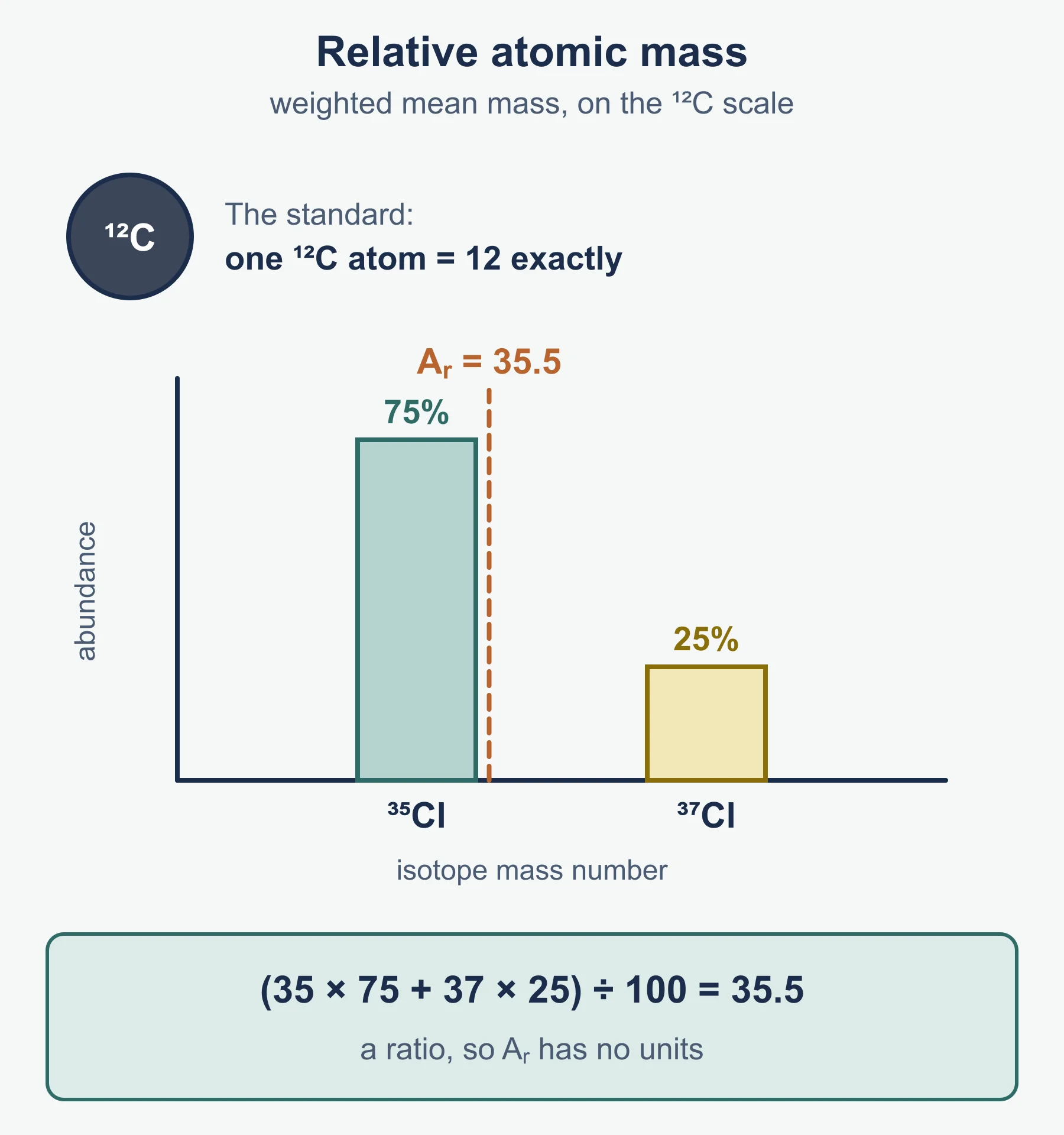
Relative atomic mass, Ar: the weighted mean mass of an atom of an element (allowing for its isotopes) divided by one twelfth of the mass of an atom of carbon-12.
Relative molecular mass, Mr: the mean mass of a molecule divided by one twelfth of the mass of an atom of carbon-12. Add the Ar values of every atom in the formula.
Relative formula mass: the term used for ionic compounds, because they exist as lattices, not separate molecules.
Neither quantity has units, because each is a ratio.
Reminder: boron is 20% ¹⁰B and 80% ¹¹B, so Ar = (0.20 × 10) + (0.80 × 11) = 10.8.
3.1.2.2 The mole, Avogadro and solutions
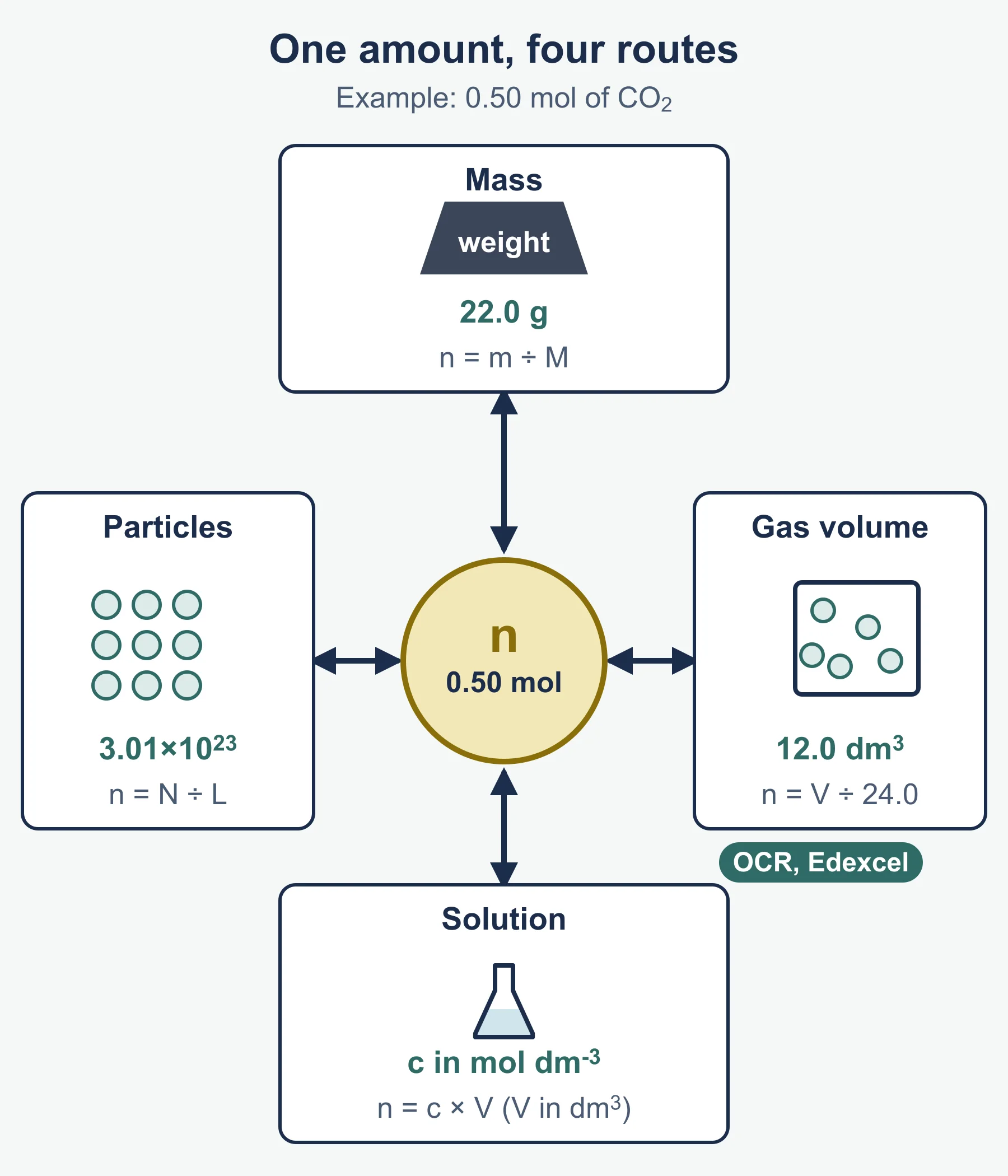
A mole of any substance always holds an identical number of entities: the Avogadro constant, L = 6.02 × 10²³ mol⁻¹. The entity can be an atom, molecule, ion, electron, formula unit or equation unit.
| Quantity | Relationship | Units |
|---|---|---|
| Amount from mass | n = m / Mr | mol, g, g mol⁻¹ |
| Number of particles | N = n × L | particles |
| Concentration | c = n / V | mol dm⁻³, mol, dm³ |
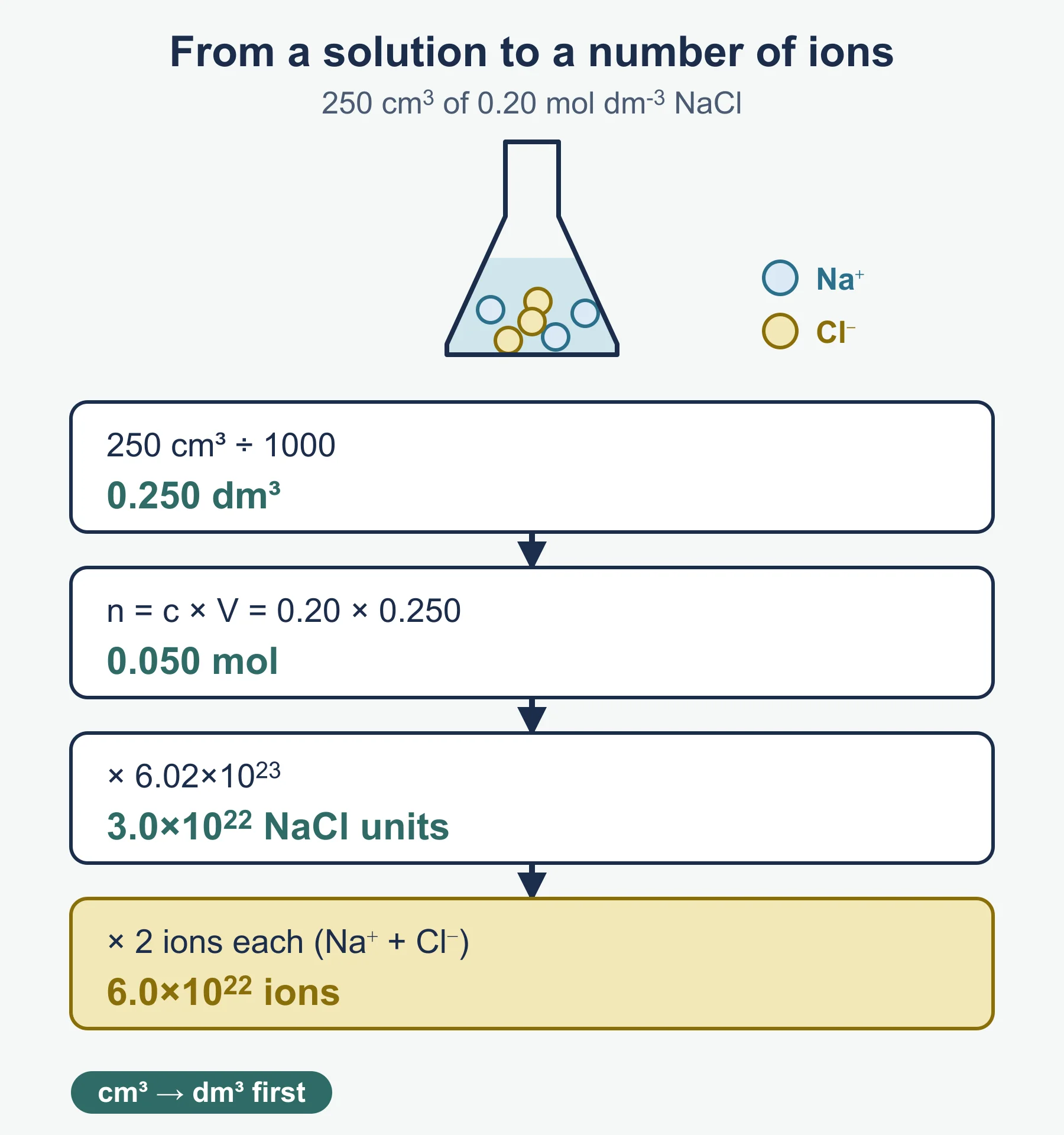
| Volume conversion | dm³ = cm³ / 1000 |
Worked reminders:
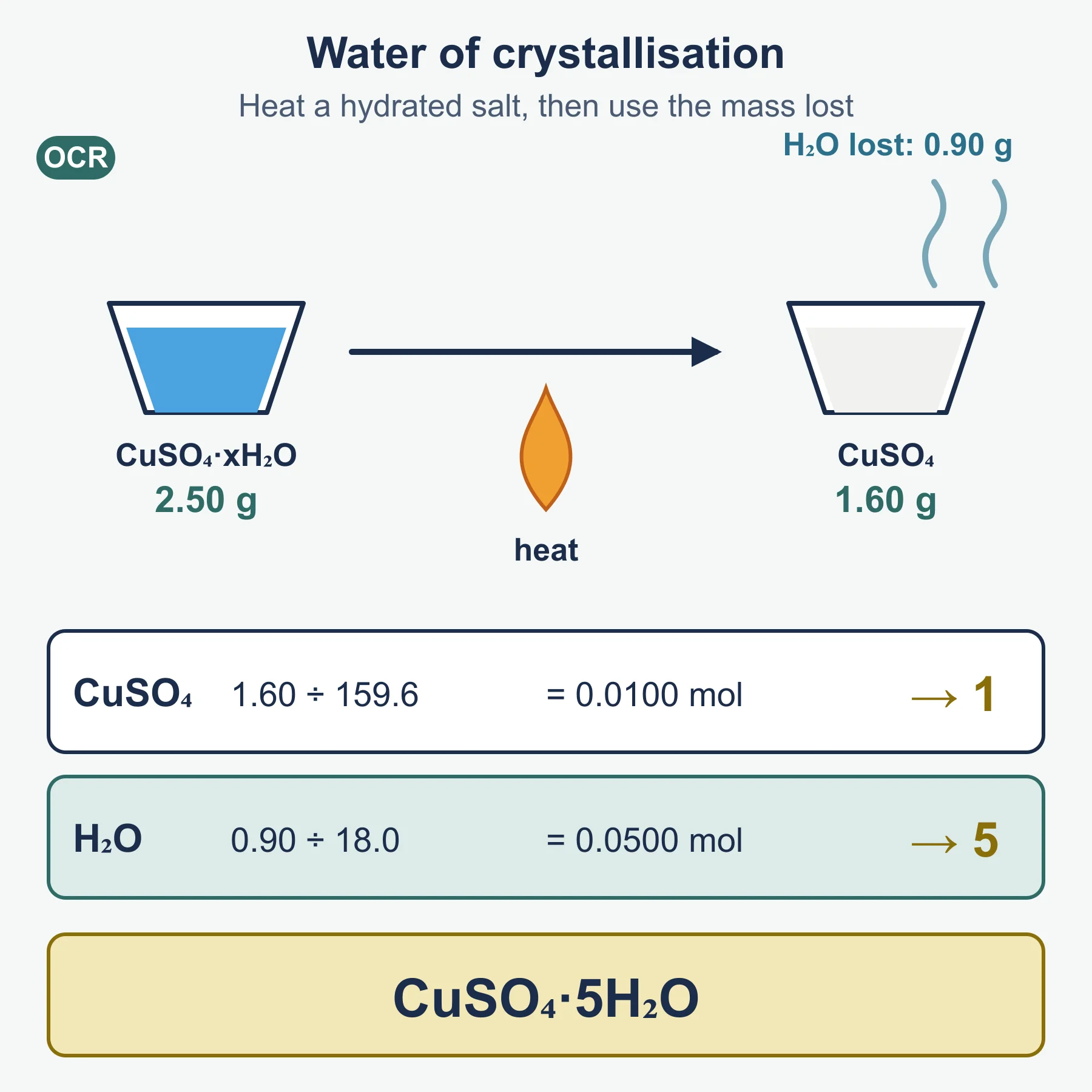
- 5.30 g of Na₂CO₃ (Mr 106.0) is 0.0500 mol. It contains 0.100 mol of Na⁺ ions, which is 6.02 × 10²² ions.
- Dissolve that 0.0500 mol to make 250 cm³ of solution: c = 0.0500 / 0.250 = 0.200 mol dm⁻³.
- 0.0200 mol of Al₂(SO₄)₃ gives 0.0400 mol Al³⁺ and 0.0600 mol SO₄²⁻, 0.100 mol of ions altogether.
- Each H₂O molecule has 10 electrons, so 0.250 mol of water holds 2.50 mol of electrons, which is 1.51 × 10²⁴ electrons.
A formula is a statement about moles too: the formula Al₂(SO₄)₃ says 2 mol Al to 3 mol SO₄ in 1 mol of compound.
3.1.2.3 The ideal gas equation
pV = nRT
| Symbol | Meaning | SI unit |
|---|---|---|
| p | gas pressure | Pa |
| V | gas volume | m³ |
| n | moles of gas | mol |
| R | molar gas constant (8.31 J K⁻¹ mol⁻¹ in these notes) | J K⁻¹ mol⁻¹ |
| T | absolute temperature | K |
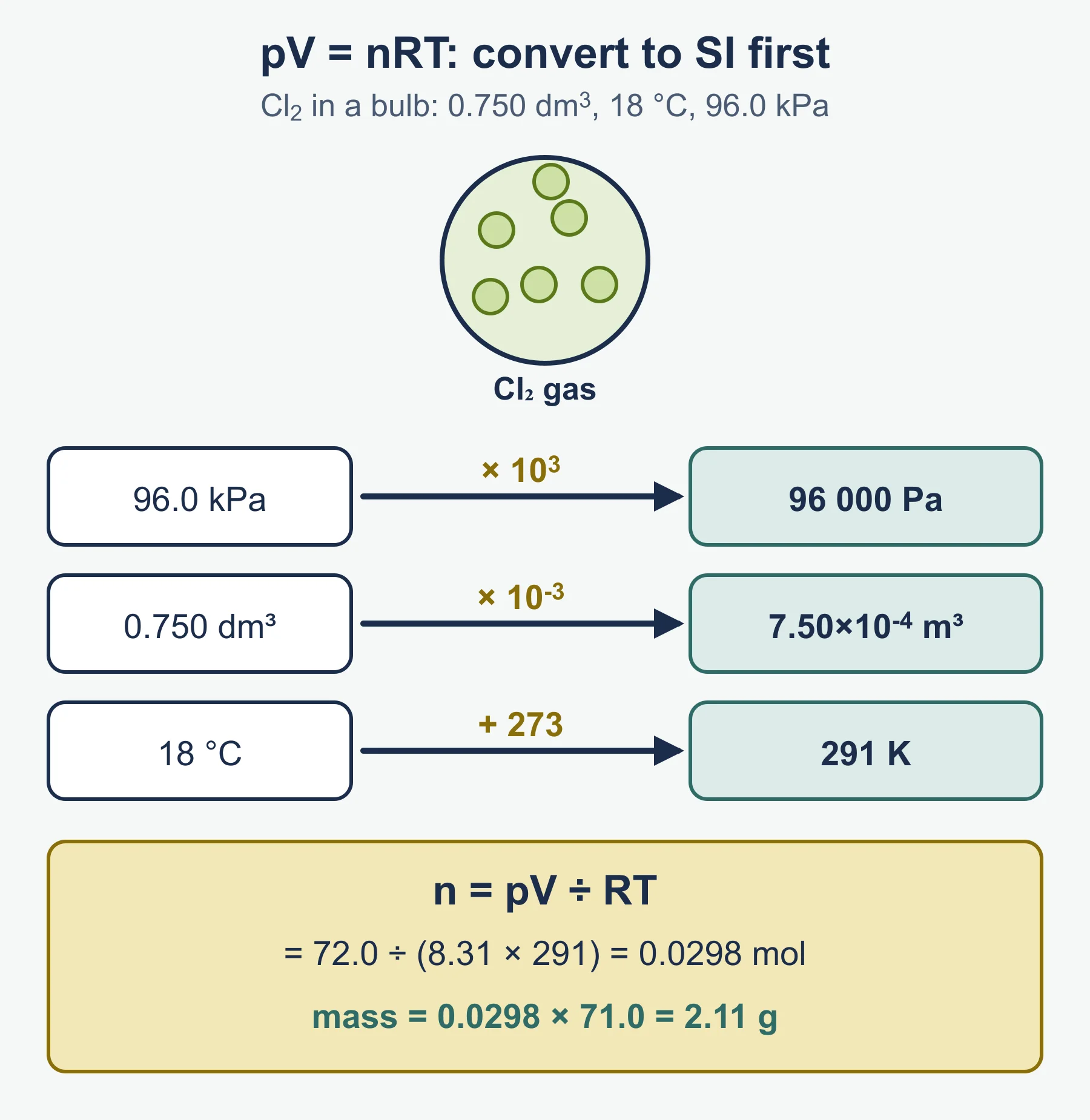
Conversions: kPa × 1000 = Pa; cm³ × 10⁻⁶ = m³; dm³ × 10⁻³ = m³; K = °C + 273.
Method in steps:
- List p, V, n (or mass and Mr) and T.
- Convert every value to SI units.
- Rearrange first, then substitute.
- Finally, express the answer in whatever unit is requested.
Reminder (finding p): 0.0800 mol of gas in 1.50 dm³ at 350 K. V = 1.50 × 10⁻³ m³, so p = nRT / V = (0.0800 × 8.31 × 350) / (1.50 × 10⁻³) = 155 000 Pa, or 155 kPa.
Reminder (finding Mr): 0.640 g of a gas occupies 0.500 dm³ at 100 kPa and 300 K. n = pV / RT = (100 000 × 0.500 × 10⁻³) / (8.31 × 300) = 0.0201 mol, so Mr = 0.640 / 0.0201 = 31.9.
3.1.2.4 Empirical and molecular formula
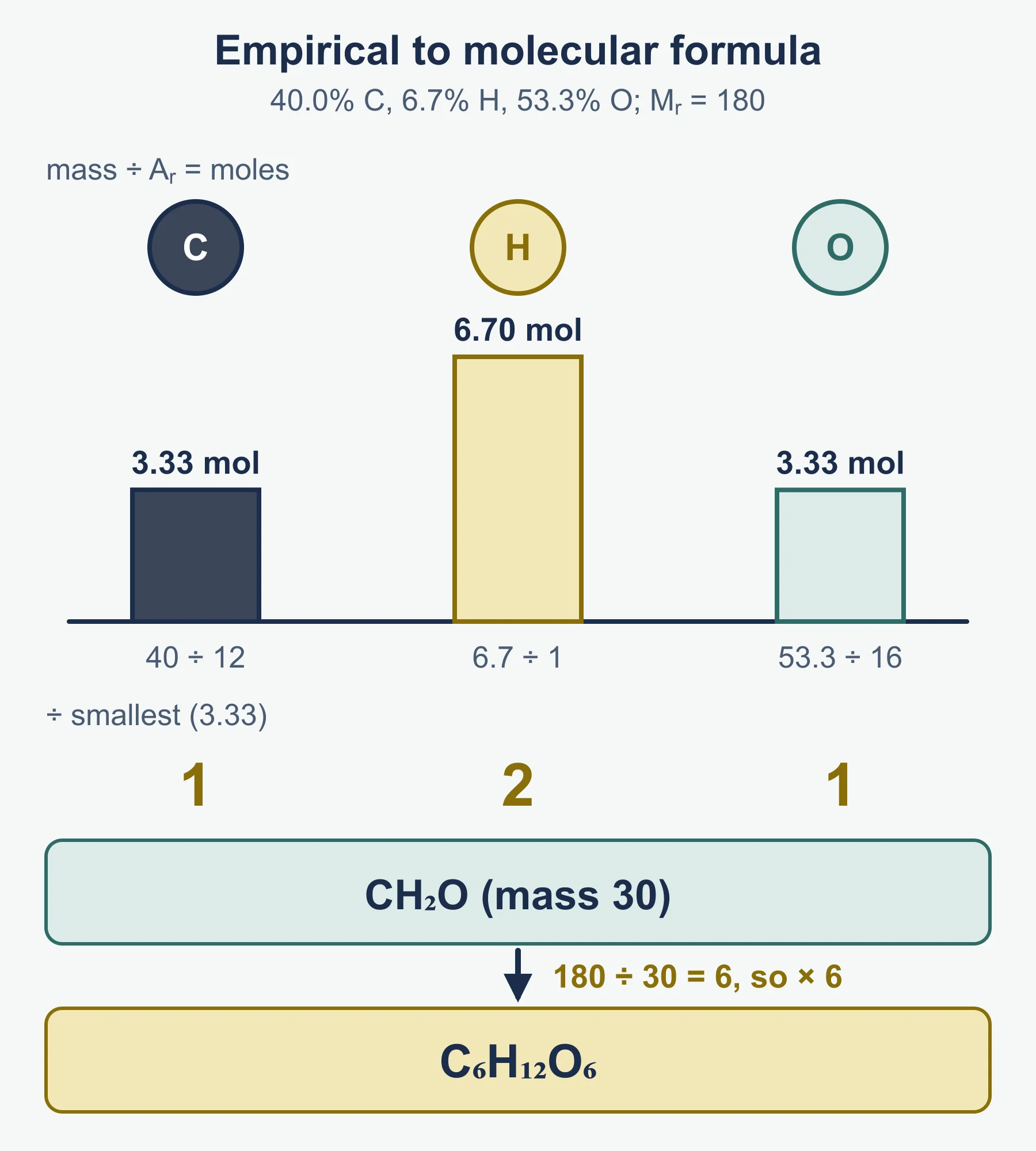
Empirical formula: the smallest whole-number atom ratio for a compound. Molecular formula: the true count of each kind of atom in a single molecule. It is a whole-number multiple of the empirical formula.
Method in steps:
- Write the mass (or percentage, treated as grams in 100 g) of each element.
- Divide each by its Ar to get moles.
- Divide all by the smallest number of moles.
- If a ratio is not whole, multiply all by the smallest integer that makes them whole (×2 for .5, ×3 for .33 or .67).
- For molecular formula, divide the given Mr by the empirical formula mass and multiply.
Reminder A: a sample holds 1.20 g C, 0.20 g H and 0.80 g O. Moles: 0.100, 0.20, 0.050. Divide by 0.050: 2 : 4 : 1. Empirical formula C₂H₄O (mass 44). If Mr = 88, then 88 / 44 = 2, so the molecular formula is C₄H₈O₂.
Reminder B: an oxide is 69.9% Fe and 30.1% O. Moles: 1.25 and 1.88. Ratio 1 : 1.50, so multiply by 2 to give 2 : 3. The empirical formula is Fe₂O₃. Do not round 1.50 down to 1.
3.1.2.5 Equations and calculations
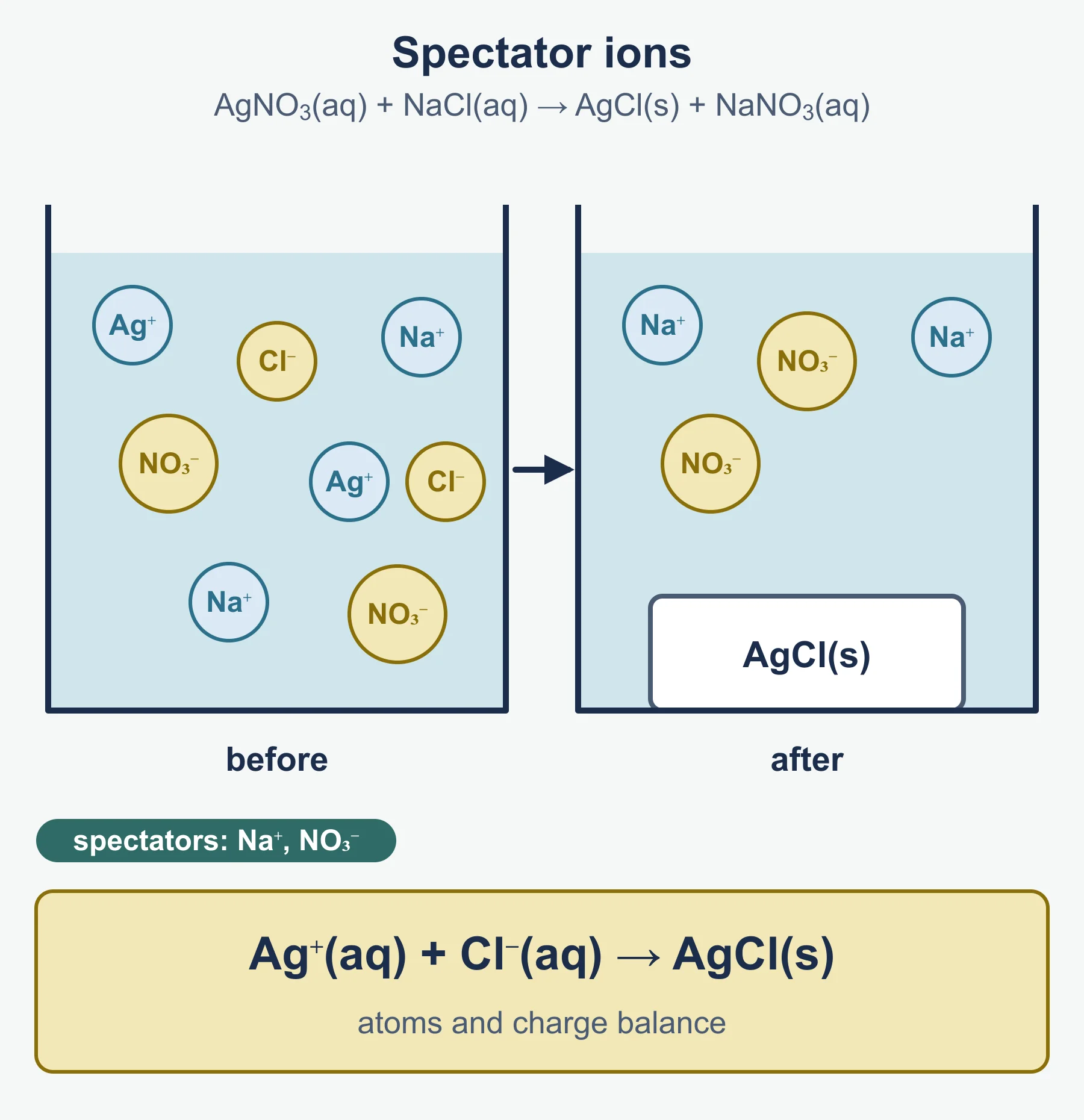
Full equation: all species shown, balanced for atoms and charge. Ionic equation: only the species that change; spectator ions are left out. For example, Pb²⁺(aq) + 2I⁻(aq) → PbI₂(s).
To balance an unfamiliar reaction when reactants and products are given: write the correct formulae first, balance one element at a time (leave elements appearing alone until last), and never change a subscript. Example: Ca(OH)₂ + NH₄Cl → CaCl₂ + NH₃ + H₂O balances as Ca(OH)₂ + 2NH₄Cl → CaCl₂ + 2NH₃ + 2H₂O.
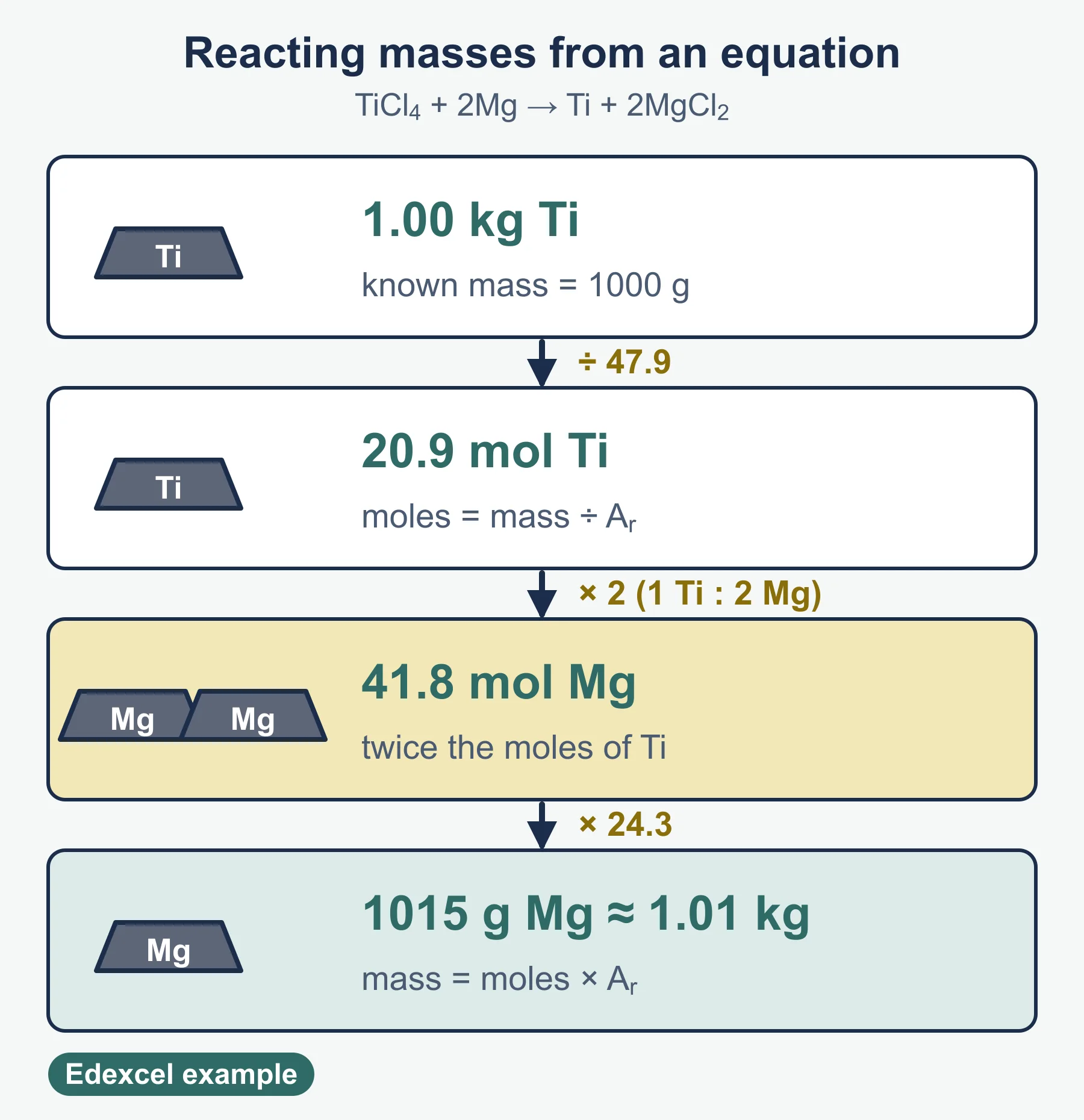
The calculation chain: given quantity → moles → use equation ratio → moles of wanted substance → required quantity.
Gas volume reminder: 0.486 g Mg (Ar 24.3) is 0.0200 mol. Mg + 2HCl → MgCl₂ + H₂ gives 0.0200 mol H₂. At 298 K and 100 kPa, V = nRT / p = (0.0200 × 8.31 × 298) / 100 000 = 4.95 × 10⁻⁴ m³ = 495 cm³.
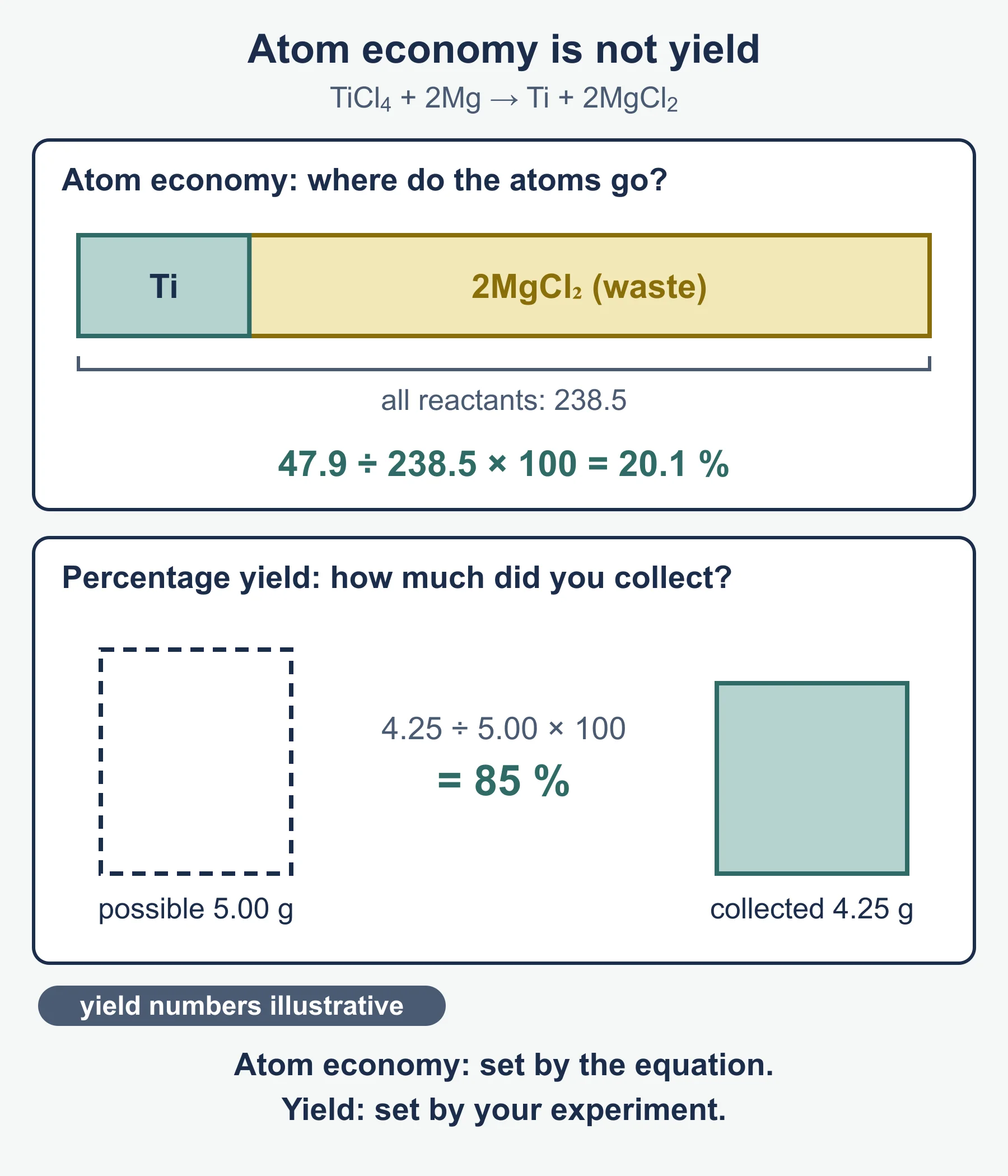
Percentage yield = (actual mass / theoretical mass) × 100.
Percentage atom economy = (molecular mass of desired product / sum of molecular masses of all reactants) × 100.
Yield and atom economy reminder: Fe₂O₃ + 3CO → 2Fe + 3CO₂. For 40.0 g of Fe₂O₃ (Mr 159.6): n = 0.251 mol, so the theoretical mass of Fe is 0.501 × 55.8 = 28.0 g. An actual 24.5 g gives a yield of 87.6%. The atom economy for making iron is 111.6 / 243.6 × 100 = 45.8%. Yield describes what happened in one experiment; atom economy is fixed by the equation.
Solutions and titration reminder: H₂SO₄ + 2NaOH → Na₂SO₄ + 2H₂O. A titre of 22.40 cm³ of 0.0500 mol dm⁻³ acid neutralises 25.0 cm³ of alkali. n(acid) = 0.02240 × 0.0500 = 1.12 × 10⁻³ mol, so n(NaOH) = 2.24 × 10⁻³ mol and c = 2.24 × 10⁻³ / 0.0250 = 0.0896 mol dm⁻³.
Why high atom economy matters: economically, less raw material ends up as unwanted product, and waste disposal or separation costs fall. Ethically and environmentally, fewer natural resources are consumed and less waste is produced, which benefits society and industry alike. Be ready to give one point for each, not a general statement.
Required practical 1: make up a volumetric solution (weigh by difference, dissolve in a beaker, transfer with rinsings to a volumetric flask, fill to the graduation line, then invert to mix) and carry out a simple acid-base titration (pipette, burette, indicator, concordant titres).
Must-know distinctions
- Ar (atoms, weighted for isotopes) against Mr (molecules) against relative formula mass (ionic compounds).
- Percentage yield (experimental) against percentage atom economy (set by the equation).
- Empirical formula (ratio) against molecular formula (actual numbers).
- Amount (mol) against concentration (mol dm⁻³) against mass (g).
Quick self-test
- Write the definition of Mr in terms of ¹²C.
- How many oxygen atoms are in 0.300 mol of CO₂? (L = 6.02 × 10²³ mol⁻¹)
- What is the concentration when 0.0400 mol is dissolved to make 500 cm³ of solution?
- Convert 250 kPa and 40 cm³ into SI units.
- A gas has n = 0.0500 mol at 400 K in a 2.00 dm³ vessel. Find p in kPa (R = 8.31 J K⁻¹ mol⁻¹).
- Find the empirical formula of a compound with 2.40 g C and 0.60 g H.
- The empirical formula is CH₂O and Mr is 60.0. State the molecular formula.
- Balance: Al + HCl → AlCl₃ + H₂.
- Find the percentage yield when 3.42 g is obtained against a theoretical 4.65 g.
- Why is the ionic equation for HCl(aq) + NaOH(aq) simply H⁺ + OH⁻ → H₂O?
Answers
- The mean mass of a molecule divided by one twelfth of the mass of a ¹²C atom.
- 0.300 × 2 × 6.02 × 10²³ = 3.61 × 10²³ oxygen atoms.
- 0.0400 / 0.500 = 0.0800 mol dm⁻³.
- 250 000 Pa and 4.0 × 10⁻⁵ m³.
- p = (0.0500 × 8.31 × 400) / (2.00 × 10⁻³) = 83 100 Pa = 83.1 kPa.
- C: 0.200 mol; H: 0.60 mol; ratio 1 : 3; CH₃.
- CH₂O has mass 30.0, so 60.0 / 30.0 = 2 and the molecular formula is C₂H₄O₂.
- 2Al + 6HCl → 2AlCl₃ + 3H₂.
- (3.42 / 4.65) × 100 = 73.5%.
- Na⁺ and Cl⁻ are spectator ions: they are present unchanged on both sides.
Where marks are usually lost
- Putting volumes in cm³ or dm³, or pressure in kPa, into pV = nRT unconverted.
- Forgetting to convert °C to kelvin.
- Rounding a ratio such as 1.50 or 2.33 to a whole number instead of multiplying through.
- Using the Mr of the wrong species or ignoring the mole ratio in the equation.
- Writing a formula like Mg(OH)₂ with the wrong Mr because the bracket multiplier was dropped.
- Giving yields or atom economy above 100% without noticing something is wrong.
- Quoting a final answer with no unit, or with far more significant figures than the data allow.
- Writing spectator ions into an ionic equation, or leaving charges unbalanced.
Frequently asked questions
Do I need to memorise the Avogadro constant and gas constant for OxfordAQA? No. The OxfordAQA 9620 specification says you need not recall the value of the Avogadro constant, L, or the gas constant, R; they are provided. You need to know how to use them.
What units are used in the ideal gas equation? All quantities must be in SI units: pressure in Pa, volume in m³ and temperature in K. Convert kPa × 1000 to Pa, cm³ × 10⁻⁶ to m³, dm³ × 10⁻³ to m³ and °C + 273 to K before substituting.
Why is relative formula mass used for ionic compounds? Ionic compounds exist as lattices of ions, not as separate molecules, so the term relative formula mass is used instead of relative molecular mass. Neither quantity has units, because each is a ratio.
Why does high atom economy matter? With high atom economy, less raw material ends up as unwanted product, so costs for raw materials, waste disposal and separation fall. It also conserves resources and causes less environmental harm.
Official syllabus
OxfordAQA, International AS and A-level Chemistry (9620) specification, Version 5.3, for International AS and A-level exams May/June 2020 onwards, section 3.1.2 Amount of substance.
Get free revision emails (optional)
Occasional emails with practice questions, worked explanations and links to free resources for the qualification and subjects you choose. No spam, and you can unsubscribe from any email. The free tools on this site never need an email.
Related resources
-
Practice questions
OxfordAQA A-Level Chemistry: Amount of Substance (9620) – Practice Questions
Twelve original OxfordAQA 9620 amount of substance questions with worked answers: moles, pV = nRT, formulae, equations, yield and atom economy.
Chemistry · OxfordAQA · AS Level
Try questions -
Study guides
OxfordAQA A-Level Chemistry: Aromatic chemistry (9620)
OxfordAQA 9620 study guide to section 3.3.10: benzene bonding, hydrogenation evidence, nitration, sulfonation, Friedel–Crafts and chlorine radicals.
Chemistry · OxfordAQA · A Level
Read guide -
Practice questions
OxfordAQA A-Level Chemistry: Aromatic chemistry (9620) – Practice Questions
Original OxfordAQA 9620 aromatic chemistry questions with marked answers: benzene stability, methylbenzene, sulfonation, alkylation and chlorination.
Chemistry · OxfordAQA · A Level
Try questions
Related articles
-
study skills
How to revise for a science examination
Most science revision fails because it rereads notes instead of retrieving them. A practical method for revising physics, chemistry and biology in the weeks before a paper.
14 July 2026
-
teaching
A Level tuition in Dubai: Cambridge or Pearson Edexcel International A Level?
Schools in Dubai and Abu Dhabi teach either Cambridge International AS & A Level or Pearson Edexcel International A Level. How the two are structured, why it matters for tuition, and how online classes from Lahore work.
9 October 2026
Studying this with a teacher
Working through Chemistry AS LEVEL?
This page is free and stays free. If you would rather be taught it, Marlbridge runs Chemistry classes one-to-one and in small groups of up to 15, online in your own time zone. The first trial class is free. WhatsApp replies within an hour (8am–11pm Pakistan time, every day); email the same day.
OxfordAQA Chemistry teachers at Marlbridge

