
Revision Notes
OxfordAQA A-Level Chemistry: Atomic structure (9620) – Revision Notes
Condensed OxfordAQA 9620 atomic structure notes: particles, isotopes, TOF mass spectrometry, electron configuration, ionisation energies and a self-test.
- Subject
- Chemistry
- Level
- AS LEVEL
- Topic
- Atomic structure
- Author
- Marlbridge Academic Team
- Updated
- Reviewed by
- Nouman Ahmed (what this means)
Aligned to OxfordAQA A Level Chemistry (9620), Version 5.3 (first teaching 2019, first AS and A-level exams 2020). Official specification .
Syllabus page (what it covers and how it is assessed): OxfordAQA A Level Chemistry.
Syllabus points this page covers
9620 (AS Level)
- 3.1.1.1 Fundamental particles
- 3.1.1.2 Mass number and isotopes
- 3.1.1.3 Electron configuration
Found an error? Report a correction.
Need help with this topic? Request a free trial class for A Level Chemistry (9620).
These notes condense section 3.1.1 Atomic structure of the OxfordAQA International AS and A-level Chemistry (9620) specification, Version 5.3, for International AS and A-level exams May/June 2020 onwards. They cover 3.1.1.1 (fundamental particles), 3.1.1.2 (mass number and isotopes) and 3.1.1.3 (electron configuration). The whole section is International AS content, so nothing here is International A-level only.
For fuller explanations start with the atomic structure study guide. When the notes feel secure, test yourself with the atomic structure practice questions. The course hub lists every 9620 topic, the printable checklist lets you tick off each point, and a free 10-minute diagnostic shows where to focus. Relative atomic mass feeds straight into amount of substance, and electron arrangements underpin bonding and structure.
3.1.1.1 Fundamental particles
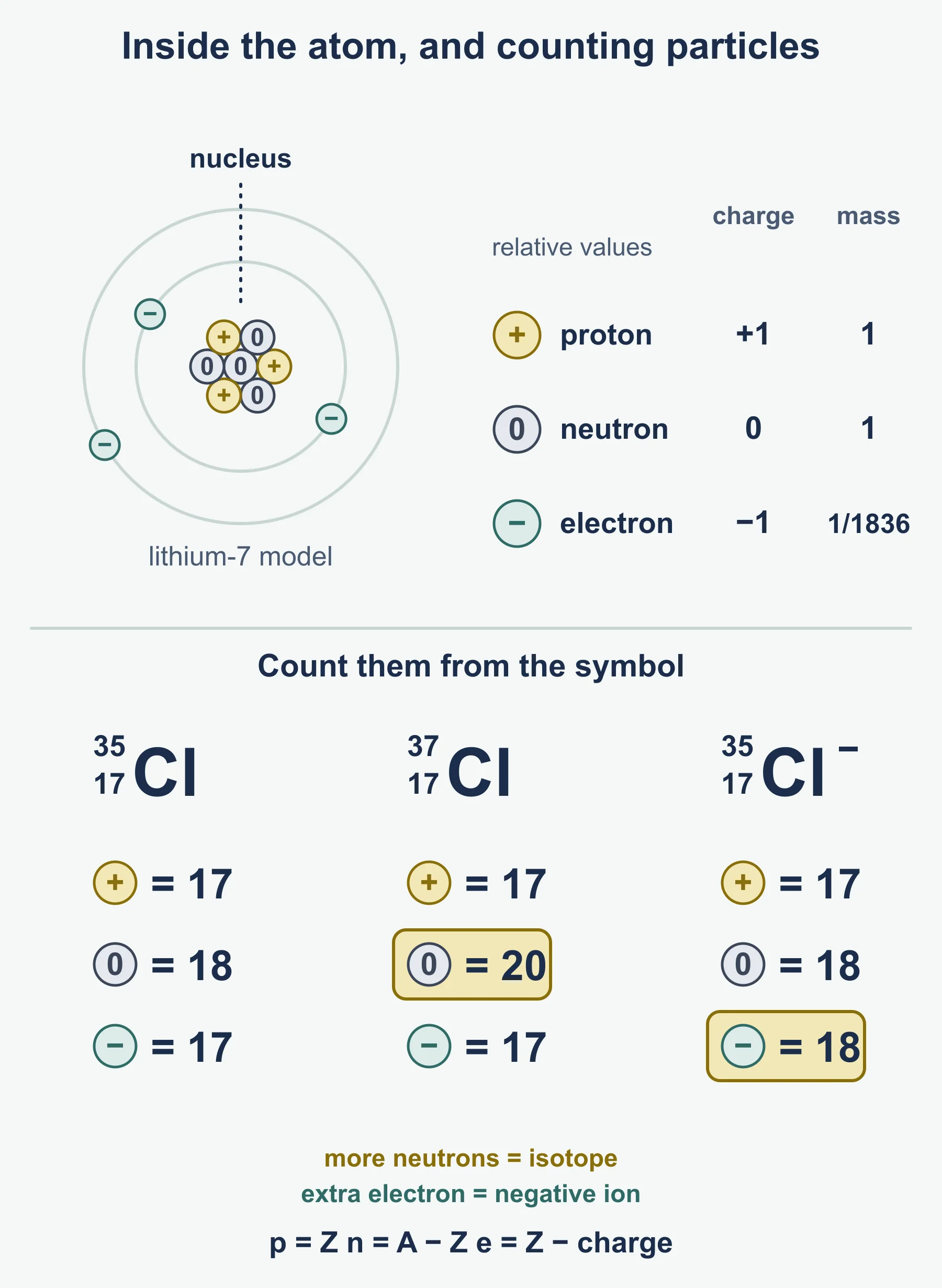
An atom has a nucleus containing protons and neutrons, surrounded by electrons.
| Particle | Where found | Relative charge | Relative mass |
|---|---|---|---|
| Proton | nucleus | +1 | 1 |
| Neutron | nucleus | 0 | 1 |
| Electron | shells around the nucleus | −1 | about 1/1840 (very small) |
The specification asks you to appreciate that ideas about atomic structure have evolved over time. Know one clear chain of cause and effect:
- Dalton pictured atoms as tiny solid spheres.
- The discovery of the electron showed that atoms contain smaller, negatively charged parts. The “plum pudding” model followed, with electrons embedded in a ball of positive charge.
- Firing alpha particles at thin gold foil did not fit that model. Nearly all passed undeflected, yet a small number bounced off at large angles. The conclusion was a tiny, dense, positive nucleus with mostly empty space around it.
- The neutron was identified later, which explained why mass numbers exceed proton numbers.
- Electrons arranged in shells and then in sub-shells and orbitals refined the picture further.
The point to make in an answer: a model is kept until new evidence it cannot explain appears, then it is revised.
3.1.1.2 Mass number and isotopes
| Symbol | Name | Meaning |
|---|---|---|
| A | Mass number | protons + neutrons |
| Z | Atomic (proton) number | number of protons |
Method for any atom or ion:
- Protons = Z.
- Neutrons = A − Z.
- Electrons = Z − charge. A 3+ ion has lost three electrons; a 2− ion has gained two.
| Species | Protons | Neutrons | Electrons |
|---|---|---|---|
| ⁵⁶Fe³⁺ (Z = 26) | 26 | 30 | 23 |
| ³²S²⁻ (Z = 16) | 16 | 16 | 18 |
| ²⁷Al³⁺ (Z = 13) | 13 | 14 | 10 |
| ⁸¹Br⁻ (Z = 35) | 35 | 46 | 36 |
Isotopes are forms of one element whose nuclei hold equal numbers of protons but unequal numbers of neutrons, so their mass numbers differ. Their electron arrangements match, so their chemical behaviour is the same. Properties tied to mass, such as density, vary a little.
Time of flight (TOF) mass spectrometer
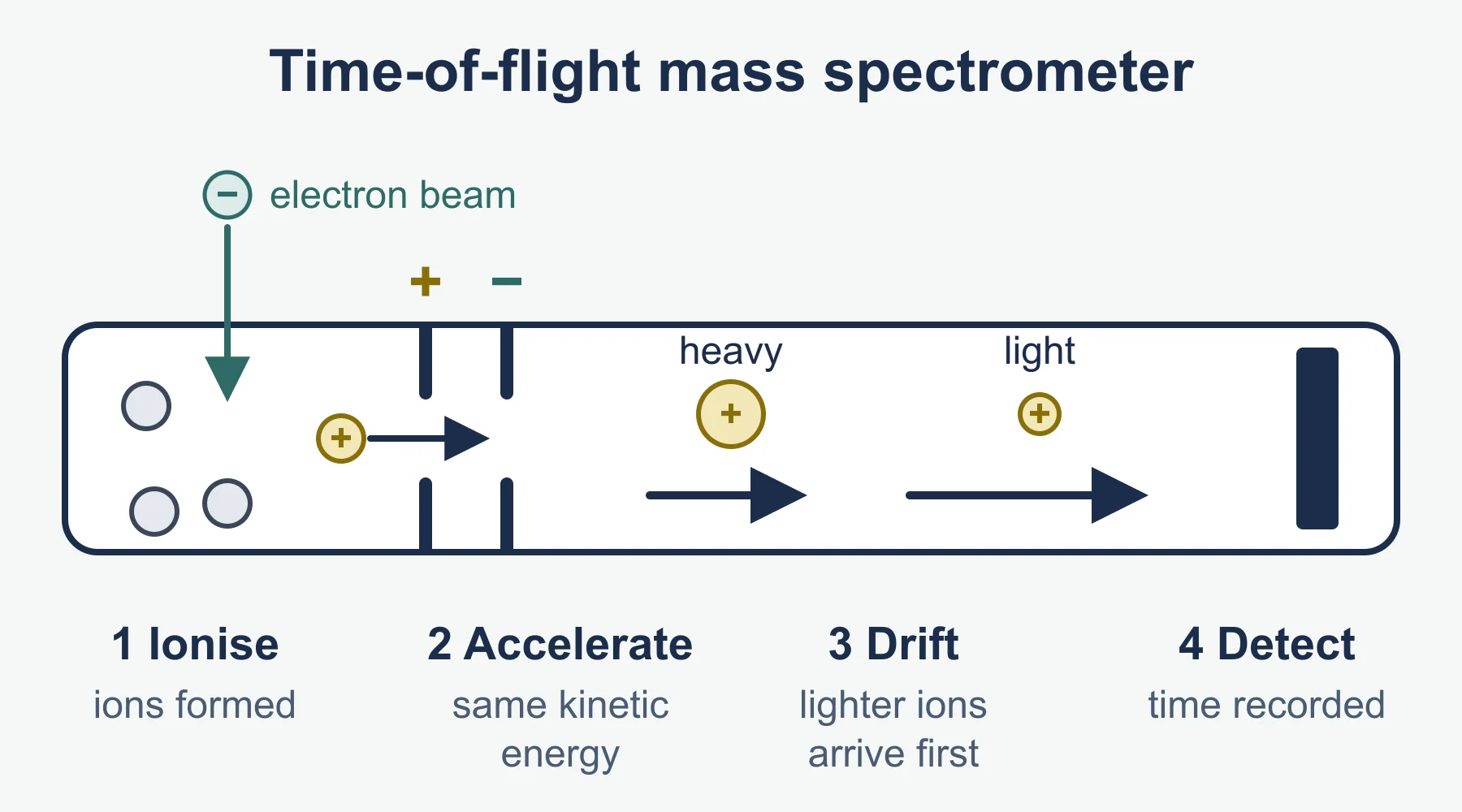
The specification limits you to four stages, then data analysis.
| Stage | What happens |
|---|---|
| Ionisation | The sample is vaporised and turned into positive ions, for example by knocking electrons out with a beam of high-energy electrons. |
| Acceleration | An electric field accelerates the ions so that all of them have the same kinetic energy. |
| Ion drift | The ions travel along a flight tube with no field. With equal kinetic energy, lighter ions move faster and arrive sooner. |
| Ion detection | Ions reach a detector, gain electrons and produce a current. A larger current means more ions. |
| Data analysis | A computer converts flight times into mass-to-charge ratio (m/z) and plots abundance against m/z. |
The whole instrument is under vacuum so that ions do not collide with air particles. Learn the reason for each stage, not just the order.
Using the spectrum
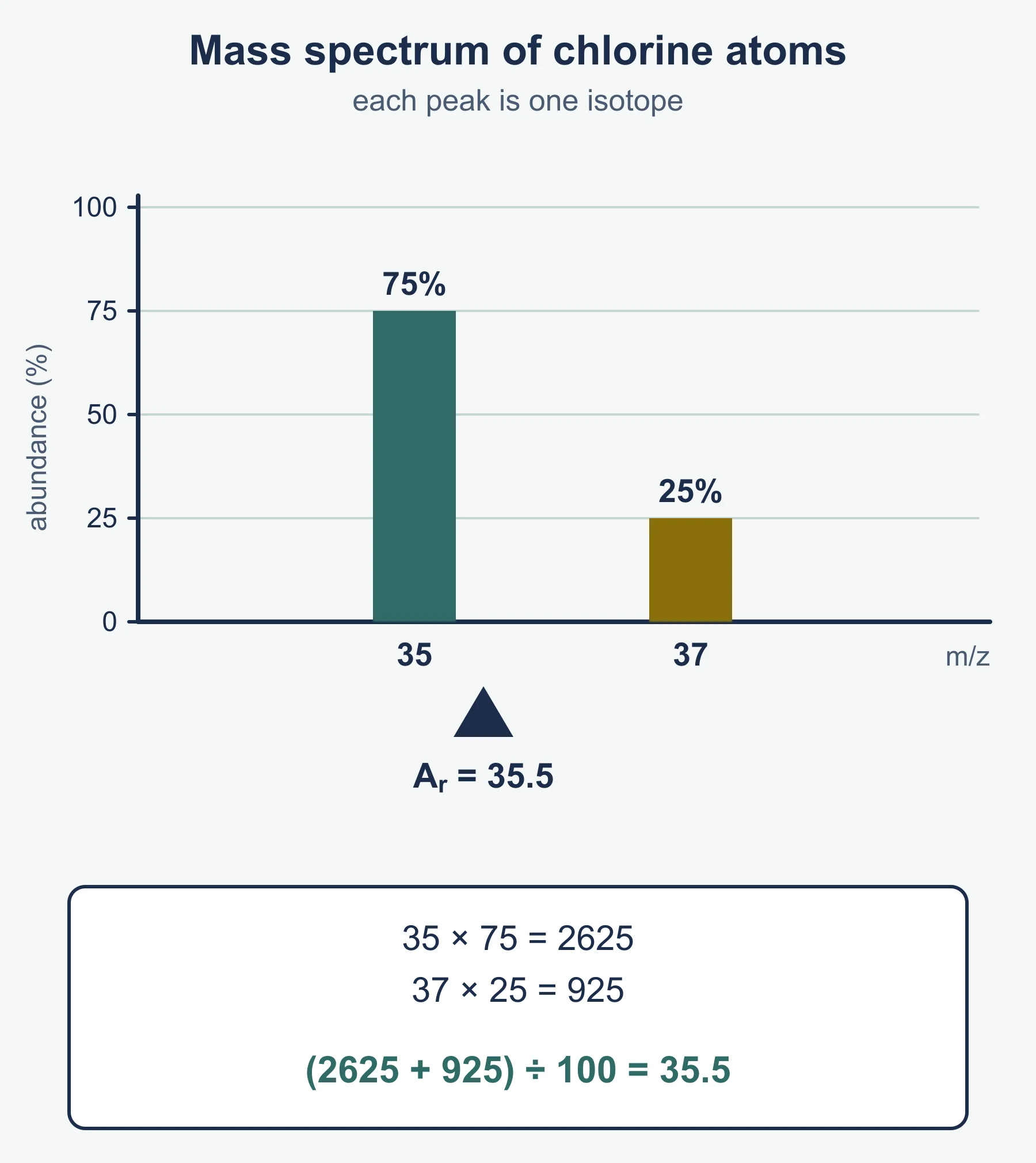
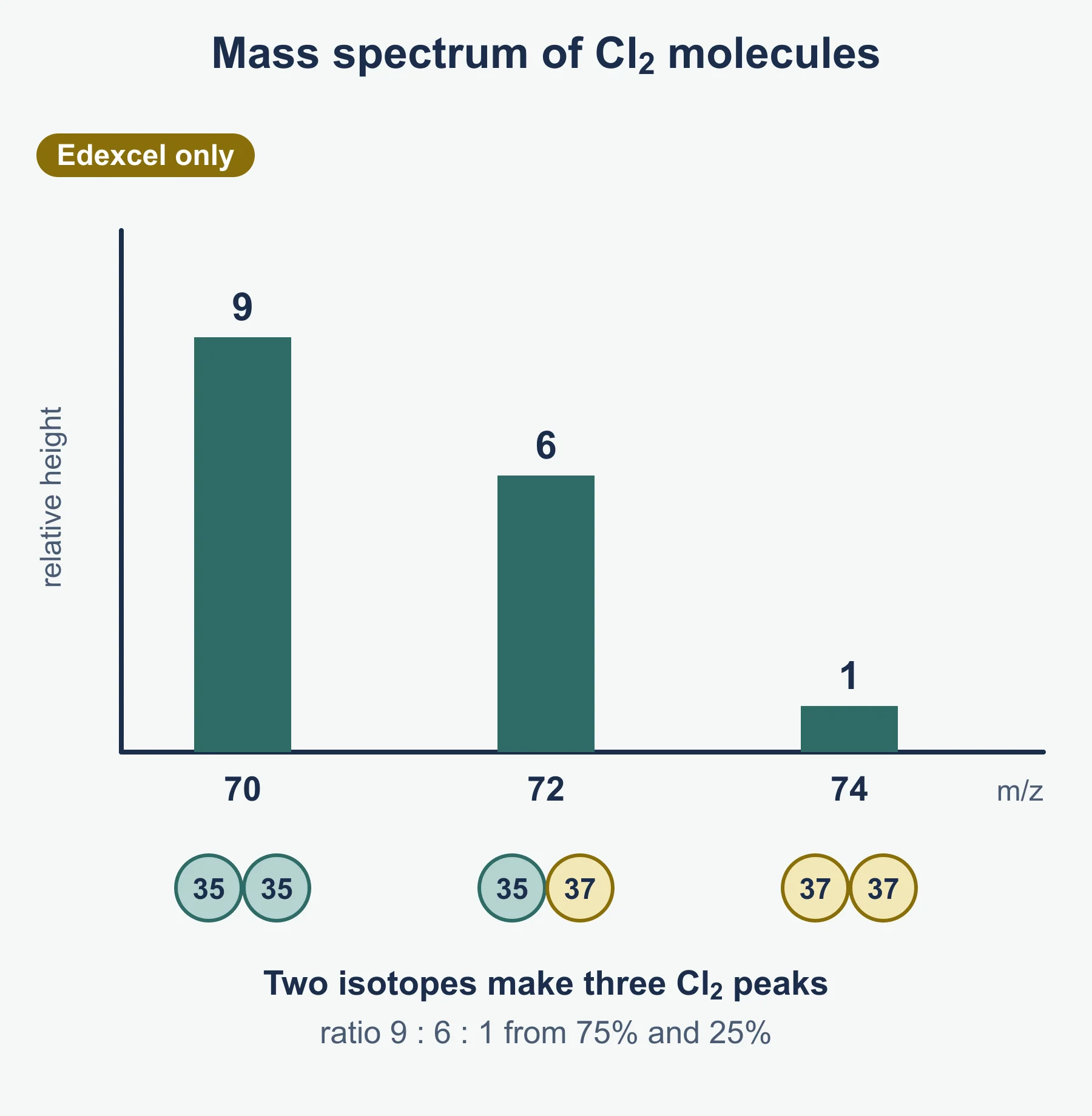
- Each peak is one isotope. Peak position is its m/z and peak height is its relative abundance. For a 1+ ion, m/z equals the relative isotopic mass.
- A spectrum identifies an element because the pattern of isotopes (positions and relative heights) is characteristic of that element.
- For a compound, the peak at the highest m/z is the molecular ion. Its m/z gives the relative molecular mass.
Relative atomic mass (limited to mononuclear ions)
Ar = Σ(isotopic mass × abundance) / Σ(abundance)
Worked reminder. An element X (invented data) shows peaks at m/z 46, 47 and 48 with relative abundances 8.0, 7.0 and 85.0. The abundances total 100.0.
Ar = (46 × 8.0 + 47 × 7.0 + 48 × 85.0) / 100.0 = 4777 / 100.0 = 47.77
To 3 significant figures that is 47.8. A sensible answer falls between the smallest and largest isotopic masses, closer to the most abundant isotope.
Working backwards. An element has isotopes of mass 20 and 22 and Ar = 20.4. If x is the fraction of the 22 isotope: 20(1 − x) + 22x = 20.4, so 2x = 0.4 and x = 0.20. The abundances are 80% and 20%.
3.1.1.3 Electron configuration
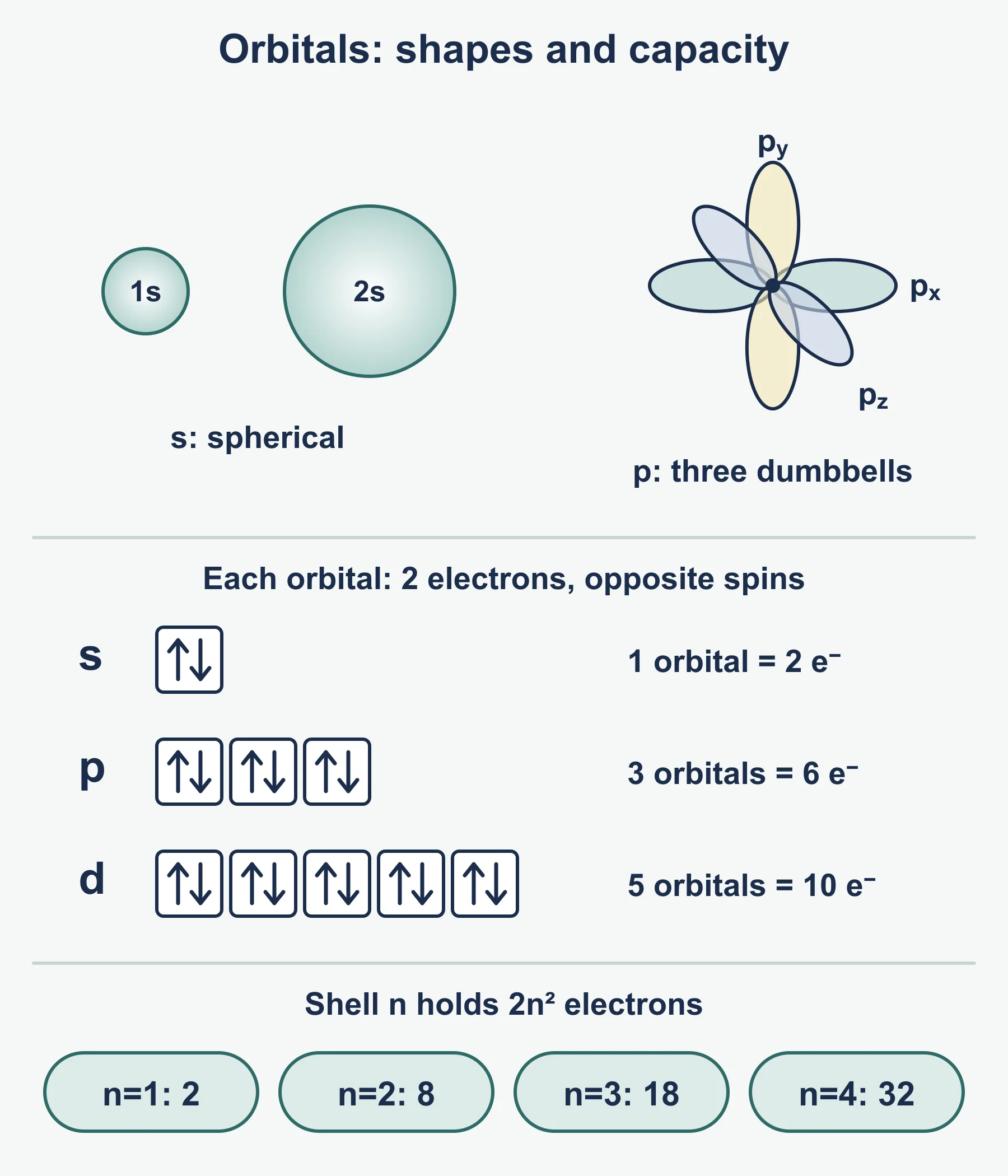
Shells, sub-shells and orbitals
| Sub-shell | Number of orbitals | Capacity (electrons) |
|---|---|---|
| s | 1 | 2 |
| p | 3 | 6 |
| d | 5 | 10 |
Each orbital holds a maximum of two electrons. Shell number n holds up to 2n² electrons (2, 8, 18, 32).
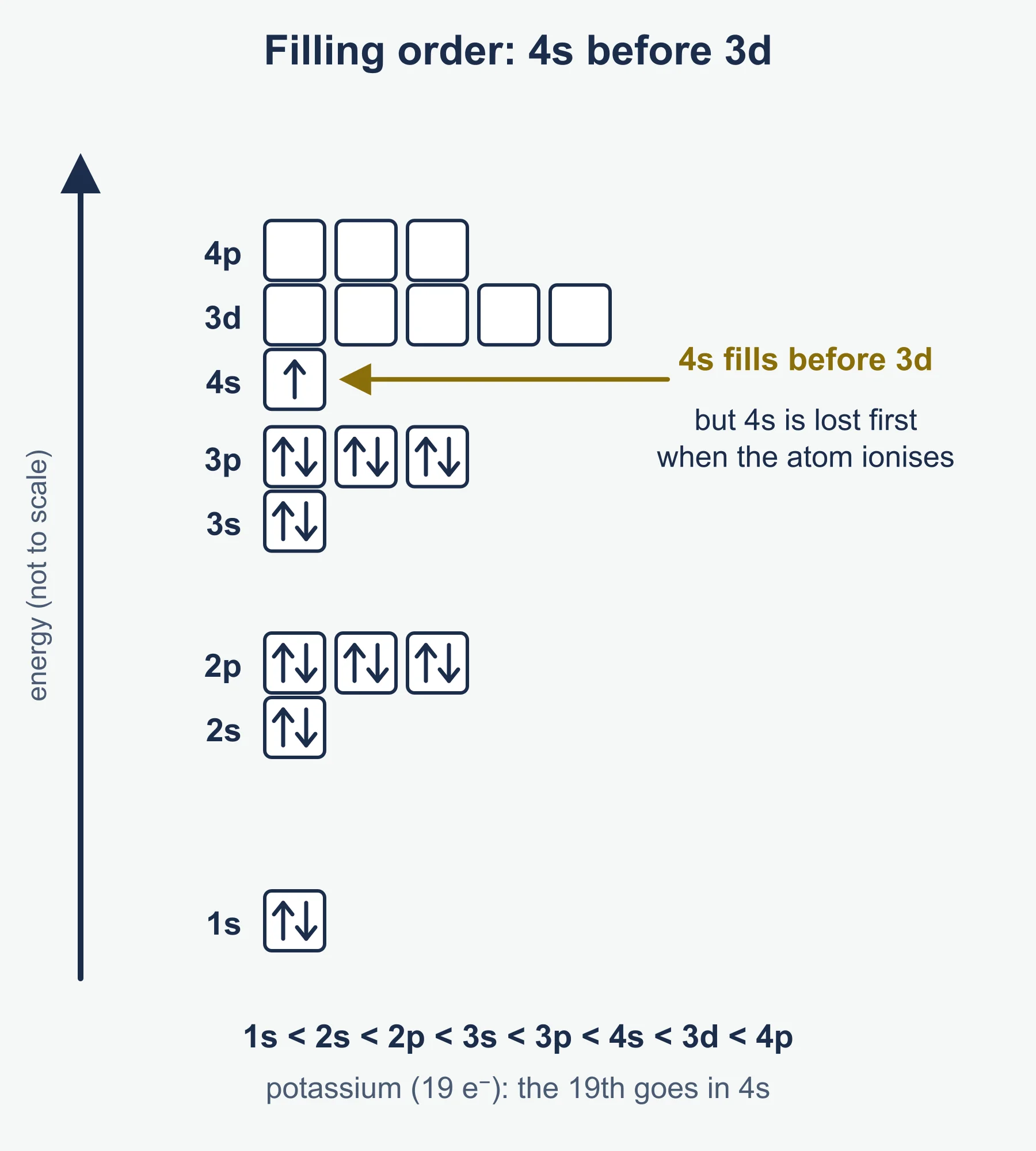
Filling order (up to Z = 36): 1s, 2s, 2p, 3s, 3p, 4s, 3d, 4p. Within that sequence 4s is occupied ahead of 3d.
| Species | Configuration |
|---|---|
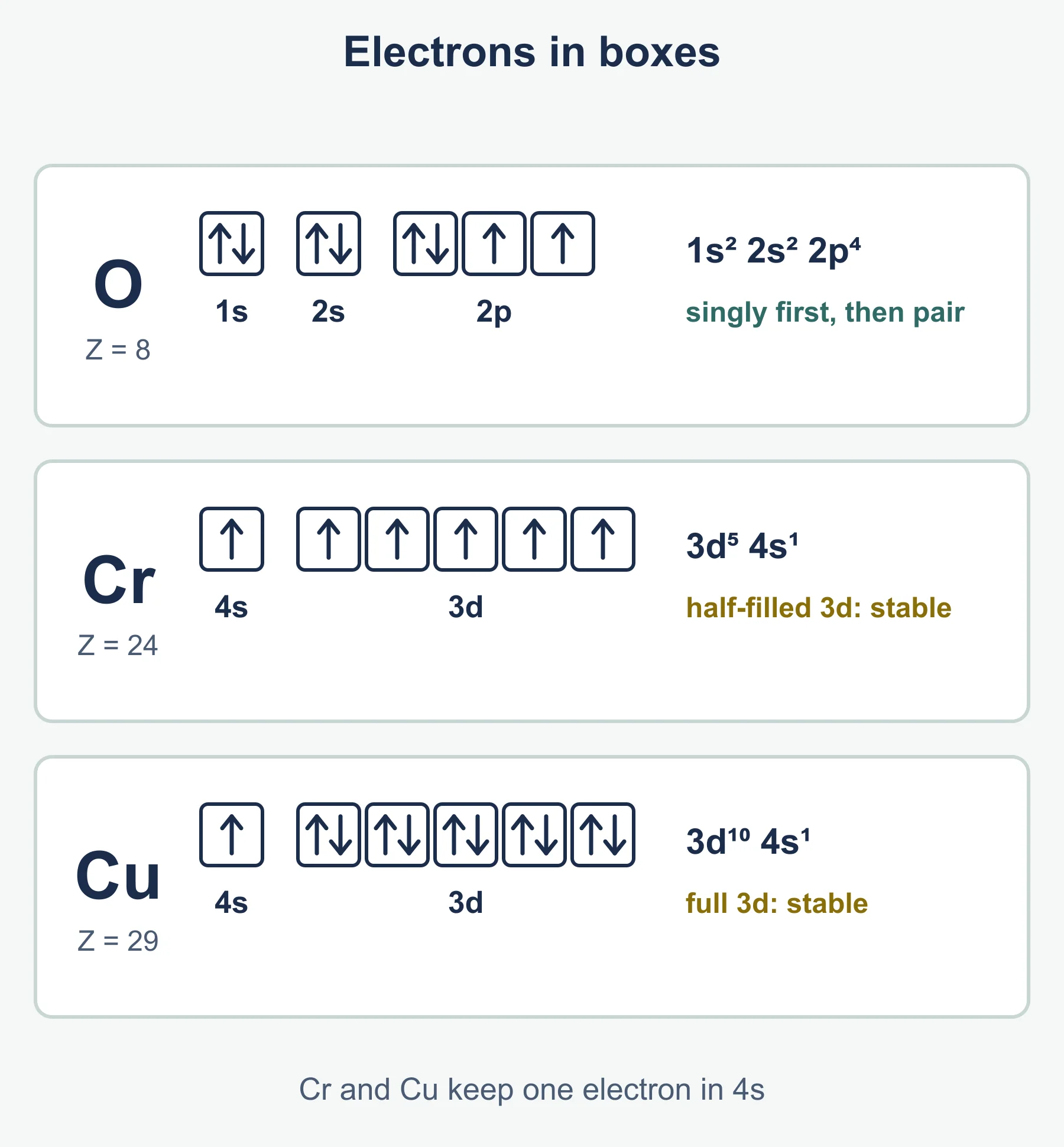
| Ca (Z = 20) | 1s² 2s² 2p⁶ 3s² 3p⁶ 4s² |
| Cr (Z = 24) | 1s² 2s² 2p⁶ 3s² 3p⁶ 3d⁵ 4s¹ |
| Cu (Z = 29) | 1s² 2s² 2p⁶ 3s² 3p⁶ 3d¹⁰ 4s¹ |
| Fe³⁺ (23 electrons) | 1s² 2s² 2p⁶ 3s² 3p⁶ 3d⁵ |
| S²⁻ (18 electrons) | 1s² 2s² 2p⁶ 3s² 3p⁶ |
Chromium and copper are the two exceptions to the filling order up to Z = 36: a half-full or full 3d set is favoured. When a d-block atom forms a positive ion, the 4s electrons are lost first. For negative ions, add the extra electrons to the next available space.
Ionisation energies
First ionisation energy: the energy change when a mole of gaseous atoms each lose one electron, giving a mole of gaseous 1+ ions.
Equations always carry state symbols:
- First: Ba(g) → Ba⁺(g) + e⁻
- Second: Ba⁺(g) → Ba²⁺(g) + e⁻
Three factors set the size: nuclear charge, distance of the outer electron from the nucleus, and shielding by inner electrons.
| Pattern | Explanation | What it is evidence for |
|---|---|---|
| First ionisation energy falls down Group 2 (Be to Ba) | Extra shells put the outer electron further away and more shielded, outweighing the greater nuclear charge | Electron shells |
| Overall rise across Period 3 (Na to Ar) | Nuclear charge increases while shielding and shell stay the same | Electrons added to the same shell |
| Dip from Mg to Al | Al’s outermost electron is held in 3p, a sub-shell a little higher in energy and further out than 3s | Sub-shells |
| Dip from P to S | In S, one 3p orbital holds a pair of electrons that repel one another, so one of them leaves more easily | Electron pairing in orbitals |
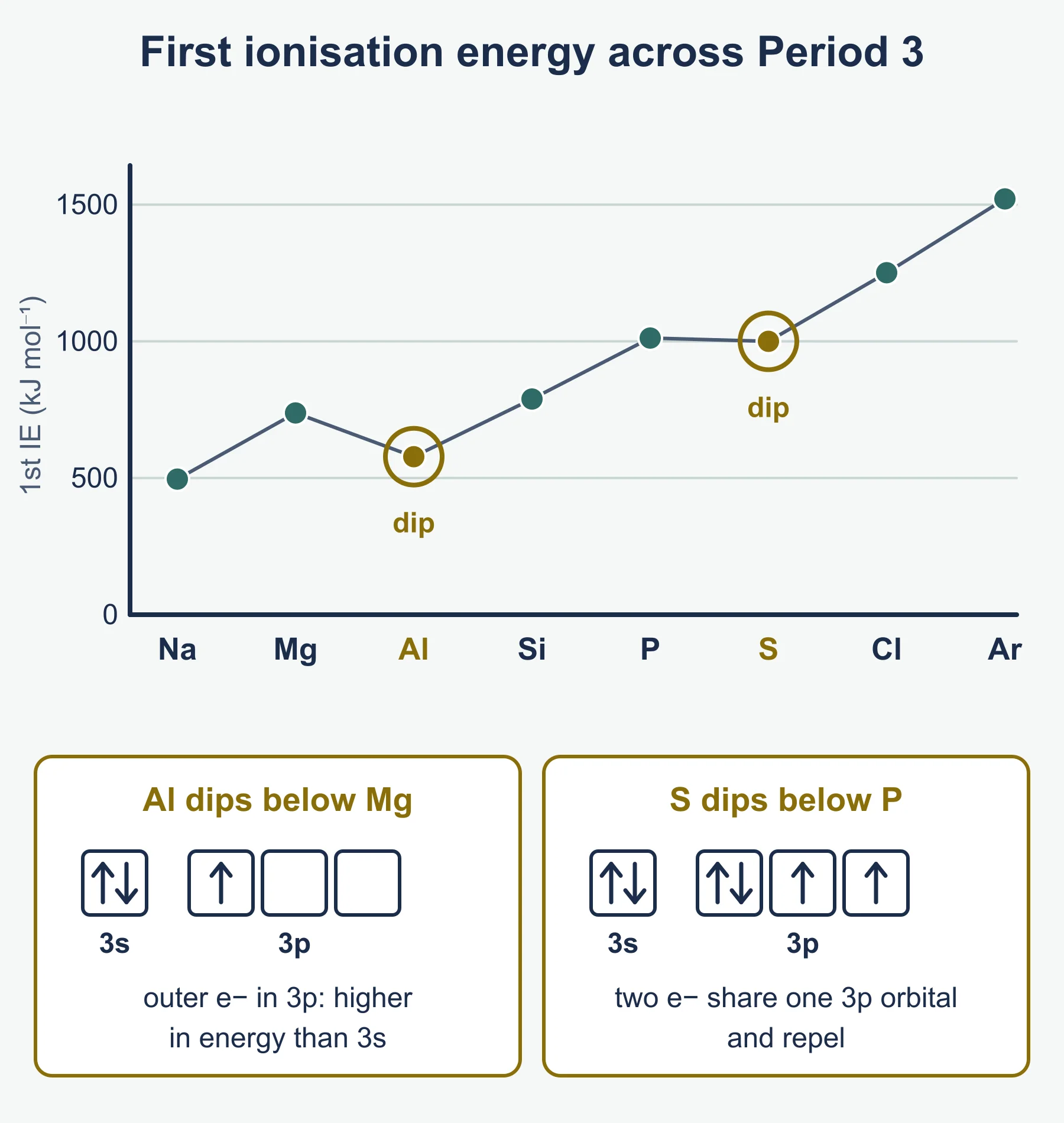
Reading successive ionisation energies
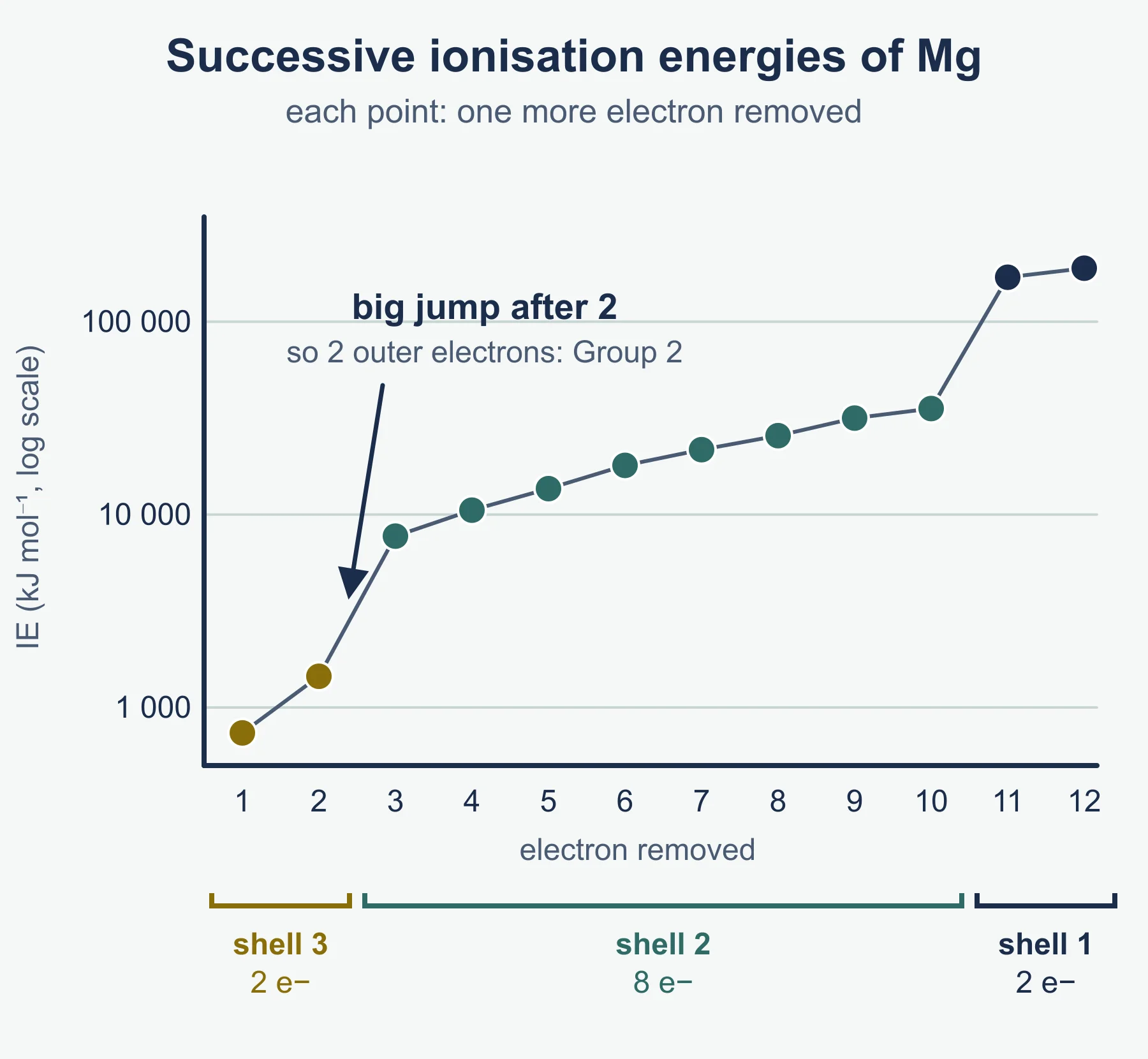
- Look for the largest jump between consecutive values.
- The number of electrons removed before that jump is the number in the outer shell. That gives the group.
- Later jumps mark the next inner shells.
Invented data for a Period 3 element, in kJ mol⁻¹: 540, 1150, 1740, 10900, 13700, 17600, 21500, 25200. The biggest jump is from the third to the fourth value (1740 to 10900), so there are three outer electrons: Group 3(13). Removing the fourth electron means breaking into a full inner shell that is closer to the nucleus and less shielded.
Quick self-test
- Give the numbers of protons, neutrons and electrons in ⁷⁹Se²⁻ (Z = 34).
- State two differences between isotopes of an element, and one thing they share.
- Name the stage of TOF mass spectrometry in which all ions are given the same kinetic energy.
- Why do lighter ions reach the detector first?
- An element has two isotopes, mass 35 and 37, in the ratio 3 : 1. Calculate Ar.
- State what the highest m/z peak in a compound’s spectrum represents.
- Write the configuration of Mn (Z = 25).
- Give the equation, with state symbols, for removing the second electron from a magnesium atom.
- Why does strontium need less energy than calcium to lose its outer electron?
- Successive ionisation energies of an element jump sharply after the second electron. State its group.
Answers
- 34 protons, 45 neutrons, 36 electrons.
- They differ in number of neutrons and in mass number (so in mass-dependent physical properties); they share the same number of protons (and so the same chemical properties).
- Acceleration.
- All ions have the same kinetic energy, so the lighter ions have the greater speed and cross the drift region in less time.
- (35 × 3 + 37 × 1) / 4 = 142 / 4 = 35.5.
- The molecular ion, which gives the relative molecular mass.
- 1s² 2s² 2p⁶ 3s² 3p⁶ 3d⁵ 4s².
- Mg⁺(g) → Mg²⁺(g) + e⁻.
- Strontium’s outermost electron occupies a more distant shell and is screened by more inner electrons; this beats the larger nuclear charge, so less energy is needed.
- Group 2.
Where marks are usually lost
- Writing electrons = A − Z for ions, instead of Z minus the charge.
- Describing isotopes as having different numbers of “particles” instead of different numbers of neutrons.
- Saying isotopes have different chemical properties.
- Giving the ionisation stage as “electron bombardment” with no mention that positive ions form.
- Leaving out state symbols, or putting charges in the wrong place, in ionisation equations.
- Defining first ionisation energy without “gaseous”, or without a mole of atoms.
- Explaining the Group 2 trend by nuclear charge alone, when shielding and distance decide it.
- Writing 3d before 4s when giving the configuration of an ion, or removing 3d electrons first from a d-block atom.
- Quoting a relative atomic mass outside the span of the isotopic masses, which signals an arithmetic slip.
Frequently asked questions
What are the four stages of a time of flight mass spectrometer? The OxfordAQA 9620 specification limits you to four stages: ionisation, acceleration, ion drift and ion detection, followed by data analysis. The whole instrument is under vacuum so that ions do not collide with air particles.
How do you calculate relative atomic mass from a mass spectrum? Use Ar = Σ(isotopic mass × abundance) ÷ Σ(abundance). For peaks at m/z 46, 47 and 48 with abundances 8.0, 7.0 and 85.0, Ar = 4777 ÷ 100.0 = 47.77.
Which electrons are lost first when a d-block atom forms an ion? The 4s electrons are lost first, even though 4s fills before 3d. Writing the 4s electrons in an ion’s configuration, or removing 3d electrons first, is a common error.
Which elements are exceptions to the electron filling order up to krypton? Chromium and copper are the two exceptions up to Z = 36, because a half-full or full 3d set is favoured. Their configurations end 3d⁵ 4s¹ and 3d¹⁰ 4s¹.
Official syllabus
OxfordAQA, International AS and A-level Chemistry (9620) specification, Version 5.3, for International AS and A-level exams May/June 2020 onwards. Section 3.1.1 Atomic structure, points 3.1.1.1 to 3.1.1.3, headed: Fundamental particles; Mass number and isotopes; Electron configuration.
Get free revision emails (optional)
Occasional emails with practice questions, worked explanations and links to free resources for the qualification and subjects you choose. No spam, and you can unsubscribe from any email. The free tools on this site never need an email.
Related resources
-
Practice questions
OxfordAQA A-Level Chemistry: Atomic structure (9620) – Practice Questions
Original OxfordAQA 9620 atomic structure questions with worked answers: isotopes, TOF mass spectra, configurations and ionisation energy evidence.
Chemistry · OxfordAQA · AS Level
Try questions -
Study guides
Bonding and Structure: Ionic, Covalent, Metallic Bonding and the Four Crystal Types
OxfordAQA 9620 sections 3.1.3.1 to 3.1.3.4: ionic, covalent, dative and metallic bonding, and the four crystal structure types with six named examples.
Chemistry · OxfordAQA · AS Level
Read guide -
Study guides
OxfordAQA A-Level Chemistry: Carboxylic acids and derivatives (9620)
OxfordAQA 9620 study guide to section 3.3.9: acids, esters, fats, soap, biodiesel, acylation, the addition-elimination mechanism and required practical 10.
Chemistry · OxfordAQA · A Level
Read guide
Related articles
-
study skills
How to revise for a science examination
Most science revision fails because it rereads notes instead of retrieving them. A practical method for revising physics, chemistry and biology in the weeks before a paper.
14 July 2026
-
teaching
A Level tuition in Dubai: Cambridge or Pearson Edexcel International A Level?
Schools in Dubai and Abu Dhabi teach either Cambridge International AS & A Level or Pearson Edexcel International A Level. How the two are structured, why it matters for tuition, and how online classes from Lahore work.
9 October 2026
Studying this with a teacher
Working through Chemistry AS LEVEL?
This page is free and stays free. If you would rather be taught it, Marlbridge runs Chemistry classes one-to-one and in small groups of up to 15, online in your own time zone. The first trial class is free. WhatsApp replies within an hour (8am–11pm Pakistan time, every day); email the same day.
OxfordAQA Chemistry teachers at Marlbridge

