
Revision Notes
OxfordAQA A-Level Chemistry: Energetics (9620) – Revision Notes
Condensed OxfordAQA 9620 energetics notes: enthalpy definitions, q = mc∆T, Hess's law cycles, mean bond enthalpies, a self-test and common slips.
- Subject
- Chemistry
- Level
- AS LEVEL
- Topic
- Energetics
- Author
- Marlbridge Academic Team
- Updated
- Reviewed by
- Nouman Ahmed (what this means)
Aligned to OxfordAQA A Level Chemistry (9620), Version 5.3 (first teaching 2019, first AS and A-level exams 2020). Official specification .
Syllabus page (what it covers and how it is assessed): OxfordAQA A Level Chemistry.
Syllabus points this page covers
9620 (AS Level)
- 3.1.4.1 Enthalpy change
- 3.1.4.2 Calorimetry
- 3.1.4.3 Applications of Hess’s law
- 3.1.4.4 Bond enthalpies
Found an error? Report a correction.
Need help with this topic? Request a free trial class for A Level Chemistry (9620).
These notes are aligned to the OxfordAQA International AS and A-level Chemistry (9620) specification, Version 5.3, for International AS and A-level exams from May/June 2020 onwards. They cover section 3.1.4 (enthalpy change, calorimetry, applications of Hess’s law and bond enthalpies, numbered 3.1.4.1 to 3.1.4.4), which the specification labels as International AS content. For full explanations read the Energetics study guide, then test yourself with the Energetics practice questions. Later A-level work extends the ideas in Thermodynamics. The course page is OxfordAQA A-level Chemistry, the printable list is the checklist, and the free diagnostics show where to start.
3.1.4.1 Enthalpy change
- Exothermic: heat energy is given out, the surroundings get hotter, ΔH is negative.
- Endothermic: heat energy is taken in, the surroundings get colder, ΔH is positive.
- Enthalpy change (ΔH) is the heat energy change of a reaction carried out at constant pressure.
- Standard enthalpy changes refer to 100 kPa and a stated temperature, which is written as a subscript, for example ΔH°₂₉₈.
Definitions to learn word for word
| Term | Definition |
|---|---|
| Standard enthalpy of combustion, ΔcH° | The heat change at constant pressure when exactly one mole of a substance reacts fully with oxygen at standard conditions, every species being in its standard state. |
| Standard enthalpy of formation, ΔfH° | The heat change at constant pressure for making exactly one mole of a compound out of its elements, each in its standard state, at standard conditions. |
| Mean bond enthalpy | The enthalpy change for breaking one mole of a particular type of bond in the gaseous phase, averaged over many different molecules that contain it. |
Standard state means the physical state of the substance at 100 kPa and the stated temperature. The standard state of oxygen is O₂(g) and of carbon is C(s).
Writing equations for the definitions
- Formation: the product is one mole of the compound, so fractions are allowed on the left. For ethanol: 2C(s) + 3H₂(g) + ½O₂(g) → C₂H₅OH(l).
- Combustion: a single mole of fuel on the left, with oxygen in excess. For propane: C₃H₈(g) + 5O₂(g) → 3CO₂(g) + 4H₂O(l).
- State symbols are part of the answer. A formation equation with a wrong state on an element is incorrect.
- An element in its standard state has ΔfH° = 0, since forming it involves no change.
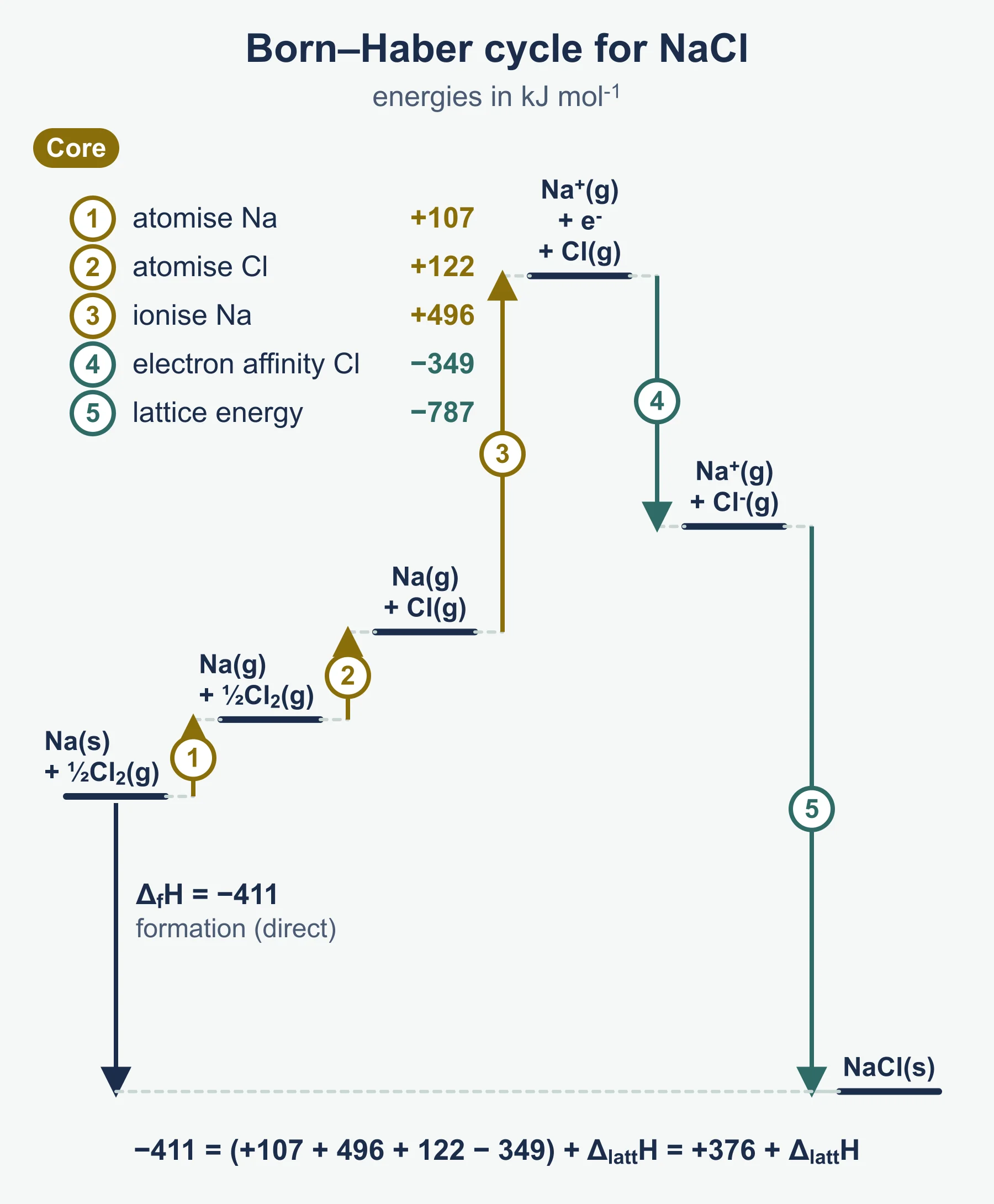
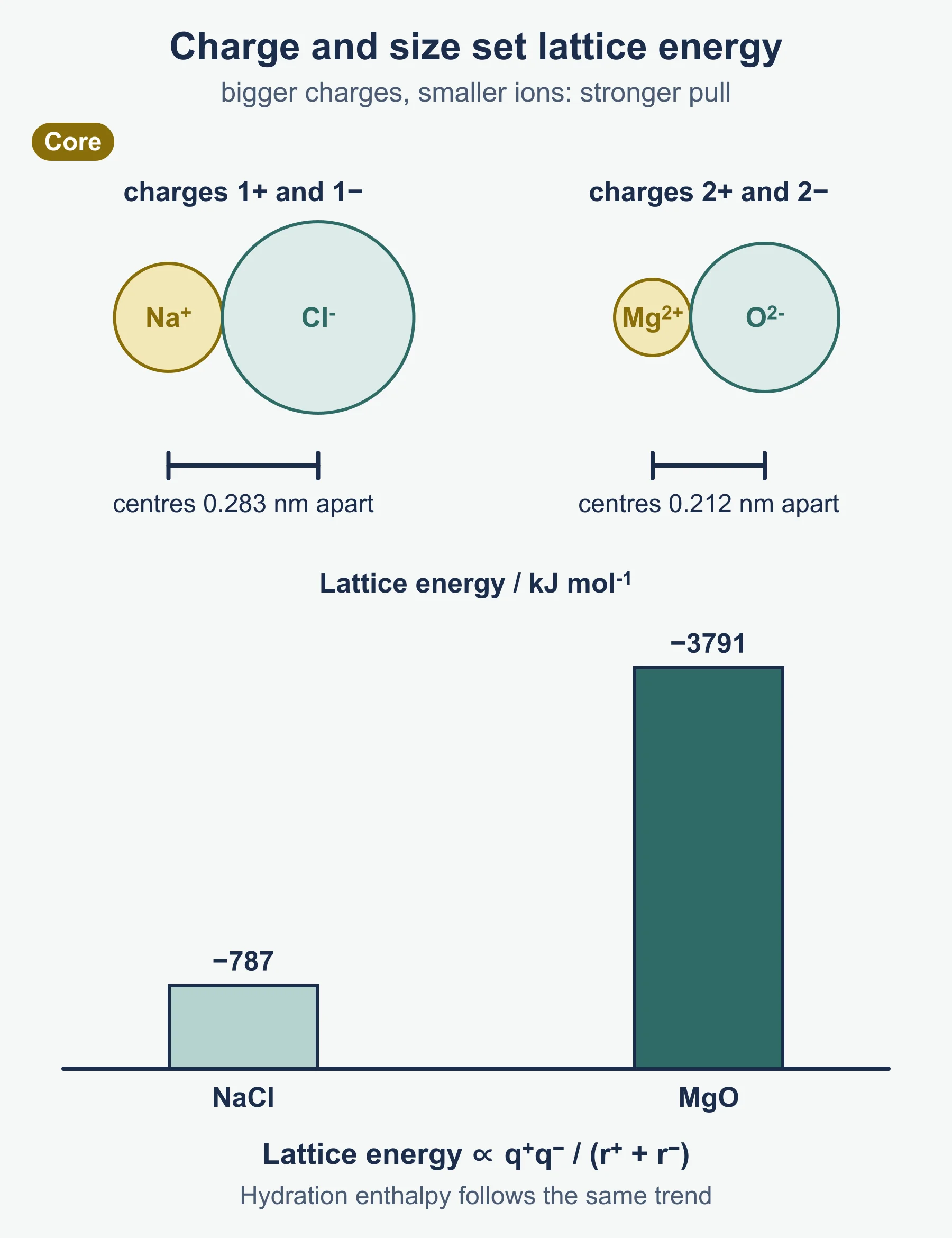
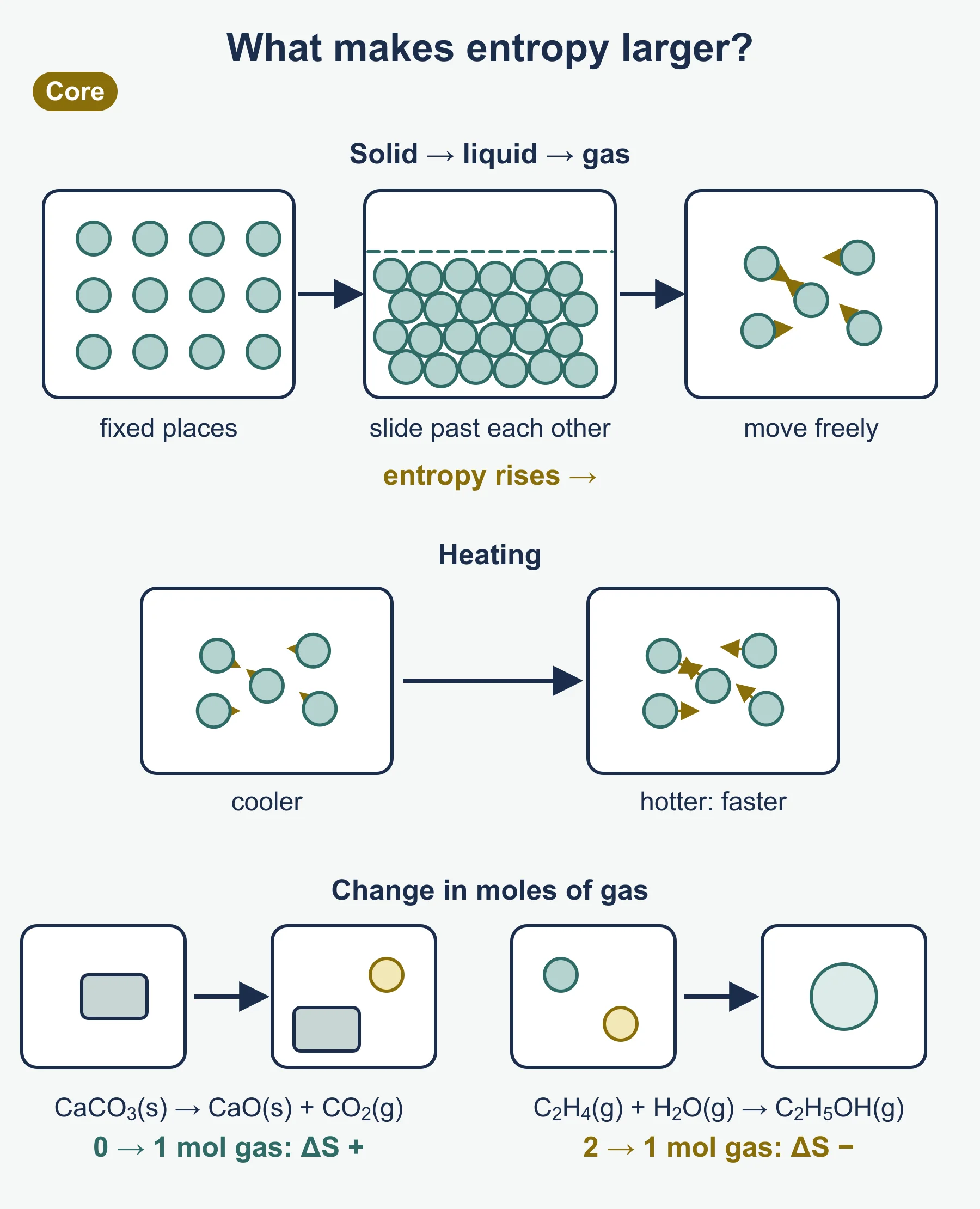
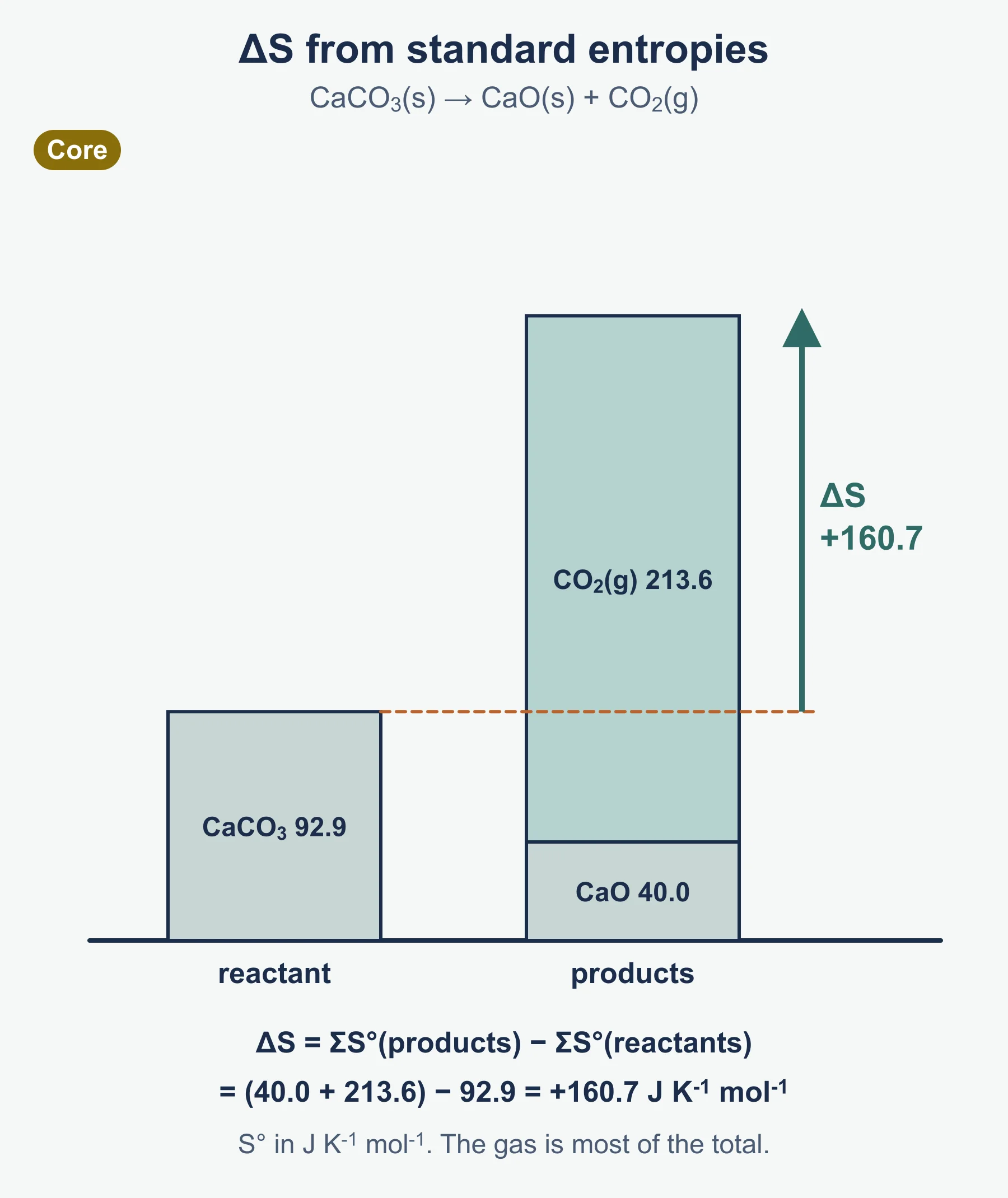
3.1.4.2 Calorimetry
q = mcΔT
| Symbol | Meaning | Usual unit |
|---|---|---|
| q | heat change | J |
| m | mass of the substance whose temperature changes | g |
| c | specific heat capacity | J g⁻¹ K⁻¹ |
| ΔT | temperature change | K (same size as °C) |
You are not expected to recall c. It will be given, so check the unit it comes with.
Method in steps
- Identify the substance that changed temperature (usually the water or the solution) and take its mass as m. In a combustion experiment, m is the water in the can, not the fuel.
- Work out ΔT as final minus initial. Use the size of the change.
- Calculate q in J, then divide by 1000 to get kJ.
- Calculate the moles of the limiting reagent or of the fuel burned, from mass ÷ Mr or concentration × volume.
- Molar enthalpy change = q ÷ moles, in kJ mol⁻¹.
- Add the sign last. Temperature rise means exothermic, so ΔH is negative. Temperature fall means endothermic, so ΔH is positive.
Worked reminder 1: solution reaction
30.0 cm³ of 1.50 mol dm⁻³ hydrochloric acid is mixed with 30.0 cm³ of 1.50 mol dm⁻³ potassium hydroxide. The temperature rises by 9.8 K. Take c = 4.18 J g⁻¹ K⁻¹ and a density of 1.00 g cm⁻³.
- m = 60.0 g, so q = 60.0 × 4.18 × 9.8 = 2458 J = 2.46 kJ
- moles of acid = 1.50 × 0.0300 = 0.0450 mol, which is the same as moles of alkali, so neither is in excess
- ΔH = −2.458 ÷ 0.0450 = −54.6 kJ mol⁻¹
Worked reminder 2: burning a fuel
0.92 g of ethanol (Mr = 46.0) is burned and heats 150 g of water by 22.0 K.
- moles of ethanol = 0.92 ÷ 46.0 = 0.0200 mol
- q = 150 × 4.18 × 22.0 = 13 794 J = 13.8 kJ
- ΔcH = −13.8 ÷ 0.0200 = −690 kJ mol⁻¹
This is much less exothermic than the accepted value for ethanol (about −1367 kJ mol⁻¹), which is the usual pattern in school experiments.
Why experimental values are poor
- Heat is lost to the surroundings and to the apparatus (the can, the air, the thermometer).
- Combustion is incomplete, so some carbon or carbon monoxide forms.
- Fuel evaporates from the burner between weighings.
- Conditions are not standard: the temperature and pressure differ from the stated standard conditions, and the experiment does not start and finish at the same temperature.
- For solutions, the assumptions are that the solution has the same density and specific heat capacity as water, and that the polystyrene cup absorbs a negligible amount of heat.
Required practical 2: measure an enthalpy change
A typical version uses a polystyrene cup with a lid, a measuring cylinder or pipette, a thermometer and a stopwatch. Your school may use a slightly different method, so follow the one you were taught.
- Insulation (polystyrene, a lid, a draught shield for a burner) cuts heat loss.
- Record the starting temperature for a few minutes, add the second reagent, then keep recording at fixed intervals.
- Plot temperature against time and extrapolate the cooling part of the line back to the time of mixing. Take ΔT from the extrapolated line. This allows for heat lost while the reaction was still happening.
- A small ΔT makes a given thermometer error a large percentage of the result, so read the thermometer carefully.
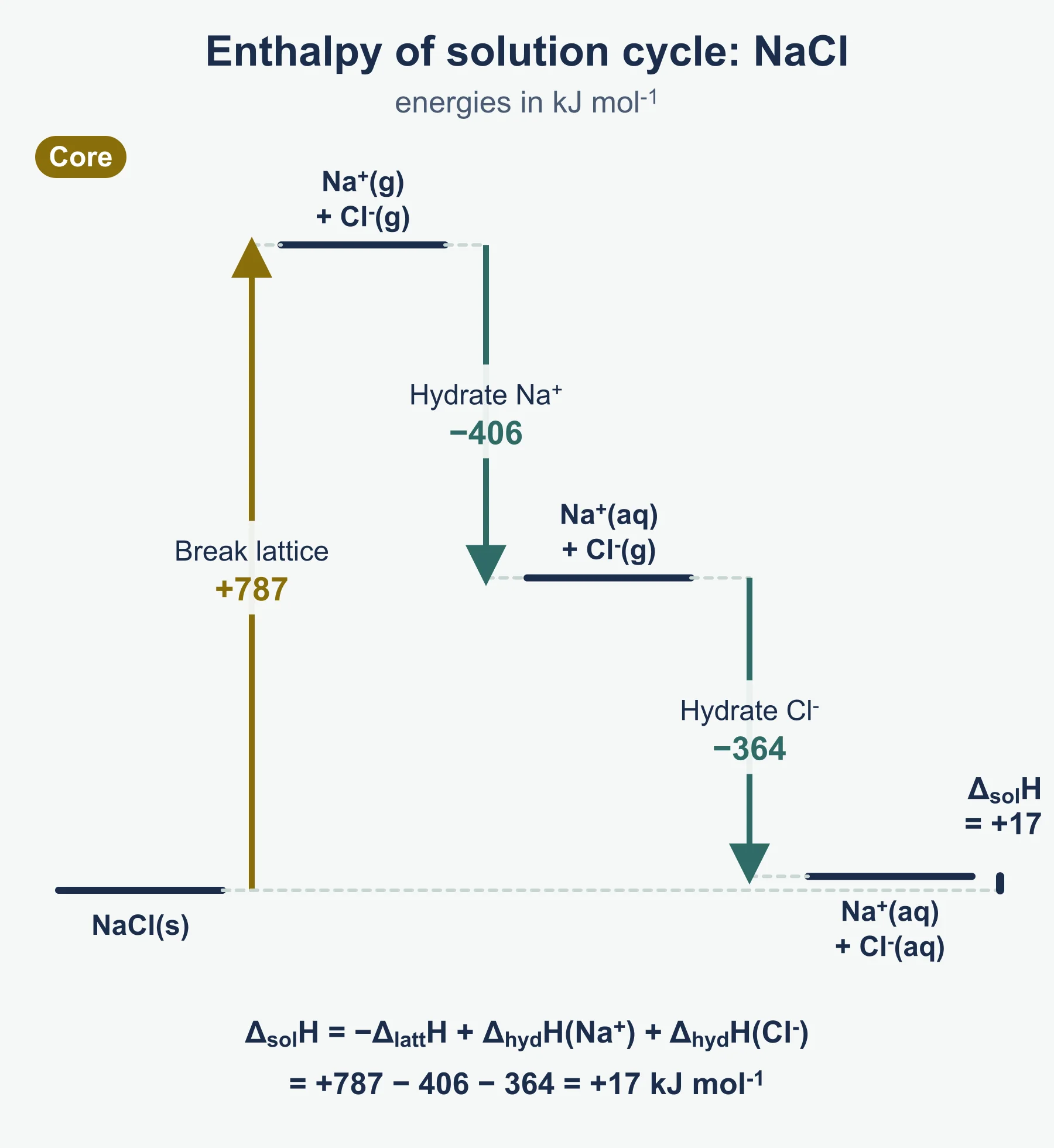
3.1.4.3 Hess’s law
Hess’s law. Whichever route a reaction follows, the overall enthalpy change is identical, as long as the starting and finishing conditions match.
Cycle rules
- Draw the reaction along the top, the elements or the combustion products at the bottom.
- Follow arrows with the arrow direction and add the enthalpy change. Go against an arrow and reverse the sign.
- Multiply a value by the number of moles in the balanced equation.
Two formulae to recognise
| Data given | Formula |
|---|---|
| Enthalpies of formation | ΔH = ΣΔfH°(products) − ΣΔfH°(reactants) |
| Enthalpies of combustion | ΔH = ΣΔcH°(reactants) − ΣΔcH°(products) |
The order of subtraction swaps. In a formation cycle the arrows go down from the elements to the compounds. In a combustion cycle the arrows go down from the compounds to the combustion products.
Worked reminder 3: from combustion data
Hydrogenation of propene: C₃H₆(g) + H₂(g) → C₃H₈(g). Given ΔcH°: C₃H₆ = −2058, H₂ = −286, C₃H₈ = −2220 kJ mol⁻¹.
ΔH = (−2058) + (−286) − (−2220) = −124 kJ mol⁻¹
Worked reminder 4: from formation data
PbO(s) + CO(g) → Pb(s) + CO₂(g). Given ΔfH°: PbO = −217, CO = −111, CO₂ = −394 kJ mol⁻¹.
ΔH = (−394) − [(−217) + (−111)] = −394 − (−328) = −66 kJ mol⁻¹
Lead is an element in its standard state, so it contributes zero.
3.1.4.4 Bond enthalpies
- Breaking bonds takes in energy: endothermic, positive.
- Making bonds gives out energy: exothermic, negative.
- ΔH = Σ(bonds broken) − Σ(bonds formed)
- Draw out the full structural formulae so you can count every bond, including double bonds as one double bond each, not two single bonds.
- Use it for reactions where everything is gaseous.
Worked reminder 5
N₂(g) + 3H₂(g) → 2NH₃(g), with N≡N 945, H–H 436 and N–H 391 kJ mol⁻¹.
- broken: 945 + 3 × 436 = 2253 kJ
- formed: 6 × 391 = 2346 kJ
- ΔH = 2253 − 2346 = −93 kJ mol⁻¹
Bond enthalpy versus Hess’s law values
- A mean bond enthalpy is an average over many different molecules. The actual enthalpy of that bond in the molecule in your reaction is slightly different.
- A Hess’s law value uses measured enthalpies of formation or combustion for the actual compounds involved, so it is specific to them.
- Bond enthalpy calculations treat every species as gaseous. If the real reaction has a liquid or solid, the energy of changing state is missing from the bond-enthalpy method.
Must-know distinctions
| Compare | Point |
|---|---|
| ΔH and q | q is the heat change of the surroundings (the water), found from mcΔT. ΔH is per mole and has the opposite sign for the reacting system. |
| Formation and combustion | Formation makes one mole of compound from elements. Combustion burns one mole in oxygen. |
| Bond enthalpy and Hess’s law | The first uses averages and gaseous species. The second uses data for the compounds in the question. |
| Broken and formed | Take bonds broken minus bonds formed. The reverse order of the Hess formation formula is a classic trap. |
Quick self-test
- State whether ΔH is positive or negative when a reaction makes its surroundings colder.
- Which mass is used in q = mcΔT when a fuel heats a can of water?
- 50.0 g of water is heated by 8.4 K. Calculate q in J (c = 4.18 J g⁻¹ K⁻¹).
- 0.0250 mol of reactant releases 2.09 kJ. Calculate the molar enthalpy change.
- Write the equation whose enthalpy change is ΔfH° of methanol, CH₃OH(l).
- State the value of ΔfH° for H₂(g).
- Use formation data to find ΔH for C₂H₄(g) + H₂O(g) → C₂H₅OH(g), given ΔfH° of −235 for C₂H₅OH(g), +52 for C₂H₄(g) and −242 for H₂O(g), all in kJ mol⁻¹.
- Given ΔcH° of carbon = −394, hydrogen = −286 and ethane = −1560 kJ mol⁻¹, find ΔfH° of ethane.
- Calculate ΔH for H₂(g) + Cl₂(g) → 2HCl(g) from H–H 436, Cl–Cl 242 and H–Cl 431 kJ mol⁻¹.
- Give one reason why a bond enthalpy result for a reaction differs from the Hess’s law value.
Answers
- Positive (endothermic).
- The mass of water in the can, not the mass of the fuel.
- 50.0 × 4.18 × 8.4 = 1755.6, so 1760 J (3 s.f.).
- 2.09 ÷ 0.0250 = 83.6, and the reaction releases heat, so ΔH is −83.6 kJ mol⁻¹.
- C(s) + 2H₂(g) + ½O₂(g) → CH₃OH(l).
- Zero, because it is an element in its standard state.
- −235 − (52 + −242) = −235 + 190 = −45 kJ mol⁻¹.
- 2(−394) + 3(−286) − (−1560) = −788 − 858 + 1560 = −86 kJ mol⁻¹.
- (436 + 242) − (2 × 431) = 678 − 862 = −184 kJ mol⁻¹.
- Mean bond enthalpies are averages over many molecules, whereas Hess’s law data are specific to the compounds in the reaction.
Where marks are usually lost
- Writing a definition without “one mole”, “standard conditions” or “standard states”.
- Writing O instead of O₂ in a combustion equation, or burning more than one mole of the fuel in a definition equation.
- Using the mass of the fuel or of the metal instead of the mass of water or solution in q = mcΔT.
- Dividing in joules by the moles instead of converting to kJ first.
- Putting a positive sign on an exothermic result because the temperature change was positive.
- Not multiplying a formation or combustion value by the number of moles in the equation.
- Using the combustion formula the wrong way round, or the formation formula the wrong way round.
- Applying bond enthalpies without first checking that every species in the equation is a gas.
- Saying the values differ “because of errors”. Name the actual reason: averages across molecules, or heat loss in the experiment.
Frequently asked questions
Is the specific heat capacity of water given in the OxfordAQA 9620 exam? You are not expected to recall the specific heat capacity; it will be given in any question that needs it. Check the unit it comes with before you substitute it into q = mcΔT.
Why is the enthalpy of formation of an element zero? An element in its standard state, such as O₂(g) or C(s), needs no change to form it, so its standard enthalpy of formation is zero. It contributes nothing in a Hess’s law calculation using formation data.
How do you find ΔT accurately in an enthalpy experiment? Record the temperature for a few minutes before adding the second reagent, then keep recording at fixed intervals. Plot temperature against time and extrapolate the cooling line back to the time of mixing to allow for heat lost while the reaction was still happening.
Can you use mean bond enthalpies for reactions involving liquids? Not directly. Bond enthalpy calculations treat every species as gaseous, so if the real reaction has a liquid or solid, the energy of changing state is missing and the result is less reliable.
Official syllabus
OxfordAQA, International AS and A-level Chemistry (9620) specification, Version 5.3, for International AS and A-level exams May/June 2020 onwards, section 3.1.4 Energetics.
Get free revision emails (optional)
Occasional emails with practice questions, worked explanations and links to free resources for the qualification and subjects you choose. No spam, and you can unsubscribe from any email. The free tools on this site never need an email.
Related resources
-
Practice questions
OxfordAQA A-Level Chemistry: Energetics (9620) – Practice Questions
Twelve original OxfordAQA 9620 energetics questions with worked answers on enthalpy definitions, calorimetry, Hess's law and mean bond enthalpies.
Chemistry · OxfordAQA · AS Level
Try questions -
Study guides
Chemical Equilibria: Le Chatelier's Principle and the Equilibrium Constant Kc
OxfordAQA 9620 AS Chemistry guide to dynamic equilibrium, Le Chatelier's principle, the Haber and Contact compromises, and calculating Kc with its units.
Chemistry · OxfordAQA · AS Level
Read guide -
Practice questions
OxfordAQA A Level Chemistry: Equilibria and Le Chatelier — Practice Questions
Original OxfordAQA 9620 practice questions with worked answers on Le Chatelier, Kc, ICE tables and the Contact process, plus labelled A2 Kp extension items.
Chemistry · OxfordAQA · AS Level
Try questions
Related articles
-
study skills
How to revise for a science examination
Most science revision fails because it rereads notes instead of retrieving them. A practical method for revising physics, chemistry and biology in the weeks before a paper.
14 July 2026
-
teaching
A Level tuition in Dubai: Cambridge or Pearson Edexcel International A Level?
Schools in Dubai and Abu Dhabi teach either Cambridge International AS & A Level or Pearson Edexcel International A Level. How the two are structured, why it matters for tuition, and how online classes from Lahore work.
9 October 2026
Studying this with a teacher
Working through Chemistry AS LEVEL?
This page is free and stays free. If you would rather be taught it, Marlbridge runs Chemistry classes one-to-one and in small groups of up to 15, online in your own time zone. The first trial class is free. WhatsApp replies within an hour (8am–11pm Pakistan time, every day); email the same day.
OxfordAQA Chemistry teachers at Marlbridge

