
Revision Notes
OxfordAQA A-Level Chemistry: Bonding (9620) – Revision Notes
Condensed OxfordAQA 9620 bonding notes, sections 3.1.3.1 to 3.1.3.7: ionic, covalent, metallic, shapes, polarity, intermolecular forces, plus a self-test.
- Subject
- Chemistry
- Level
- AS LEVEL
- Topic
- Bonding
- Author
- Marlbridge Academic Team
- Updated
- Reviewed by
- Nouman Ahmed (what this means)
Aligned to OxfordAQA A Level Chemistry (9620), Version 5.3 (first teaching 2019, first AS and A-level exams 2020). Official specification .
Syllabus page (what it covers and how it is assessed): OxfordAQA A Level Chemistry.
Syllabus points this page covers
9620 (AS Level)
- 3.1.3.1 Ionic bonding
- 3.1.3.2 Nature of covalent and dative covalent bonds
- 3.1.3.3 Metallic bonding
- 3.1.3.4 Bonding and physical properties
- 3.1.3.5 Shapes of simple molecules and ions
- 3.1.3.6 Bond polarity
- 3.1.3.7 Forces between molecules
Found an error? Report a correction.
Need help with this topic? Request a free trial class for A Level Chemistry (9620).
These notes condense section 3.1.3 Bonding (3.1.3.1 to 3.1.3.7) of the OxfordAQA International AS and A-level Chemistry (9620) specification, Version 5.3, for International AS and A-level exams May/June 2020 onwards. All of the section is International AS content. Bonding sits in Unit 1 (Inorganic 1 and Physical 1), and the specification says Unit 2 questions may draw on bonding principles.
For full explanations use the study guides on ionic, covalent, metallic bonding and crystal types and on shapes, polarity and intermolecular forces. Then test yourself with the bonding practice questions, check the course hub and printable checklist, or take a free 10-minute diagnostic.
3.1.3.1 Ionic bonding
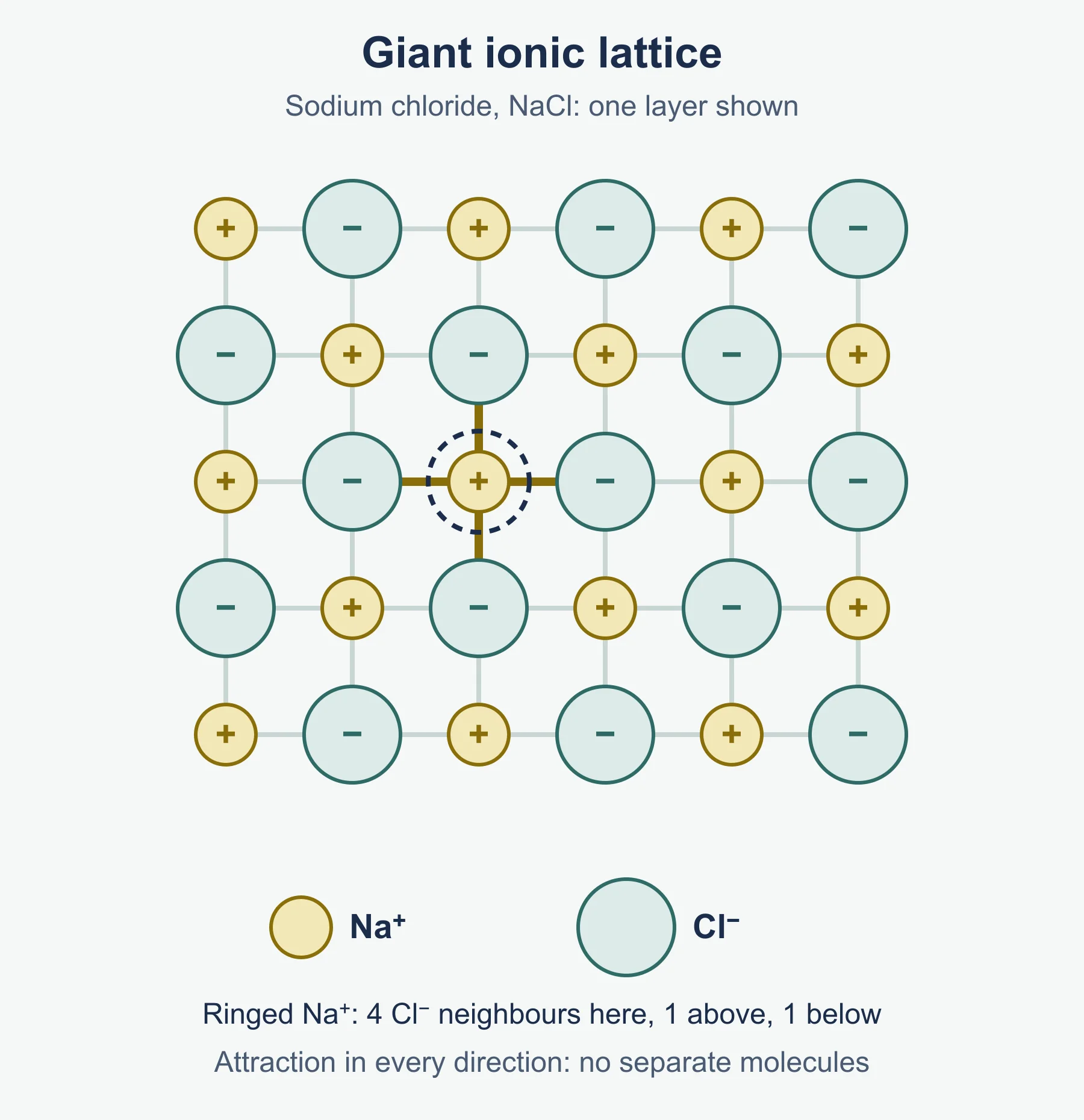
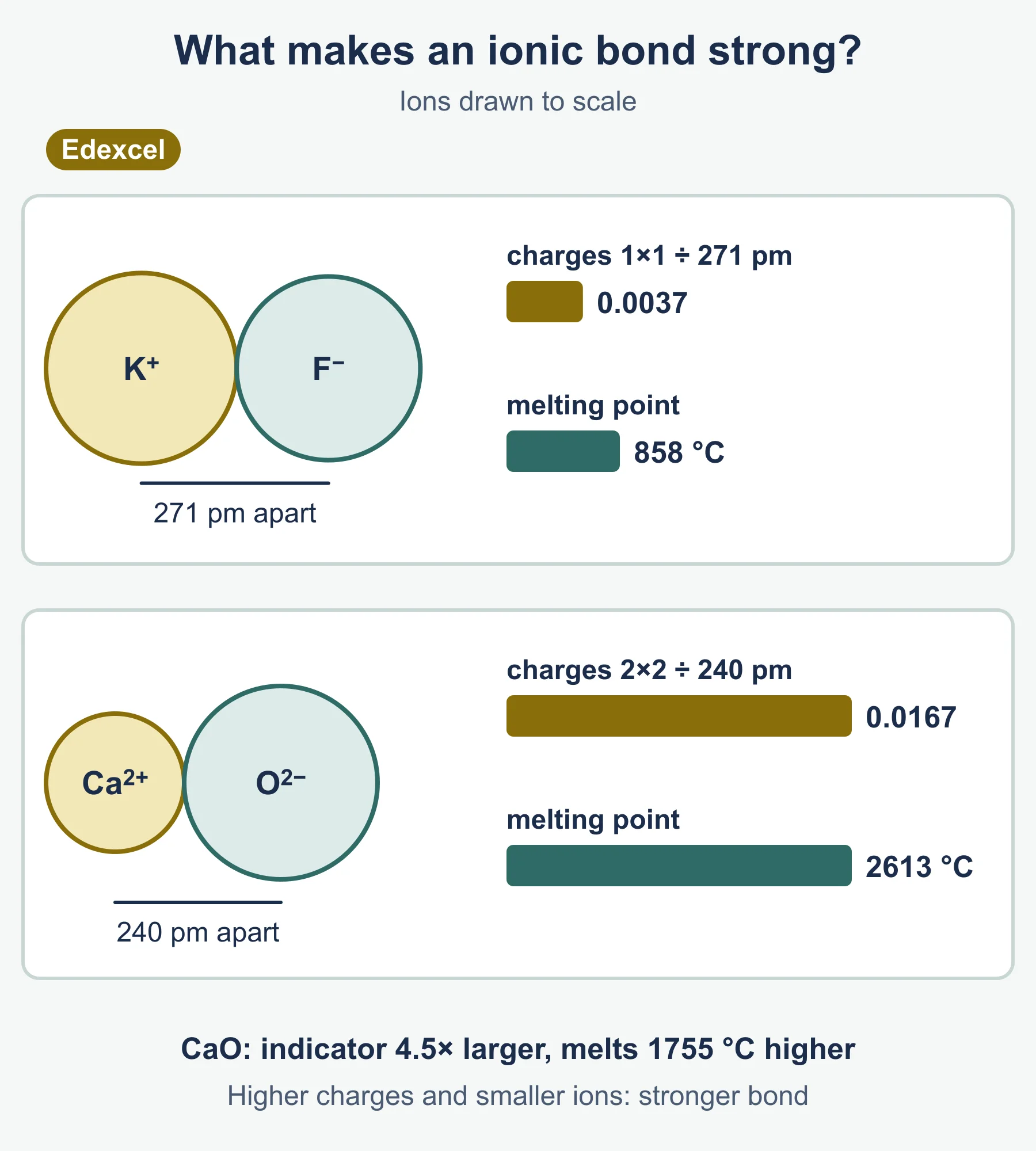
Ionic bonding is the electrostatic attraction holding oppositely charged ions together in a lattice. The attraction acts in all directions, not just between one pair.
| Group | 1 | 2 | 3 | 5 | 6 | 7 |
|---|---|---|---|---|---|---|
| Simple ion | 1+ | 2+ | 3+ | 3− | 2− | 1− |
Learn five compound ions: sulfate SO₄²⁻, carbonate CO₃²⁻, nitrate NO₃⁻, hydroxide OH⁻ and ammonium NH₄⁺.
Method for a formula
- Write both ions with charges.
- Find the smallest numbers of each that make total charge zero (cross the charge numbers, then cancel).
- Where a compound ion is needed more than once, enclose it in brackets and put the count after them. Never alter the formula inside the brackets.
Reminders: aluminium sulfate is Al₂(SO₄)₃ (two 3+ cancel three 2−); ammonium carbonate is (NH₄)₂CO₃; lithium oxide is Li₂O; magnesium nitride is Mg₃N₂.
3.1.3.2 Covalent and dative covalent bonds
- Each single covalent bond is one shared pair of electrons, drawn as a line.
- A multiple bond has more shared pairs: double = two pairs (four electrons), triple = three pairs (six electrons).
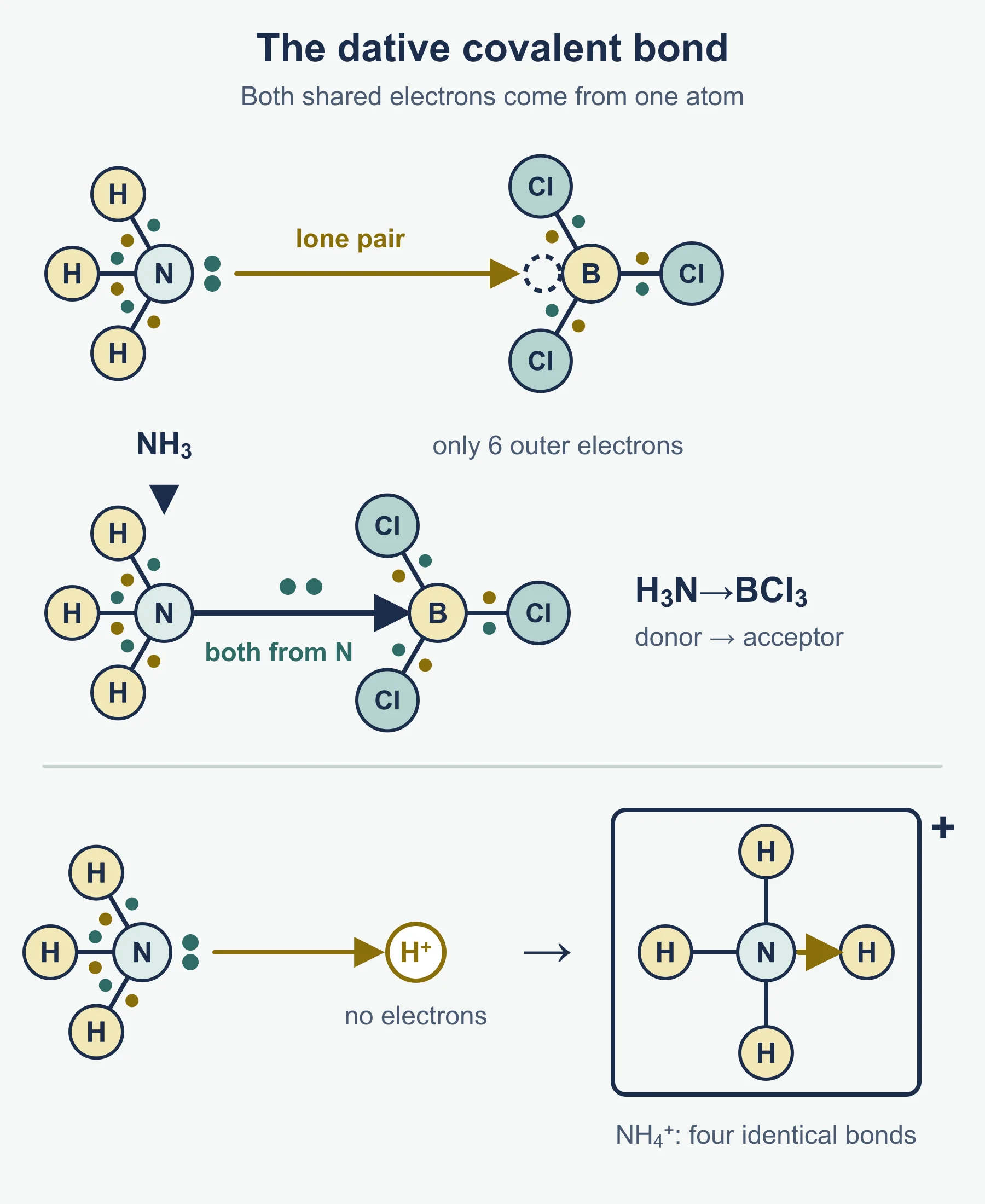
- A co-ordinate (dative covalent) bond is a shared pair where both electrons come from one atom. Draw an arrow from the donor to the acceptor.
The donor needs a lone pair. The acceptor needs an empty orbital or a gap in its outer shell. Once formed, a dative bond cannot be told apart from the other covalent bonds in the species.
| Species | Donor | Acceptor |
|---|---|---|
| NH₄⁺ from NH₃ | N of NH₃ | H⁺ |
| H₃O⁺ from H₂O | O of H₂O | H⁺ |
| H₃N→BF₃ | N of NH₃ | B of BF₃ |
3.1.3.3 Metallic bonding
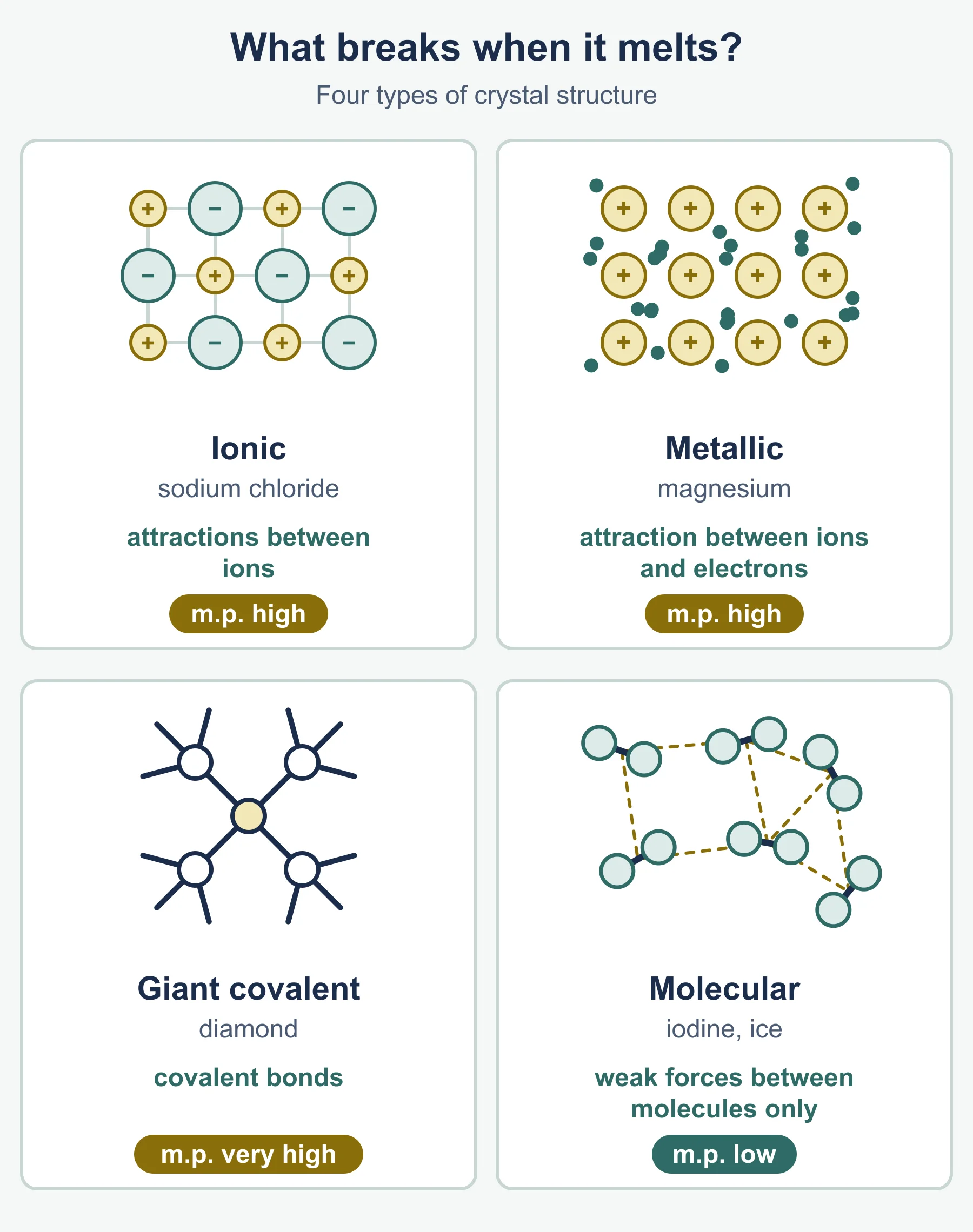
In a metal, positive ions sit in a regular lattice among delocalised electrons that move freely. The bonding is the attraction between the ions and those electrons. The attraction grows when the ions carry a bigger charge, each atom releases more electrons and the ions are smaller in size. This is why magnesium (2+, two electrons each) melts at a much higher temperature than sodium (1+, one electron each).
3.1.3.4 Bonding and physical properties
| Type | Example | Particles | Melting point | Conducts? |
|---|---|---|---|---|
| Ionic | Sodium chloride | Ions | High | Not as a solid. Yes if molten or dissolved (ions move) |
| Metallic | Magnesium | Positive ions, delocalised electrons | Generally high | Yes, solid and liquid (electrons move) |
| Macromolecular | Diamond | Atoms, 4 bonds each | Very high | No (no free charge carriers) |
| Macromolecular | Graphite | Atoms, 3 bonds each, layers | Very high | Yes, along the layers (delocalised electrons) |
| Molecular | Iodine, ice | Small molecules | Low | No |
Energy changes of state. Melting, boiling and sublimation need energy (endothermic) because particles are pulled apart against attraction. Freezing, condensing and deposition release energy (exothermic). Always name what is overcome:
- ionic solid: ionic bonds between ions
- metal: attraction between ions and delocalised electrons
- giant covalent solid: covalent bonds between atoms
- molecular solid: only the intermolecular forces. The covalent bonds inside each molecule stay intact.
Diagrams with specified numbers of particles. Sodium chloride, a layer of nine ions (alternating, five of one ion and four of the other):
Na+ Cl- Na+
Cl- Na+ Cl-
Na+ Cl- Na+
Magnesium, six ions with electrons between them:
 Mg2+  e-  Mg2+  e-  Mg2+
   e-  Mg2+  e-  Mg2+  e-
For iodine, draw separate I₂ molecules (each a line joining two atoms) in a regular pattern, and label the forces between them as weak. For ice, draw each H₂O molecule with its two hydrogen atoms and show dotted hydrogen bonds to the neighbours. For graphite, draw layers of hexagons with three bonds per carbon and weak forces between layers.
3.1.3.5 Shapes of simple molecules and ions
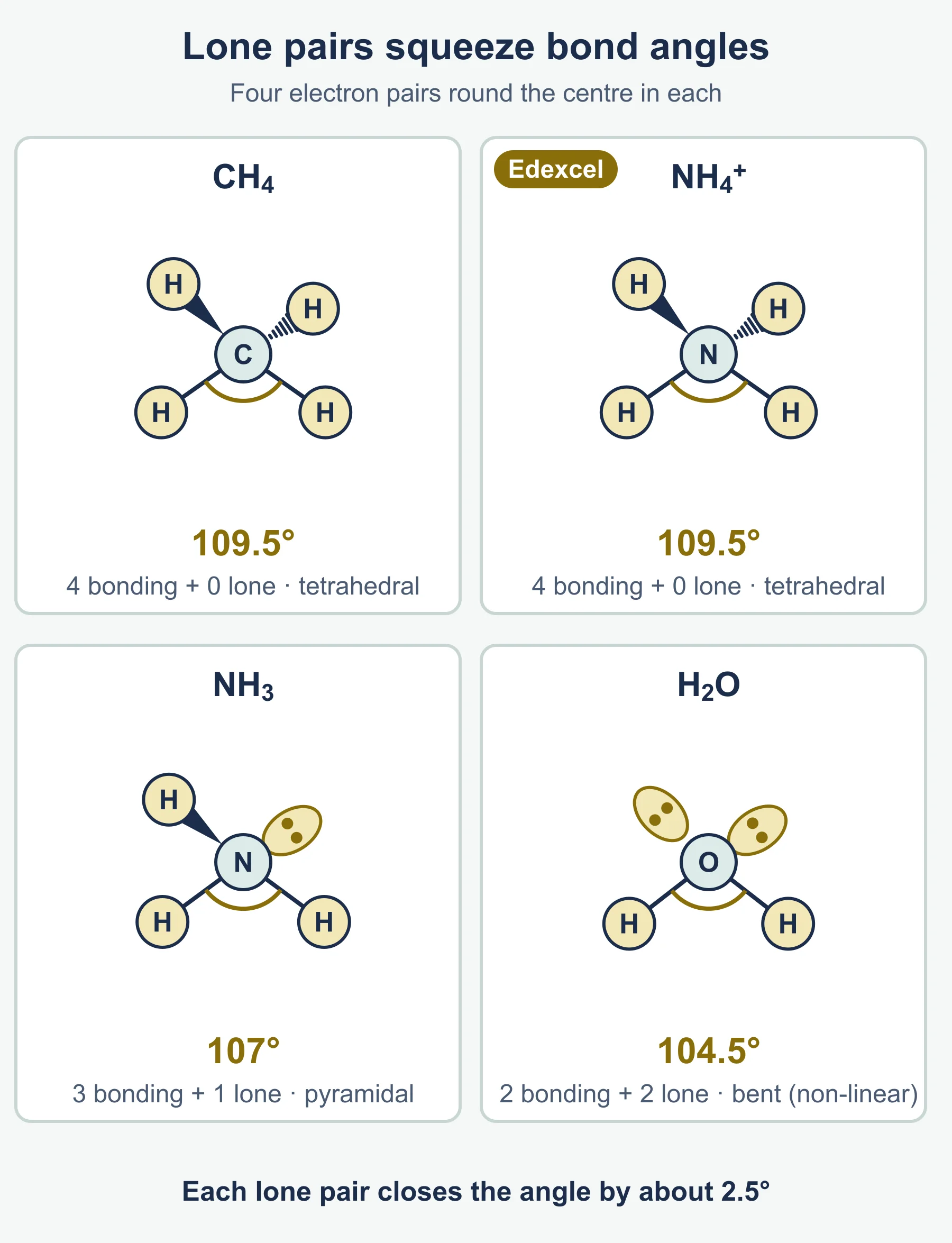
Rule. Bonding pairs and lone pairs are charge clouds that repel and sit as far apart as possible. Lone pair–lone pair > lone pair–bond pair > bond pair–bond pair in repulsion strength, so each lone pair squeezes the bond angles.
Method
- Central atom’s outer electrons, plus one per bonded monovalent atom, minus the charge (add for a negative ion).
- Divide by two for the total electron pairs.
- Subtract bonding pairs to find lone pairs.
- Name the shape from the table.
| Example | Shape | Pairs around centre | Angle |
|---|---|---|---|
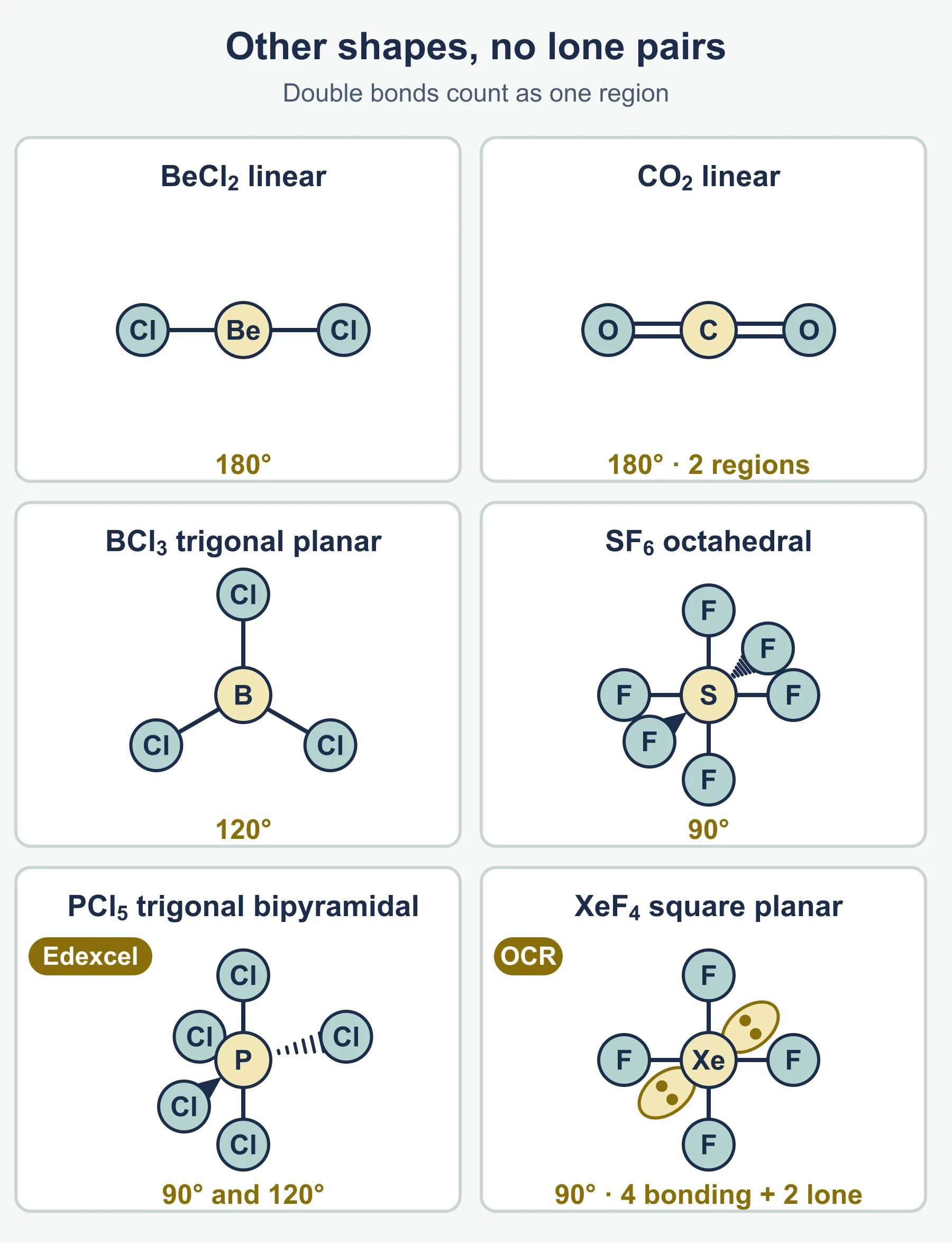
| BeCl₂ | Linear | 2 bonding, 0 lone | 180° |
| BF₃ | Trigonal planar | 3 bonding, 0 lone | 120° |
| SO₂ | Bent | 2 bonding, 1 lone | below 120° |
| NH₄⁺, SO₄²⁻ | Tetrahedral | 4 bonding, 0 lone | 109.5° |
| NH₃ | Pyramidal | 3 bonding, 1 lone | about 107° |
| H₂O | Bent | 2 bonding, 2 lone | about 104.5° |
| PCl₅ | Trigonal bipyramidal | 5 bonding, 0 lone | 90° and 120° |
| SF₄ | See-saw | 4 bonding, 1 lone | below 90° and 120° |
| ClF₃ | T-shaped | 3 bonding, 2 lone | below 90° |
| XeF₂ | Linear | 2 bonding, 3 lone | 180° |
| SF₆ | Octahedral | 6 bonding, 0 lone | 90° |
| BrF₅ | Square pyramidal | 5 bonding, 1 lone | below 90° |
| ICl₄⁻, XeF₄ | Square planar | 4 bonding, 2 lone | 90° |
In trigonal bipyramids the lone pairs take the equatorial positions, where they have fewer close neighbours at 90°. With two lone pairs in an octahedral arrangement they sit opposite each other, 180° apart.
Worked reminder: ICl₄⁻ has 7 + 4 + 1 = 12 electrons, so 6 pairs, 4 bonding and 2 lone. The shape is square planar.
3.1.3.6 Bond polarity
Electronegativity is how strongly an atom pulls the shared pair of a covalent bond towards itself. If the two atoms differ, the electron density is unsymmetrical and the bond is polar. Mark the more electronegative atom δ− and the other δ+, for example P^δ+–Cl^δ−.
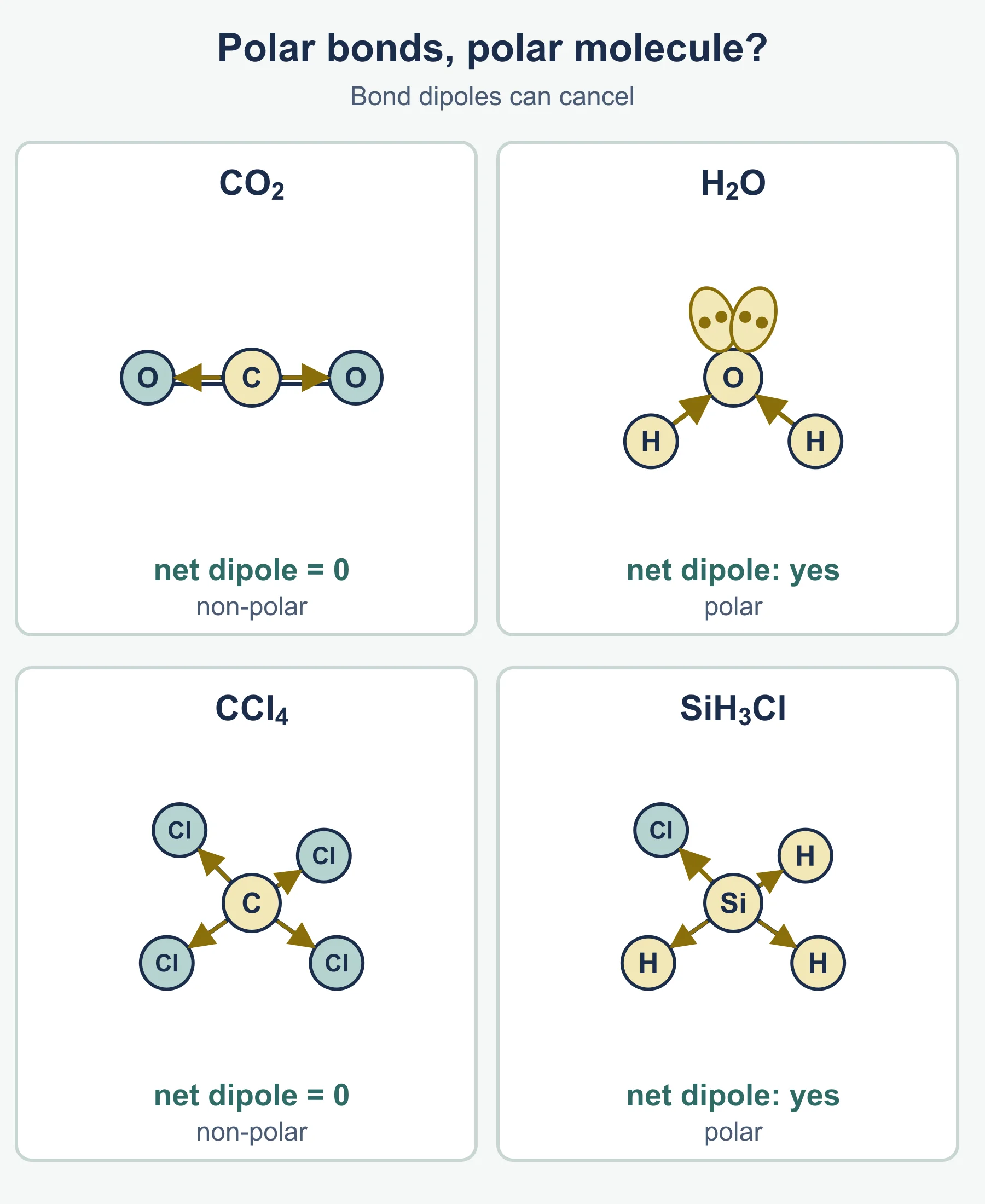
A molecule has a permanent dipole only if the bond dipoles do not cancel. Polar bonds that are identical and arranged symmetrically cancel, so the molecule has no overall dipole.
| Molecule | Shape | Polar bonds? | Permanent dipole? |
|---|---|---|---|
| SO₃ | Trigonal planar | Yes | No (cancel) |
| SF₆ | Octahedral | Yes | No (cancel) |
| PCl₃ | Pyramidal | Yes | Yes |
| CH₂Cl₂ | Tetrahedral, unlike atoms | Yes | Yes (do not cancel) |
3.1.3.7 Forces between molecules
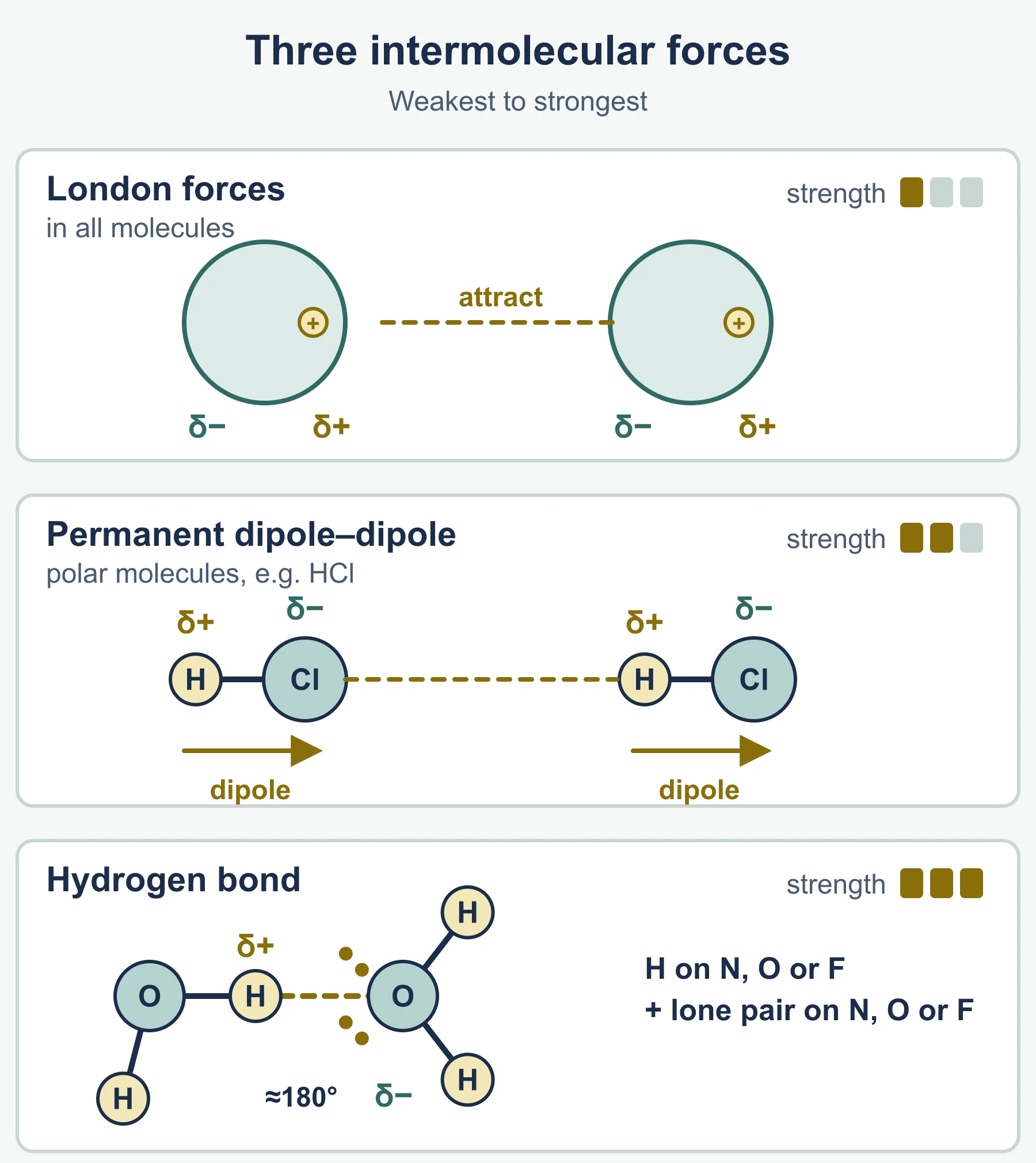
| Force | Where it acts | Cause |
|---|---|---|
| Induced dipole–dipole (van der Waals, dispersion, London) | Between all molecules | Electron movement creates a temporary dipole that induces one in a neighbour |
| Permanent dipole–dipole | Between polar molecules | Attraction of δ+ to δ− |
| Hydrogen bonding | H on N, O or F, attracted to a lone pair on N, O or F of another molecule | Very polar X–H plus a lone pair |
Induced forces grow with more electrons and a larger surface area of contact. For example, straight-chain pentane (about 36 °C) boils higher than its branched isomer 2,2-dimethylpropane (about 10 °C) because the chain touches neighbours along more of its length.
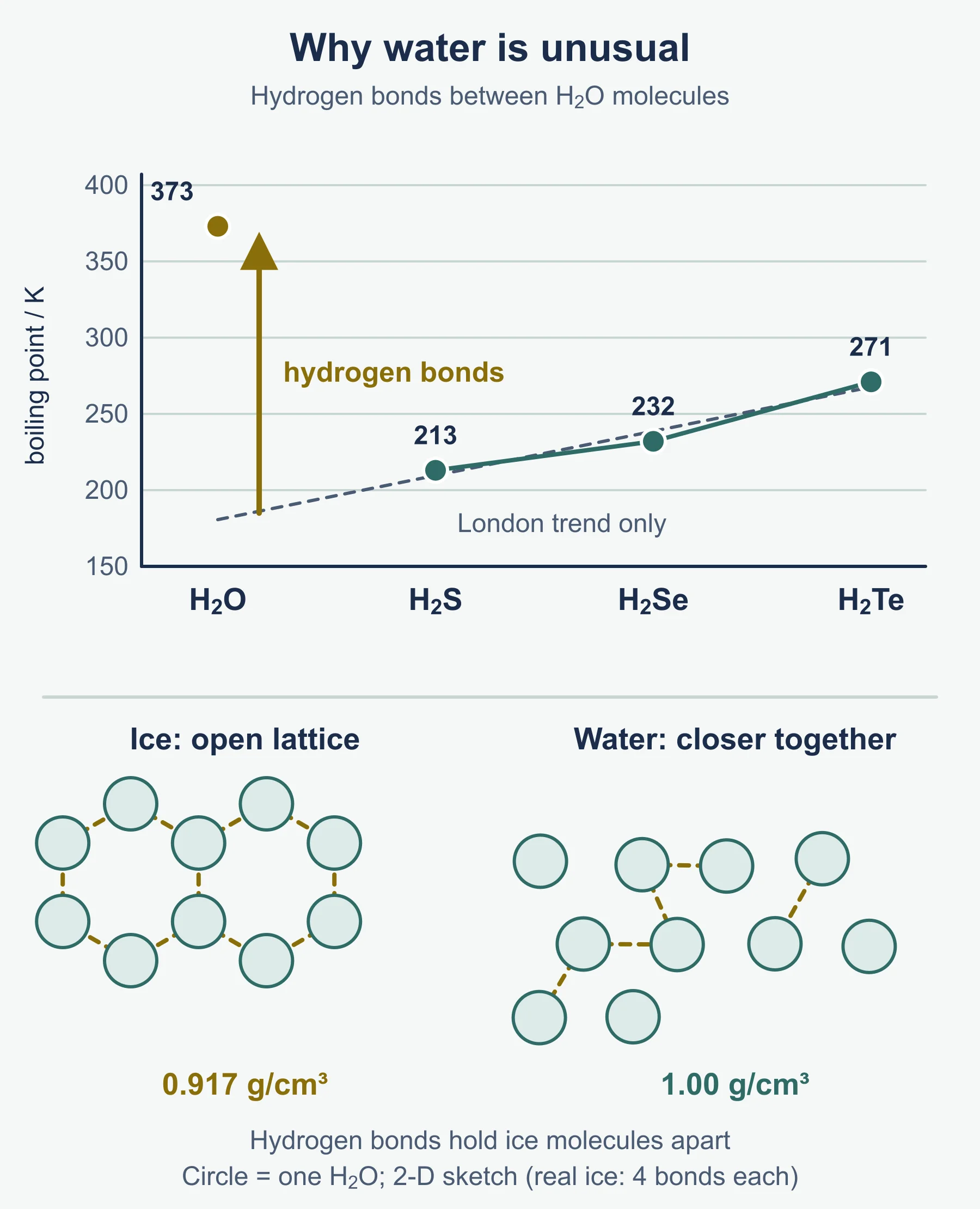
Hydrogen bonding explains:
- anomalous boiling points: water, ammonia and hydrogen fluoride boil higher than the trend from their Group neighbours predicts
- low density of ice: each molecule is held by four hydrogen bonds in an open lattice, so the molecules sit further apart than in liquid water.
Melting and boiling points of molecular substances depend on the strength of these forces, not on covalent bond strength.
Quick self-test
- Write the formula of potassium carbonate.
- What charge does a Group 5 element’s simple ion carry?
- How many electrons are shared in the C≡C bond of ethyne?
- In H₃N→BF₃, which atom supplies both electrons in the arrow bond?
- State the shape of, and bond angle in, the sulfate ion SO₄²⁻.
- Give the shape of SF₄ and say how many lone pairs it has.
- Explain why solid magnesium conducts electricity.
- What is overcome when solid iodine sublimes?
- CH₂Cl₂ has a permanent dipole but CCl₄ does not. Explain why.
- Chlorine boils at about −34 °C and bromine at about 59 °C. Explain the difference.
Answers
- K₂CO₃.
- 3−.
- Six (three shared pairs).
- The nitrogen of NH₃, using its lone pair.
- Tetrahedral, 109.5° (four bonding pairs, no lone pairs).
- See-saw, one lone pair (6 + 4 = 10 electrons, 5 pairs, 4 bonding).
- Delocalised electrons are free to move through the lattice and carry charge.
- The weak induced dipole–dipole forces between I₂ molecules. The I–I covalent bonds stay.
- In CH₂Cl₂ the two polar C–Cl bonds are not balanced by two C–H bonds of different polarity, so the dipoles do not cancel. In CCl₄ four identical polar bonds point symmetrically and cancel.
- Bromine molecules have more electrons, so the induced dipole–dipole forces are stronger and need more energy to overcome.
Where marks are usually lost
- Writing “bonds” when the question is about a molecular substance: the answer needs intermolecular forces.
- Saying ionic compounds “conduct when dissolved” without saying that the ions are free to move.
- Drawing an arrow for a dative bond the wrong way round, or a line instead of an arrow.
- Forgetting the extra electron for a negative ion when counting pairs.
- Giving a bond angle without saying the lone pairs cause the reduction.
- Calling a molecule non-polar because it has non-polar bonds, rather than because the dipoles cancel.
- Writing “hydrogen bonds” for any molecule containing hydrogen, without the N, O or F link.
- Saying graphite conducts without adding that the delocalised electrons move along the layers.
Frequently asked questions
What is a co-ordinate (dative covalent) bond? A co-ordinate bond is a shared pair of electrons in which both electrons come from one atom. The donor needs a lone pair and the acceptor needs an empty orbital; draw it as an arrow from the donor to the acceptor.
Why is ice less dense than liquid water? In ice, each water molecule is held by four hydrogen bonds in an open lattice, so the molecules sit further apart than in liquid water.
Why does pentane boil higher than 2,2-dimethylpropane? Both have the same number of electrons, but straight-chain pentane has a larger surface area of contact with its neighbours, so its induced dipole–dipole forces are stronger than those of the branched isomer.
What is broken when a molecular substance melts or boils? Only the intermolecular forces between molecules are overcome; the covalent bonds inside each molecule stay intact. Writing “bonds break” for a molecular substance is a common way to lose marks.
Official syllabus
OxfordAQA, International AS and A-level Chemistry (9620) specification, Version 5.3, for International AS and A-level exams May/June 2020 onwards, section 3.1.3 Bonding (3.1.3.1 to 3.1.3.7), published by OxfordAQA.
Get free revision emails (optional)
Occasional emails with practice questions, worked explanations and links to free resources for the qualification and subjects you choose. No spam, and you can unsubscribe from any email. The free tools on this site never need an email.
Related resources
-
Practice questions
OxfordAQA A-Level Chemistry: Bonding (9620) – Practice Questions
Original OxfordAQA 9620 bonding questions with worked answers: formulae, dative bonds, structures, shapes, polarity and intermolecular forces.
Chemistry · OxfordAQA · AS Level
Try questions -
Study guides
OxfordAQA A-Level Chemistry: Thermodynamics (9620)
Study guide for OxfordAQA International A-level Chemistry 9620 section 3.1.8: Born–Haber cycles, hydration, entropy and ΔG = ΔH – TΔS.
Chemistry · OxfordAQA · A Level
Read guide -
Practice questions
OxfordAQA A-Level Chemistry: Thermodynamics (9620) – Practice Questions
Original OxfordAQA 9620 Thermodynamics practice questions with marked answers: Born–Haber and solution cycles, ionic model, ΔS and ΔG.
Chemistry · OxfordAQA · A Level
Try questions
Related articles
-
study skills
How to revise for a science examination
Most science revision fails because it rereads notes instead of retrieving them. A practical method for revising physics, chemistry and biology in the weeks before a paper.
14 July 2026
-
teaching
A Level tuition in Dubai: Cambridge or Pearson Edexcel International A Level?
Schools in Dubai and Abu Dhabi teach either Cambridge International AS & A Level or Pearson Edexcel International A Level. How the two are structured, why it matters for tuition, and how online classes from Lahore work.
9 October 2026
Studying this with a teacher
Working through Chemistry AS LEVEL?
This page is free and stays free. If you would rather be taught it, Marlbridge runs Chemistry classes one-to-one and in small groups of up to 15, online in your own time zone. The first trial class is free. WhatsApp replies within an hour (8am–11pm Pakistan time, every day); email the same day.
OxfordAQA Chemistry teachers at Marlbridge

