
Revision Notes
OxfordAQA International AS and A-level English Language (9670): Section B: Language and Social Groups – Writing – Revision Notes
Recall notes for OxfordAQA 9670 Unit 2 Section B: thesis, evidence and counter-argument, academic register, citing studies and using Section A data well.
- Subject
- English
- Level
- AS LEVEL
- Topic
- Unit 2 – Language and Society
- Author
- Marlbridge Academic Team
- Updated
- Reviewed by
- Ammar Bilal (what this means)
Aligned to OxfordAQA A Level English (9670), Version 5.2, for International AS exams from May/June 2018, A-level from May/June 2019. Official specification .
Syllabus page (what it covers and how it is assessed): OxfordAQA A Level English Language.
Found an error? Report a correction.
Need help with this topic? Request a free trial class for A Level English Language (9670).
Condensed recall for specification section 3.2.2 of OxfordAQA International AS and A-level English Language (9670). For explanations, a full plan and a model paragraph, use the Language and Social Groups – Writing study guide.
The task in brief
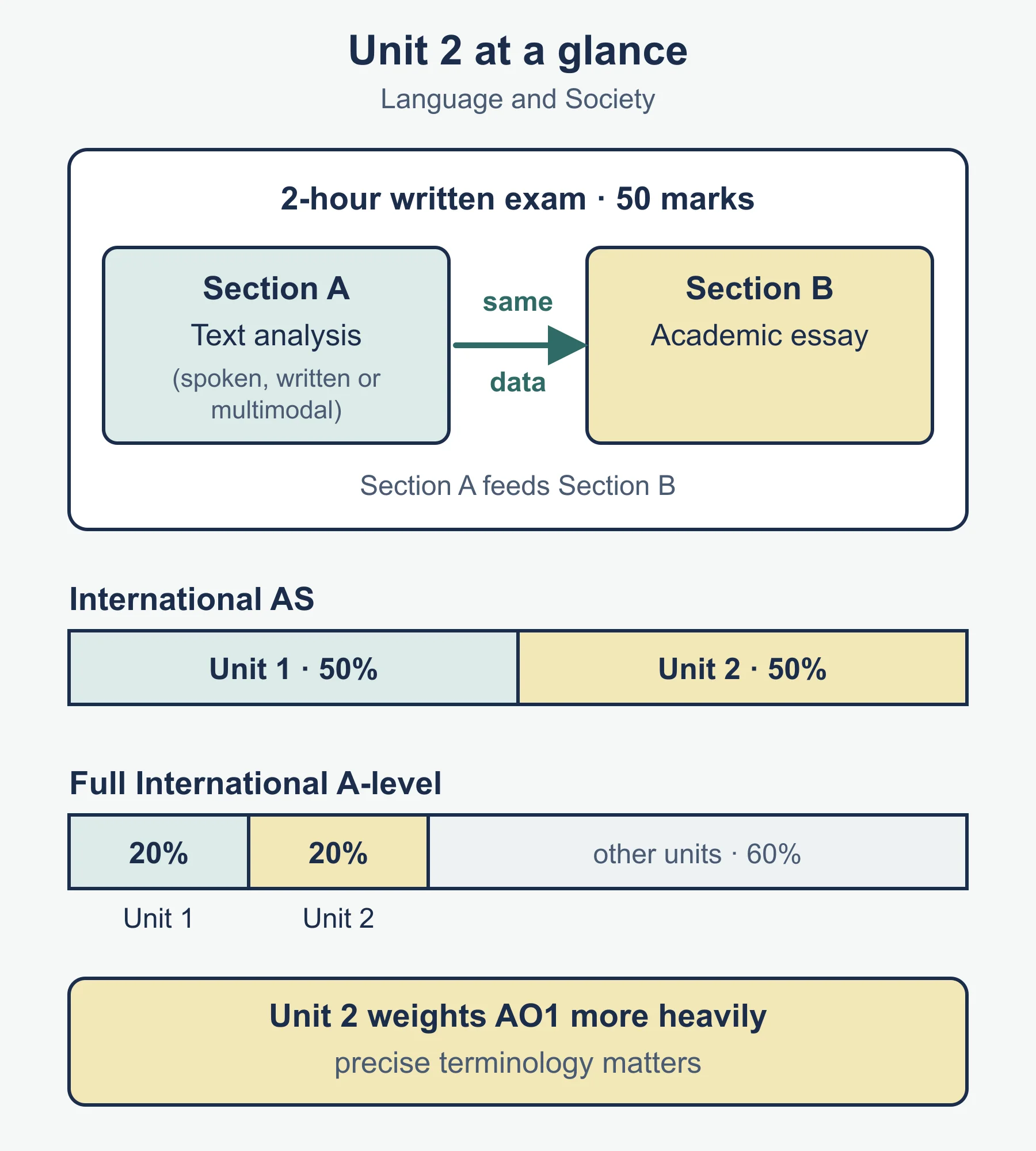
- One compulsory writing task, 25 of Unit 2’s 50 marks.
- Focus: the skills of academic argument in written language.
- The essay discusses an aspect of language and social group behaviour that connects with the Section A data.
- Unit 2 weights AO1 most heavily, then AO2, then AO3: concepts and terminology, data analysis, controlled writing.
- Read the Section B question before writing Section A.
Academic argument: the components
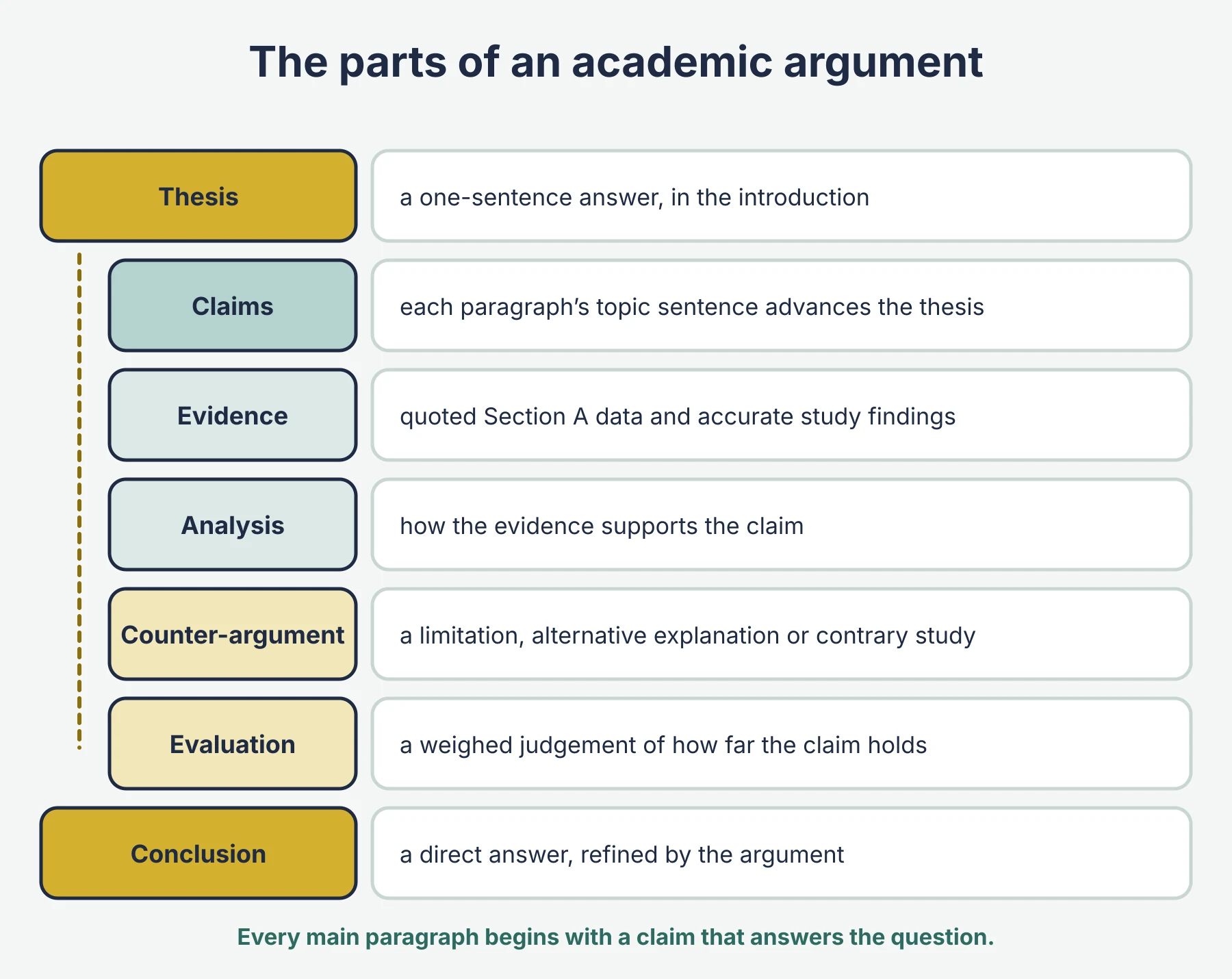
- Thesis: a one-sentence answer, in the introduction.
- Claims: topic sentences that each advance the thesis.
- Evidence: quoted Section A data and accurate research findings.
- Analysis: how the evidence supports the claim.
- Counter-argument: limitation, alternative explanation, contrary study.
- Evaluation: how far the claim holds.
- Conclusion: a refined, direct answer.
Not academic argument
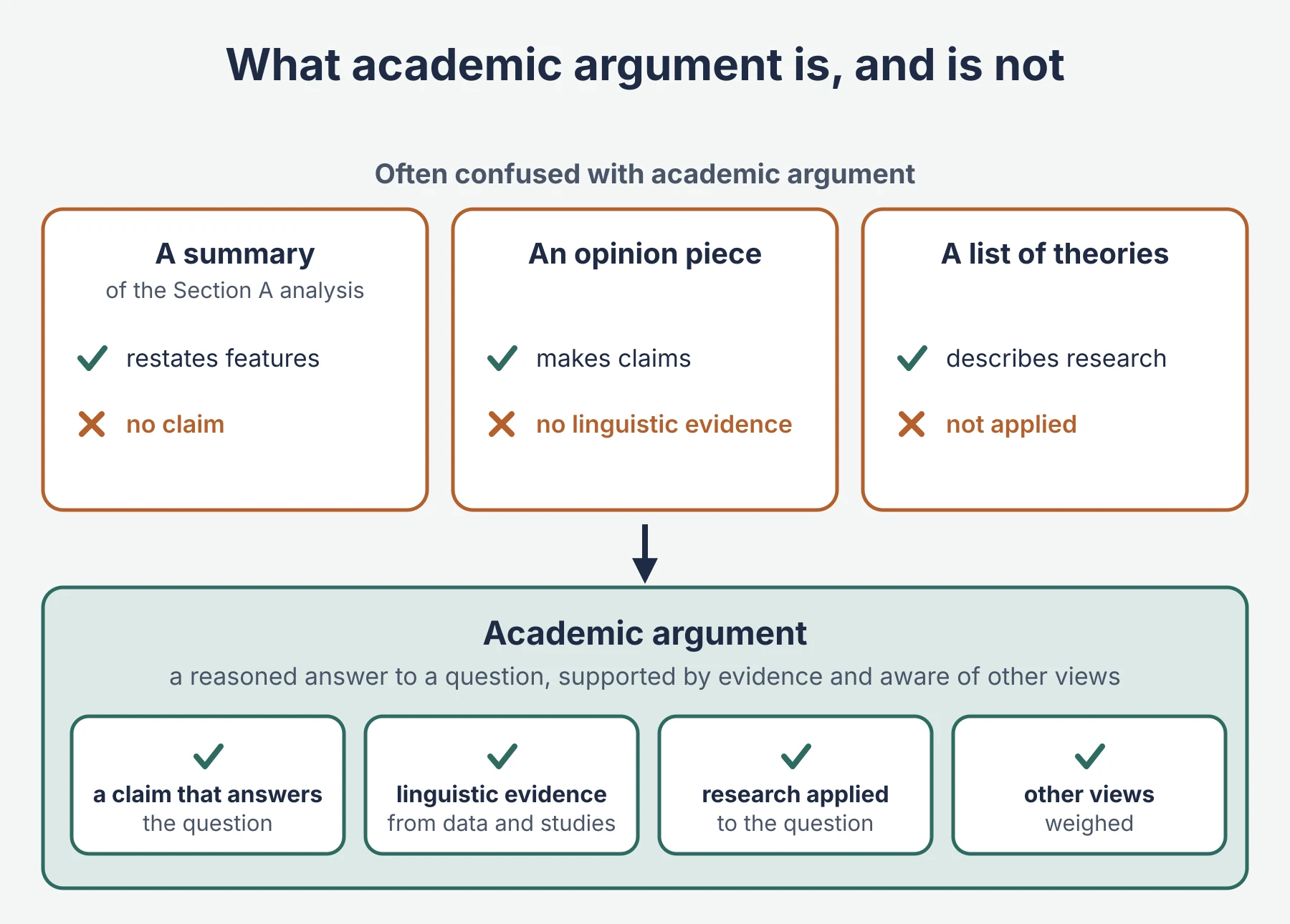
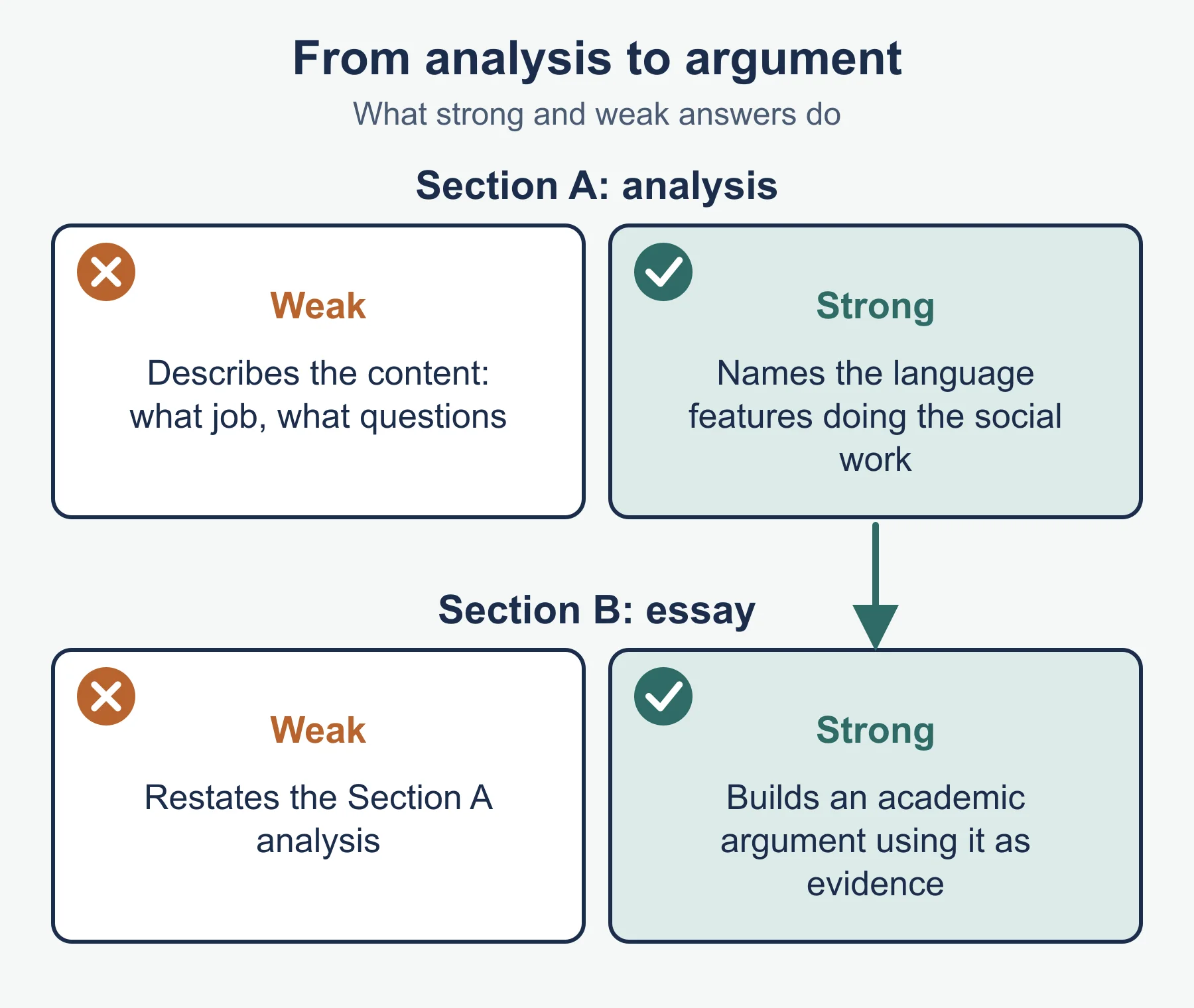
- A summary of the Section A analysis.
- An opinion piece without linguistic evidence.
- A list of theories not applied to the question.
Paragraph template
Claim (answers the question) → data (short quotation, named feature) → concept or study → analysis → qualification (hedge or counter-point) → link to thesis.
Academic register toolkit
| Need | Language |
|---|---|
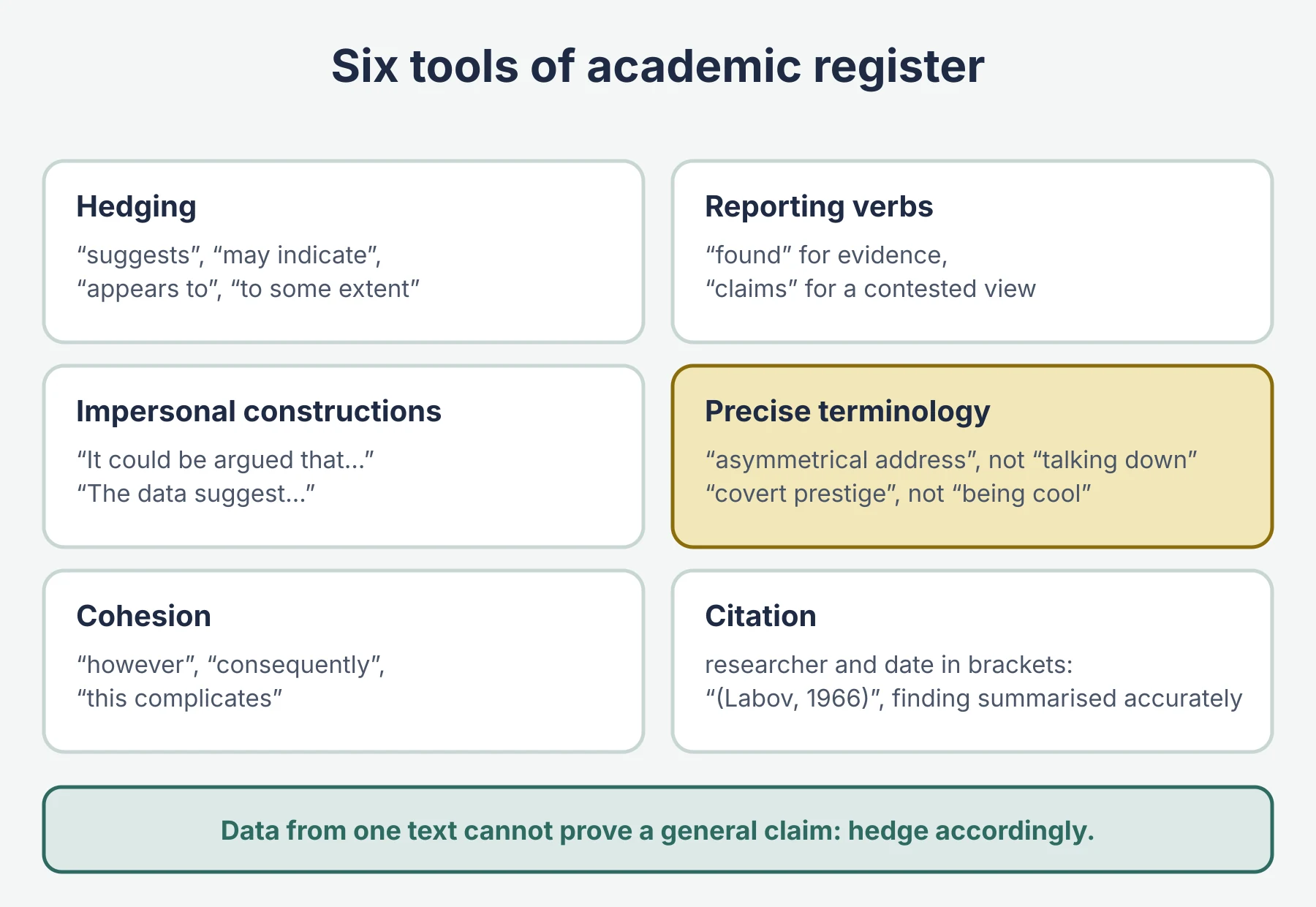
| Hedge | suggests, may indicate, appears to, to some extent, tends to |
| Report a finding | found, showed, observed, recorded |
| Report a contested view | claims, argues, proposes, asserts |
| Contrast | however, by contrast, whereas, nevertheless |
| Consequence | therefore, consequently, as a result |
| Concession | although, admittedly, while it is true that |
| Evaluation | this complicates, this only partly supports, this challenges |
Use precise terms: asymmetrical address, covert prestige, convergence, positive face, in-group lexis.
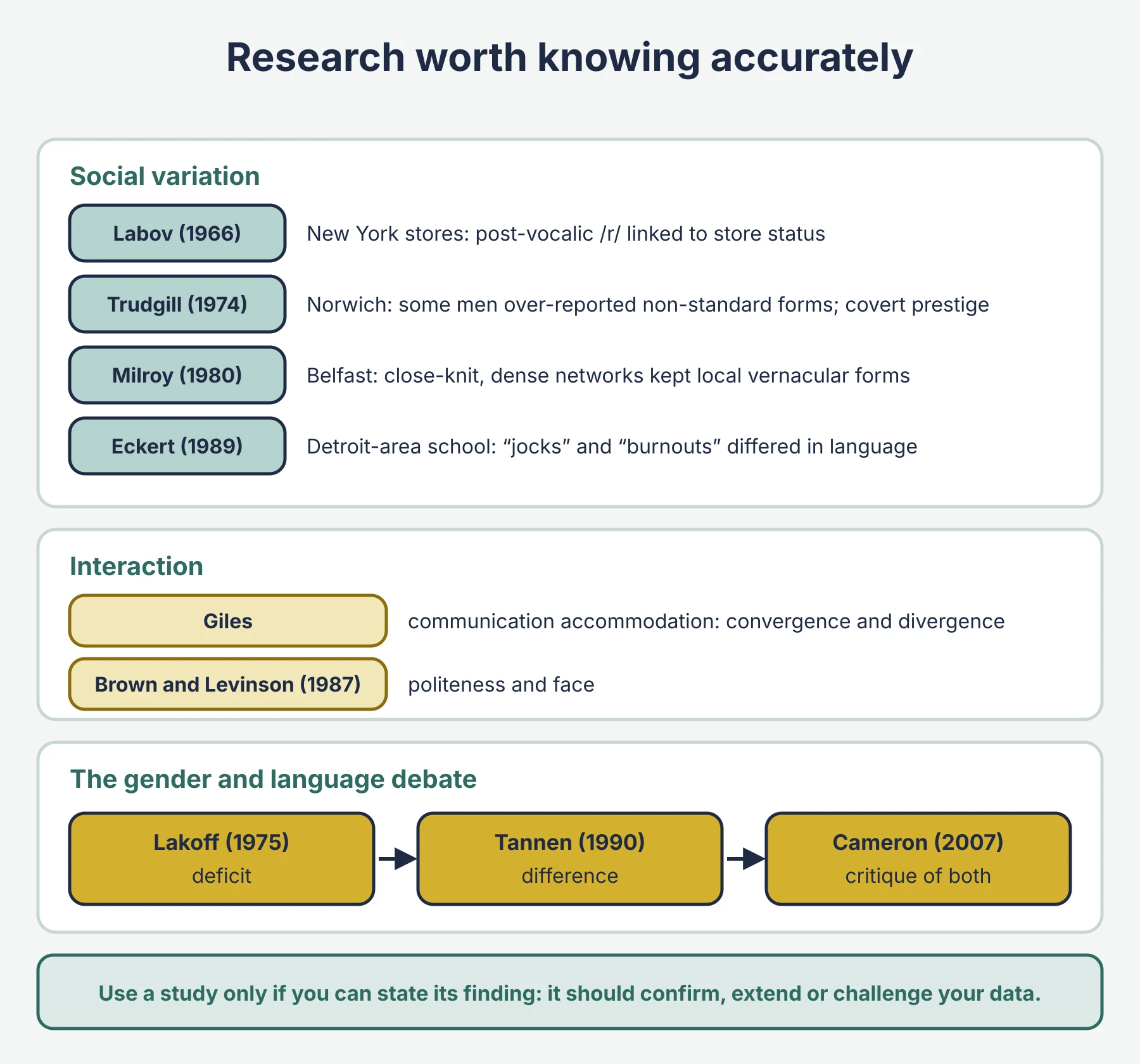
Studies to cite accurately
| Study | Finding to state |
|---|---|
| Labov (1966), New York | Post-vocalic /r/ linked to the status of the department store |
| Trudgill (1974), Norwich | Some men over-reported non-standard forms: covert prestige |
| Milroy (1980), Belfast | Dense, close-knit networks maintained vernacular forms |
| Eckert (1989), Detroit-area high school | “Jocks” and “burnouts” marked group identity through variation |
| Giles | Convergence and divergence in accommodation theory |
| Brown and Levinson (1987) | Positive and negative face; politeness strategies |
| Lakoff (1975) / Tannen (1990) / Cameron (2007) | Deficit, difference, and critique of gendered-language claims |
| Wareing | Instrumental and influential power |
Only cite what you can state correctly. A misremembered study weakens AO1.
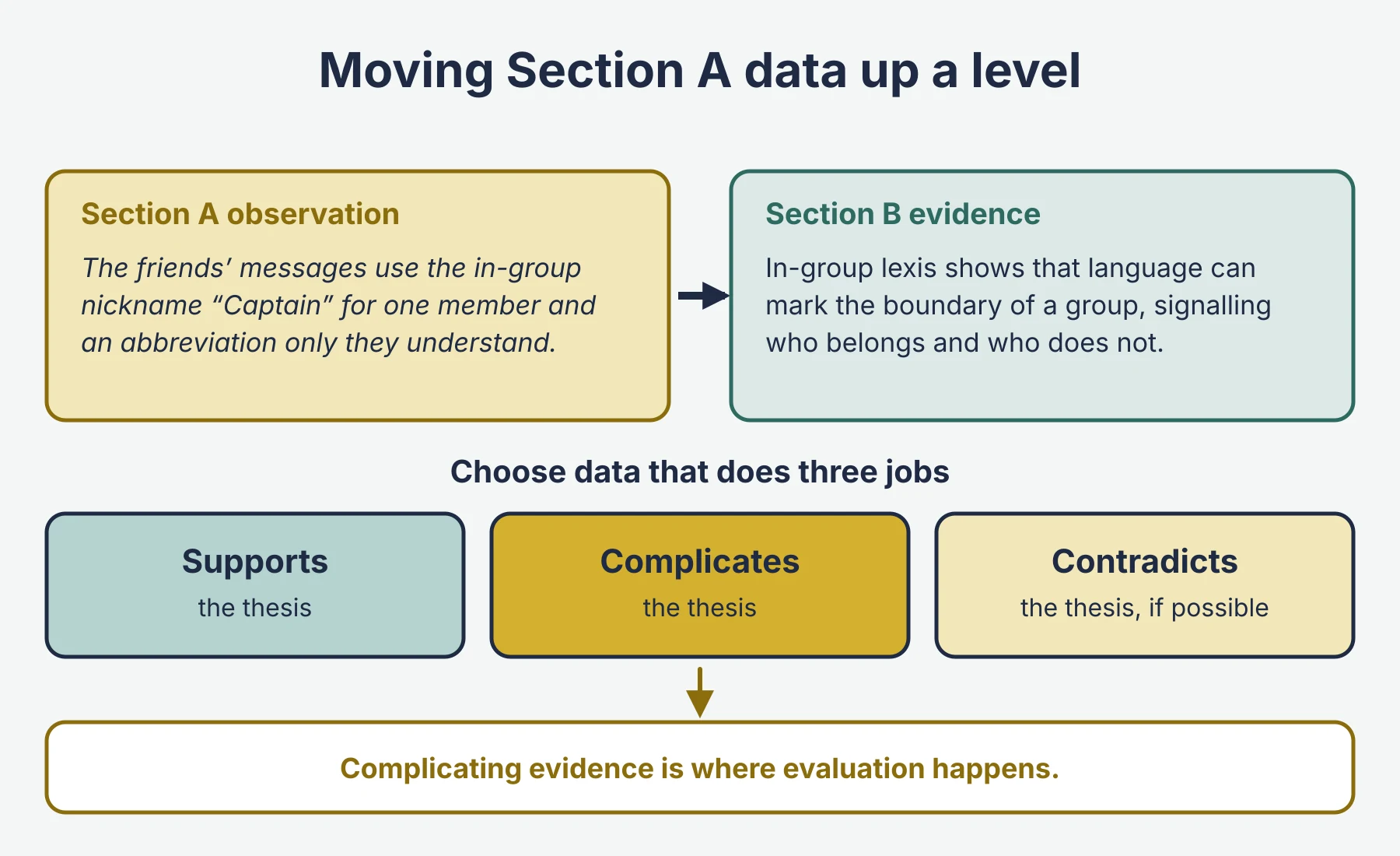
Turning Section A observations into evidence
- Observation: a feature in the text (“the coach signs off ‘Regards, Mr Patel’”).
- Evidence: what it shows about social group behaviour (“formal sign-off maintains role distance within a group that otherwise uses first names”).
- Select data that supports, complicates and contradicts the thesis.
Handling the question’s key word
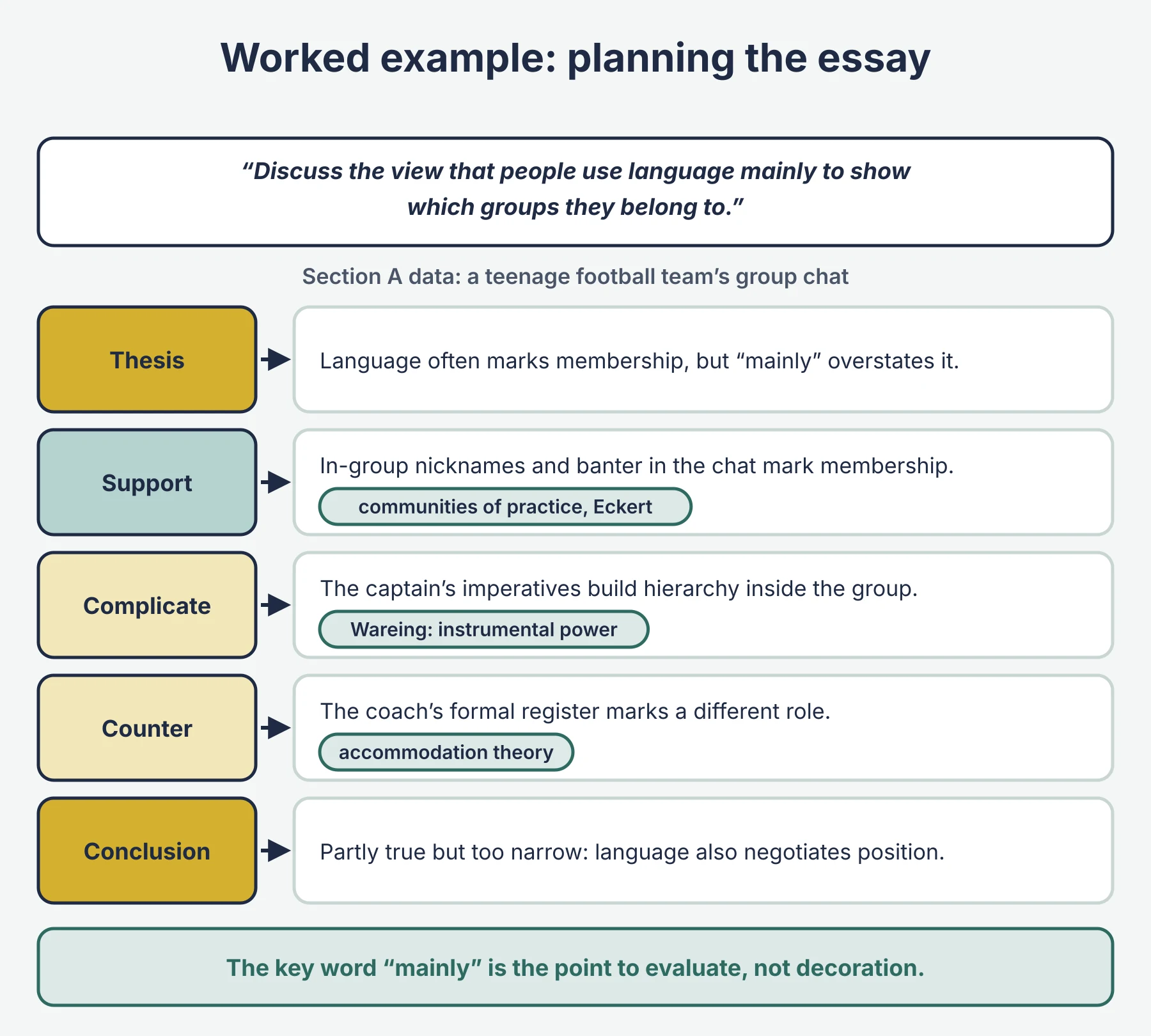
Words like mainly, always, only, entirely, simply are the evaluation point. Plan to test them: “mainly” invites you to show other functions; “always” invites a counter-example.
Introductions and conclusions
Introduction (three moves): define the key term in the question; state the thesis; signal the route.
Group membership is signalled through shared ways of speaking. This essay argues that language often marks belonging, but that the data also show speakers using it to claim status within the group, so the view is only partly persuasive.
Conclusion (three moves): answer the question directly; name the strongest evidence; state the limit of the claim.
Language does mark membership, as the in-group lexis shows; yet the captain’s imperatives reveal hierarchy inside the same group. Belonging is one function among several, not the main one.
Five-minute plan
- Underline the key claim and the qualifying word.
- Write the thesis.
- Note three claims with one piece of Section A data and one concept or study each.
- Note one counter-argument.
- Note the final judgement.
Exam traps
- No thesis; the essay drifts.
- Section A analysis repeated rather than used.
- Research named without findings, or findings invented.
- No counter-argument.
- Informal or vague register.
- The conclusion repeats the introduction.
- The key qualifying word in the question ignored.
Self-test
- What does the specification say Section B focuses on?
- What must the essay connect with?
- How does Section B differ from Unit 1’s Section B?
- What is a thesis, and where should it appear?
- Give three hedging expressions.
- Why choose “claims” rather than “found” for some research?
- What did Milroy’s Belfast study suggest?
- What is the difference between an observation and evidence?
- Why is a counter-argument essential?
- How should you treat the word “mainly” in a question?
- Why read the Section B question before writing Section A?
Answers: 1. The skills of academic argument in written language. 2. The data analysed in Section A. 3. Unit 1’s Section B is directed writing that transforms source material into a new text; Unit 2’s is an academic essay arguing about language and social groups. 4. A one-sentence answer to the question, given in the introduction. 5. Any three: suggests, may indicate, appears to, to some extent, tends to. 6. “Claims” signals that the view is contested, while “found” presents a result as evidence. 7. That speakers in dense, close-knit networks maintained local vernacular forms more. 8. An observation identifies a feature in the text; evidence explains what that feature shows about the question. 9. Evaluation depends on weighing the claim against alternatives; without a counter-argument, there is no judgement. 10. As the point to evaluate: show what else language does besides the function claimed. 11. So that your Section A analysis gathers the evidence your essay needs.
Practise with the Language and Social Groups – Writing practice questions, and see how both sections connect in the Unit 2 revision notes.
Related resources
-
Study guides
OxfordAQA International A-Level English Language: Language and Society (9670)
OxfordAQA International AS English Language 9670 Unit 2 Language and Society: language and social groups, text analysis and academic writing, with the format.
English · OxfordAQA · AS Level
Read guide -
Practice questions
OxfordAQA International A-Level English Language: Language and Society — Practice Questions
Original practice with worked answers on the social functions of language, linking text analysis to argument, and the format of OxfordAQA 9670 Unit 2.
English · OxfordAQA · AS Level
Try questions -
Revision notes
OxfordAQA International A-Level English Language: Language and Society — Revision Notes
Condensed notes on the four social functions of language and on linking analysis to academic argument for OxfordAQA AS English Language 9670 Unit 2.
English · OxfordAQA · AS Level
Revise topic
Get free revision emails (optional)
Occasional emails with practice questions, worked explanations and links to free resources for the qualification and subjects you choose. No spam, and you can unsubscribe from any email. The free tools on this site never need an email.