
Study Guides
OxfordAQA International AS and A-level English Language (9670): Section B: Language and Social Groups – Writing
OxfordAQA 9670 Unit 2 Section B: writing an academic essay on language and social groups, using Section A data and research as evidence, with a model plan.
- Subject
- English
- Level
- AS LEVEL
- Topic
- Unit 2 – Language and Society
- Author
- Marlbridge Academic Team
- Updated
- Reviewed by
- Ammar Bilal (what this means)
Aligned to OxfordAQA A Level English (9670), Version 5.2, for International AS exams from May/June 2018, A-level from May/June 2019. Official specification .
Syllabus page (what it covers and how it is assessed): OxfordAQA A Level English Language.
Found an error? Report a correction.
Need help with this topic? Request a free trial class for A Level English Language (9670).
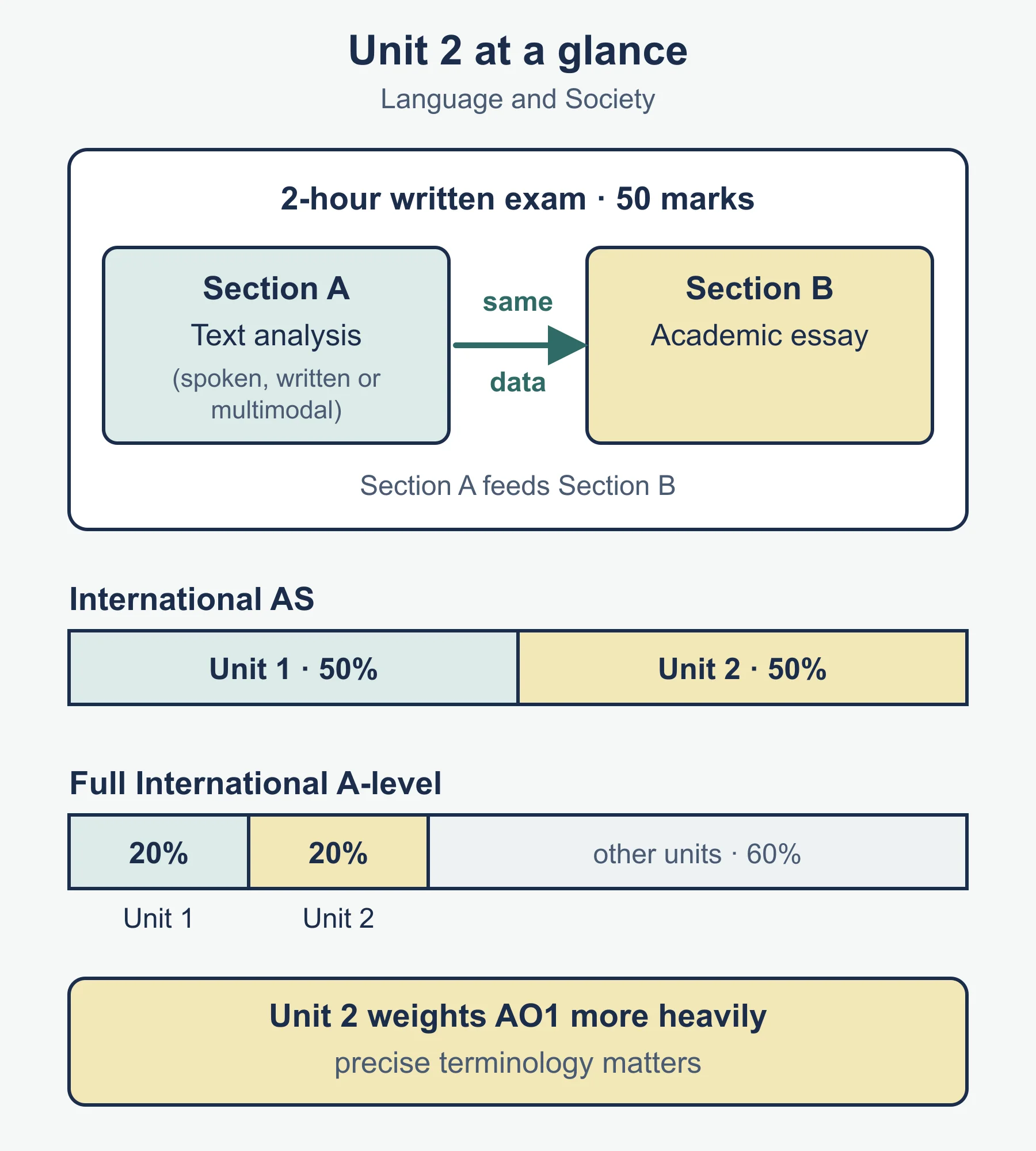
Section B of Unit 2, Language and society, in the OxfordAQA International AS and A-level English Language specification (9670) is specification section 3.2.2 Language and social groups: writing. It is one compulsory writing task, and unlike Unit 1’s directed writing it is not creative or transformational. The specification says it focuses on the skills of academic argument in written language: the essay question asks you to discuss an aspect of language and social group behaviour that connects with the data analysed in Section A. This guide explains what academic argument means here, how to turn Section A observations into evidence, and how to bring in wider research without losing the thread.
What the task involves
Unit 2 is a 2-hour exam worth 50 marks; Section B is worth 25. Across the unit, the specification’s AO1 (understanding of methods, terminology, concepts and issues) carries the largest weighting, followed by AO2 (analysing how meanings are shaped in texts and data) and AO3 (using English in different ways). For this essay that means three things together: accurate concepts and terminology, analysis of data, and controlled academic writing.
Because the essay connects with Section A, the most efficient approach is to read the Section B question before you write Section A, so that your analysis gathers the evidence your essay will need.
What makes writing “academic argument”
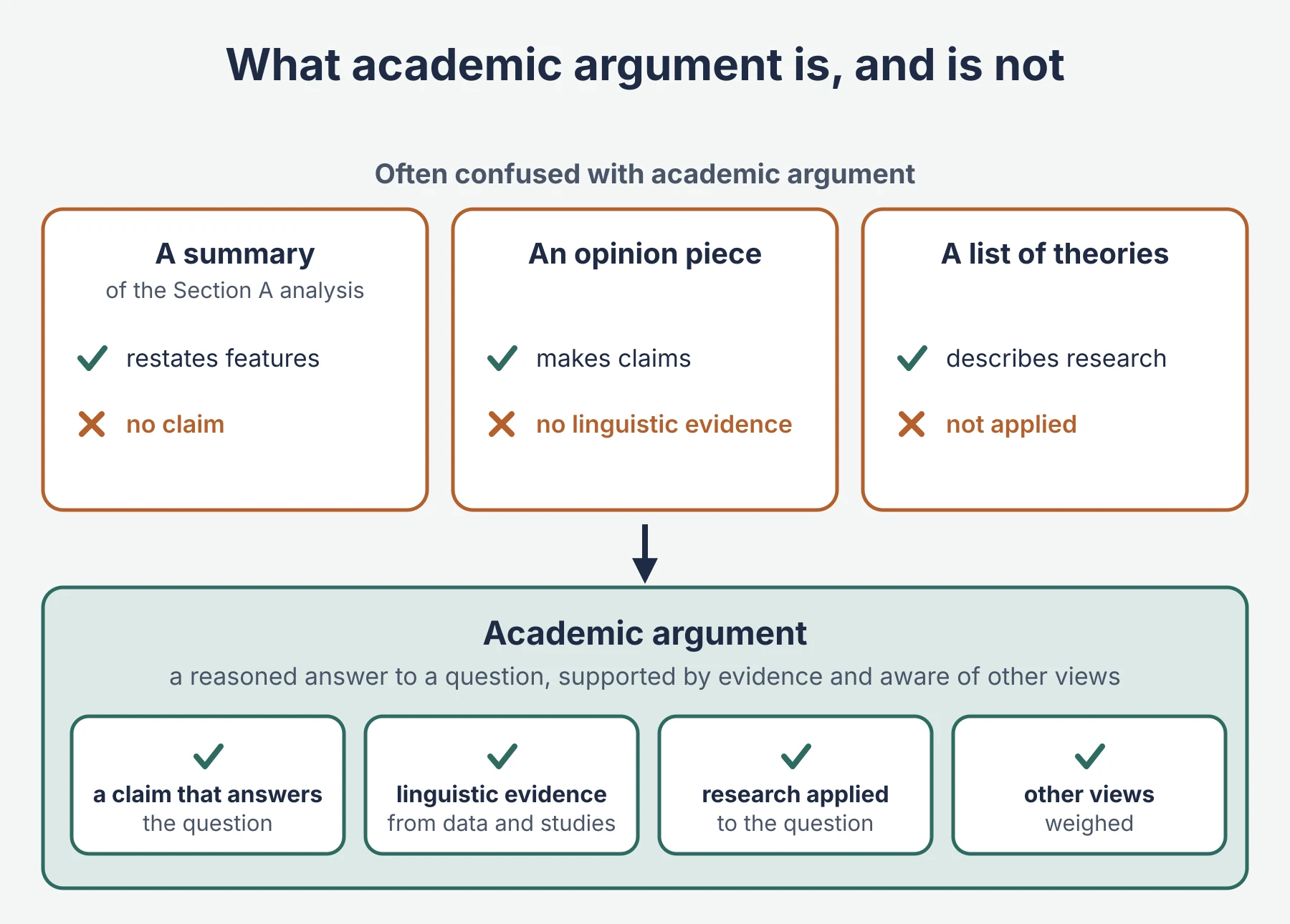
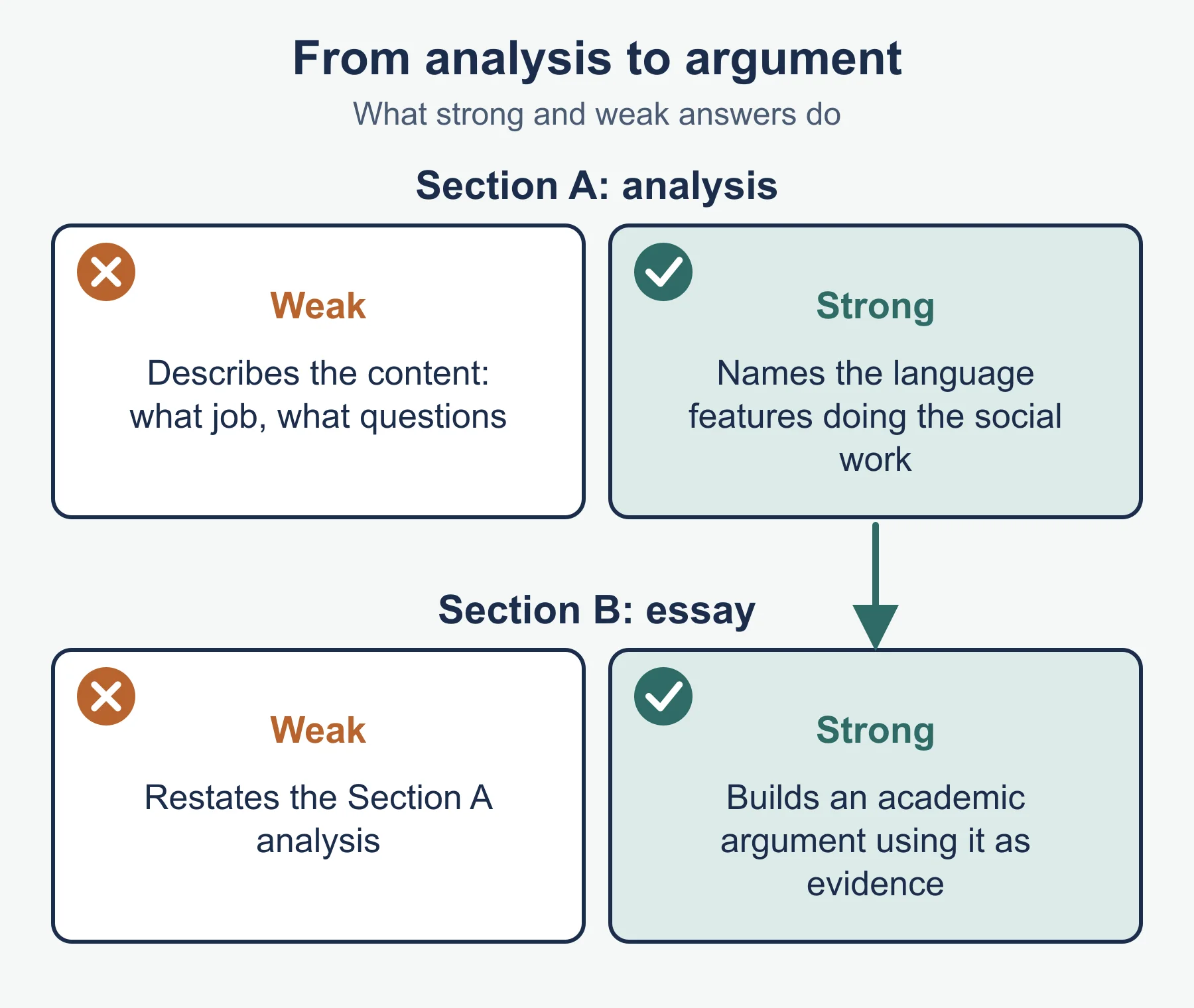
An academic argument is a reasoned answer to a question, supported by evidence and aware of other views. It is different from three things it is often confused with:
- a summary of the Section A analysis (restating features with no claim);
- an opinion piece (claims with no linguistic evidence);
- a list of theories (research described but not applied to the question).
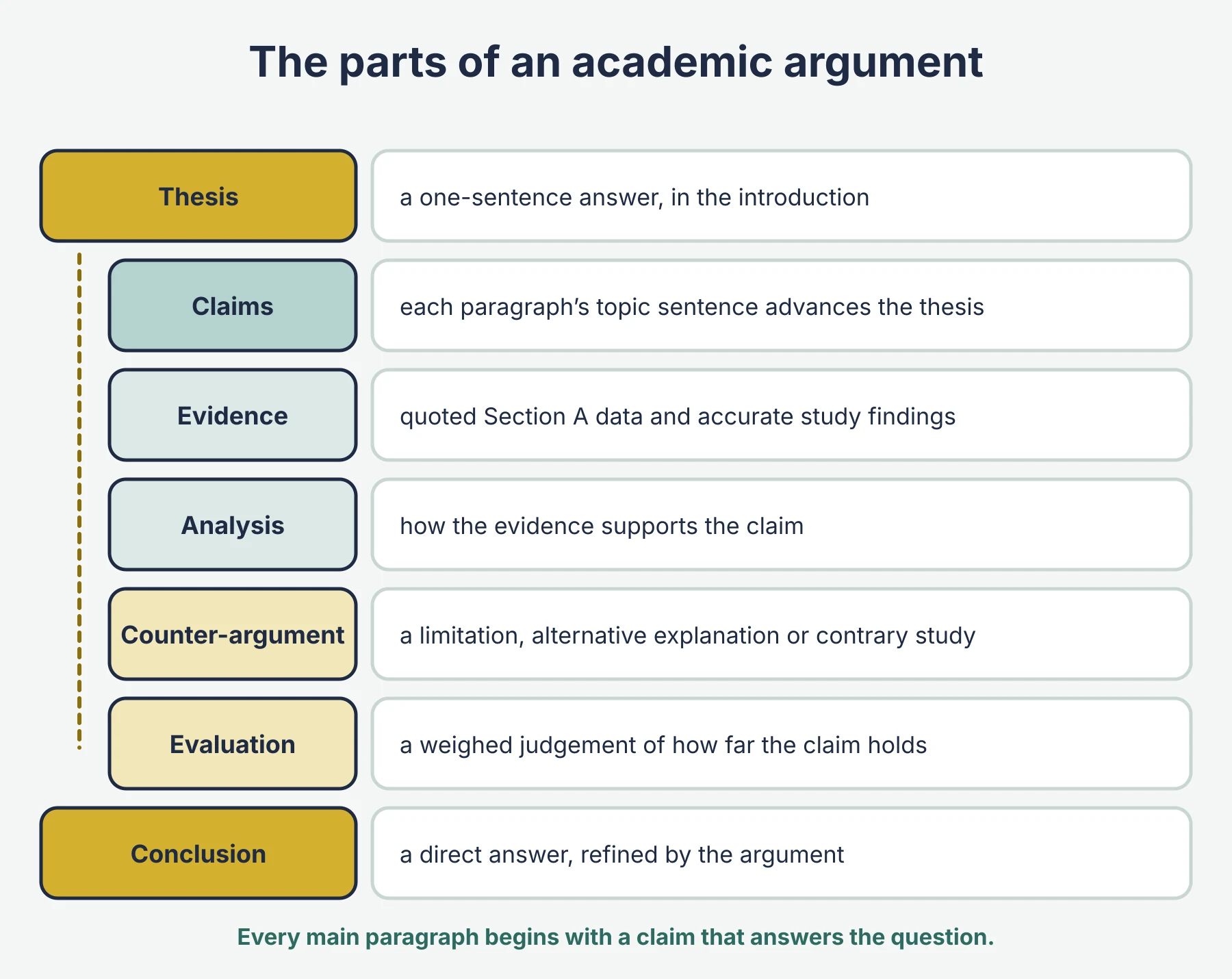
Its components:
| Component | What it looks like |
|---|---|
| Thesis | A one-sentence answer to the question, given in the introduction |
| Claims | Each paragraph’s topic sentence, advancing the thesis |
| Evidence | Quoted data from Section A, and findings from studies you know accurately |
| Analysis | Explanation of how the evidence supports the claim |
| Counter-argument | A limitation, alternative explanation or contrary study |
| Evaluation | A weighed judgement about how far the claim holds |
| Conclusion | A direct answer, refined by the argument |
Academic register
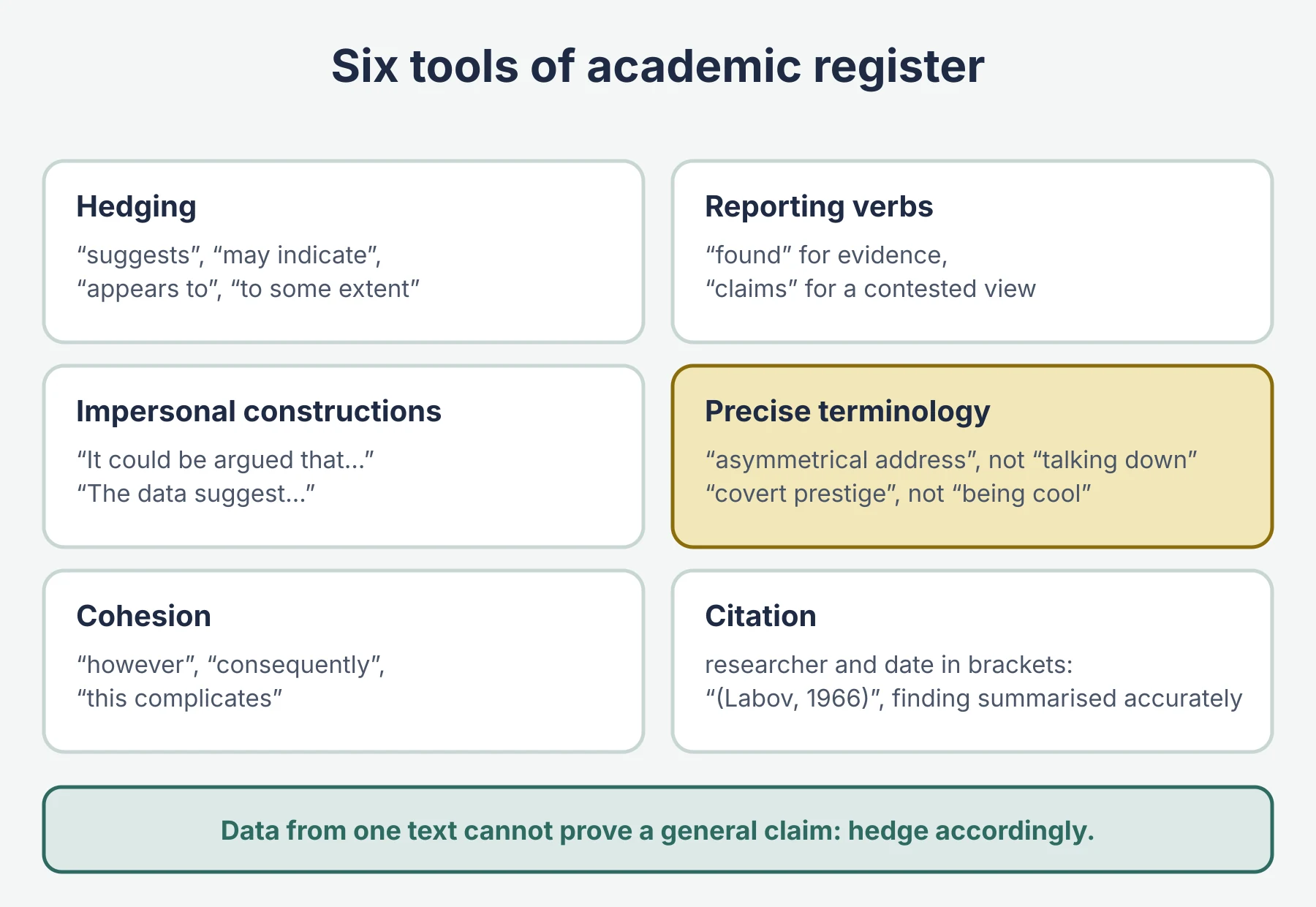
The writing itself is assessed, so control the register.
- Hedging: “suggests”, “may indicate”, “appears to”, “to some extent”. Data from one text cannot prove a general claim.
- Reporting verbs: “argues”, “found”, “proposes”, “challenges”, “claims”. Choose verbs that show your attitude to the source: “found” for evidence, “claims” for a contested view.
- Impersonal constructions where appropriate: “It could be argued that…”, “The data suggest…”.
- Precise terminology: “asymmetrical address” rather than “talking down”; “covert prestige” rather than “being cool”.
- Cohesion: discourse markers that show logical relationships (“however”, “consequently”, “this complicates”).
- Citation: researcher and date in brackets, “(Labov, 1966)”, with an accurate summary of the finding.
Using Section A data as evidence
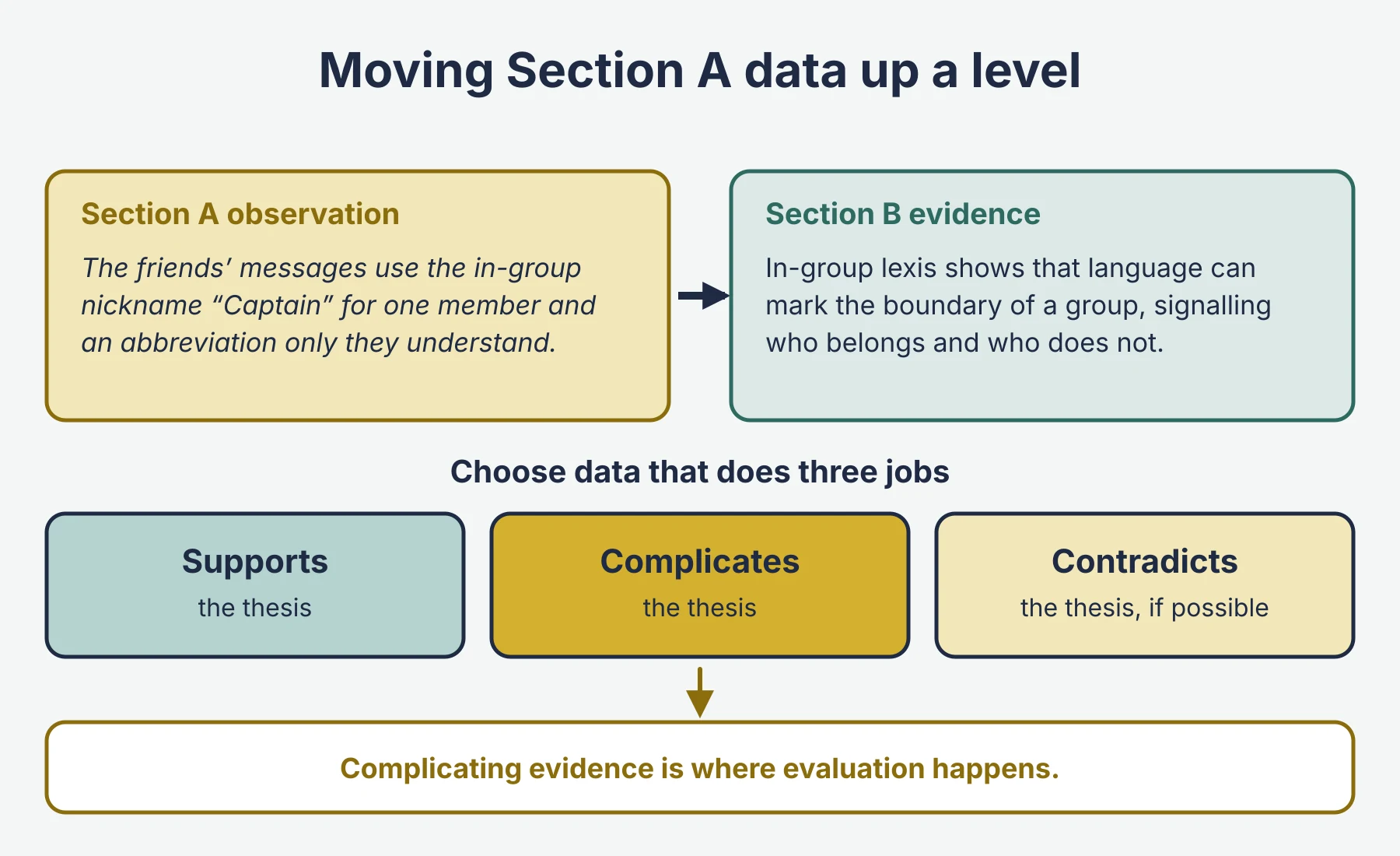
Section A gives you features; Section B asks what they mean beyond the text. Move up a level:
Section A observation: the friends’ messages use the in-group nickname “Captain” for one member and an abbreviation only they understand.
Section B evidence: in-group lexis in the data shows that language can mark the boundary of a group, signalling who belongs and who does not.
Choose data that supports, data that complicates and, if possible, data that contradicts your thesis. Complicating evidence is where evaluation happens.
Research worth knowing accurately
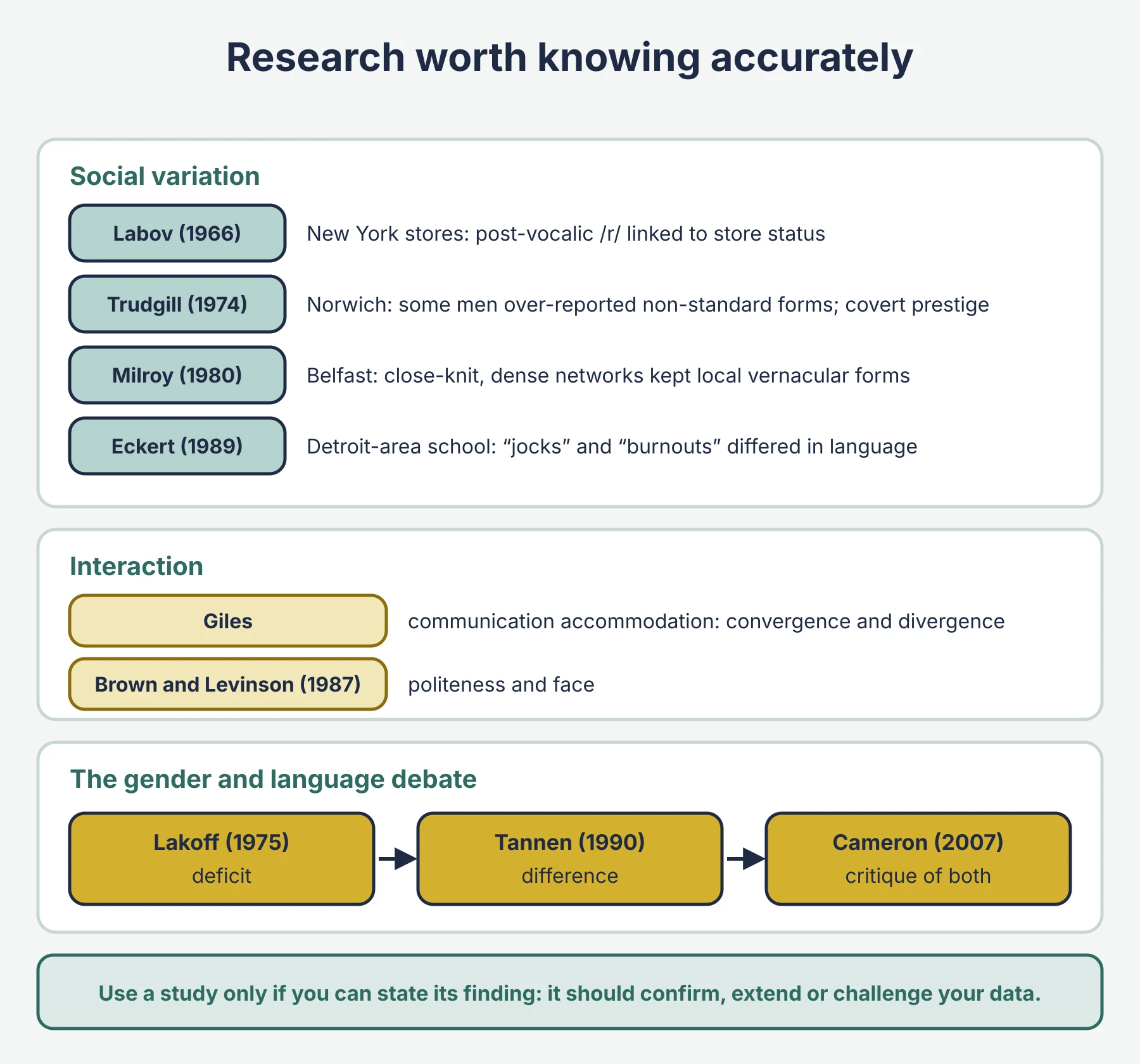
Use studies only when you can state the finding correctly. Relevant examples:
- Labov (1966): New York department stores; post-vocalic /r/ linked to the social status of the store, evidence for social stratification of pronunciation.
- Trudgill (1974): Norwich; some men over-reported non-standard pronunciations, evidence of covert prestige.
- Milroy (1980): Belfast; speakers in close-knit, dense social networks maintained local vernacular forms more.
- Eckert (1989): a Detroit-area high school; “jocks” and “burnouts” differed in their language, showing adolescent social categories marked through variation.
- Giles: communication accommodation theory, convergence and divergence.
- Brown and Levinson (1987): politeness and face.
- Lakoff (1975), Tannen (1990), Cameron (2007): the gender and language debate, from deficit to difference to critique of both.
A study should do work in your argument: confirm, extend or challenge what your data show.
Worked example
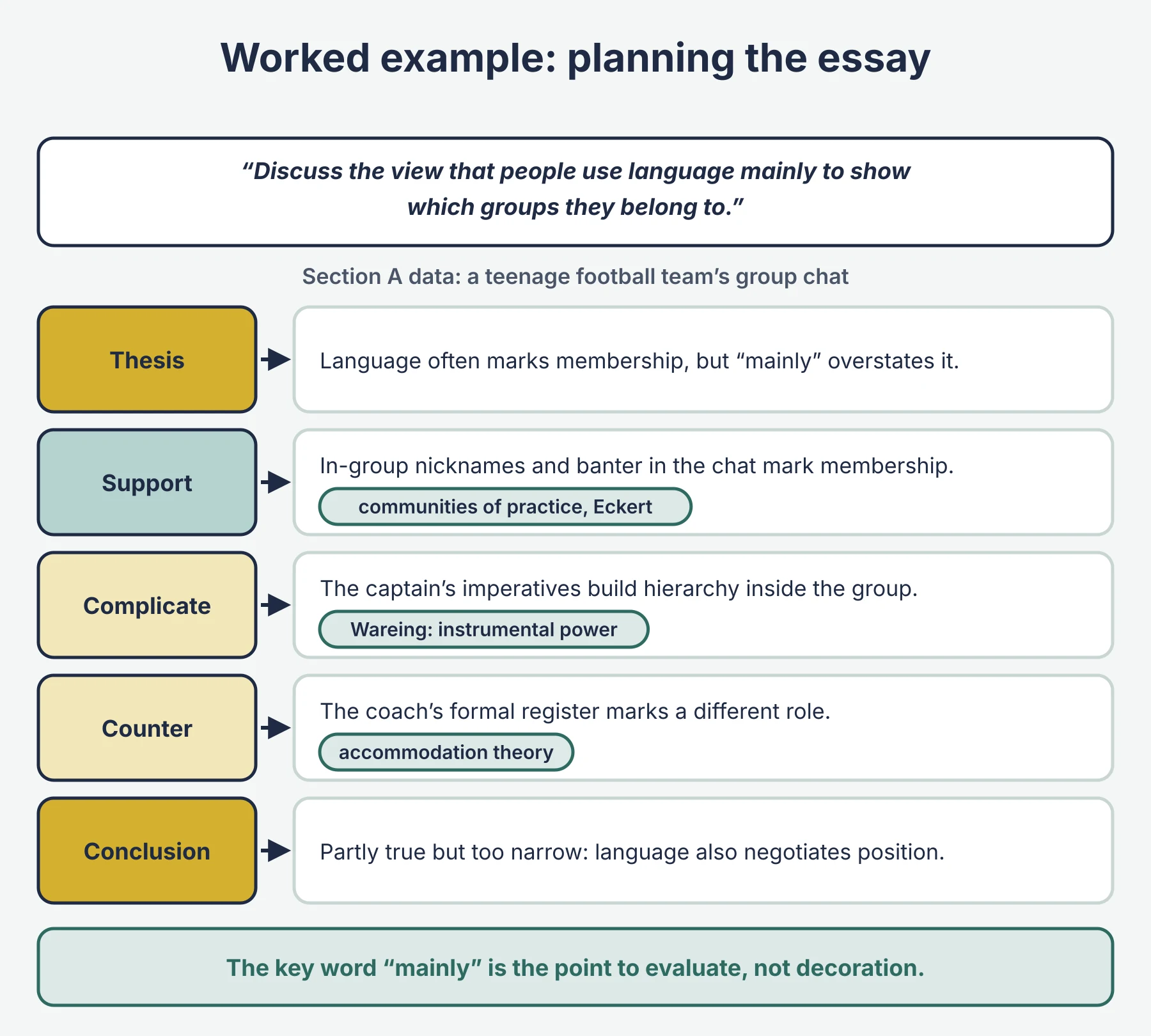
Question (original, written for this guide): “Discuss the view that people use language mainly to show which groups they belong to.” In your answer, refer to the data you analysed in Section A and to your wider study.
Assume Section A data: a transcript of a teenage football team’s group chat (in-group nicknames, banter, a coach’s messages using imperatives and formal sign-offs).
Plan:
- Introduction and thesis: language often marks group membership, but “mainly” overstates it; speakers also use language to claim status within groups and to manage relationships across them.
- Support: in-group nicknames and banter in the chat mark membership; link to communities of practice and Eckert’s findings that social categories are marked through variation.
- Complicate: within the same group, the captain’s imperatives assert status; membership is not equality, so language also builds hierarchy inside groups (Wareing, instrumental power).
- Counter: the coach’s formal register shows a speaker belonging to the group in one sense but marking a different role; accommodation theory explains shifts between styles depending on audience.
- Conclusion: language shows group membership, but it is equally a tool for negotiating position and relationship; the view is partly true but too narrow.
Model paragraph (point 3):
However, the data suggest that showing membership is only part of what the team’s language does, since the same chat also builds a hierarchy within the group. The captain’s message “everyone at the gate 8.15 sharp, no excuses” uses imperatives, a precise time and the absolute “no excuses”, features that assert instrumental power in Wareing’s sense: authority derived from a role rather than from persuasion. Significantly, other members reply with brief agreement tokens rather than banter, which indicates they recognise this shift in register. Membership of the group, therefore, does not mean equal status within it, and a view that treats language mainly as a badge of belonging cannot account for how members use it to rank one another.
Notice the topic sentence that answers the question, short embedded evidence, a named concept used accurately, a hedged interpretation and a link back to the essay’s thesis.
Common mistakes
- Restating the Section A analysis without a thesis.
- Writing about social groups in general with no reference to the data.
- Citing research inaccurately, or inventing findings.
- No counter-argument, so no evaluation.
- Informal register (“this is really cool because…”).
- A conclusion that repeats the introduction instead of refining it.
- Treating the question’s key word (“mainly”, “always”, “only”) as decoration rather than the point to evaluate.
Exam technique
Underline the question’s key claim and its qualifying word. Plan for five minutes: thesis, three or four claims, the evidence for each, and one counter-argument. Write a short introduction that states the thesis, then let every paragraph begin with a claim that answers the question. End with a judgement that says how far the view holds and why.
Keep going
- Language and Social Groups – Writing revision notes
- Language and Social Groups – Writing practice questions
- The analysis that feeds the essay: Language and Social Groups – Texts study guide
- The whole unit: Unit 2 Language and Society study guide
Related resources
-
Practice questions
OxfordAQA International AS and A-level English Language (9670): Section B: Language and Social Groups – Writing – Practice Questions
Original practice for OxfordAQA 9670 Unit 2 Section B: theses, academic register, using data and studies as evidence, and essay planning, with answers.
English · OxfordAQA · AS Level
Try questions -
Revision notes
OxfordAQA International AS and A-level English Language (9670): Section B: Language and Social Groups – Writing – Revision Notes
Recall notes for OxfordAQA 9670 Unit 2 Section B: thesis, evidence and counter-argument, academic register, citing studies and using Section A data well.
English · OxfordAQA · AS Level
Revise topic -
Study guides
OxfordAQA International A-Level English Language: Language and Society (9670)
OxfordAQA International AS English Language 9670 Unit 2 Language and Society: language and social groups, text analysis and academic writing, with the format.
English · OxfordAQA · AS Level
Read guide
Get free revision emails (optional)
Occasional emails with practice questions, worked explanations and links to free resources for the qualification and subjects you choose. No spam, and you can unsubscribe from any email. The free tools on this site never need an email.