
Revision Notes
OxfordAQA International AS and A-level English Language (9670): Section A: Language and Social Groups – Texts – Revision Notes
Recall notes for OxfordAQA 9670 Unit 2 Section A: features signalling rapport, power, identity and play, with face, accommodation and power frameworks.
- Subject
- English
- Level
- AS LEVEL
- Topic
- Unit 2 – Language and Society
- Author
- Marlbridge Academic Team
- Updated
- Reviewed by
- Ammar Bilal (what this means)
Aligned to OxfordAQA A Level English (9670), Version 5.2, for International AS exams from May/June 2018, A-level from May/June 2019. Official specification .
Syllabus page (what it covers and how it is assessed): OxfordAQA A Level English Language.
Found an error? Report a correction.
Need help with this topic? Request a free trial class for A Level English Language (9670).
Condensed recall for specification section 3.2.1 of OxfordAQA International AS and A-level English Language (9670). For explanations and an annotated transcript, use the Language and Social Groups – Texts study guide.
The task in brief
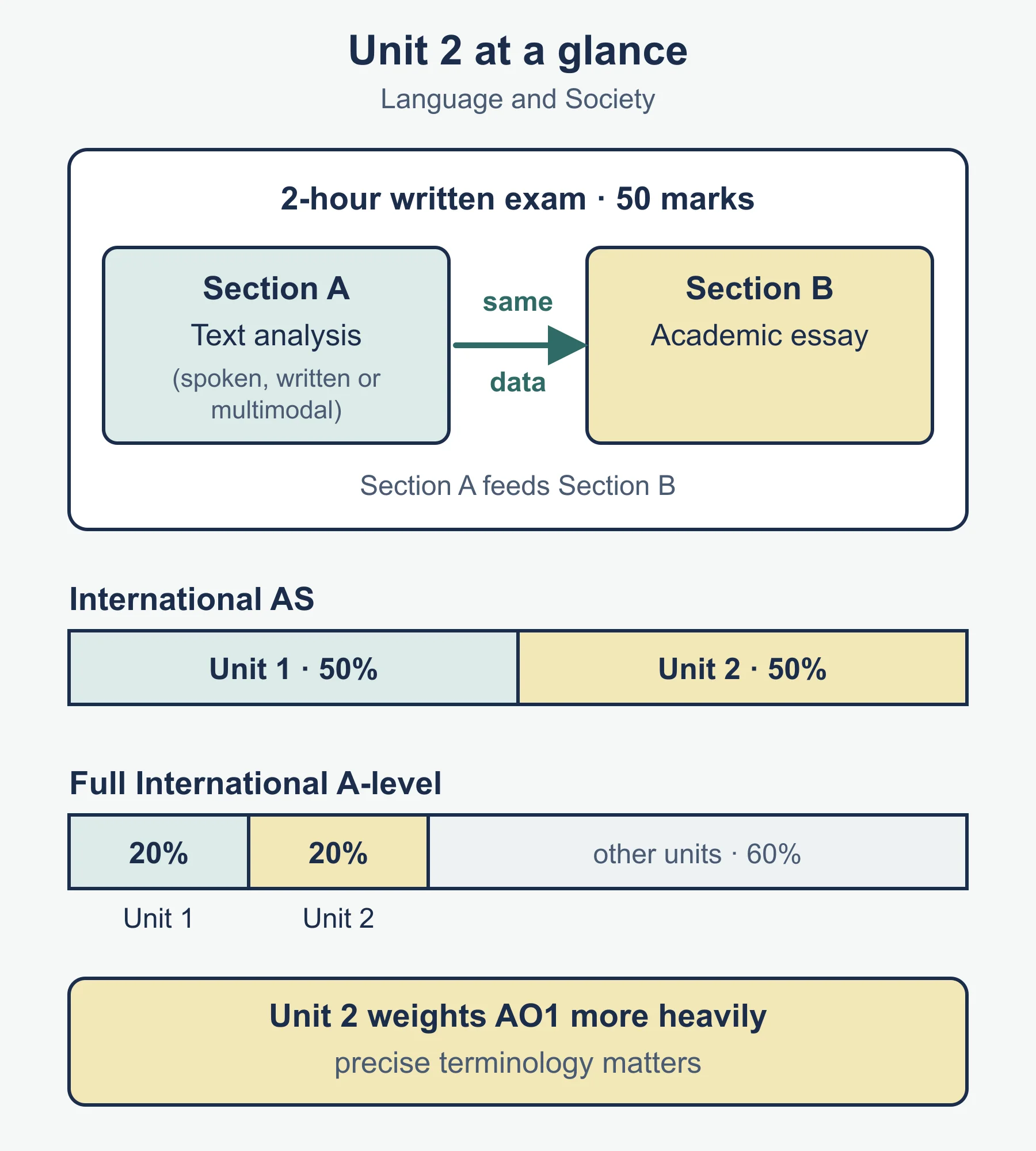
- One compulsory text analysis task, 25 of Unit 2’s 50 marks.
- Text or texts may be spoken, written or multimodal.
- Contexts: power-laden (interviews); persuasive texts asserting power and status; shared interests or group affiliations; play and pleasure.
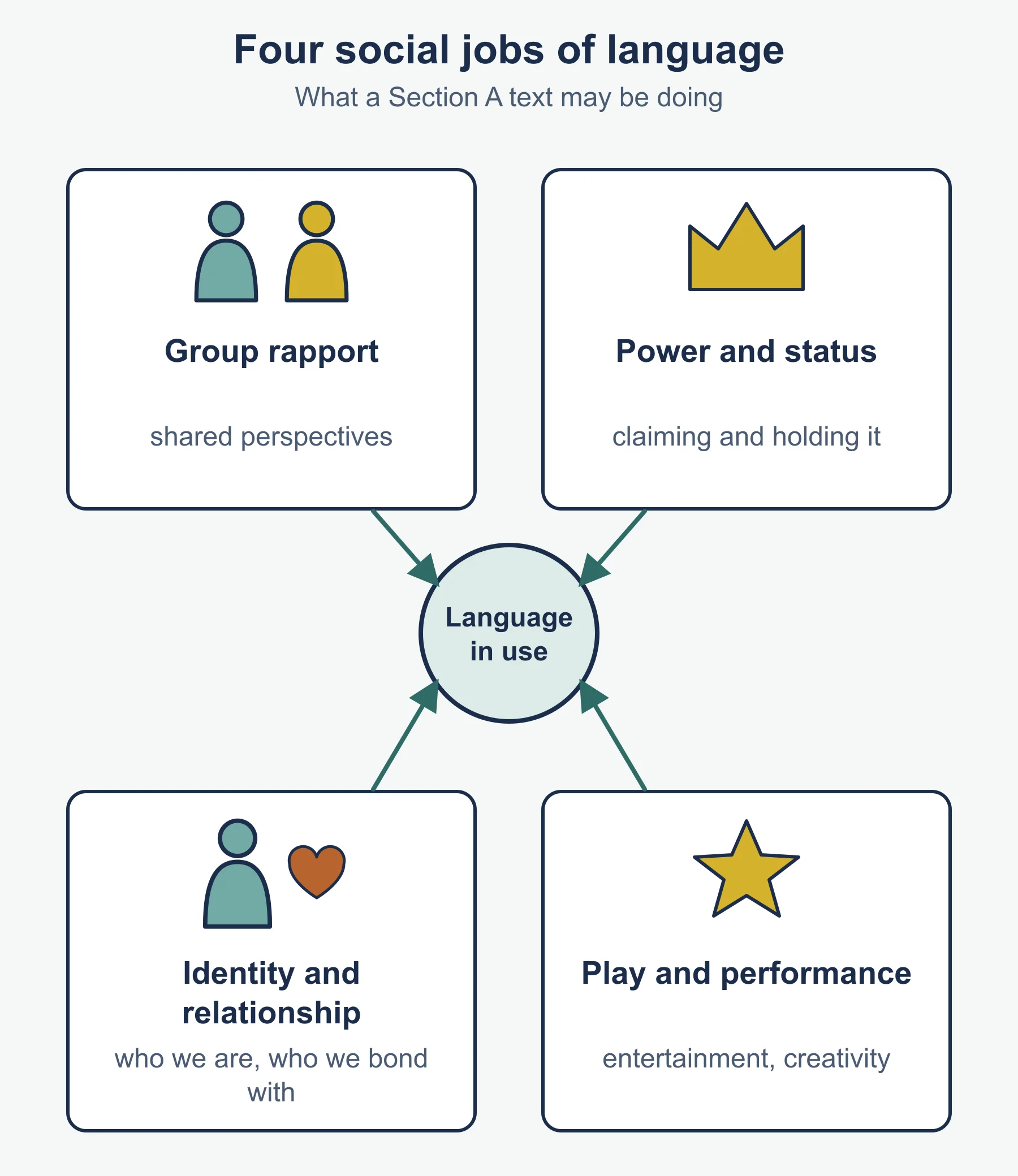
- Credited for identifying how language contributes to: group rapport and shared perspectives; assertions of power and status; expressions of identity and relationship; creative play and performance.
Feature bank by credited area
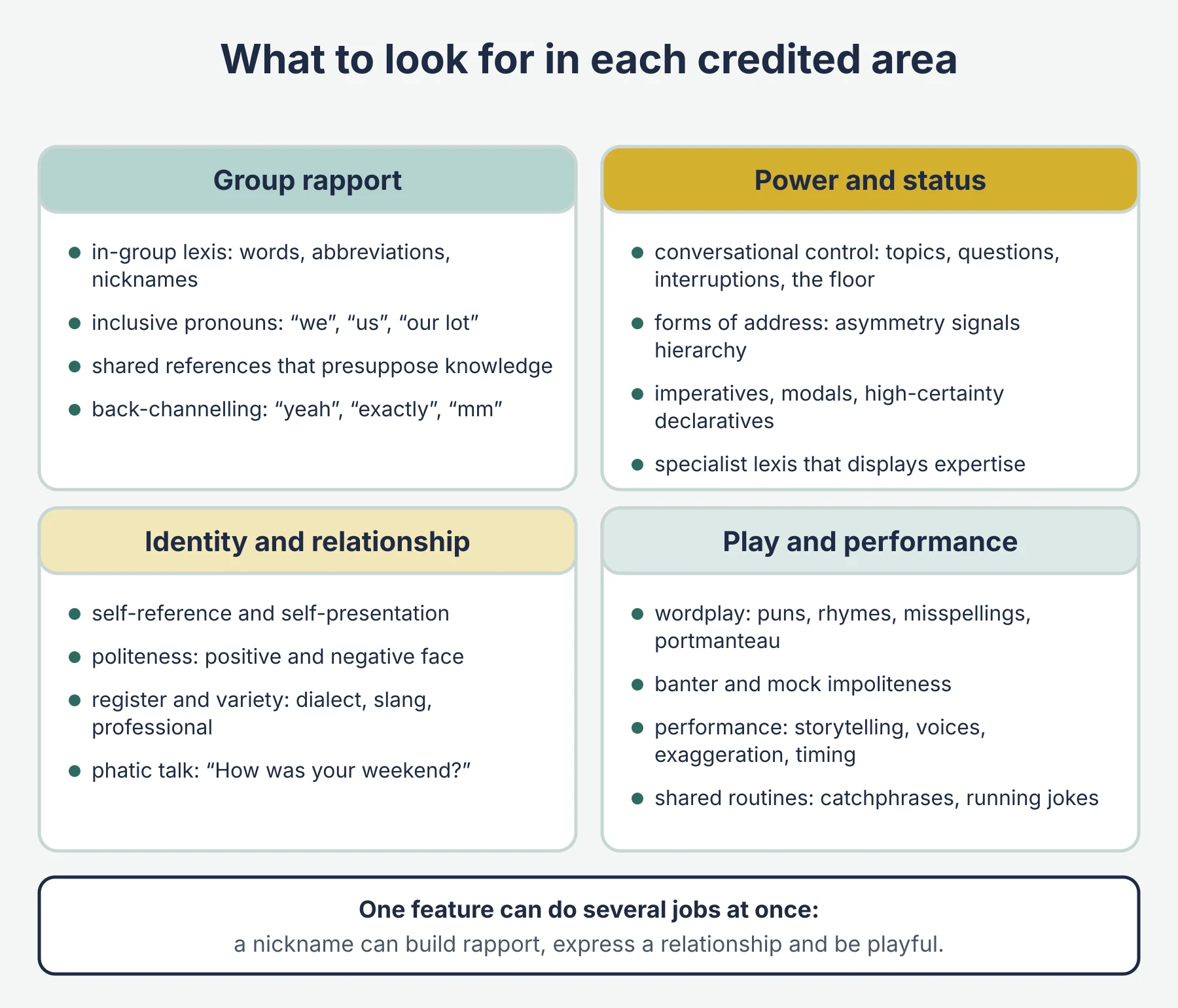
Group rapport and shared perspectives
- In-group lexis, nicknames, abbreviations
- Inclusive “we”, “us”, “our”
- Shared references and presupposed knowledge
- Back-channelling (“yeah”, “mm”), agreement tokens, completing each other’s turns
- Convergence of accent, lexis or style
Assertions of power and status
- Topic control: opening, changing and closing topics
- Questions that require answers; interruption; holding the floor
- Asymmetrical address (title and surname versus first name)
- Imperatives, high modality, declaratives
- Specialist lexis displaying expertise
Expressions of identity and relationship
- Self-reference and self-presentation
- Politeness strategies, hedges, apologies, compliments
- Variety choices: dialect, slang, professional register
- Phatic talk that maintains relationships
Creative play and performance
- Puns, rhyme, deliberate misspelling, coinages
- Banter and mock impoliteness
- Storytelling, voices, exaggeration, comic timing
- Catchphrases and running jokes
Frameworks
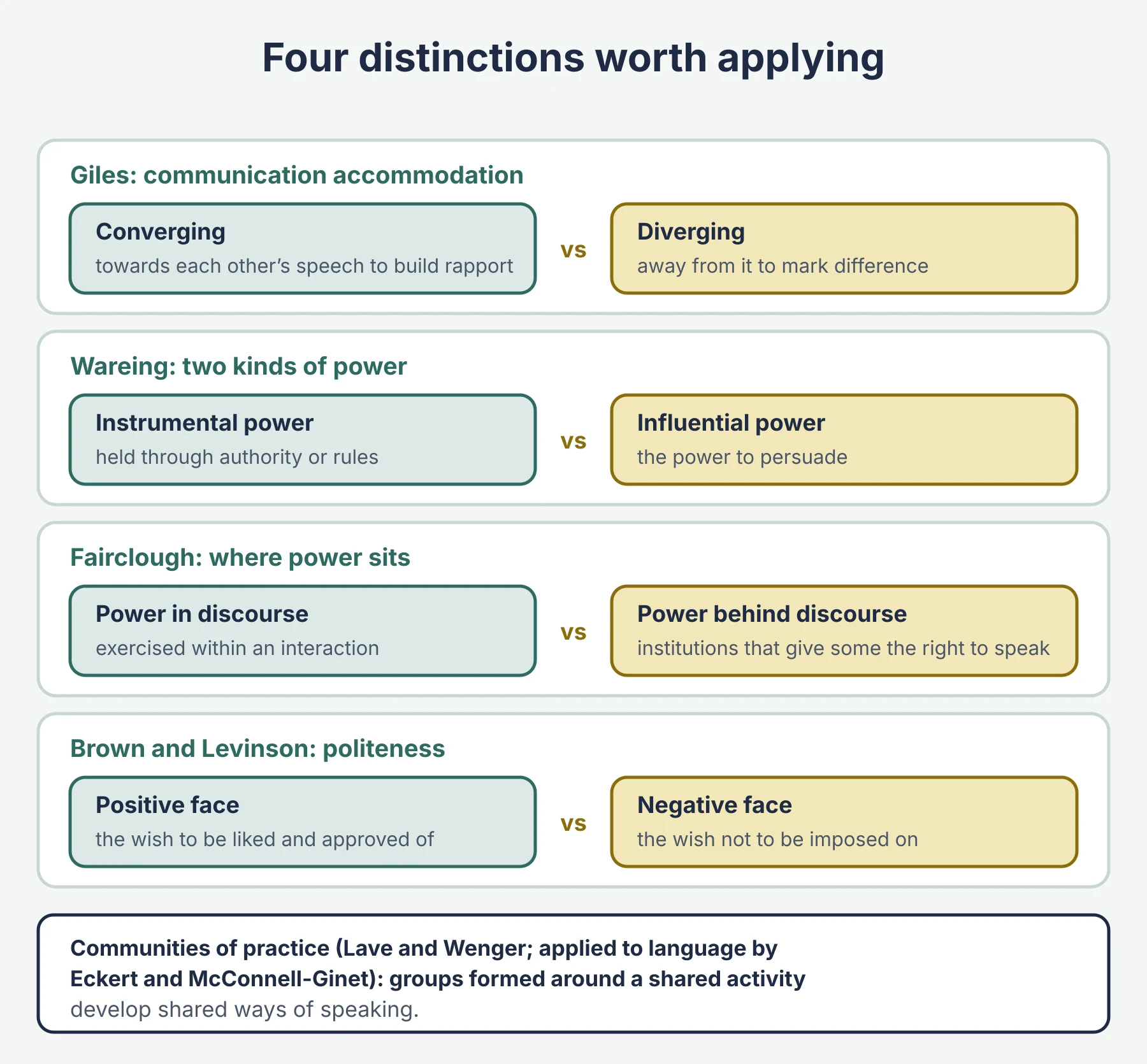
| Framework | Key idea | Use it for |
|---|---|---|
| Brown and Levinson, politeness | Positive face (wish to be approved of) and negative face (wish not to be imposed on); face-threatening acts | Hedges, apologies, compliments, indirect requests |
| Giles, communication accommodation | Convergence builds rapport; divergence marks difference | Shifts in style between speakers |
| Wareing, power | Instrumental power (authority, rules) and influential power (persuasion) | Institutional talk, persuasive texts |
| Fairclough, power | Power in discourse and power behind discourse; synthetic personalisation | Interviews, advertising, public texts |
| Communities of practice | Groups united by shared activity develop shared ways of speaking | Clubs, teams, online communities |
Key terms
| Term | Meaning |
|---|---|
| Adjacency pair | Two related turns, such as question and answer |
| Back-channelling | Listener signals of attention (“mm”, “yeah”) |
| Phatic talk | Language that maintains relationships rather than conveys information |
| Mock impoliteness | Apparently rude language used to signal closeness |
| Asymmetrical address | Unequal forms of address that signal hierarchy |
| Face-threatening act | An utterance that risks someone’s positive or negative face |
| Hedge | A word or phrase that softens a claim (“sort of”, “I think”) |
| Multimodal | Combining words with images, layout, sound or other modes |
Analysing by mode
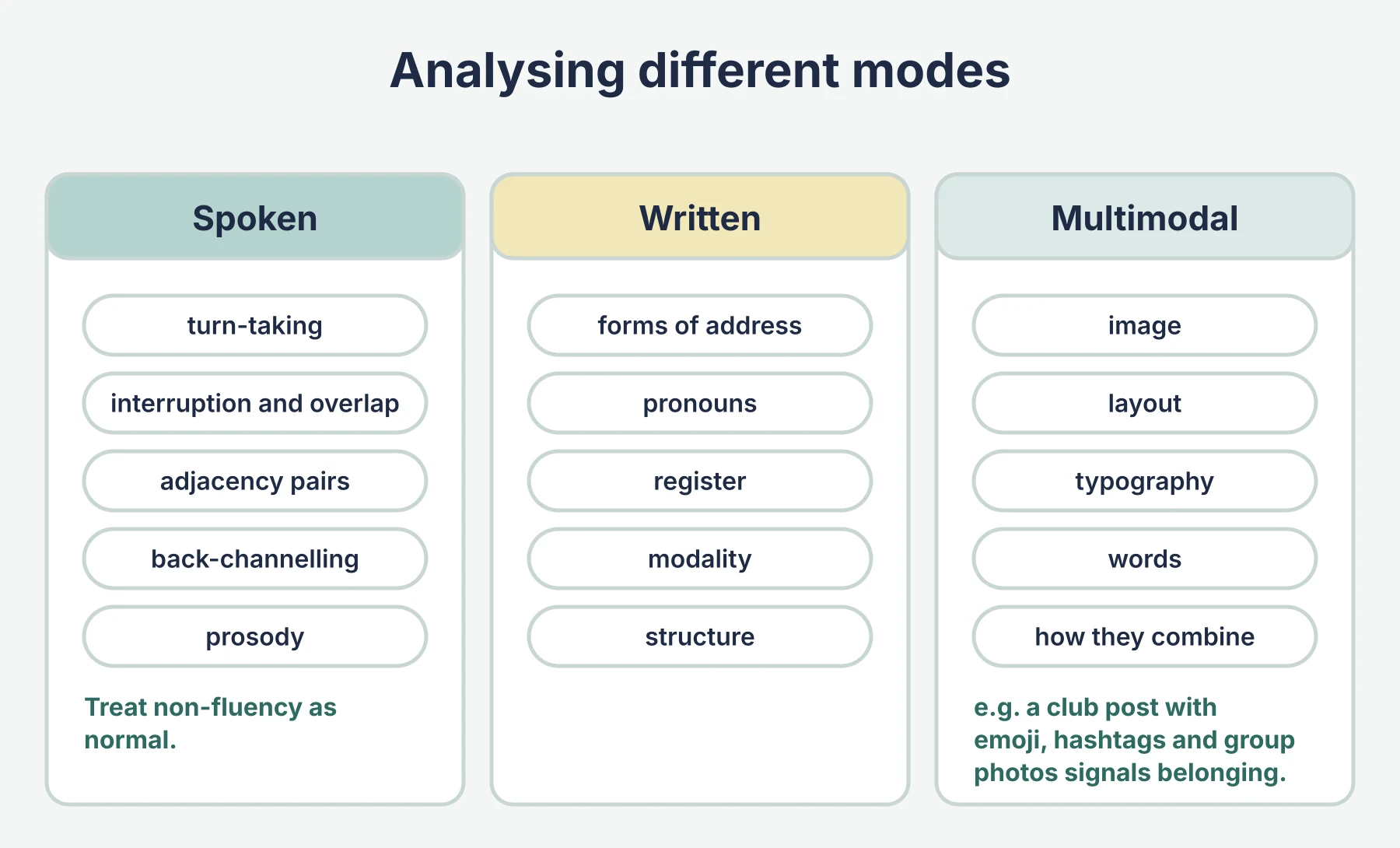
- Spoken: turn length, interruptions, overlaps, adjacency pairs, prosody, laughter.
- Written: address, pronouns, register, modality, paragraph and layout choices.
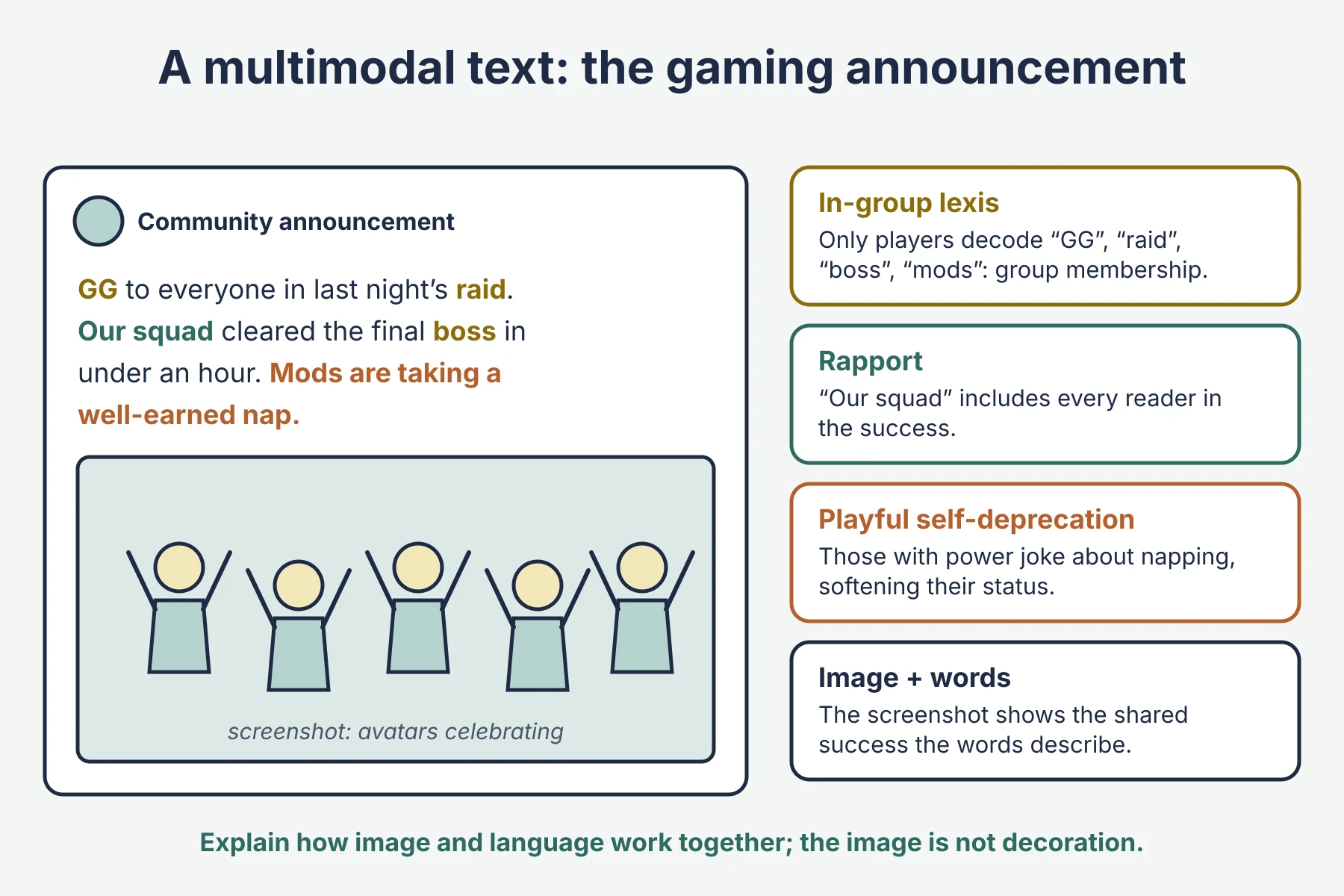
- Multimodal: image, colour, typography, emoji, hashtags working with the words.
Overlap and negotiation
- One feature can do several jobs: a teasing nickname builds rapport, expresses a relationship and is playful.
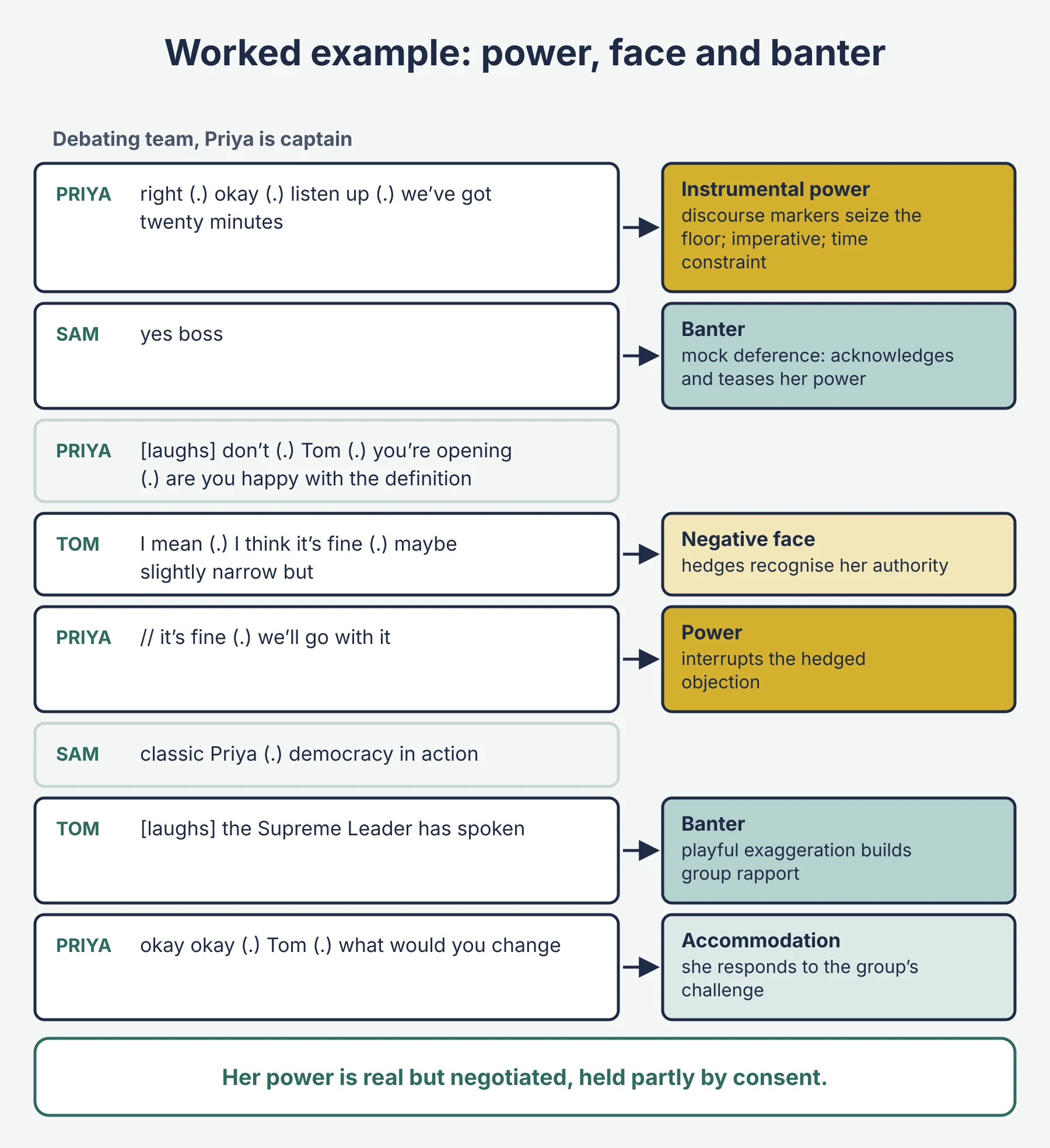
- Power is often negotiated: a leader may accept teasing that softens authority while keeping control.
- Say which function dominates in context, and why.
- Status can be claimed from below: humour, expertise or a well-timed challenge lets a less powerful speaker gain ground, so track how power shifts across the whole interaction rather than fixing it at the start.
Paragraph formula
- Moment: quote a short, precise piece of the text.
- Feature: name it with exact terminology (hedge, asymmetrical address, back-channel, pun).
- Function: link it to one or more credited areas.
- Framework: apply a theory where it adds insight, not by habit.
- Context: explain why this function matters for these participants.
Example: The interviewer’s minimal response “okay” withholds positive evaluation; by offering no approval, she maintains instrumental power, leaving the candidate to work harder for acceptance.
Exam traps
- Describing what happens instead of the language that makes it happen.
- Category labels without feature evidence.
- Power seen as only top-down.
- Banter read literally.
- Frameworks name-dropped without application.
- Multimodal features ignored.
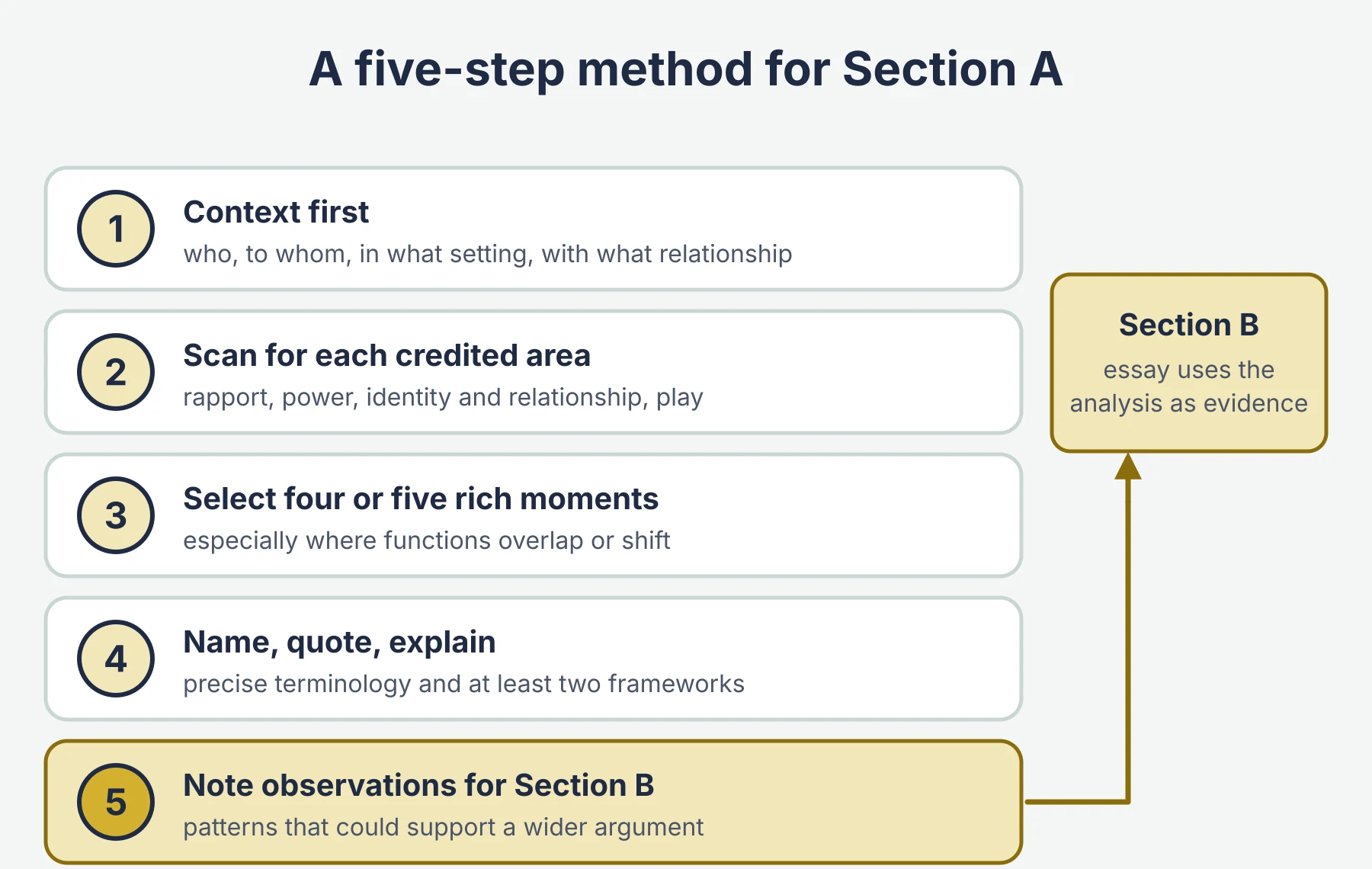
- Forgetting to note patterns for the Section B essay.
Self-test
- List the five social uses of language named in 3.2.1.
- List the four areas students are credited for identifying.
- Name the three modes Section A texts may use.
- Give two linguistic signals of power in a spoken interview.
- What is the difference between positive and negative face?
- What does convergence show in Giles’s theory?
- Distinguish instrumental and influential power.
- What is mock impoliteness?
- What is phatic talk? Give an example.
- What is a community of practice?
- Why should you note patterns during Section A?
- How can one feature serve more than one credited area?
Answers: 1. Express identities; construct and maintain relationships; mark group membership; claim power and status; play and entertain. 2. Group rapport and shared perspectives; assertions of power and status; expressions of identity and relationship; creative play and performance. 3. Spoken, written and multimodal. 4. Any two: topic control; questions requiring answers; interruptions; holding the floor; asymmetrical address; imperatives. 5. Positive face is the wish to be liked and approved of; negative face is the wish not to be imposed on. 6. A speaker adjusting towards another’s speech, usually to build rapport or approval. 7. Instrumental power comes from authority or rules; influential power comes from persuasion. 8. Apparently rude language used between people who are close, signalling solidarity. 9. Talk that maintains relationships rather than exchanging information, such as “Lovely weather today.” 10. A group united by shared activity that develops shared ways of using language. 11. Because Section B’s essay must connect with the data analysed in Section A. 12. A nickname, for example, can build rapport, express a relationship and be playful at the same time.
Try the Language and Social Groups – Texts practice questions, then the Unit 2 revision notes.
Related resources
-
Study guides
OxfordAQA International AS and A-level English Language (9670): Section B: Language and Social Groups – Writing
OxfordAQA 9670 Unit 2 Section B: writing an academic essay on language and social groups, using Section A data and research as evidence, with a model plan.
English · OxfordAQA · AS Level
Read guide -
Practice questions
OxfordAQA International AS and A-level English Language (9670): Section B: Language and Social Groups – Writing – Practice Questions
Original practice for OxfordAQA 9670 Unit 2 Section B: theses, academic register, using data and studies as evidence, and essay planning, with answers.
English · OxfordAQA · AS Level
Try questions -
Revision notes
OxfordAQA International AS and A-level English Language (9670): Section B: Language and Social Groups – Writing – Revision Notes
Recall notes for OxfordAQA 9670 Unit 2 Section B: thesis, evidence and counter-argument, academic register, citing studies and using Section A data well.
English · OxfordAQA · AS Level
Revise topic
Get free revision emails (optional)
Occasional emails with practice questions, worked explanations and links to free resources for the qualification and subjects you choose. No spam, and you can unsubscribe from any email. The free tools on this site never need an email.