
Study Guides
OxfordAQA International AS and A-level English Language (9670): Section A: Language and Social Groups – Texts
OxfordAQA 9670 Unit 2 Section A: analysing rapport, power, identity and play in spoken, written and multimodal texts, with politeness and power frameworks.
- Subject
- English
- Level
- AS LEVEL
- Topic
- Unit 2 – Language and Society
- Author
- Marlbridge Academic Team
- Updated
- Reviewed by
- Ammar Bilal (what this means)
Aligned to OxfordAQA A Level English (9670), Version 5.2, for International AS exams from May/June 2018, A-level from May/June 2019. Official specification .
Syllabus page (what it covers and how it is assessed): OxfordAQA A Level English Language.
Found an error? Report a correction.
Need help with this topic? Request a free trial class for A Level English Language (9670).
Section A of Unit 2, Language and society, in the OxfordAQA International AS and A-level English Language specification (9670) is specification section 3.2.1 Language and social groups: texts. It is one compulsory text analysis task. Where Unit 1 asked how context shapes a text, this section asks what people do to each other with language: how they bond, compete, present themselves and play. This guide sets out the specification’s categories, the frameworks that help you analyse them, and a method for a transcript, with a worked example.
What the specification says
Section A focuses on the social aspects of language use, the ways people use language to:
- express identities
- construct and maintain relationships
- mark group membership
- claim power and status
- play and entertain themselves and others.
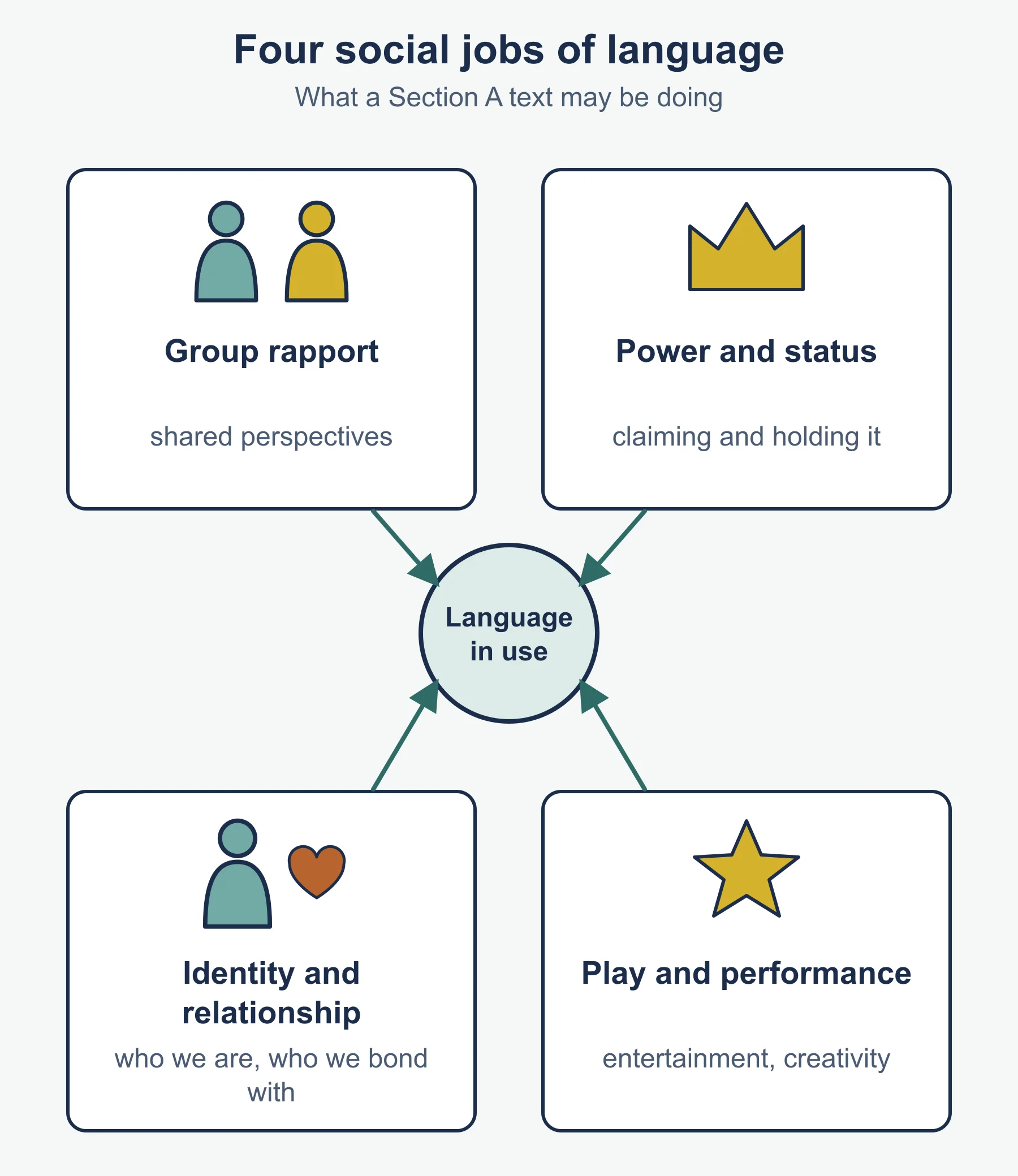
Students are credited for identifying how language choices contribute to four things: group rapport and shared perspectives, assertions of power and status, expressions of identity and relationship, and creative play and performance.
The text or texts may be spoken, written or multimodal. They will come from contexts where these factors are strongly present: power-laden settings such as interviews; spoken or written texts that exhort and persuade by asserting power and status; interactions or written texts focused on shared interests or group affiliations; and texts, dialogues or performances where language is used for shared play and pleasure.
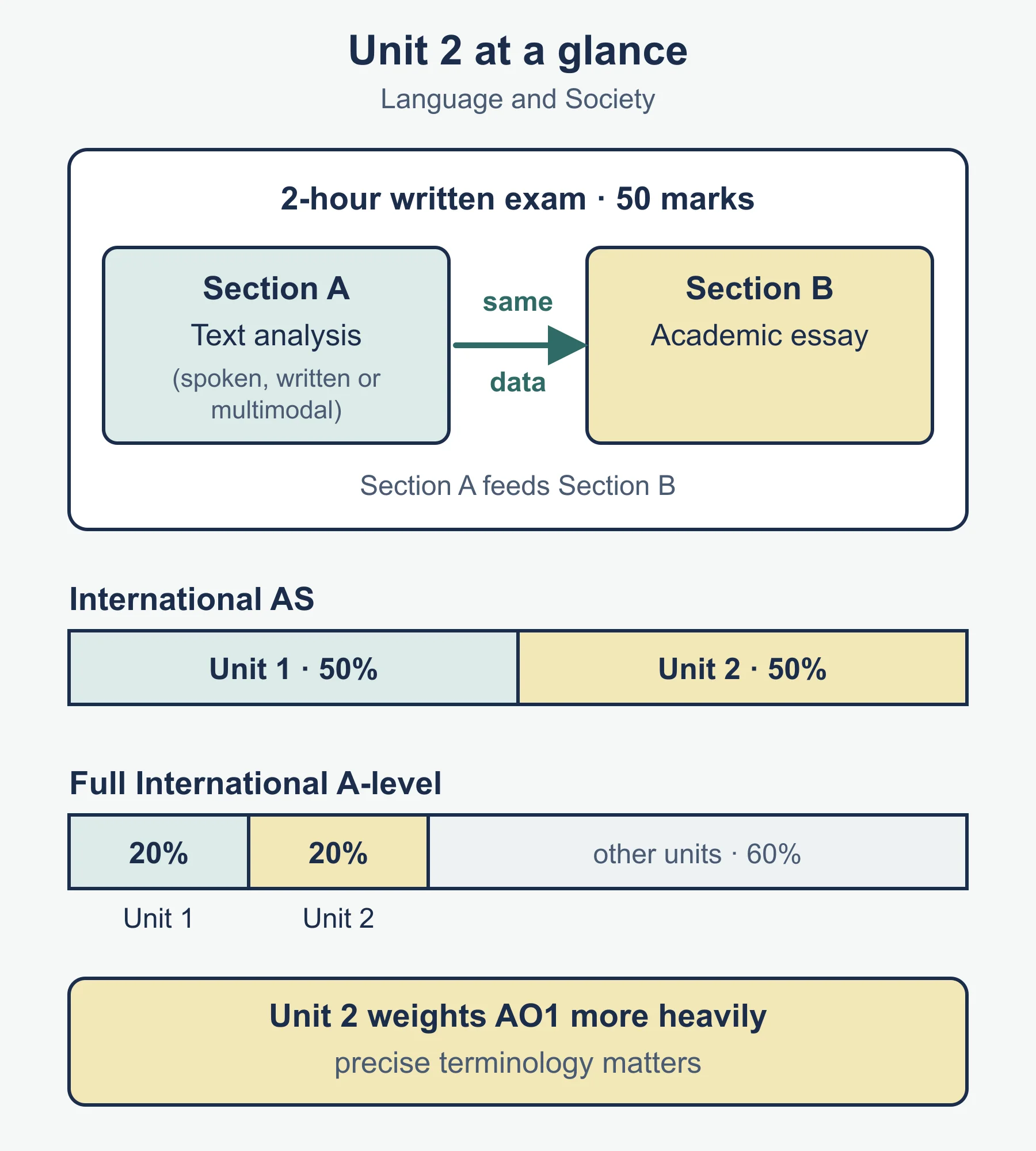
Unit 2 is a 2-hour exam worth 50 marks; Section A is worth 25. Your Section A analysis then becomes the evidence for the Section B essay, so note patterns that could support an argument as you go.
Frameworks for each credited area
Group rapport and shared perspectives
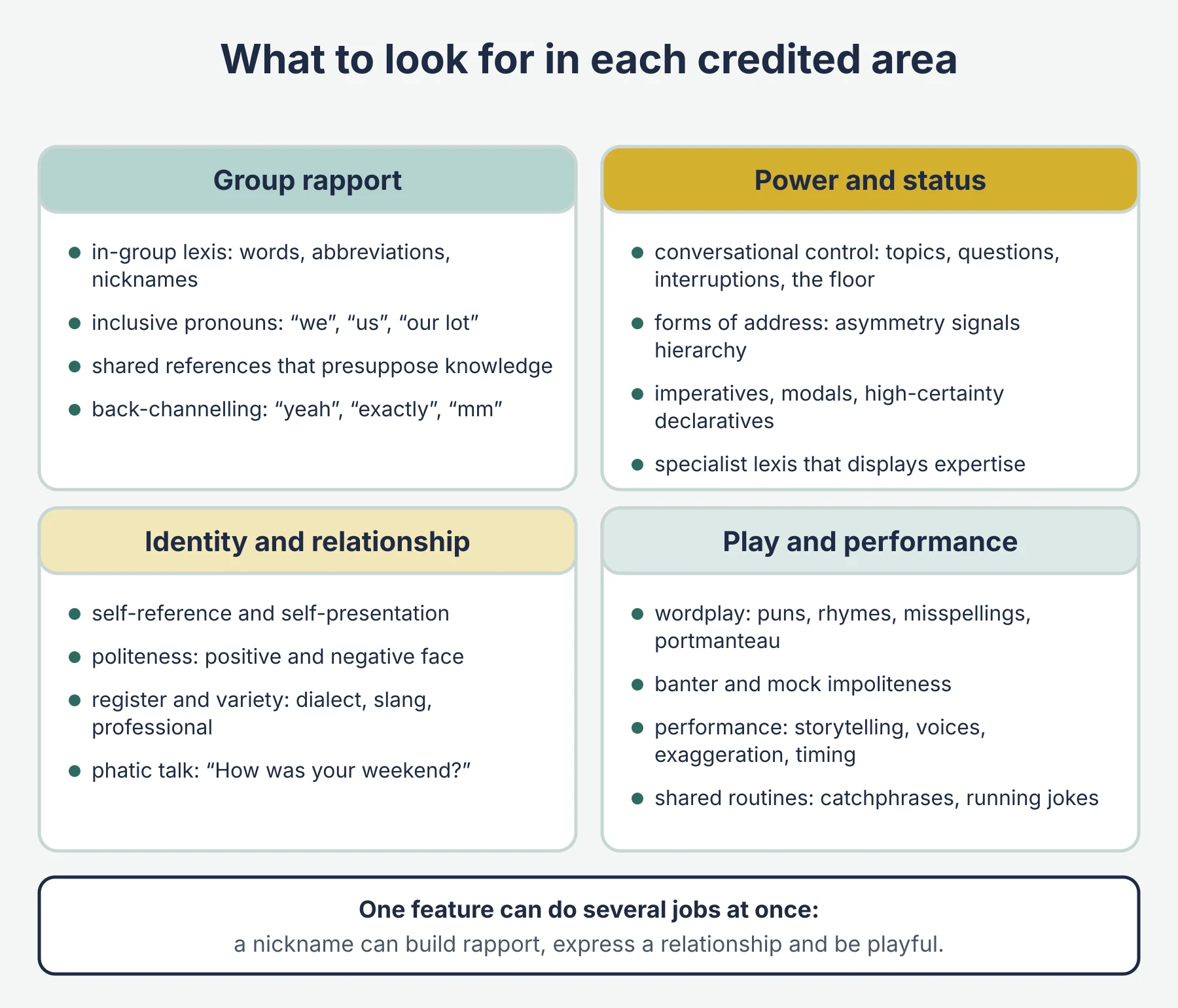
- In-group lexis: vocabulary, abbreviations and nicknames that only members understand.
- Inclusive pronouns: “we”, “us”, “our lot”.
- Shared references: allusions that presuppose common knowledge.
- Back-channelling and agreement tokens: “yeah”, “exactly”, “mm”.
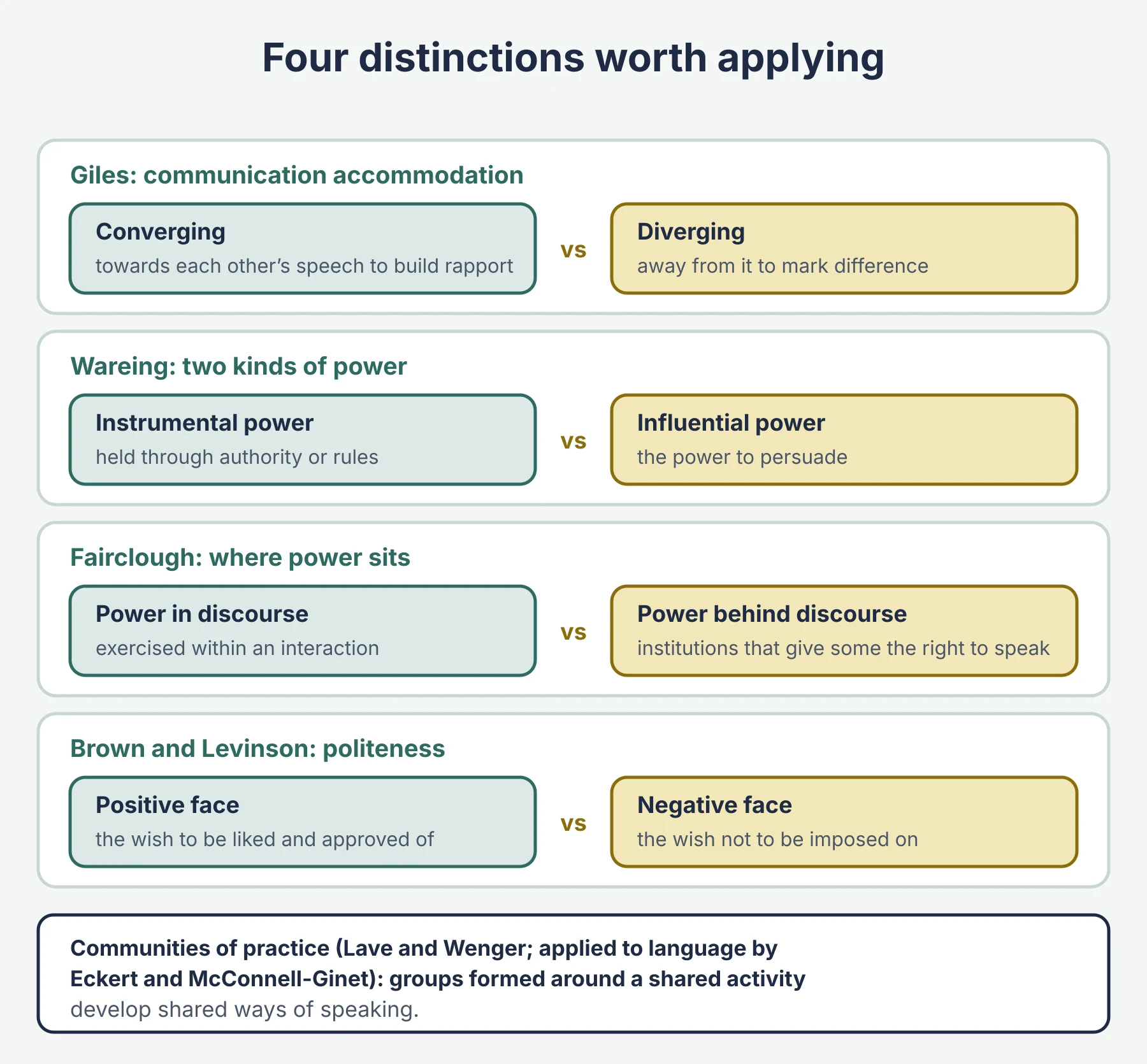
- Accommodation: Howard Giles’s communication accommodation theory describes speakers converging towards each other’s speech to build rapport, or diverging to mark difference.
- Communities of practice: groups formed around a shared activity develop shared ways of speaking; the concept, from Lave and Wenger, was applied to language by Eckert and McConnell-Ginet.
Assertions of power and status
- Conversational control: who opens and closes topics, asks questions, interrupts and holds the floor longest.
- Forms of address: titles and surnames versus first names; asymmetry (one side uses a title, the other a first name) signals hierarchy.
- Imperatives, modal verbs and declaratives of high certainty.
- Specialist lexis used to display expertise.
- Shan Wareing distinguishes instrumental power, power held through authority or rules, from influential power, power to persuade.
- Norman Fairclough distinguishes power in discourse (power exercised within an interaction) from power behind discourse (the institutional structures that give some speakers the right to speak).
Expressions of identity and relationship
- Self-reference and self-presentation: how speakers describe themselves, and what they choose to reveal.
- Politeness: Brown and Levinson’s theory distinguishes positive face (the wish to be liked and approved of) from negative face (the wish not to be imposed on). Compliments and inclusive language attend to positive face; hedges, apologies and indirect requests attend to negative face.
- Register and variety choices: dialect, slang or a professional register mark who a speaker is or wants to be.
- Relational talk: phatic expressions (“How was your weekend?”) maintain relationships rather than exchange information.
Creative play and performance
- Wordplay: puns, rhymes, deliberate misspellings, portmanteau words.
- Banter and mock impoliteness: insults that, between friends, signal closeness rather than hostility.
- Performance features: storytelling, voices, exaggeration, timing.
- Shared play routines: catchphrases and running jokes that rely on group memory.
The same feature can serve more than one function. A nickname can build rapport, express a relationship and be playful at once; a teacher’s joke can build rapport while confirming who has the right to joke.
Analysing different modes
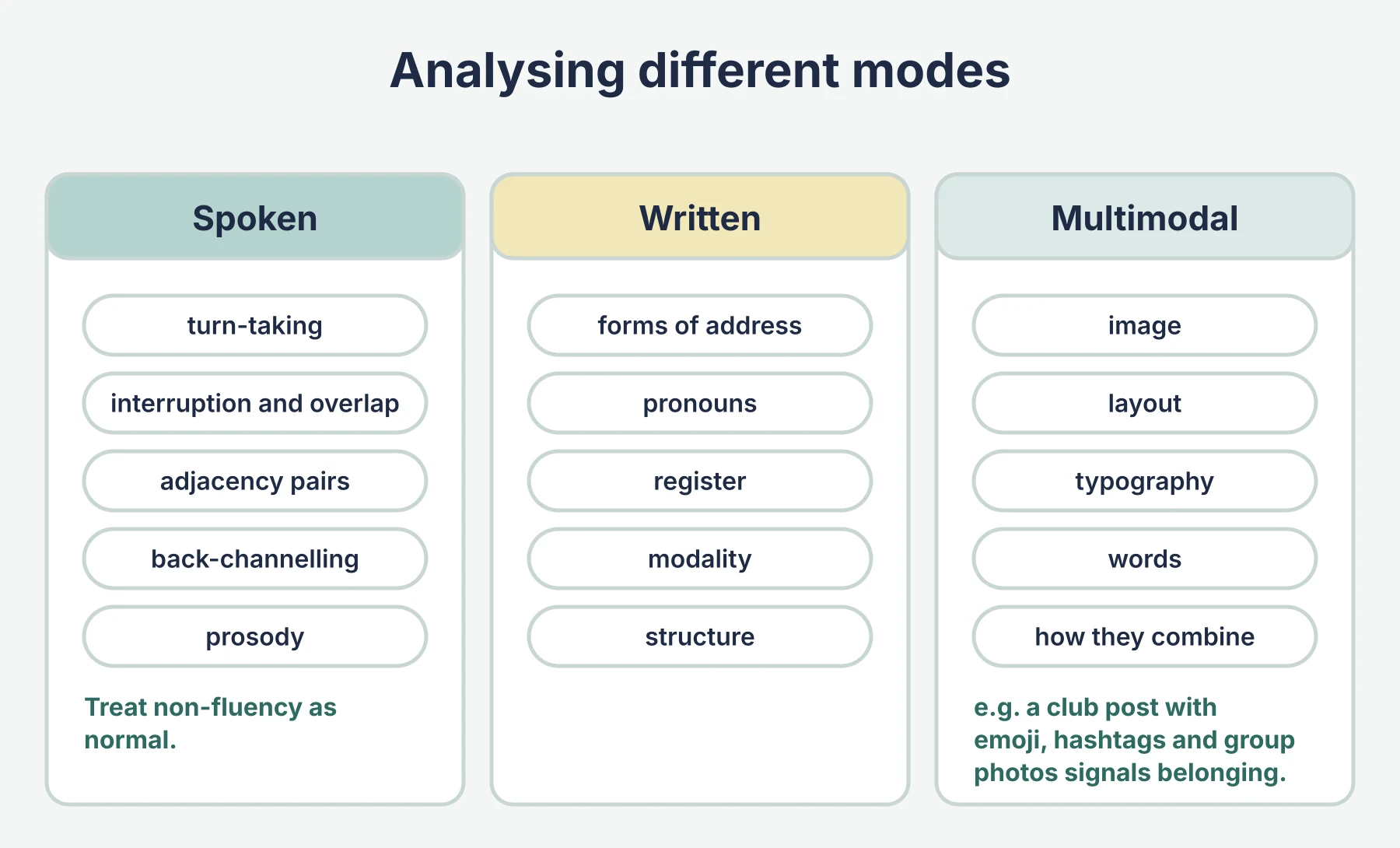
- Spoken: turn-taking, interruption, overlap, adjacency pairs, back-channelling, prosody. Treat non-fluency as normal.
- Written: forms of address, pronouns, register, modality, structure.
- Multimodal: how image, layout, typography and words combine, such as a club’s social media post using emoji, hashtags and group photos to signal belonging.
Worked example
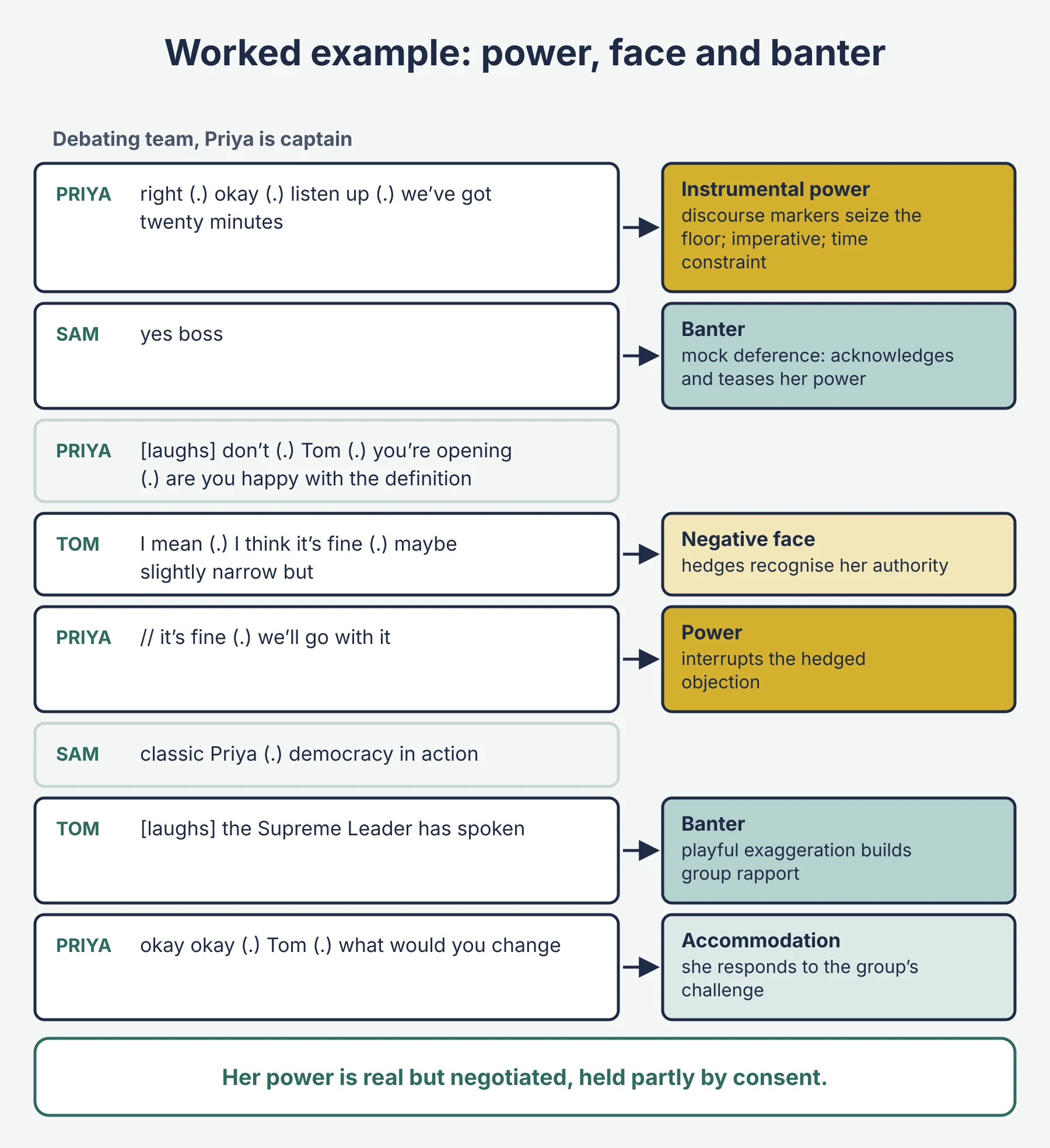
Transcript (original, invented for this guide). Three members of a school debating team prepare for a competition. Priya is captain.
PRIYA:  right (.) okay (.) listen up (.) we've got twenty minutes
SAM:    yes boss
PRIYA:  [laughs] don't (.) Tom (.) you're opening (.) are you happy with the
        definition
TOM:    I mean (.) I think it's fine (.) maybe slightly narrow but
PRIYA:  // it's fine (.) we'll go with it
SAM:    classic Priya (.) democracy in action
TOM:    [laughs] the Supreme Leader has spoken
PRIYA:  okay okay (.) Tom (.) what would you change
Analysis:
Priya asserts instrumental power as captain through discourse markers that seize the floor (“right (.) okay (.) listen up”), an imperative and a time constraint, and later by interrupting Tom’s hedged objection (“// it’s fine”). Tom’s hedges (“I mean”, “I think”, “maybe slightly”) attend to Priya’s negative face, showing he recognises her authority. Sam and Tom respond with mock deference (“yes boss”, “the Supreme Leader has spoken”), playful exaggeration that both acknowledges and gently challenges her power; this banter builds group rapport, as only close teammates could tease the captain this way. Priya’s laughter and her return to Tom (“what would you change”) show her accommodating the group’s challenge: her power is real but negotiated, held partly by consent.
The analysis names specific features, uses two frameworks and shows functions overlapping, which is the kind of insight the credited areas reward.
A multimodal example in brief
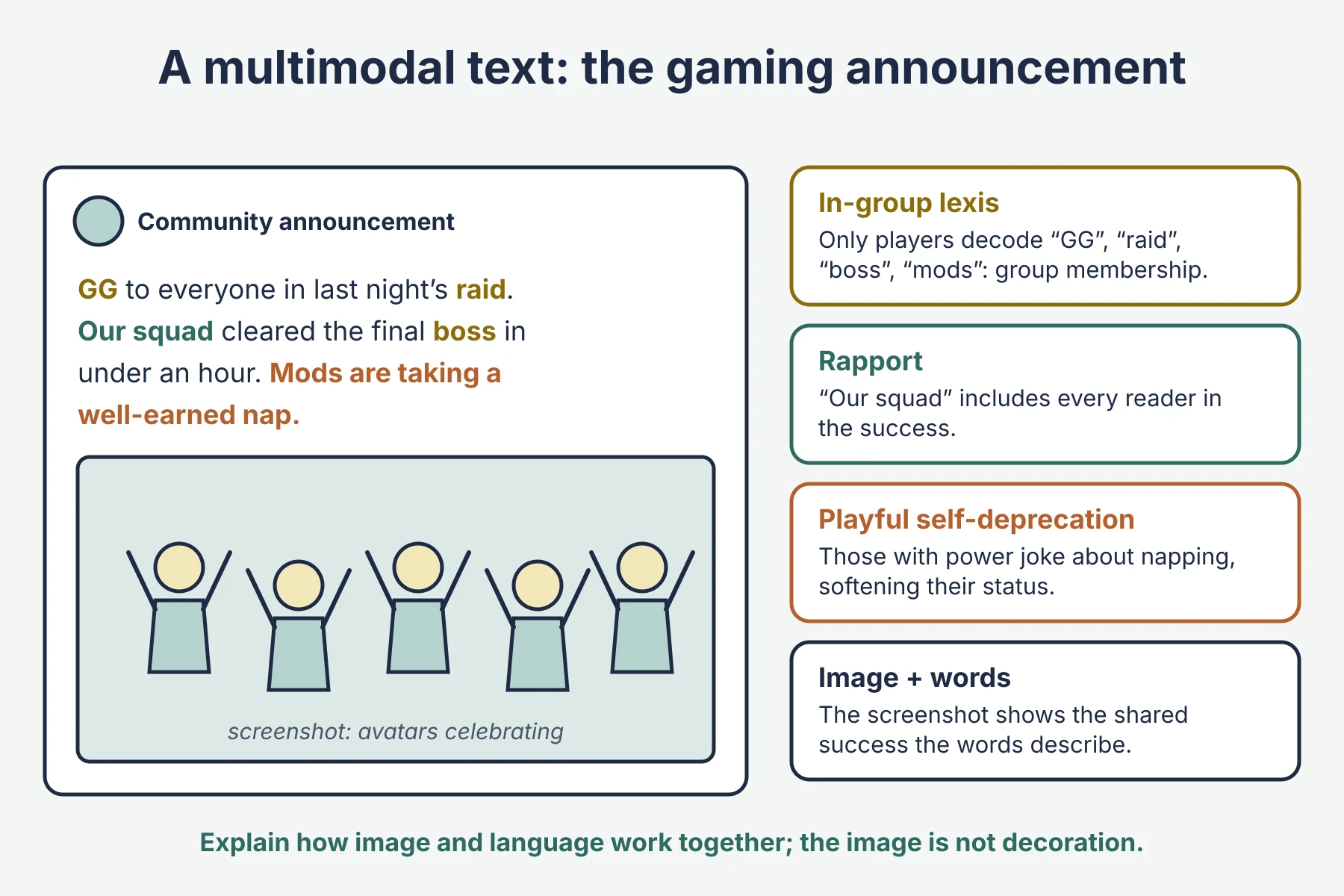
A gaming community’s announcement (original, invented) reads “GG to everyone in last night’s raid. Our squad cleared the final boss in under an hour. Mods are taking a well-earned nap.” beside a screenshot of avatars in a celebratory pose. The abbreviation “GG” (“good game”) and “raid”, “boss” and “mods” are in-group lexis that only players decode, marking group membership. “Our squad” builds rapport, while the joke about moderators napping is playful self-deprecation by those with power in the community, softening their status. The image supports the words by showing the group’s shared success. An analysis should explain how image and language work together, not treat the screenshot as decoration.
Method
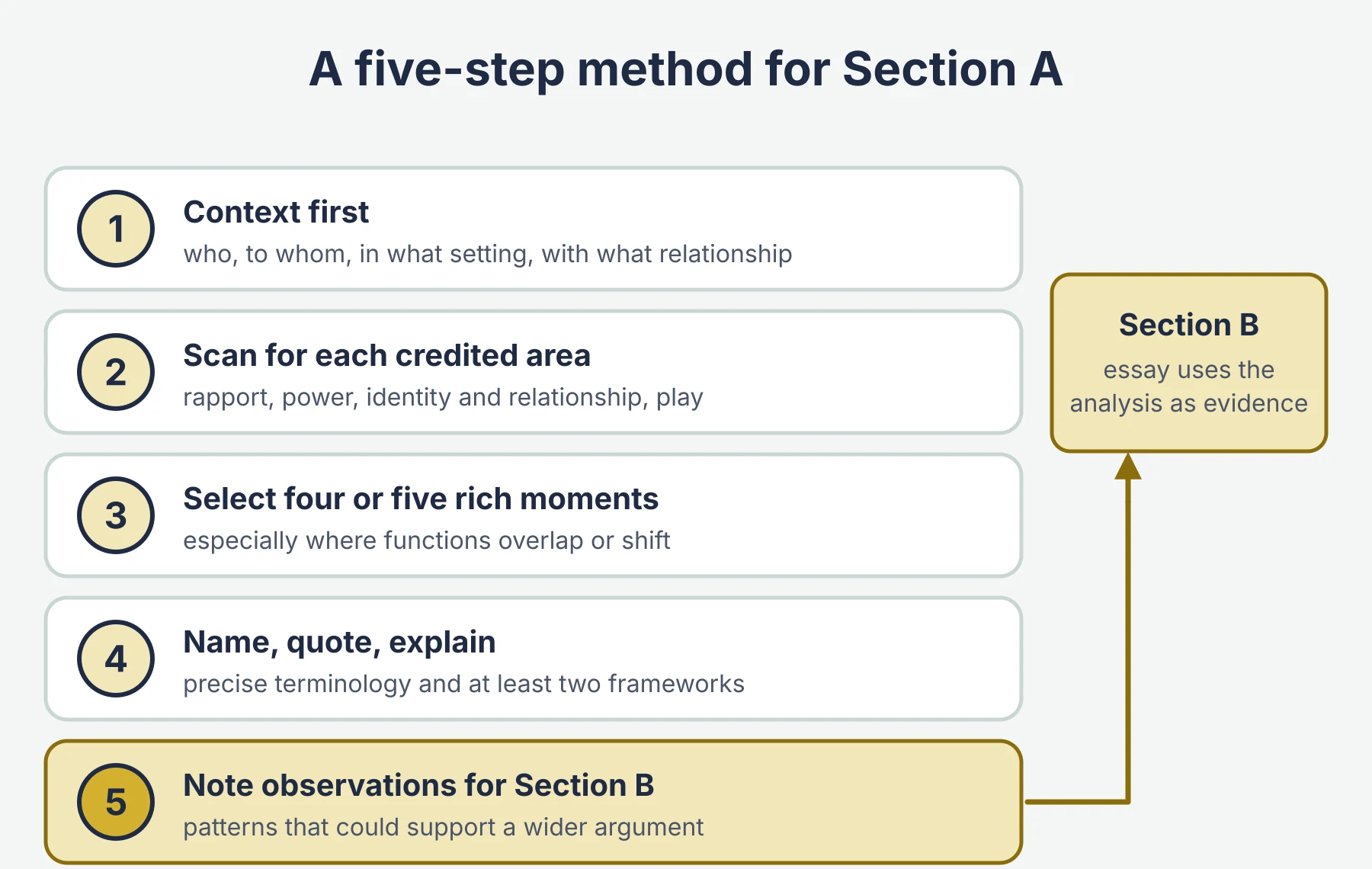
- Context first: who is speaking or writing, to whom, in what setting, with what relationship.
- Scan for each credited area: rapport, power, identity and relationship, play.
- Select four or five rich moments, especially where functions overlap or shift.
- Name, quote, explain using precise terminology and at least two frameworks.
- Note observations that could support a wider argument for Section B.
Common mistakes
- Describing content (“they are planning a debate”) instead of language features.
- Using the categories as labels without showing which features create them.
- Treating “power” as only negative or only top-down; it is often negotiated.
- Reading banter literally as hostility.
- Citing a framework without applying it to a specific moment.
- Ignoring multimodal features in a visual text.
Keep going
Related resources
-
Practice questions
OxfordAQA International AS and A-level English Language (9670): Section A: Language and Social Groups – Texts – Practice Questions
Original practice for OxfordAQA 9670 Unit 2 Section A: rapport, power, identity and play in a transcript and a written text, with mark-scheme-style answers.
English · OxfordAQA · AS Level
Try questions -
Revision notes
OxfordAQA International AS and A-level English Language (9670): Section A: Language and Social Groups – Texts – Revision Notes
Recall notes for OxfordAQA 9670 Unit 2 Section A: features signalling rapport, power, identity and play, with face, accommodation and power frameworks.
English · OxfordAQA · AS Level
Revise topic -
Study guides
OxfordAQA International AS and A-level English Language (9670): Section B: Language and Social Groups – Writing
OxfordAQA 9670 Unit 2 Section B: writing an academic essay on language and social groups, using Section A data and research as evidence, with a model plan.
English · OxfordAQA · AS Level
Read guide
Get free revision emails (optional)
Occasional emails with practice questions, worked explanations and links to free resources for the qualification and subjects you choose. No spam, and you can unsubscribe from any email. The free tools on this site never need an email.