
Study Guides
OxfordAQA International A-Level Sociology (9690): Families, Marriage and Kinship
Study guide to OxfordAQA 9690 section 3.1.1.1: family types, alternatives to families, Therborn's family systems, matriarchy and patriarchy, and marriage.
- Subject
- Sociology
- Level
- AS LEVEL
- Topic
- Unit 1 – Introducing Sociology
- Author
- Marlbridge Academic Team
- Updated
- Reviewed by
- Naqiya Yousaf (what this means)
Aligned to OxfordAQA A Level Sociology (9690), Version 1.1 (new qualification). Official specification .
Syllabus page (what it covers and how it is assessed): OxfordAQA A Level Sociology.
Syllabus points this page covers
9690 (AS Level)
- 3.1.1.1 Families, marriage and kinship
Found an error? Report a correction.
Need help with this topic? Request a free trial class for A Level Sociology (9690).
Section 3.1.1.1 Families, marriage and kinship opens the Families content of OxfordAQA International AS/A level Sociology (9690) and is examined in Unit 1 Section A. The specification lists five things: types of family (extended, “including vertically and horizontally extended”, nuclear and single parent); alternatives to families (“communes, living alone, and foster care/children’s homes”); Therborn’s types of family system; variations between cultures (matriarchal and patriarchal families); and types of marriage (arranged, love and monogamy). For the unit as a whole, see the Introducing Sociology study guide.
This section is mostly definitions and comparison, but it is not a vocabulary list. Every later part of the Families topic, from functionalist “fit” to family diversity, depends on being able to say precisely what kind of family or household you mean.
Families, households and kinship
Three terms are often blurred and should be kept apart.
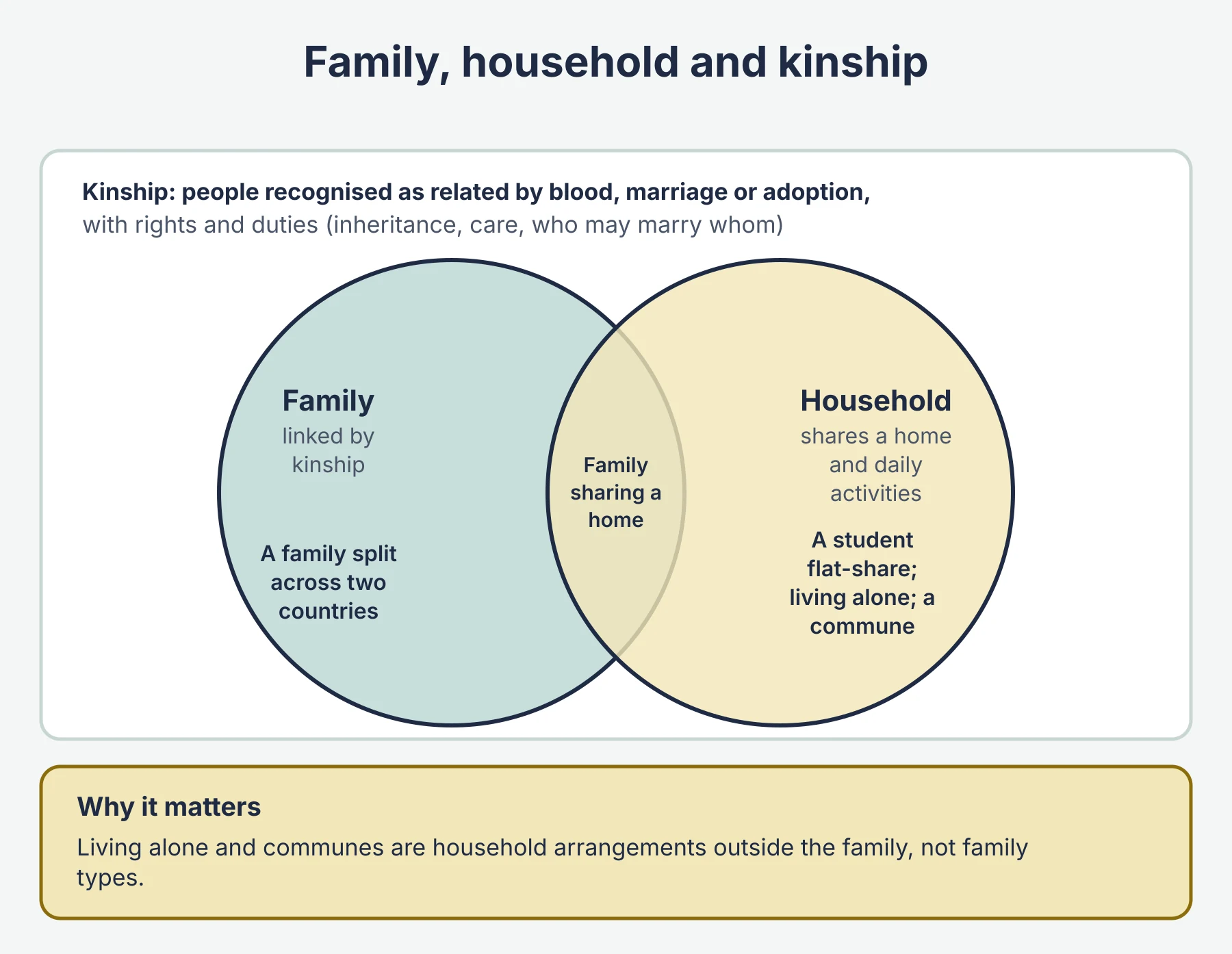
- Kinship is the network of people recognised as related by blood, marriage or adoption, and the rights and duties that come with that recognition (who inherits, who must be cared for, who may marry whom).
- A family is a group of people linked by kinship, though they need not live together.
- A household is a person or group sharing a home and usually some daily activities. A student flat-share is a household but not a family; a family split across two countries is a family but not one household.
Keeping these apart lets you answer questions about living alone or communes, which are household arrangements outside the family rather than family types.
Types of family
Nuclear family. Two generations: parents (traditionally a married couple) and their dependent children. George Peter Murdock’s Social Structure (1949), a comparative study of around 250 societies, claimed the nuclear family was universal. Critics point to societies and groups where child-rearing is shared beyond the couple, which is why “alternatives to families” matter.
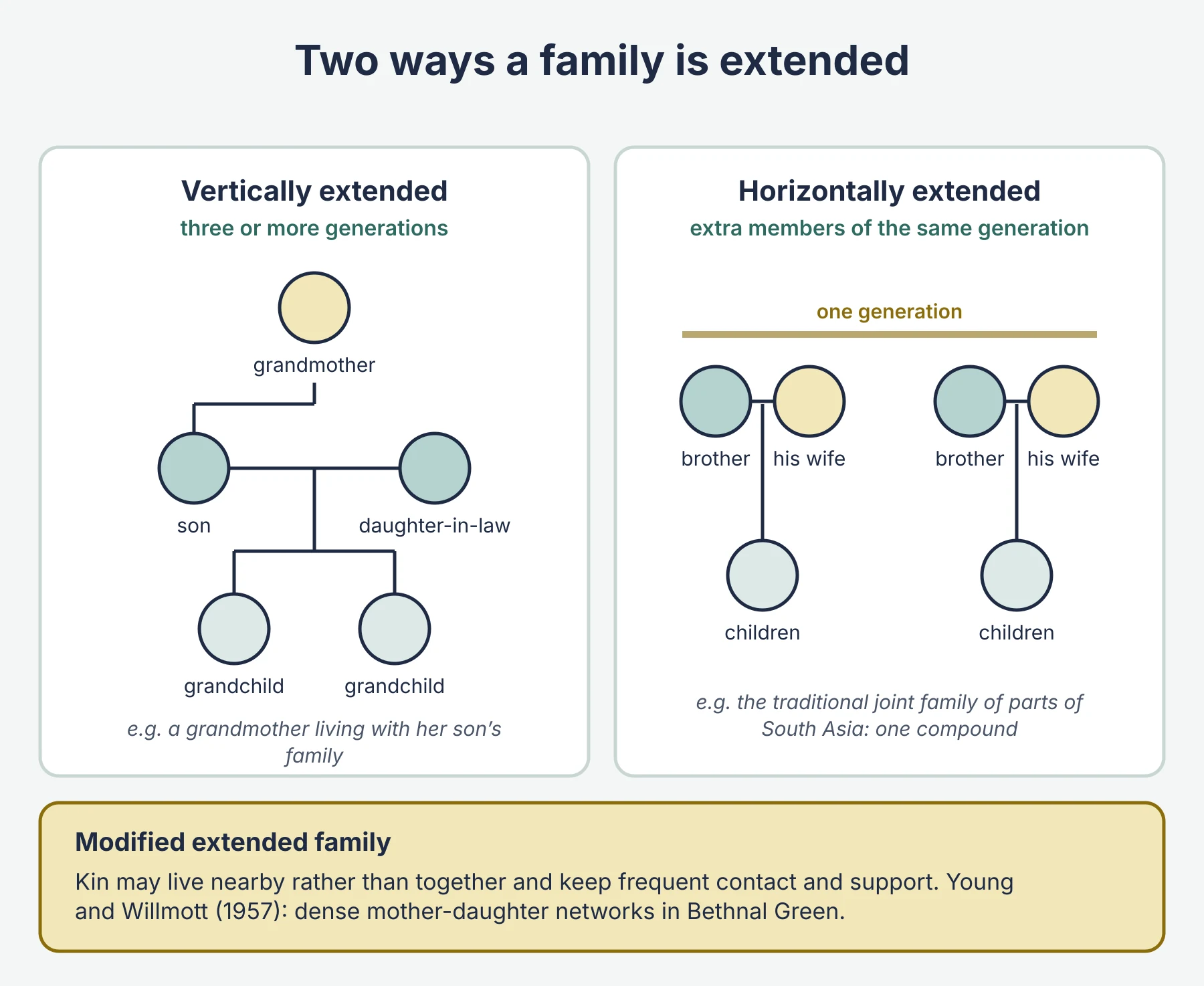
Extended family. Any family wider than the nuclear unit. The specification asks for two forms.
| Form | Meaning | Example |
|---|---|---|
| Vertically extended | Three or more generations, e.g. grandparents, parents and children | A grandmother living with her son, daughter-in-law and grandchildren |
| Horizontally extended | Extra members from the same generation, e.g. brothers, their wives, or cousins | Married brothers and their families sharing one compound, as in the traditional joint family of parts of South Asia |
Extended families may share a home (classic extended) or live nearby and keep frequent contact and support (sometimes called the modified extended family). Michael Young and Peter Willmott’s Family and Kinship in East London (1957) found dense mother-daughter networks in Bethnal Green before families were rehoused to new estates.
Single-parent family. One parent with dependent children, created by divorce, separation, death of a partner or birth outside a couple. Most are headed by mothers in most societies, though the reasons for single parenthood, and how it is viewed, differ widely.
Alternatives to families
| Alternative | What it involves | Sociological point |
|---|---|---|
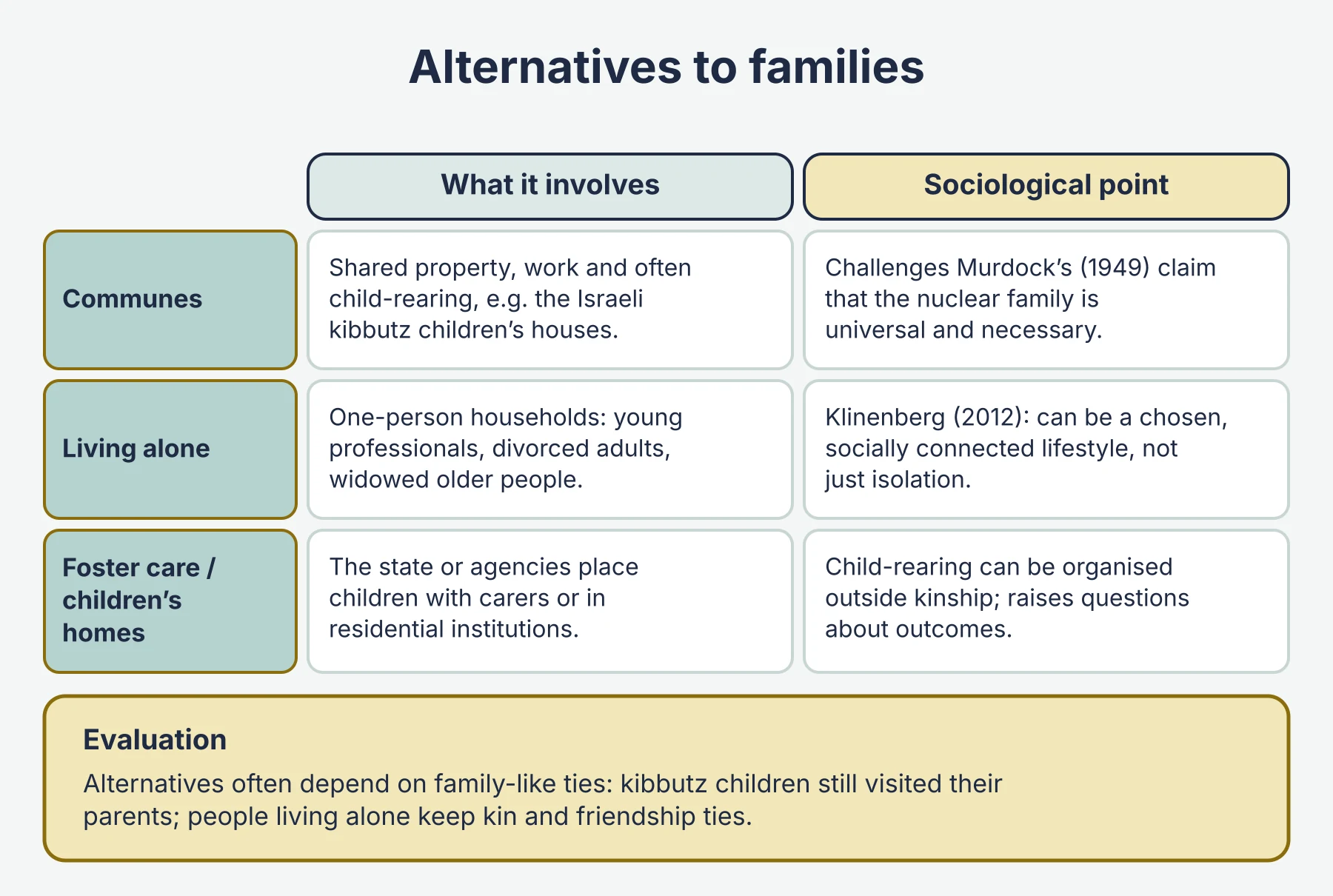
| Communes | Groups sharing property, work and often child-rearing, such as the Israeli kibbutz, where children traditionally spent much of their time in collective children’s houses | Challenges Murdock’s claim that the nuclear family is universal and necessary |
| Living alone | One-person households, often young professionals, divorced adults or widowed older people | Eric Klinenberg’s Going Solo (2012) argues living alone can be a chosen, socially connected lifestyle, not just isolation |
| Foster care / children’s homes | The state or agencies place children with carers or in residential institutions | Shows that child-rearing can be organised outside kinship, and raises questions about outcomes for children in care |
A useful evaluation point: alternatives often depend on family-like relationships. Kibbutz children still knew and visited their parents; people living alone usually keep kin and friendship ties.
Therborn’s types of family system
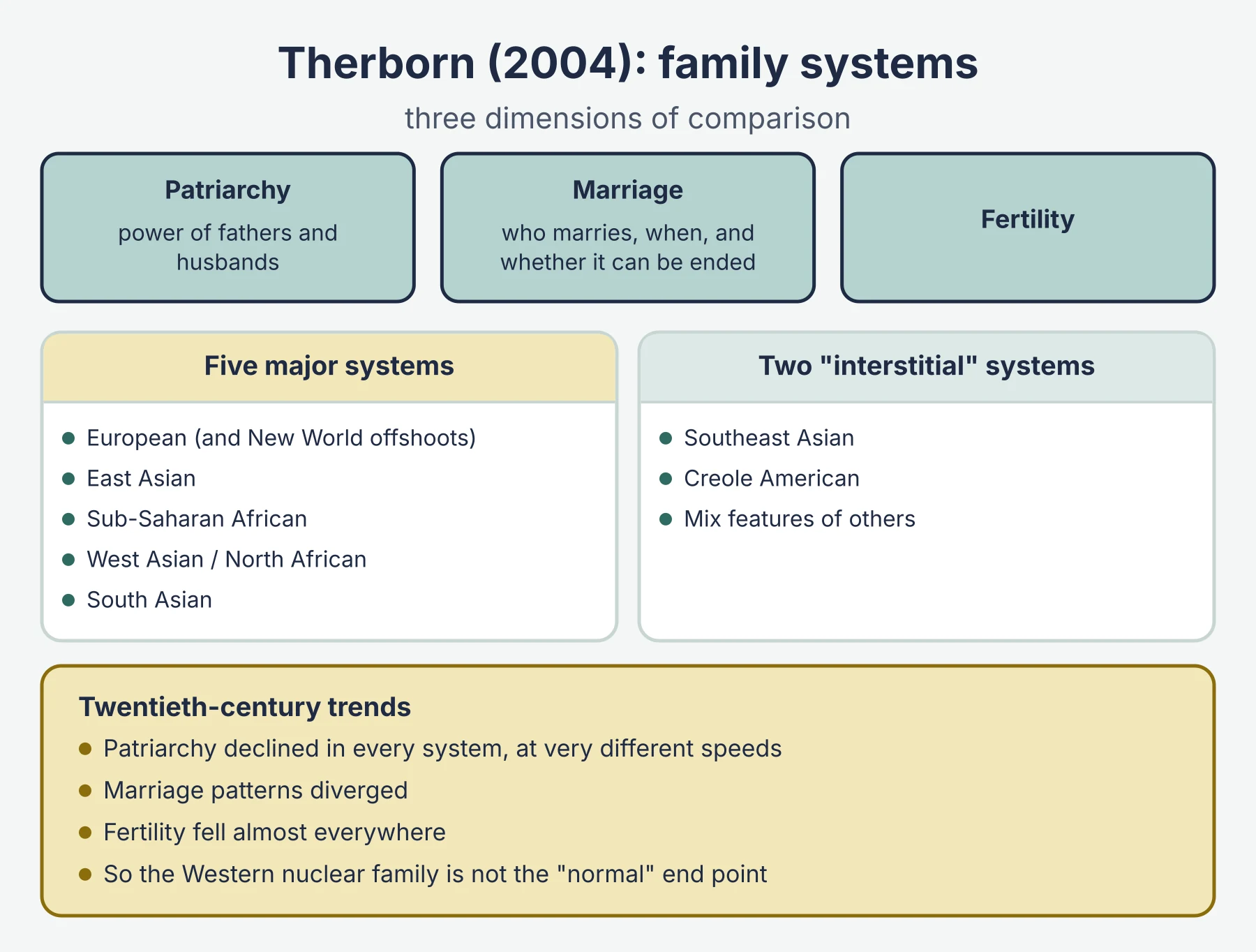
Göran Therborn’s Between Sex and Power: Family in the World, 1900–2000 (2004) compares family systems across world regions on three dimensions: patriarchy (the power of fathers and husbands), marriage (who marries, when, and whether it can be ended) and fertility. He identifies five major systems, broadly European (including its New World offshoots), East Asian, sub-Saharan African, West Asian/North African and South Asian, plus two “interstitial” systems, Southeast Asian and Creole American, which mix features of others.
His main argument is that patriarchy declined across the twentieth century in every system, but at very different speeds and from different starting points; marriage patterns diverged; and fertility fell almost everywhere. For exam purposes, Therborn is valuable because he:
- shows family forms are shaped by religion, law, colonial history and economy, not by industrialisation alone;
- gives you a framework for comparing your own society with others, which the specification requires in selected extended answers;
- warns against treating the Western nuclear family as the “normal” end point.
Matriarchal and patriarchal families
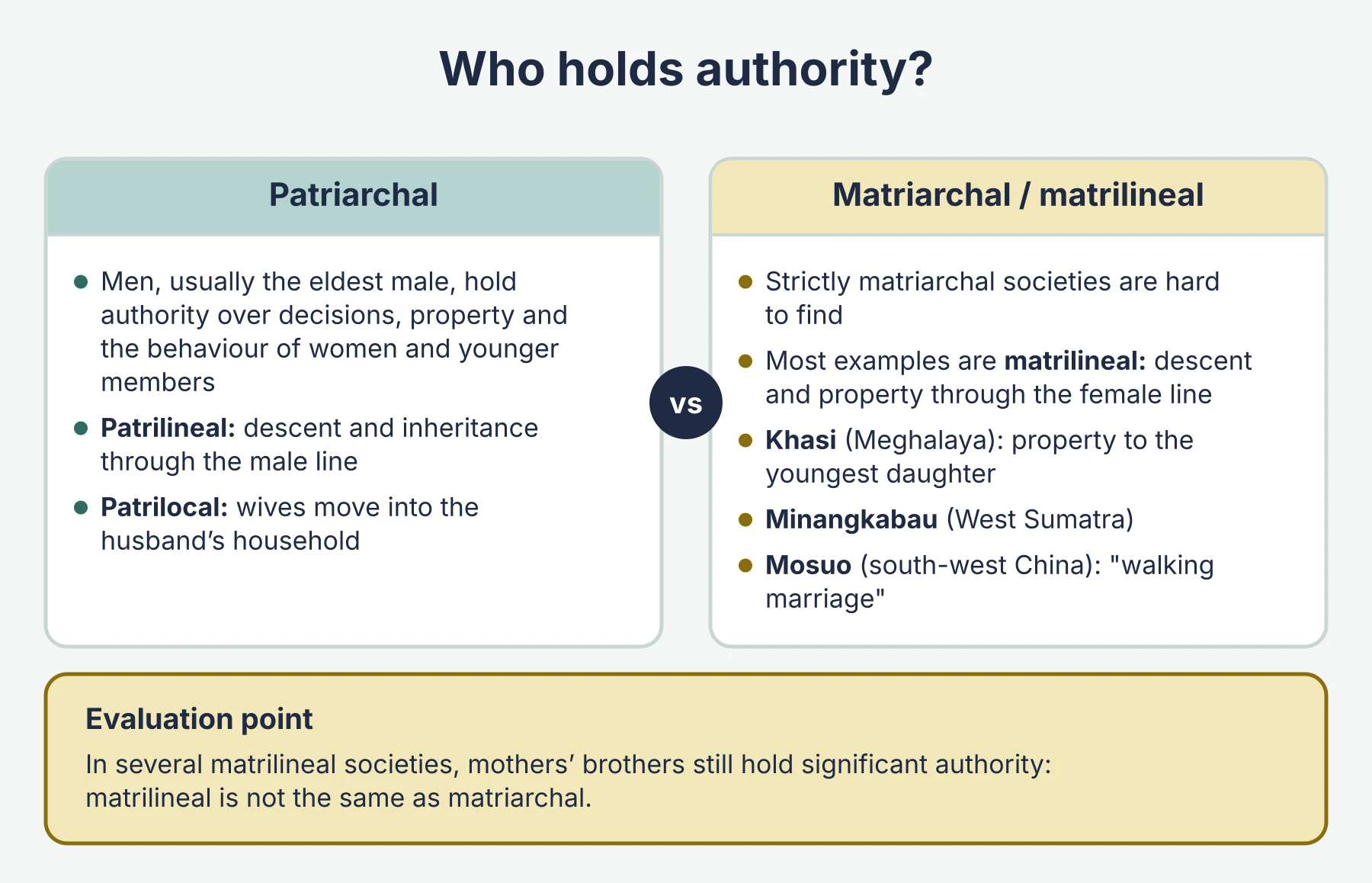
A patriarchal family is one in which men, usually the eldest male, hold authority over decisions, property and the behaviour of women and younger members. Descent and inheritance often pass through the male line (patrilineal) and wives often move into the husband’s household (patrilocal).
A matriarchal family is one in which women hold the main authority. Strictly matriarchal societies are hard to find; most examples are matrilineal (descent and property pass through the female line) rather than ruled by women. Examples sociologists use include the Khasi of Meghalaya in north-east India, where property traditionally passes to the youngest daughter, the Minangkabau of West Sumatra, and the Mosuo of south-west China, whose “walking marriage” lets partners live apart in their maternal households. In several matrilineal societies, mothers’ brothers still hold significant authority, which is a strong evaluation point.
Types of marriage
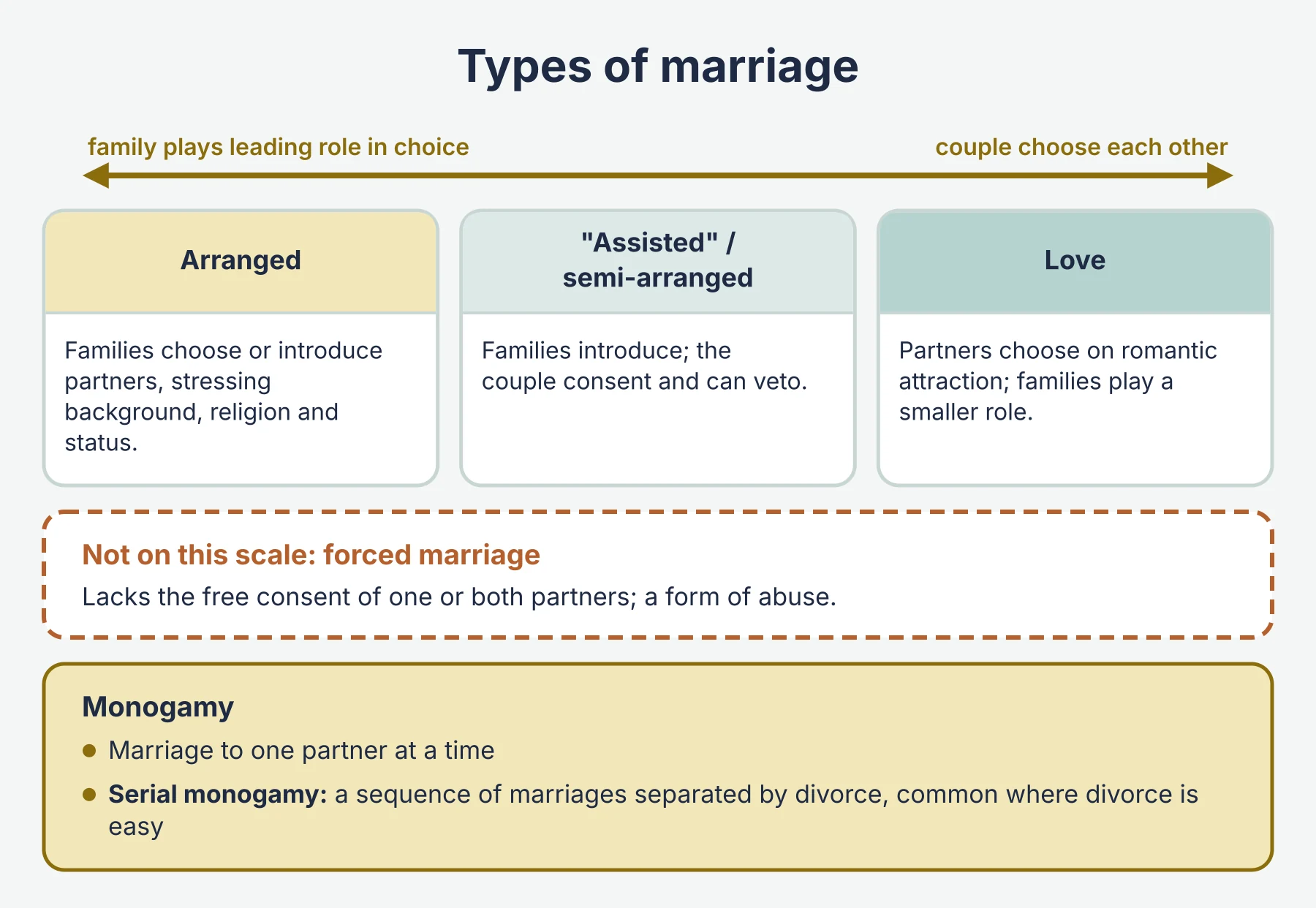
- Monogamy: marriage to one partner at a time. Serial monogamy (a sequence of marriages, separated by divorce) is common where divorce is easy.
- Arranged marriage: families play a leading role in choosing or introducing partners, often stressing compatibility of background, religion and status. Arranged marriage is not the same as forced marriage, which lacks the free consent of one or both partners and is a form of abuse. Many arranged marriages involve the couple’s consent and veto (“assisted” or semi-arranged marriage).
- Love marriage: partners choose each other on the basis of romantic attraction, with families playing a smaller role.
The specification notes that other types, such as polygamy, may be taught where appropriate to the local context; they are not directly assessed but are credited if used relevantly.
Worked example: an 8-mark answer
Explain two differences between arranged marriages and love marriages. (practice question)
Who chooses. In an arranged marriage, parents and wider kin take a leading role in choosing or introducing a partner, so marriage joins two families as well as two individuals. In a love marriage, the couple choose each other, reflecting individualisation, where personal feelings outweigh family strategy. However, the line is blurred: many arranged marriages give the couple a veto, and “love” choices are still shaped by class, religion and ethnicity.
The basis of the relationship. Love marriage rests on romantic attraction before marriage, while arranged marriage often expects affection to grow afterwards and stresses compatibility of background and the couple’s duties to both families. This can make arranged marriages more embedded in extended kin support, whereas love marriages depend more on the couple’s emotional satisfaction, which some sociologists link to higher divorce risk.
Why it works: each difference is identified, explained and developed with a qualification, and neither confuses arranged with forced marriage.
Common mistakes
- Defining an extended family without saying whether it is vertically or horizontally extended when the question asks.
- Calling living alone or communes “family types”: they are alternatives to families.
- Treating matrilineal and matriarchal as identical.
- Equating arranged marriage with forced marriage.
- Mentioning Therborn by name only; examiners reward his dimensions (patriarchy, marriage, fertility) and his comparative argument.
- Describing every society as moving towards the Western nuclear family.
Exam technique
The Families section mixes short and extended questions. In this course’s Marlbridge practice, define questions need a precise definition plus, ideally, an example; outline and explain questions need each point developed (why, with what effect); and evaluate questions need arguments for and against, a named society and a justified conclusion. Section 3.1.1.1 often provides the examples for extended answers elsewhere: Therborn and matrilineal societies are strong evidence against functionalist claims of a universal nuclear family.
- Condensed recall and a self-test: Families, marriage and kinship revision notes
- Exam-style questions with mark schemes: Families, marriage and kinship practice questions
- The theories that interpret these family types: perspectives on families study guide
Related resources
-
Practice questions
OxfordAQA International A-Level Sociology (9690): Families, Marriage and Kinship – Practice Questions
Original OxfordAQA 9690 Unit 1 style questions on family types, alternatives to families, Therborn, matriarchy and types of marriage, with mark schemes.
Sociology · OxfordAQA · AS Level
Try questions -
Revision notes
OxfordAQA International A-Level Sociology (9690): Families, Marriage and Kinship – Revision Notes
Revision notes for OxfordAQA 9690 section 3.1.1.1: extended, nuclear and single-parent families, alternatives, Therborn, matriarchy and marriage types.
Sociology · OxfordAQA · AS Level
Revise topic -
Practice questions
OxfordAQA A-Level Sociology (9690): Gender, Age and the Experience of Family Life — Practice Questions
Original OxfordAQA 9690 Unit 1 style questions on gender roles, the triple shift, domestic labour, children, boomerang families and older people.
Sociology · OxfordAQA · AS Level
Try questions
Related articles
Get free revision emails (optional)
Occasional emails with practice questions, worked explanations and links to free resources for the qualification and subjects you choose. No spam, and you can unsubscribe from any email. The free tools on this site never need an email.