
Revision Notes
OxfordAQA International A-Level Sociology (9690): Families, Marriage and Kinship – Revision Notes
Revision notes for OxfordAQA 9690 section 3.1.1.1: extended, nuclear and single-parent families, alternatives, Therborn, matriarchy and marriage types.
- Subject
- Sociology
- Level
- AS LEVEL
- Topic
- Unit 1 – Introducing Sociology
- Author
- Marlbridge Academic Team
- Updated
- Reviewed by
- Naqiya Yousaf (what this means)
Aligned to OxfordAQA A Level Sociology (9690), Version 1.1 (new qualification). Official specification .
Syllabus page (what it covers and how it is assessed): OxfordAQA A Level Sociology.
Syllabus points this page covers
9690 (AS Level)
- 3.1.1.1 Families, marriage and kinship
Found an error? Report a correction.
Need help with this topic? Request a free trial class for A Level Sociology (9690).
These notes condense 3.1.1.1 Families, marriage and kinship in OxfordAQA International AS/A level Sociology (9690), Unit 1 Section A. In one sentence: families take nuclear, extended and single-parent forms; some people live in alternatives such as communes, alone or in care; Therborn shows family systems differ by world region; authority and descent can run through men or women; and marriage can be arranged, love-based and monogamous.
Fuller explanation: Families, marriage and kinship study guide.
Specification checklist
- Types of family: extended (vertically and horizontally), nuclear, single parent.
- Alternatives to families: communes, living alone, foster care/children’s homes.
- Therborn’s types of family system.
- Variations between cultures: matriarchal and patriarchal families.
- Types of marriage: arranged, love, monogamy (other types such as polygamy are credited if used relevantly but not directly assessed).
Key terms
| Term | Definition |
|---|---|
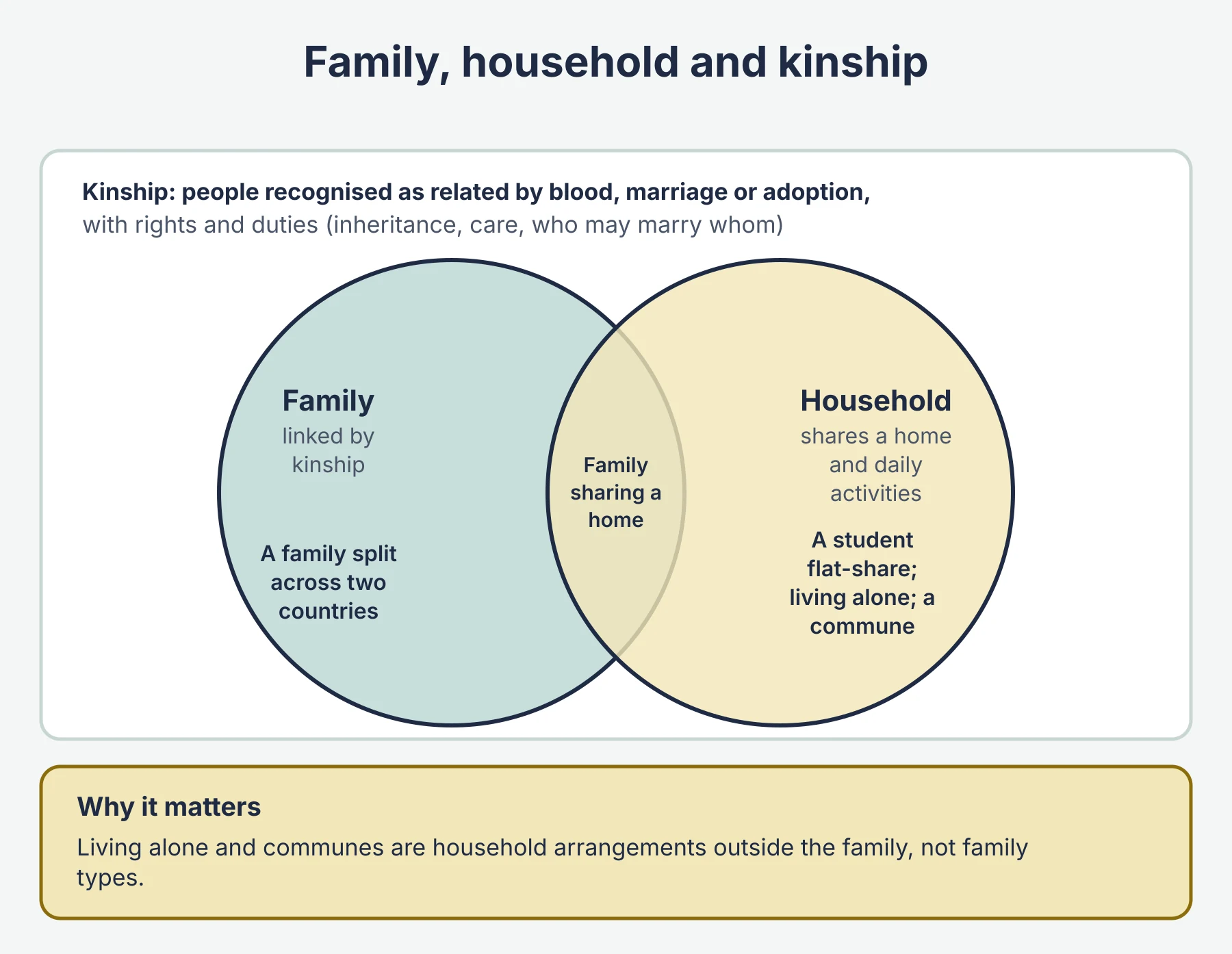
| Kinship | Relationships recognised through blood, marriage or adoption, with linked rights and duties |
| Household | A person or group sharing accommodation and daily life; need not be related |
| Nuclear family | Parents and their dependent children; two generations |
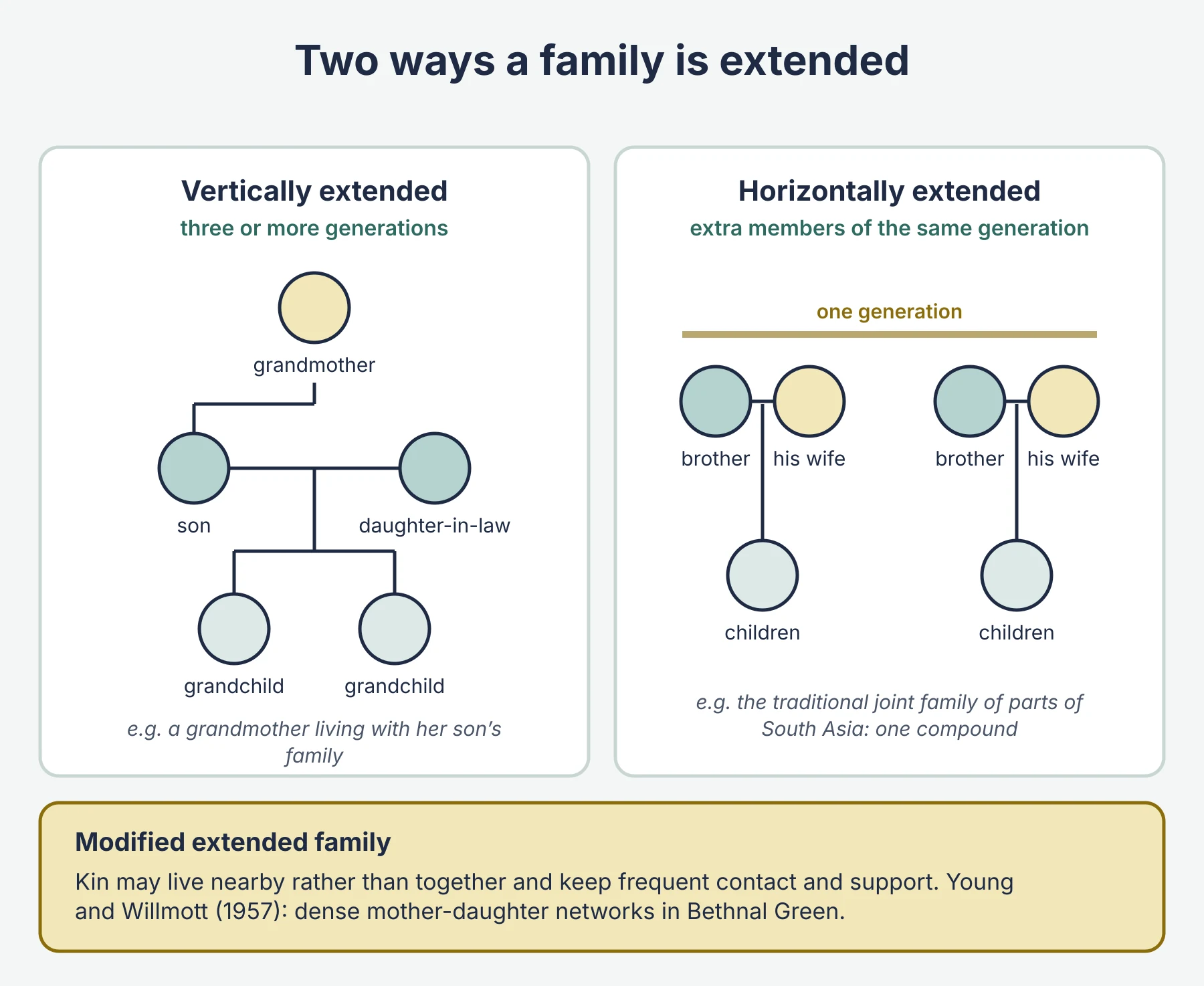
| Vertically extended family | Three or more generations of one family |
| Horizontally extended family | Additional members of the same generation, such as siblings and their spouses |
| Modified extended family | Kin who live apart but keep regular contact and support |
| Single-parent family | One parent with dependent children |
| Commune | A group sharing property, work and often child-rearing |
| Patriarchal family | Men hold authority over decisions, property and other members |
| Matriarchal family | Women hold the main authority |
| Matrilineal / patrilineal | Descent and inheritance traced through the female / male line |
| Monogamy / serial monogamy | One spouse at a time / a sequence of single marriages |
| Arranged marriage | Families take a leading role in choosing or introducing partners |
| Love marriage | Partners choose each other on the basis of romantic attraction |
Family types at a glance
- Nuclear: Murdock (1949) claimed it was universal after comparing around 250 societies. Critics use communes and matrilineal societies against him.
- Vertically extended: grandparents, parents and children; often linked to care of older people and shared childcare.
- Horizontally extended: for example, married brothers and their families in a joint household.
- Single parent: arises through divorce, separation, death or birth outside a couple; usually mother-headed.
- Young and Willmott (1957) found strong extended kin ties in working-class Bethnal Green.
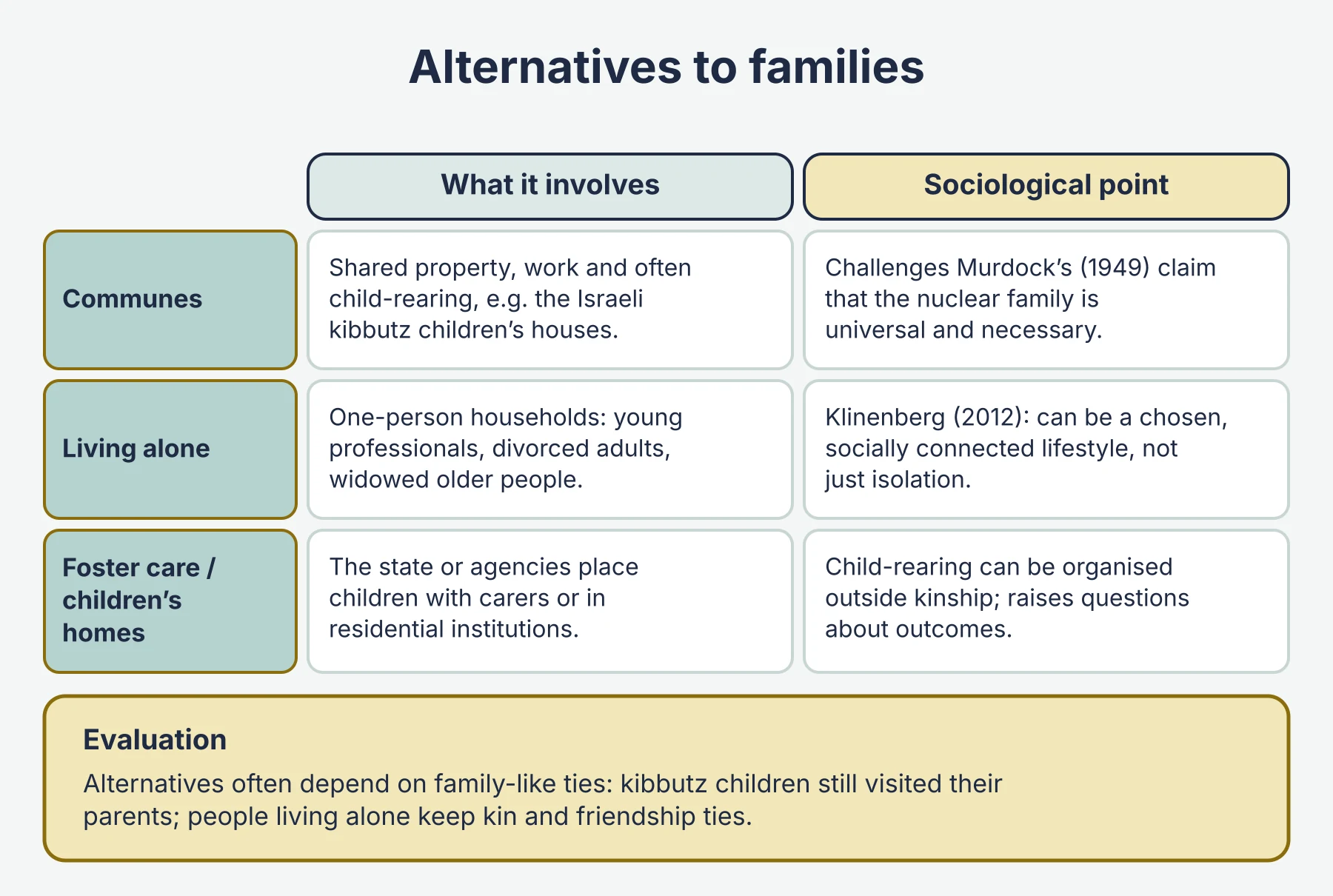
Alternatives to families
- Communes: the kibbutz raised children collectively in children’s houses; parents still kept relationships with children.
- Living alone: Klinenberg (2012), Going Solo, sees it as often chosen and socially connected.
- Foster care/children’s homes: child-rearing organised by the state or agencies, outside kinship.
Therborn’s family systems
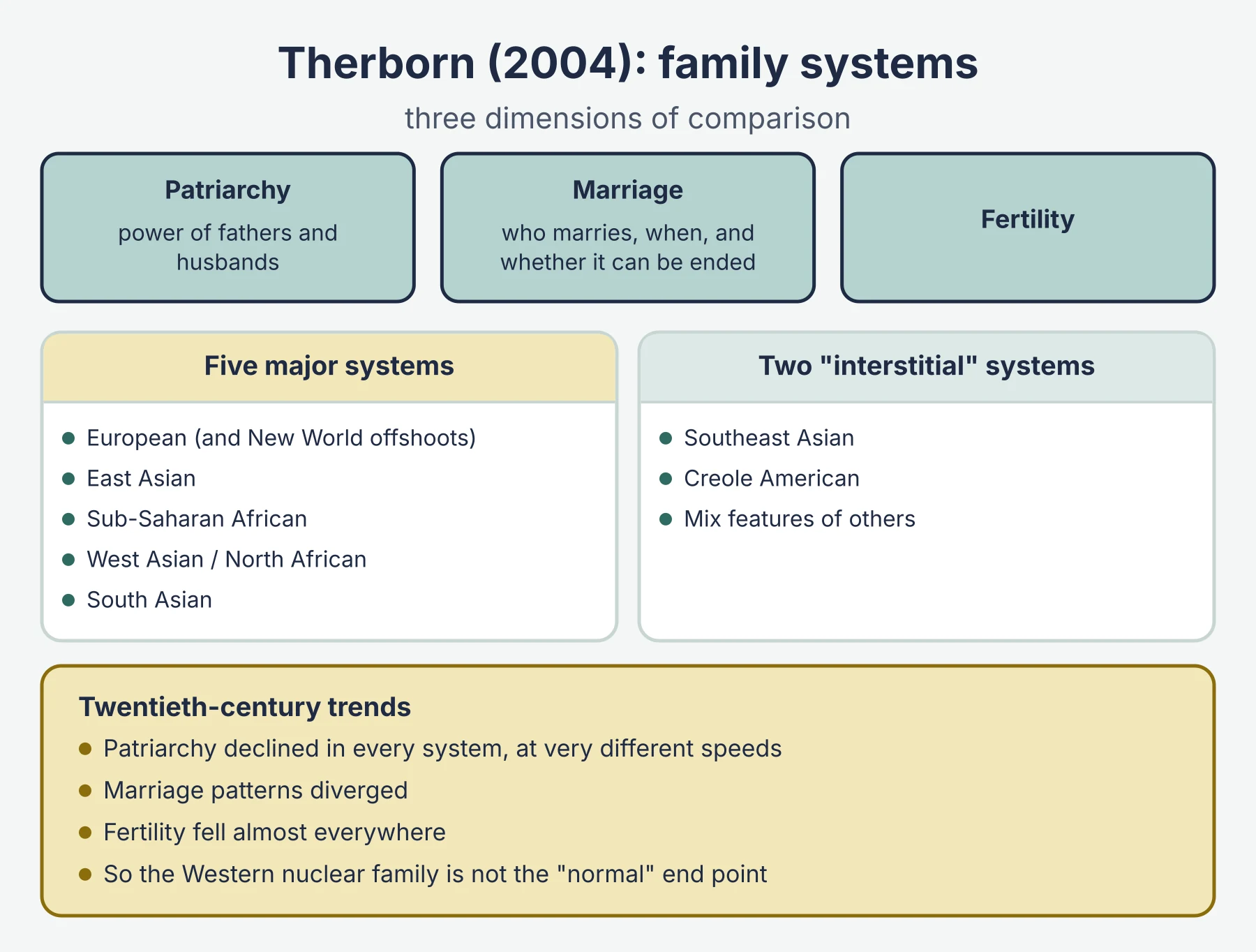
- Source: Between Sex and Power: Family in the World, 1900–2000 (2004).
- Three dimensions compared: patriarchy, marriage, fertility.
- Five major systems: European (with New World offshoots), East Asian, sub-Saharan African, West Asian/North African, South Asian; two interstitial: Southeast Asian, Creole American.
- Argument: patriarchy declined everywhere in the twentieth century, but unevenly; fertility fell widely; marriage patterns did not converge on one model.
- Use: comparative evidence against one universal or “normal” family.
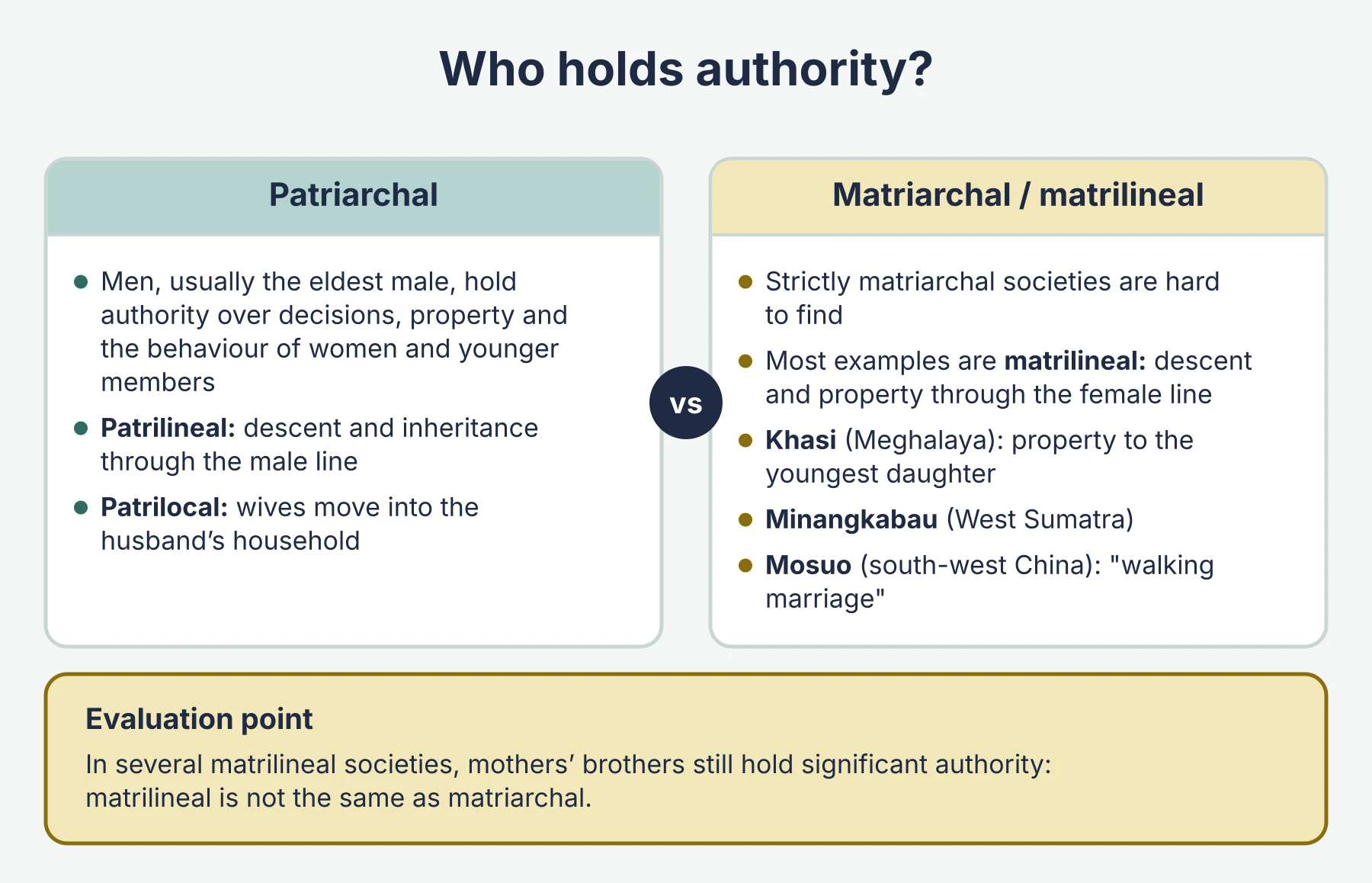
Matriarchy and patriarchy
- Patriarchal families are often also patrilineal and patrilocal.
- True matriarchies are rare; most cited cases are matrilineal: Khasi (north-east India), Minangkabau (West Sumatra), Mosuo (south-west China).
- Evaluation: in some matrilineal groups a mother’s brother holds authority, so matrilineal does not mean women rule.
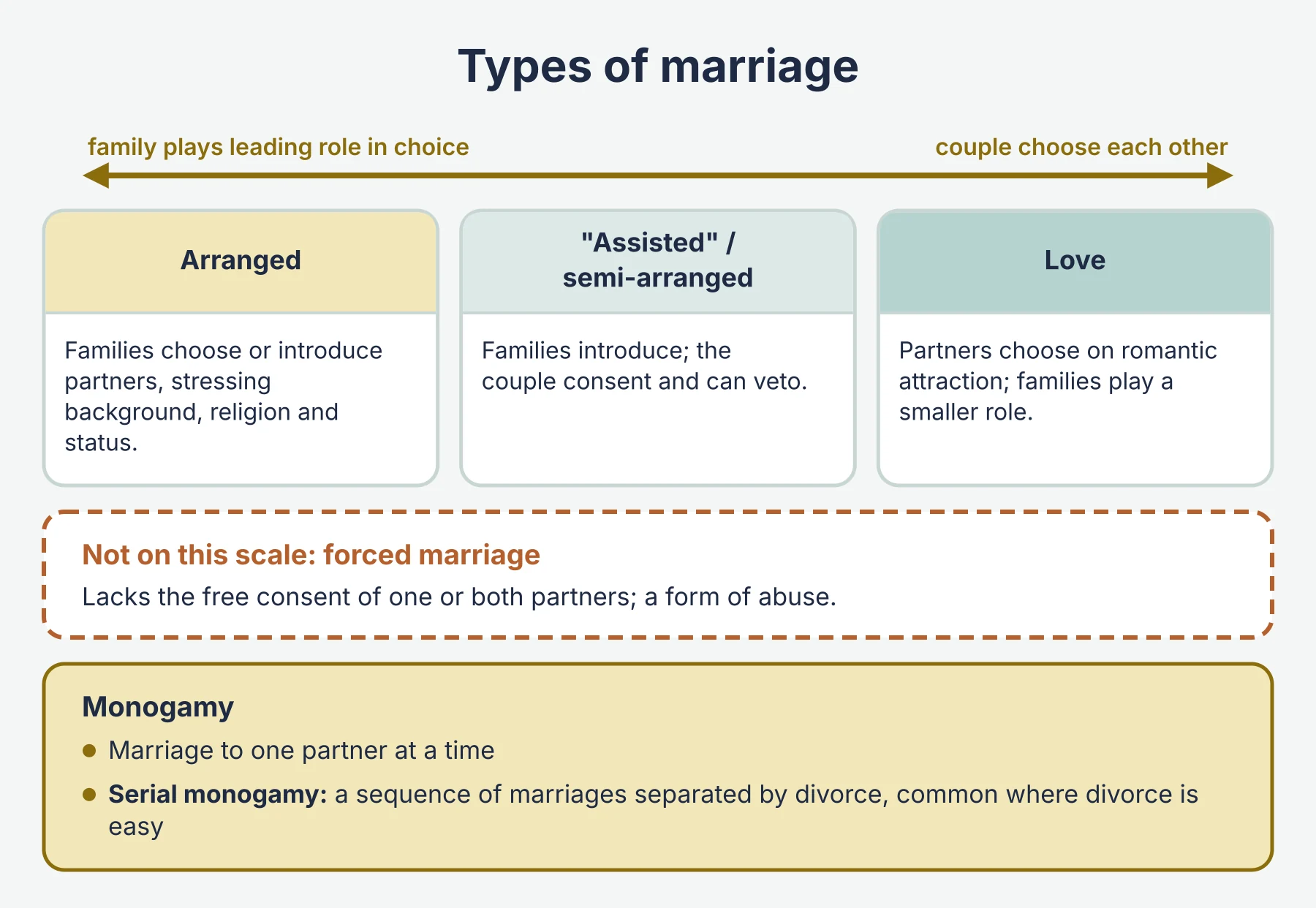
Marriage types
| Type | Key features | Evaluation |
|---|---|---|
| Arranged | Families choose or introduce; marriage links families | Not the same as forced marriage; many involve consent and veto |
| Love | Couple chooses; romance before marriage | Choice still shaped by class, religion and ethnicity |
| Monogamy | One spouse at a time | Serial monogamy common where divorce is easy |
Exam traps
- Calling communes or living alone a family type: they are alternatives to families.
- Confusing matrilineal with matriarchal.
- Treating arranged and forced marriage as the same thing.
- Forgetting to say vertical or horizontal when describing an extended family.
- Naming Therborn without his three dimensions or his comparative conclusion.
- Assuming all societies are moving towards the Western nuclear family.
Linking forward
- 3.1.1.2: functionalists use the nuclear family as the “fit” with industrial society; Marxists and feminists question whose interests it serves.
- 3.1.1.3: newer types (beanpole, reconstituted, living apart together) build on these basic forms.
- 3.1.1.4: patriarchal authority links to power and decision-making within families.
Self-test
- What is the difference between a family and a household?
- Define a vertically extended family.
- Give an example of a horizontally extended family.
- Name the three alternatives to families in the specification.
- Which sociologist claimed the nuclear family was universal, and when?
- What three dimensions does Therborn use to compare family systems?
- Name two of Therborn’s five major family systems.
- What is the difference between matrilineal and matriarchal?
- Give one example of a matrilineal society.
- How does an arranged marriage differ from a forced marriage?
- What is serial monogamy?
- Give one way living alone may be compatible with strong social ties.
Answers
- A family is linked by kinship; a household is people sharing a home, who may or may not be related.
- A family with three or more generations, such as grandparents, parents and children.
- Married brothers and their wives and children living together, as in a traditional joint family.
- Communes, living alone, and foster care/children’s homes.
- Murdock, Social Structure (1949).
- Patriarchy, marriage and fertility.
- Any two of: European, East Asian, sub-Saharan African, West Asian/North African, South Asian.
- Matrilineal means descent passes through women; matriarchal means women hold authority.
- The Khasi, the Minangkabau or the Mosuo.
- An arranged marriage can involve both partners’ consent; a forced marriage lacks free consent.
- A series of marriages, one at a time, separated by divorce or death.
- Klinenberg argues people living alone often keep active friendship, kin and community networks.
Practise next: Families, marriage and kinship practice questions | Introducing Sociology study guide
Related resources
-
Practice questions
OxfordAQA A-Level Sociology (9690): Gender, Age and the Experience of Family Life — Practice Questions
Original OxfordAQA 9690 Unit 1 style questions on gender roles, the triple shift, domestic labour, children, boomerang families and older people.
Sociology · OxfordAQA · AS Level
Try questions -
Study guides
OxfordAQA International A-Level Sociology (9690): Gender, Age and the Experience of Family Life
Study guide to OxfordAQA 9690 section 3.1.1.4: conjugal roles, domestic labour, power, violence, childhood, boomerang children and older people in families.
Sociology · OxfordAQA · AS Level
Read guide -
Revision notes
OxfordAQA International A-Level Sociology (9690): Gender, Age and the Experience of Family Life – Revision Notes
Revision notes for OxfordAQA 9690 section 3.1.1.4: expressive and instrumental roles, triple shift, domestic labour, power, childhood and older people.
Sociology · OxfordAQA · AS Level
Revise topic
Related articles
Get free revision emails (optional)
Occasional emails with practice questions, worked explanations and links to free resources for the qualification and subjects you choose. No spam, and you can unsubscribe from any email. The free tools on this site never need an email.