
Revision Notes
OxfordAQA International A-Level Sociology (9690): Gender, Age and the Experience of Family Life – Revision Notes
Revision notes for OxfordAQA 9690 section 3.1.1.4: expressive and instrumental roles, triple shift, domestic labour, power, childhood and older people.
- Subject
- Sociology
- Level
- AS LEVEL
- Topic
- Unit 1 – Introducing Sociology
- Author
- Marlbridge Academic Team
- Updated
- Reviewed by
- Naqiya Yousaf (what this means)
Aligned to OxfordAQA A Level Sociology (9690), Version 1.1 (new qualification). Official specification .
Syllabus page (what it covers and how it is assessed): OxfordAQA A Level Sociology.
Syllabus points this page covers
9690 (AS Level)
- 3.1.1.4 Gender, age and the experience of family life
Found an error? Report a correction.
Need help with this topic? Request a free trial class for A Level Sociology (9690).
These notes condense 3.1.1.4 Gender, age and the experience of family life in OxfordAQA International AS/A level Sociology (9690), Unit 1 Section A. Core idea: family life is experienced unequally. Gender shapes work, power and safety; age shapes status, from childhood through adult children returning home to older people and grandparents.
Full explanation: gender, age and the experience of family life study guide.
Specification checklist
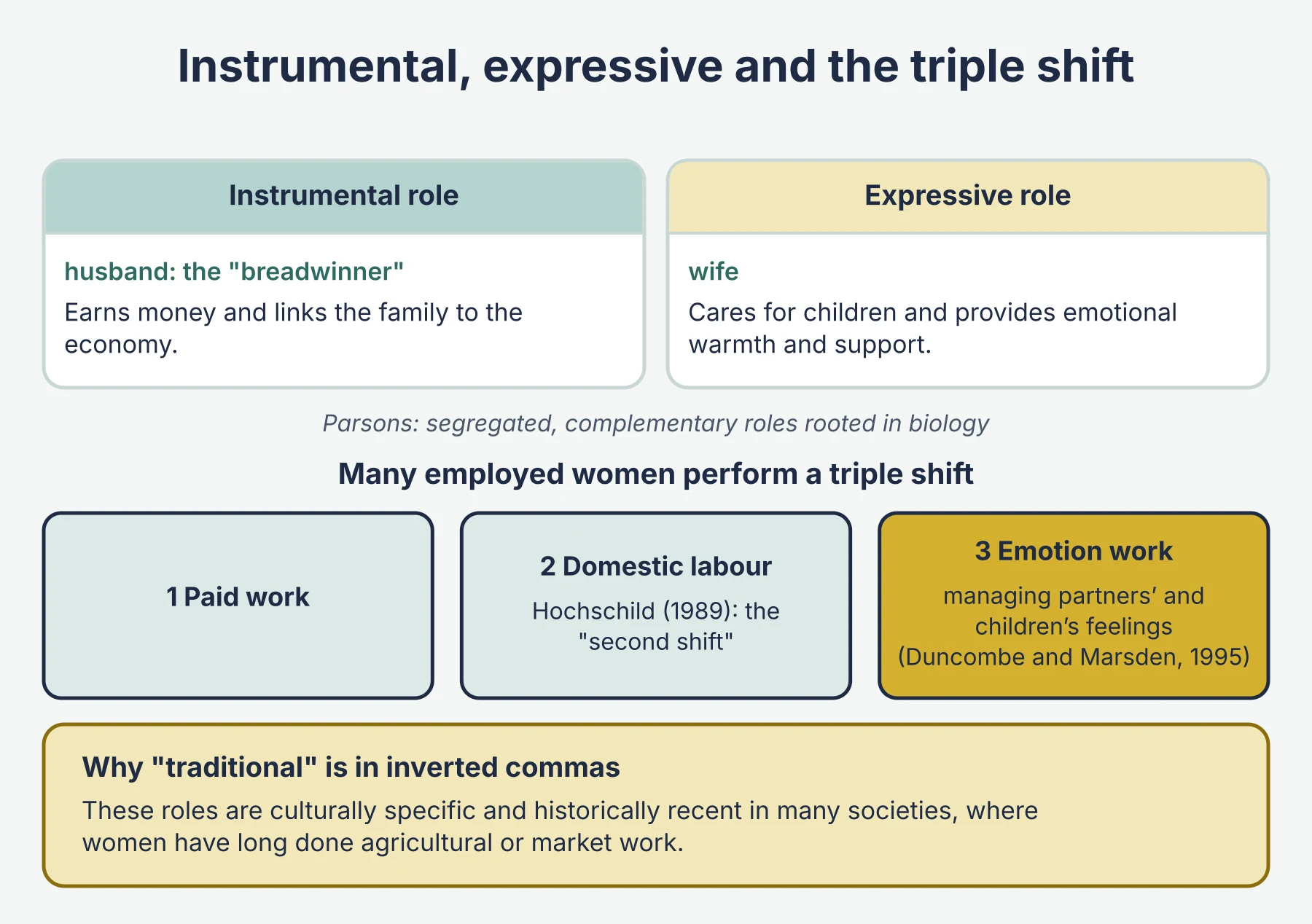
- “Traditional” roles: female/expressive role (emotional support, triple shift); male/instrumental or breadwinner role.
- Changes to these roles and reasons.
- Division of domestic labour; gender differences in power and decision making.
- Violence against women and children.
- Children: status and roles in different societies; changes over time; child centredness.
- Adult children, including boomerang families.
- Older people: status and roles in different societies, including grandparent roles.
Key terms
| Term | Definition |
|---|---|
| Conjugal roles | Roles of partners within a marriage or couple |
| Segregated / joint roles | Separate tasks and leisure / shared tasks and leisure |
| Instrumental role | Breadwinning role linking the family to the economy (Parsons) |
| Expressive role | Caring, emotional role (Parsons) |
| Emotion work | Managing the feelings of others in the family |
| Triple shift | Paid work + domestic labour + emotion work (Duncombe and Marsden, 1995) |
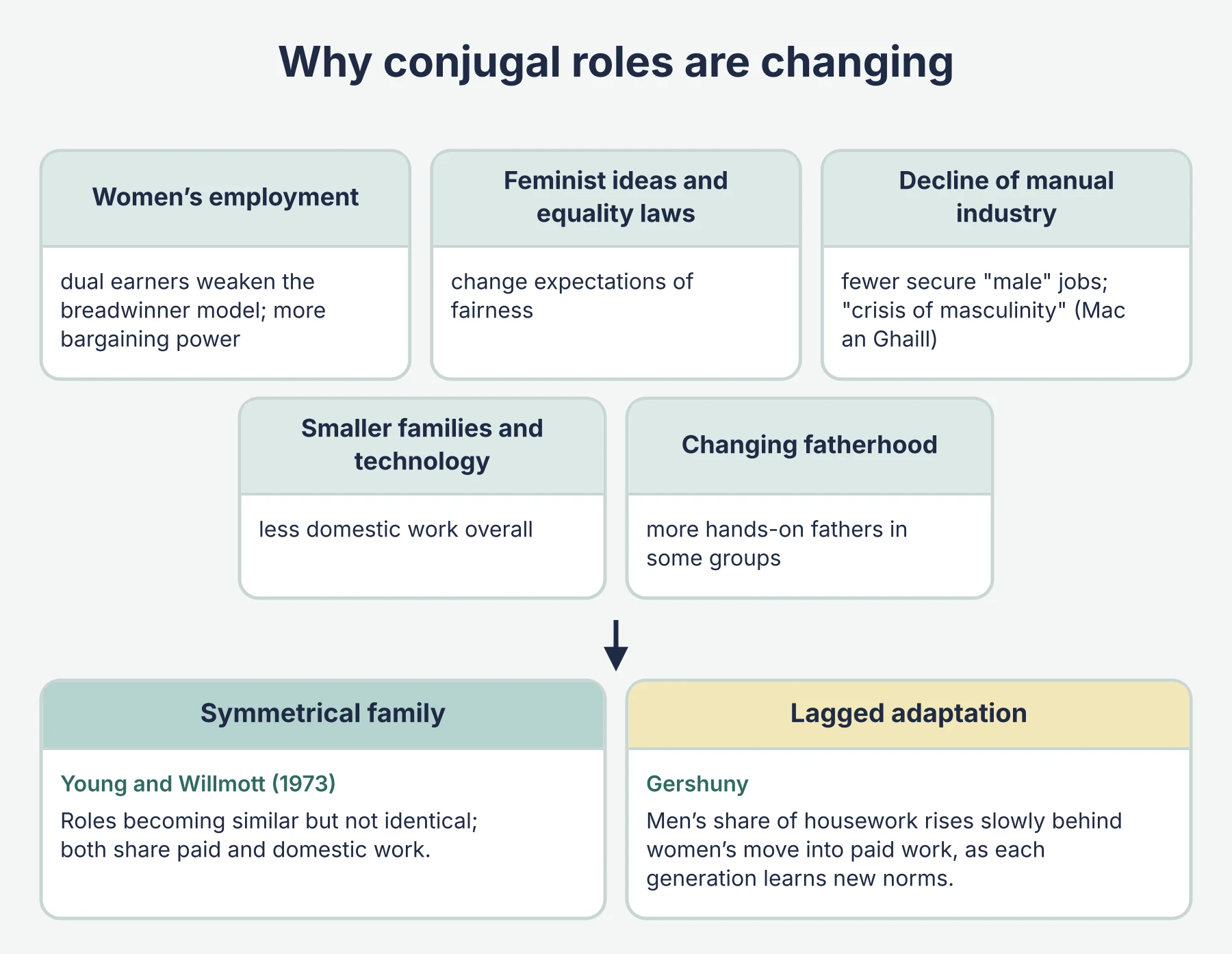
| Symmetrical family | Partners’ roles similar though not identical (Young and Willmott, 1973) |
| Lagged adaptation | Men’s domestic share slowly catching up with women’s paid work (Gershuny) |
| Child centredness | Family life organised around children’s needs |
| Age patriarchy | Adult domination of children (Gittins) |
| Boomerang family | Adult children returning to live with parents |
| Filial piety | Duty of respect and care owed by children to parents |
Gender: who does what
- Parsons: complementary instrumental and expressive roles, seen as natural.
- Young and Willmott (1973): towards the symmetrical family.
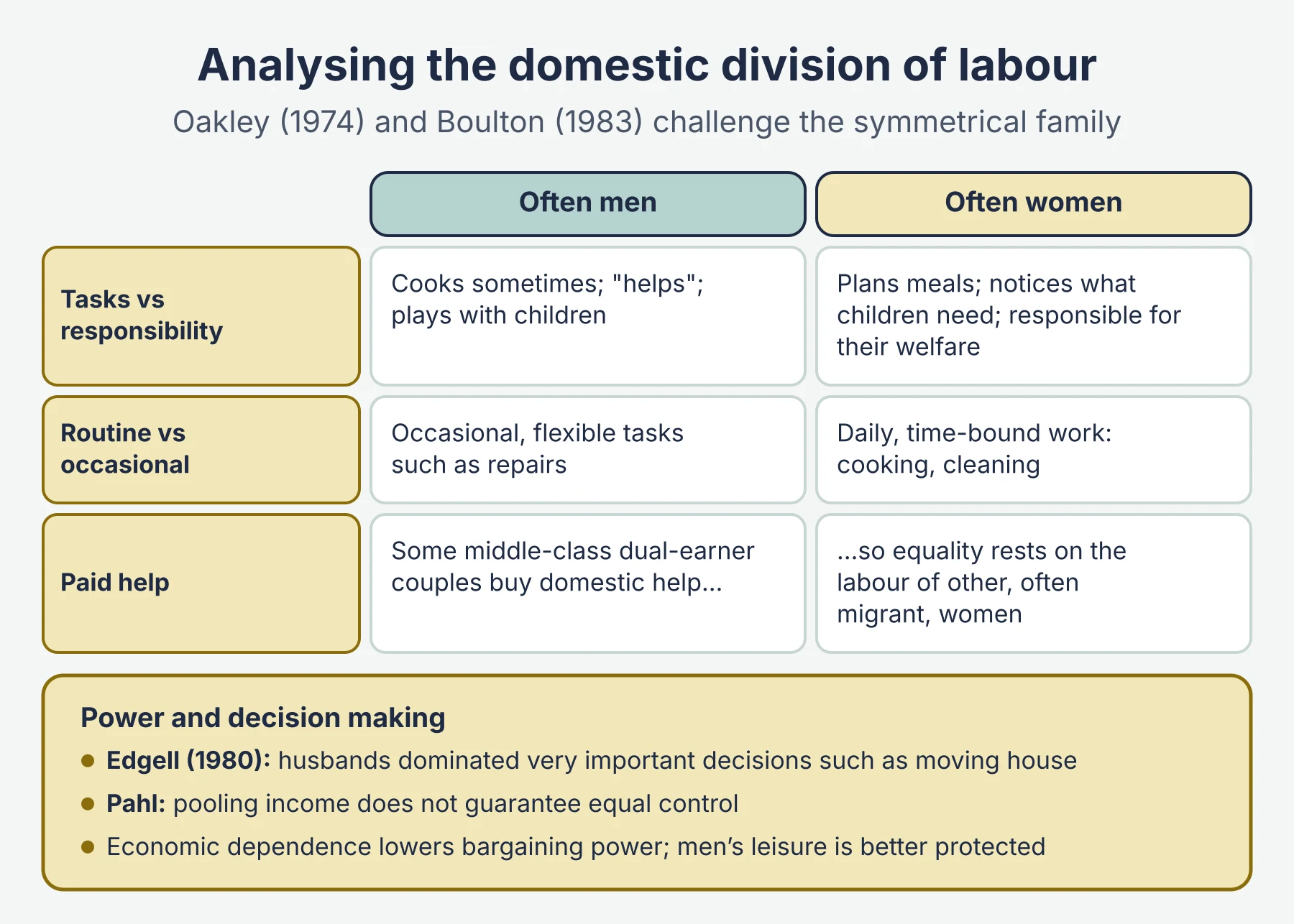
- Oakley (1974): little real sharing; men “help”; women keep responsibility.
- Boulton (1983): responsibility for children stays with mothers even when fathers help.
- Hochschild (1989): the second shift. Duncombe and Marsden (1995): triple shift and emotion work.
- Gershuny: lagged adaptation; change happens, but slowly.
Reasons roles have changed
- Women’s employment and education.
- Feminist ideas and equality legislation.
- Decline of manual industry; Mac an Ghaill’s “crisis of masculinity”.
- Smaller families and domestic technology.
- New expectations of involved fatherhood.
Power and decision making
| Evidence | Finding |
|---|---|
| Edgell (1980) | Husbands made very important decisions; wives made frequent, less important ones |
| Pahl | Pooling money does not guarantee equal control |
| Economic dependence | Lower-earning partner has less bargaining power |
Violence
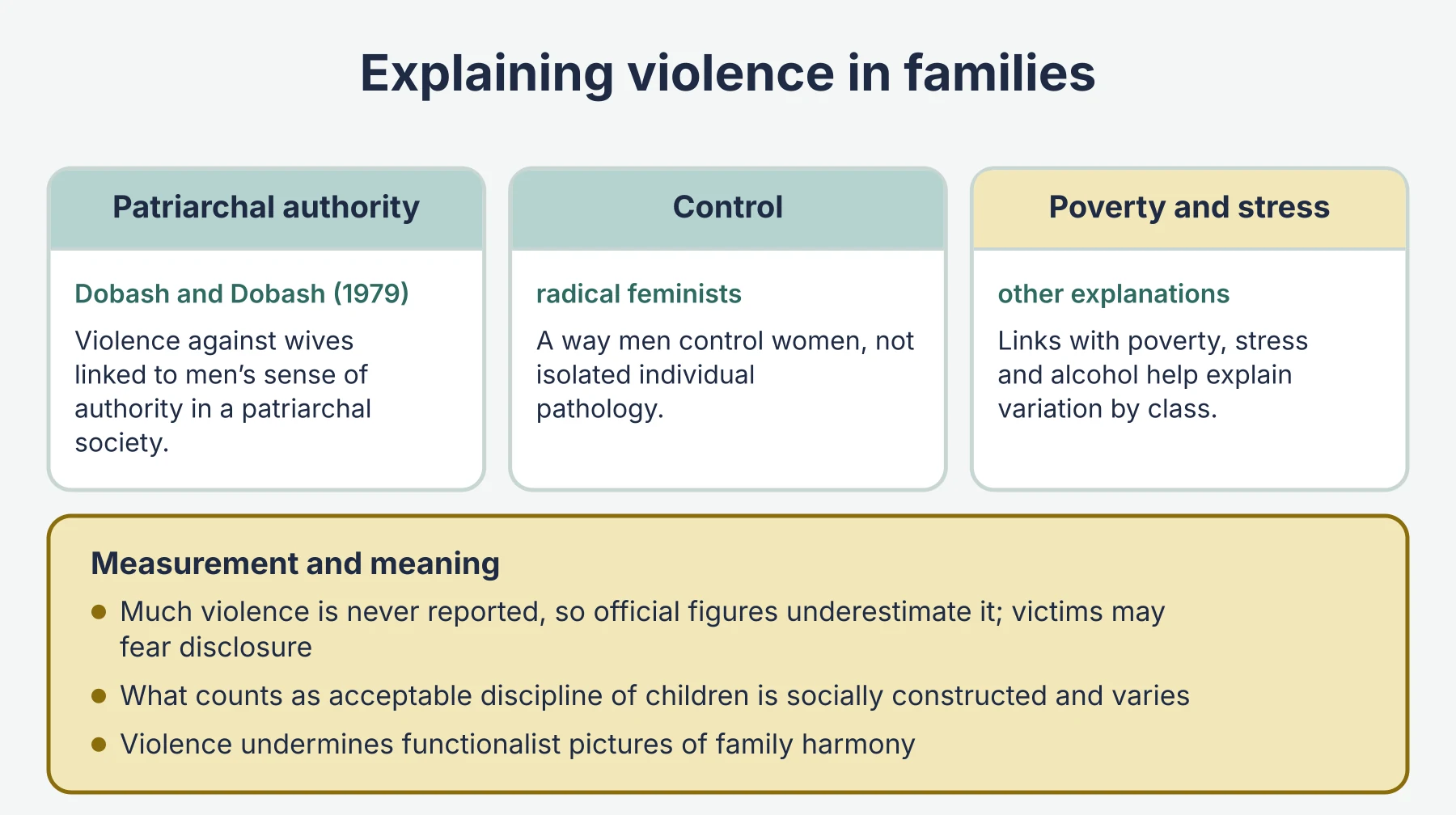
- Dobash and Dobash (1979): violence against wives linked to patriarchal authority.
- Radical feminists: violence as male control. Others: links with poverty and stress.
- Hidden: under-reported, so statistics underestimate it.
- Acceptable discipline of children is socially constructed and varies.
Age
| Group | Key points |
|---|---|
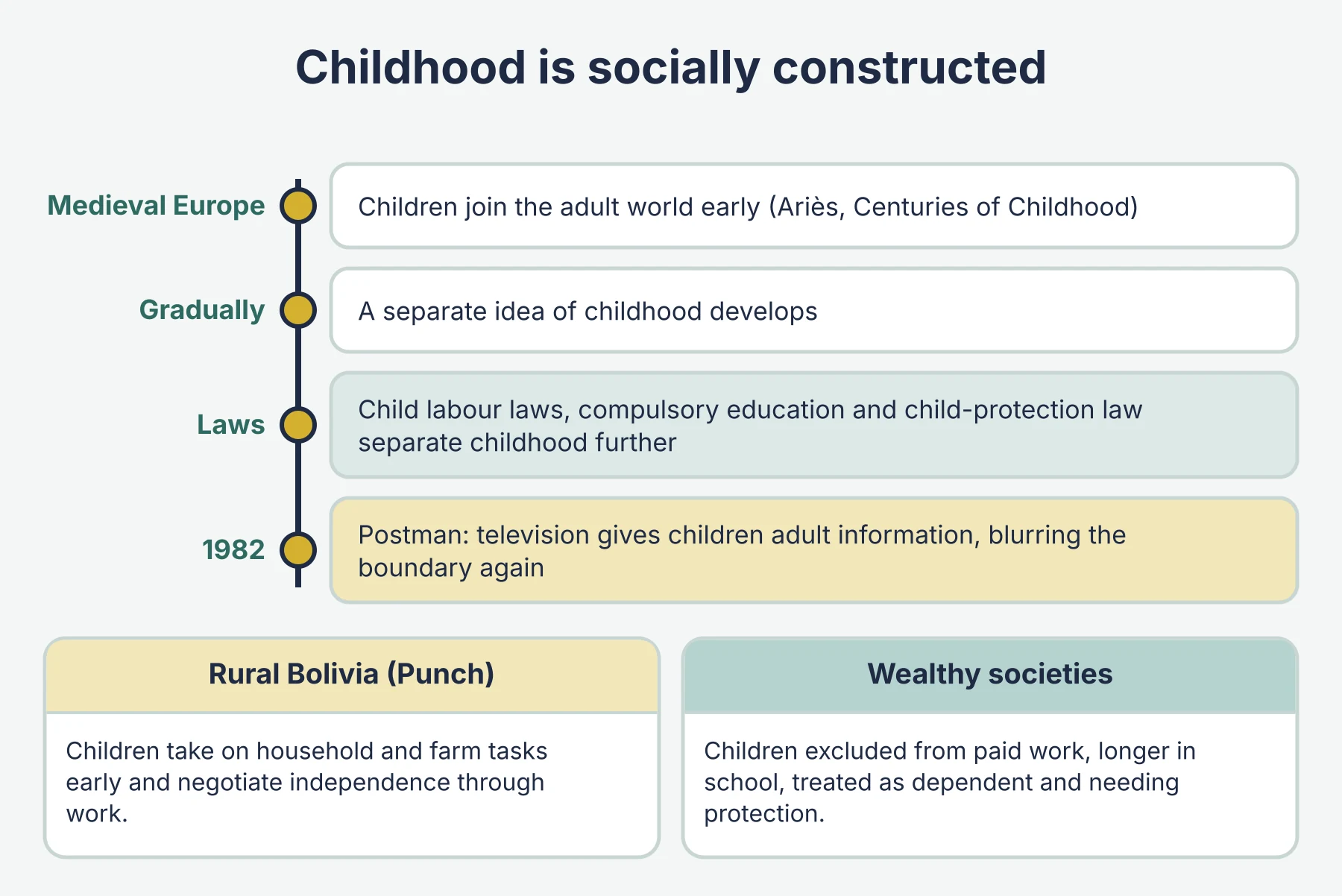
| Children | Work from young age in some societies (Punch, rural Bolivia); protected dependants in others; Ariès: childhood as a separate stage developed over centuries; Postman (1982): media blurring childhood |
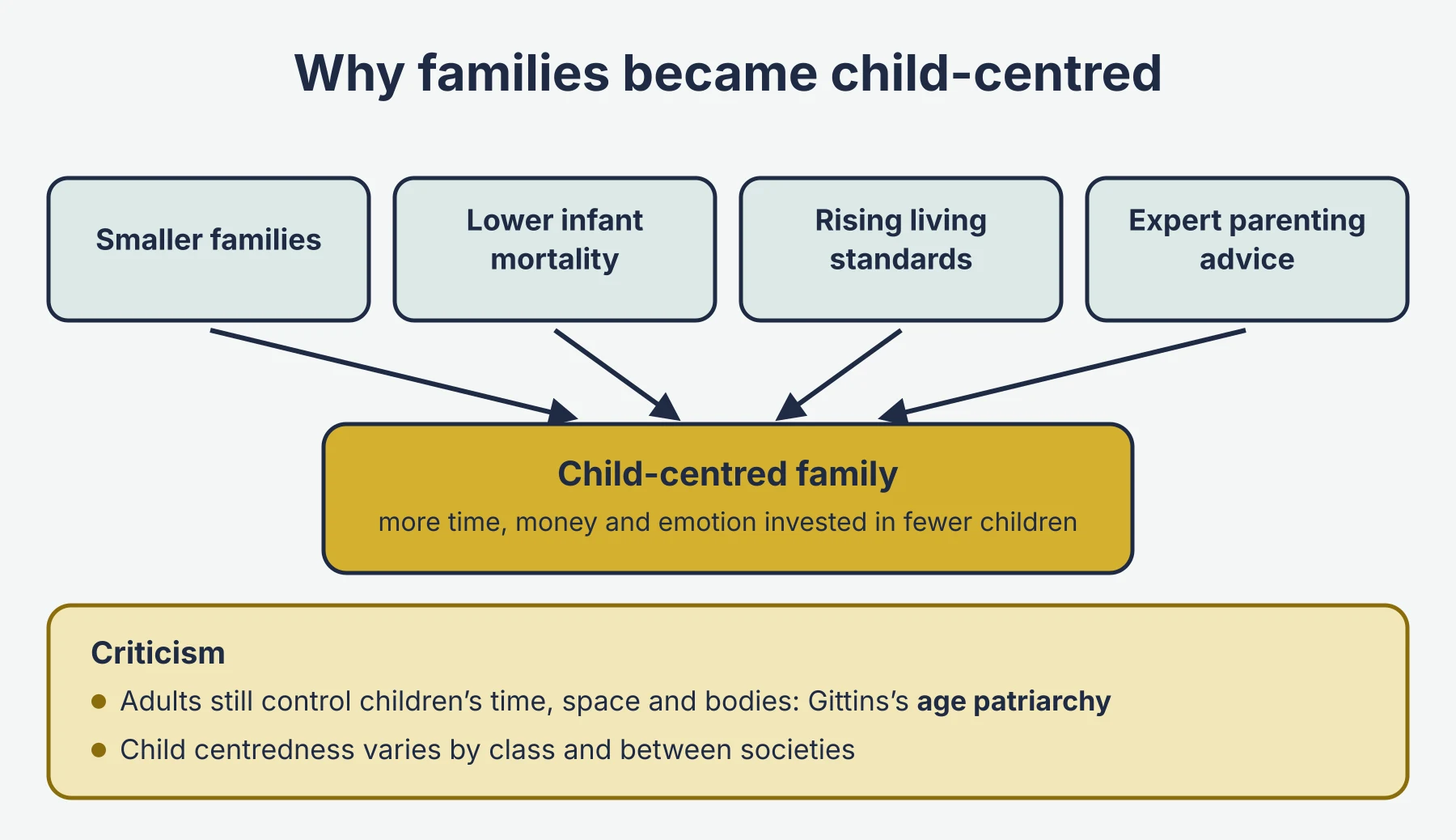
| Child centredness | Fewer children, more investment; critics: age patriarchy (Gittins), class and global variation |
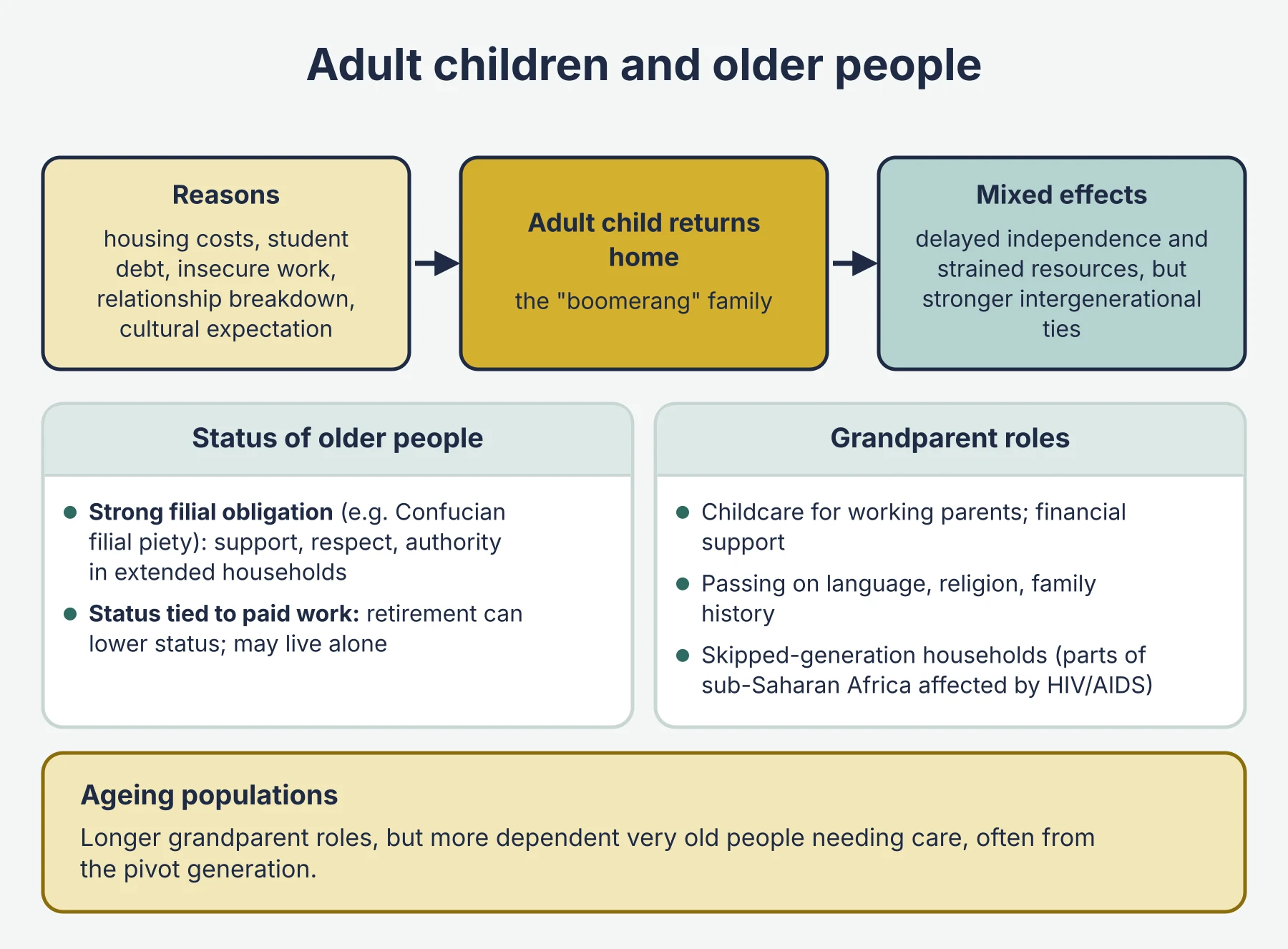
| Adult children | Boomerang families from housing costs, debt, insecure work, relationship breakdown, cultural norms |
| Older people | High status where filial piety is strong; may fall with retirement in work-centred societies |
| Grandparents | Childcare, money, cultural transmission; skipped-generation households where parents migrate or die |
Perspectives applied to this section
| Perspective | Reading of gender and age in families |
|---|---|
| Functionalist | Instrumental and expressive roles are complementary; child centredness reflects families specialising in socialisation |
| Liberal feminist | Roles are becoming more equal through reform, though slowly (fits lagged adaptation) |
| Radical feminist | Domestic labour, control of money and violence show men benefiting from patriarchy |
| Marxist feminist | Women’s unpaid labour and emotion work reproduce the workforce cheaply |
| Postmodern / personal life | Roles are negotiated and vary between couples, so no single pattern exists |
Evaluation lines to reuse
- “Attitudes towards sharing have changed faster than practice, so equality in principle can hide inequality in responsibility.”
- “Evidence on decision making from middle-class couples may not apply to other classes or societies.”
- “Child centredness and age patriarchy can both be true: children receive more investment while adults keep control over their time and space.”
Exam traps
- Defining the triple shift without emotion work.
- Counting tasks but ignoring responsibility.
- Discussing children only in one society.
- Leaving out older people and grandparents.
- Treating Young and Willmott’s symmetry claim as proven.
- Forgetting examples from a named society in extended answers.
Self-test
- What is the instrumental role?
- Define emotion work.
- What three elements make up the triple shift?
- What did Young and Willmott mean by the symmetrical family?
- How did Oakley challenge them?
- What is lagged adaptation?
- What did Edgell find about decision making?
- Give one reason violence against women is hard to measure.
- What did Ariès argue about childhood?
- Define age patriarchy.
- Give two reasons for boomerang families.
- Give two roles grandparents play.
Answers
- The breadwinning role that links the family to the economy.
- Managing and supporting the feelings of others in the family.
- Paid work, domestic labour and emotion work.
- Partners’ roles becoming similar, with both sharing paid and domestic work.
- She found men’s contribution limited and women still responsible for housework.
- Men’s domestic contribution slowly catching up after women’s entry into paid work.
- Husbands dominated the very important decisions.
- Victims may not report it because of fear, shame or dependence.
- That childhood as a separate stage developed gradually; medieval children joined adult life early.
- Adults’ domination and control of children (Gittins).
- Housing costs, student debt, insecure work, relationship breakdown.
- Childcare, financial support, passing on culture, or raising grandchildren.
Practise next: gender, age and family life practice questions | Introducing Sociology study guide
Related resources
-
Study guides
OxfordAQA International A-Level Sociology (9690): Perspectives on Families and Society
Study guide to OxfordAQA 9690 section 3.1.1.2: functionalist, Marxist and feminist views of families and how families relate to wider society.
Sociology · OxfordAQA · AS Level
Read guide -
Practice questions
OxfordAQA International A-Level Sociology (9690): Perspectives on Families and Society – Practice Questions
Original OxfordAQA 9690 Unit 1 style questions on functionalist, Marxist and feminist perspectives on families, with full mark schemes and levels.
Sociology · OxfordAQA · AS Level
Try questions -
Revision notes
OxfordAQA International A-Level Sociology (9690): Perspectives on Families and Society – Revision Notes
Revision notes for OxfordAQA 9690 section 3.1.1.2: Murdock, Parsons and fit, Engels and Marxism, and liberal, Marxist and radical feminist views of families.
Sociology · OxfordAQA · AS Level
Revise topic
Related articles
Get free revision emails (optional)
Occasional emails with practice questions, worked explanations and links to free resources for the qualification and subjects you choose. No spam, and you can unsubscribe from any email. The free tools on this site never need an email.