
Revision Notes
OxfordAQA International A-Level Sociology (9690): Perspectives on Families and Society – Revision Notes
Revision notes for OxfordAQA 9690 section 3.1.1.2: Murdock, Parsons and fit, Engels and Marxism, and liberal, Marxist and radical feminist views of families.
- Subject
- Sociology
- Level
- AS LEVEL
- Topic
- Unit 1 – Introducing Sociology
- Author
- Marlbridge Academic Team
- Updated
- Reviewed by
- Naqiya Yousaf (what this means)
Aligned to OxfordAQA A Level Sociology (9690), Version 1.1 (new qualification). Official specification .
Syllabus page (what it covers and how it is assessed): OxfordAQA A Level Sociology.
Syllabus points this page covers
9690 (AS Level)
- 3.1.1.2 Perspectives on families and the relationship between families and society
Found an error? Report a correction.
Need help with this topic? Request a free trial class for A Level Sociology (9690).
These notes condense 3.1.1.2 Perspectives on families and the relationship between families and society in OxfordAQA International AS/A level Sociology (9690), Unit 1 Section A. Functionalists say families meet the needs of society and its members; Marxists say they serve capitalism as agents of social control; feminists say they shape, and usually disadvantage, the position of women.
Full explanation: perspectives on families study guide.
Specification checklist
- Functionalism: functions of the family; how the nuclear family “fits” modern industrial societies.
- Marxism: families as agents of social control.
- Feminisms: families as shaping the position of men and women in society.
- Named sociologists most relevant here: Parsons, Engels, Oakley.
Key terms
| Term | Definition |
|---|---|
| Function | The contribution an institution makes to keeping society stable |
| Primary socialisation | Early learning of norms and values, mainly in the family |
| Stabilisation of adult personalities | Parsons: emotional support in the family that relieves the stress of work |
| Structural differentiation | Specialised institutions take over functions once performed by the family |
| Functional fit | The idea that a family type suits the needs of a particular economy |
| Instrumental / expressive role | Breadwinning role / caring, emotional role (Parsons) |
| Agent of social control | An institution that encourages conformity to dominant norms |
| Ideological state apparatus | Althusser: institutions that spread ruling-class ideas without force |
| Unit of consumption | The family as a buyer of goods, generating profit |
| Patriarchy | A system of male power and female subordination |
| Domestic labour | Unpaid work such as cleaning, cooking and childcare |
Functionalism
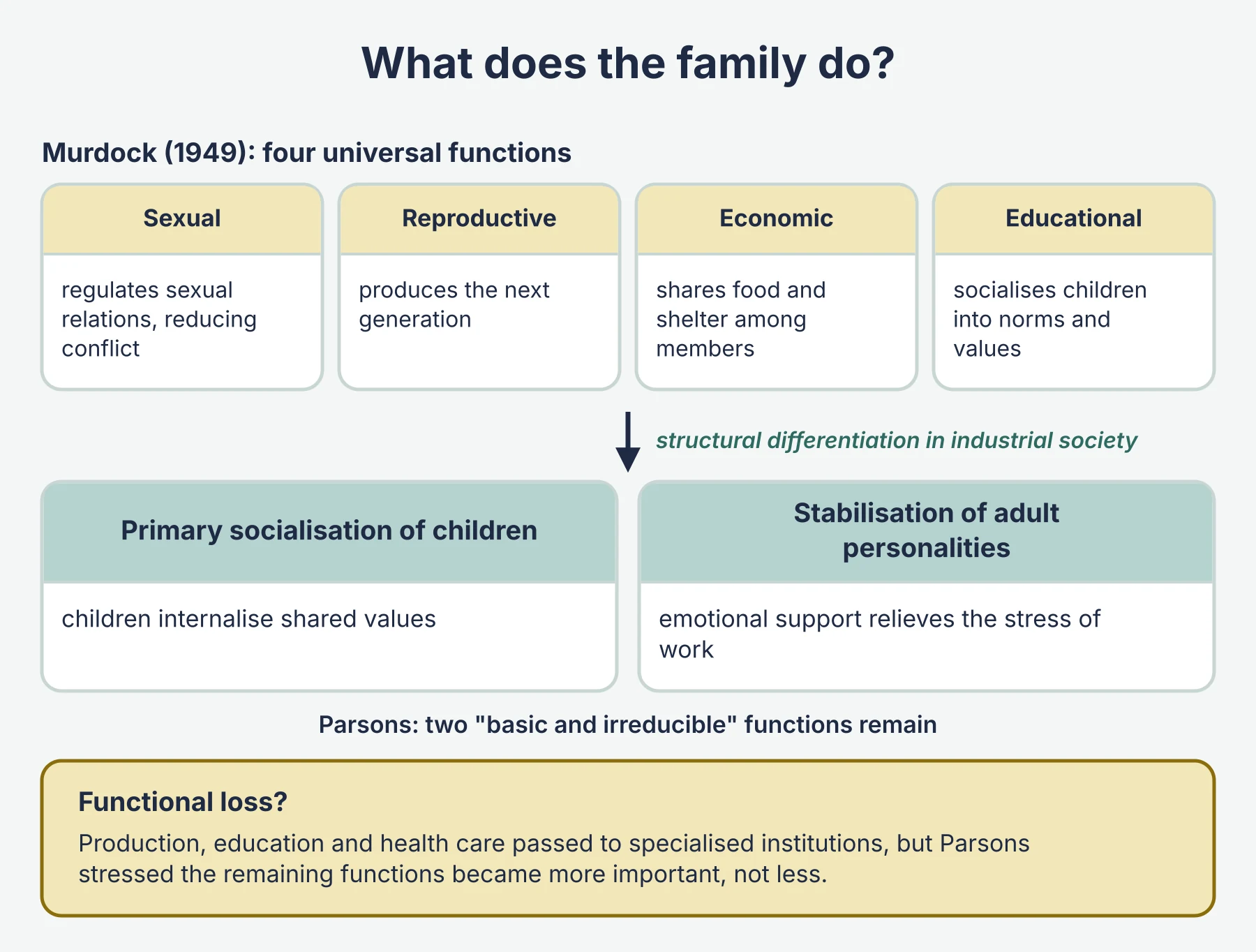
- Murdock (1949): four universal functions: sexual, reproductive, economic, educational.
- Parsons: two irreducible functions in modern society: primary socialisation and stabilisation of adult personalities.
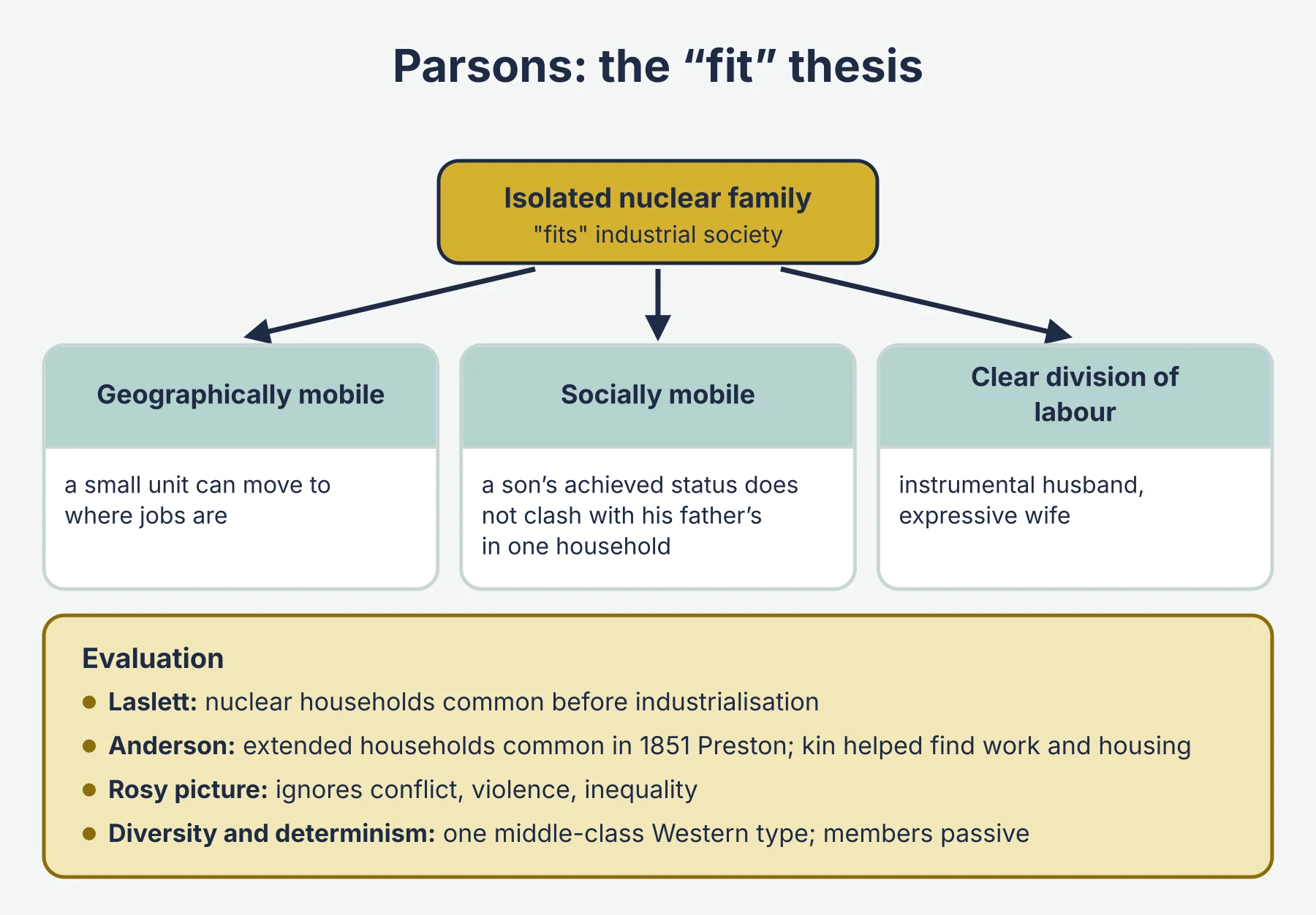
- Fit thesis: the isolated nuclear family suits industrial society because it is geographically and socially mobile, with instrumental and expressive roles.
- Criticisms: Laslett found nuclear households common before industrialisation; Anderson (Preston, 1851 census) found extended households used for mutual aid in industrial towns; ignores conflict and abuse; ignores diversity; assumes passive members.
Marxism
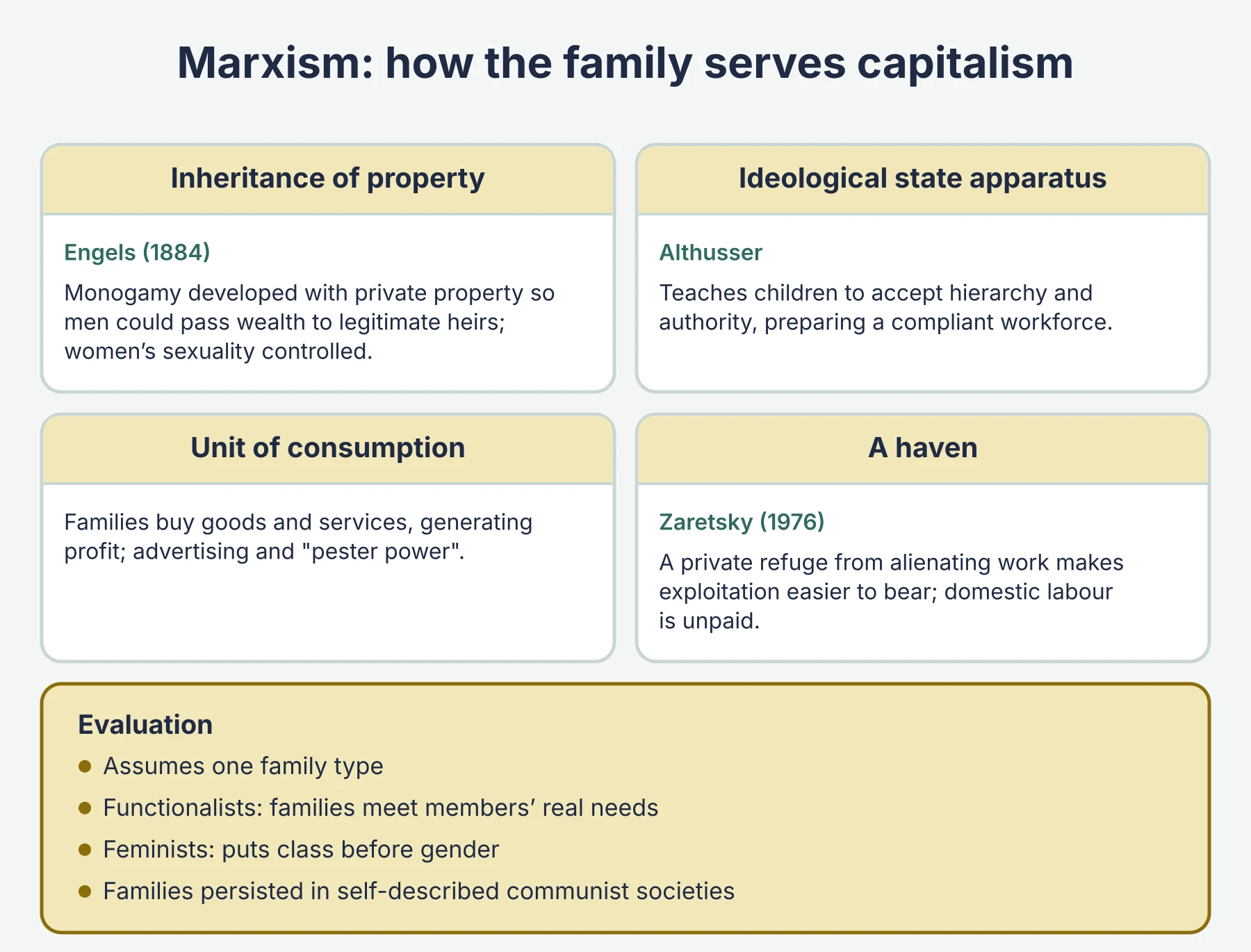
- Engels (1884): monogamy developed with private property so men could pass wealth to legitimate heirs; women’s sexuality was controlled.
- Althusser: family as an ideological state apparatus, teaching acceptance of hierarchy.
- Unit of consumption: families buy goods; advertising targets parents and children.
- Zaretsky (1976): the family is a private refuge from alienating work that props up capitalism.
- Criticisms: assumes one family type; ignores benefits members gain; feminists say gender is ignored; families survived in societies without private capitalism.
Feminisms
| Strand | Argument | Sociologist |
|---|---|---|
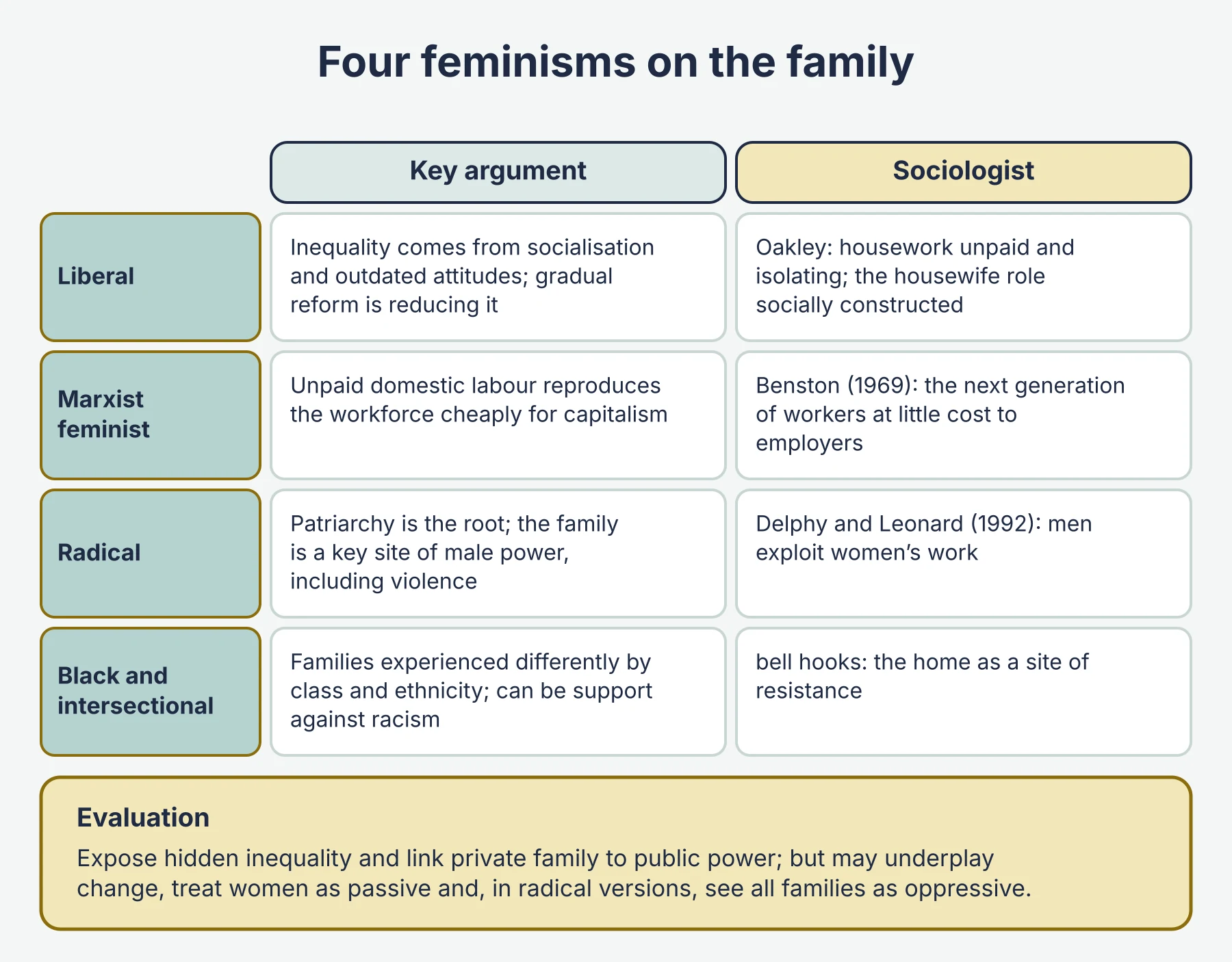
| Liberal | Inequality is cultural and being reduced by reform | Oakley: housework as unpaid work; housewife role socially constructed |
| Marxist feminist | Domestic labour reproduces labour power for capitalism | Benston (1969) |
| Radical | Men exploit women’s labour; family is a site of patriarchal power and violence | Delphy and Leonard (1992) |
| Black / intersectional | Experiences differ by ethnicity and class; family can be a refuge from racism | bell hooks |
- Criticisms: may overlook real change and men’s increased involvement; may treat women as passive; radical versions can see all families as oppressive.
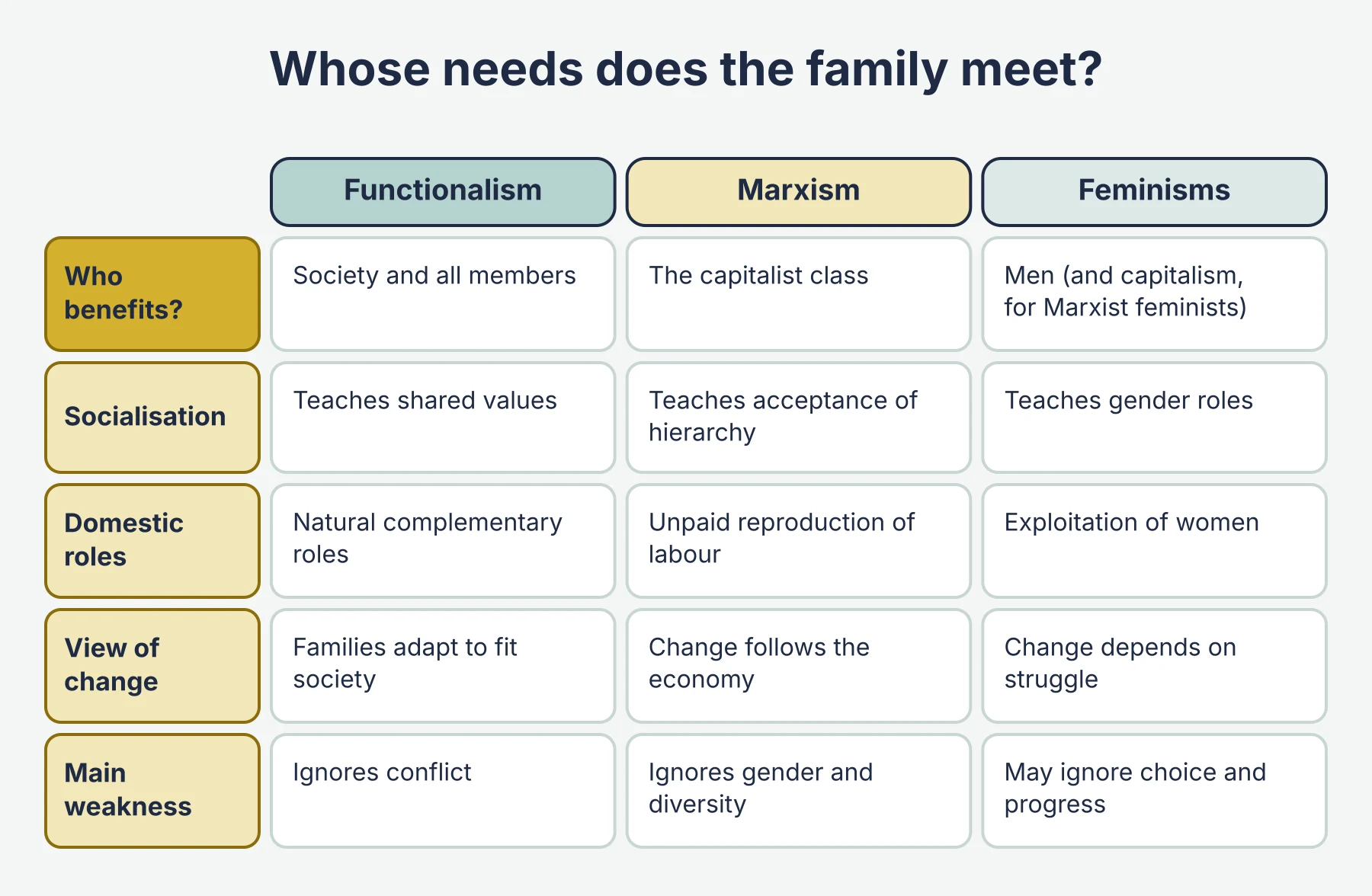
Quick comparison
| Theme | Functionalism | Marxism | Feminisms |
|---|---|---|---|
| Beneficiary | Society and members | Capitalist class | Men |
| Socialisation | Shared values | Ruling-class ideology | Gender roles |
| Domestic division | Complementary | Reproduces workers | Exploitative |
Exam traps
- Attributing Murdock’s four functions to Parsons.
- Writing “the feminist view” as if there were only one.
- Explaining Marxism without the specification’s phrase “agents of social control”.
- Giving criticisms with no evidence: name Laslett, Anderson or a feminist study.
- Describing perspectives in isolation rather than comparing them.
- Forgetting to apply to a named society in extended answers.
Evaluation phrases that score
- “Laslett’s evidence suggests the nuclear family pre-dated industrialisation, which weakens Parsons’ claim that it emerged to fit industry.”
- “Whereas Marxists see socialisation as ideological, functionalists see it as integrating; feminists add that it is gendered.”
- “Engels links women’s oppression to property, but radical feminists argue patriarchy is older and wider than class society.”
Self-test
- List Murdock’s four functions.
- Which two functions did Parsons see as irreducible?
- Give two reasons Parsons gave for the nuclear family fitting industrial society.
- What did Laslett’s research show?
- What did Anderson find in Preston?
- Why, according to Engels, did monogamy develop?
- What does it mean to call the family an ideological state apparatus?
- How does the family act as a unit of consumption?
- What did Benston argue?
- How do radical feminists differ from Marxist feminists?
- Give one criticism of the feminist view.
- Which perspective best explains violence within families, and why?
Answers
- Sexual, reproductive, economic and educational.
- Primary socialisation of children and stabilisation of adult personalities.
- Geographical mobility; social mobility without status conflict; clear instrumental and expressive roles.
- Nuclear households were already common in pre-industrial England.
- Extended households were common in an early industrial town and helped kin find work and housing.
- So that men could be sure of paternity and pass private property to legitimate heirs.
- It spreads ruling-class ideas, such as acceptance of authority, without using force (Althusser).
- Families buy goods and services, generating profit for capitalist businesses.
- The family reproduces and maintains the workforce cheaply through women’s unpaid labour.
- Radical feminists see patriarchy, not capitalism, as the root of women’s oppression.
- It can underplay change towards more equal roles, or treat women as passive victims.
- Radical feminism, because it sees violence as an expression of patriarchal power within families.
Practise next: perspectives on families practice questions | Introducing Sociology study guide
Related resources
-
Study guides
OxfordAQA International A-Level Sociology (9690): Research Methods (Unit 1 Section B)
Study guide to research methods for OxfordAQA 9690 Unit 1 Section B: methods, sampling, validity, ethics and interpreting tables and field notes.
Sociology · OxfordAQA · AS Level
Read guide -
Practice questions
OxfordAQA International A-Level Sociology (9690): Research Methods (Unit 1 Section B) – Practice Questions
Original OxfordAQA 9690 Unit 1 Section B style questions on methods, sampling, ethics and interpreting a fictional table and field notes, with answers.
Sociology · OxfordAQA · AS Level
Try questions -
Revision notes
OxfordAQA International A-Level Sociology (9690): Research Methods (Unit 1 Section B) – Revision Notes
Revision notes for OxfordAQA 9690 Unit 1 research methods: surveys, interviews, observation, experiments, sampling, ethics and data interpretation.
Sociology · OxfordAQA · AS Level
Revise topic
Related articles
Get free revision emails (optional)
Occasional emails with practice questions, worked explanations and links to free resources for the qualification and subjects you choose. No spam, and you can unsubscribe from any email. The free tools on this site never need an email.