
Revision Notes
OxfordAQA International A-Level Sociology (9690): Research Methods (Unit 1 Section B) – Revision Notes
Revision notes for OxfordAQA 9690 Unit 1 research methods: surveys, interviews, observation, experiments, sampling, ethics and data interpretation.
- Subject
- Sociology
- Level
- AS LEVEL
- Topic
- Unit 1 – Introducing Sociology
- Author
- Marlbridge Academic Team
- Updated
- Reviewed by
- Naqiya Yousaf (what this means)
Aligned to OxfordAQA A Level Sociology (9690), Version 1.1 (new qualification). Official specification .
Syllabus page (what it covers and how it is assessed): OxfordAQA A Level Sociology.
Syllabus points this page covers
9690 (AS Level)
- 3.1.3 Research methods and theory (Section B – Research methods)
Found an error? Report a correction.
Need help with this topic? Request a free trial class for A Level Sociology (9690).
These notes condense the research methods content tested in Unit 1 Section B of OxfordAQA International AS/A level Sociology (9690): short questions plus a structured question on data about an unseen issue of global significance. They cover 3.1.3.1 to 3.1.3.4; theory (3.1.3.5) is in the research methods and theory revision notes.
Full explanation: research methods (Unit 1) study guide.
Specification checklist
- Quantitative and qualitative; primary and secondary; positivist and interpretivist approaches.
- Surveys: postal/telephone, online, self-completion; types of questions.
- Interviews: structured, unstructured, group.
- Ethnography and participant observation; covert, overt and non-participant observation.
- Laboratory and field experiments; triangulation; longitudinal studies.
- Qualitative secondary sources (diaries, letters, personal documents); quantitative secondary sources (official statistics).
- Operationalisation; population and sampling frames; random, systematic, quota, multistage, stratified random and snowball samples.
- Validity, reliability; researcher/interviewer bias; Hawthorne effect; social desirability.
- Practical issues (time, funding); ethics (informed consent, confidentiality, anonymity, participant wellbeing).
- Causation and correlation; representativeness and generalisability.
- Interpreting quantitative data (tables, charts, graphs) and qualitative data (field notes, unstructured interviews).
Key terms
| Term | Definition |
|---|---|
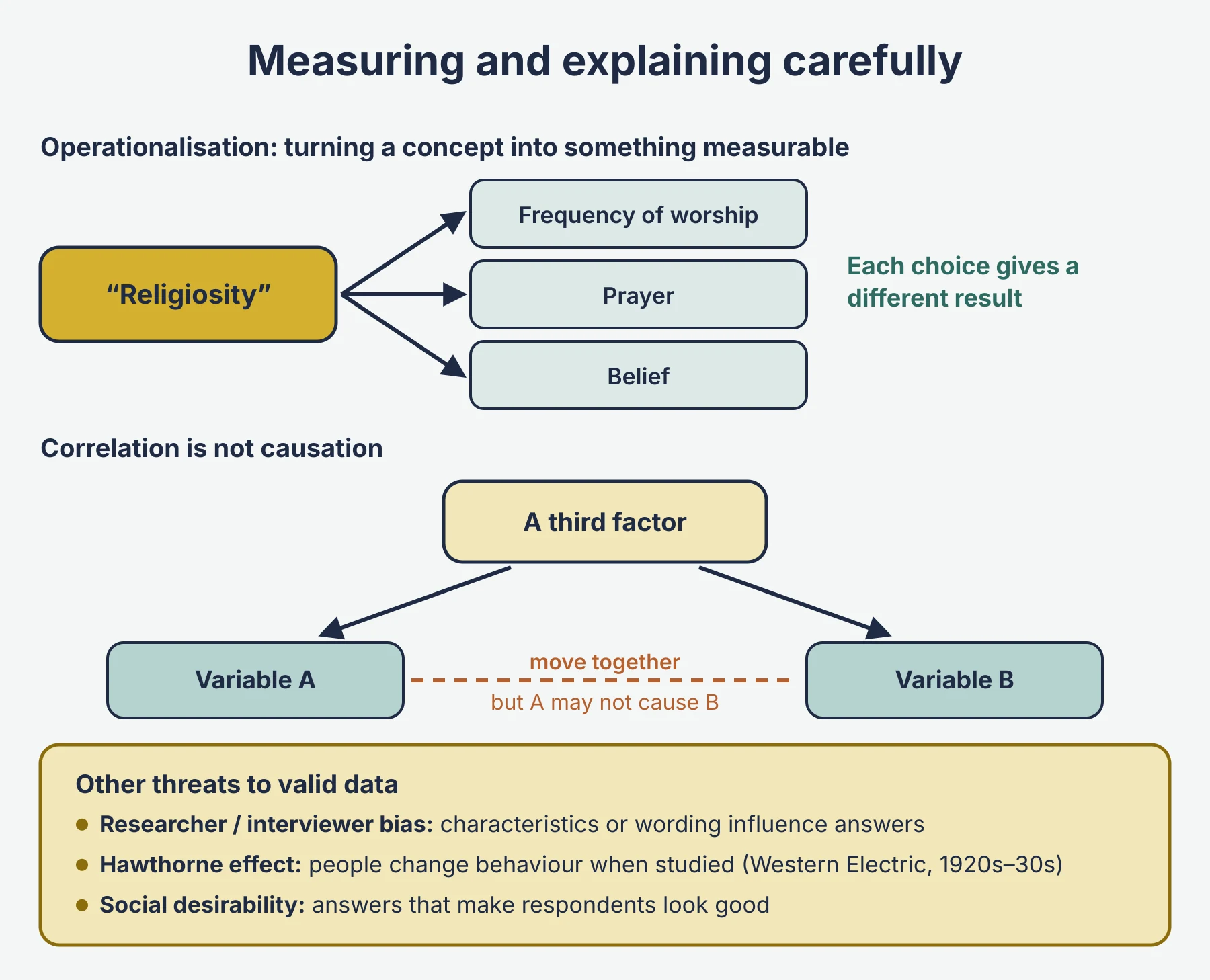
| Operationalisation | Turning a concept into measurable indicators |
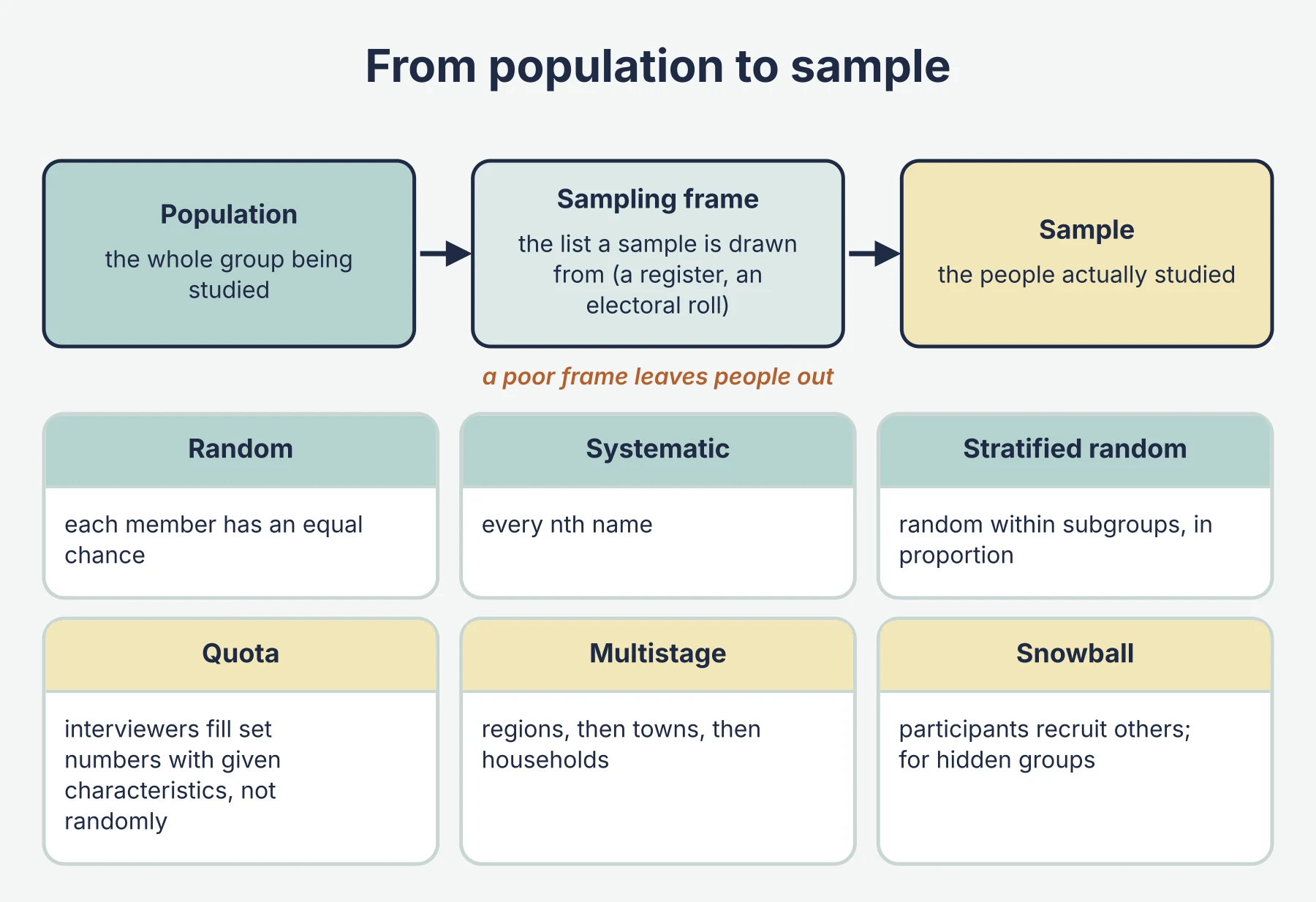
| Population | Everyone the research is about |
| Sampling frame | List of the population from which a sample is drawn |
| Representative | Sample has the same characteristics as the population |
| Generalisability | Findings can be applied beyond the sample |
| Validity | Data give a true picture |
| Reliability | Repeating the research gives the same results |
| Hawthorne effect | Behaviour changes because people know they are studied |
| Social desirability | Answering to appear good or acceptable |
| Interviewer bias | Interviewer influences answers |
| Triangulation | Combining methods or data sources to check findings |
| Attrition | Participants dropping out of a longitudinal study |
| Correlation | Two variables change together |
| Causation | One variable produces change in another |
Samples in one line each
- Random: every member has an equal chance; needs a full sampling frame.
- Systematic: every nth name from the frame.
- Stratified random: divide into strata (age, sex) and sample randomly in proportion.
- Quota: fill set numbers per category; not random, interviewer chooses.
- Multistage: sample in stages, such as regions, districts, households.
- Snowball: participants recruit others; for hidden or hard-to-reach groups.
Methods: one strength, one limitation
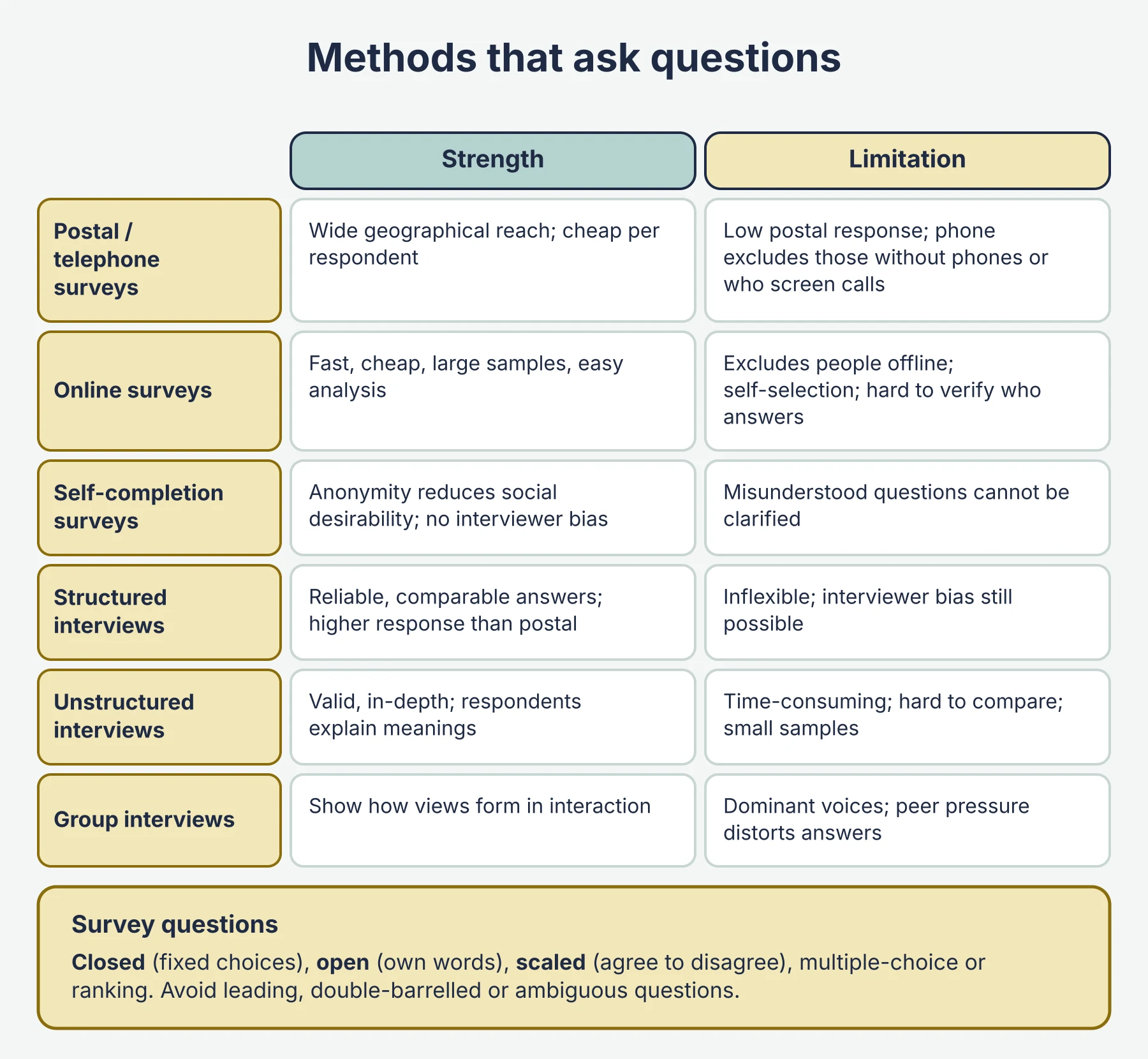
| Method | Strength | Limitation |
|---|---|---|
| Postal survey | Wide reach, cheap | Low response rate |
| Telephone survey | Quick, clarifies questions | Excludes those without phones; refusals |
| Online survey | Fast, large samples | Excludes non-users; self-selection |
| Structured interview | Reliable, comparable | Inflexible; interviewer bias |
| Unstructured interview | Valid, in-depth | Hard to compare; time-consuming |
| Group interview | Shows group norms | Dominant voices |
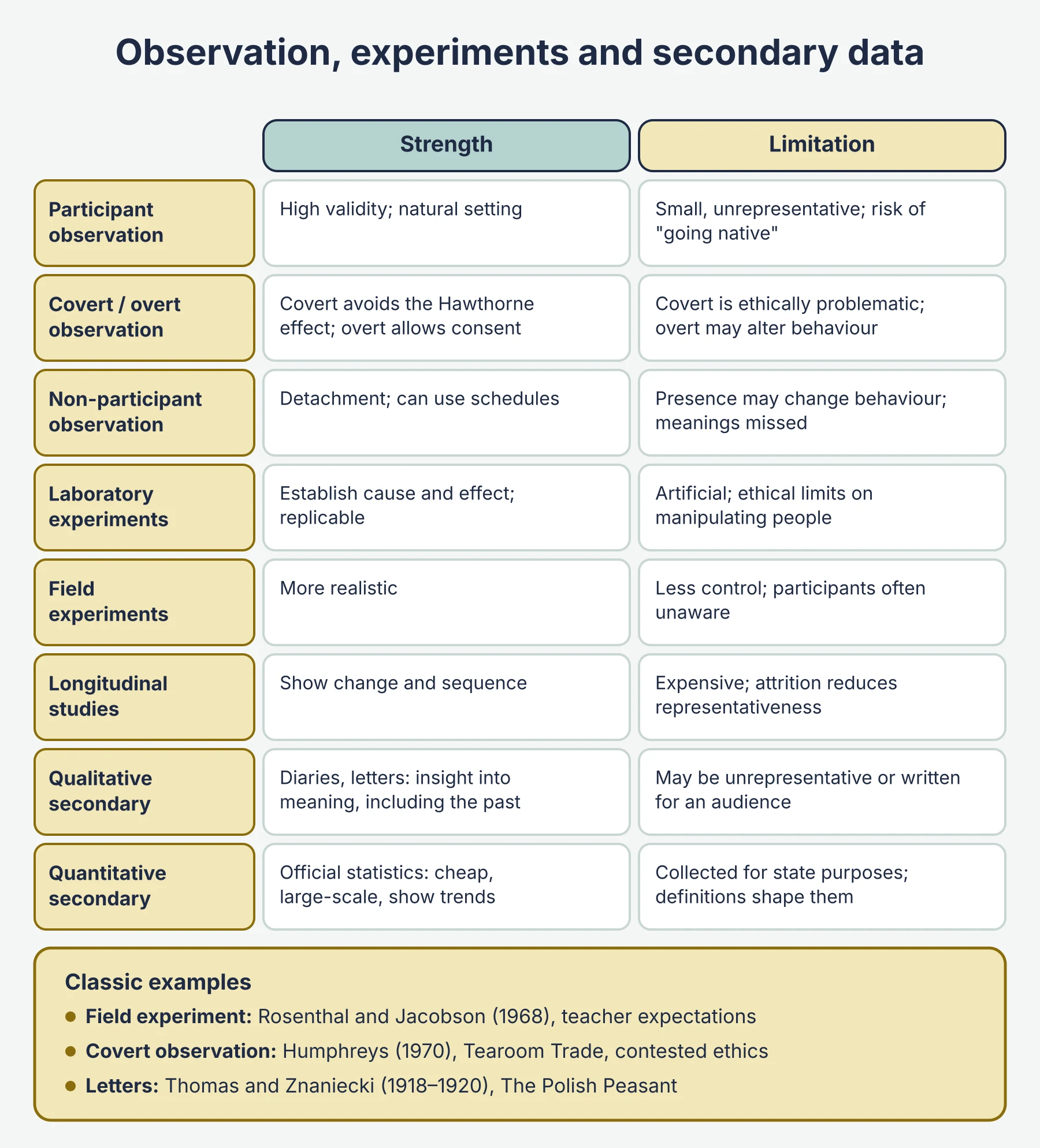
| Covert participant observation | Natural behaviour | No consent; risky |
| Overt participant observation | Ethical consent | Hawthorne effect |
| Non-participant observation | Detached; can be structured | Misses meanings |
| Lab experiment | Cause and effect | Artificial |
| Field experiment | Realistic setting | Less control; consent problems |
| Longitudinal study | Shows change over time | Costly; attrition |
| Personal documents | Meanings; historical insight | Unrepresentative; may be written for an audience |
| Official statistics | Cheap; trends | Socially constructed; definitions change |
Examples to cite
- Rosenthal and Jacobson (1968): field experiment on teacher expectations.
- Humphreys (1970), Tearoom Trade: covert observation and ethical controversy.
- Thomas and Znaniecki (1918–1920): letters as qualitative secondary data.
- Hawthorne Works studies (1920s–1930s): origin of the Hawthorne effect.
Reading data
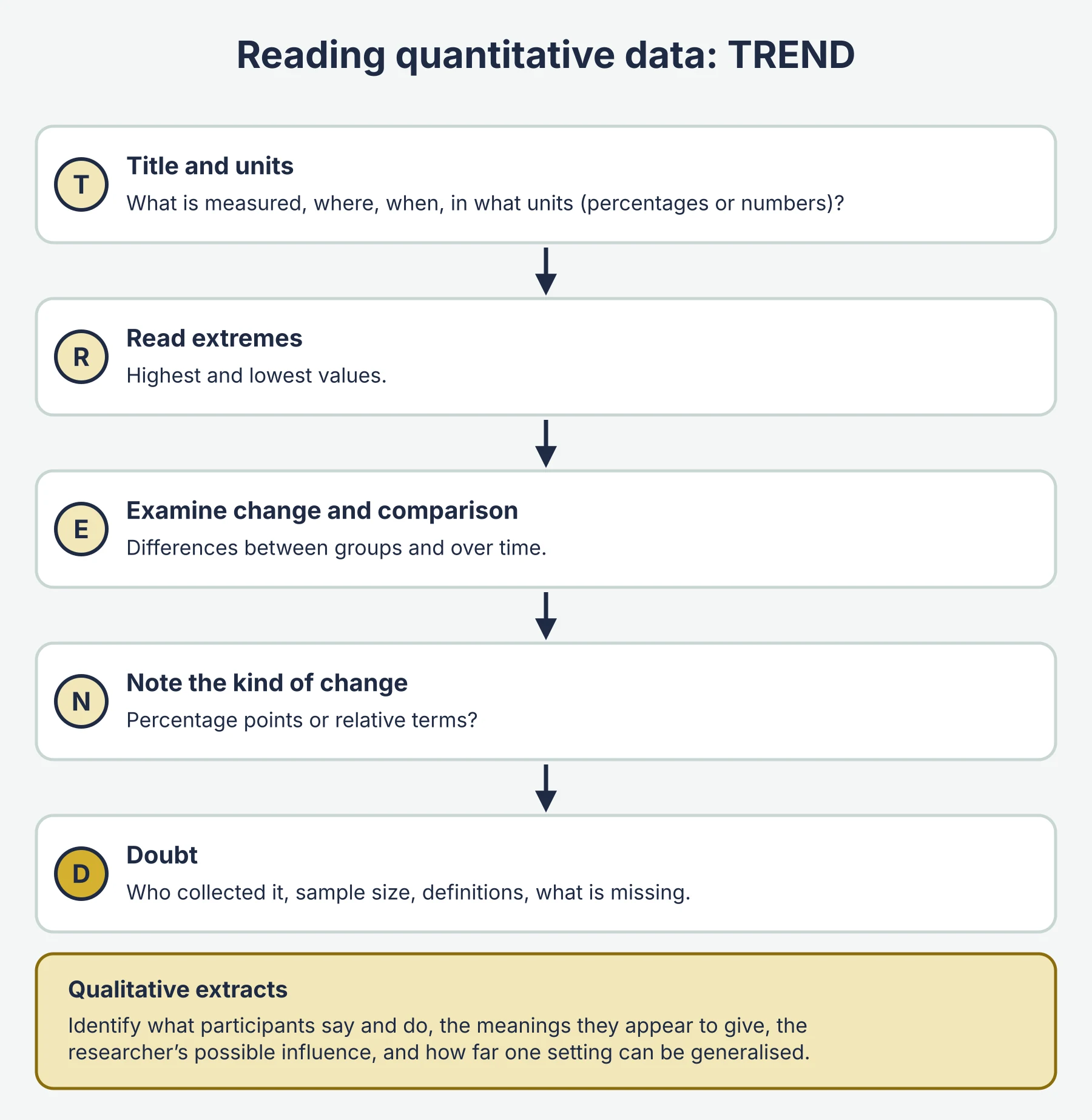
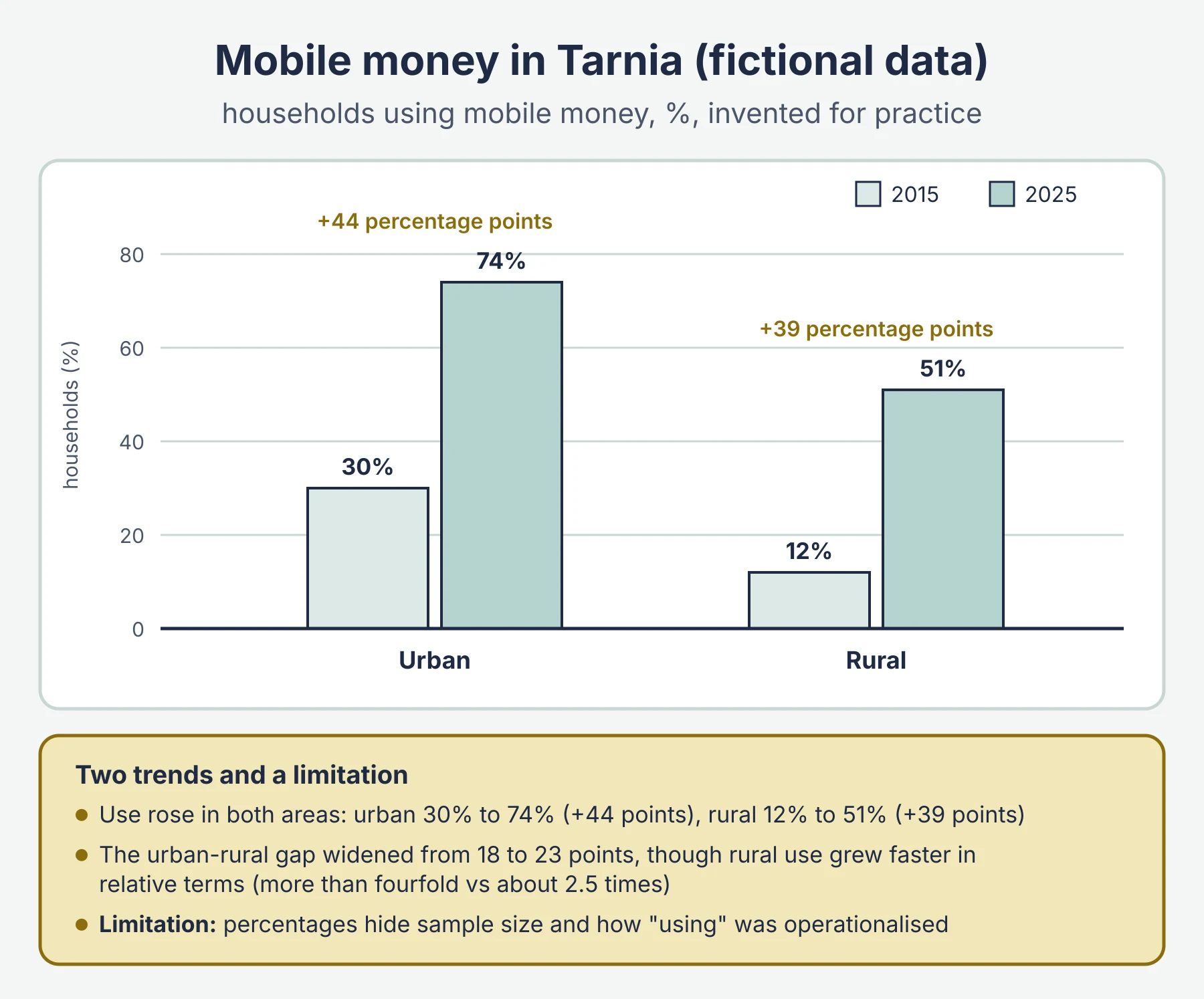
- Quote figures with units; say “percentage points” for differences between percentages.
- Compare groups and change over time; look for exceptions.
- Ask: sample size? who collected it? how was the concept operationalised? what is missing?
- Correlation in a table is not proof of causation.
- For field notes: what is said and done, likely meanings, researcher effect, limited generalisability.
Choosing a method for an unseen issue
Ask four questions about the item, then match the method:
| Question about the issue | If yes, consider | Why |
|---|---|---|
| Is the group hidden or vulnerable (refugees, undocumented workers, victims)? | Snowball sample; unstructured interviews | Trust and access; care for wellbeing |
| Is the topic sensitive or embarrassing? | Anonymous self-completion survey | Reduces social desirability and interviewer bias |
| Do you need patterns across countries or large populations? | Online or structured surveys; official statistics | Large, comparable, reliable data |
| Do you need to see change over time? | Longitudinal study | Shows sequence and change in the same people |
Always add one practical issue (time, funding, access) and one ethical issue (consent, confidentiality, anonymity, wellbeing) applied to the people in the item.
Exam traps
- Reliability and validity swapped.
- Quota described as random.
- “Unethical” with no principle named.
- Strengths not applied to the issue in the item.
- Rounding or misquoting figures from the table.
Self-test
- Define operationalisation and give an example.
- What is a sampling frame?
- How does a stratified random sample differ from a quota sample?
- When is a snowball sample useful?
- Give one strength of online surveys.
- What is the Hawthorne effect?
- Name four ethical principles in the specification.
- Why might a field experiment raise ethical issues?
- What is attrition?
- Distinguish causation from correlation.
- Give one limitation of personal documents.
- What does triangulation achieve?
Answers
- Turning a concept into measurable indicators, such as measuring religiosity by frequency of worship.
- A list of the population from which a sample is drawn.
- Stratified random selects randomly within strata; quota lets the researcher choose people to fill set numbers.
- For hidden or hard-to-reach groups, such as undocumented workers.
- Fast, cheap and able to reach large samples.
- People change their behaviour because they know they are being studied.
- Informed consent, confidentiality, anonymity, participant wellbeing.
- Participants are often unaware they are being studied, so they cannot give informed consent.
- Participants dropping out over the course of a longitudinal study.
- Correlation is two variables changing together; causation means one produces change in the other.
- They may be unrepresentative or written with an audience in mind.
- It checks findings from one method against another, improving validity and reliability.
Practise next: research methods (Unit 1) practice questions | Introducing Sociology study guide
Related resources
-
Study guides
OxfordAQA International A-Level Sociology (9690): Social Change and Changing Families
Study guide to OxfordAQA 9690 section 3.1.1.3: demographic change, industrialisation, family diversity, personal life, transnational families and pets.
Sociology · OxfordAQA · AS Level
Read guide -
Practice questions
OxfordAQA International A-Level Sociology (9690): Social Change and Changing Families – Practice Questions
Original OxfordAQA 9690 Unit 1 style questions on demographic change, industrialisation, family diversity, personal life and transnational families.
Sociology · OxfordAQA · AS Level
Try questions -
Revision notes
OxfordAQA International A-Level Sociology (9690): Social Change and Changing Families – Revision Notes
Revision notes for OxfordAQA 9690 section 3.1.1.3: demographic change, industrialisation, family diversity, Smart, Stacey and transnational families.
Sociology · OxfordAQA · AS Level
Revise topic
Related articles
Get free revision emails (optional)
Occasional emails with practice questions, worked explanations and links to free resources for the qualification and subjects you choose. No spam, and you can unsubscribe from any email. The free tools on this site never need an email.