
Study Guides
OxfordAQA International A-Level Sociology (9690): Social Change and Changing Families
Study guide to OxfordAQA 9690 section 3.1.1.3: demographic change, industrialisation, family diversity, personal life, transnational families and pets.
- Subject
- Sociology
- Level
- AS LEVEL
- Topic
- Unit 1 – Introducing Sociology
- Author
- Marlbridge Academic Team
- Updated
- Reviewed by
- Naqiya Yousaf (what this means)
Aligned to OxfordAQA A Level Sociology (9690), Version 1.1 (new qualification). Official specification .
Syllabus page (what it covers and how it is assessed): OxfordAQA A Level Sociology.
Syllabus points this page covers
9690 (AS Level)
- 3.1.1.3 Social change and changing families
Found an error? Report a correction.
Need help with this topic? Request a free trial class for A Level Sociology (9690).
Section 3.1.1.3 Social change and changing families is the broadest part of the Families topic in OxfordAQA International AS/A level Sociology (9690), examined in Unit 1 Section A. It covers demographic changes and their explanations; “the relationship between families and industrialisation and between families and urbanisation”; family diversity, including “pivot/sandwich generation, reconstituted/blended families, living apart together, child free couples, and beanpole families”; explanations of diversity, including laws and social policies; individualisation and personal life (Smart); diasporas and transnational families; friends as family; and pets or companion animals as family members. The unit overview is in the Introducing Sociology study guide.
Demographic changes
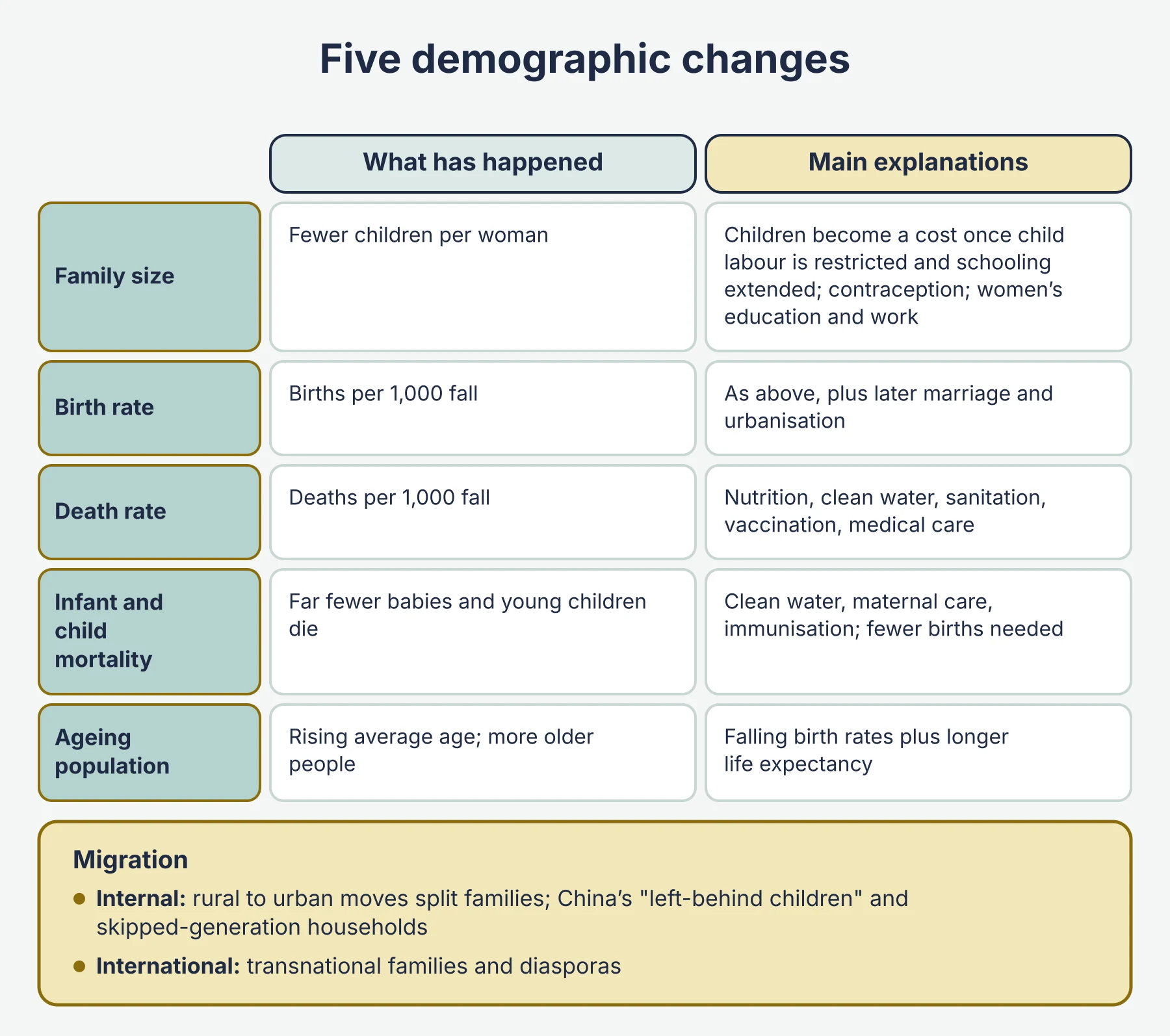
Demography is the study of population size and structure. The specification lists five changes.
| Change | What has happened in many societies | Main explanations |
|---|---|---|
| Family size | Fewer children per woman | Children become an economic cost rather than an asset once child labour is restricted and schooling extended; contraception; women’s education and paid work |
| Birth rate | Births per 1,000 of the population fall | As above, plus later marriage and urbanisation |
| Death rate | Deaths per 1,000 fall | Better nutrition, clean water and sanitation, vaccination and medical care |
| Infant and child mortality | Far fewer babies and young children die | Clean water, maternal health care, immunisation; parents then need fewer births to ensure some children survive |
| Ageing population | Rising average age and more older people | Falling birth rates combined with longer life expectancy |
Migration is the fifth change, and the specification names both kinds:
- Internal migration, such as rural to urban movement, can split families across city and village. In China, millions of rural parents who moved to cities left children with grandparents, creating “left-behind children” and skipped-generation households.
- International migration creates transnational families and diasporas, discussed below.
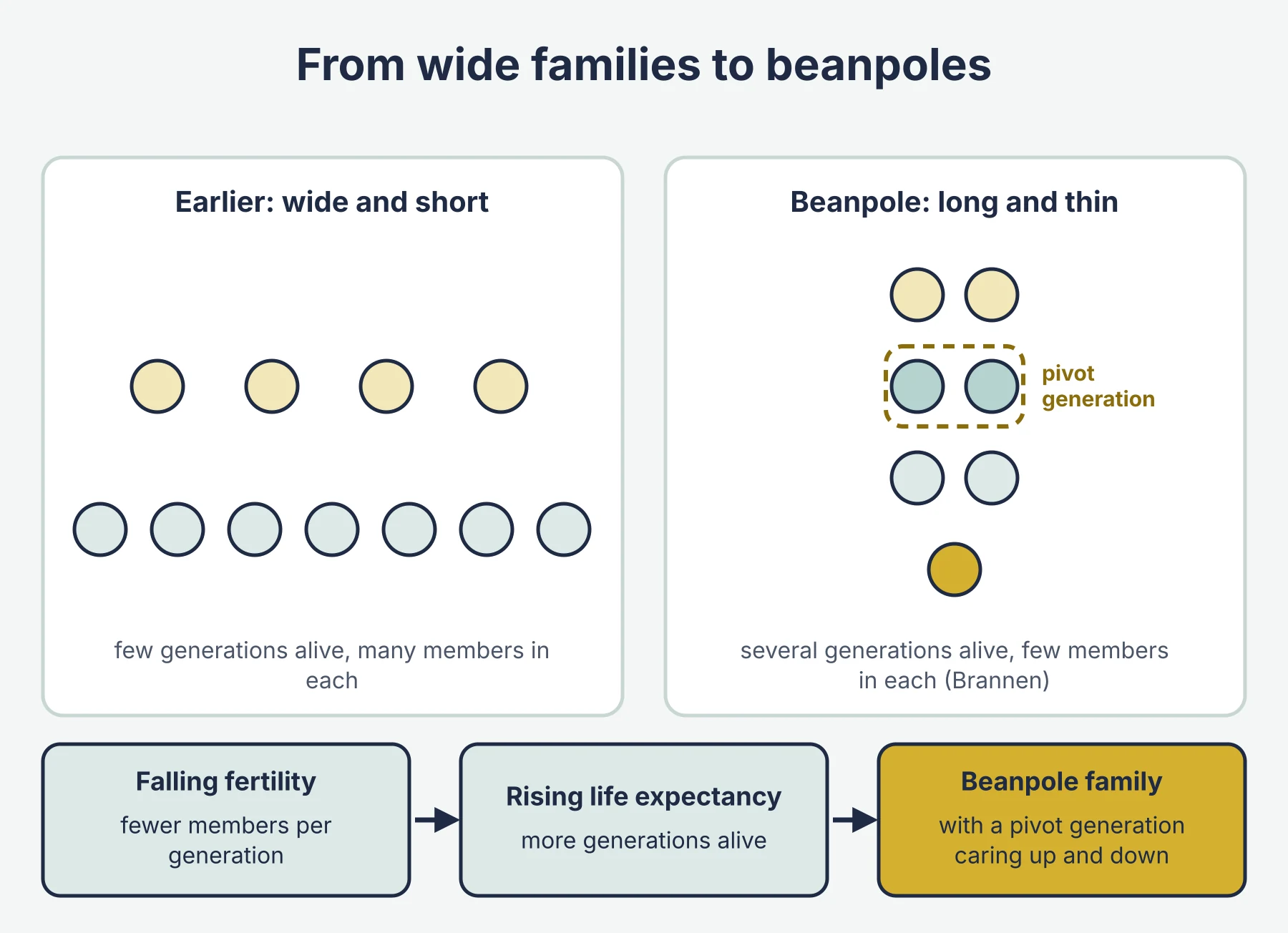
The point for exams is to connect each change to family structure: lower fertility and longer life produce families with more generations but fewer members in each, which is the basis of the beanpole family.
Families, industrialisation and urbanisation
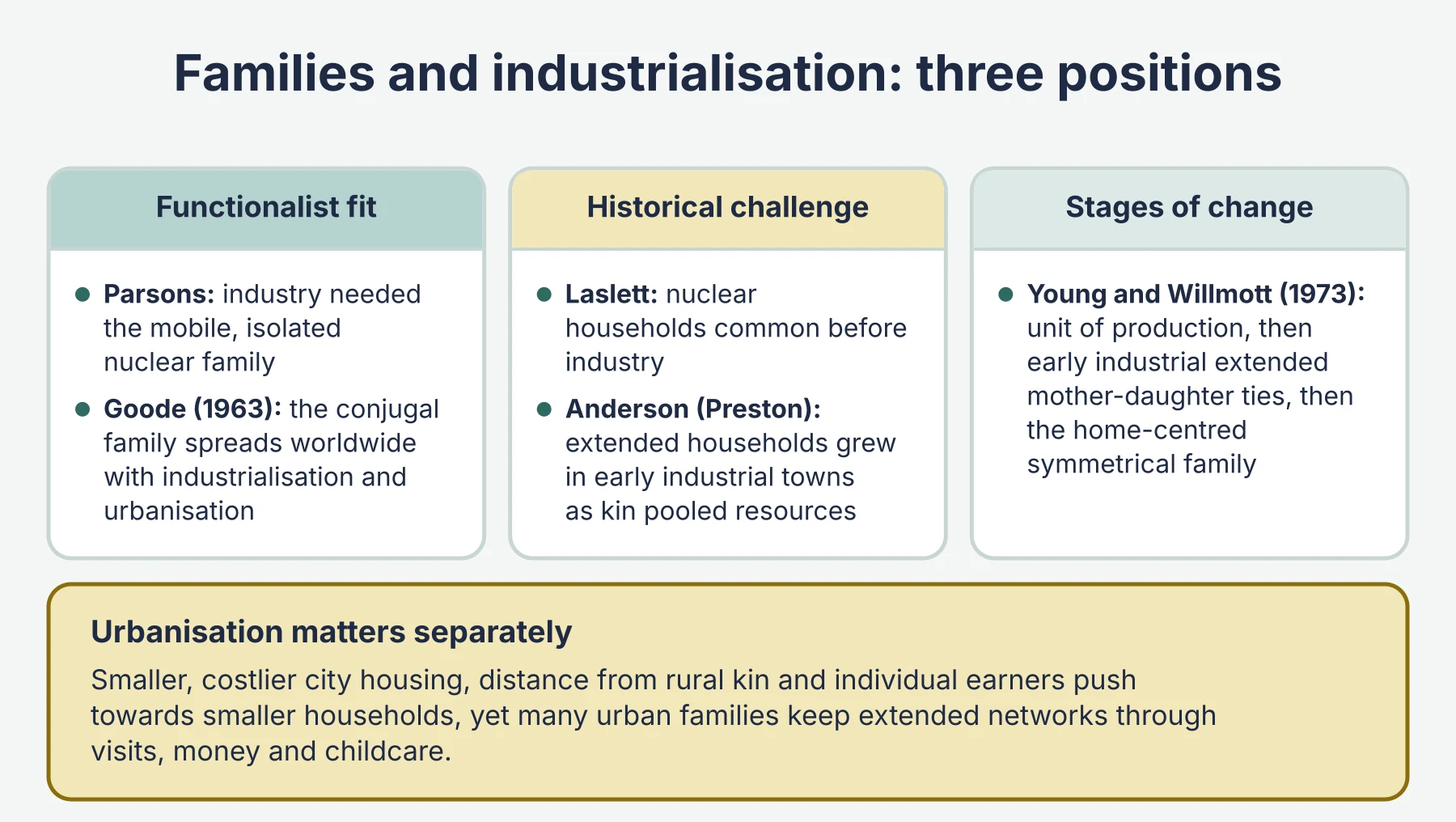
Three positions are worth comparing.
- Functionalist fit. Parsons argued industrialisation replaced extended families with the isolated nuclear family because industry needed a mobile workforce. William Goode (World Revolution and Family Patterns, 1963) argued that the conjugal family was spreading worldwide with industrialisation and urbanisation.
- Historical challenge. Laslett’s research showed nuclear households were common before industrialisation, and Anderson’s study of Preston found extended households grew in early industrial towns as kin pooled resources. The relationship is not one-way.
- Stages of change. Michael Young and Peter Willmott (The Symmetrical Family, 1973) described a move from the pre-industrial family as a unit of production, through an early industrial family with strong mother-daughter extended ties, to the home-centred, more equal symmetrical family.
Urbanisation matters separately from industry. City housing is smaller and more expensive, distances from rural kin are greater, and urban labour markets reward individual earners; all push towards smaller households. Yet many urban families in developing societies keep strong ties to rural kin through visits, money and childcare, so households shrink while family networks remain extended.
Family diversity: the named newer types
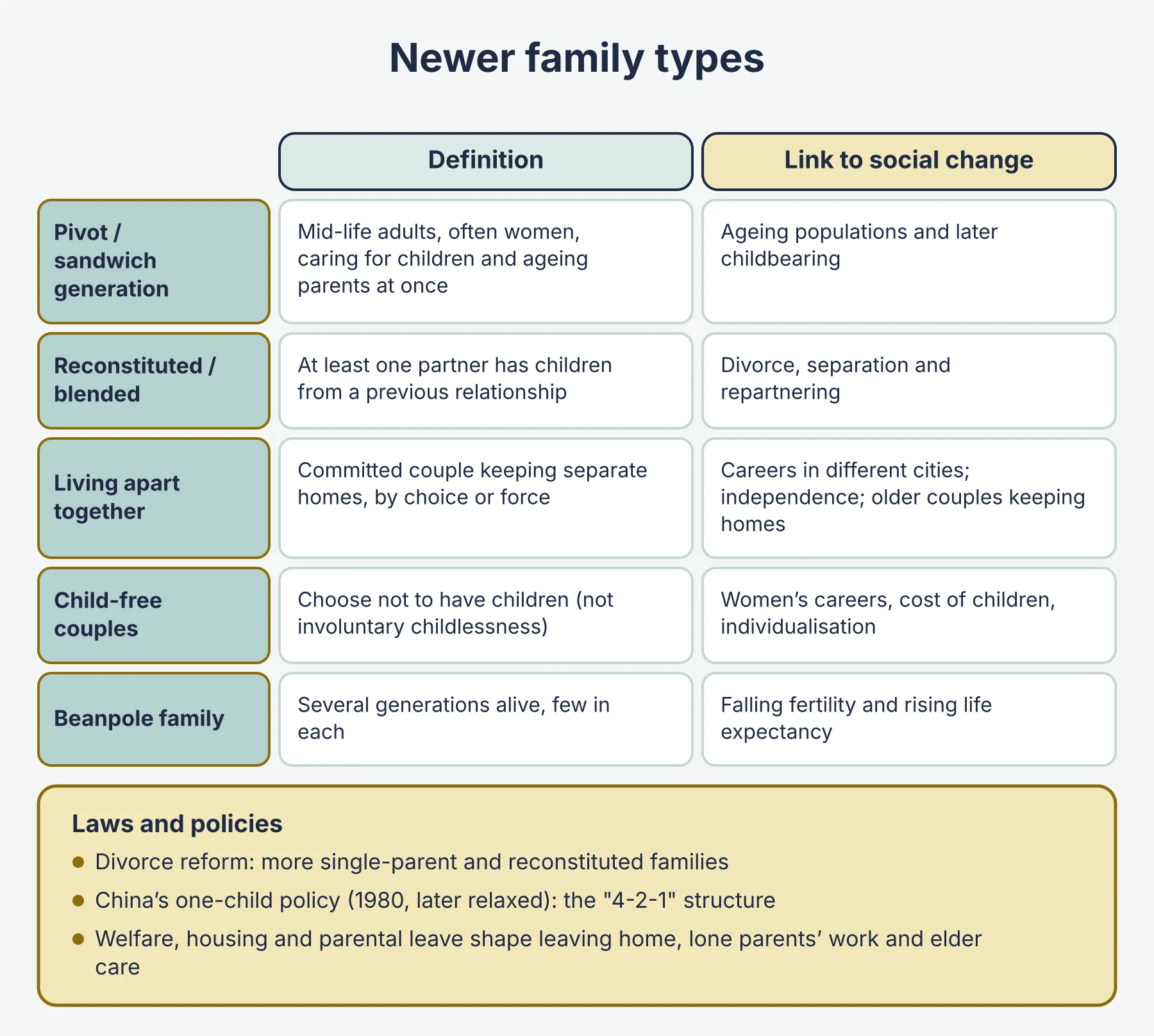
| Type | Definition | Link to social change |
|---|---|---|
| Pivot / sandwich generation | Adults, often women in mid-life, caring at the same time for children and for ageing parents | Ageing populations and later childbearing |
| Reconstituted / blended family | A family in which at least one partner has children from a previous relationship | Divorce, separation and repartnering |
| Living apart together (LAT) | A committed couple who choose, or are forced, to keep separate homes | Careers in different cities, wish for independence, older couples keeping their own homes |
| Child-free couples | Couples who choose not to have children (distinct from involuntary childlessness) | Women’s careers, cost of children, individualisation |
| Beanpole family | Long, thin family structure: several generations alive, few members in each | Falling fertility and rising life expectancy |
Julia Brannen’s work in the early 2000s described the beanpole family and the middle pivot generation that gives support both up and down the generations.
Explanations of diversity combine demographic change with laws and social policies. Divorce law reform makes ending marriages easier, which increases single-parent and reconstituted families. China’s one-child policy, introduced in 1980 and later relaxed to allow two and then three children, produced a “4-2-1” structure of four grandparents, two parents and one child. Welfare, housing and parental leave policies shape whether young adults can leave home, whether lone parents can work, and how care for older people is shared.
Individualisation and personal life (Smart)
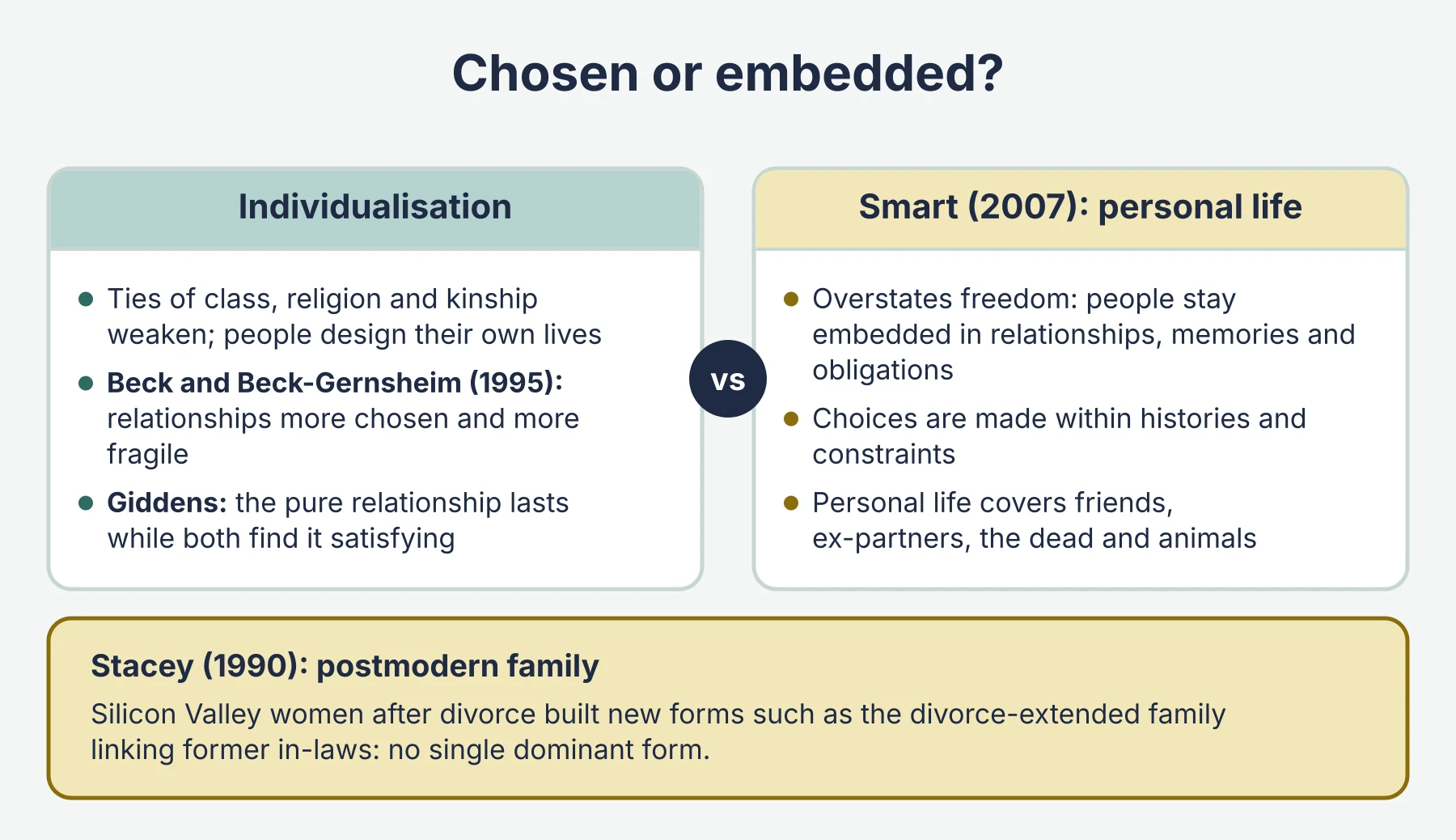
Individualisation theorists argue that traditional ties of class, religion and kinship have weakened, so individuals must design their own lives. Ulrich Beck and Elisabeth Beck-Gernsheim (The Normal Chaos of Love, 1995) saw relationships as more chosen and also more fragile. Anthony Giddens described the pure relationship, which lasts only as long as both partners find it satisfying.
Carol Smart (Personal Life, 2007) argued this overstates freedom. People remain embedded in webs of relationships, memories and obligations; choices are made within histories and constraints. She proposed personal life as a wider concept than “the family”, covering all significant relationships, including with friends, ex-partners, the dead and animals. This broadening is what links the specification’s final three items.
Judith Stacey (Brave New Families, 1990), another named sociologist, studied families in California’s Silicon Valley and found women creating new arrangements after divorce, such as the divorce-extended family linking former in-laws, which she saw as evidence of a postmodern family with no single dominant form.
Diasporas and transnational families
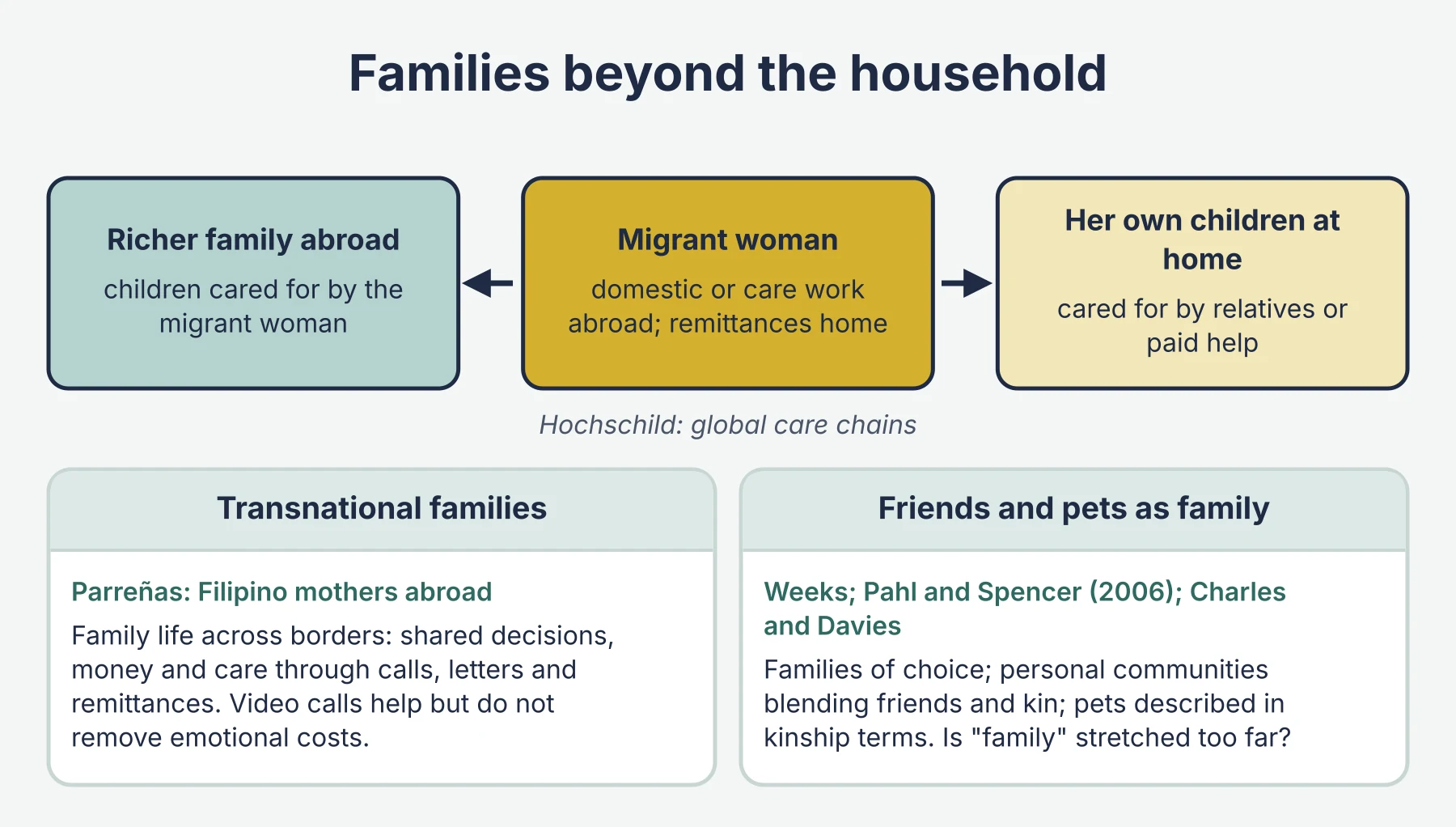
A diaspora is a population dispersed from a homeland that keeps a sense of shared identity. A transnational family keeps family life across national borders: members live in different countries but share decisions, money and care. Rhacel Parreñas studied Filipino families in which mothers worked abroad as domestic workers while children stayed at home, keeping contact through calls, letters and remittances. Arlie Hochschild’s idea of global care chains describes how a migrant woman cares for a richer family’s children while her own children are cared for by relatives or paid help at home. Cheap video calls and money transfer apps have made “doing family” at a distance easier but do not remove the emotional costs.
Friends as family and pets as family
- Friends as family: Jeffrey Weeks and colleagues used the term families of choice for networks of friends who give the support usually expected of kin. Ray Pahl and Liz Spencer’s Rethinking Friendship (2006) described personal communities in which friends and kin are blended, with some friends treated like family and some kin like friends.
- Pets/companion animals: Nickie Charles and Charlotte Aull Davies found that many people include pets as family members, describing them in kinship terms. Smart’s concept of personal life makes room for these bonds, while critics ask whether the term “family” is being stretched too far.
Worked example: annotated 20-mark plan
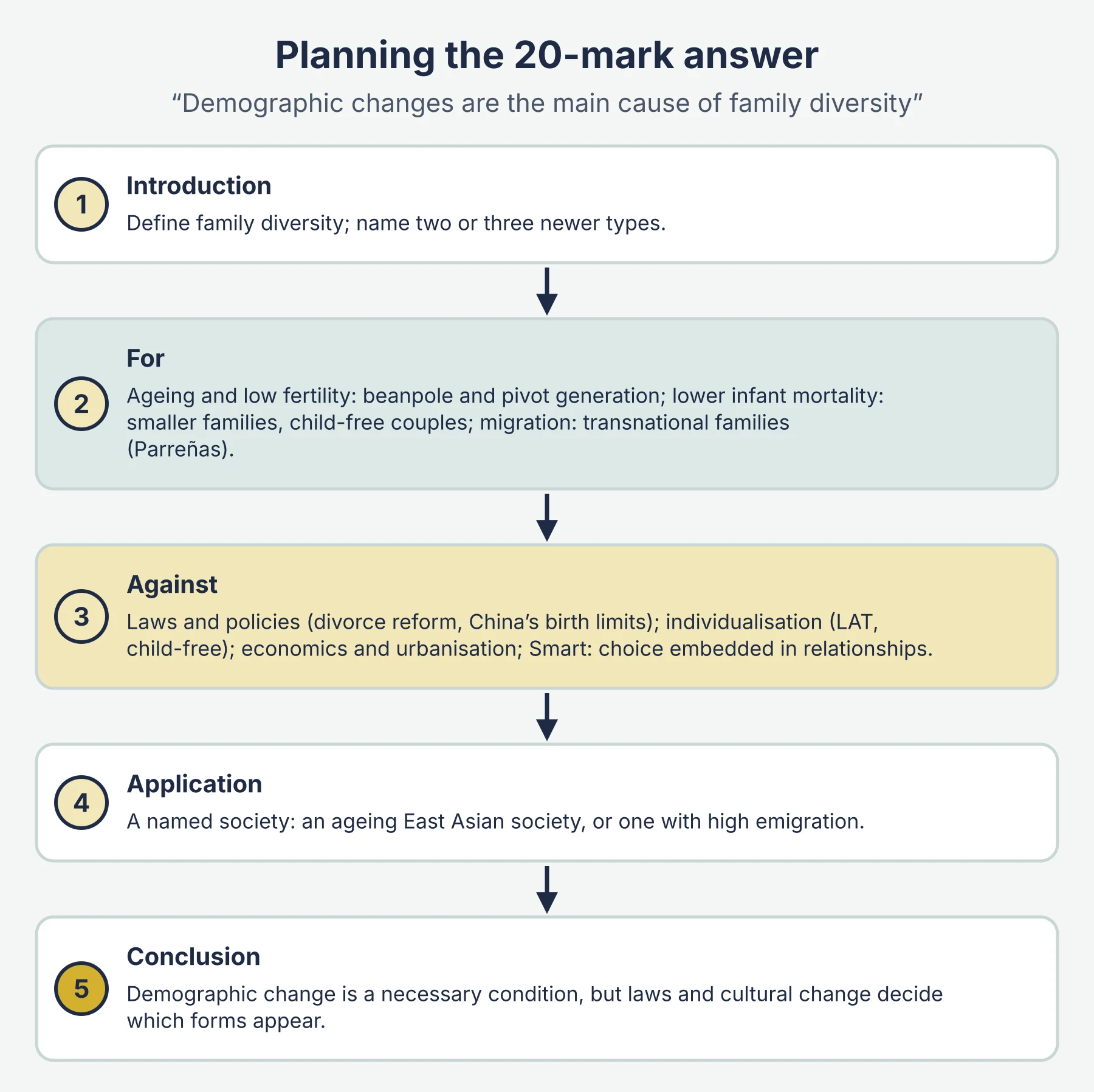
Using examples from a society you know, evaluate the view that demographic changes are the main cause of family diversity.
- Introduction: define family diversity; name two or three newer types.
- For: ageing and low fertility explain beanpole and pivot-generation families; falling infant mortality allows smaller families and more child-free couples; migration explains transnational families (Parreñas).
- Against: laws and policies, such as divorce reform or China’s birth limits, directly change structures; individualisation and changing values explain LAT and child-free choices; economic change and urbanisation shape household size; Smart argues personal choice is embedded in relationships, so no single cause works alone.
- Application: apply each point to a named society, for example an ageing East Asian society or a society with high emigration.
- Conclusion: demographic change is a necessary condition, but laws and cultural change decide which forms appear.
Common mistakes
- Listing family types without explaining why they have increased.
- Confusing birth rate (per 1,000 people) with family size (children per family).
- Treating industrialisation and urbanisation as the same process.
- Forgetting laws and social policies, which the specification names explicitly.
- Describing Smart as an individualisation theorist: she criticises it.
Exam technique
Explain questions on this section reward a chain: change, cause, effect on families. In evaluate questions, set demographic explanations against cultural, legal and economic ones, and always apply to a named society, because the specification requires it in selected extended responses.
- Social change and changing families revision notes
- Social change and changing families practice questions
- How roles inside these families are changing: gender, age and the experience of family life study guide
Related resources
-
Practice questions
OxfordAQA International A-Level Sociology (9690): Social Change and Changing Families – Practice Questions
Original OxfordAQA 9690 Unit 1 style questions on demographic change, industrialisation, family diversity, personal life and transnational families.
Sociology · OxfordAQA · AS Level
Try questions -
Revision notes
OxfordAQA International A-Level Sociology (9690): Social Change and Changing Families – Revision Notes
Revision notes for OxfordAQA 9690 section 3.1.1.3: demographic change, industrialisation, family diversity, Smart, Stacey and transnational families.
Sociology · OxfordAQA · AS Level
Revise topic -
Practice questions
OxfordAQA A Level Sociology: Introducing Sociology — Practice Questions
Original OxfordAQA International A-level Sociology (9690) Unit 1 practice questions, with worked answers on families, marriage, perspectives and methods.
Sociology · OxfordAQA · AS Level
Try questions
Related articles
Get free revision emails (optional)
Occasional emails with practice questions, worked explanations and links to free resources for the qualification and subjects you choose. No spam, and you can unsubscribe from any email. The free tools on this site never need an email.