
Revision Notes
OxfordAQA International A-Level Sociology (9690): Social Change and Changing Families – Revision Notes
Revision notes for OxfordAQA 9690 section 3.1.1.3: demographic change, industrialisation, family diversity, Smart, Stacey and transnational families.
- Subject
- Sociology
- Level
- AS LEVEL
- Topic
- Unit 1 – Introducing Sociology
- Author
- Marlbridge Academic Team
- Updated
- Reviewed by
- Naqiya Yousaf (what this means)
Aligned to OxfordAQA A Level Sociology (9690), Version 1.1 (new qualification). Official specification .
Syllabus page (what it covers and how it is assessed): OxfordAQA A Level Sociology.
Syllabus points this page covers
9690 (AS Level)
- 3.1.1.3 Social change and changing families
Found an error? Report a correction.
Need help with this topic? Request a free trial class for A Level Sociology (9690).
These notes condense 3.1.1.3 Social change and changing families in OxfordAQA International AS/A level Sociology (9690), Unit 1 Section A. Core idea: demographic, economic, legal and cultural changes have produced a wider range of family forms, and some sociologists now prefer “personal life” to “the family” to capture them.
Full explanation: social change and changing families study guide.
Specification checklist
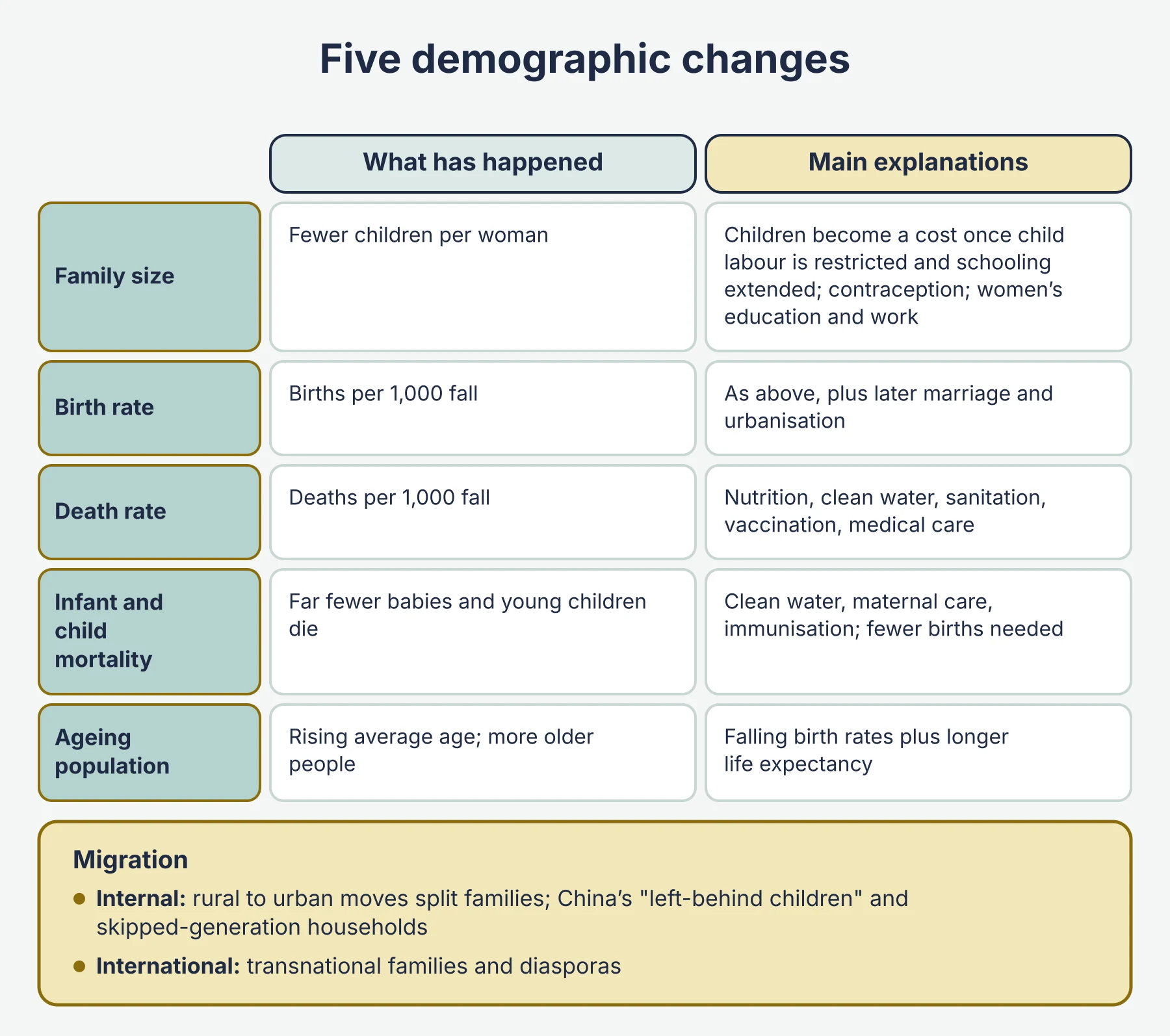
- Demographic changes: family size; birth and death rates; infant and child mortality; migration (internal and international); ageing populations; explanations of these changes.
- Families and industrialisation; families and urbanisation.
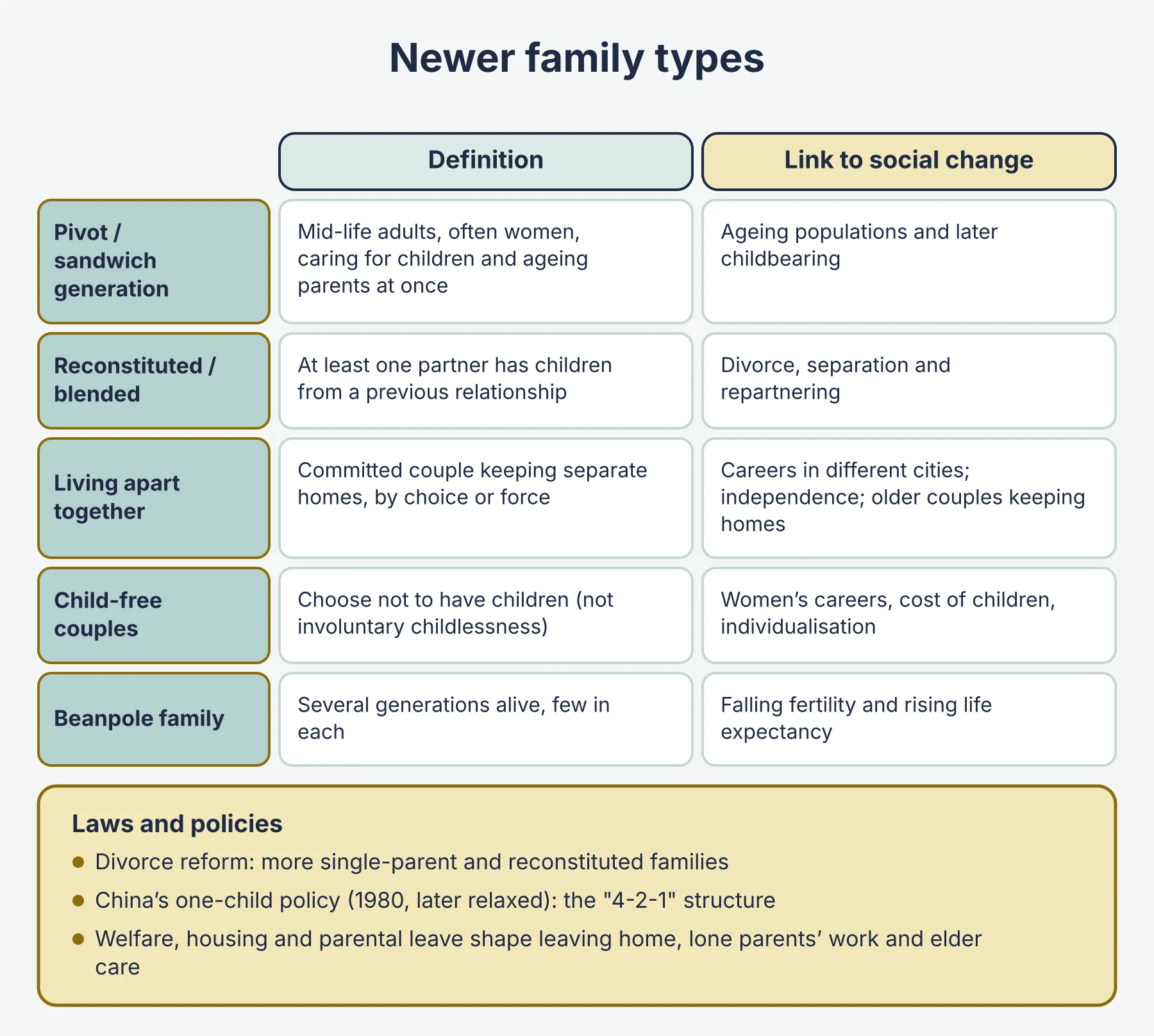
- Newer types: pivot/sandwich generation, reconstituted/blended, living apart together, child free couples, beanpole.
- Explanations of diversity, including demographic change and laws and social policies.
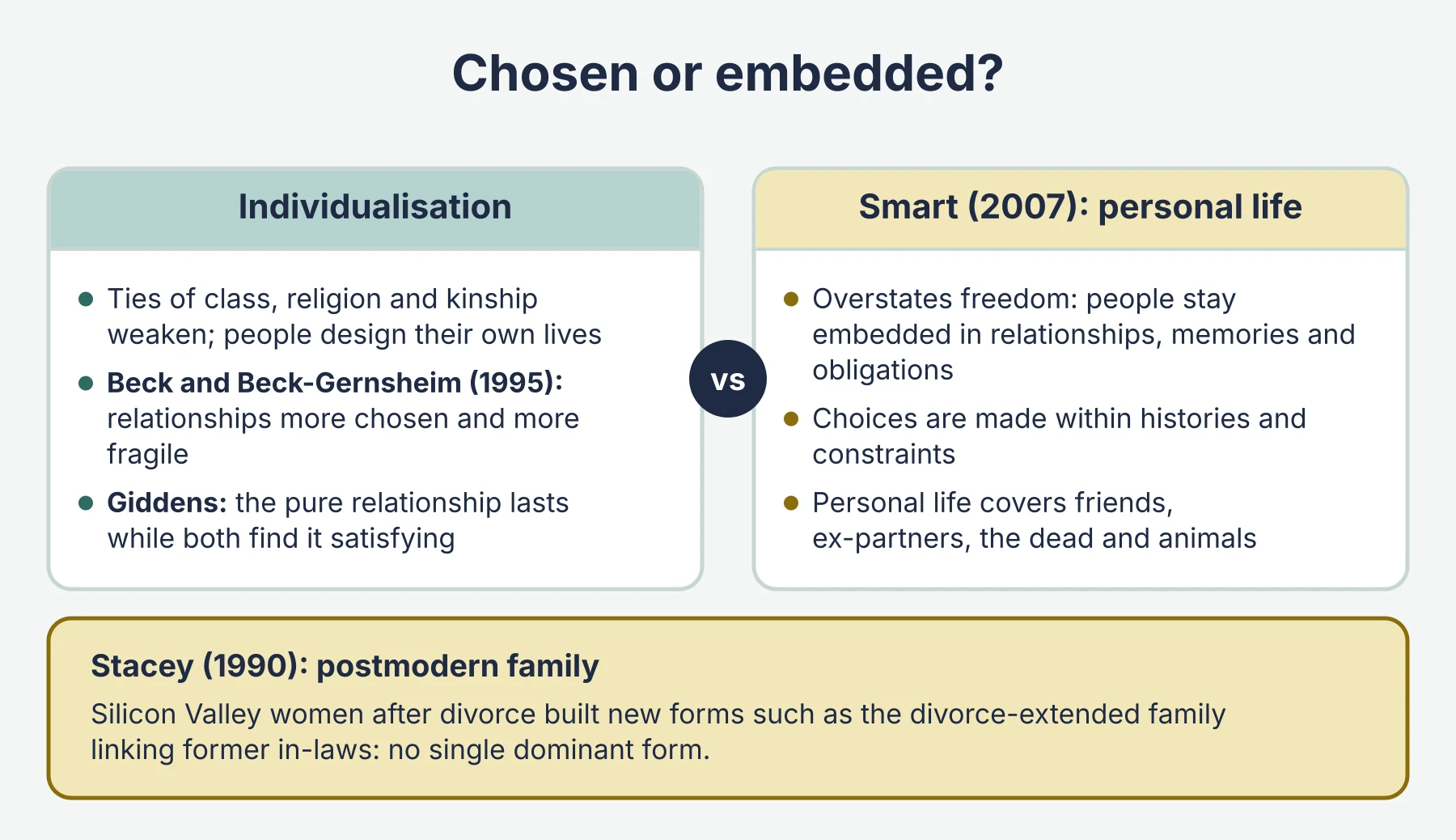
- Individualisation; personal life (Smart).
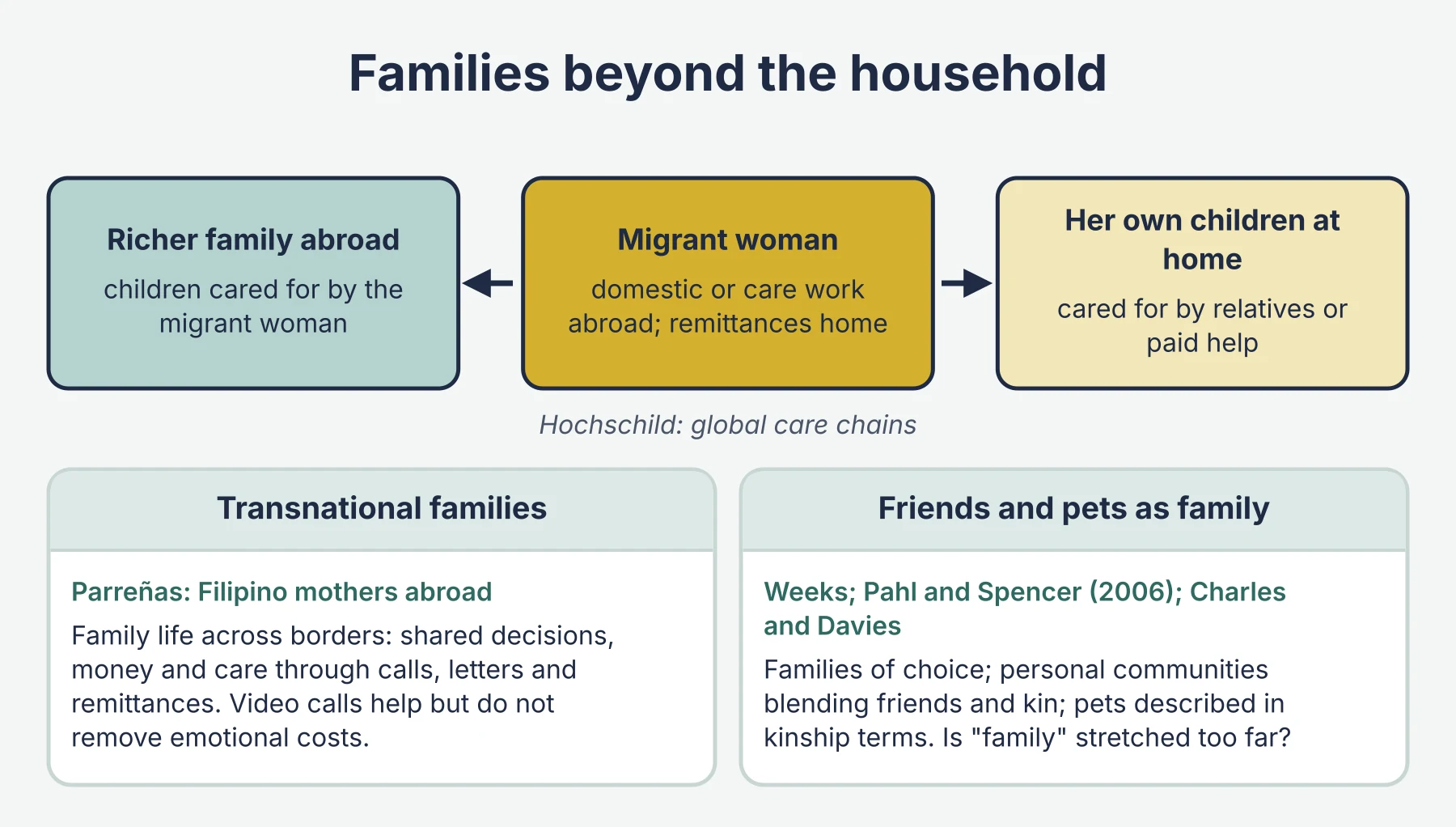
- Diasporas and transnational families; friends as family; pets/companion animals as family members.
- Cohabitation and civil partnerships may be credited where appropriate but are not directly assessed.
Key terms
| Term | Definition |
|---|---|
| Birth rate | Live births per 1,000 of the population per year |
| Death rate | Deaths per 1,000 of the population per year |
| Infant mortality rate | Deaths of babies under one year per 1,000 live births |
| Ageing population | Rising average age and growing share of older people |
| Internal / international migration | Movement within / between countries |
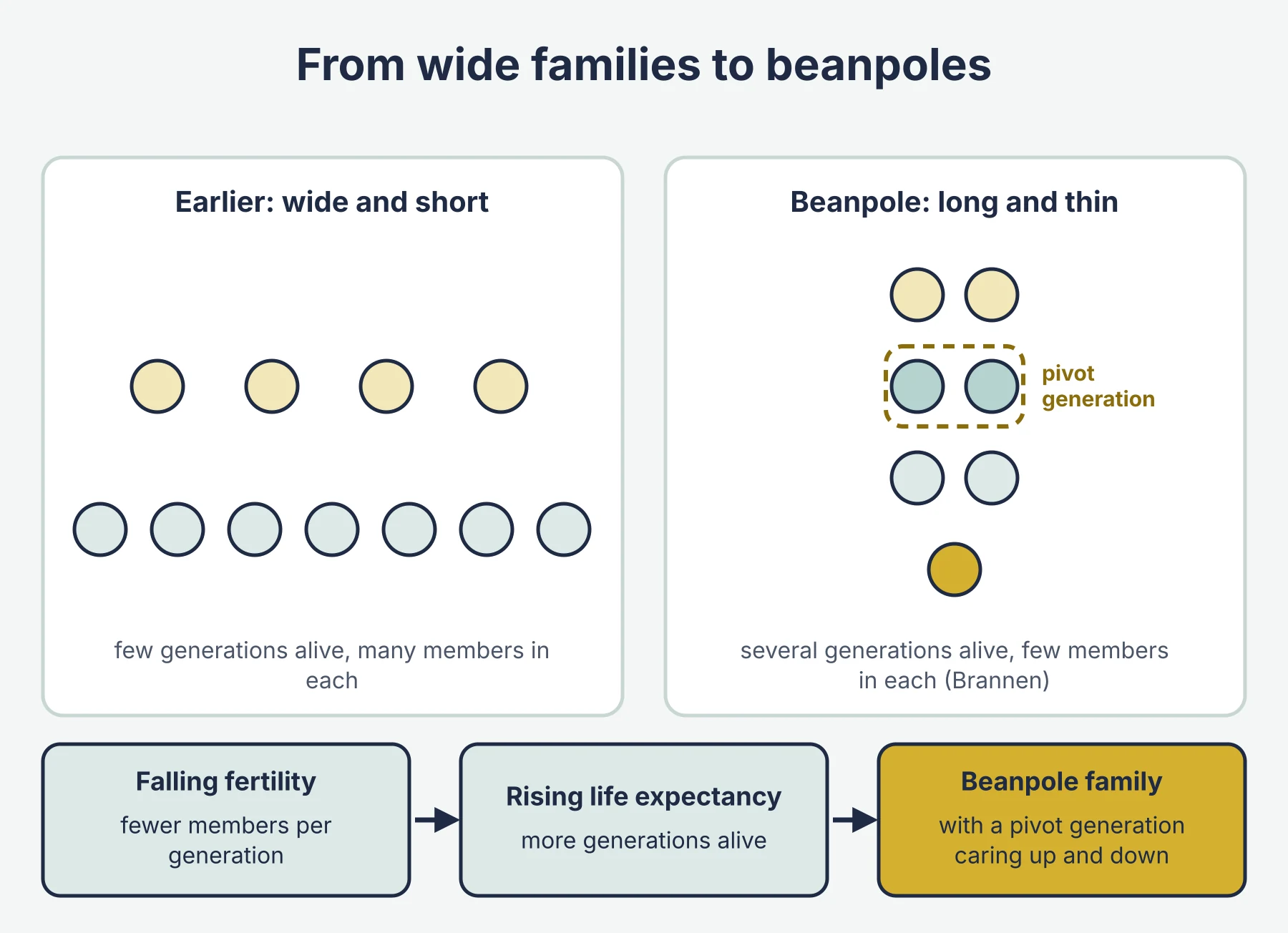
| Beanpole family | Several generations, few members in each |
| Pivot / sandwich generation | Adults caring for both children and older parents |
| Reconstituted family | Family including children from a previous relationship |
| Living apart together | Committed couple keeping separate homes |
| Child-free couple | Couple choosing not to have children |
| Individualisation | Weakening of traditional ties so that people shape their own lives |
| Personal life | Smart’s wider concept of all significant, embedded relationships |
| Transnational family | Family life maintained across national borders |
| Families of choice | Friendship networks performing family roles (Weeks and colleagues) |
Demographic change: cause and family effect
| Change | Cause | Effect on families |
|---|---|---|
| Smaller family size | Children cost more; contraception; women’s education and work | Fewer siblings; more child-centred families |
| Lower death rate | Nutrition, sanitation, medicine | More generations alive at once |
| Lower infant mortality | Clean water, immunisation, maternal care | Fewer births needed; smaller families |
| Ageing population | Low fertility plus longer life | Beanpole families; pivot generation; grandparent childcare |
| Internal migration | Urban jobs | Split households; children left with grandparents |
| International migration | Work, safety, family reunion | Transnational families; diasporas |
Industrialisation and urbanisation
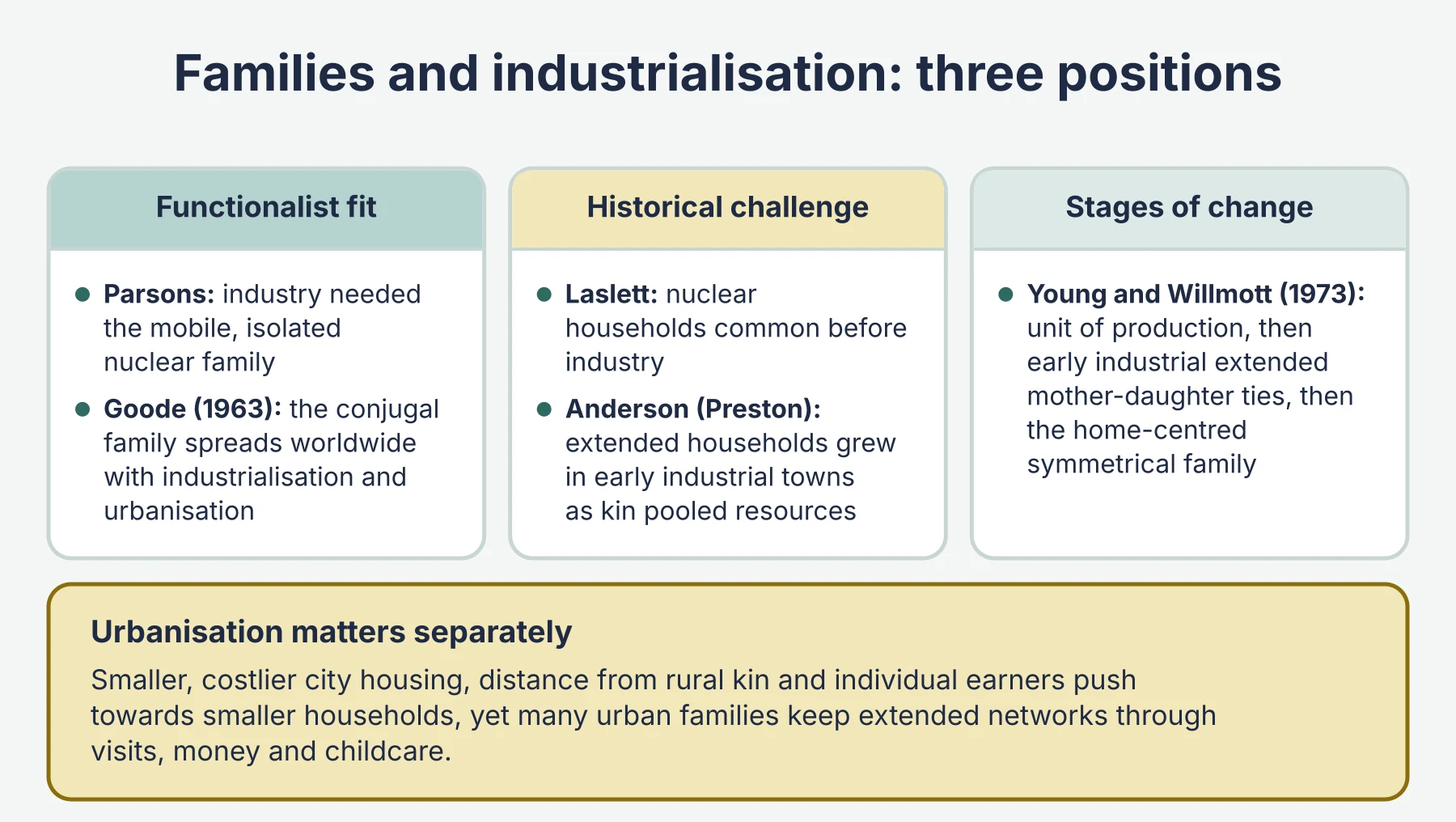
- Parsons: nuclear family fits industrial need for mobility. Goode (1963): conjugal family spreads worldwide.
- Laslett: nuclear households common before industry. Anderson: extended households in industrial Preston (1851 census) for mutual aid.
- Young and Willmott (1973): unit of production, then extended early industrial family, then symmetrical family.
- Urbanisation: smaller, costly housing and distance from kin shrink households, but rural-urban networks keep extended ties alive.
Explaining diversity
- Demographic: ageing (beanpole, pivot); lower fertility (child-free, small families).
- Laws and policies: divorce reform (reconstituted, single-parent families); China’s one-child policy (1980) and later two- and three-child limits (“4-2-1” structure); welfare, housing and leave policies.
- Economic: women’s employment; housing costs; career mobility (LAT).
- Cultural: secularisation; less stigma; individualisation.
Theorists
| Sociologist | Idea |
|---|---|
| Beck and Beck-Gernsheim (1995) | Individualisation; love becomes chosen and fragile |
| Giddens | The pure relationship, kept only while satisfying |
| Smart (2007) | Personal life: people stay embedded in relationships; critiques individualisation |
| Stacey (1990) | Postmodern family; divorce-extended families in Silicon Valley |
| Brannen | Beanpole family and pivot generation |
| Parreñas | Filipino transnational mothering |
| Hochschild | Global care chains |
| Weeks and colleagues | Families of choice |
| Pahl and Spencer (2006) | Personal communities blending friends and kin |
| Charles and Davies | Pets described as kin |
Exam traps
- Listing family types with no cause.
- Mixing up birth rate and fertility or family size.
- Calling Smart an individualisation theorist; she argues for embeddedness.
- Leaving out laws and social policies.
- Saying industrialisation simply “created” the nuclear family.
- Forgetting a named society in extended answers.
Evaluation lines to reuse
- “Ageing and low fertility explain the shape of beanpole families, but not why some couples choose to live apart together; that needs individualisation or economic explanations.”
- “Smart accepts that relationships are more varied but argues they are still embedded in kin, memory and obligation, so choice is narrower than Beck and Beck-Gernsheim suggest.”
- “China’s birth limits show that state policy can reshape family structure within a generation, faster than gradual cultural change.”
Self-test
- Define the infant mortality rate.
- Give two reasons for falling family size.
- Why does an ageing population create beanpole families?
- What is the pivot generation?
- What did Anderson find about industrial Preston?
- Name Young and Willmott’s final stage of family.
- Give one example of a law or policy affecting family structure.
- What is the difference between individualisation and Smart’s personal life?
- What is a divorce-extended family?
- What are global care chains?
- Who used the term families of choice?
- Give one reason couples may live apart together.
Answers
- Deaths of babies under one year per 1,000 live births.
- Children becoming an economic cost; contraception; women’s education and paid work.
- Fewer births reduce width; longer life adds generations.
- Adults supporting both their children and their ageing parents.
- Extended households were common, as kin pooled resources.
- The symmetrical family.
- Divorce reform, or China’s one-child policy from 1980.
- Individualisation stresses free choice; Smart stresses that choices stay embedded in relationships and histories.
- Former in-laws and ex-partners keeping kin-like ties after divorce (Stacey).
- Migrant women care for richer families while their own children are cared for by others at home.
- Jeffrey Weeks and colleagues.
- Jobs in different cities, or a wish to keep independence and separate homes.
Practise next: social change and changing families practice questions | Introducing Sociology study guide
Related resources
-
Practice questions
OxfordAQA A Level Sociology: Introducing Sociology — Practice Questions
Original OxfordAQA International A-level Sociology (9690) Unit 1 practice questions, with worked answers on families, marriage, perspectives and methods.
Sociology · OxfordAQA · AS Level
Try questions -
Revision notes
OxfordAQA A Level Sociology: Introducing Sociology — Revision Notes
OxfordAQA International A-level Sociology (9690) Unit 1 recall notes: families (3.1.1) and research methods and theory (3.1.3), with traps and a self-test.
Sociology · OxfordAQA · AS Level
Revise topic -
Study guides
OxfordAQA International A-Level Sociology: Introducing Sociology (9690)
Families (3.1.1), and research methods and theory (3.1.3) – the content of Unit 1 for OxfordAQA International A-Level Sociology (9690).
Sociology · OxfordAQA · AS Level
Read guide
Related articles
Get free revision emails (optional)
Occasional emails with practice questions, worked explanations and links to free resources for the qualification and subjects you choose. No spam, and you can unsubscribe from any email. The free tools on this site never need an email.