
Study Guides
OxfordAQA International A-Level Sociology (9690): Gender, Age and the Experience of Family Life
Study guide to OxfordAQA 9690 section 3.1.1.4: conjugal roles, domestic labour, power, violence, childhood, boomerang children and older people in families.
- Subject
- Sociology
- Level
- AS LEVEL
- Topic
- Unit 1 – Introducing Sociology
- Author
- Marlbridge Academic Team
- Updated
- Reviewed by
- Naqiya Yousaf (what this means)
Aligned to OxfordAQA A Level Sociology (9690), Version 1.1 (new qualification). Official specification .
Syllabus page (what it covers and how it is assessed): OxfordAQA A Level Sociology.
Syllabus points this page covers
9690 (AS Level)
- 3.1.1.4 Gender, age and the experience of family life
Found an error? Report a correction.
Need help with this topic? Request a free trial class for A Level Sociology (9690).
Section 3.1.1.4 Gender, age and the experience of family life in OxfordAQA International AS/A level Sociology (9690) is examined in Unit 1 Section A. It asks how family life differs for men and women, for children, for adult children and for older people. The specification lists “traditional” male and female roles, including “the female/expressive role including emotional support and the triple shift” and “the male/instrumental or ‘breadwinner’ role”; changes to these roles and reasons; the division of domestic labour and gender differences in power and decision making; violence against women and children; children’s status and roles in different societies and over time, and child centredness; adult children, including “boomerang” families; and older people, including grandparent roles. The unit overview is in the Introducing Sociology study guide.
Part 1: gender
“Traditional” roles
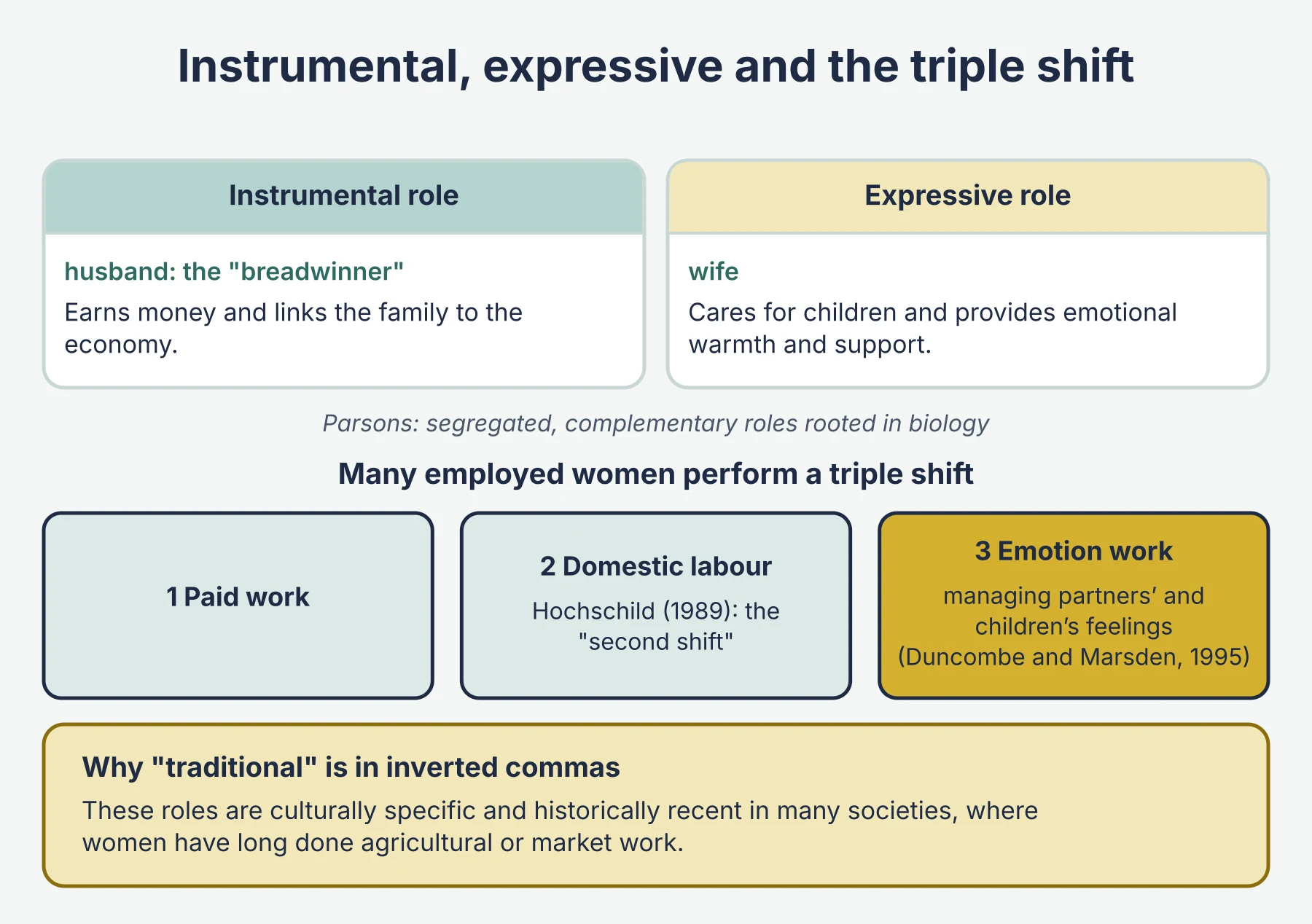
Talcott Parsons described a segregated division of labour in the nuclear family: the husband performs the instrumental role, earning money and linking the family to the economy; the wife performs the expressive role, caring for children and providing emotional warmth. Parsons saw these roles as complementary and rooted in biology. The specification’s inverted commas around “traditional” are a reminder that such roles are culturally specific and historically recent in many societies, where women have long done agricultural or market work.
The expressive role includes emotional support. Jean Duncombe and Dennis Marsden (1995) argued that women also do emotion work (managing the feelings of partners and children), so many employed women perform a triple shift: paid work, domestic labour and emotion work. Arlie Hochschild’s The Second Shift (1989) had already described employed American women returning home to a second shift of housework and childcare.
Changes to roles, and reasons
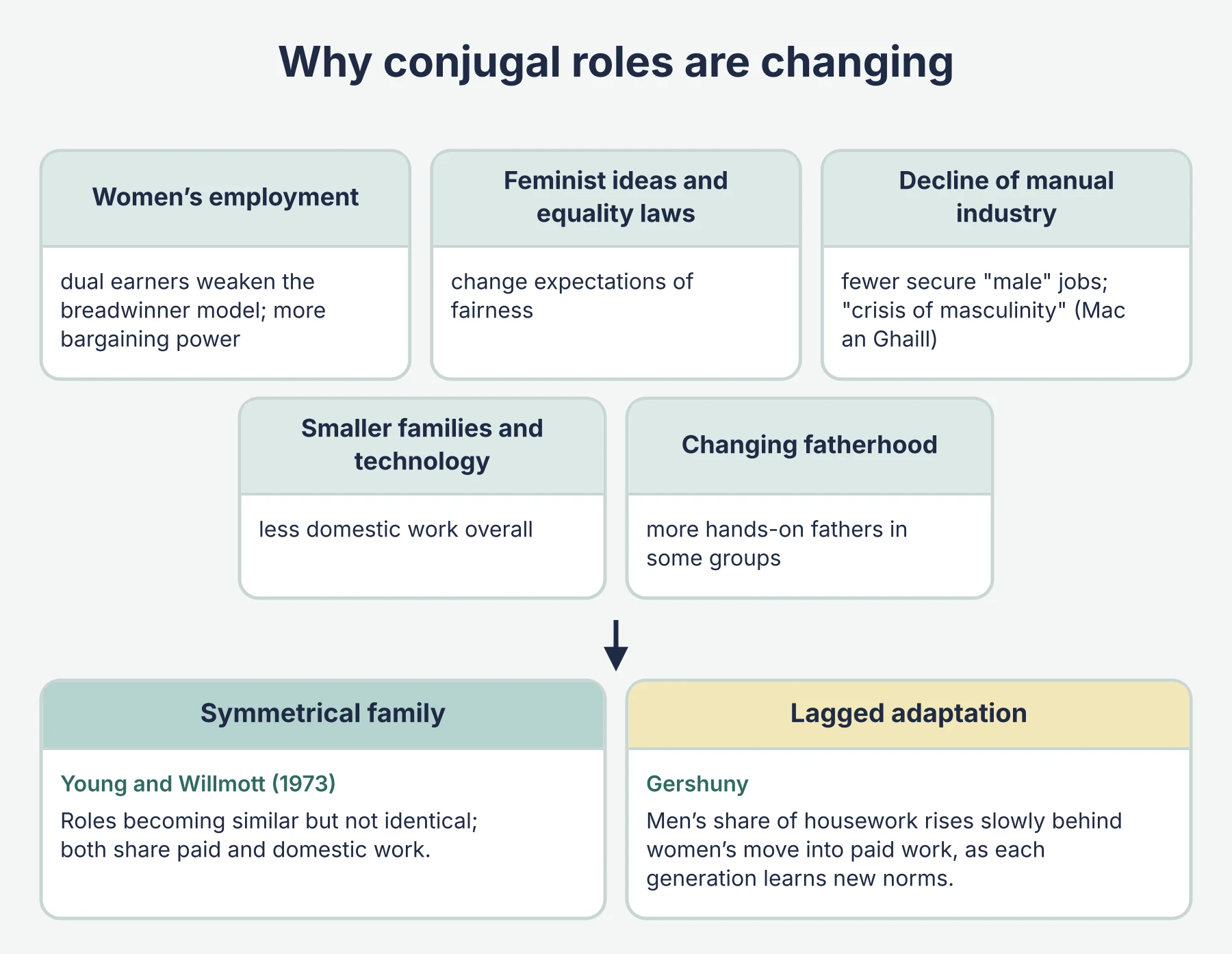
| Reason | How it changes roles |
|---|---|
| Women’s employment | Dual-earner couples weaken the single breadwinner model and give women bargaining power |
| Feminist ideas and equality laws | Change expectations about fairness and men’s duties |
| Decline of manual industry | Fewer secure “male” jobs, contributing to what Máirtín Mac an Ghaill called a “crisis of masculinity” |
| Smaller families and household technology | Less domestic work overall |
| Changing ideas of fatherhood | More involved, hands-on fathers in some groups |
Michael Young and Peter Willmott (The Symmetrical Family, 1973) argued that roles were becoming symmetrical: similar but not identical, with both partners sharing paid and domestic work. Jonathan Gershuny’s idea of lagged adaptation suggests men’s share of housework rises slowly behind women’s move into paid work, as each generation is socialised into new norms.
The division of domestic labour
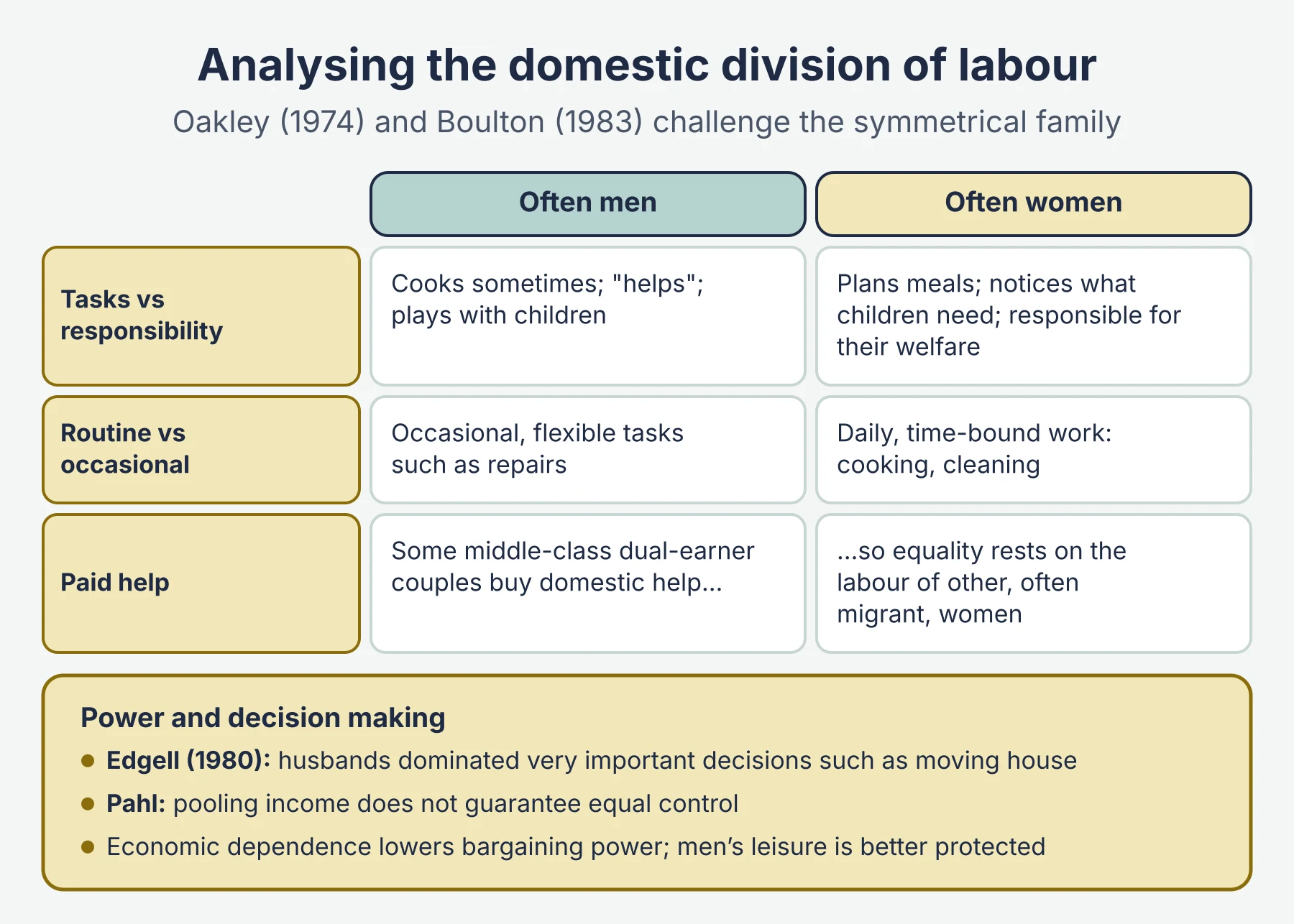
Ann Oakley’s research on housewives, published in 1974, challenged Young and Willmott: she found men’s “help” was limited, often confined to tasks such as playing with children, and that women kept overall responsibility. Mary Boulton’s study of mothers (1983) made a similar point: counting tasks hides who is responsible for children’s welfare. Three distinctions help you analyse any evidence:
- Tasks vs responsibility: a man may cook sometimes, but who plans meals and notices what children need?
- Routine vs occasional work: women more often do daily, time-bound work (cooking, cleaning); men more often do occasional, flexible tasks (repairs).
- Paid help: in some societies, middle-class dual-earner couples buy domestic help, so equality between partners rests on the labour of other, often migrant, women.
Power and decision making
Power is about who makes important decisions and who controls resources. Stephen Edgell’s study of middle-class couples (1980) found husbands dominated decisions seen as very important, such as moving house. Jan Pahl’s research on household money showed that pooling income does not guarantee equal control. Economic dependence matters: a partner without earnings has less bargaining power. Feminists also point to the gendering of leisure: men’s time off is often better protected.
Violence against women and children
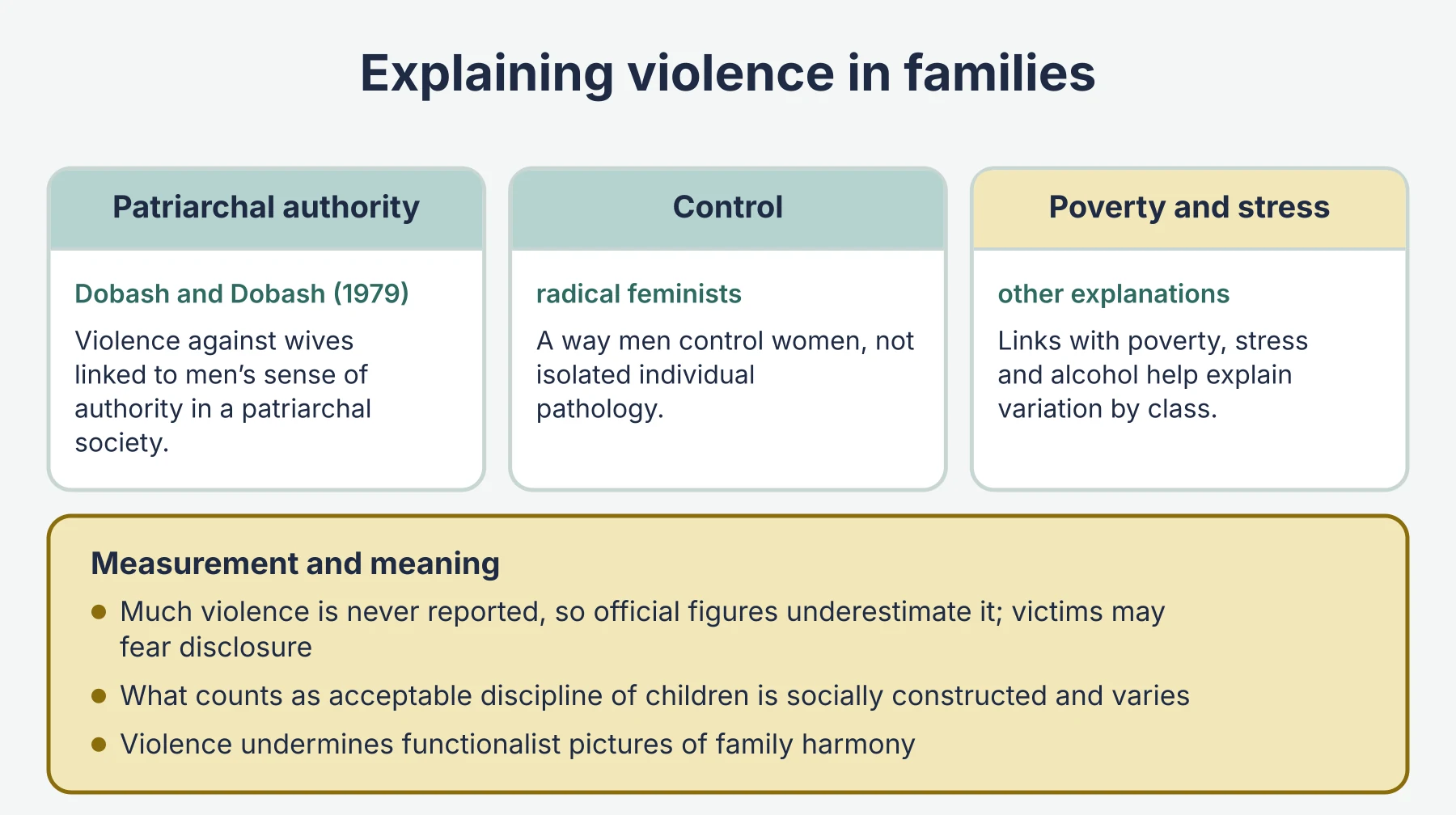
Violence and abuse within families undermine functionalist pictures of harmony. R. Emerson Dobash and Russell Dobash’s research (1979) linked violence against wives to men’s sense of authority in a patriarchal society. Radical feminists see such violence as a way men control women, not as isolated individual pathology. Others stress links with poverty, stress and alcohol, which helps explain variation by class. Measurement is difficult: much violence is never reported, so official figures underestimate it, and victims may fear the consequences of disclosure. Violence against children includes physical punishment, neglect and abuse; what counts as acceptable discipline is itself socially constructed and differs between societies and over time.
Part 2: age
Children
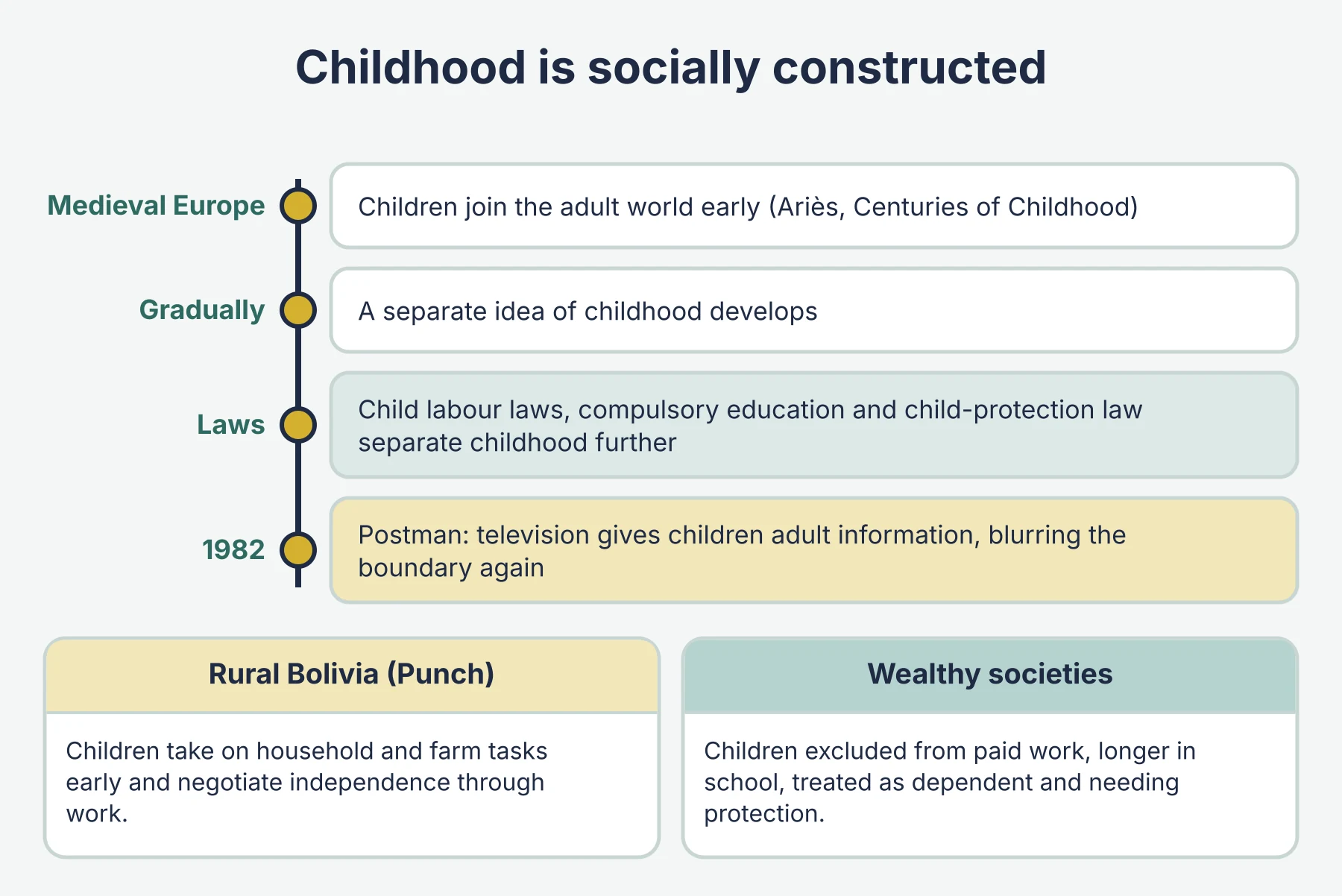
Status and roles in different societies. In many societies children are expected to work in fields, markets or the home from a young age. Samantha Punch’s study of children in rural Bolivia found they took on household and farm tasks early and negotiated some independence through this work. In wealthy societies children are usually excluded from paid work, required to stay longer in school and treated as dependent and in need of protection.
Changes over time. Philippe Ariès (Centuries of Childhood, English edition 1962) argued that in medieval Europe children joined the adult world early, and that a separate idea of childhood developed gradually. Child labour laws, compulsory education and child-protection law then separated childhood further. Neil Postman (The Disappearance of Childhood, 1982) argued that television, by giving children access to adult information, was blurring this boundary again.
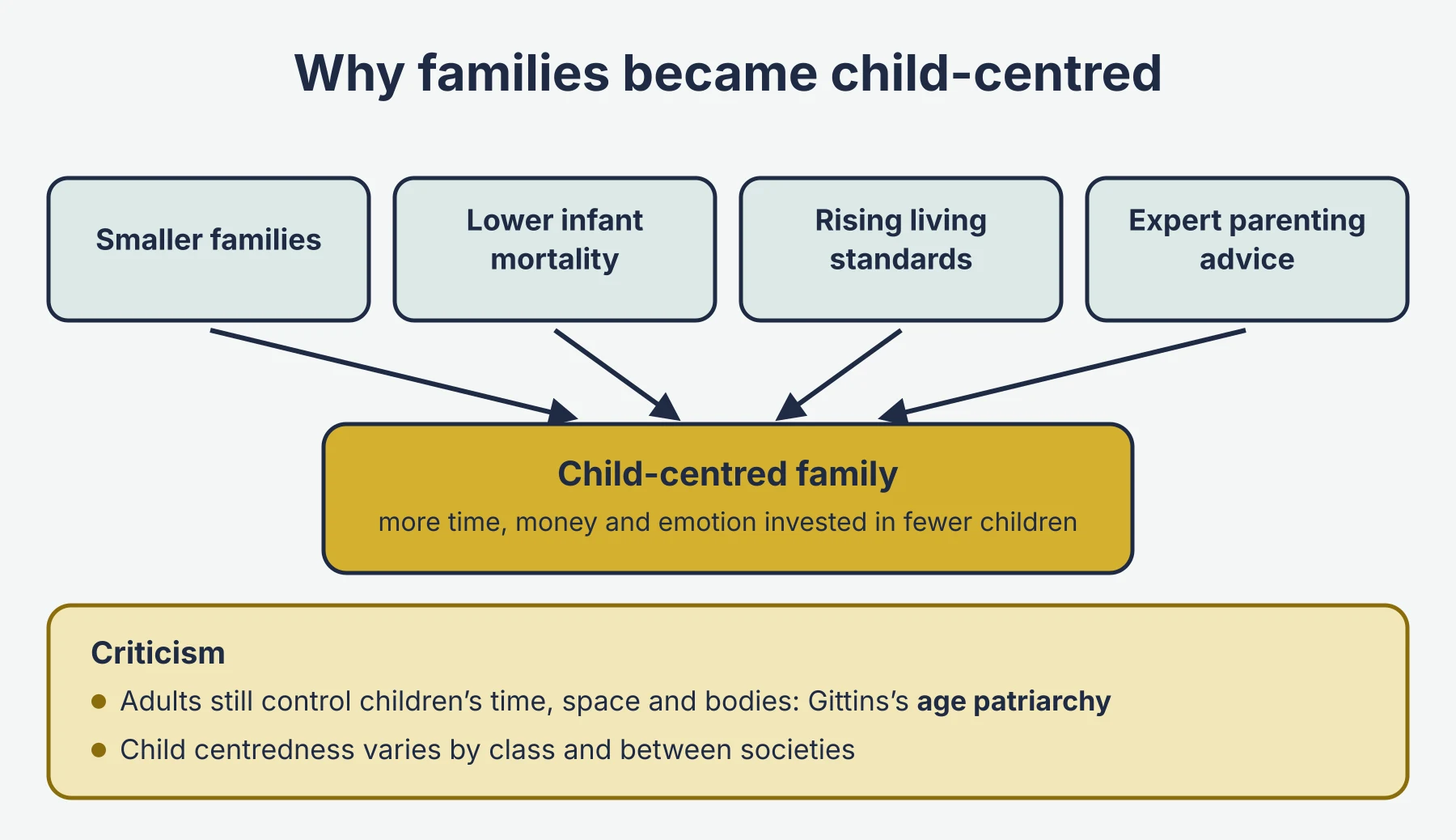
Child centredness. Family life increasingly revolves around children’s needs, with more time, money and emotional investment in fewer children. Explanations include smaller families, lower infant mortality (parents expect children to survive), rising living standards and expert advice on parenting. Critics argue that adults still control children’s time, space and bodies; Diana Gittins used the term age patriarchy for adult domination of children. Child centredness also varies by class and between societies.
Adult children and “boomerang” families
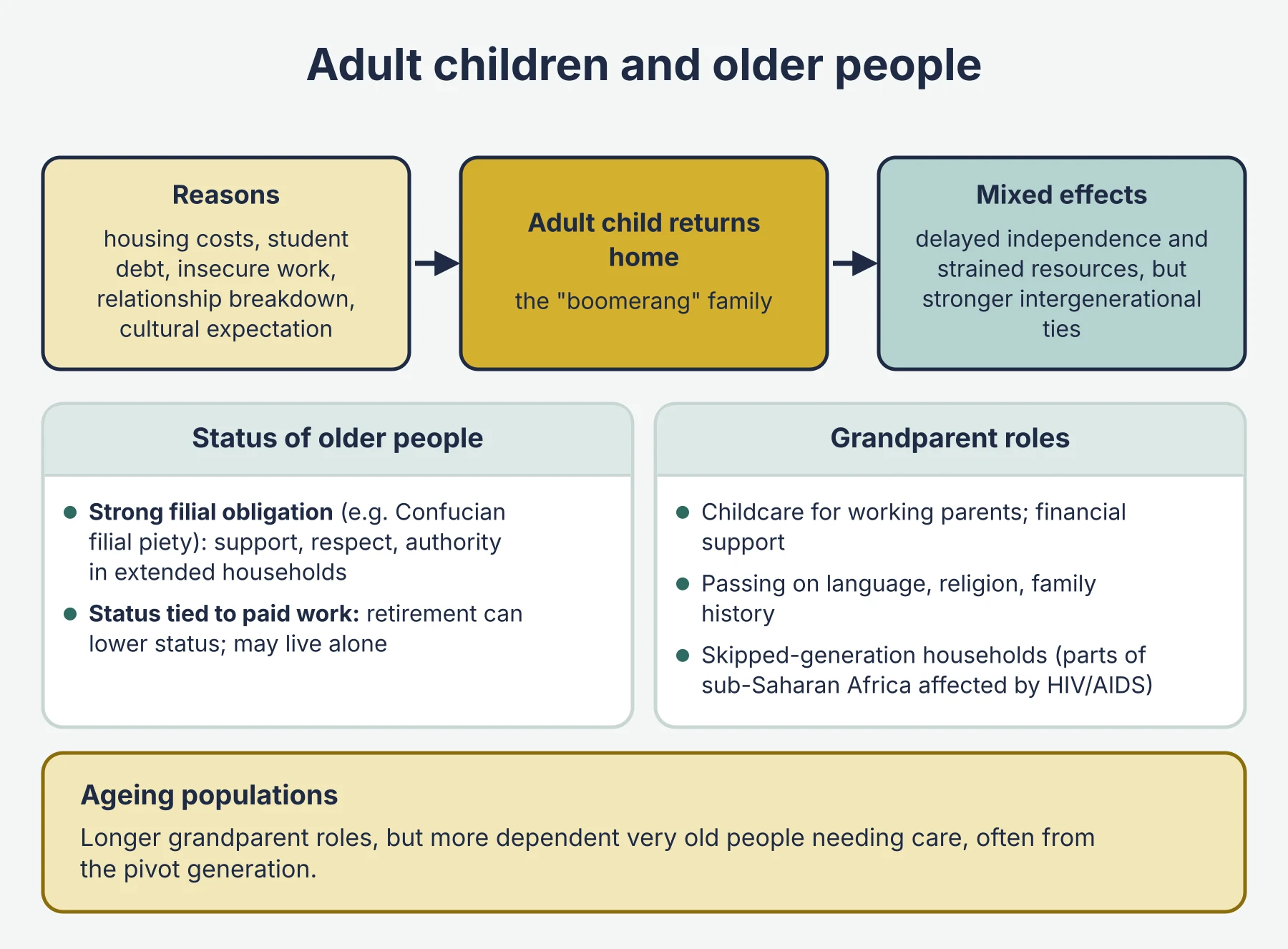
A boomerang family forms when adult children return to the parental home after a period of independence. Reasons include housing costs, student debt, insecure work, relationship breakdown and, in some societies, the cultural expectation that unmarried children live with parents. The effects are mixed: parents may give support well into their children’s adulthood, which delays independence and may strain resources, yet it can also strengthen intergenerational ties.
Older people and grandparent roles
The status of older people differs between societies. Where filial obligation is strong, as in societies shaped by Confucian ideas of filial piety, adult children are expected to support and respect parents, and older people may hold authority in extended households. In societies where status is tied to paid work, retirement can reduce status and older people may live alone. Grandparent roles include childcare for working parents, financial support, transmitting language, religion and family history, and, in some regions, raising grandchildren whose parents have migrated or died, as in skipped-generation households in parts of sub-Saharan Africa affected by HIV/AIDS. Ageing populations make the grandparent role longer and more important, while longer lives also create more dependent very old people needing care, often from the pivot generation.
Worked example: annotated 8-mark answer
Explain two reasons why women may still do more domestic labour than men.
Gender socialisation and lagged adaptation. Girls and boys are socialised into different expectations about caring, so many men still see housework as women’s responsibility (explain). Gershuny’s idea of lagged adaptation suggests norms change only slowly after women enter paid work (evidence), so even dual-earner couples keep unequal patterns (develop).
Economic power. Men on average still earn more in many societies, so couples may protect the higher earner’s career by placing domestic work on the woman (explain). Pahl’s research showed unequal control of money (evidence), which reduces women’s bargaining power at home (develop).
Common mistakes
- Using “triple shift” to mean three jobs: it is paid work, domestic labour and emotion work.
- Counting tasks without discussing responsibility.
- Writing about children only in Western societies; the specification asks about different societies and change over time.
- Forgetting older people and grandparents, which are named content.
- Treating violence as rare or as a purely individual issue without sociological explanation.
Exam technique
In explain answers, give a reason, a mechanism and a named study or example. In evaluate answers on gender equality, distinguish attitudes from practice and tasks from responsibility, and apply to a named society. For age, compare at least two societies or two historical periods.
Related resources
-
Revision notes
OxfordAQA International A-Level Sociology (9690): Gender, Age and the Experience of Family Life – Revision Notes
Revision notes for OxfordAQA 9690 section 3.1.1.4: expressive and instrumental roles, triple shift, domestic labour, power, childhood and older people.
Sociology · OxfordAQA · AS Level
Revise topic -
Study guides
OxfordAQA International A-Level Sociology (9690): Perspectives on Families and Society
Study guide to OxfordAQA 9690 section 3.1.1.2: functionalist, Marxist and feminist views of families and how families relate to wider society.
Sociology · OxfordAQA · AS Level
Read guide -
Practice questions
OxfordAQA International A-Level Sociology (9690): Perspectives on Families and Society – Practice Questions
Original OxfordAQA 9690 Unit 1 style questions on functionalist, Marxist and feminist perspectives on families, with full mark schemes and levels.
Sociology · OxfordAQA · AS Level
Try questions
Related articles
Get free revision emails (optional)
Occasional emails with practice questions, worked explanations and links to free resources for the qualification and subjects you choose. No spam, and you can unsubscribe from any email. The free tools on this site never need an email.