
Study Guides
OxfordAQA International A-Level Sociology (9690): Perspectives on Families and Society
Study guide to OxfordAQA 9690 section 3.1.1.2: functionalist, Marxist and feminist views of families and how families relate to wider society.
- Subject
- Sociology
- Level
- AS LEVEL
- Topic
- Unit 1 – Introducing Sociology
- Author
- Marlbridge Academic Team
- Updated
- Reviewed by
- Naqiya Yousaf (what this means)
Aligned to OxfordAQA A Level Sociology (9690), Version 1.1 (new qualification). Official specification .
Syllabus page (what it covers and how it is assessed): OxfordAQA A Level Sociology.
Syllabus points this page covers
9690 (AS Level)
- 3.1.1.2 Perspectives on families and the relationship between families and society
Found an error? Report a correction.
Need help with this topic? Request a free trial class for A Level Sociology (9690).
Section 3.1.1.2 Perspectives on families and the relationship between families and society in OxfordAQA International AS/A level Sociology (9690) is examined in Unit 1 Section A. The specification names three positions: functionalism (“functions of the family; how the nuclear family ‘fits’ modern industrial societies”), Marxism (“families as agents of social control”) and feminisms (“families as shaping the position of men and women in society”). Of the named sociologists for 3.1.1, Parsons, Engels and Oakley belong here. For the whole unit see the Introducing Sociology study guide.
The organising question is the same for all three: whose needs does the family meet? Functionalists answer “society’s and its members’”; Marxists answer “capitalism’s”; feminists answer “men’s”. Holding that question in mind keeps essays analytical rather than descriptive.
Functionalism
Functionalists see society as a system of interdependent parts, each meeting needs that keep the whole stable. The family is analysed by the functions it performs.
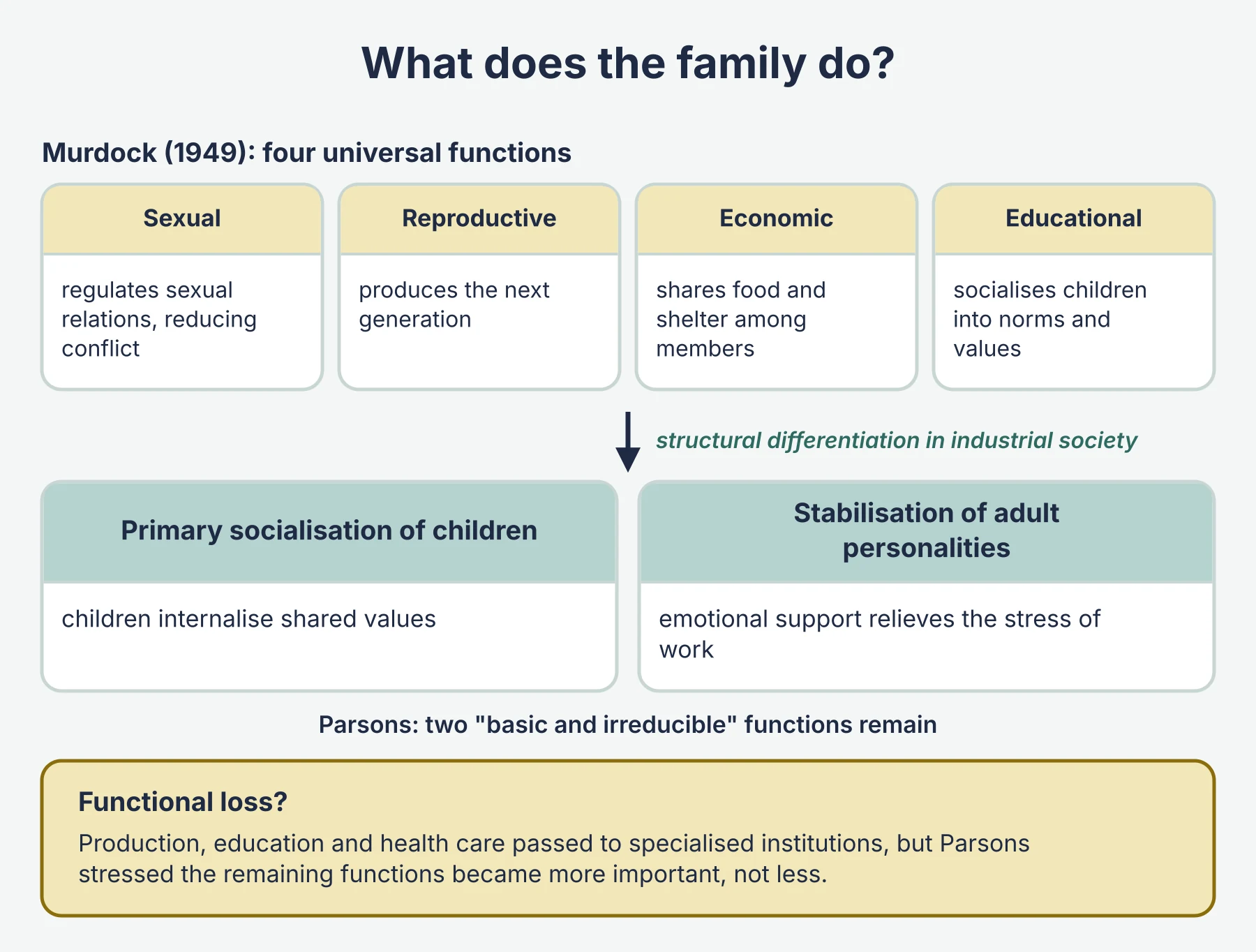
Murdock (1949) argued four functions are universal:
| Function | What it does for society |
|---|---|
| Sexual | Regulates sexual relations, reducing conflict |
| Reproductive | Produces the next generation |
| Economic | Shares resources, such as food and shelter, among members |
| Educational | Socialises children into society’s norms and values |
Talcott Parsons argued that in modern industrial societies the family has been stripped down to two “basic and irreducible” functions: the primary socialisation of children, so that they internalise shared values, and the stabilisation of adult personalities, where the family gives emotional support that relieves the stress of working life. Other functions, such as production, education and health care, passed to specialised institutions through structural differentiation. This is sometimes called functional loss, though Parsons stressed that the remaining functions became more important, not less.
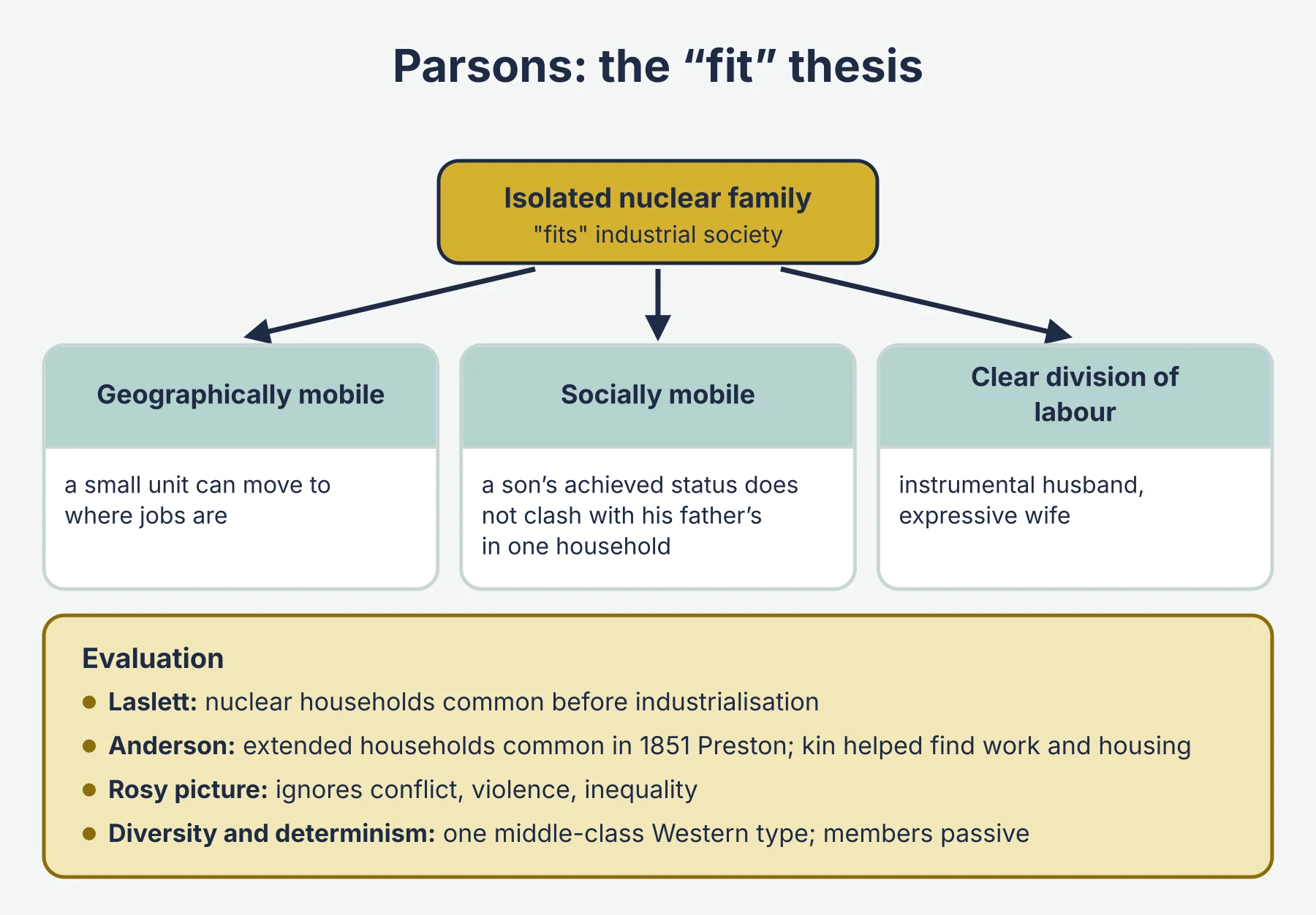
The “fit” thesis. Parsons argued the isolated nuclear family fits industrial society because:
- it is geographically mobile: a small unit can move to where jobs are;
- it is socially mobile: status in industrial society is achieved at work, and a son’s achieved status will not clash with his father’s in the same household, as it might in an extended family where status is ascribed;
- it has a clear division of labour: the husband’s instrumental role (breadwinning) and the wife’s expressive role (care and emotional support).
Evaluation of functionalism.
- Historical evidence: Peter Laslett’s research on English parish records found nuclear households were already common before industrialisation, so industry did not create them. Michael Anderson’s study of Preston using the 1851 census found extended households were common in early industrial towns, where kin helped each other find work and housing.
- Rosy picture: functionalists stress harmony and ignore conflict, violence and inequality within families (3.1.1.4).
- Diversity: the “fit” model describes one middle-class, Western family type and struggles to explain single-parent, reconstituted or transnational families (3.1.1.3).
- Determinism: family members appear to absorb roles passively; social action views stress negotiation.
Marxism
Marxists see society as divided between a ruling class, which owns the means of production, and a working class, which sells its labour. The family is an agent of social control that helps capitalism survive.
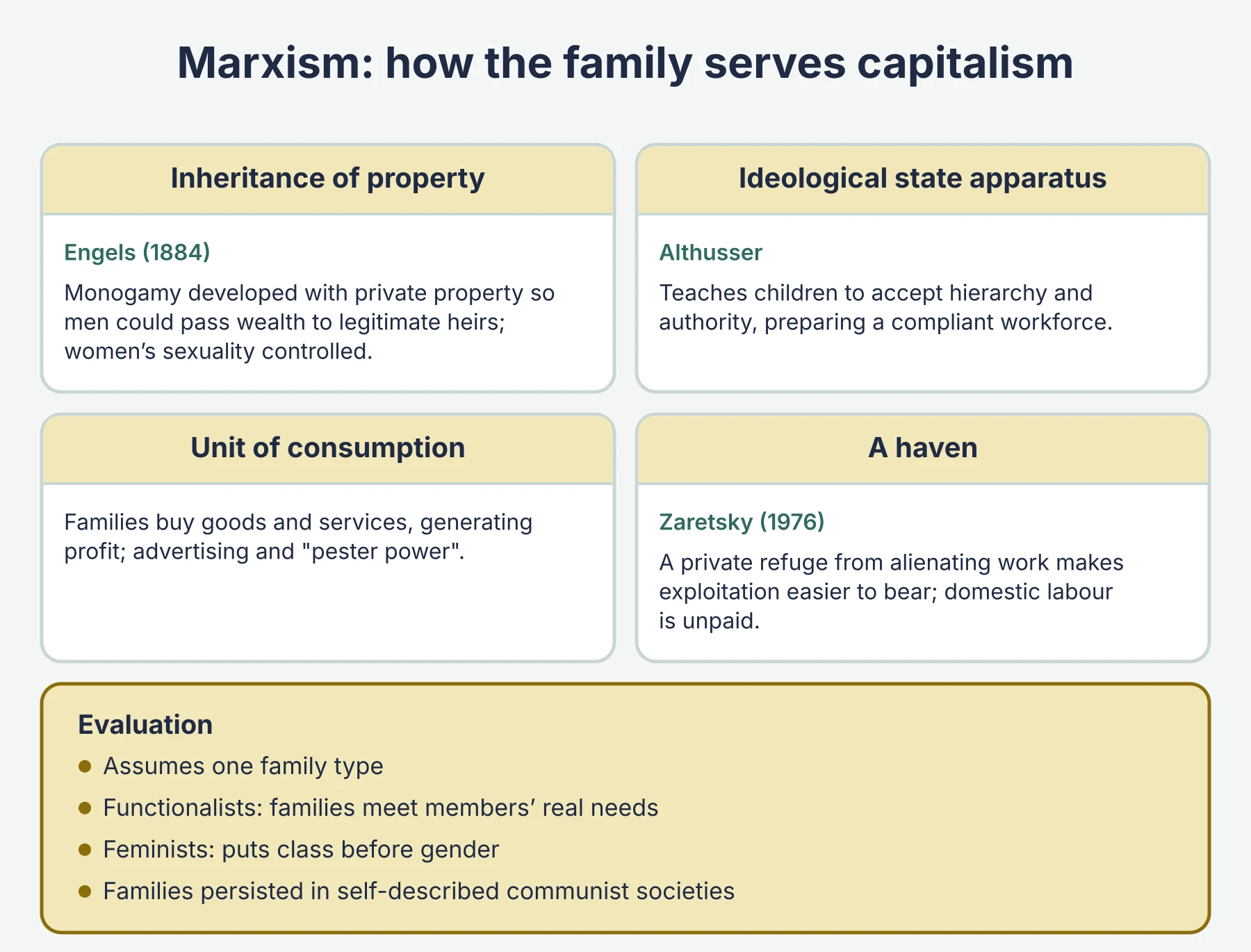
- Inheritance of property. Friedrich Engels, in The Origin of the Family, Private Property and the State (1884), argued that the monogamous family developed alongside private property. Men needed to be certain of their children’s paternity so that wealth could pass to legitimate heirs; women’s sexuality was therefore controlled. Engels linked women’s subordination to class society.
- Ideological functions. Louis Althusser treated the family as an ideological state apparatus: it teaches children to accept hierarchy and authority, preparing a compliant workforce. Inequalities seem natural because they are first experienced as part of family life.
- Unit of consumption. Families buy goods and services, generating profit; advertisers and children’s “pester power” increase spending.
- A haven that props up capitalism. Eli Zaretsky (Capitalism, the Family and Personal Life, 1976) argued that the family offers a private refuge from alienating work, which makes exploitation easier to bear while the domestic labour that sustains workers is unpaid.
Evaluation of Marxism. Marxists tend to assume one family type and ignore diversity; functionalists argue families meet real needs of members, not only capitalism’s; feminists argue Marxists put class before gender and miss the specific oppression of women; and the persistence of family life in societies that called themselves communist suggests families are not purely a product of capitalism.
Feminisms
The specification says feminisms, plural, because feminists disagree.
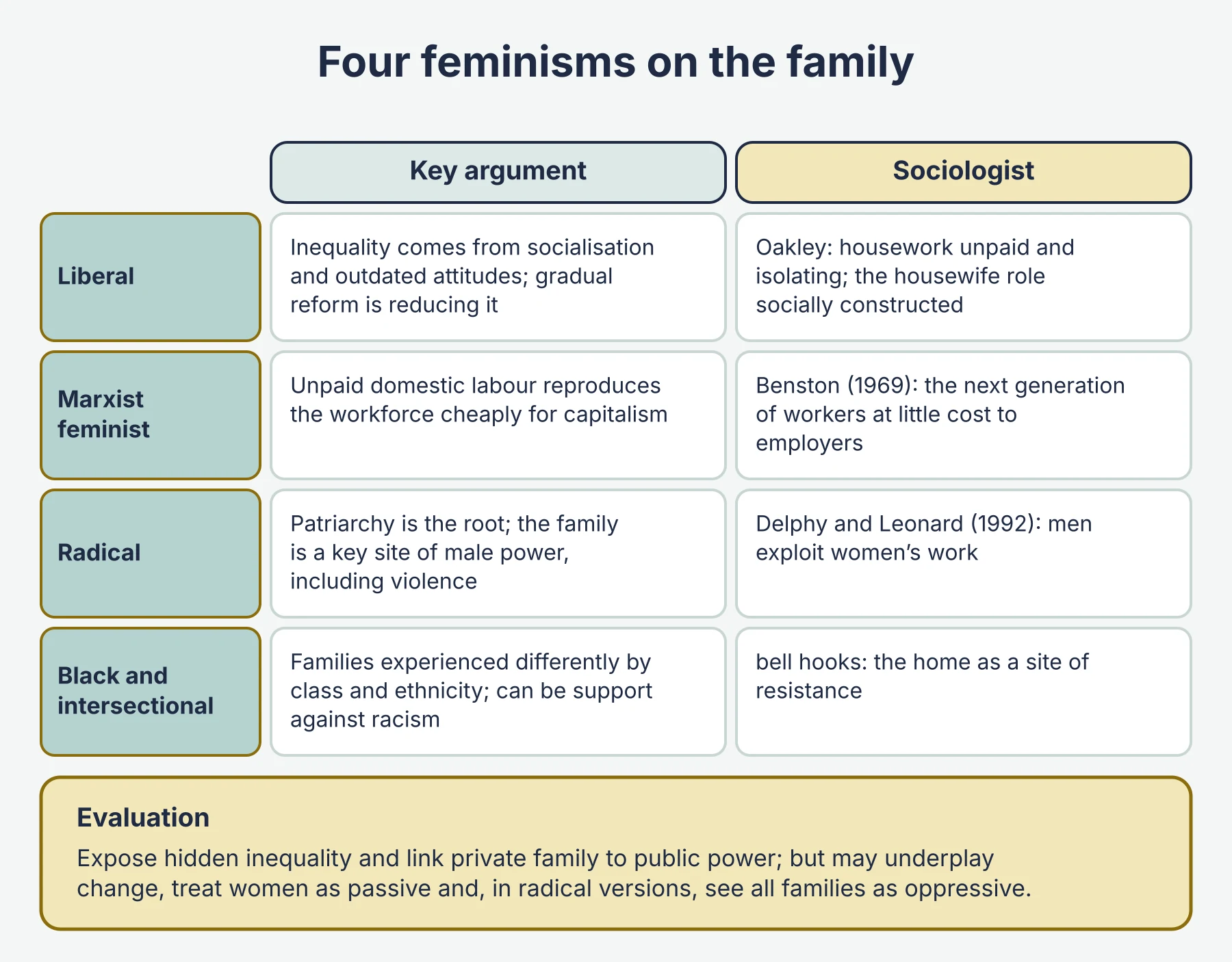
| Feminism | Key argument about families | Example of sociologist |
|---|---|---|
| Liberal | Inequality comes from socialisation and outdated attitudes; gradual reform (laws, education, equal pay) is reducing it | Ann Oakley’s research on housewives showed housework as unpaid, isolating work, and that the housewife role was socially constructed |
| Marxist feminist | Women’s unpaid domestic labour reproduces the workforce cheaply, benefiting capitalism | Margaret Benston (1969): the family produces and maintains the next generation of workers at little cost to employers |
| Radical | Patriarchy, not capitalism, is the root; men benefit directly from women’s labour and the family is a key site of male power, including violence | Christine Delphy and Diana Leonard (Familiar Exploitation, 1992): the family is an economic system in which men exploit women’s work |
| Black and intersectional | Families are experienced differently by class and ethnicity; for some women the family can be a place of support and resistance against racism | bell hooks’s idea of the home as a site of resistance |
Evaluation of feminisms. They expose inequality hidden by functionalist harmony and link the private family to public power; but they may underplay change (more equal roles in some groups), treat women as passive victims, and, in radical versions, see all families as oppressive. Their internal debates are themselves good evaluation material.
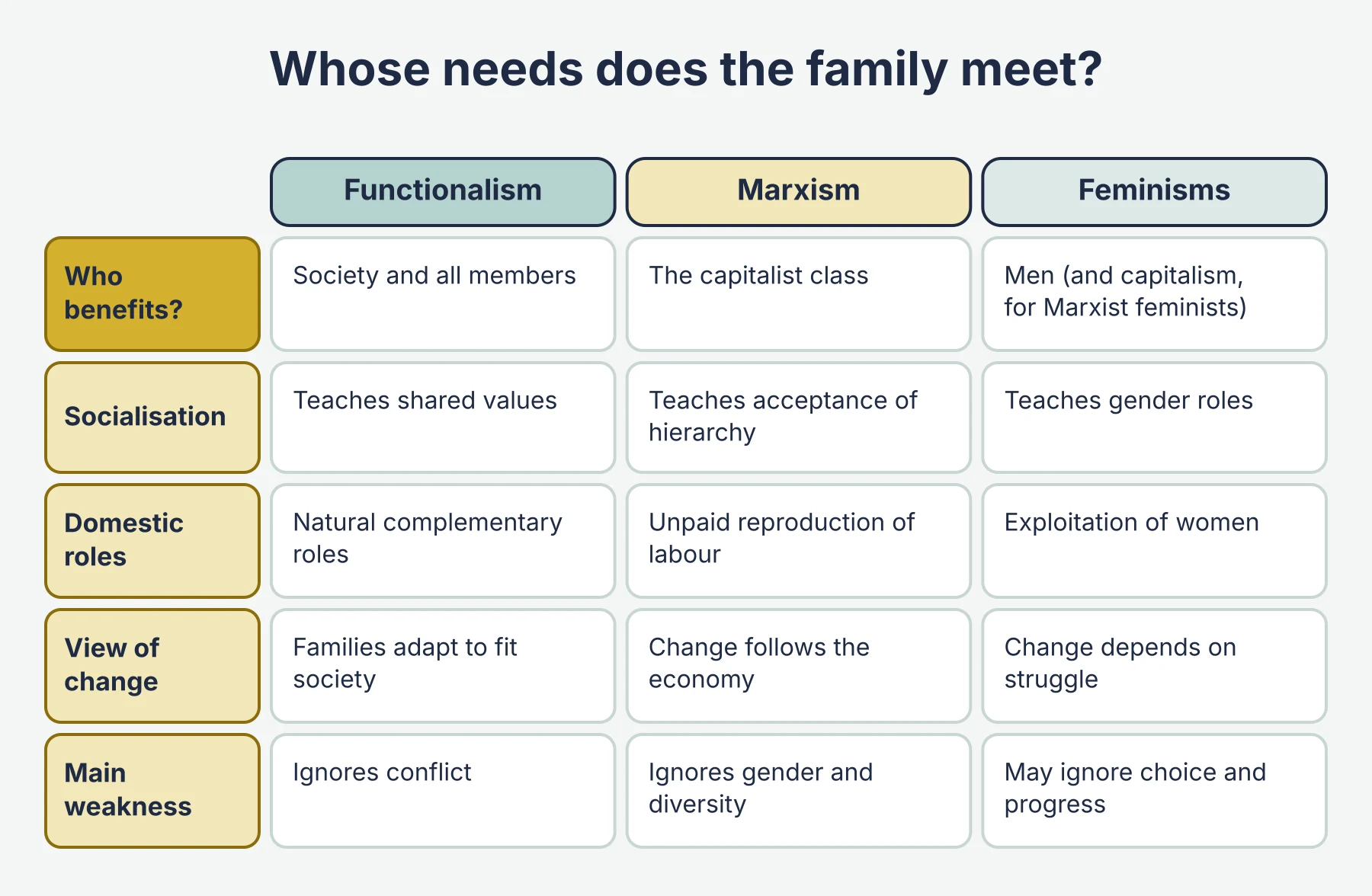
Comparing the three perspectives
| Functionalism | Marxism | Feminisms | |
|---|---|---|---|
| Who benefits? | Society and all members | The capitalist class | Men (and capitalism, for Marxist feminists) |
| Socialisation | Teaches shared values | Teaches acceptance of hierarchy | Teaches gender roles |
| Domestic roles | Natural complementary roles | Unpaid reproduction of labour | Exploitation of women |
| View of change | Families adapt to fit society | Change follows the economy | Change depends on struggle |
| Main weakness | Ignores conflict | Ignores gender and diversity | May ignore choice and progress |
Worked example: annotated 8-mark paragraph
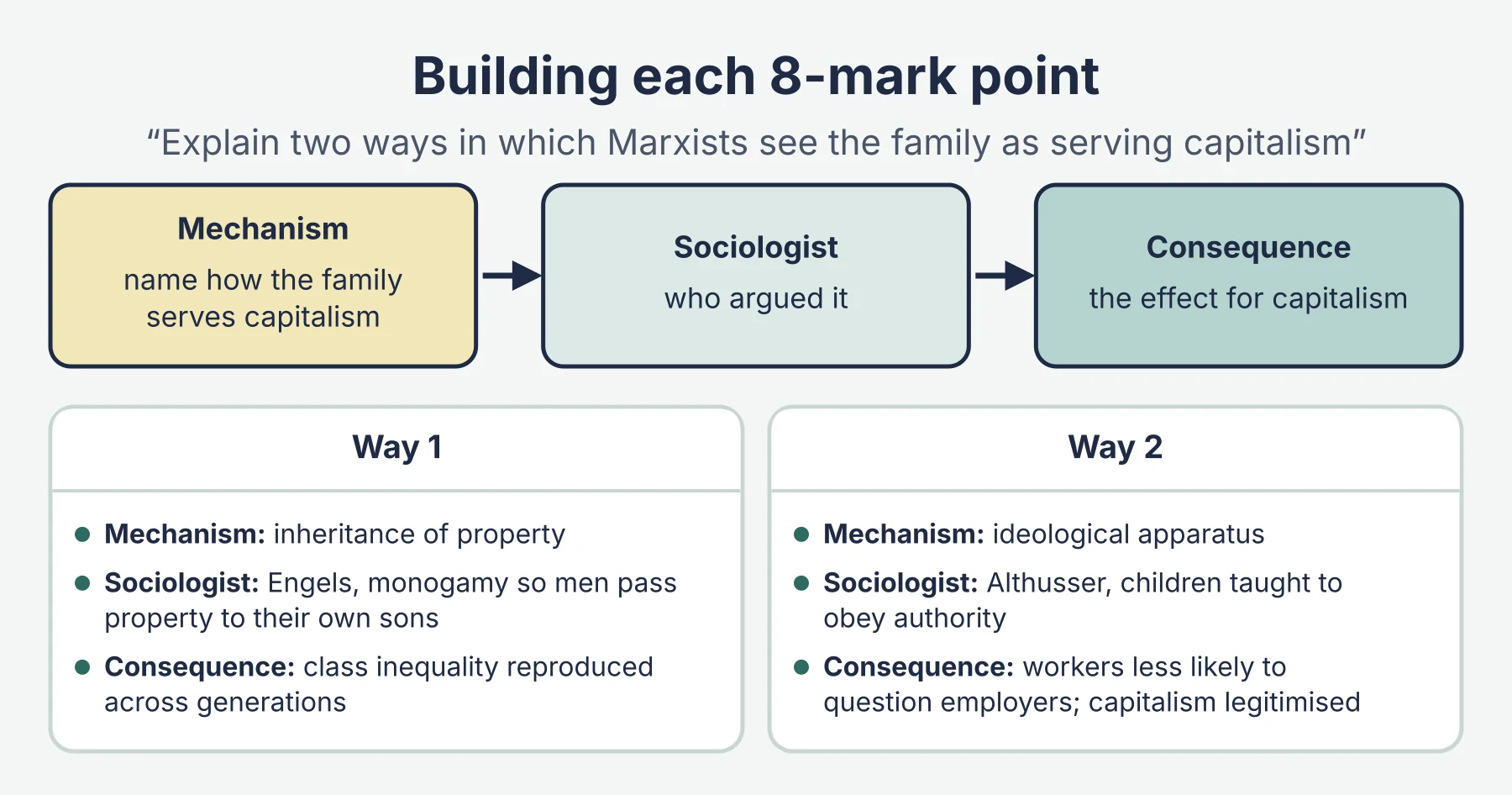
Explain two ways in which Marxists see the family as serving capitalism.
One way is the inheritance of property. Engels argued that monogamy arose so men could pass private property to sons they knew were their own (knowledge). This means the family reproduces class inequality from generation to generation, because wealth stays within ruling-class families (explanation and development).
A second way is that the family acts as an ideological apparatus. Althusser argued families teach children to obey authority, preparing them to accept hierarchy at work (knowledge). Because parents’ authority is experienced as natural, workers are less likely to question employers’ power later, so capitalism is legitimised (analysis).
The paragraph earns marks by naming the mechanism, the sociologist and the consequence for capitalism each time.
Common mistakes
- Writing that Parsons listed four functions: that is Murdock. Parsons stressed two.
- Treating “feminism” as one view.
- Describing functionalism with no evaluation from Laslett or Anderson.
- Presenting Engels only as a historian of families rather than linking him to property and women’s subordination.
- Forgetting the specification’s focus on the relationship between families and society: always say what the family does for or to the wider social structure.
Exam technique
In longer answers, compare perspectives point by point rather than describing each in turn: for example, “functionalists see primary socialisation as passing on shared values, whereas Marxists see it as passing on ruling-class ideology”. When asked to evaluate a view (for example, that the family benefits all its members), use the other two perspectives as your counter-arguments and finish with a judgement grounded in a named society.
- Perspectives on families revision notes
- Perspectives on families practice questions
- Family forms these theories describe: families, marriage and kinship study guide
Related resources
-
Practice questions
OxfordAQA International A-Level Sociology (9690): Perspectives on Families and Society – Practice Questions
Original OxfordAQA 9690 Unit 1 style questions on functionalist, Marxist and feminist perspectives on families, with full mark schemes and levels.
Sociology · OxfordAQA · AS Level
Try questions -
Revision notes
OxfordAQA International A-Level Sociology (9690): Perspectives on Families and Society – Revision Notes
Revision notes for OxfordAQA 9690 section 3.1.1.2: Murdock, Parsons and fit, Engels and Marxism, and liberal, Marxist and radical feminist views of families.
Sociology · OxfordAQA · AS Level
Revise topic -
Study guides
OxfordAQA International A-Level Sociology (9690): Research Methods (Unit 1 Section B)
Study guide to research methods for OxfordAQA 9690 Unit 1 Section B: methods, sampling, validity, ethics and interpreting tables and field notes.
Sociology · OxfordAQA · AS Level
Read guide
Related articles
Get free revision emails (optional)
Occasional emails with practice questions, worked explanations and links to free resources for the qualification and subjects you choose. No spam, and you can unsubscribe from any email. The free tools on this site never need an email.