
Revision Notes
OxfordAQA International A-Level Sociology (9690): Research Methods and Theory (Unit 2 Section B) – Revision Notes
Revision notes for OxfordAQA 9690 Unit 2 research methods and theory: positivism, value freedom, Burawoy, structure and agency and the main theories.
- Subject
- Sociology
- Level
- AS LEVEL
- Topic
- Unit 2 – Exploring Sociology
- Author
- Marlbridge Academic Team
- Updated
- Reviewed by
- Naqiya Yousaf (what this means)
Aligned to OxfordAQA A Level Sociology (9690), Version 1.1 (new qualification). Official specification .
Syllabus page (what it covers and how it is assessed): OxfordAQA A Level Sociology.
Syllabus points this page covers
9690 (AS Level)
- 3.1.3 Research methods and theory (Section B – Research methods and theory)
Found an error? Report a correction.
Need help with this topic? Request a free trial class for A Level Sociology (9690).
These notes condense the research methods and theory content behind Unit 2 Section B of OxfordAQA International AS/A level Sociology (9690), a 20-mark extended response question. The focus is 3.1.3.5 Sociological theories and perspectives, linked to the methodological debates in 3.1.3.1. Method-by-method detail is in the research methods (Unit 1) revision notes.
Full explanation: research methods and theory (Unit 2) study guide.
Specification checklist (3.1.3.5)
- Public sociology (Burawoy).
- Values and value freedom.
- Sociology and activism.
- Structure and agency.
- Marxism and neo-Marxisms.
- Feminisms.
- Functionalism and neo-functionalism.
- Symbolic interactionism.
- Postmodernism and postmodernity.
- Plus, from 3.1.3.1: positivist and interpretivist approaches; from 3.1.3.2: triangulation.
Key terms
| Term | Definition |
|---|---|
| Positivism | Sociology should use scientific, mainly quantitative methods to find laws of social behaviour |
| Interpretivism | Sociology should understand the meanings people give to actions, mainly through qualitative methods |
| Social facts | Durkheim: external social phenomena that constrain individuals |
| Value freedom | Research uninfluenced by the researcher’s values |
| Value relevance | Weber: values shape topic choice, but method should be objective |
| Public sociology | Sociology engaging directly with publics beyond academia (Burawoy) |
| Structure / agency | Social forces that shape behaviour / individuals’ capacity to act freely |
| Structuration | Giddens: structure and action reproduce each other (duality of structure) |
| Latent function | Merton: unintended, unrecognised consequence of an institution |
| Hegemony | Gramsci: ruling-class leadership through consent |
| Intersectionality | Overlapping oppressions of gender, race, class and more (Crenshaw, 1989) |
| Metanarrative | A grand theory claiming to explain everything (rejected by Lyotard) |
| Hyperreality | Baudrillard: media images that seem more real than reality |
| Triangulation | Combining methods to check findings |
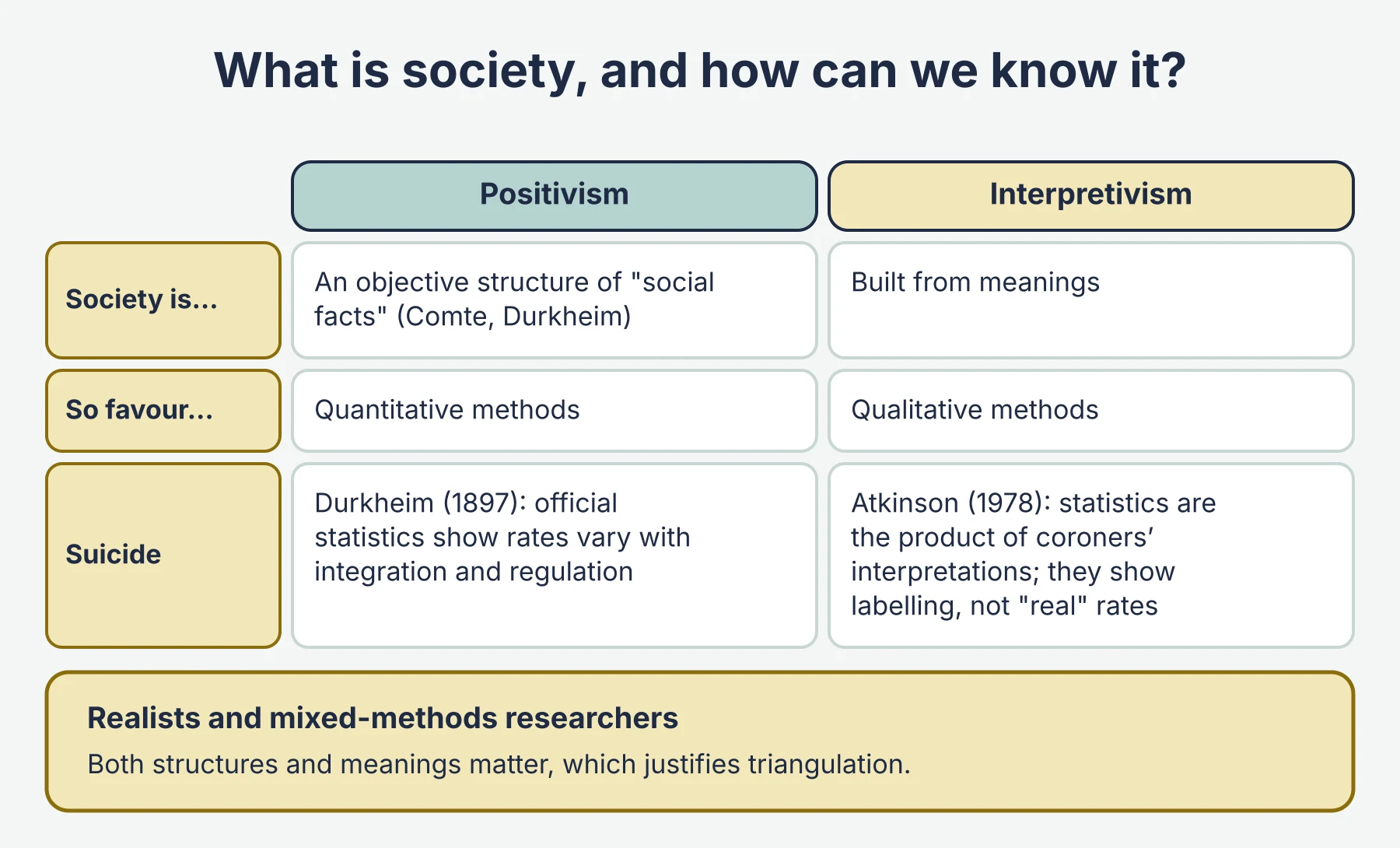
Positivism vs interpretivism in one table
| Positivism | Interpretivism | |
|---|---|---|
| View of society | Objective structure of social facts | Built from meanings and interaction |
| Aim | Find patterns, causes, laws | Understand meanings (Weber’s verstehen) |
| Preferred data | Quantitative | Qualitative |
| Key value | Reliability, representativeness | Validity |
| Classic study | Durkheim, Suicide (1897) | Atkinson, Discovering Suicide (1978) |
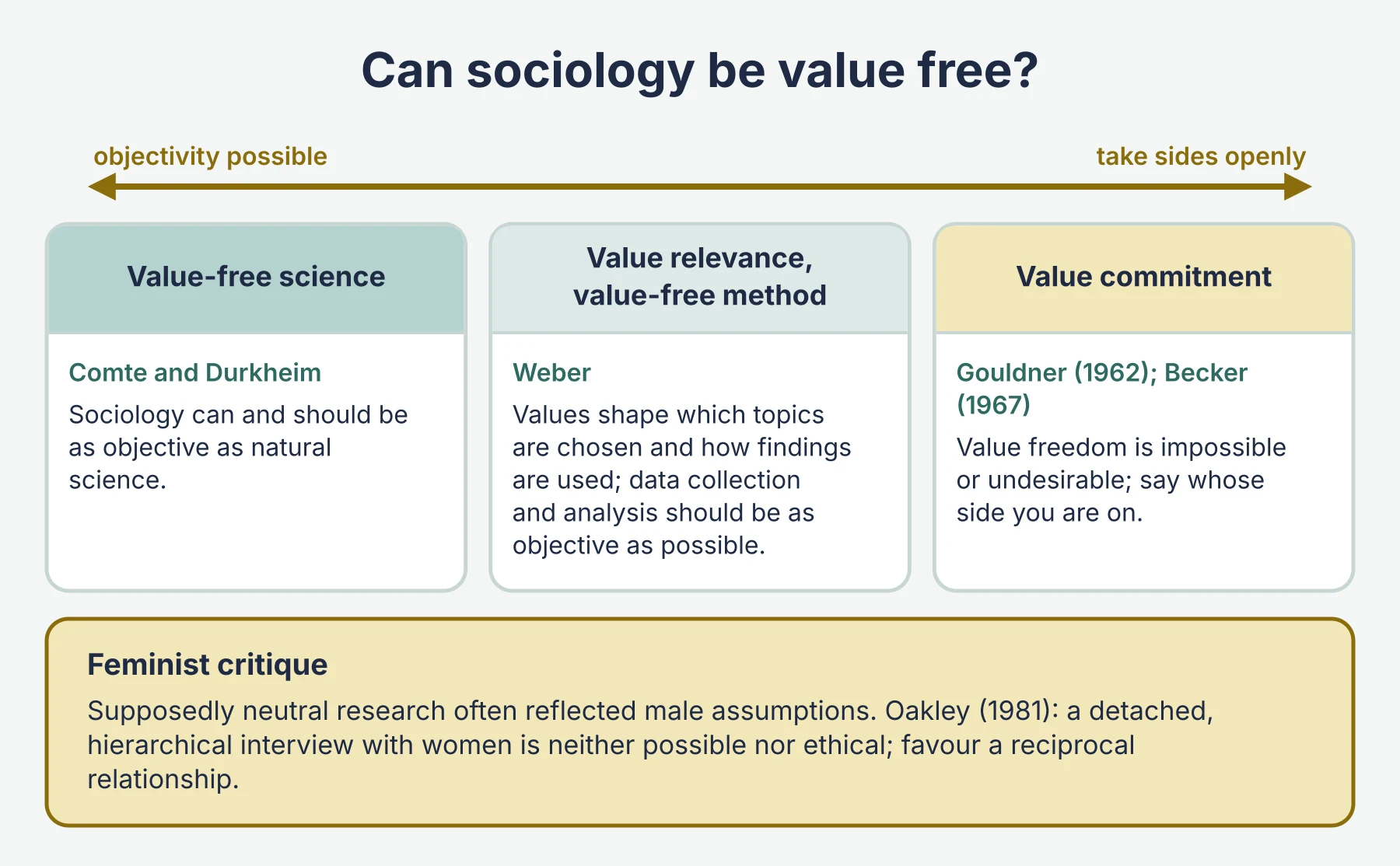
Values
- Comte/Durkheim: value-free science is possible.
- Weber: values in topic choice; objectivity in method.
- Gouldner (1962): value freedom is a myth that can hide commitment.
- Becker (1967): “Whose side are we on?”; sociologists inevitably take sides.
- Oakley (1981): feminist interviewing should be reciprocal, not detached.
Burawoy’s four sociologies (2004)
| Type | Audience | Purpose |
|---|---|---|
| Professional | Academics | Rigorous research programmes |
| Policy | Clients (governments, organisations) | Solving set problems |
| Critical | Academics | Questioning assumptions |
| Public | Communities, movements, media | Dialogue with civil society |
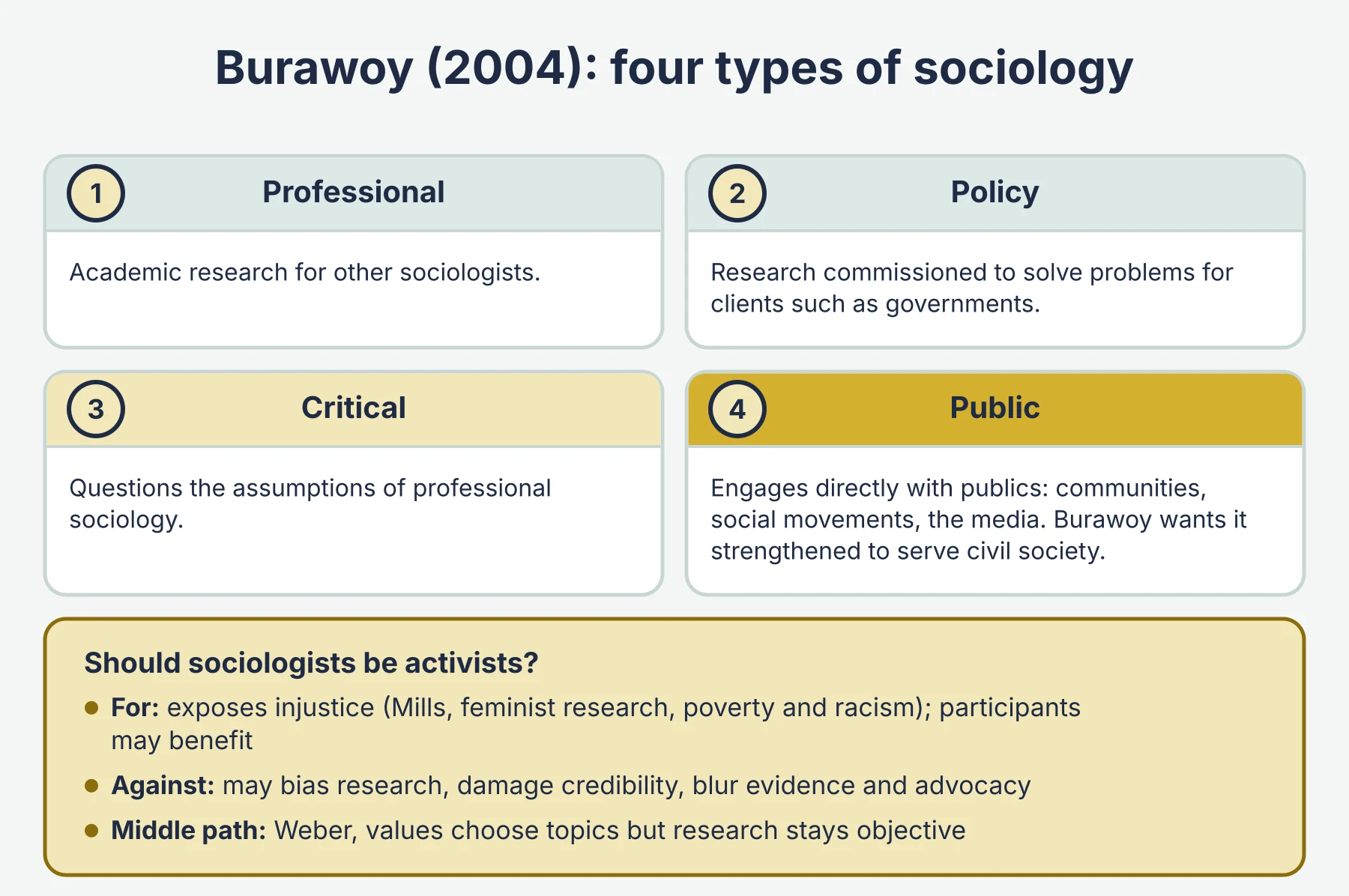
Activism
- For: exposes injustice; Mills; feminist and anti-racist research; benefits participants.
- Against: bias; loss of credibility; advocacy replaces evidence.
- Middle path: Weber’s distinction; transparency about values.
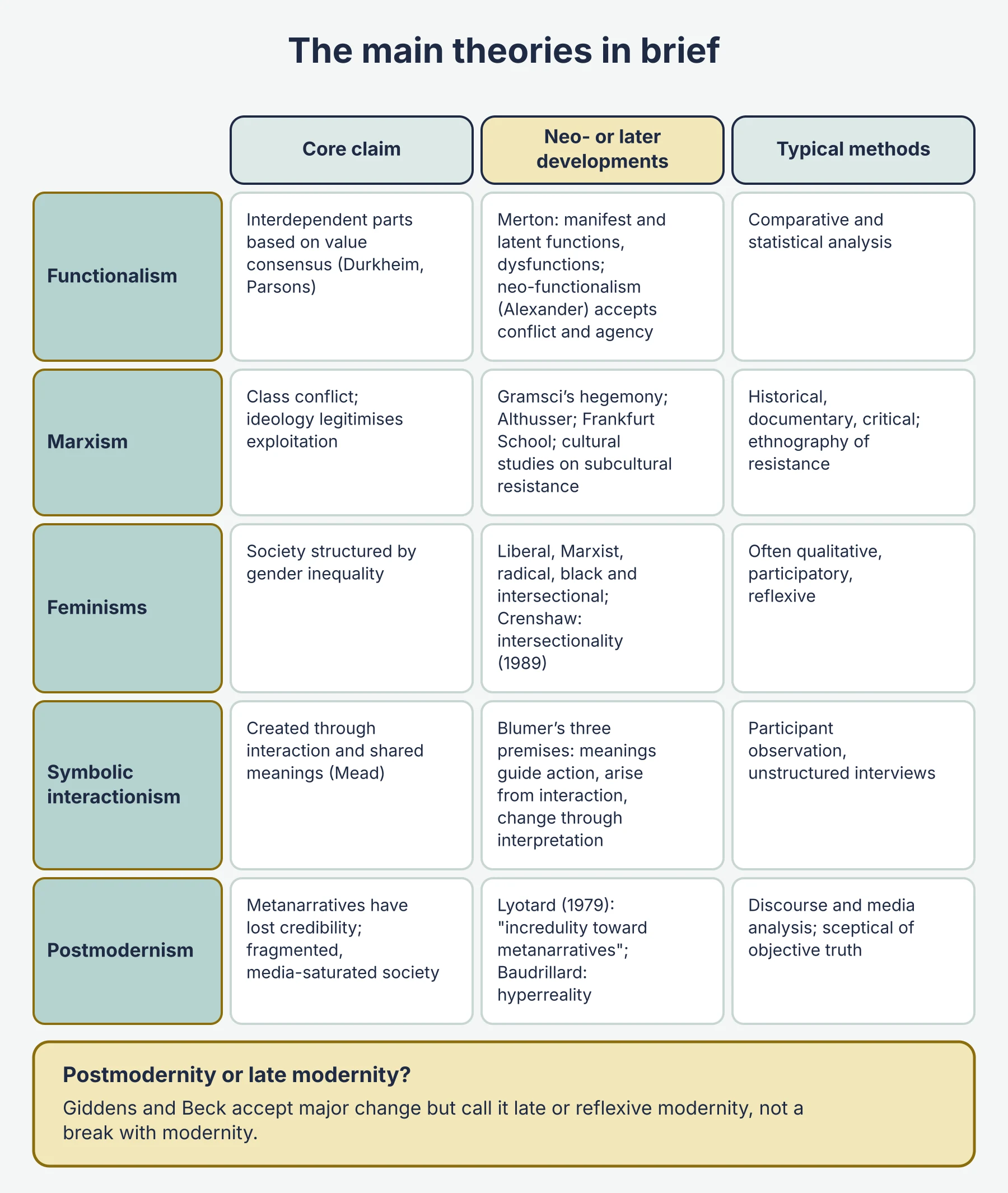
Theories summary
| Theory | Core idea | Development |
|---|---|---|
| Functionalism | Consensus, interdependent parts (Durkheim, Parsons) | Merton: manifest/latent functions, dysfunctions; neo-functionalism (Alexander) |
| Marxism | Class conflict, ideology | Gramsci (hegemony), Althusser (structural Marxism), Frankfurt School |
| Feminisms | Gender inequality | Liberal, Marxist, radical, black, intersectional (Crenshaw) |
| Symbolic interactionism | Meanings from interaction (Mead) | Blumer’s three premises |
| Postmodernism | End of metanarratives (Lyotard, 1979); hyperreality (Baudrillard) | Critics: late modernity (Giddens), reflexive modernity (Beck) |
Structure and agency
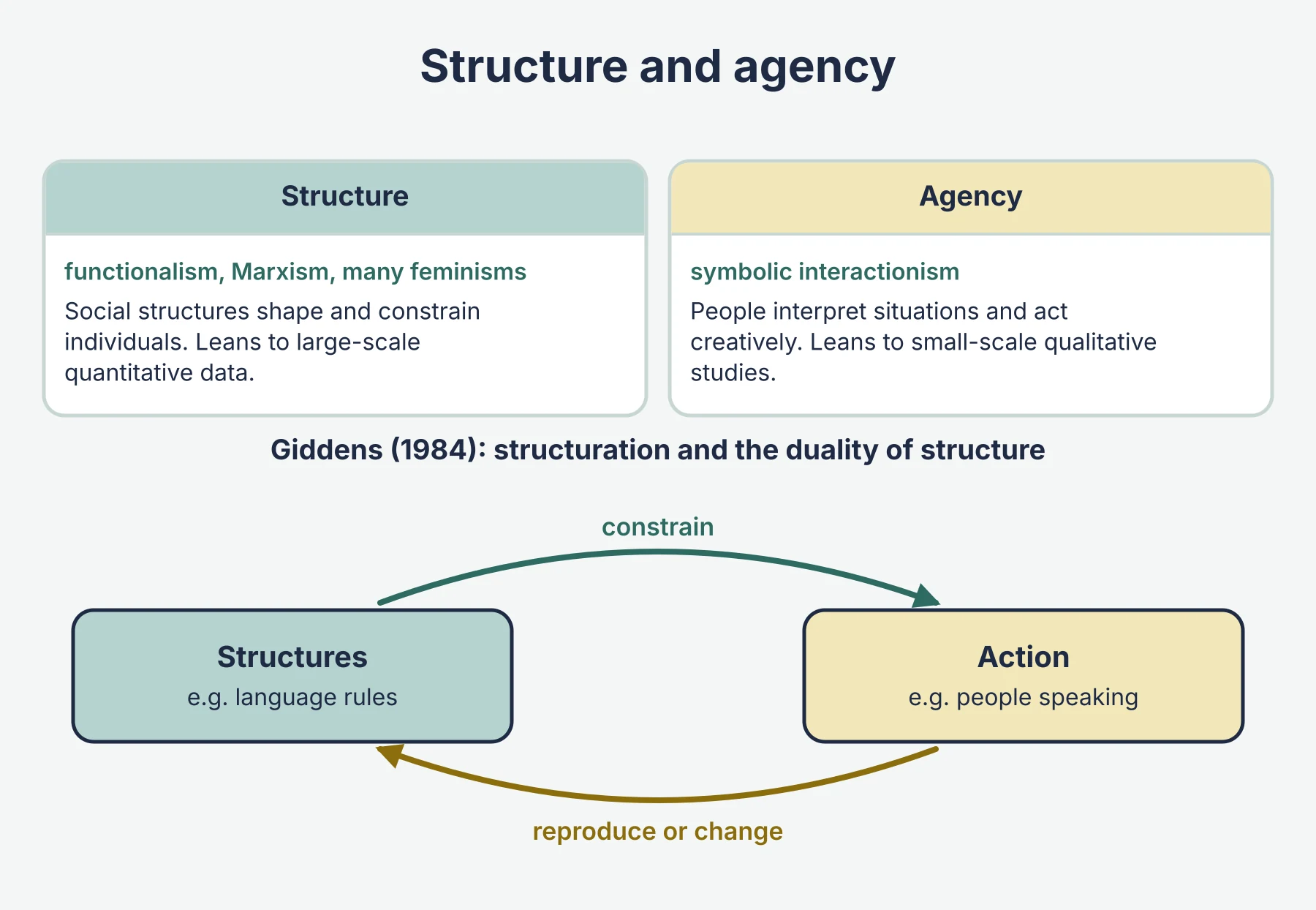
- Structural: functionalism, Marxism, many feminisms; large-scale quantitative methods.
- Action: interactionism; small-scale qualitative methods.
- Giddens (1984): duality of structure, as with language rules and speech.
Plan template for the 20-mark extended response
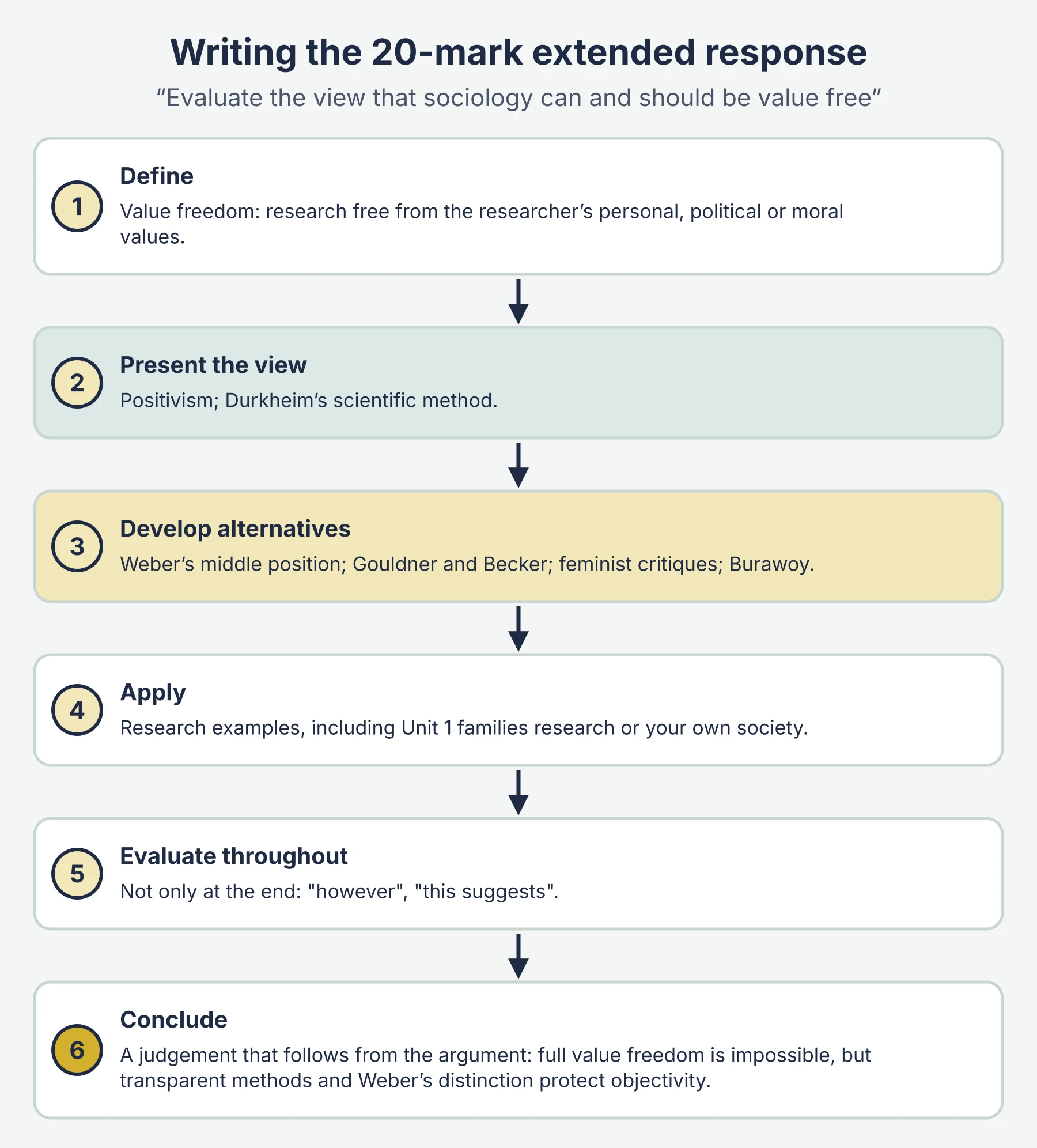
- Define the key term in the question in one sentence.
- Argument for the view: theory, named thinker, research example.
- Argument against: a contrasting theory, named thinker, research example.
- Second line of evaluation: practical or ethical factors, or a middle position (Weber, Giddens, triangulation).
- Application: a research example from families, crime or your own society.
- Conclusion: a judgement that follows from the points made, not a summary.
Aim to evaluate within each paragraph (“however”, “this suggests”, “a weakness is”) rather than saving all evaluation for the end.
Exam traps
- Positivism (methodology) confused with functionalism (theory).
- Burawoy without the four types.
- Theories described but not linked to methods or values.
- Weak conclusion (“it depends”) without a judgement.
- Postmodernity (an era) confused with postmodernism (a theory).
Self-test
- What did Durkheim’s Suicide aim to show?
- How did Atkinson challenge suicide statistics?
- State Weber’s position on values.
- What did Becker ask, and why?
- Name Burawoy’s four types of sociology.
- Give one argument against sociology as activism.
- What is the duality of structure?
- Distinguish manifest from latent functions.
- Name two neo-Marxist thinkers or schools.
- What does intersectionality mean?
- What did Lyotard mean by incredulity toward metanarratives?
- Distinguish postmodernism from postmodernity.
Answers
- That suicide rates vary with social integration and regulation, so social facts shape behaviour.
- He argued statistics reflect coroners’ interpretations of deaths, not objective rates.
- Values shape topic choice, but research should be conducted objectively.
- “Whose side are we on?”: sociologists inevitably take sides, so value freedom is impossible.
- Professional, policy, critical and public.
- It may bias research and reduce credibility.
- Structures constrain action but are reproduced or changed by it (Giddens).
- Manifest functions are intended and recognised; latent functions are unintended (Merton).
- Gramsci; Althusser; the Frankfurt School.
- Overlapping oppressions such as gender, race and class combine to shape experience.
- People no longer believe grand theories that claim to explain everything.
- Postmodernism is a theory; postmodernity is a claimed new era of society.
Practise next: research methods and theory (Unit 2) practice questions | Exploring Sociology study guide
Related resources
-
Study guides
OxfordAQA International A-Level Sociology (9690): Social Control
Study guide to OxfordAQA 9690 section 3.1.2.4: sanctions, stigma and othering, punishment, policing, surveillance, Althusser, Gramsci and four perspectives.
Sociology · OxfordAQA · AS Level
Read guide -
Practice questions
OxfordAQA International A-Level Sociology (9690): Social Control – Practice Questions
Original OxfordAQA 9690 Unit 2 style questions on stigma, othering, punishment, policing, surveillance, state apparatuses and hegemony, with answers.
Sociology · OxfordAQA · AS Level
Try questions -
Revision notes
OxfordAQA International A-Level Sociology (9690): Social Control – Revision Notes
Revision notes for OxfordAQA 9690 section 3.1.2.4: sanctions, Goffman's stigma, othering, punishment, policing, surveillance, RSAs, ISAs and hegemony.
Sociology · OxfordAQA · AS Level
Revise topic
Related articles
Get free revision emails (optional)
Occasional emails with practice questions, worked explanations and links to free resources for the qualification and subjects you choose. No spam, and you can unsubscribe from any email. The free tools on this site never need an email.