
Study Guides
OxfordAQA International A-Level Sociology (9690): Research Methods and Theory (Unit 2 Section B)
Study guide to research methods and theory for OxfordAQA 9690 Unit 2 Section B: value freedom, public sociology, structure and agency and the main theories.
- Subject
- Sociology
- Level
- AS LEVEL
- Topic
- Unit 2 – Exploring Sociology
- Author
- Marlbridge Academic Team
- Updated
- Reviewed by
- Naqiya Yousaf (what this means)
Aligned to OxfordAQA A Level Sociology (9690), Version 1.1 (new qualification). Official specification .
Syllabus page (what it covers and how it is assessed): OxfordAQA A Level Sociology.
Syllabus points this page covers
9690 (AS Level)
- 3.1.3 Research methods and theory (Section B – Research methods and theory)
Found an error? Report a correction.
Need help with this topic? Request a free trial class for A Level Sociology (9690).
Section 3.1.3 Research methods and theory in OxfordAQA International AS/A level Sociology (9690) is examined in both AS units. In Unit 2 Section B (Research methods and theory) the specification sets “an extended response question” worth 20 marks. That format rewards sustained argument, which is why this guide concentrates on 3.1.3.5 Sociological theories and perspectives: “Public sociology (Burawoy)”, “Values and value freedom”, “Sociology and activism”, “Structure and agency”, “Marxism and neo-Marxisms”, “Feminisms”, “Functionalism and neo-functionalism”, “Symbolic interactionism” and “Postmodernism and postmodernity”, and on linking them to methods. Method-by-method detail is in the research methods (Unit 1) study guide; the unit overview is in the Exploring Sociology study guide.
Theory and method: the core link
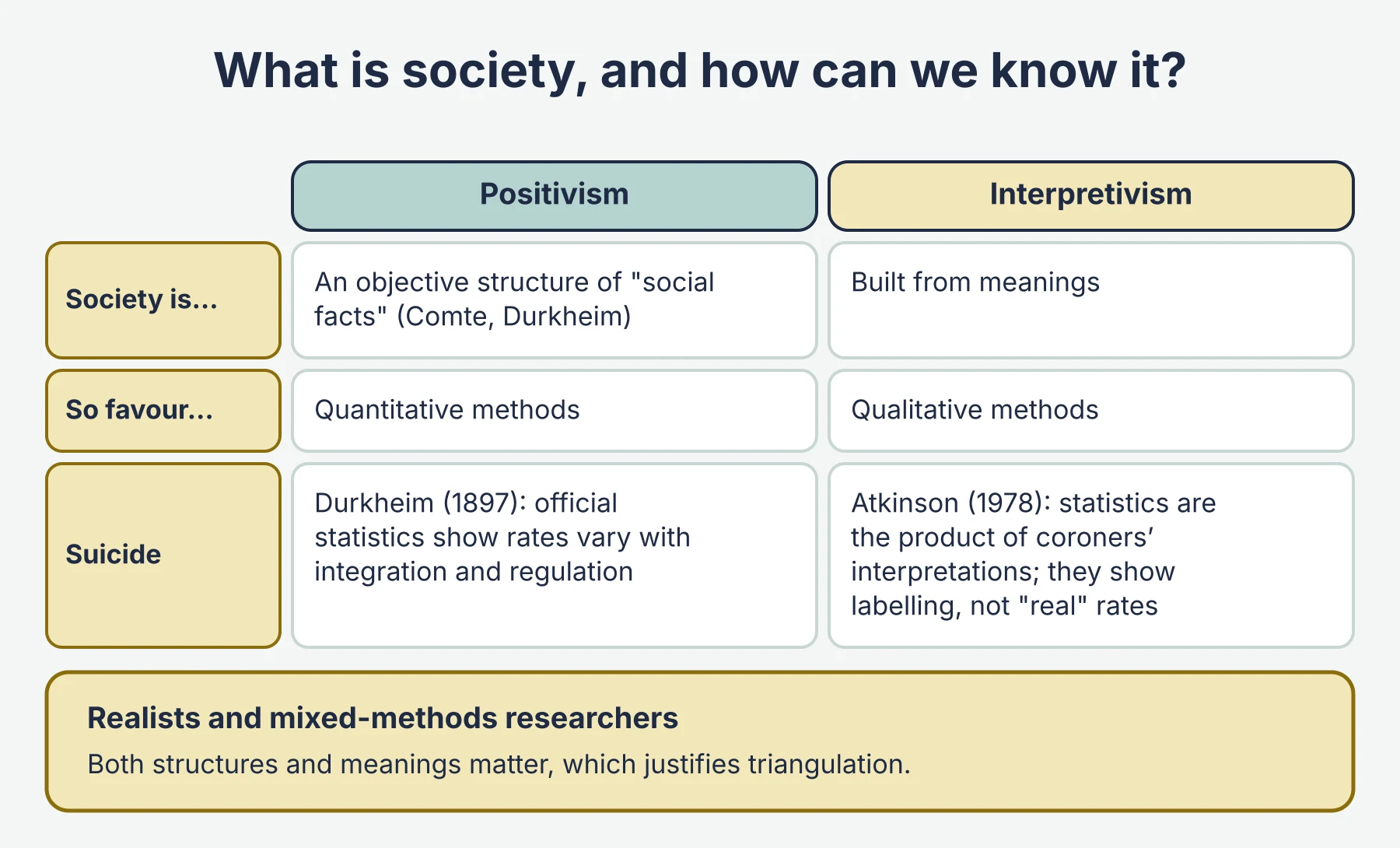
Every methods debate rests on a theoretical question: what kind of thing is society, and how can we know about it?
- Positivists (in the tradition of Auguste Comte and Émile Durkheim) see society as an objective structure of “social facts” that can be measured, so they favour quantitative methods. Durkheim’s Suicide (1897) used official statistics to show suicide rates varied with social integration and regulation.
- Interpretivists see society as built from meanings, so they favour qualitative methods. J. Maxwell Atkinson’s Discovering Suicide (1978) argued suicide statistics are themselves the product of coroners’ interpretations, so they reveal how deaths are labelled rather than “real” rates.
- Realists and mixed-methods researchers argue that both structures and meanings matter, which justifies triangulation.
Values and value freedom
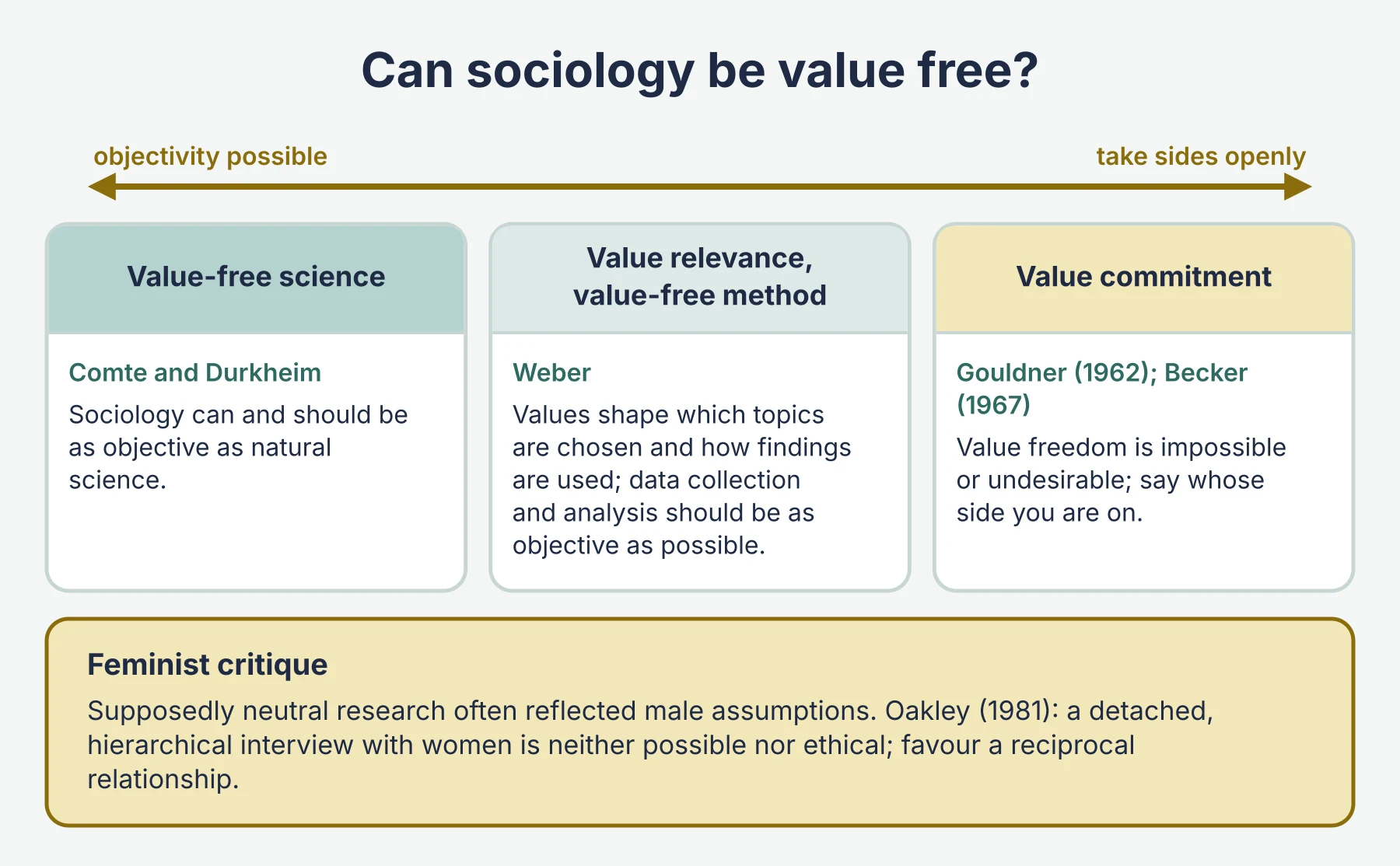
Can sociology be objective? Three positions are worth comparing.
| Position | Argument | Key thinkers |
|---|---|---|
| Value-free science | Sociology can and should be as objective as natural science | Comte and Durkheim (positivism) |
| Value relevance with value freedom in method | Values inevitably shape which topics are chosen and how findings are used, but the collection and analysis of data should be as objective as possible | Max Weber |
| Value commitment | Value freedom is impossible or undesirable; sociologists should be open about whose side they are on | Alvin Gouldner’s “Anti-Minotaur” essay (1962); Howard Becker’s “Whose Side Are We On?” (1967) |
Feminists add that supposedly neutral research often reflected male assumptions. Ann Oakley’s essay on interviewing women (1981) argued that a detached, hierarchical interview is neither possible nor ethical in research with women, favouring a more equal, reciprocal relationship.
Public sociology and activism
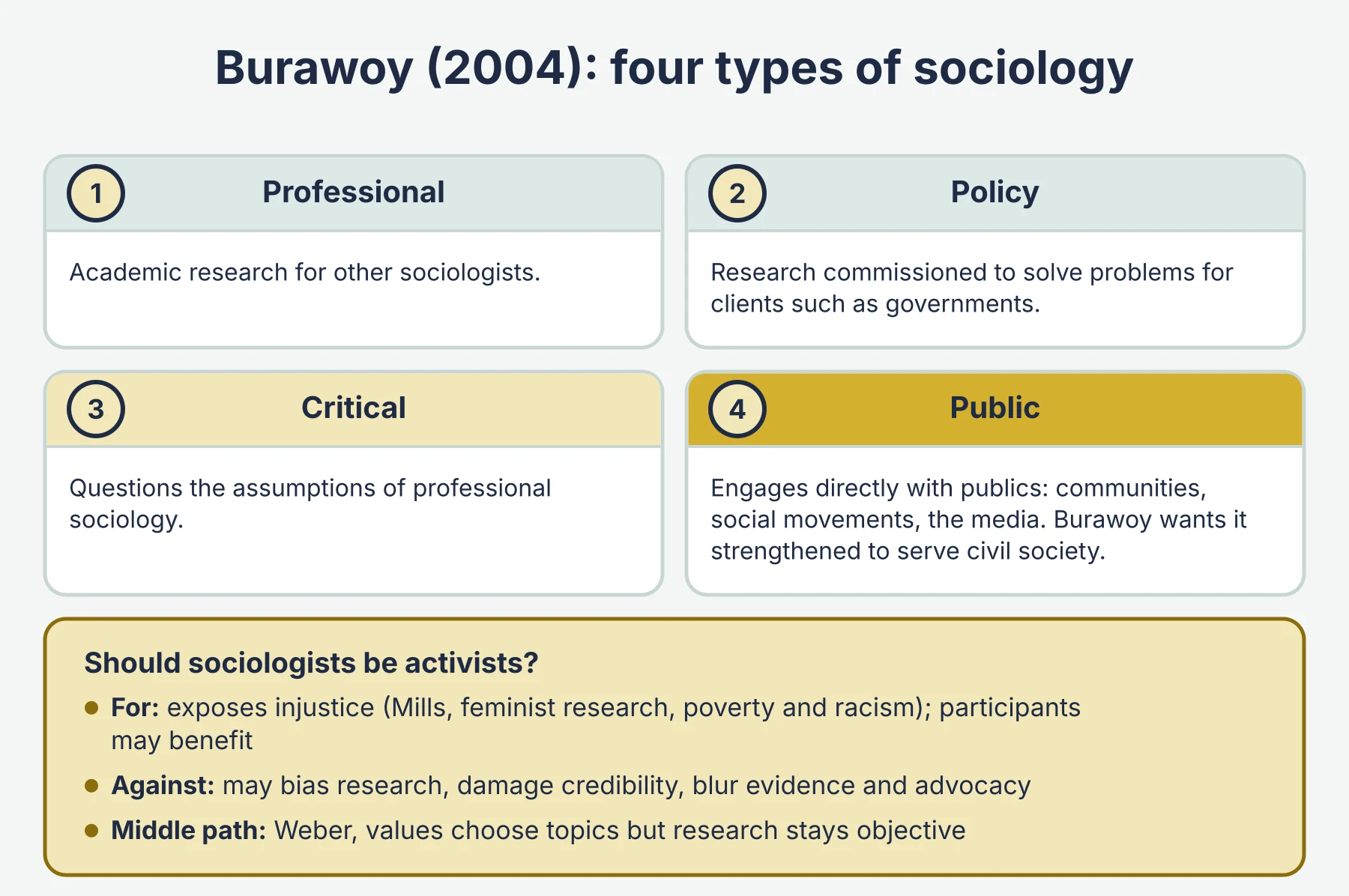
Michael Burawoy, in his 2004 presidential address to the American Sociological Association, distinguished four types of sociology: professional (academic research for other sociologists), policy (research commissioned to solve problems for clients such as governments), critical (questioning the assumptions of professional sociology) and public (engaging directly with publics outside the university, such as communities, social movements and the media). He argued public sociology should be strengthened so that sociology serves civil society.
Sociology and activism asks whether researchers should also campaign for change. Arguments for: sociology exposes injustice (Mills’s sociological imagination, feminist research, research on poverty and racism); participants may benefit from research that leads to action. Arguments against: activism may bias research, damage credibility with policymakers and blur the line between evidence and advocacy. A balanced answer notes that Weber’s distinction between choosing topics by values and conducting research objectively offers a middle path.
Structure and agency
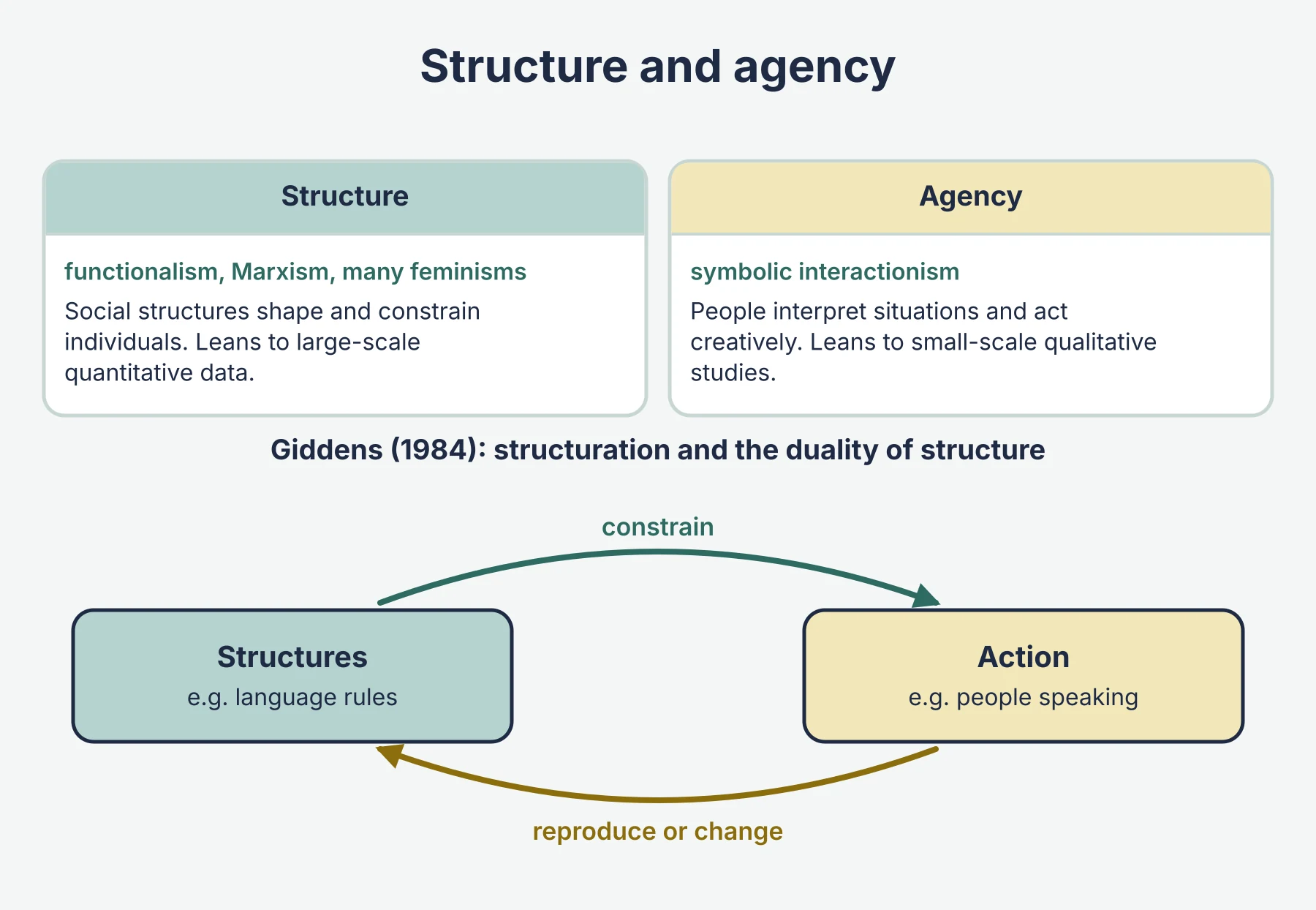
Structural theories (functionalism, Marxism, many feminisms) explain behaviour through social structures that shape and constrain individuals. Social action theories (symbolic interactionism) stress agency: people interpret situations and act creatively. Anthony Giddens’ structuration theory (The Constitution of Society, 1984) argues for a duality of structure: structures both constrain action and are reproduced or changed by it, as language rules constrain speech yet exist only because people keep speaking. The debate maps onto method choice: structural theories lean towards large-scale quantitative data, action theories towards small-scale qualitative studies.
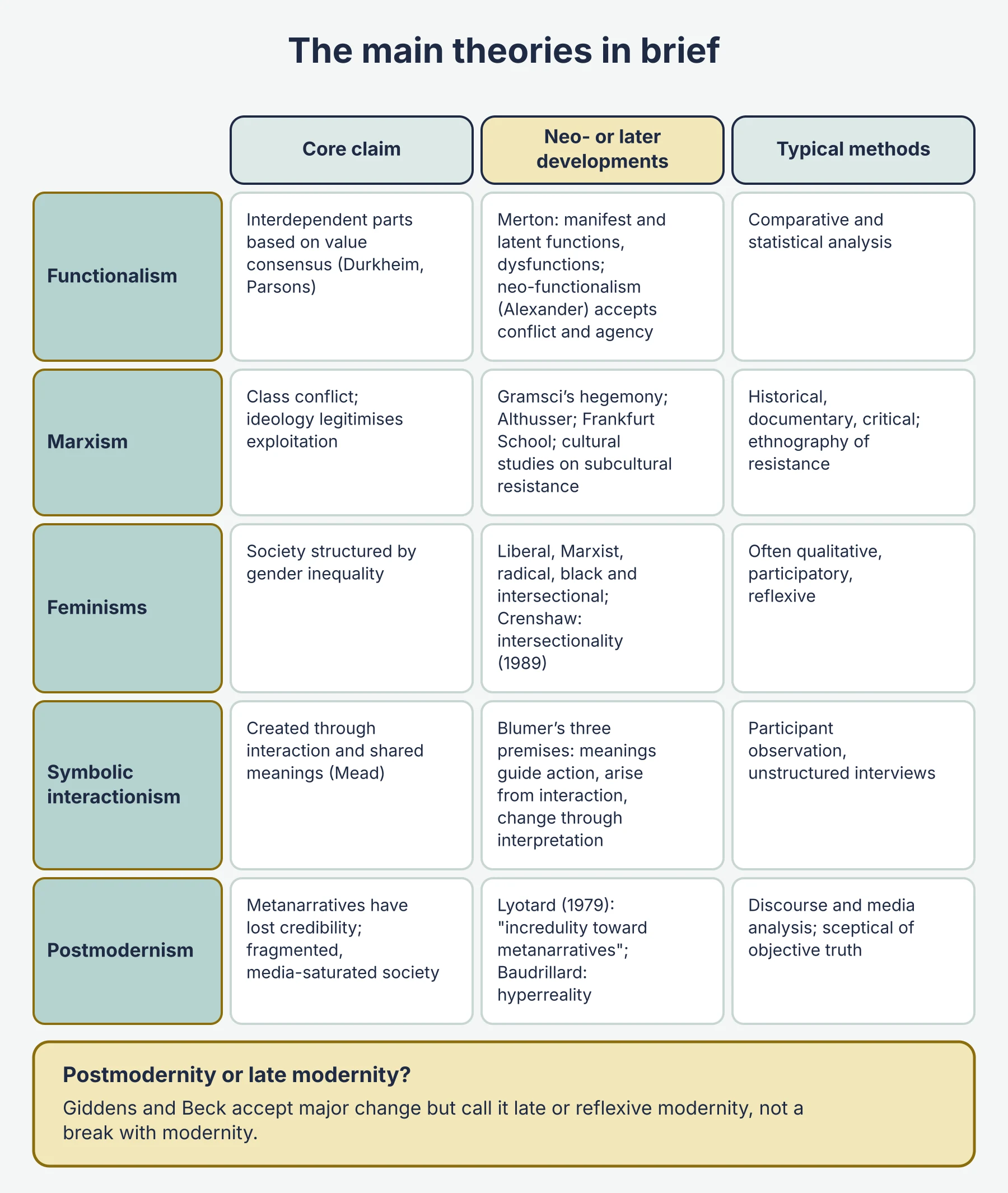
The main theories in brief
| Theory | Core claim | Neo- or later developments | Typical methods |
|---|---|---|---|
| Functionalism | Society is a system of interdependent parts based on value consensus (Durkheim, Parsons) | Robert Merton: manifest and latent functions and dysfunctions; neo-functionalism (associated with Jeffrey Alexander) accepts conflict and agency within a broadly functionalist framework | Comparative and statistical analysis |
| Marxism | Society is shaped by class conflict between owners and workers; ideology legitimises exploitation | Neo-Marxisms: Gramsci’s hegemony; Althusser’s structural Marxism; the Frankfurt School’s critique of the culture industry; cultural studies on resistance through subcultures | Historical, documentary and critical analysis; also ethnography of resistance |
| Feminisms | Society is structured by gender inequality | Liberal, Marxist, radical, black and intersectional feminisms; Kimberlé Crenshaw coined intersectionality (1989) for overlapping oppressions | Often qualitative, participatory, reflexive methods |
| Symbolic interactionism | Society is created through interaction and shared meanings (Mead) | Herbert Blumer coined the term and set out three premises: people act towards things on the basis of meanings; meanings arise from interaction; meanings are modified through interpretation | Participant observation, unstructured interviews |
| Postmodernism | Grand theories (“metanarratives”) have lost credibility; society is fragmented and media-saturated | Jean-François Lyotard (The Postmodern Condition, 1979): “incredulity toward metanarratives”; Jean Baudrillard: hyperreality | Discourse and media analysis; scepticism about objective truth |
Postmodernism and postmodernity. Postmodernity refers to a claimed new era (globalised, consumer-based, media-saturated); postmodernism refers to theories that reject grand narratives. Critics such as Giddens and Ulrich Beck accept major change but describe it as late or reflexive modernity rather than a break with modernity.
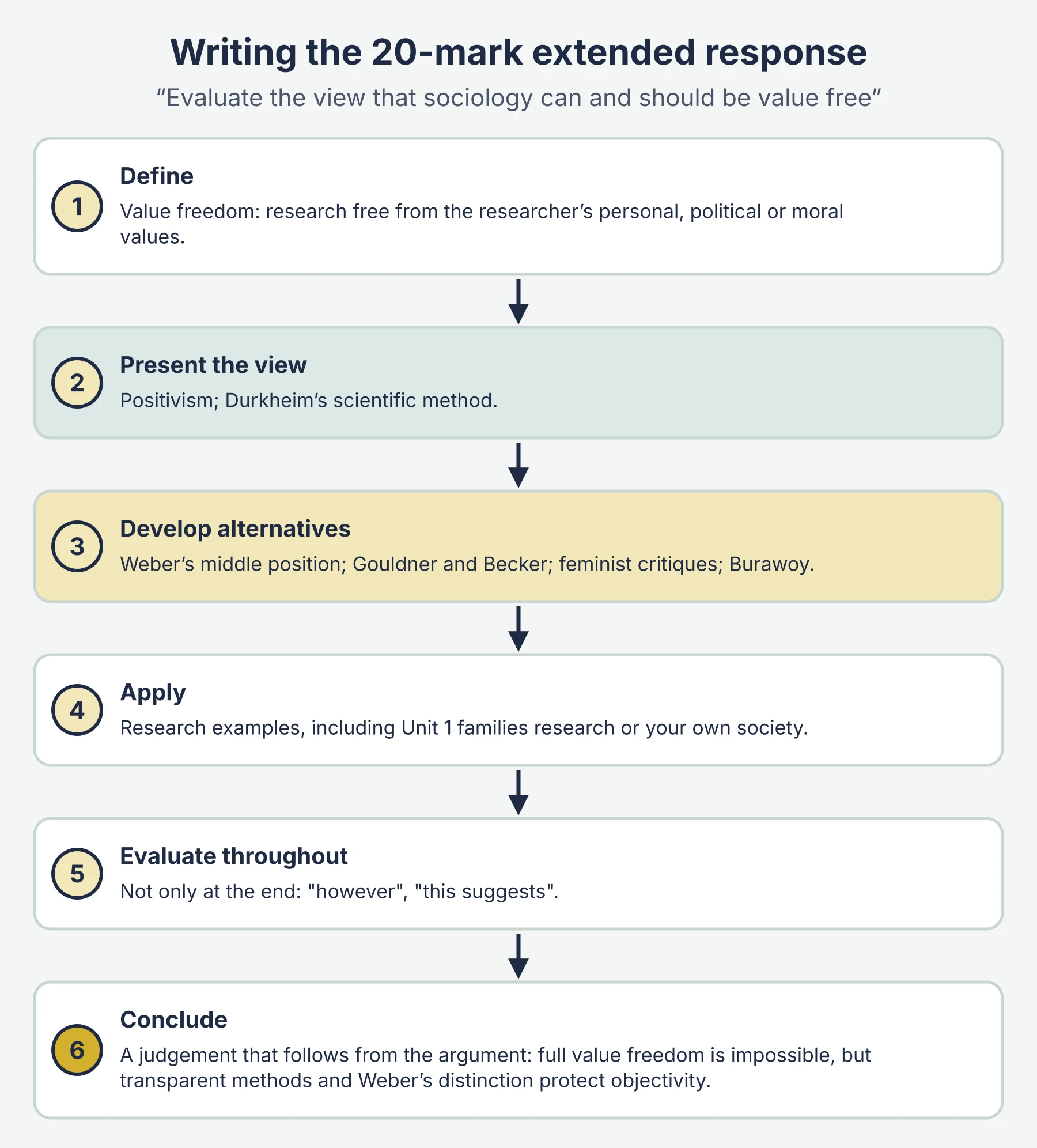
Writing the 20-mark extended response
A strong structure for a question such as “Evaluate the view that sociology can and should be value free”:
- Define the key term precisely (value freedom: research free from the researcher’s personal, political or moral values).
- Present the view with theory and evidence (positivism; Durkheim’s scientific method).
- Develop alternatives (Weber’s middle position; Gouldner and Becker; feminist critiques; Burawoy’s public sociology).
- Apply to research examples, including from Unit 1 families research or your own society.
- Evaluate throughout, not only at the end, using “however” and “this suggests”.
- Conclude with a judgement that follows from the argument (for example, that full value freedom is impossible, but transparent methods and Weber’s distinction protect objectivity).
Worked example: annotated paragraph
Weber argued that values are unavoidable in choosing a topic, since sociologists study what they regard as important (knowledge). For example, a researcher concerned about gender inequality may choose to study domestic labour (application). However, Weber insisted that once the topic is chosen, data should be collected and analysed objectively, so that other researchers could check the findings (analysis). This offers a compromise between positivists, who think objectivity is easy, and Becker, who argues researchers inevitably take sides, although critics reply that values also shape how concepts are operationalised, so bias can enter the method itself (evaluation).
Common mistakes
- Treating positivism and functionalism as the same thing: one is a methodology, the other a theory.
- Mentioning Burawoy without his four types of sociology.
- Describing theories without linking them to methods or to value debates.
- Ending with “it depends” instead of a reasoned judgement.
- Listing practical strengths and weaknesses of methods with no theoretical justification.
Related resources
-
Practice questions
OxfordAQA International A-Level Sociology (9690): Research Methods and Theory (Unit 2 Section B) – Practice Questions
Original OxfordAQA 9690 Unit 2 Section B style questions on value freedom, public sociology, structure and agency and the main theories, with answers.
Sociology · OxfordAQA · AS Level
Try questions -
Revision notes
OxfordAQA International A-Level Sociology (9690): Research Methods and Theory (Unit 2 Section B) – Revision Notes
Revision notes for OxfordAQA 9690 Unit 2 research methods and theory: positivism, value freedom, Burawoy, structure and agency and the main theories.
Sociology · OxfordAQA · AS Level
Revise topic -
Study guides
OxfordAQA International A-Level Sociology (9690): Social Control
Study guide to OxfordAQA 9690 section 3.1.2.4: sanctions, stigma and othering, punishment, policing, surveillance, Althusser, Gramsci and four perspectives.
Sociology · OxfordAQA · AS Level
Read guide
Related articles
Get free revision emails (optional)
Occasional emails with practice questions, worked explanations and links to free resources for the qualification and subjects you choose. No spam, and you can unsubscribe from any email. The free tools on this site never need an email.