
Study Guides
OxfordAQA International A-Level Sociology (9690): Deviance, Harm and Crime
Study guide to OxfordAQA 9690 section 3.1.2.5: how crime is constructed, eight crime types, social harm, measuring crime and explaining offending patterns.
- Subject
- Sociology
- Level
- AS LEVEL
- Topic
- Unit 2 – Exploring Sociology
- Author
- Marlbridge Academic Team
- Updated
- Reviewed by
- Naqiya Yousaf (what this means)
Aligned to OxfordAQA A Level Sociology (9690), Version 1.1 (new qualification). Official specification .
Syllabus page (what it covers and how it is assessed): OxfordAQA A Level Sociology.
Syllabus points this page covers
9690 (AS Level)
- 3.1.2.5 Deviance, harm and crime
Found an error? Report a correction.
Need help with this topic? Request a free trial class for A Level Sociology (9690).
Section 3.1.2.5 Deviance, harm and crime completes 3.1.2 Socialisation and social control in OxfordAQA International AS/A level Sociology (9690) and is examined in Unit 2 Section A. The specification lists the “Social construction of crime and deviance, including the differences between societies and over time”; eight types of crime (violent, property, white collar, corporate, state, green/environmental, “victimless” and cyber); “Social harms, including examples of actions which cause harm but are not considered as crimes”; issues in measuring crime through official statistics, self-report studies and victim surveys; and “Patterns of offending and victimisation by: gender; social class; age; ethnicity”. Stanley Cohen is the named sociologist most directly relevant. The unit overview is in the Exploring Sociology study guide, and the condensed deviance, harm and crime revision notes hold the key-term tables. This guide focuses on the arguments and explanations behind them.
Crime, deviance and social construction
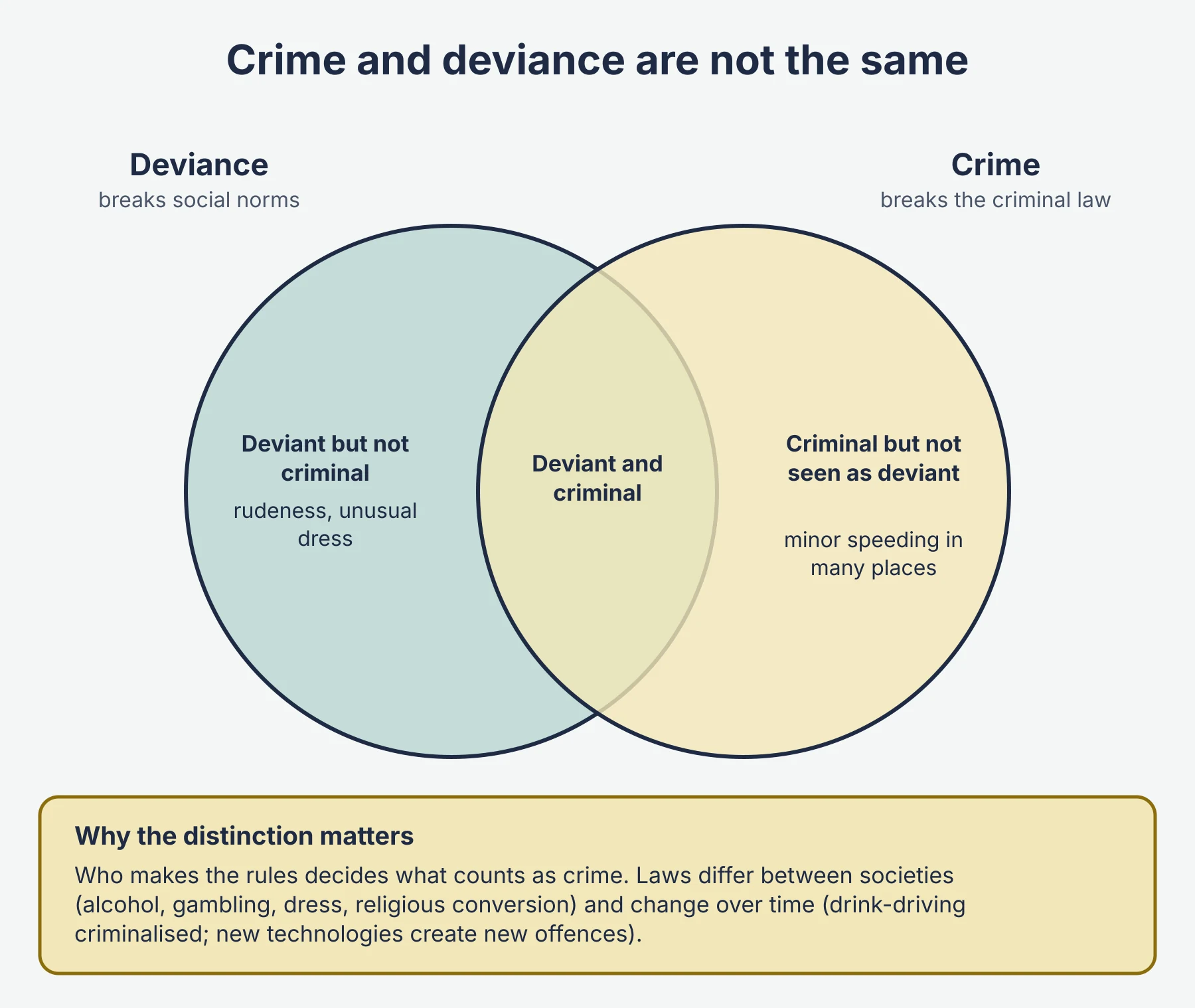
Deviance is behaviour that breaks social norms; crime is behaviour that breaks the criminal law. Not all deviance is criminal (rudeness, unusual dress) and not all crime is seen as deviant (minor speeding in many places). The distinction matters because it shows that who makes the rules decides what counts as crime.
Three arguments explain social construction:
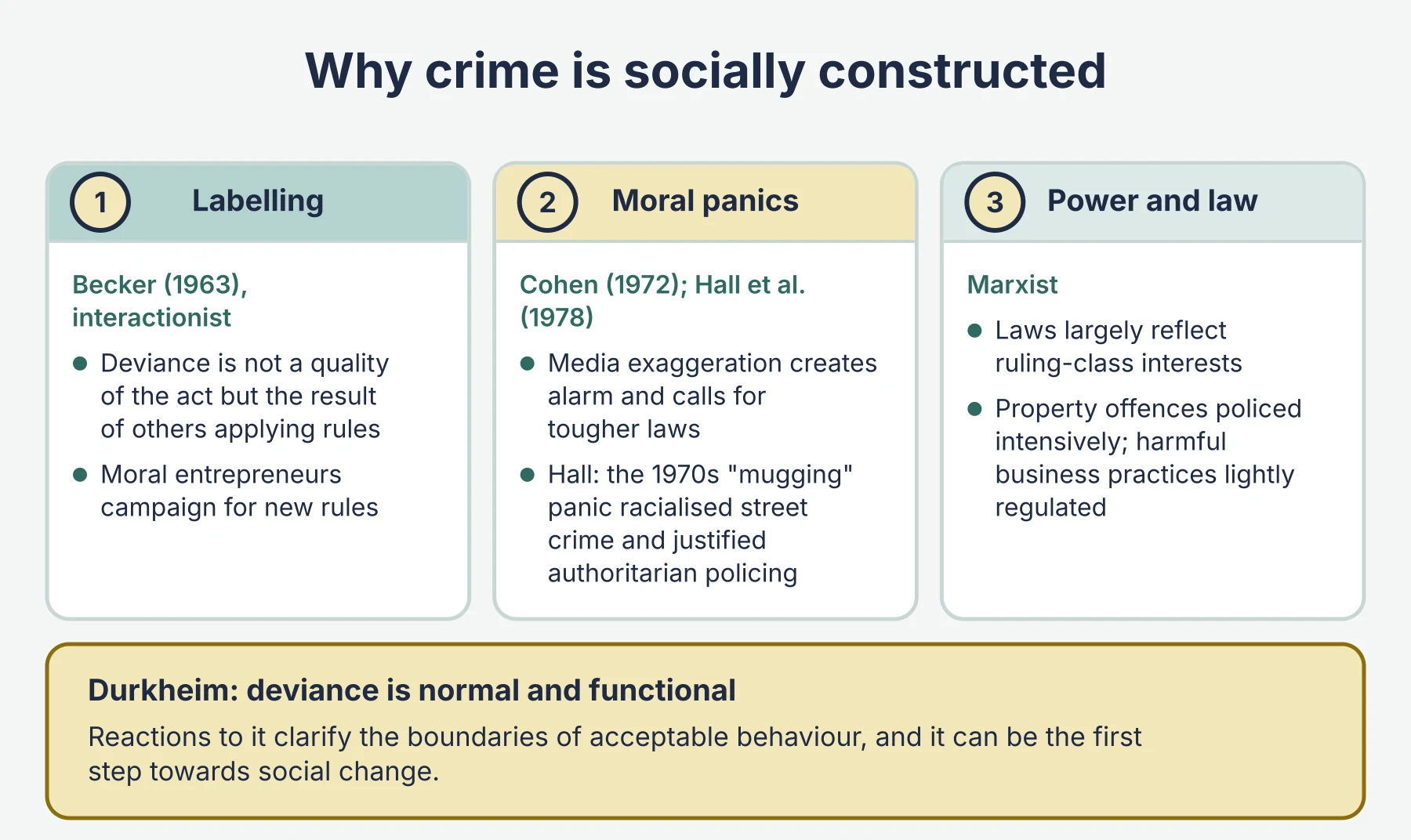
- Interactionist labelling. Howard Becker (Outsiders, 1963) argued that deviance is not a quality of the act but the result of others applying rules and sanctions to an “offender”. Moral entrepreneurs campaign for new rules, and the same act may be labelled differently depending on who commits it and where.
- Moral panics. Stanley Cohen’s Folk Devils and Moral Panics (1972) showed media exaggeration of youth disturbances creating public alarm and calls for tougher laws. Stuart Hall and colleagues’ Policing the Crisis (1978) argued that a 1970s panic about “mugging” in Britain racialised street crime and helped justify more authoritarian policing during an economic crisis.
- Power and law. Marxists argue laws largely reflect ruling-class interests: offences against property are policed intensively while harmful business practices are lightly regulated.
Differences between societies and over time provide the evidence. Alcohol, gambling, certain forms of dress and religious conversion are legal in some states and criminal in others; behaviours once tolerated, such as drink-driving, have been criminalised, and others have been decriminalised; new technologies create new offences. Durkheim added that some deviance is normal and functional: reactions to it clarify the boundaries of acceptable behaviour, and deviance can be the first step towards social change.
Types of crime: what makes each sociologically interesting
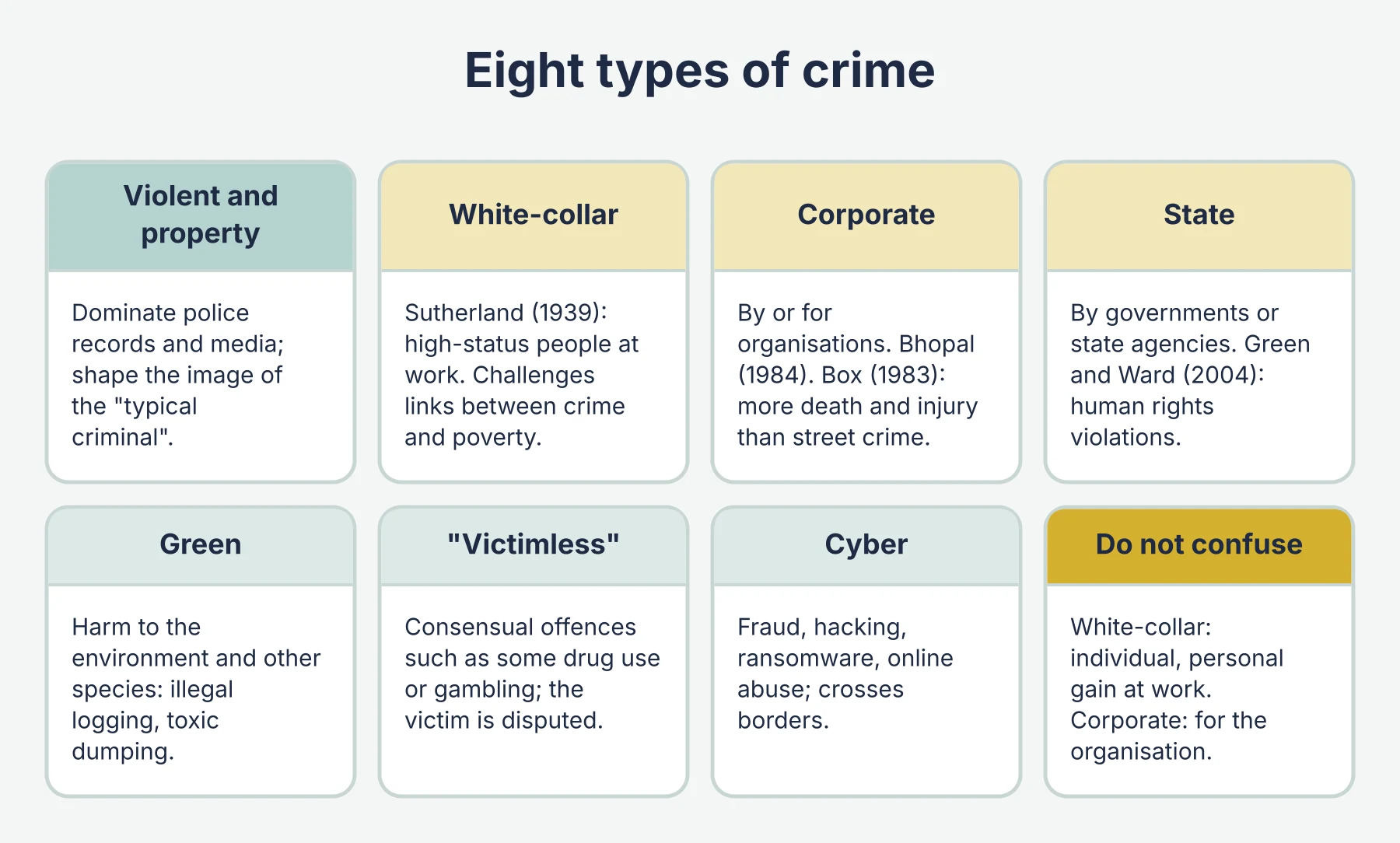
- Violent and property crime dominate police records and media coverage, shaping public images of the “typical criminal” as young, male and working class.
- White-collar crime (Edwin Sutherland’s term, introduced in 1939) is committed by respectable, high-status people in the course of their work; it challenges theories that link crime to poverty.
- Corporate crime is committed by or for organisations. The 1984 gas leak at the Union Carbide pesticide plant in Bhopal, India, which killed thousands, is widely studied as a case of corporate negligence and of how difficult it is to hold companies to account. Steven Box (Power, Crime and Mystification, 1983) argued corporate crime causes more death and injury than street crime but is hidden by its complexity and weak enforcement.
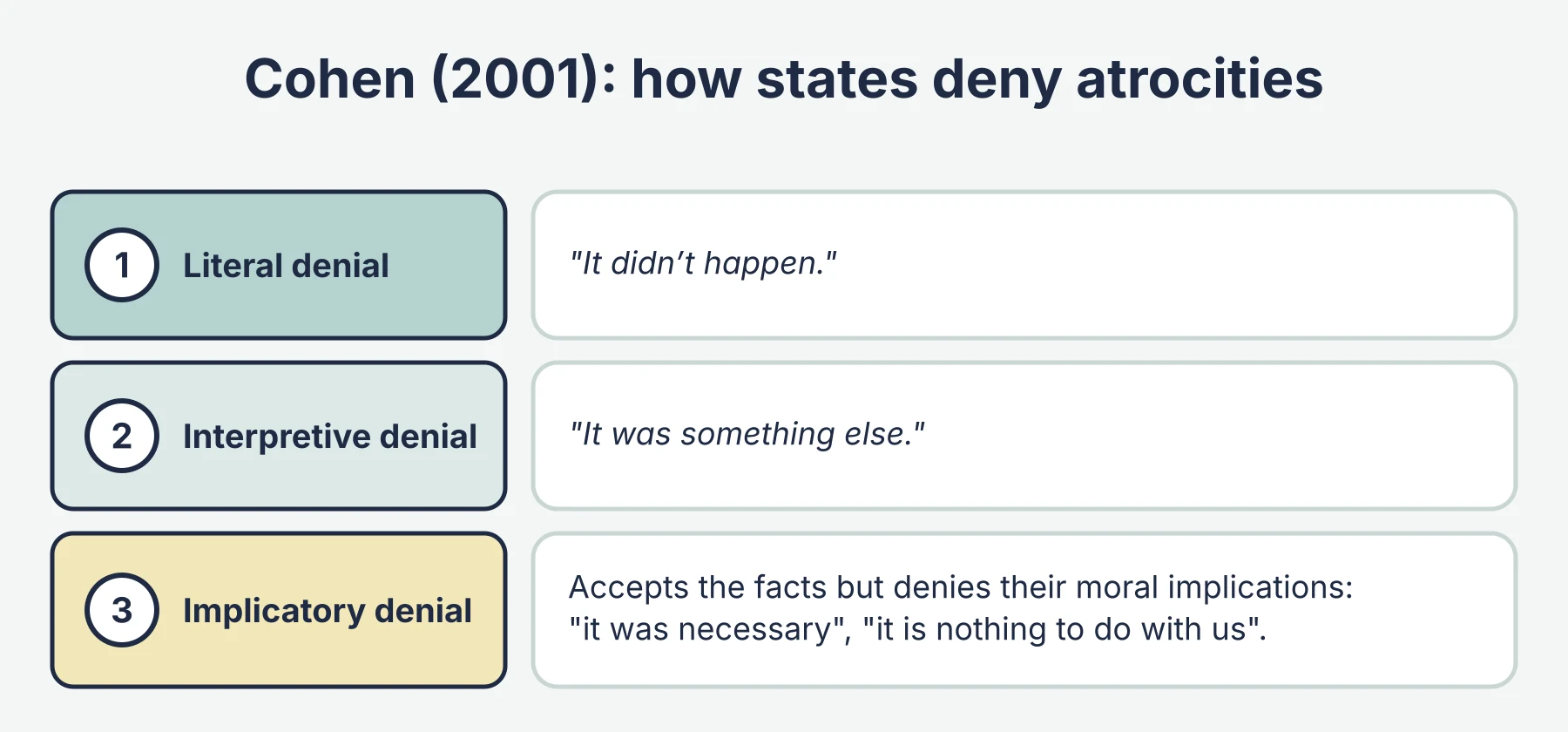
- State crime is committed by governments or state agencies, from torture and genocide to corruption. Penny Green and Tony Ward (State Crime, 2004) define it as state organisational deviance involving human rights violations. Stanley Cohen’s States of Denial (2001) explains how states deny atrocities: literal denial (“it didn’t happen”), interpretive denial (“it was something else”) and implicatory denial, which accepts the facts but denies their moral implications (“it was necessary”, “it is nothing to do with us”).
- Green crime covers harm to the environment and other species, such as illegal logging and toxic dumping; green criminologists also study legal but damaging activities.
- “Victimless” crime (the specification’s own inverted commas) refers to consensual offences, such as some drug use or gambling, where the victim is disputed.
- Cybercrime uses digital technology: fraud, hacking, ransomware and online abuse. It crosses borders, so jurisdiction and recording are difficult.
Social harm
The social harm (or zemiology) approach argues that criminology should study harm, not just legally defined crime. Examples of harmful but often legal actions include deaths from unsafe but legal working conditions, pollution within permitted limits, aggressive marketing of addictive products, poverty resulting from policy decisions, and tax avoidance that reduces public services. The approach links to conflict theory: powerful groups are better able to keep their harmful actions outside the criminal law.
Evaluation: the harm approach widens the field and exposes hidden suffering, but critics argue “harm” is hard to define and measure, and may blur the useful legal line between crime and other wrongs.
Measuring and researching crime
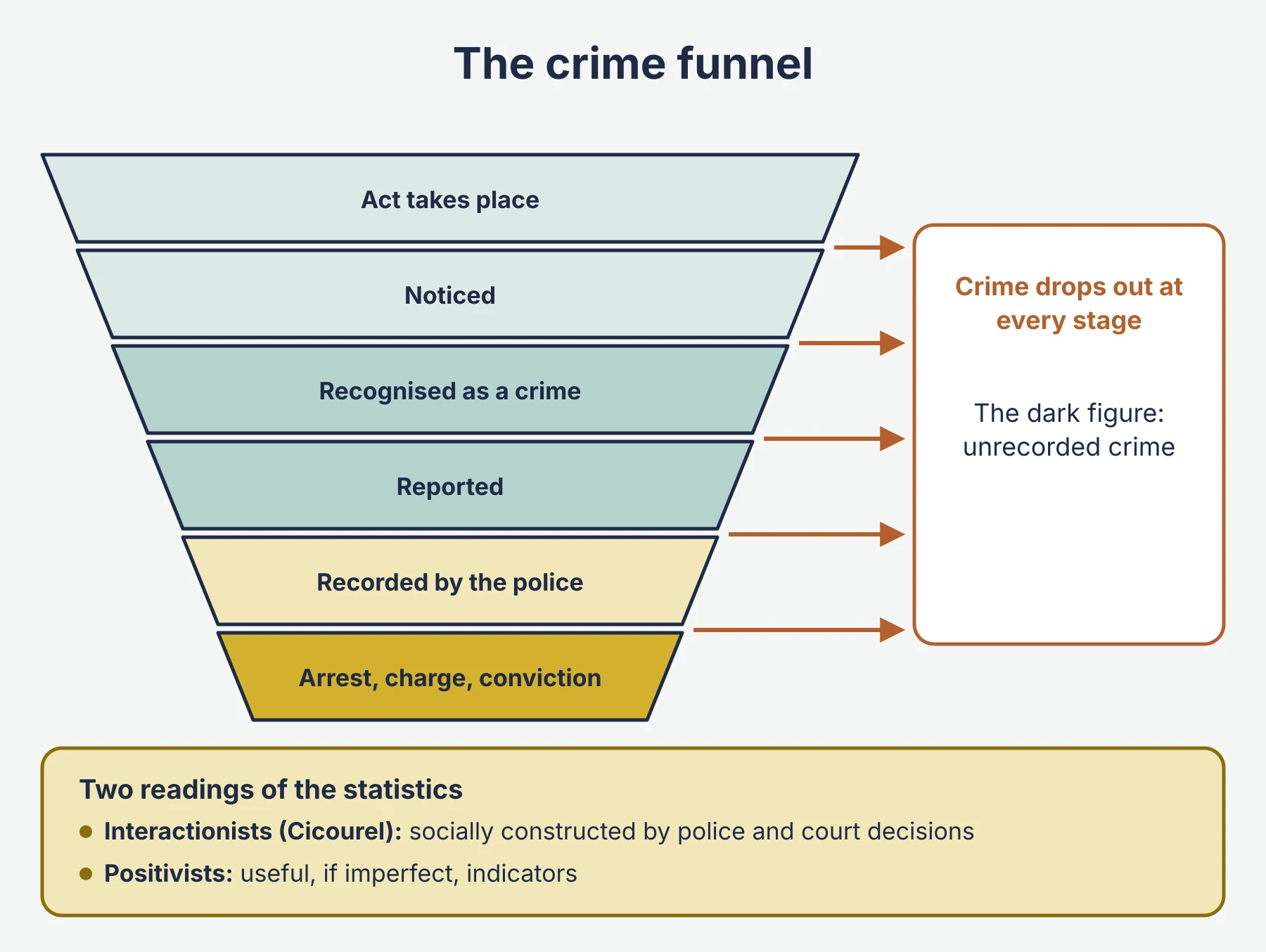
Think of recorded crime as the end of a funnel: an act must be noticed, recognised as a crime, reported, recorded by the police, and then may lead to an arrest, charge and conviction. Crime can drop out at every stage, creating the dark figure of unrecorded crime.
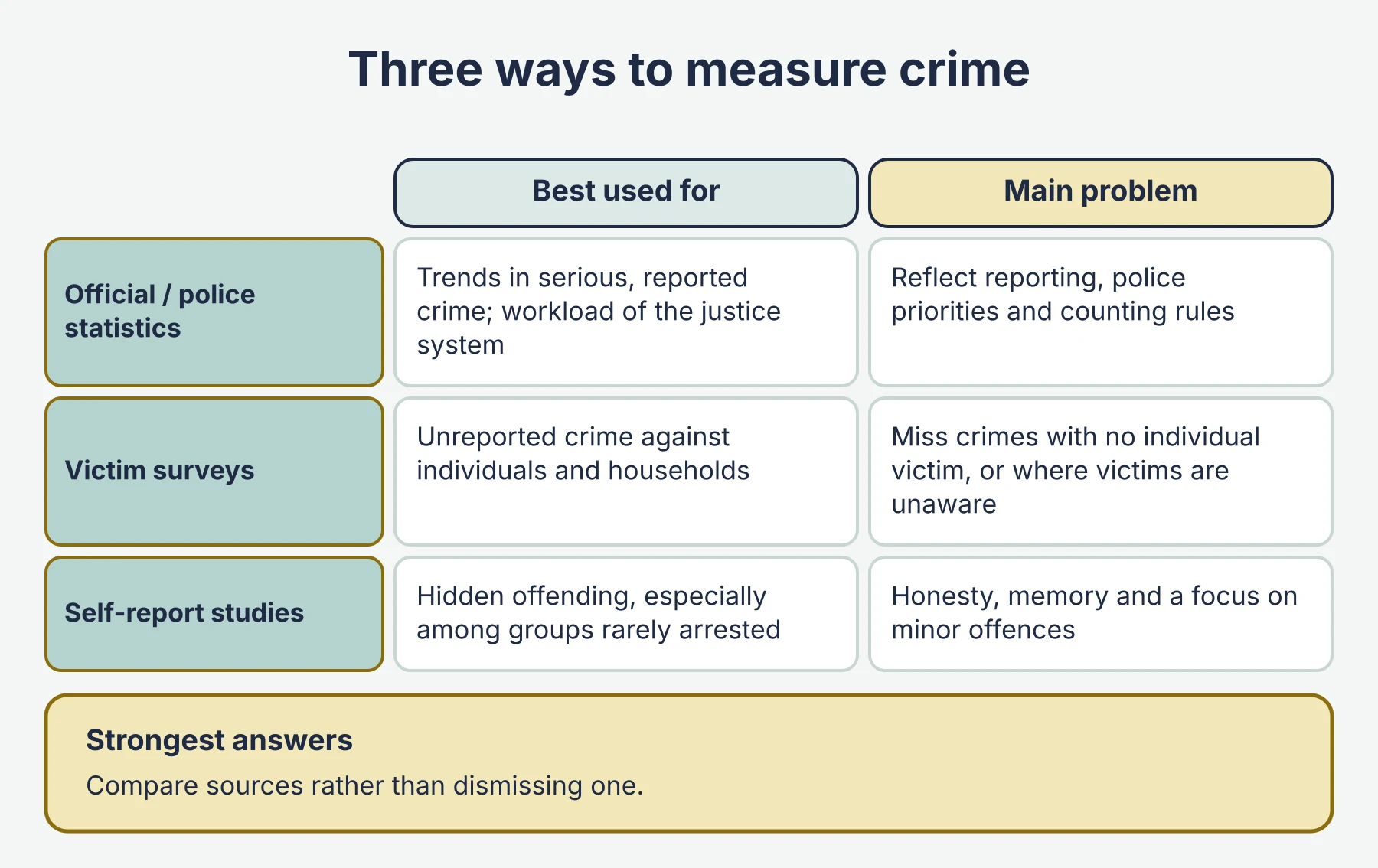
| Source | Best used for | Main problem |
|---|---|---|
| Official/police statistics | Trends in serious, reported crime; workload of the justice system | Reflect reporting, police priorities and counting rules |
| Victim surveys | Unreported crime against individuals and households | Miss crimes with no individual victim or where victims are unaware |
| Self-report studies | Hidden offending, especially among groups rarely arrested | Honesty, memory and focus on minor offences |
Interactionists such as Aaron Cicourel argued that statistics are socially constructed by the decisions of police and courts; positivists use them as useful, if imperfect, indicators. The strongest answers compare sources rather than dismissing one.
Explaining patterns of offending and victimisation
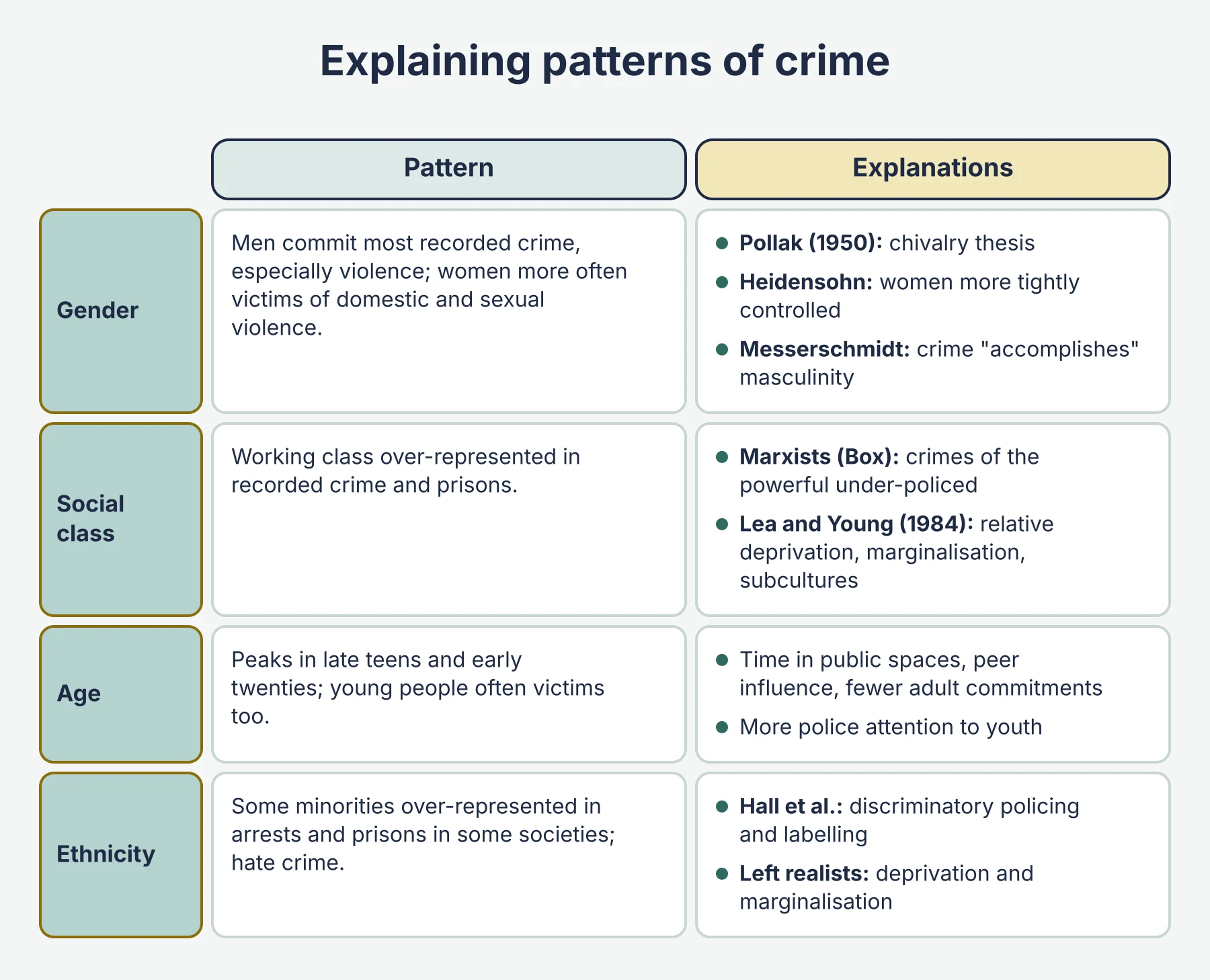
| Pattern | Explanations to use |
|---|---|
| Gender: men commit most recorded crime, especially violence; women are more often victims of domestic and sexual violence | Otto Pollak’s chivalry thesis (1950): police and courts treat women more leniently; Heidensohn’s argument that women are more tightly controlled; James Messerschmidt’s view that crime is a way of “accomplishing” masculinity |
| Social class: working-class people are over-represented in recorded crime and prisons | Marxists (Box) argue the crimes of the powerful are under-policed; left realists John Lea and Jock Young (1984) link street crime to relative deprivation, marginalisation and subcultures |
| Age: recorded offending peaks in the late teens and early twenties; young people are also frequent victims | More time in public spaces, peer influence, fewer adult commitments; higher police attention to youth |
| Ethnicity: some minority groups are over-represented in arrests and prisons in some societies; minorities may suffer hate crime | Debate between explanations stressing discriminatory policing and labelling (Hall and colleagues) and those stressing deprivation and marginalisation (left realists) |
Worked example: annotated 20-mark plan
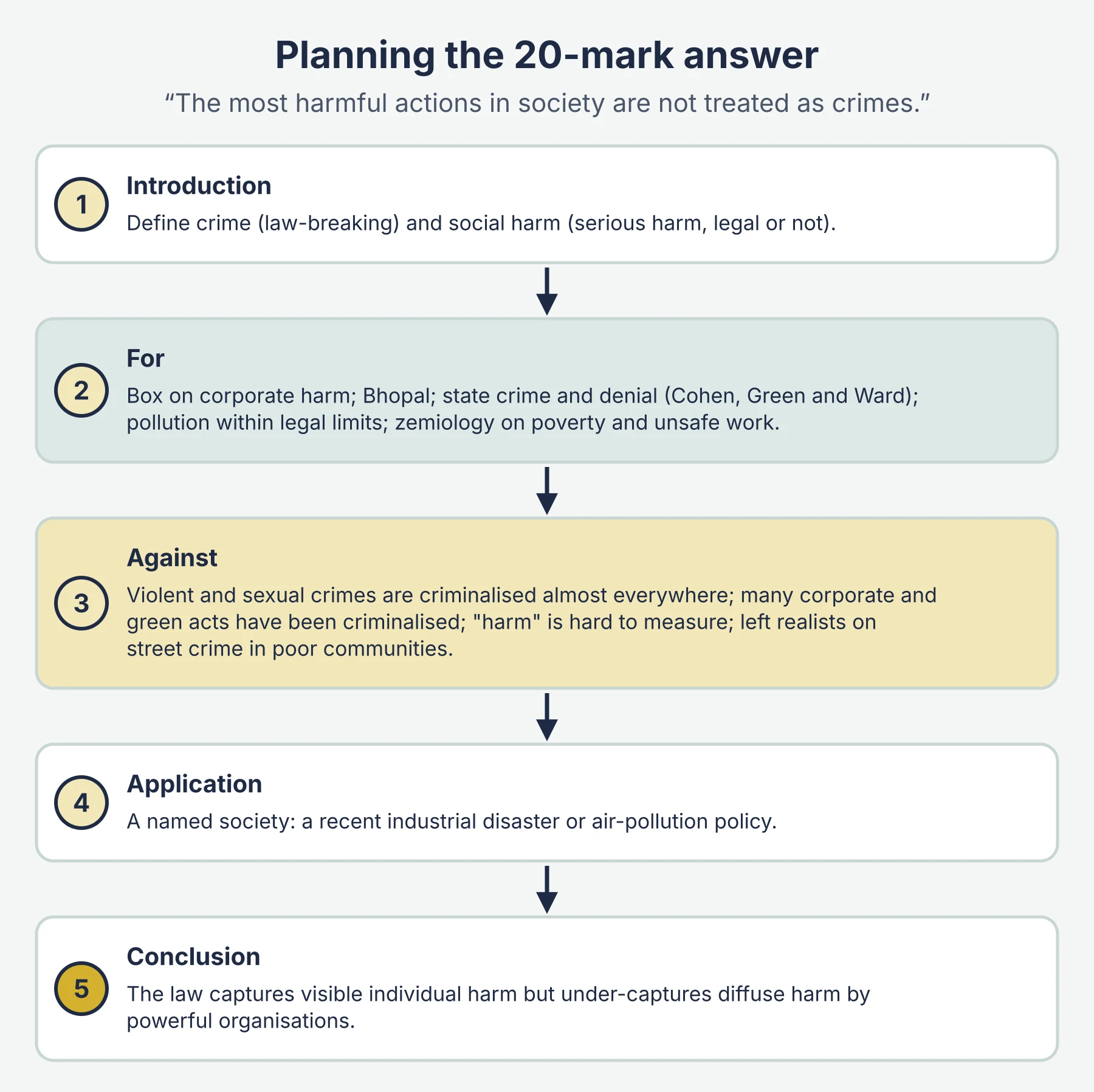
Using examples from a society you know, evaluate the view that the most harmful actions in society are not treated as crimes.
- Introduction: define crime (law-breaking) and social harm (serious harm, legal or not).
- For: Box on corporate harm; Bhopal as an example of corporate negligence; state crime and denial (Cohen, Green and Ward); pollution within legal limits; zemiology’s case that harms of poverty and unsafe work outweigh street crime.
- Against: violent and sexual crimes cause deep individual harm and are criminalised almost everywhere; many harmful corporate and green acts have been criminalised over time; “harm” is hard to measure, so comparisons are uncertain; left realists stress the real impact of street crime on poor communities.
- Application: named society, for example a recent industrial disaster or air-pollution policy.
- Conclusion: a judgement, for example that the criminal law captures visible individual harm but under-captures diffuse harm caused by powerful organisations.
Common mistakes
- Defining crime and deviance as the same thing.
- Confusing white-collar crime (individual, for personal gain at work) with corporate crime (for the organisation).
- Giving “social harm” without examples of harmful but legal acts.
- Describing patterns without explaining them or without mentioning victimisation.
- Treating any single data source as a true picture.
Exam technique
In explain questions, link each point to a mechanism, for example how police discretion shapes class patterns in statistics. In evaluate questions, compare data sources and perspectives, and use a named society’s laws or statistics for application.
- Deviance, harm and crime revision notes
- Deviance, harm and crime practice questions
- How societies respond to crime: social control study guide
Related resources
-
Practice questions
OxfordAQA A-Level Sociology (9690): Deviance, Harm and Crime — Practice Questions
Original OxfordAQA 9690 Unit 2 style questions on the social construction of crime, corporate, state and green crime, social harm and crime statistics.
Sociology · OxfordAQA · AS Level
Try questions -
Revision notes
OxfordAQA A-Level Sociology (9690): Deviance, Harm and Crime — Revision Notes
Revision notes for OxfordAQA 9690 section 3.1.2.5: the social construction of crime, types of crime, social harm, measuring crime and patterns of offending.
Sociology · OxfordAQA · AS Level
Revise topic -
Practice questions
OxfordAQA A-Level Sociology (9690): Individuals, Society and Social Identities — Practice Questions
Original OxfordAQA 9690 Unit 2 style questions on culture, subcultures, Mills's sociological imagination and changing gender, ethnic and online identities.
Sociology · OxfordAQA · AS Level
Try questions
Related articles
Get free revision emails (optional)
Occasional emails with practice questions, worked explanations and links to free resources for the qualification and subjects you choose. No spam, and you can unsubscribe from any email. The free tools on this site never need an email.