
Revision Notes
OxfordAQA International A-Level Sociology (9690): Social Control – Revision Notes
Revision notes for OxfordAQA 9690 section 3.1.2.4: sanctions, Goffman's stigma, othering, punishment, policing, surveillance, RSAs, ISAs and hegemony.
- Subject
- Sociology
- Level
- AS LEVEL
- Topic
- Unit 2 – Exploring Sociology
- Author
- Marlbridge Academic Team
- Updated
- Reviewed by
- Naqiya Yousaf (what this means)
Aligned to OxfordAQA A Level Sociology (9690), Version 1.1 (new qualification). Official specification .
Syllabus page (what it covers and how it is assessed): OxfordAQA A Level Sociology.
Syllabus points this page covers
9690 (AS Level)
- 3.1.2.4 Social control
Found an error? Report a correction.
Need help with this topic? Request a free trial class for A Level Sociology (9690).
These notes condense 3.1.2.4 Social control in OxfordAQA International AS/A level Sociology (9690), Unit 2 Section A. Core idea: societies secure conformity through formal and informal agencies using positive and negative sanctions; consensus theorists see this as protecting shared values, conflict theorists as protecting the powerful, and interactionists as creating labelled outsiders.
Full explanation: social control study guide.
Specification checklist
- Formal and informal social control; positive and negative sanctions.
- Consensus and conflict views.
- Stigmatised identities; othering.
- Informal agencies: families, schools, peers, media, religion, workplace.
- Formal agencies: government/laws, police and other enforcement agencies, criminal justice system.
- Aims and types of punishment.
- Crime prevention: types of policing, surveillance.
- Repressive and ideological state apparatuses, interpellation; hegemony.
- Functionalist, Marxist, feminist and social action/interactionist perspectives.
Key terms
| Term | Definition |
|---|---|
| Formal control | Enforcement of written rules by official bodies |
| Informal control | Control through everyday relationships and unwritten norms |
| Sanction | A reward (positive) or punishment (negative) for behaviour |
| Stigma | A deeply discrediting attribute (Goffman, 1963) |
| Discredited / discreditable | Stigma visible / stigma hidden but at risk of discovery |
| Othering | Defining a group as different from and inferior to “us” |
| Folk devil | A group portrayed as a threat in a moral panic (Stanley Cohen, 1972) |
| Retribution | Punishment deserved in proportion to harm |
| Deterrence | Discouraging future offending by the offender or others |
| Incapacitation | Removing the ability to offend |
| Restorative justice | Repairing harm, often through victim-offender meetings |
| Panopticon | Prison design where inmates may always be watched (Bentham; Foucault) |
| Synopticon | The many watching the few (Mathiesen) |
| RSA / ISA | Control by force / by ideas (Althusser, 1970) |
| Interpellation | Ideology “hailing” individuals into accepting roles as their own |
| Hegemony | Rule through consent to ruling-class ideas (Gramsci) |
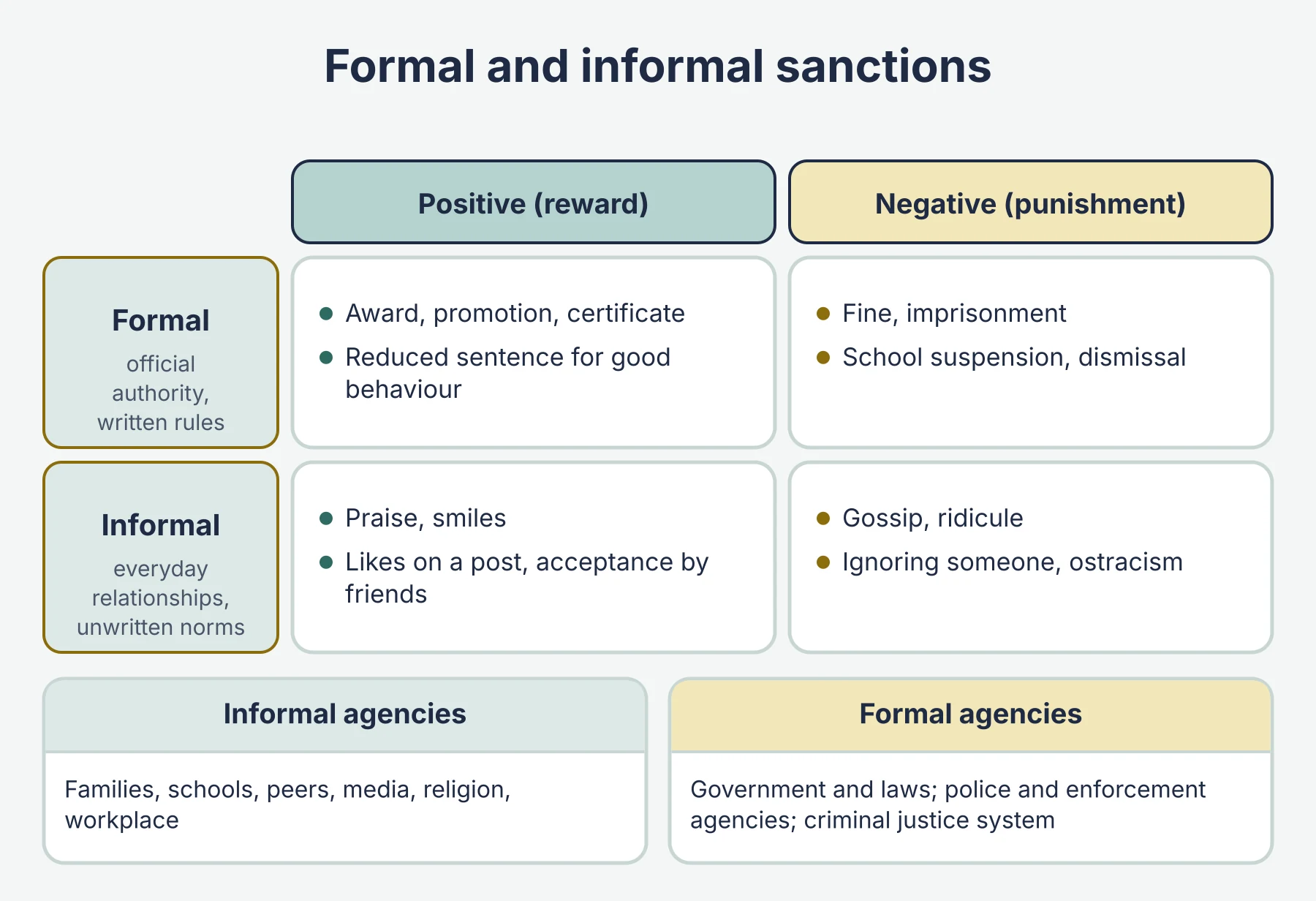
Sanctions grid
| Positive | Negative | |
|---|---|---|
| Formal | Award, promotion | Fine, prison, exclusion |
| Informal | Praise, likes, acceptance | Gossip, ridicule, ostracism |
Stigma and othering
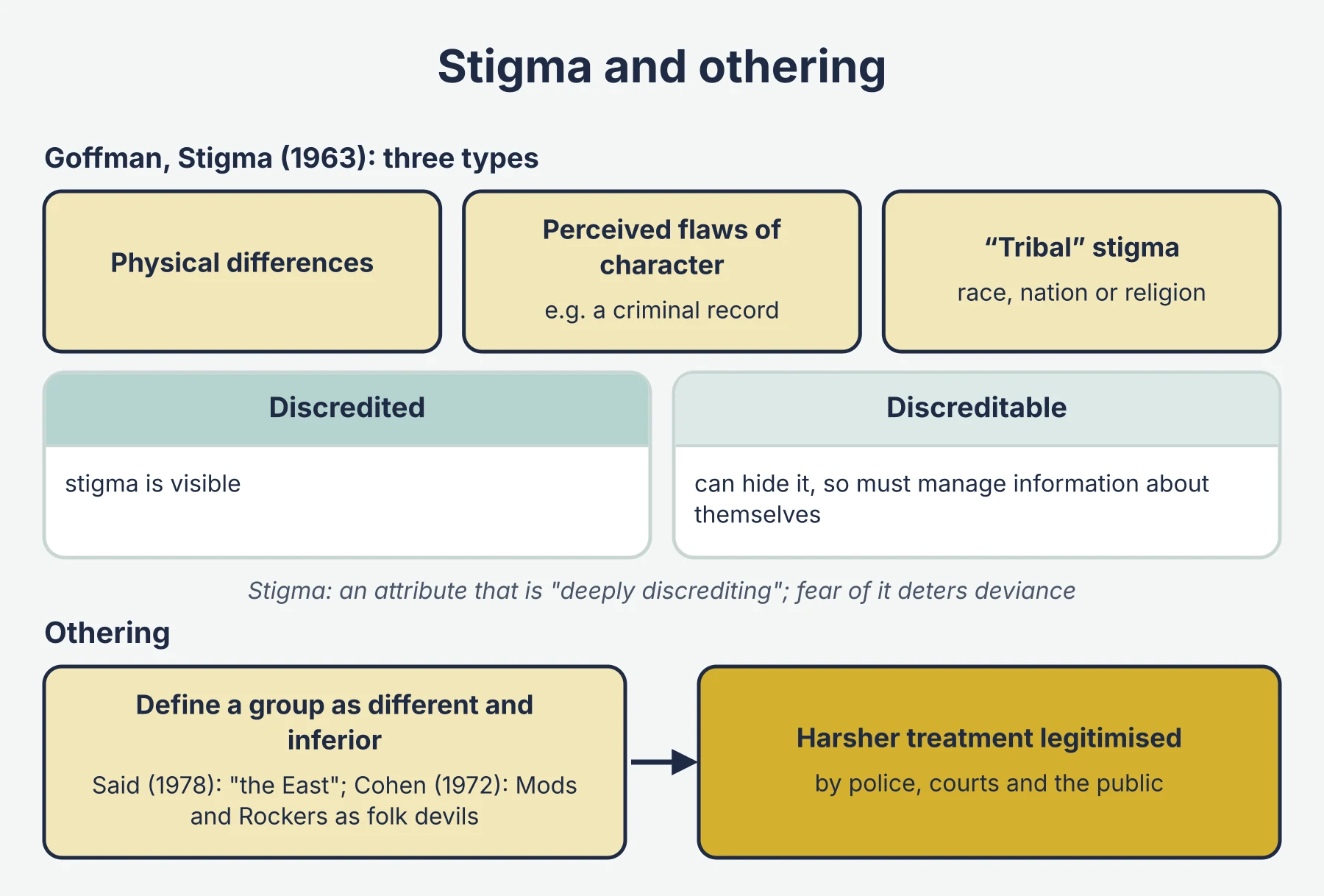
- Goffman’s three types: physical; character (such as a criminal record); “tribal” (race, nation, religion).
- Stigmatised people manage information and interactions; fear of stigma deters deviance.
- Said (1978): Orientalism othered “the East” to justify colonial rule.
- Stanley Cohen (1972): media turned Mods and Rockers into folk devils, prompting calls for tougher control.
Punishment
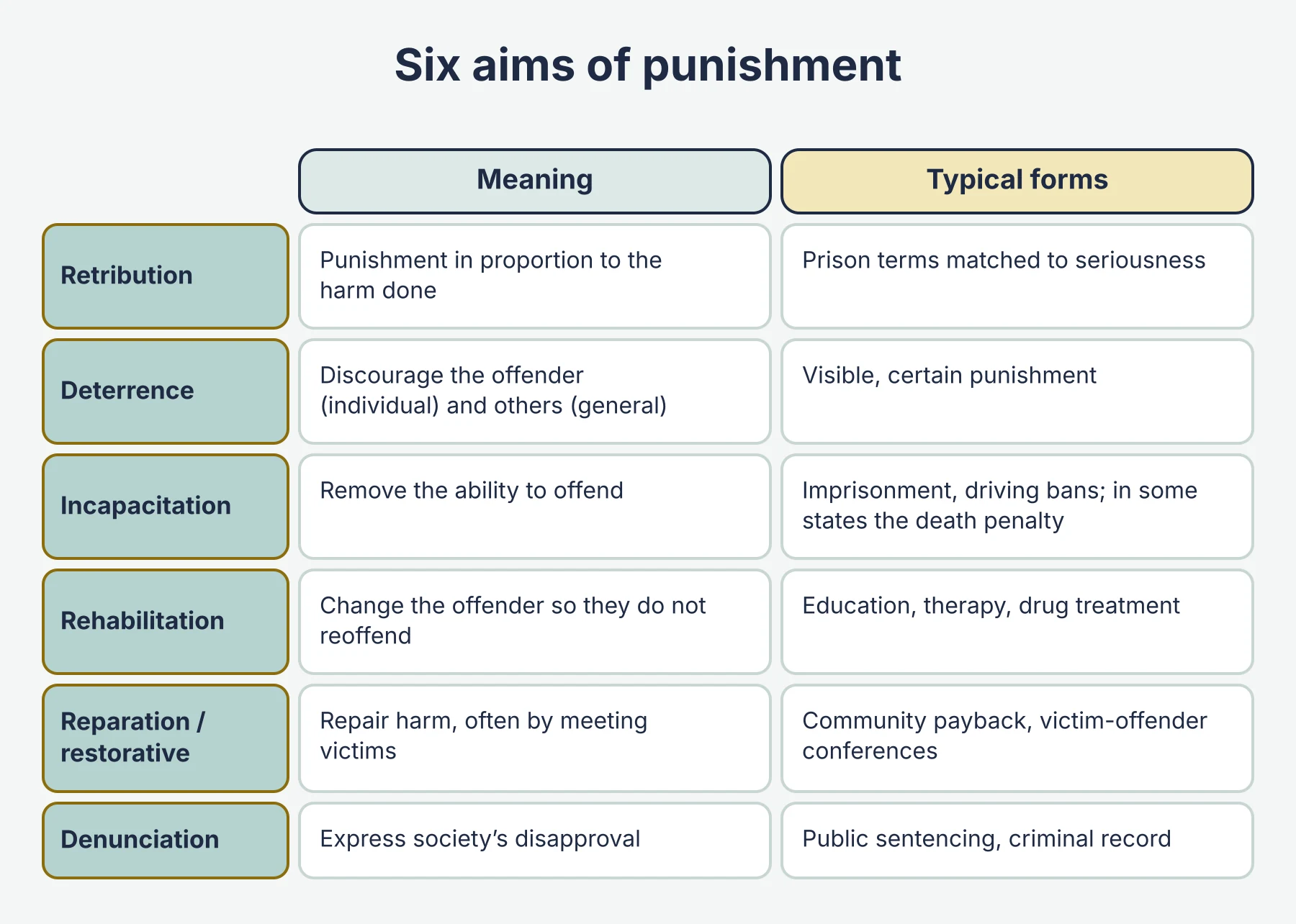
- Aims: retribution, deterrence, incapacitation, rehabilitation, reparation, denunciation.
- Types: fines, community sentences, probation, prison, corporal and capital punishment (in some societies).
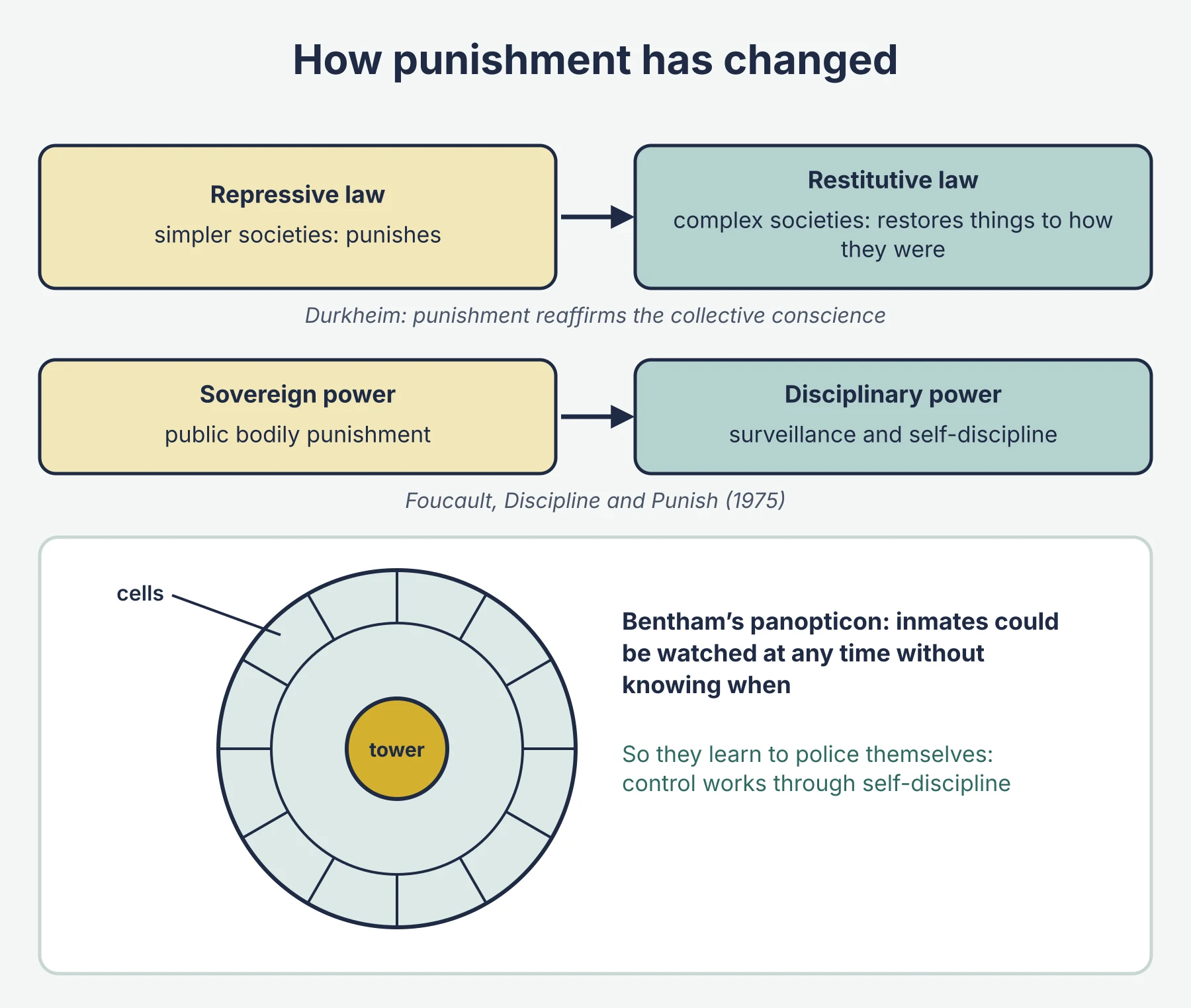
- Durkheim: punishment reaffirms the collective conscience; repressive law vs restitutive law.
- Foucault (1975): from sovereign power (public bodily punishment) to disciplinary power (surveillance, self-discipline); the panopticon.
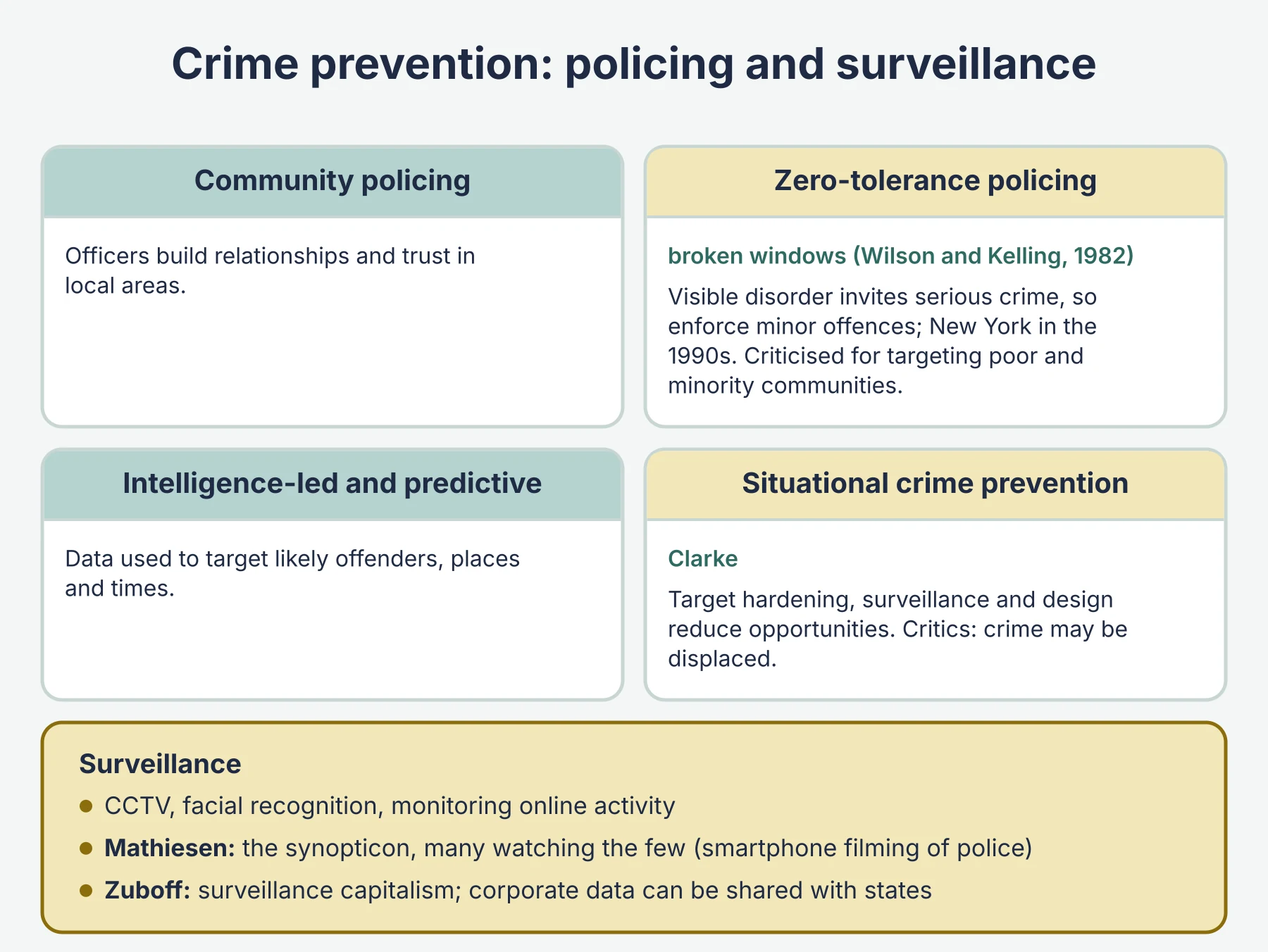
Crime prevention
| Approach | Idea | Criticism |
|---|---|---|
| Community policing | Build trust locally | Slow; depends on resources |
| Zero tolerance | Enforce minor offences; broken windows (Wilson and Kelling, 1982) | Targets poor and minority groups |
| Intelligence-led / predictive | Data target people and places | Biased data reproduce bias |
| Situational prevention | Reduce opportunities (Clarke) | Displacement |
| Surveillance | CCTV, facial recognition, online monitoring | Privacy; Zuboff’s surveillance capitalism |
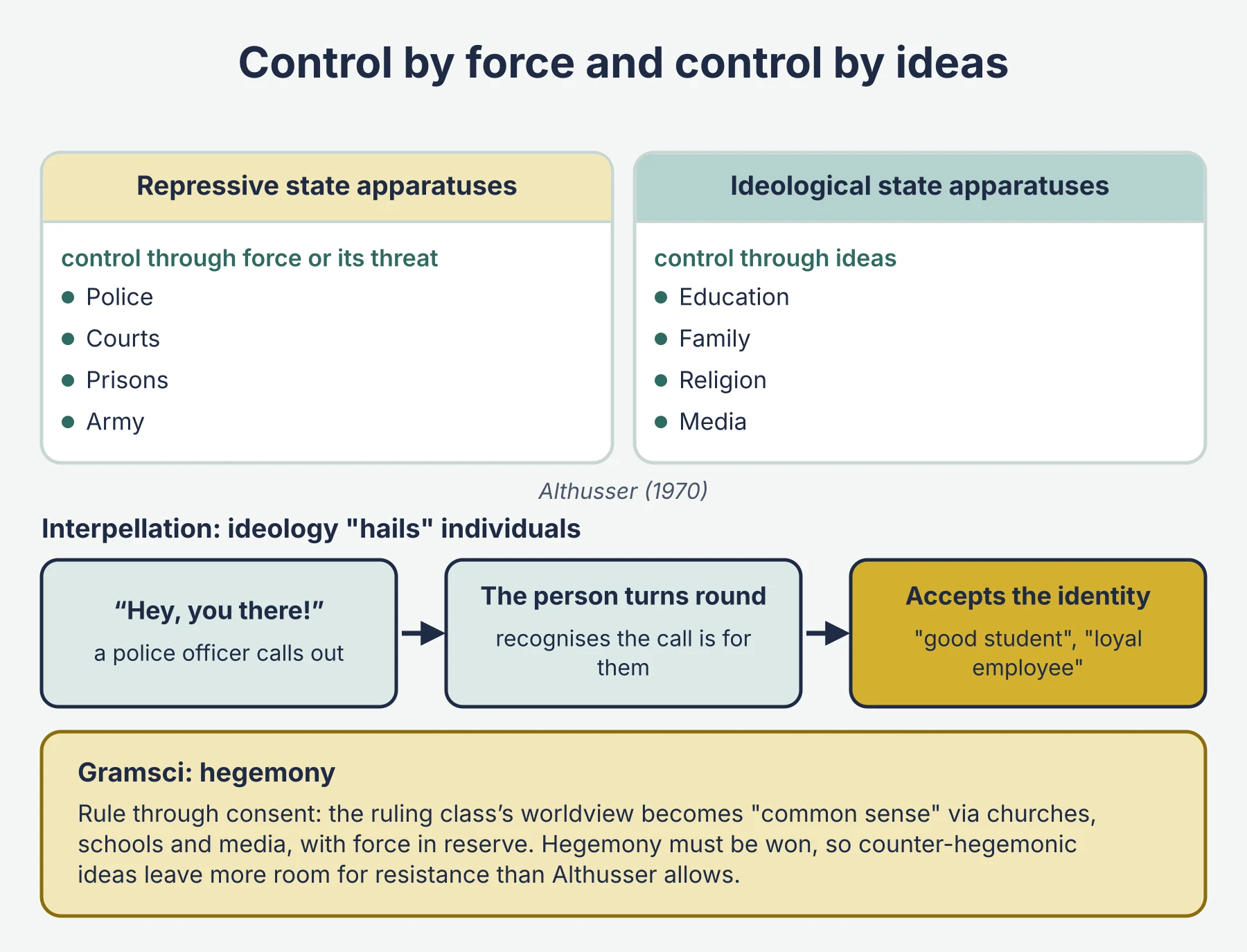
Althusser and Gramsci
- RSAs: police, courts, prisons, army: force.
- ISAs: education, family, religion, media: ideas.
- Interpellation: “Hey, you there!” and turning round: accepting an offered identity.
- Hegemony: consent through civil society; force in reserve; open to counter-hegemony.
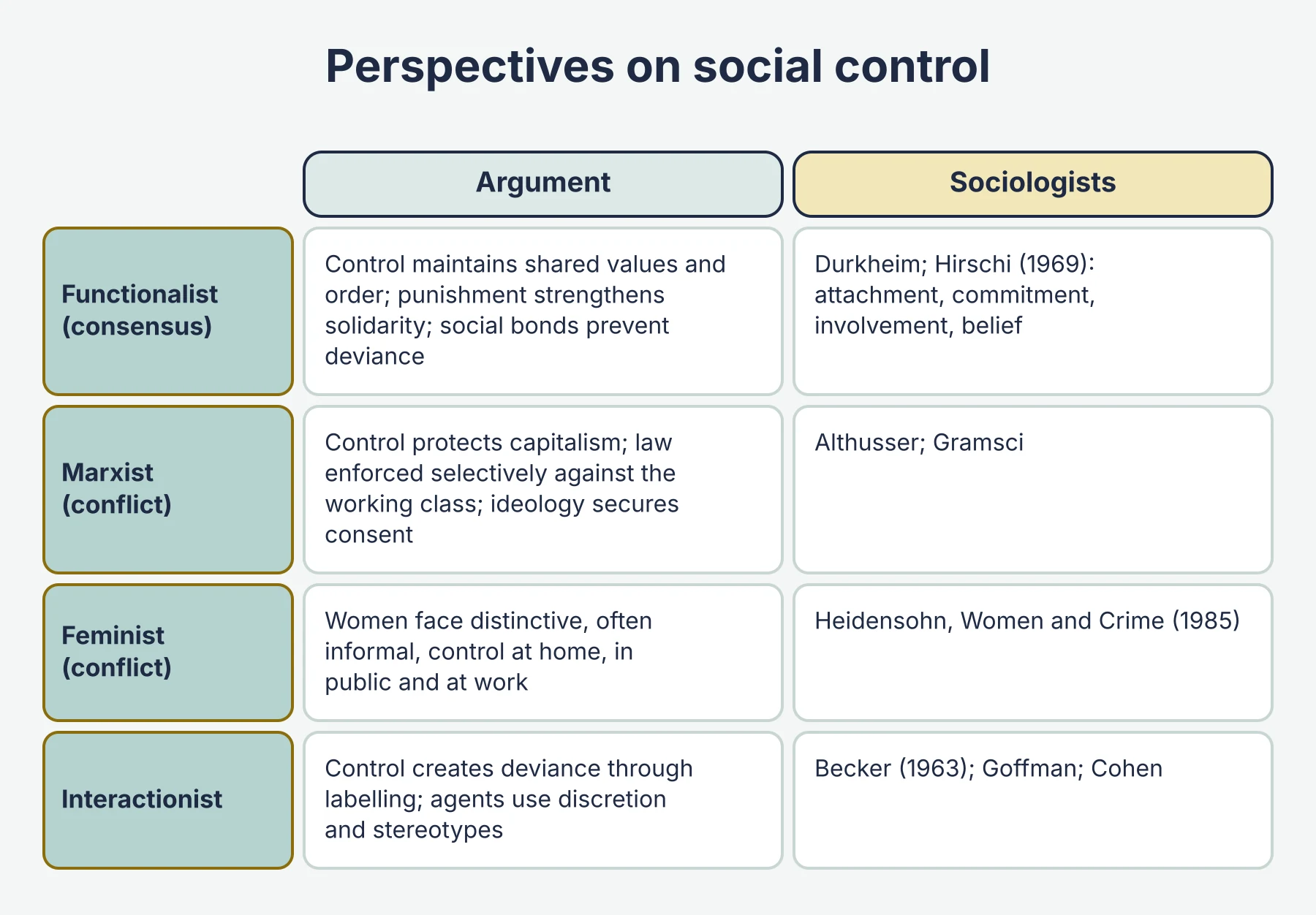
Perspectives
| Perspective | Key point | Name |
|---|---|---|
| Functionalist | Control protects shared values; bonds prevent deviance | Durkheim; Hirschi (1969): attachment, commitment, involvement, belief |
| Marxist | Control protects capitalism | Althusser; Gramsci |
| Feminist | Women controlled at home, in public and at work | Heidensohn (1985) |
| Interactionist | Labelling creates deviance | Becker (1963); Goffman; Stanley Cohen |
Evaluation lines to reuse
- “Durkheim explains why punishment unites the law-abiding, but not why it falls more heavily on the poor, which Marxists stress.”
- “Gramsci allows more room for resistance than Althusser, because hegemony has to be won.”
- “Surveillance may deter, but situational measures risk displacing crime and eroding privacy.”
- “Labelling theory shows control can amplify deviance, but it says little about the harm victims experience.”
Exam traps
- Informal control assumed to be positive.
- Hegemony attributed to Althusser.
- Aims and types of punishment confused.
- Feminist perspective omitted.
- No named society in extended answers.
Self-test
- Give one formal positive and one informal negative sanction.
- What is the difference between discredited and discreditable?
- Define othering.
- What is a folk devil?
- Distinguish retribution from rehabilitation.
- What did Durkheim see as the function of punishment?
- What did Foucault mean by disciplinary power?
- What is the broken windows argument?
- Give one criticism of situational crime prevention.
- Give two examples of ISAs.
- Explain interpellation.
- How does hegemony differ from control by force?
Answers
- Formal positive: a promotion; informal negative: ridicule.
- Discredited: stigma visible; discreditable: stigma hidden but could be revealed.
- Defining a group as different from and inferior to “us”.
- A group portrayed by the media as a threat to society in a moral panic.
- Retribution punishes because it is deserved; rehabilitation aims to change the offender.
- To reaffirm the collective conscience and unite society against wrongdoing.
- Control through surveillance and self-discipline rather than public force.
- Visible minor disorder signals no one cares, inviting more serious crime.
- It may displace crime to other places or times.
- Education, the family, religion, the media.
- Ideology “hails” individuals, who accept the identity offered as their own.
- Hegemony rests on consent to ruling ideas, with force kept in reserve.
Practise next: social control practice questions | Exploring Sociology study guide
Related resources
-
Study guides
OxfordAQA International A-Level Sociology (9690): Social Identities and Social Change
Study guide to OxfordAQA 9690 section 3.1.2.3: socially constructed identities, seven bases of identity, and changing gender, ethnic and online identities.
Sociology · OxfordAQA · AS Level
Read guide -
Practice questions
OxfordAQA International A-Level Sociology (9690): Social Identities and Social Change – Practice Questions
Original OxfordAQA 9690 Unit 2 style questions on cohort, disability, nationality, hybrid and online identities, masculinity and class, with mark schemes.
Sociology · OxfordAQA · AS Level
Try questions -
Revision notes
OxfordAQA International A-Level Sociology (9690): Social Identities and Social Change – Revision Notes
Revision notes for OxfordAQA 9690 section 3.1.2.3: bases of identity, Fanon, Goffman, Zuboff, hybrid identities, diasporas, masculinities and consumption.
Sociology · OxfordAQA · AS Level
Revise topic
Related articles
Get free revision emails (optional)
Occasional emails with practice questions, worked explanations and links to free resources for the qualification and subjects you choose. No spam, and you can unsubscribe from any email. The free tools on this site never need an email.