
Study Guides
OxfordAQA International A-Level Sociology (9690): Social Identities and Social Change
Study guide to OxfordAQA 9690 section 3.1.2.3: socially constructed identities, seven bases of identity, and changing gender, ethnic and online identities.
- Subject
- Sociology
- Level
- AS LEVEL
- Topic
- Unit 2 – Exploring Sociology
- Author
- Marlbridge Academic Team
- Updated
- Reviewed by
- Naqiya Yousaf (what this means)
Aligned to OxfordAQA A Level Sociology (9690), Version 1.1 (new qualification). Official specification .
Syllabus page (what it covers and how it is assessed): OxfordAQA A Level Sociology.
Syllabus points this page covers
9690 (AS Level)
- 3.1.2.3 Social identities and social change
Found an error? Report a correction.
Need help with this topic? Request a free trial class for A Level Sociology (9690).
Section 3.1.2.3 Social identities and social change in OxfordAQA International AS/A level Sociology (9690) is examined in Unit 2 Section A. The specification lists “Individual and collective identities”; “The social construction of identities through socialisation”; identities based on “age and generation/cohort; sex and gender; race and ethnicity; social class; religion; ability/disability; nationality”; and “Social change and identities: gender identities including masculinity and femininity; hybrid ethnic identities and diasporas; online identities (in social media and virtual communities); greater consumption and globalisation as influences on identities”. Fanon, Goffman, Mead and Zuboff, all named for 3.1.2, are especially useful. The unit overview is in the Exploring Sociology study guide.
What identity means
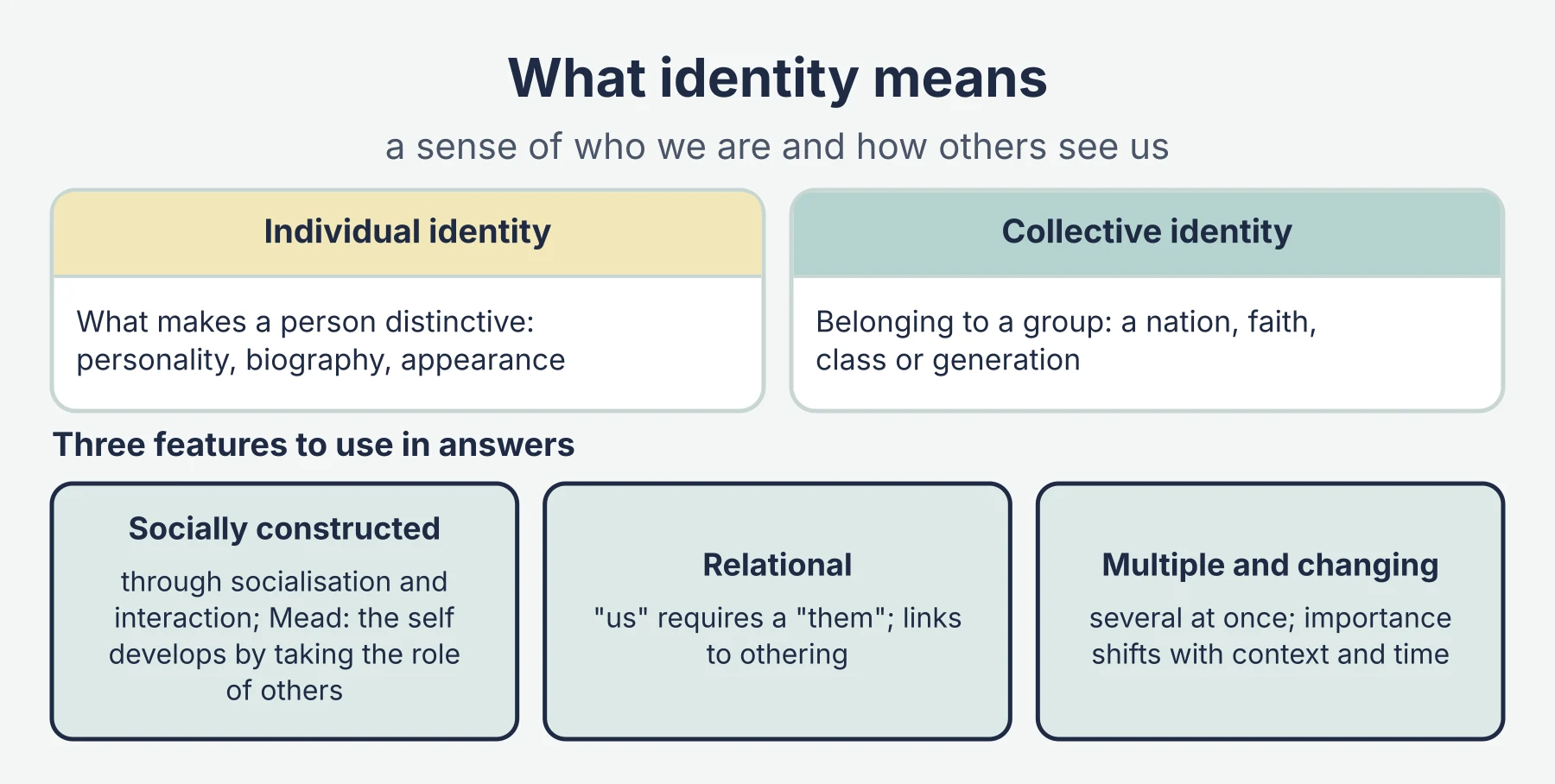
Identity is a person’s sense of who they are and how others see them. An individual identity is what makes a person distinctive (personality, biography, appearance); a collective identity is a sense of belonging to a group (a nation, faith, class or generation). Identities have three features that answers should use:
- Socially constructed: produced through socialisation and interaction rather than given by biology (3.1.2.2). Mead’s account of the self developing through taking the role of others is the classic interactionist explanation.
- Relational: identities form in contrast with others; “us” requires a “them”, which links to othering in 3.1.2.4.
- Multiple and changing: people hold several identities at once, and their importance shifts with context and over time.
The seven bases of identity
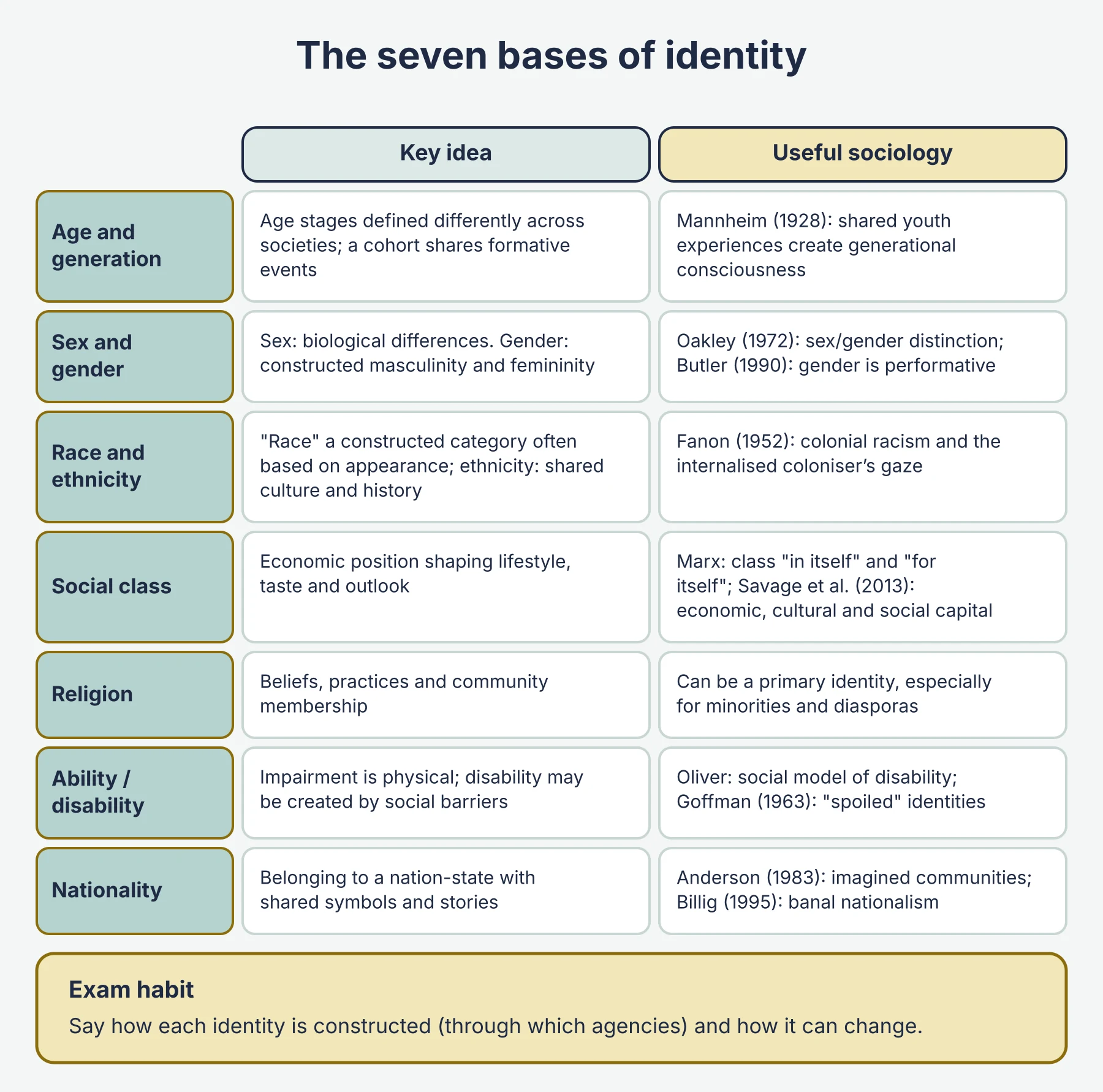
| Basis | Key idea | Useful sociology |
|---|---|---|
| Age and generation/cohort | Age stages (childhood, youth, old age) are defined differently across societies; a cohort is people born in the same period who share formative events | Karl Mannheim’s essay The Problem of Generations (1928): shared historical experiences in youth create generational consciousness |
| Sex and gender | Sex refers to biological differences; gender to socially constructed masculinity and femininity | Oakley (1972) drew the sex/gender distinction; Judith Butler (Gender Trouble, 1990) argued gender is performative, created through repeated acts |
| Race and ethnicity | “Race” is a socially constructed category often based on appearance; ethnicity refers to shared culture, history and sometimes language or religion | Frantz Fanon (Black Skin, White Masks, 1952) on colonial racism and the internalisation of the coloniser’s gaze |
| Social class | Position in economic structure, shaping lifestyle, taste and outlook | Marx’s distinction between a class “in itself” and “for itself” (with class consciousness); Mike Savage and colleagues (2013) argued class now combines economic, cultural and social capital |
| Religion | Beliefs, practices and community membership | Religion can be a primary identity, especially for minorities and diasporas |
| Ability/disability | Impairment is physical; disability may be created by social barriers | Mike Oliver’s social model of disability; Goffman’s Stigma (1963) on managing “spoiled” identities |
| Nationality | Belonging to a nation-state, often with shared symbols and stories | Benedict Anderson’s imagined communities (1983); Michael Billig’s banal nationalism (1995): flags, weather maps and sports coverage remind people daily of the nation |
A good exam habit is to say how each identity is constructed (through which agencies) and how it can change.
Social change and identities
Gender identities: masculinity and femininity
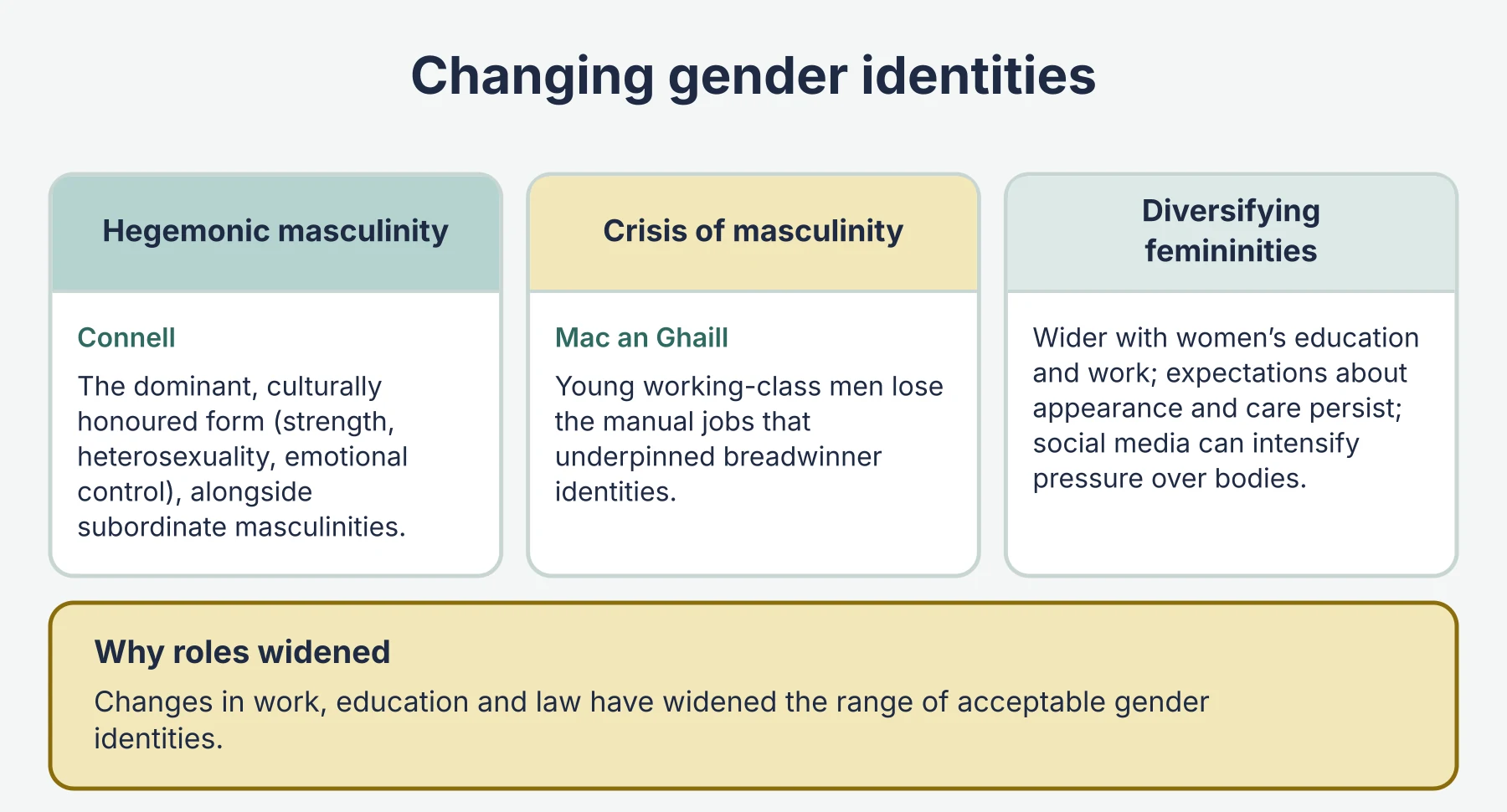
Changes in work, education and law have widened the range of acceptable gender identities. Raewyn Connell’s concept of hegemonic masculinity describes the dominant, culturally honoured form of masculinity (strength, heterosexuality, emotional control), alongside subordinate masculinities. Máirtín Mac an Ghaill described a crisis of masculinity among young working-class men facing the loss of manual jobs that once underpinned male breadwinner identities. Femininities have also diversified as women’s education and employment have expanded, although expectations about appearance and care persist, and social media can intensify pressure over bodies.
Hybrid ethnic identities and diasporas
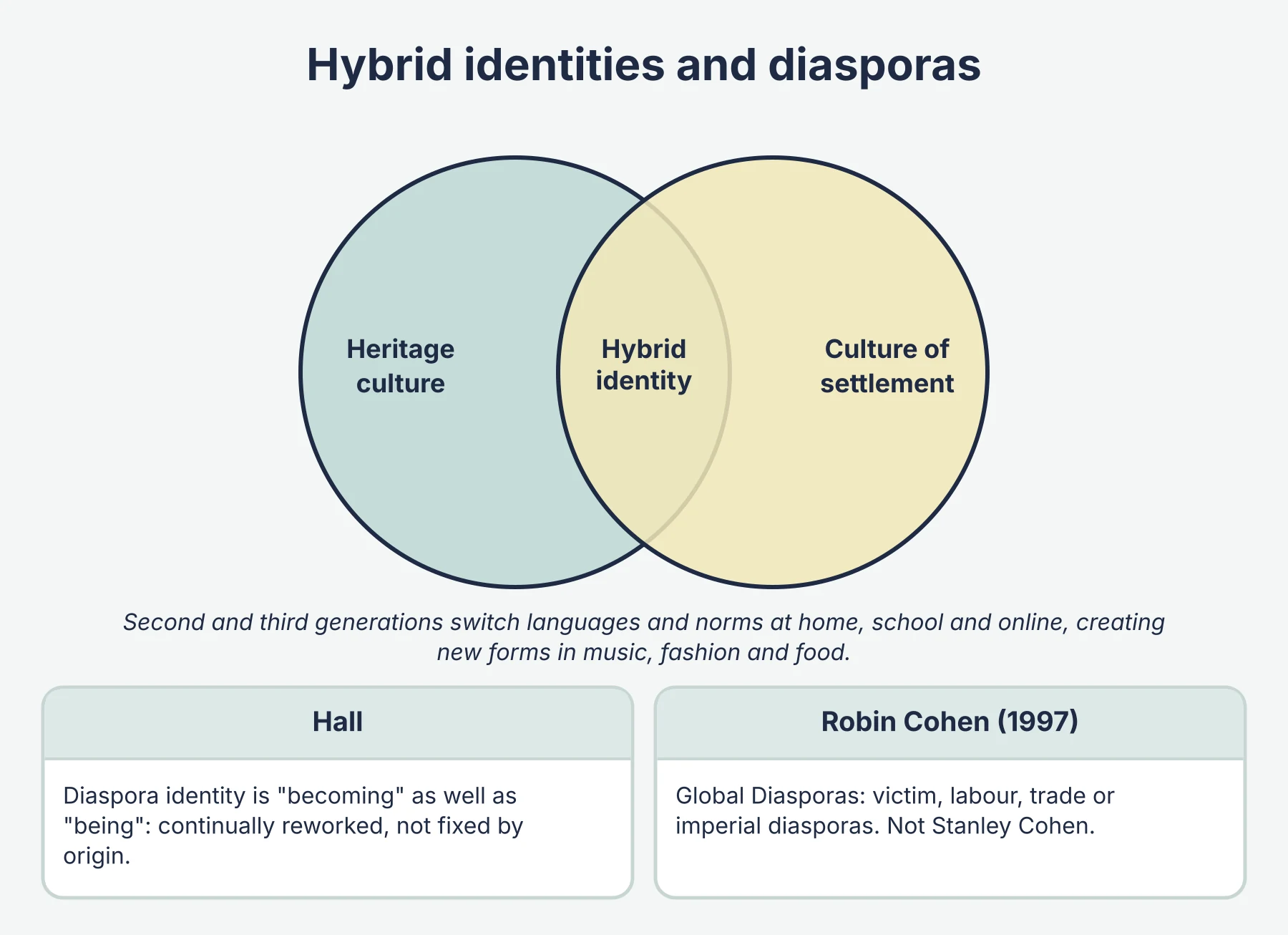
A hybrid identity combines elements of more than one culture. A diaspora is a population dispersed from a homeland that keeps a shared identity and ties to it. Stuart Hall argued that cultural identity in diasporas is a matter of “becoming” as well as “being”: identities are continually reworked rather than fixed by origin. Second- and third-generation migrants may switch between languages and norms at home, school and online, and create new cultural forms in music, fashion and food. Robin Cohen’s Global Diasporas (1997) classified diasporas, for example as victim, labour, trade or imperial diasporas. (Robin Cohen is a different sociologist from Stanley Cohen, who is named in the specification for his work on moral panics and denial.)
Online identities
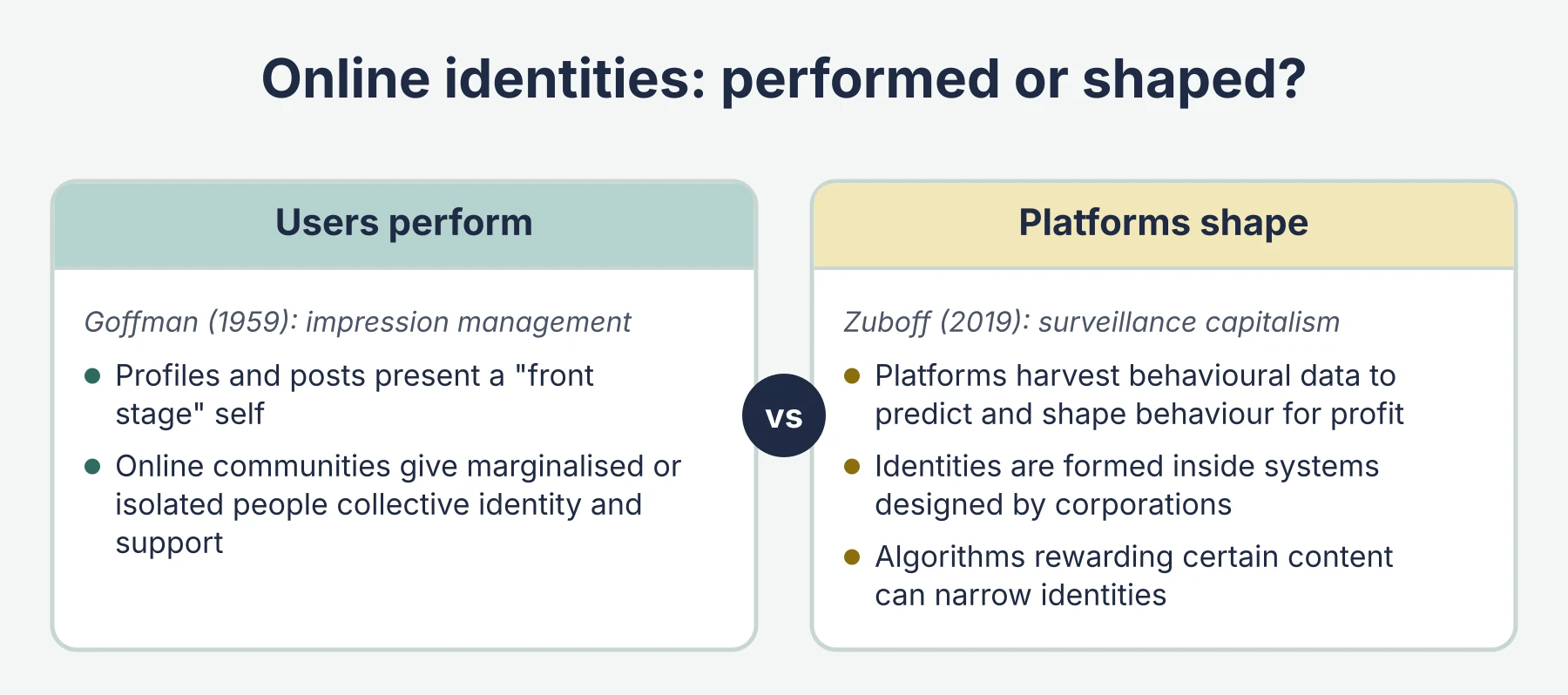
Social media and virtual communities allow people to create and manage identities. Goffman’s dramaturgical idea of impression management in The Presentation of Self in Everyday Life (1959) is often applied to profiles and posts: users perform a “front stage” self. Online communities can give marginalised or isolated people collective identity and support. However, Shoshana Zuboff (The Age of Surveillance Capitalism, 2019) argues platforms harvest behavioural data to predict and shape users’ behaviour for profit, so online identities are formed inside systems designed by corporations. Algorithms that reward certain content can also narrow the identities people present.
Consumption and globalisation
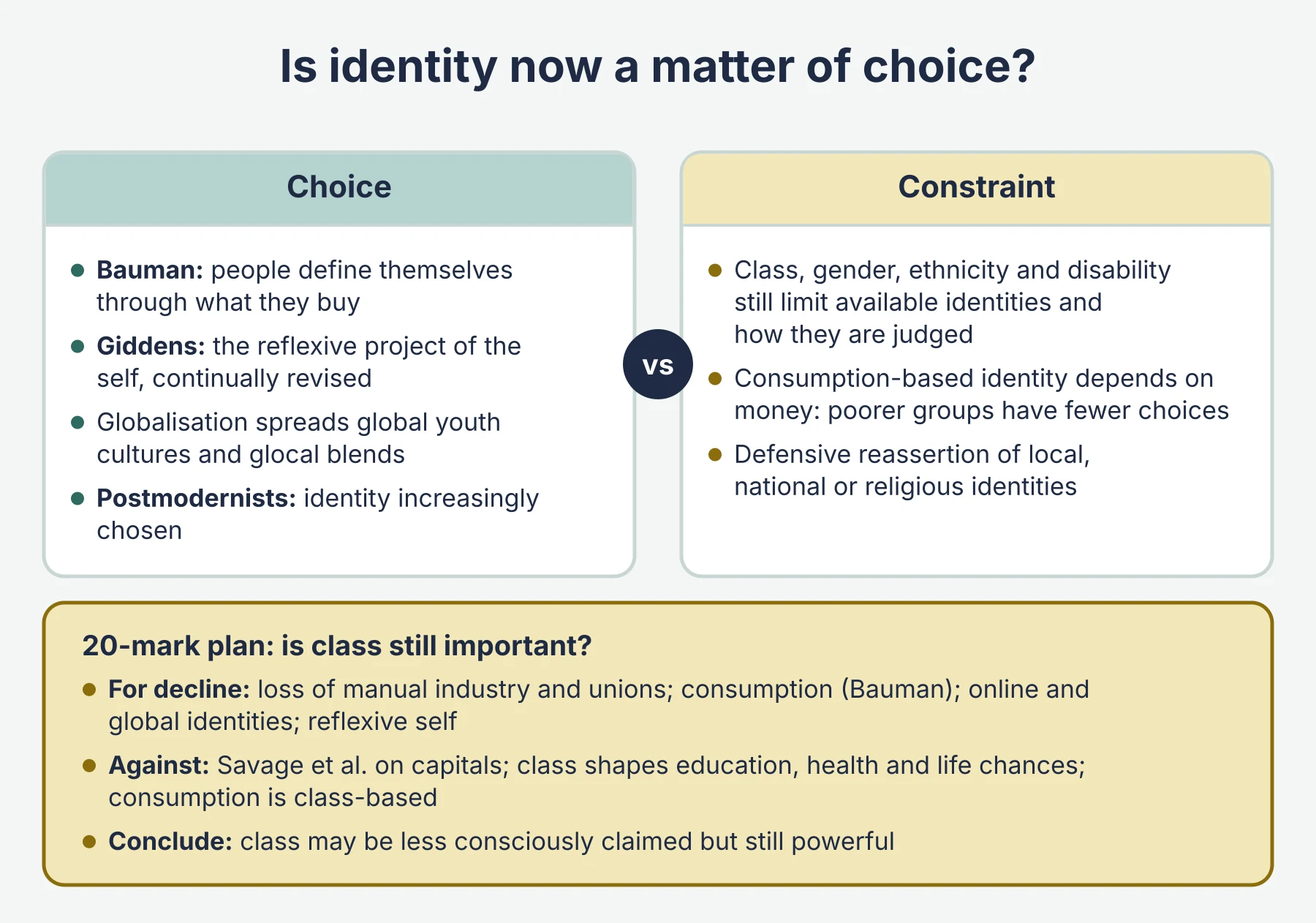
Rising consumption allows people to express identity through brands, music, fashion and leisure. Zygmunt Bauman argued that in consumer societies people increasingly define themselves through what they buy, while Anthony Giddens described the reflexive project of the self: in late modernity individuals continually construct and revise their self-identity. Globalisation spreads images and products across borders, producing global youth cultures, but also glocal blends and defensive reassertions of local, national or religious identities.
Evaluation. Postmodernists see identity as increasingly a matter of choice; structural sociologists reply that class, gender, ethnicity and disability still constrain which identities are available and how they are judged. Consumption-based identity depends on money, so poorer groups have fewer choices.
Worked example: annotated 20-mark plan
Using examples from a society you know, evaluate the view that social class is no longer an important source of identity.
- For: decline of manual industry and trade unions weakens traditional working-class identity; consumption and lifestyle (Bauman) replace class; online and global identities cut across class; Giddens’ reflexive self suggests choice.
- Against: Savage and colleagues show class reworked through economic, cultural and social capital; class still shapes education, health and life chances; consumption itself is class-based; class identity may be weaker even where class inequality is strong.
- Application: named society, for example growth of a new middle class in a rapidly industrialising economy.
- Conclusion: class may be less consciously claimed but remains powerful in shaping identities.
Common mistakes
- Treating sex and gender as the same thing.
- Confusing race (a social category based on perceived physical difference) with ethnicity (shared culture).
- Mixing up Stanley Cohen and Robin Cohen.
- Describing online identity only positively, without Zuboff’s critique.
- Writing that identities are “chosen” without discussing constraints.
Exam technique
When explaining a basis of identity, cover definition, agency of construction and change. For example, national identity is defined as belonging to a nation-state, constructed through schools (national history, anthems), media (Billig’s banal nationalism) and sport, and changed by migration, dual citizenship and global media. The same three-step pattern works for religion, class, gender or disability. In evaluation questions on change, set postmodern ideas of choice against structural constraints and apply to a named society.
- Social identities and social change revision notes
- Social identities and social change practice questions
- How identities are controlled and stigmatised: social control study guide
Related resources
-
Practice questions
OxfordAQA International A-Level Sociology (9690): Social Identities and Social Change – Practice Questions
Original OxfordAQA 9690 Unit 2 style questions on cohort, disability, nationality, hybrid and online identities, masculinity and class, with mark schemes.
Sociology · OxfordAQA · AS Level
Try questions -
Revision notes
OxfordAQA International A-Level Sociology (9690): Social Identities and Social Change – Revision Notes
Revision notes for OxfordAQA 9690 section 3.1.2.3: bases of identity, Fanon, Goffman, Zuboff, hybrid identities, diasporas, masculinities and consumption.
Sociology · OxfordAQA · AS Level
Revise topic -
Study guides
OxfordAQA International A-Level Sociology (9690): Socialisation
Study guide to OxfordAQA 9690 section 3.1.2.2: primary, secondary and re-socialisation, agencies and their methods, and four perspectives on socialisation.
Sociology · OxfordAQA · AS Level
Read guide
Related articles
Get free revision emails (optional)
Occasional emails with practice questions, worked explanations and links to free resources for the qualification and subjects you choose. No spam, and you can unsubscribe from any email. The free tools on this site never need an email.