
Revision Notes
OxfordAQA International A-Level Sociology (9690): Socialisation – Revision Notes
Revision notes for OxfordAQA 9690 section 3.1.2.2: types of socialisation, six agencies and their methods, and four perspectives including Mead.
- Subject
- Sociology
- Level
- AS LEVEL
- Topic
- Unit 2 – Exploring Sociology
- Author
- Marlbridge Academic Team
- Updated
- Reviewed by
- Naqiya Yousaf (what this means)
Aligned to OxfordAQA A Level Sociology (9690), Version 1.1 (new qualification). Official specification .
Syllabus page (what it covers and how it is assessed): OxfordAQA A Level Sociology.
Syllabus points this page covers
9690 (AS Level)
- 3.1.2.2 Socialisation
Found an error? Report a correction.
Need help with this topic? Request a free trial class for A Level Sociology (9690).
These notes condense 3.1.2.2 Socialisation in OxfordAQA International AS/A level Sociology (9690), Unit 2 Section A. Core idea: culture is learned through primary, secondary and re-socialisation, via six named agencies using identifiable methods; perspectives disagree about whether this creates consensus, ideology, patriarchy or active selves.
Full explanation: socialisation study guide.
Specification checklist
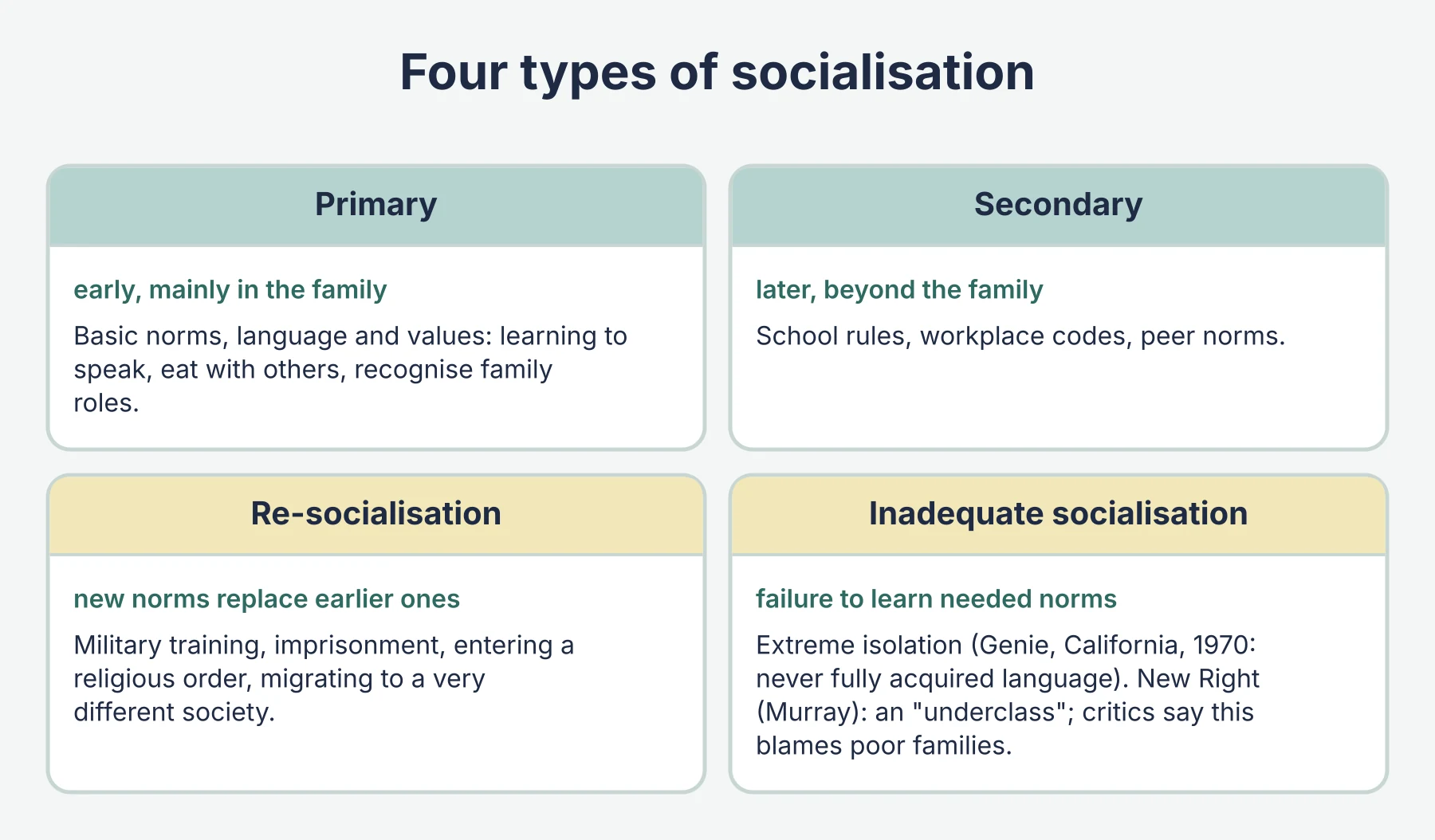
- Primary and secondary socialisation; re-socialisation; inadequate socialisation.
- Agencies: families; schools; peers; media; religions; workplace.
- Processes/methods used by these agencies.
- Perspectives: functionalist; Marxist; feminist; social action/interactionist.
- Named sociologist most relevant: Mead.
Key terms
| Term | Definition |
|---|---|
| Socialisation | Lifelong learning of the culture of a society |
| Primary socialisation | Early learning, mainly in the family |
| Secondary socialisation | Later learning from agencies beyond the family |
| Re-socialisation | Learning new norms that replace earlier ones |
| Inadequate socialisation | Failure to learn the norms needed for social life |
| Anticipatory socialisation | Preparing for a role before entering it |
| Canalisation | Channelling children towards gender-typed toys and activities (Oakley) |
| Manipulation | Encouraging or discouraging behaviour according to sex (Oakley) |
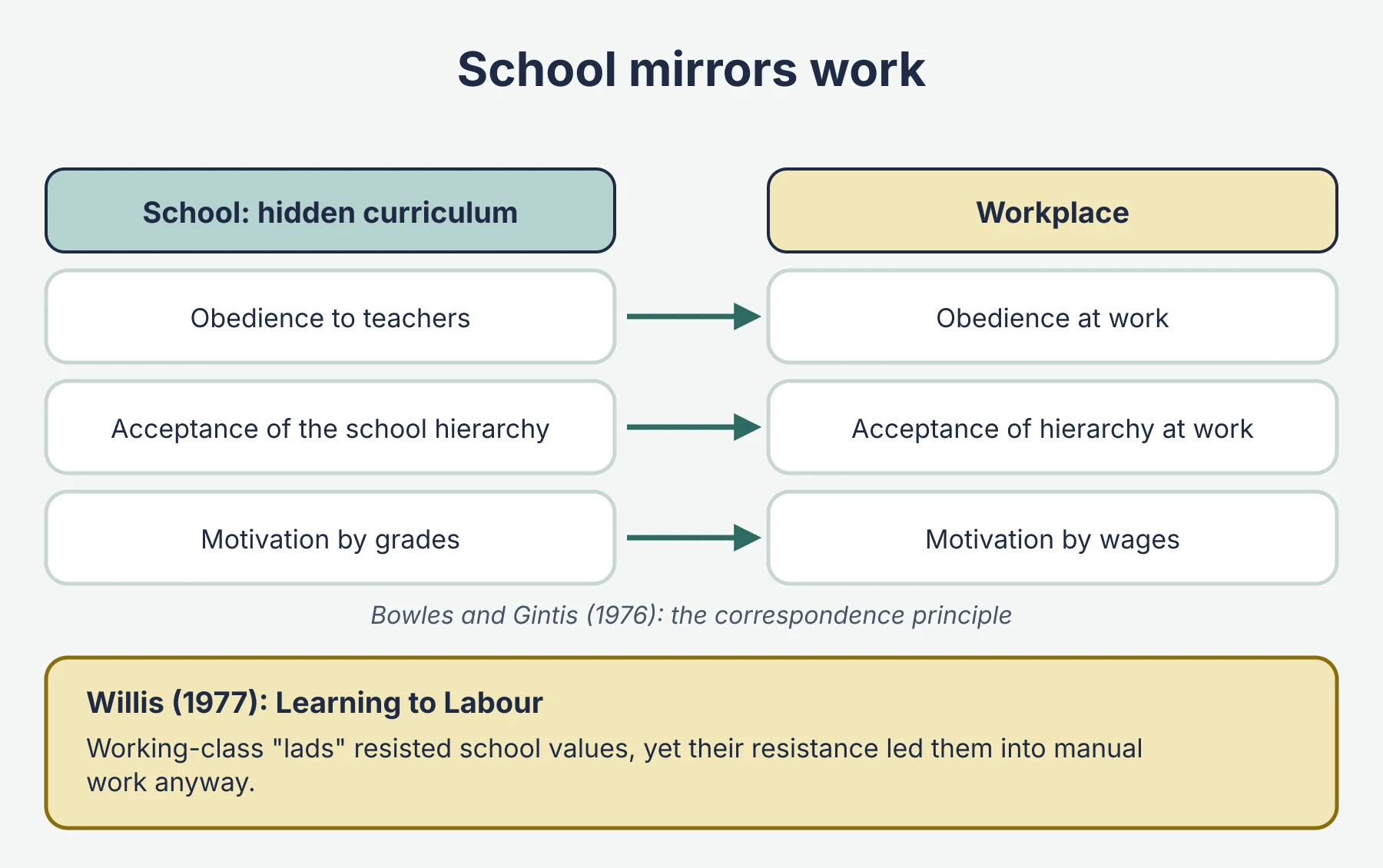
| Hidden curriculum | Norms and values taught through how school is organised |
| Correspondence principle | School mirrors the workplace (Bowles and Gintis, 1976) |
| Particularistic / universalistic standards | Judged as a unique individual / by the same rules as all (Parsons) |
| Generalised other | The expectations of society as a whole, internalised (Mead) |
| Looking-glass self | Seeing ourselves as we imagine others see us (Cooley, 1902) |
Types of socialisation: examples
- Primary: language, eating habits, early gender roles.
- Secondary: school rules, peer slang, workplace codes.
- Re-socialisation: army basic training, prison, religious orders, migration.
- Inadequate: extreme isolation (the Genie case, found in California in 1970); contested New Right claims about an “underclass” (Charles Murray), criticised for blaming the poor.
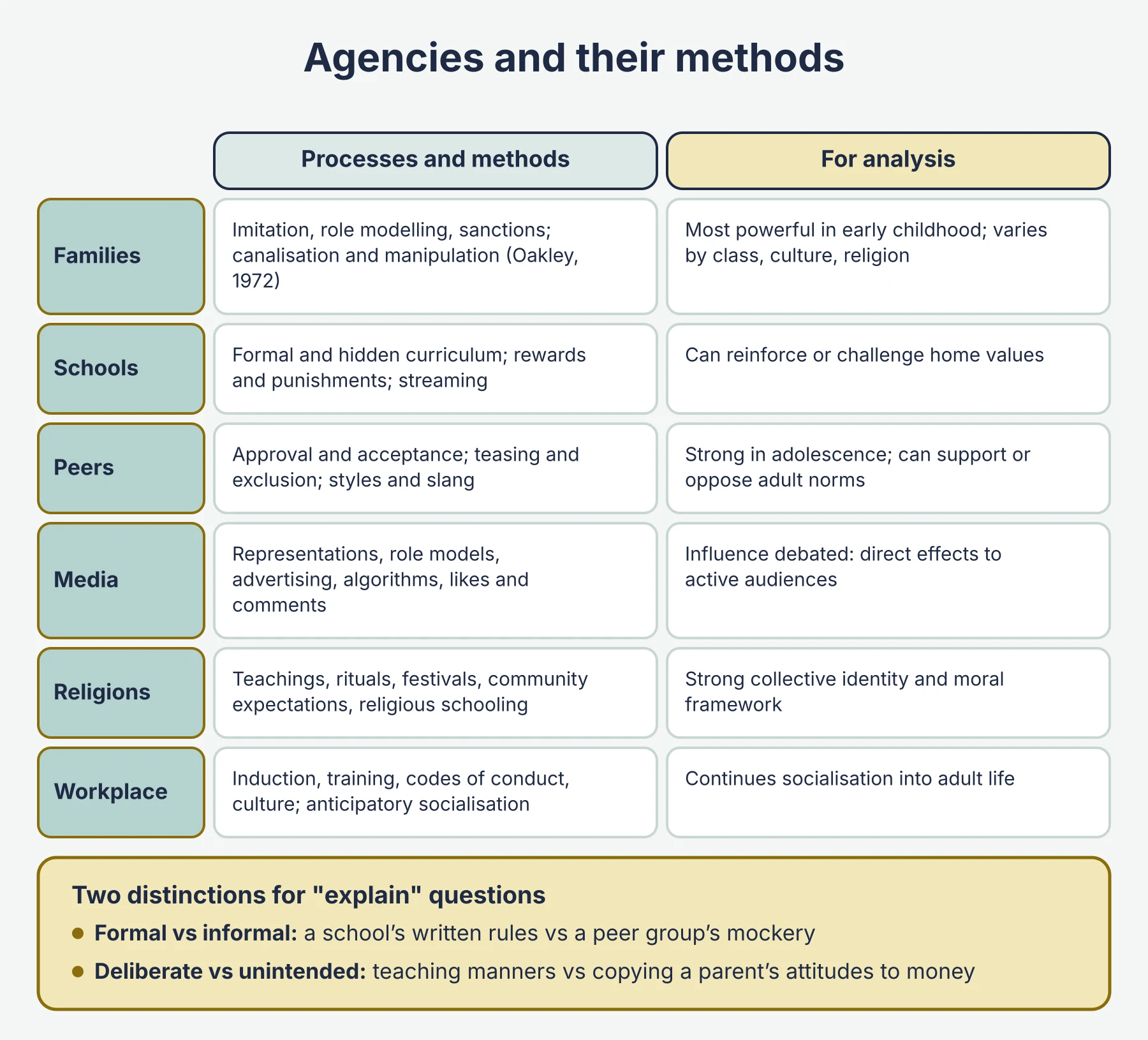
Agencies and methods
| Agency | Methods |
|---|---|
| Families | Imitation, role models, sanctions, canalisation, manipulation |
| Schools | Formal and hidden curriculum, sanctions, streaming, exams |
| Peers | Approval, teasing, exclusion, shared style |
| Media | Representations, role models, advertising, algorithms, online feedback |
| Religions | Teachings, rituals, festivals, community expectations |
| Workplace | Induction, training, codes of conduct, anticipatory socialisation |
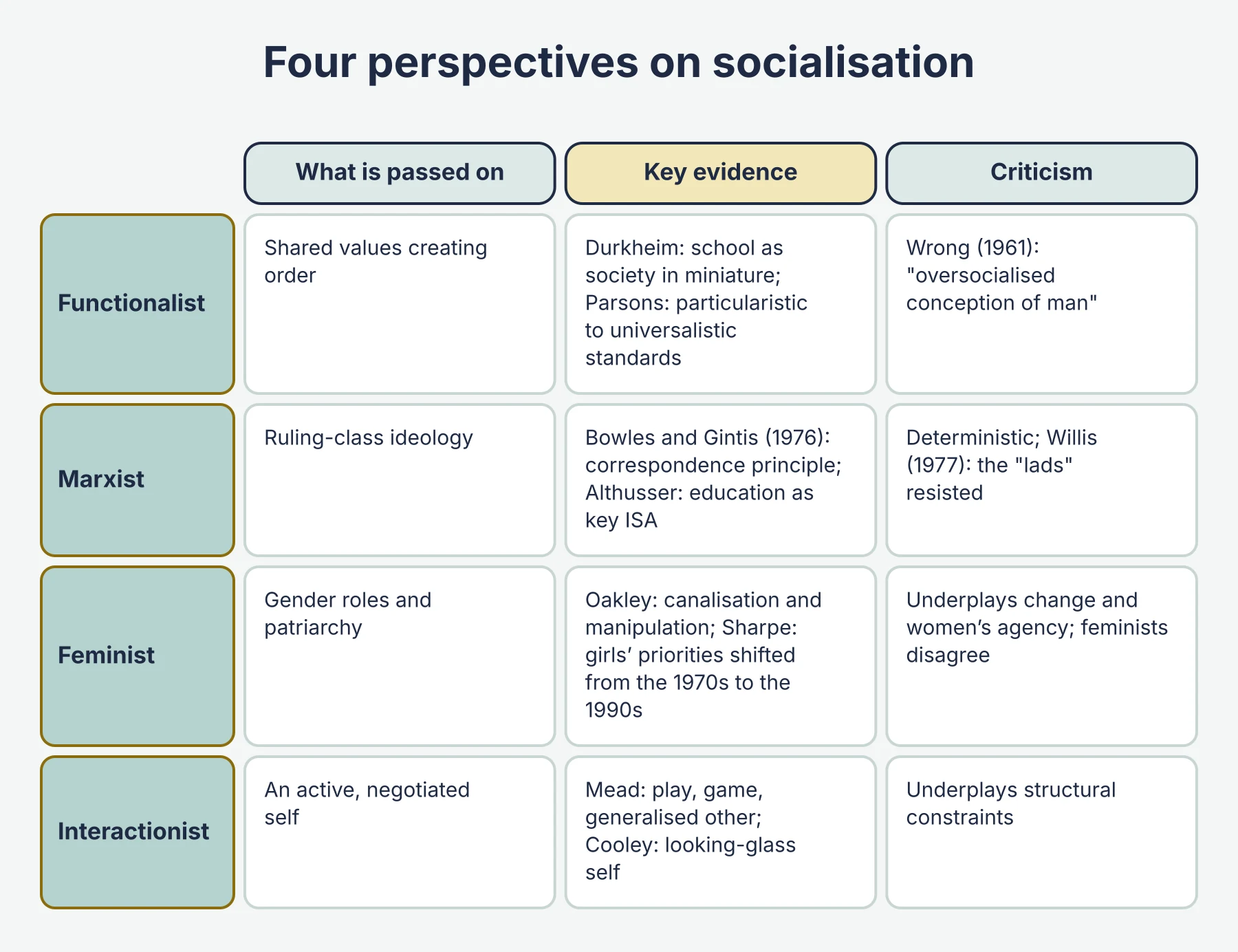
Perspectives compared
| Perspective | Socialisation is… | Evidence | Criticism |
|---|---|---|---|
| Functionalist | Transmission of shared values for order | Durkheim: school as society in miniature; Parsons: families as personality “factories”, universalistic standards | Wrong (1961): “oversocialised” view |
| Marxist | Transmission of ruling-class ideology | Bowles and Gintis (1976): correspondence principle; Althusser: ideological state apparatus | Willis (1977): lads resisted school |
| Feminist | Reproduction of gender roles and patriarchy | Oakley (1972): canalisation and manipulation; Sharpe: girls’ priorities shifted from marriage to careers between the 1970s and 1990s | Underplays change and agency |
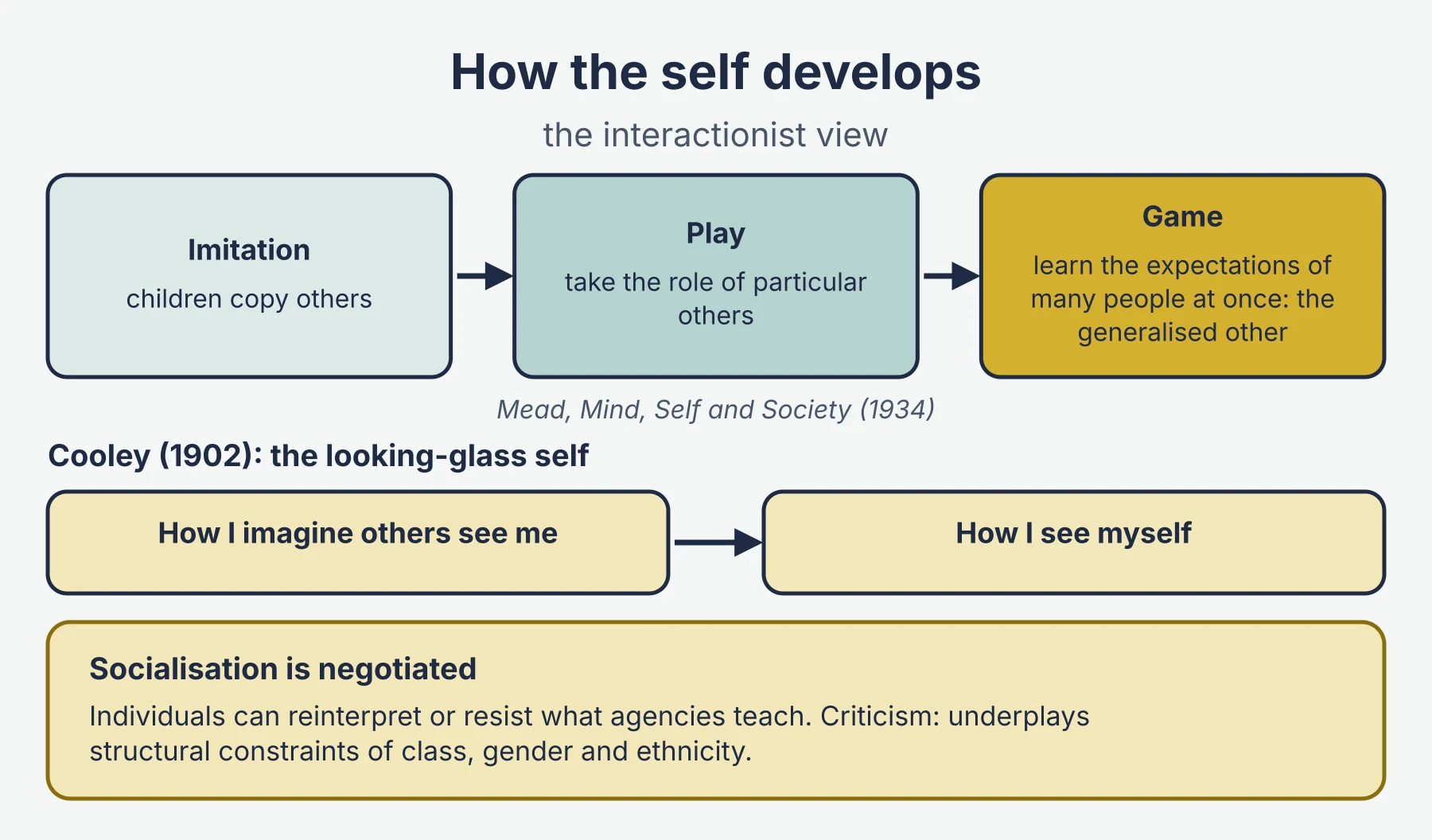
| Interactionist | Active, negotiated development of the self | Mead (1934): imitation, play, game, generalised other; Cooley: looking-glass self | Underplays structure |
Mead’s stages
- Imitation: copying others without understanding.
- Play: taking the role of particular others, such as pretending to be a parent.
- Game: understanding many roles at once and the rules linking them.
- Result: the generalised other, and a self with an “I” (spontaneous) and a “me” (socialised).
Agencies across the life course
| Stage | Dominant agencies | What is mainly learned |
|---|---|---|
| Infancy and early childhood | Family, religion (in many societies) | Language, basic norms, early gender roles, faith identity |
| School years | School, peers, media | Rules, achievement, peer norms, consumer and online identities |
| Adolescence | Peers, media | Style, slang, independence from parents, body ideals |
| Adulthood | Workplace, media, religion, new family roles | Occupational norms, parenting, civic and moral roles |
| Later life | Family, religion, community, care institutions | Retirement, grandparent roles, sometimes re-socialisation into care homes |
Use this table to answer “most important agency” questions: importance depends on life stage and on the society, not on one agency alone.
Exam traps
- Re-socialisation confused with secondary socialisation.
- Agencies listed without methods.
- Feminist view given without a named method such as canalisation.
- Mead’s ideas given with no stages.
- Examples only from one society.
Evaluation lines to reuse
- “Willis’s lads show socialisation can be resisted, though their resistance still reproduced class position.”
- “Primary socialisation lays foundations, but media and peers increasingly compete with families in adolescence.”
- “Sharpe’s comparison across two decades shows gender socialisation is not fixed.”
Self-test
- Define secondary socialisation.
- Give two examples of re-socialisation.
- What does the case of Genie suggest?
- What are canalisation and manipulation?
- What is the hidden curriculum?
- State the correspondence principle.
- What did Parsons mean by universalistic standards?
- Name Mead’s three stages.
- What is the looking-glass self?
- What did Wrong criticise?
- How did Willis’s lads respond to school?
- Give one method of workplace socialisation.
Answers
- Later learning from agencies beyond the family, such as schools, peers, media and work.
- Army training; imprisonment; entering a religious order; migration.
- That language and much “human” behaviour must be learned through interaction.
- Channelling children to gendered toys; encouraging or discouraging behaviour by sex (Oakley).
- Norms and values learned through how school is organised, not the formal lessons.
- School relationships mirror workplace relationships, preparing a compliant workforce.
- Being judged by the same rules as everyone else, as in school and work.
- Imitation, play and game.
- Seeing ourselves as we imagine others see us (Cooley).
- The functionalist “oversocialised” view of people as passive.
- They rejected school values but this led them into manual jobs.
- Induction, training or codes of conduct.
Practise next: socialisation practice questions | Exploring Sociology study guide
Related resources
-
Practice questions
OxfordAQA A-Level Sociology: Exploring Sociology — Practice Questions
Original 60-mark Unit 2 practice paper for OxfordAQA International A-level Sociology (9690): socialisation and social control, and research methods and theory.
Sociology · OxfordAQA · AS Level
Try questions -
Revision notes
OxfordAQA A-Level Sociology: Exploring Sociology — Revision Notes
OxfordAQA A-level Sociology (9690) Unit 2 recall notes: agencies of socialisation, formal and informal control, and positivist vs interpretivist methods.
Sociology · OxfordAQA · AS Level
Revise topic -
Study guides
OxfordAQA International A-Level Sociology: Exploring Sociology (9690)
Study guide to Unit 2 Exploring Sociology in OxfordAQA International A-level Sociology 9690: socialisation, social control, crime and research methods.
Sociology · OxfordAQA · AS Level
Read guide
Related articles
Get free revision emails (optional)
Occasional emails with practice questions, worked explanations and links to free resources for the qualification and subjects you choose. No spam, and you can unsubscribe from any email. The free tools on this site never need an email.