
Study Guides
OxfordAQA International A-Level Sociology (9690): Socialisation
Study guide to OxfordAQA 9690 section 3.1.2.2: primary, secondary and re-socialisation, agencies and their methods, and four perspectives on socialisation.
- Subject
- Sociology
- Level
- AS LEVEL
- Topic
- Unit 2 – Exploring Sociology
- Author
- Marlbridge Academic Team
- Updated
- Reviewed by
- Naqiya Yousaf (what this means)
Aligned to OxfordAQA A Level Sociology (9690), Version 1.1 (new qualification). Official specification .
Syllabus page (what it covers and how it is assessed): OxfordAQA A Level Sociology.
Syllabus points this page covers
9690 (AS Level)
- 3.1.2.2 Socialisation
Found an error? Report a correction.
Need help with this topic? Request a free trial class for A Level Sociology (9690).
Section 3.1.2.2 Socialisation in OxfordAQA International AS/A level Sociology (9690) is examined in Unit 2 Section A. The specification lists “Primary and secondary socialisation; re-socialisation; inadequate socialisation”, the agencies (“families; schools; peers; media; religions; workplace”), the “processes/methods used by these agencies”, and “functionalist; Marxist; feminist; social action/interactionist” perspectives. Mead is the named sociologist most closely tied to it. The unit overview is in the Exploring Sociology study guide.
Socialisation is the lifelong process by which people learn the culture of their society (3.1.2.1) and come to see themselves as particular kinds of person (3.1.2.3). The key exam skill is connecting an agency to a method and then to a perspective’s interpretation.
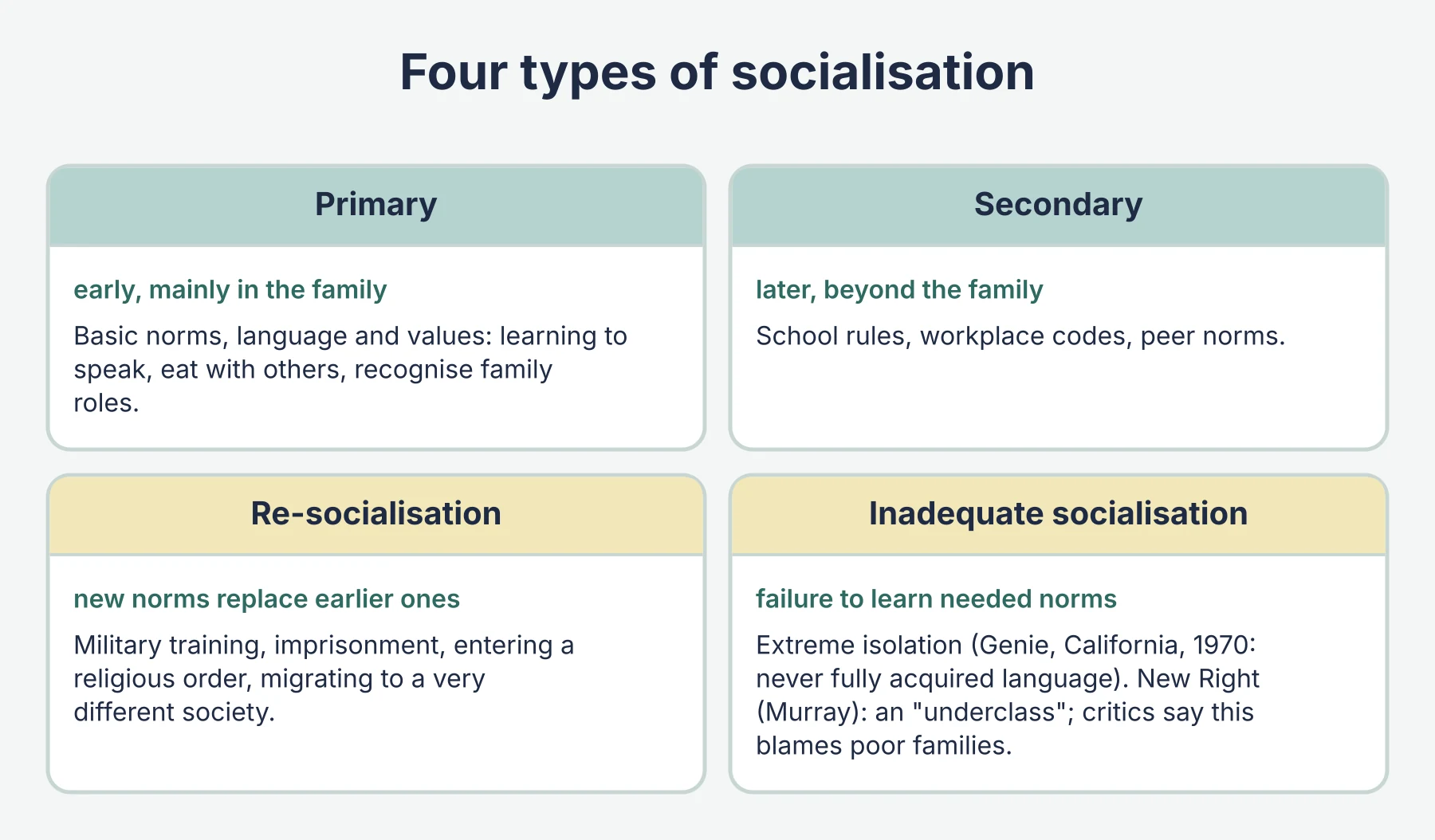
Four types of socialisation
| Type | Meaning | Example |
|---|---|---|
| Primary | Early learning of basic norms, language and values, mainly in the family | Learning to speak, eat with others and recognise family roles |
| Secondary | Later learning from agencies beyond the family | Learning school rules, workplace codes or peer norms |
| Re-socialisation | Learning new norms that replace earlier ones | Military training, imprisonment, entering a religious order, migrating to a very different society |
| Inadequate socialisation | Failure to learn the norms needed to take part in society | Children kept in extreme isolation, or, in some accounts, children whose families fail to pass on mainstream norms |
Inadequate socialisation is shown most dramatically by cases of extreme isolation. The case known as Genie, a girl found in California in 1970 after years of severe isolation and neglect, is often cited: despite later care she never fully acquired language. Such cases suggest that much of what seems “human nature” is learned. Sociologists also use the idea more controversially: some New Right writers, such as Charles Murray, linked crime and welfare dependency to an “underclass” whose children were said to be inadequately socialised. Critics reply that this blames poor families for structural problems.
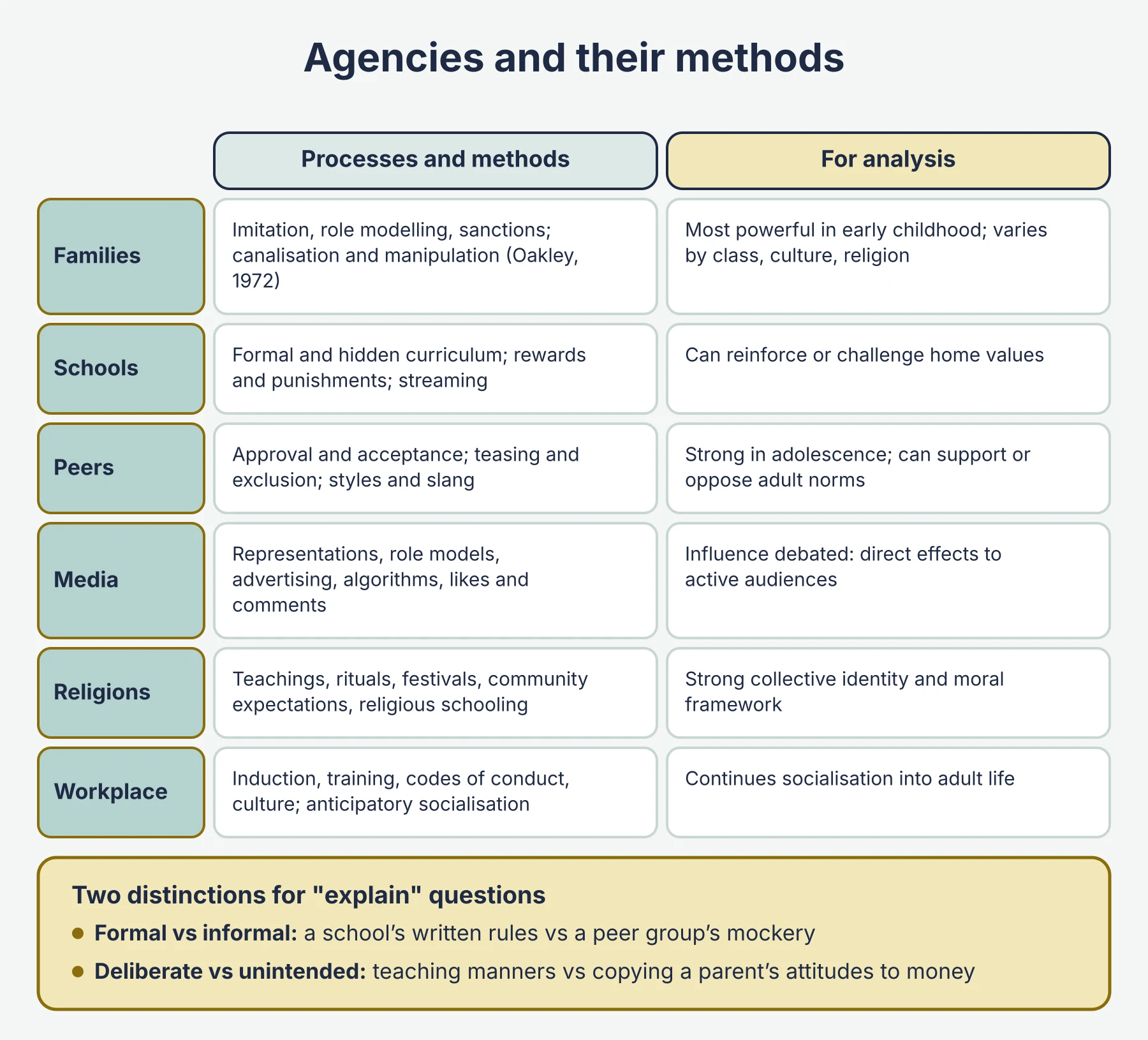
Agencies and their processes
| Agency | Processes and methods | Notes for analysis |
|---|---|---|
| Families | Imitation; role modelling; positive and negative sanctions; canalisation (channelling children towards gender-typed toys and activities) and manipulation (encouraging or discouraging behaviour by sex), as described by Ann Oakley (1972) | The most powerful agency in early childhood; content varies by class, culture and religion |
| Schools | Formal curriculum; hidden curriculum (lessons learned from how schools are organised, such as punctuality and obedience); rewards and punishments; streaming | Transmits both knowledge and values; can reinforce or challenge home values |
| Peers | Approval and acceptance; teasing and exclusion; shared styles and slang | Strong in adolescence; can support or oppose adult norms |
| Media | Representations and role models; advertising; algorithms that select content; online likes and comments | Influence debated: from direct effects to active audiences |
| Religions | Teachings and sacred texts; rituals and festivals; community expectations; religious schooling | Can give a strong collective identity and moral framework |
| Workplace | Induction and training; codes of conduct; organisational culture; anticipatory socialisation (preparing for a role before entering it) | Continues socialisation into adult life |
Two distinctions help in explain questions:
- Formal vs informal methods: a school’s written rules are formal; a peer group’s mockery is informal.
- Deliberate vs unintended: a parent teaching manners is deliberate; a child copying a parent’s attitudes to money is unintended.
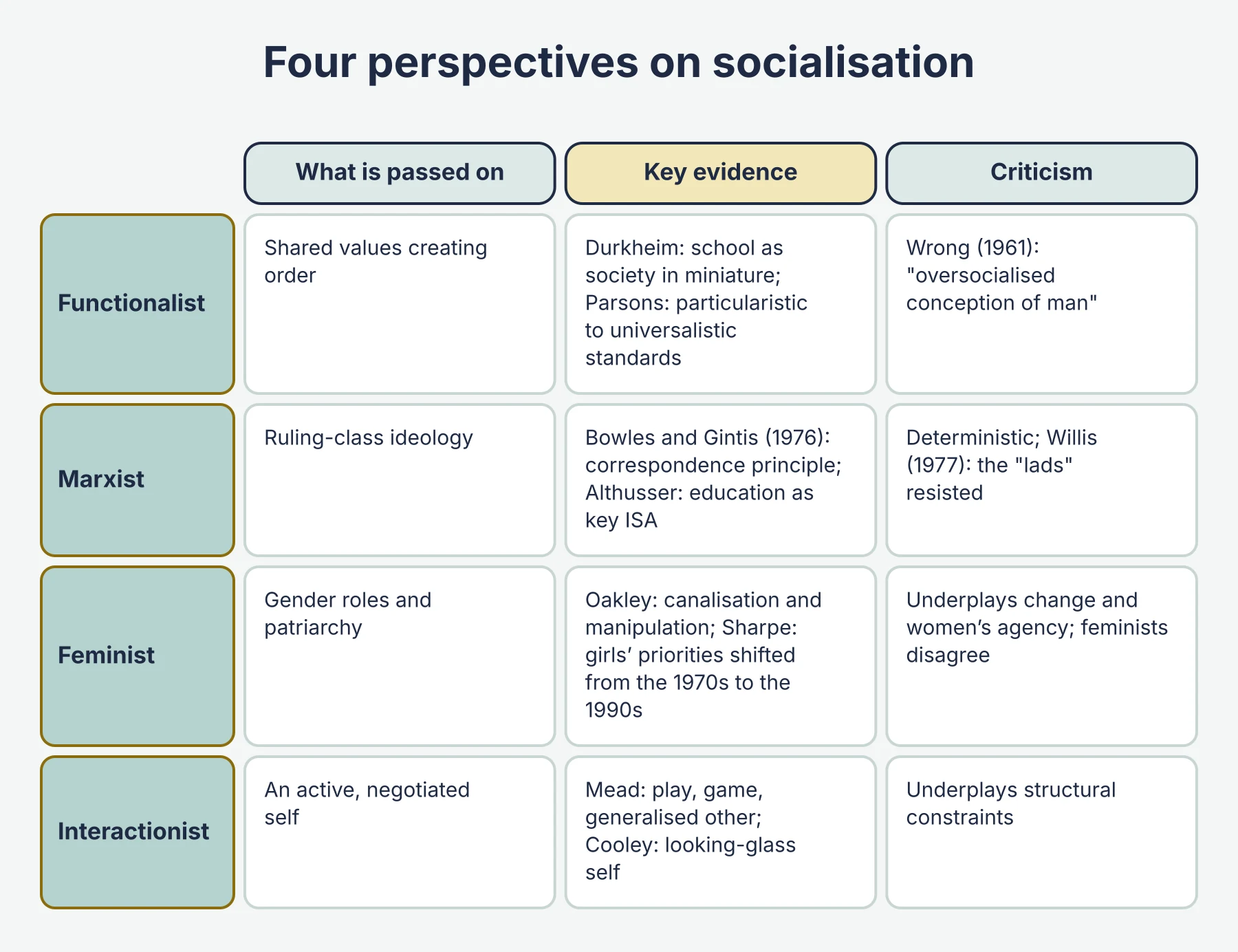
Perspectives on socialisation
Functionalist
Functionalists see socialisation as the transmission of shared values, creating order and consensus. Émile Durkheim saw education as passing on the society’s collective values and described the school as a society in miniature. Talcott Parsons argued families are “factories” producing personalities committed to society’s values, and that schools move children from the particularistic standards of family life (treated as a unique individual) to the universalistic standards of wider society (judged by the same rules as everyone).
Criticism: assumes values are shared by all and that people absorb them passively; Dennis Wrong (1961) called this an “oversocialised conception of man”.
Marxist
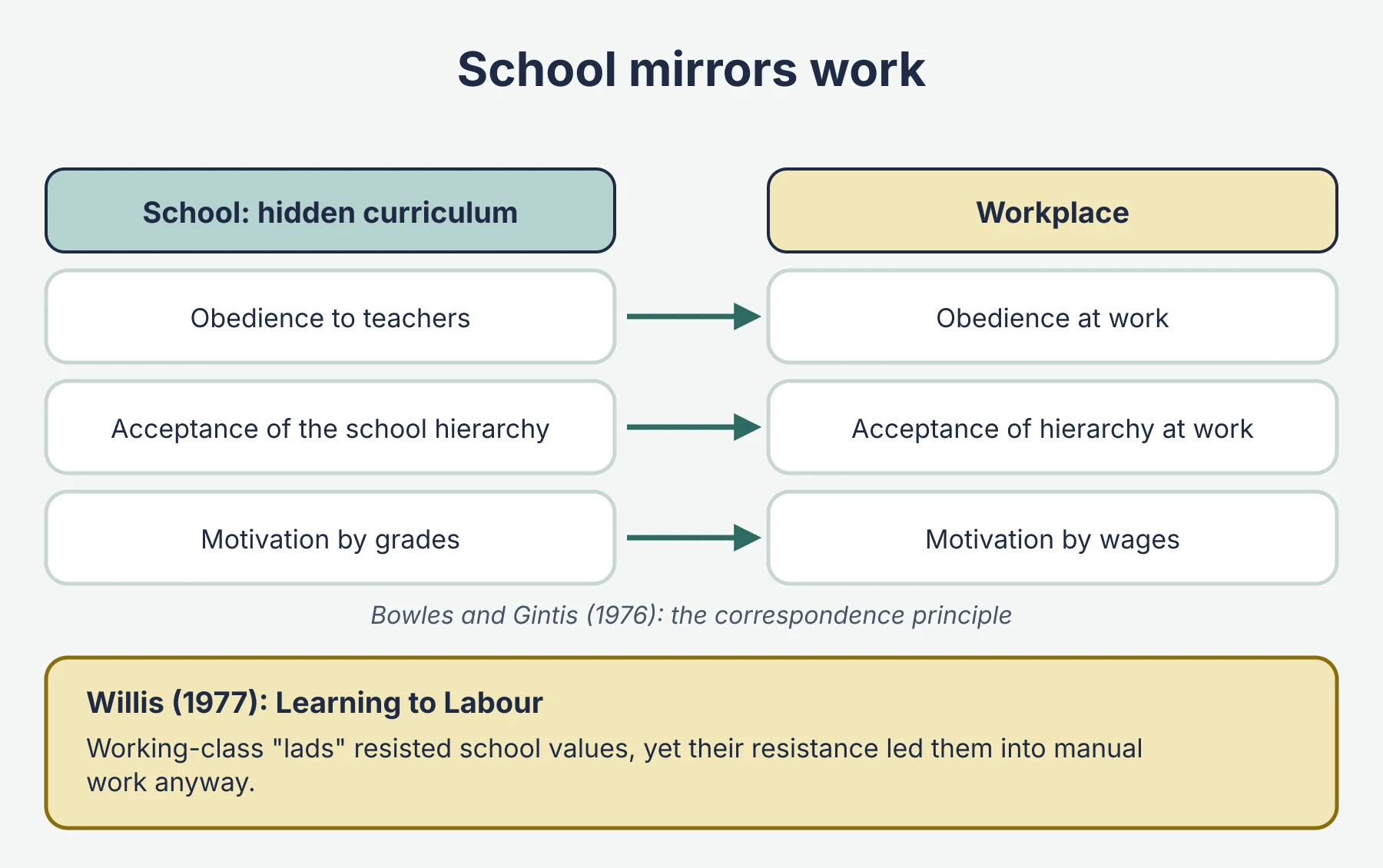
Marxists see socialisation as passing on ruling-class ideology, so that inequality appears natural and workers accept exploitation. Samuel Bowles and Herbert Gintis (Schooling in Capitalist America, 1976) argued for a correspondence principle: the hidden curriculum of schools mirrors the workplace, teaching obedience, acceptance of hierarchy and motivation by external rewards such as grades, as wages are later. Louis Althusser saw education as the key ideological state apparatus. Media ownership by wealthy elites is used to argue that mass media also spread dominant ideas.
Criticism: deterministic; Paul Willis’s Learning to Labour (1977) showed working-class “lads” resisting school values, though their resistance led them into manual work anyway.
Feminist
Feminists see socialisation as reproducing gender roles and patriarchy. Oakley’s canalisation and manipulation describe how families create gendered behaviour. Sue Sharpe’s study of girls’ priorities (Just Like a Girl, first published 1976) found girls in the 1970s ranked love, marriage and children highly, while those she interviewed in the 1990s gave careers more importance, showing that gender socialisation changes. Feminists also study gendered media representations and school subject choices.
Criticism: may underplay change and the agency of girls and women; liberal, radical and intersectional feminists disagree about how deep the problem goes.
Social action / interactionist
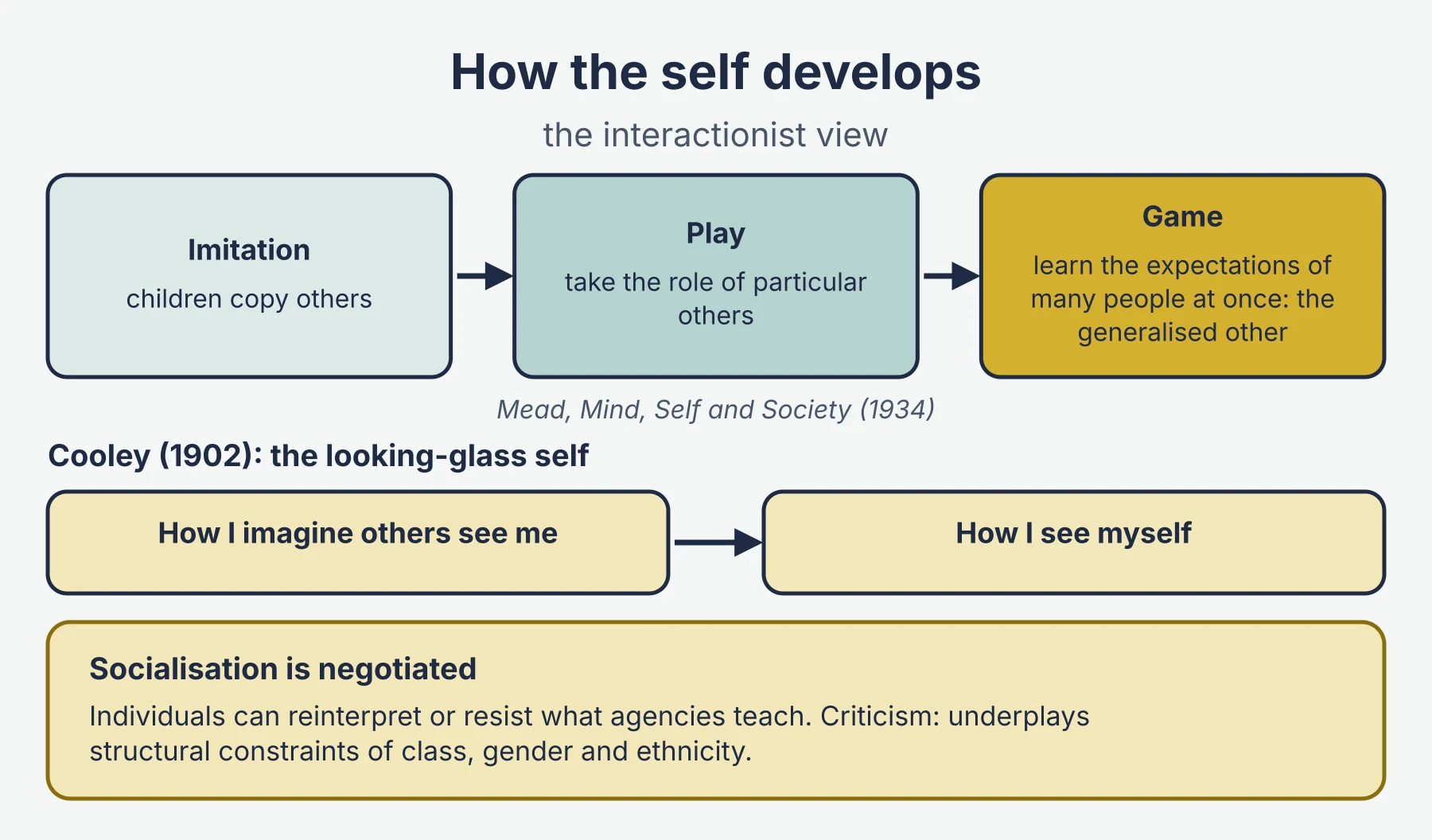
Interactionists see socialisation as active. George Herbert Mead (Mind, Self and Society, 1934) argued the self develops through interaction: children first imitate, then in play take the role of particular others, then in games learn the expectations of many people at once, the generalised other. Charles Horton Cooley’s looking-glass self (1902) describes how we see ourselves through how we imagine others see us. Socialisation is therefore negotiated, and individuals can reinterpret or resist what agencies teach.
Criticism: can underplay structural constraints of class, gender and ethnicity on how far individuals can reinterpret norms.
Worked example: annotated 8-mark answer
Explain two ways in which schools act as agencies of secondary socialisation.
The hidden curriculum. Schools teach norms through how they are organised, such as bells, uniforms and respect for teachers’ authority (method). Bowles and Gintis argued this hidden curriculum prepares pupils to accept hierarchy at work, so schools socialise future workers (perspective and consequence).
Universalistic standards. In school, pupils are judged by the same rules and exams as everyone else, unlike at home (method). Parsons argued this bridges family and wider society, teaching achievement and fairness, which functionalists see as essential for a meritocratic society (perspective and consequence).
Common mistakes
- Confusing re-socialisation with secondary socialisation.
- Listing agencies without the processes/methods they use, which the specification names.
- Writing only about Western societies: religion and extended kin may be stronger agencies elsewhere.
- Presenting perspectives in sequence without comparing them.
- Treating media effects as simple and direct.
Exam technique
For 4-mark questions, name a method and say what is learned. For 8-mark questions, add a named sociologist or perspective and a consequence. In 20-mark questions such as “evaluate the view that the family is the most important agency of socialisation”, weigh agencies against each other across the life course and apply to a named society.
- Socialisation revision notes
- Socialisation practice questions
- How socialisation creates identity: social identities and social change study guide
Related resources
-
Practice questions
OxfordAQA International A-Level Sociology (9690): Socialisation – Practice Questions
Original OxfordAQA 9690 Unit 2 style questions on types and agencies of socialisation, their methods and four perspectives, with full mark schemes.
Sociology · OxfordAQA · AS Level
Try questions -
Revision notes
OxfordAQA International A-Level Sociology (9690): Socialisation – Revision Notes
Revision notes for OxfordAQA 9690 section 3.1.2.2: types of socialisation, six agencies and their methods, and four perspectives including Mead.
Sociology · OxfordAQA · AS Level
Revise topic -
Practice questions
OxfordAQA A-Level Sociology: Exploring Sociology — Practice Questions
Original 60-mark Unit 2 practice paper for OxfordAQA International A-level Sociology (9690): socialisation and social control, and research methods and theory.
Sociology · OxfordAQA · AS Level
Try questions
Related articles
Get free revision emails (optional)
Occasional emails with practice questions, worked explanations and links to free resources for the qualification and subjects you choose. No spam, and you can unsubscribe from any email. The free tools on this site never need an email.