
Revision Notes
OxfordAQA International A-Level Sociology (9690): Individuals and Society – Revision Notes
Revision notes for OxfordAQA 9690 section 3.1.2.1: culture, folkways and mores, ascribed and achieved status, stereotypes, subcultures and Mills.
- Subject
- Sociology
- Level
- AS LEVEL
- Topic
- Unit 2 – Exploring Sociology
- Author
- Marlbridge Academic Team
- Updated
- Reviewed by
- Naqiya Yousaf (what this means)
Aligned to OxfordAQA A Level Sociology (9690), Version 1.1 (new qualification). Official specification .
Syllabus page (what it covers and how it is assessed): OxfordAQA A Level Sociology.
Syllabus points this page covers
9690 (AS Level)
- 3.1.2.1 Individuals and society
Found an error? Report a correction.
Need help with this topic? Request a free trial class for A Level Sociology (9690).
These notes condense 3.1.2.1 Individuals and society in OxfordAQA International AS/A level Sociology (9690), Unit 2 Section A. Core idea: individuals live inside cultures made of values, norms, roles and statuses; stereotypes and subcultures show how groups are seen and how they differ; and Mills’s sociological imagination links private lives to public structures.
Full explanation: individuals and society study guide.
Specification checklist
- Culture: norms and values; roles; status; stereotypes.
- Subcultures, including ethnic groups in multicultural societies.
- The sociological imagination (Mills): connecting personal troubles and public issues.
- Named sociologists for 3.1.2 include Mills; others are credited.
Key terms
| Term | Definition |
|---|---|
| Culture | Learned, shared way of life of a group |
| Material / non-material culture | Objects and technology / beliefs, values, norms, language |
| Values | General beliefs about what is good or worthwhile |
| Norms | Specific rules of behaviour that express values |
| Folkways / mores | Mild everyday conventions / norms with strong moral force (Sumner, 1906) |
| Status | A social position |
| Ascribed / achieved status | Fixed at birth / earned (Linton, 1936) |
| Role | Behaviour expected of a status |
| Role conflict | Incompatible demands of two roles |
| Master status | Status that dominates how others see a person |
| Stereotype | Oversimplified, generalised image of a group (Lippmann, 1922) |
| Subculture | Group with some distinct norms and values within a wider culture |
| Multicultural society | Society with several ethnic groups keeping distinct cultures |
| Ethnocentrism | Judging other cultures by the standards of your own |
| Cultural relativism | Understanding a practice within its own cultural context |
| Sociological imagination | Linking biography and history, troubles and issues (Mills, 1959) |
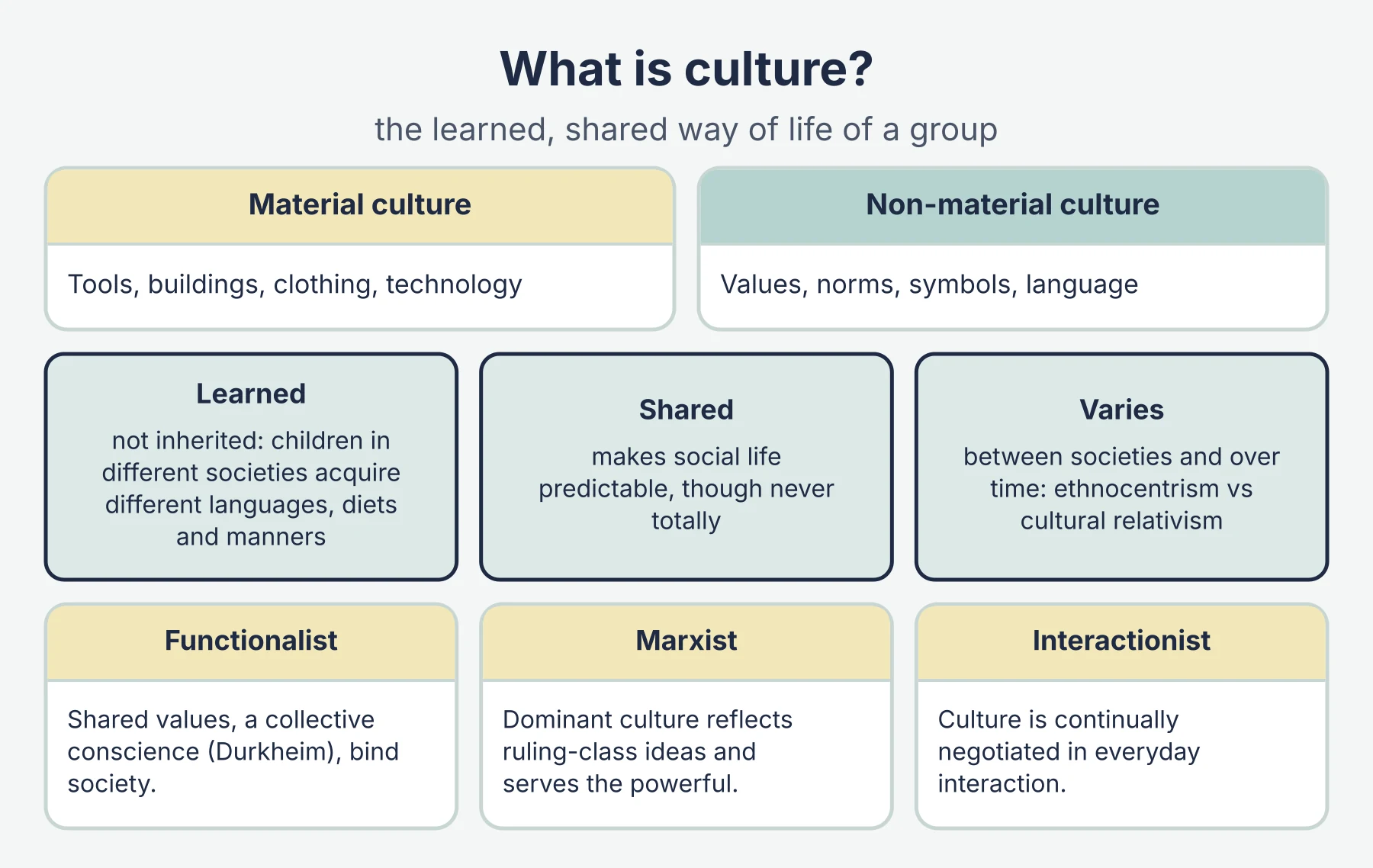
Culture in three points
- Learned: different societies produce different behaviour, so culture is not biological.
- Shared: makes social life predictable; never shared completely.
- Variable: between societies and over time.
| Perspective | View of culture |
|---|---|
| Functionalist | Shared values (Durkheim’s collective conscience) integrate society |
| Marxist | Dominant culture reflects ruling-class ideology |
| Interactionist | Culture negotiated in everyday interaction |
Norms, values, roles and status
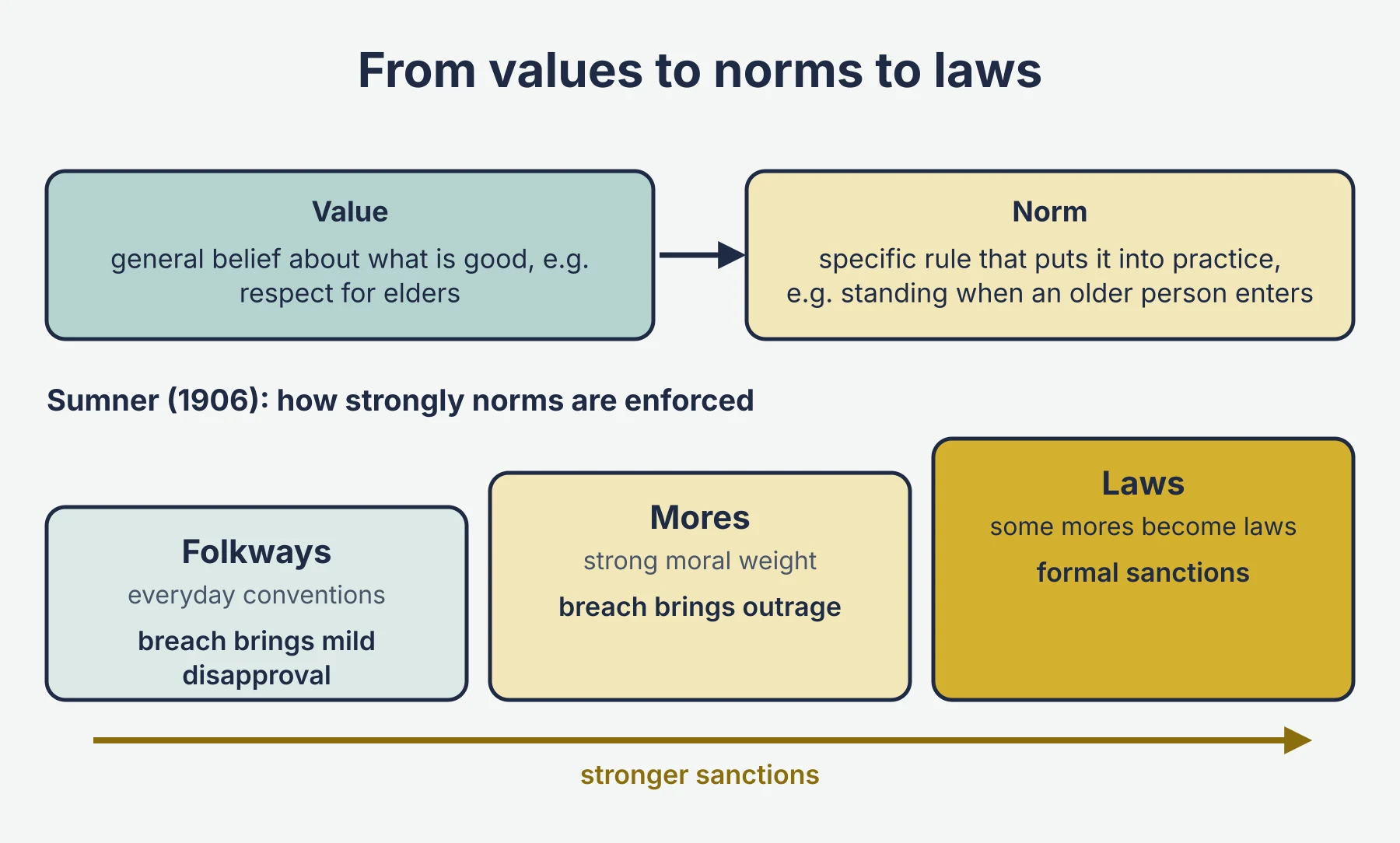
- Value → norm: respect for elders → stand when an older person enters.
- Folkway broken → mild disapproval; more broken → outrage; some mores become laws.
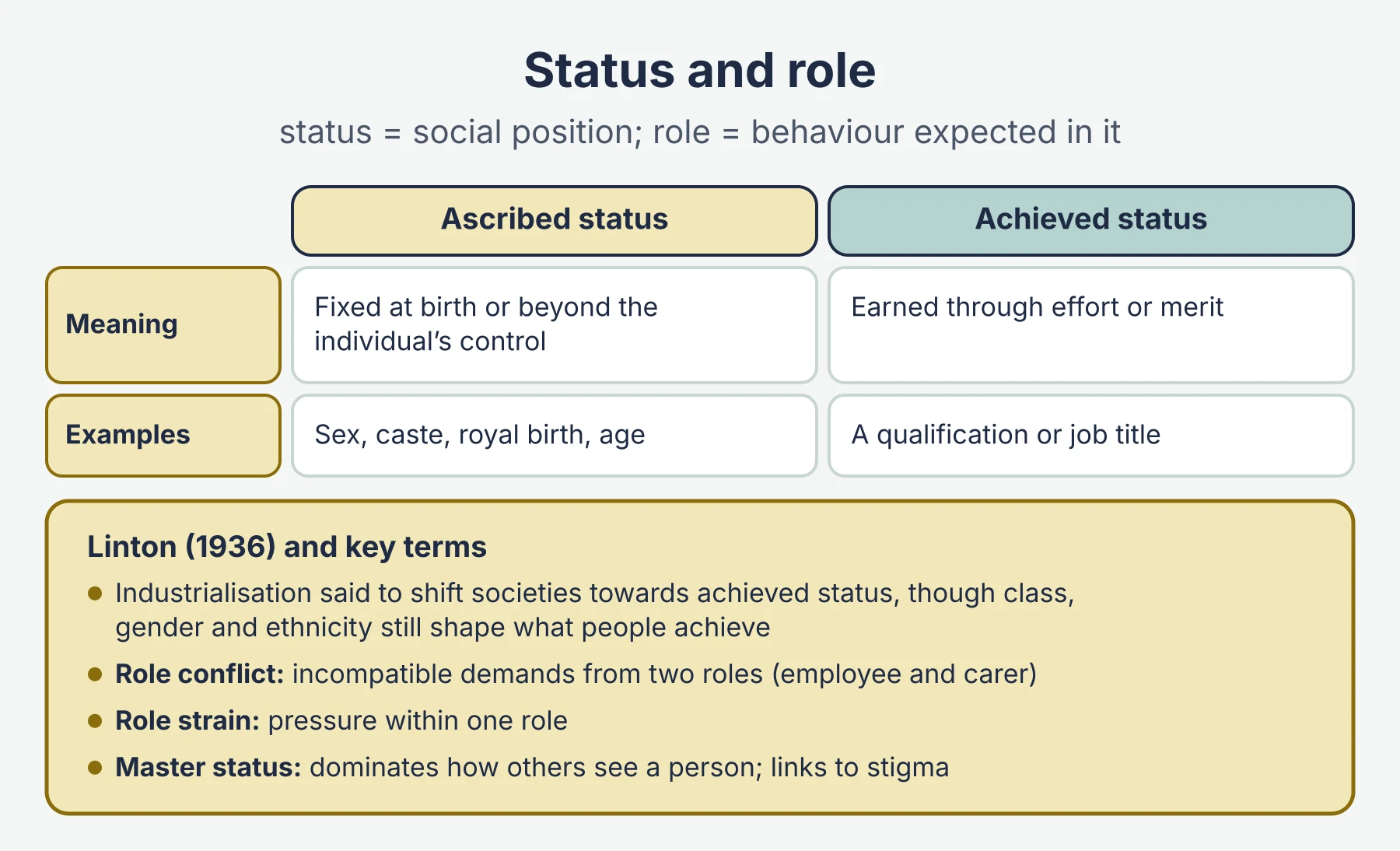
- Ascribed: sex, caste, age, royal birth. Achieved: qualification, occupation.
- Industrial societies are often said to stress achieved status, but class, gender and ethnicity still limit achievement.
- Multiple statuses produce role conflict and role strain.
Stereotypes
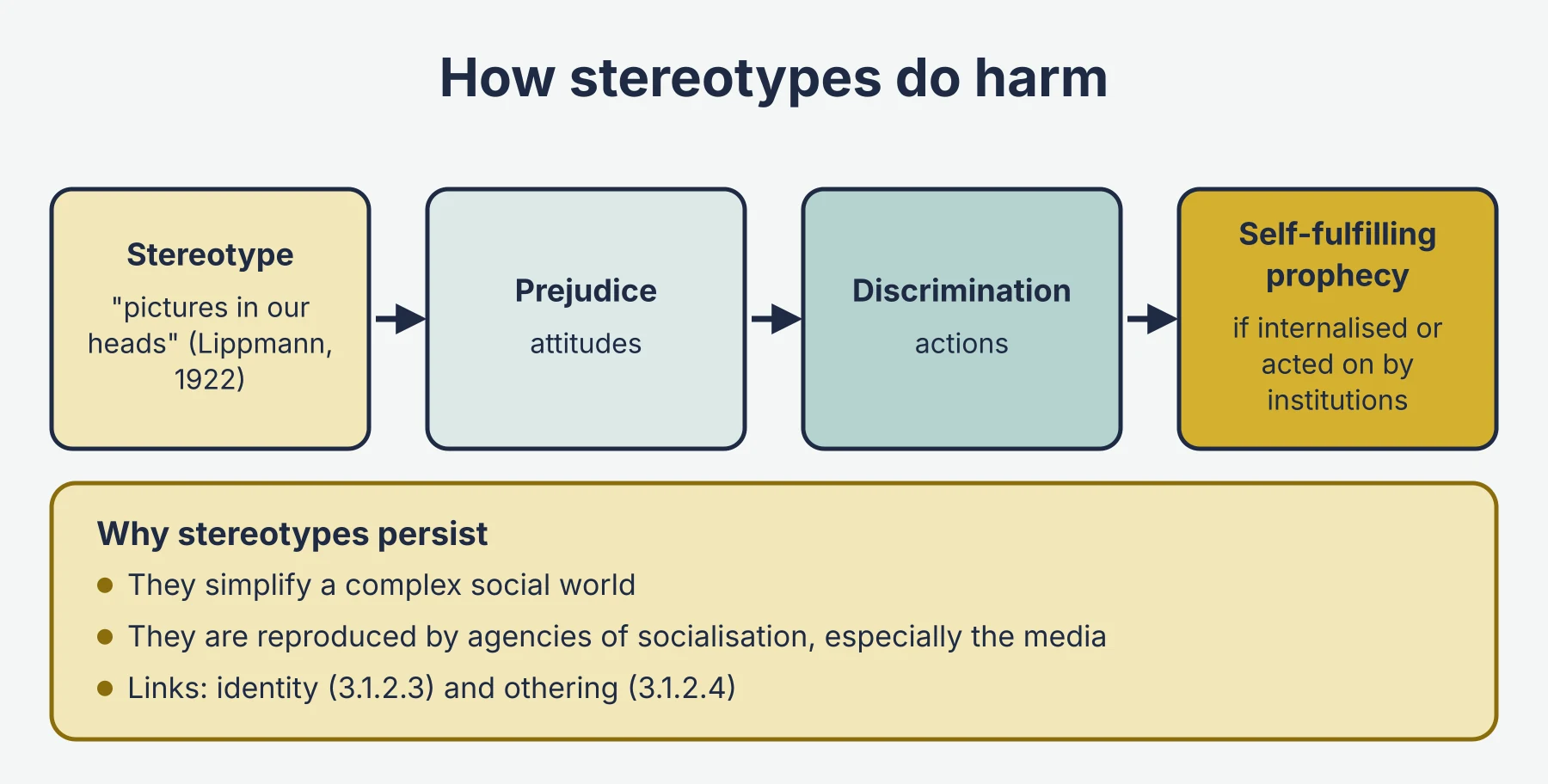
- “Pictures in our heads” (Lippmann).
- Simplify; often negative; justify prejudice and discrimination.
- Can be self-fulfilling.
- Spread by media and other agencies; link to othering (3.1.2.4) and identity (3.1.2.3).
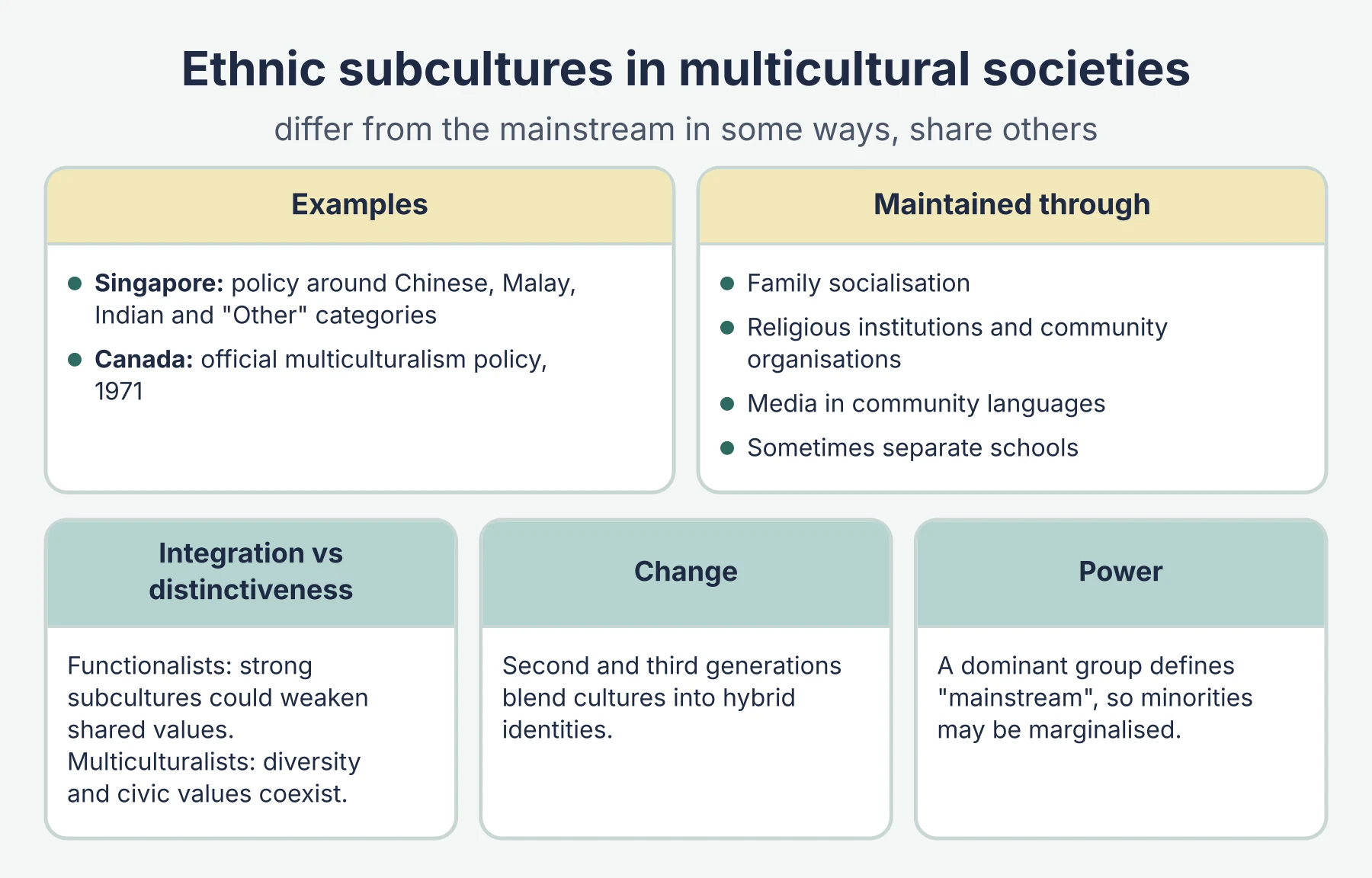
Ethnic subcultures in multicultural societies
- Examples: Singapore’s Chinese, Malay, Indian and “Other” categories; Canada’s multiculturalism policy (1971).
- Maintained by family, religion, community organisations, community-language media, schools.
- Debates: shared values vs distinctiveness; generational blending into hybrid identities; dominant groups define the mainstream.
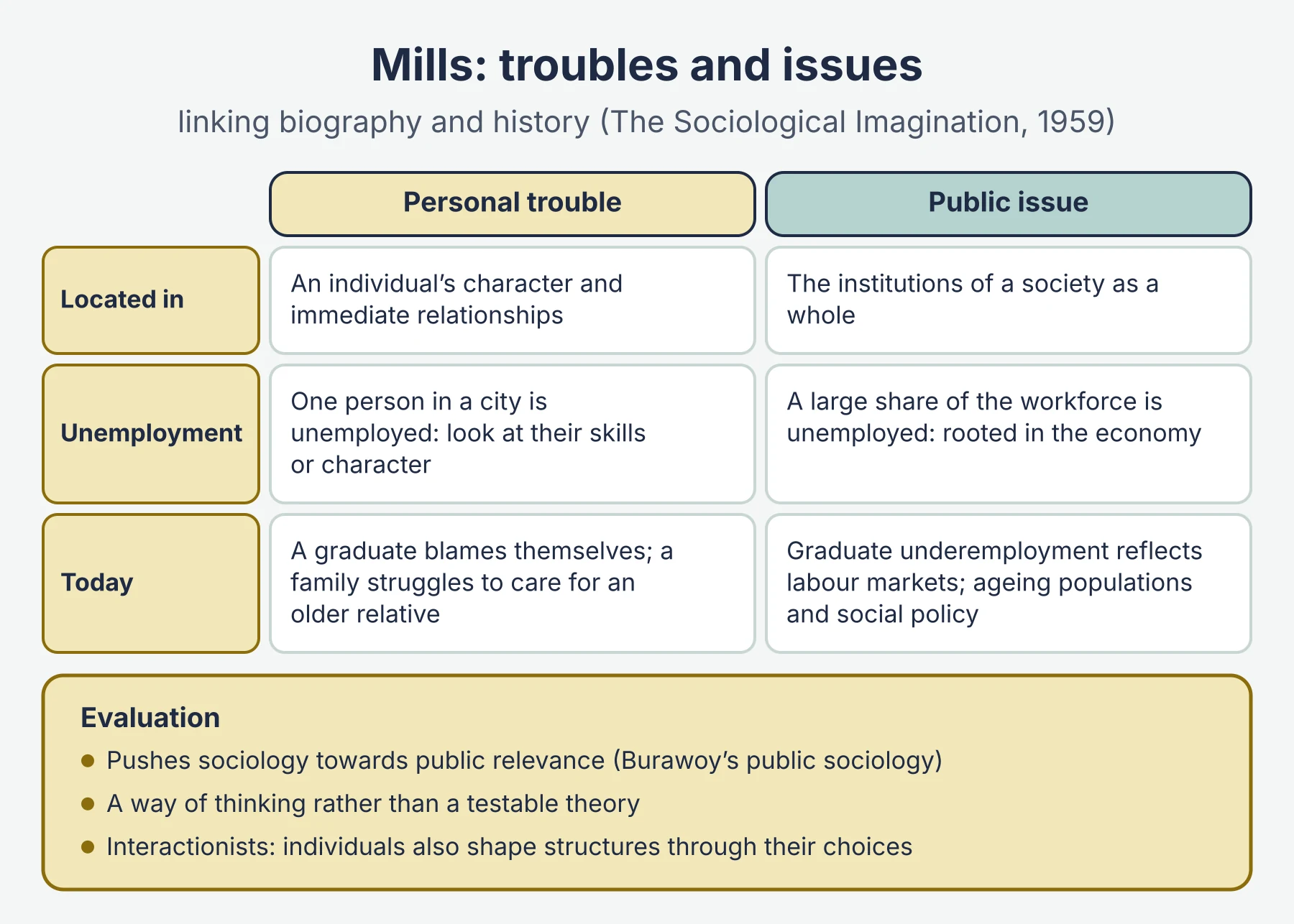
Mills
- Troubles: private, within a person’s own milieu.
- Issues: public, about institutions and structure.
- Example: one unemployed person is a trouble; mass unemployment is an issue.
- Modern applications: graduate underemployment; care for ageing relatives; housing costs.
- Evaluation: a perspective, not a testable theory; underplays agency; but inspires public sociology.
Applying Mills in three steps
- Name the trouble as an individual experiences it, such as a young worker in insecure gig work blaming themselves for low income.
- Widen the lens: how many people share it, and what institutions are involved (labour markets, platform companies, employment law)?
- Locate it in history: what has changed (digital platforms, deregulation) to turn many private troubles into a public issue?
This routine turns a description into the analysis that 8-mark answers reward.
Exam traps
- Norms and values used interchangeably.
- Role and status confused.
- Mills without both “troubles” and “issues”.
- Subcultures discussed with no ethnic or multicultural example.
- No named society in extended answers.
Evaluation lines to reuse
- “Shared values may be exaggerated: in a multicultural society, agreement on civic norms can sit alongside wide variation in family and religious norms.”
- “Achieved status is formally open, but ascribed characteristics still shape achievement.”
- “Mills shows how structure shapes biography, but interactionists stress that people also interpret and resist their circumstances.”
Self-test
- Define culture.
- Give one example each of material and non-material culture.
- What is the difference between a norm and a value?
- Distinguish folkways from mores.
- Who distinguished ascribed and achieved status?
- Give an example of role conflict.
- What is a master status?
- Who popularised the term stereotype, and how did he describe it?
- Name two ways ethnic subcultures are maintained.
- What is cultural relativism?
- Define personal troubles and public issues.
- Give a modern example of a trouble that is also an issue.
Answers
- The learned, shared way of life of a group.
- Material: a mobile phone or building; non-material: a religious belief or language.
- Values are general beliefs; norms are specific rules of behaviour that express them.
- Folkways are mild conventions; mores carry strong moral force.
- Ralph Linton (1936).
- A working parent whose job demands overtime when a child is ill.
- A status that dominates how others see a person.
- Walter Lippmann (1922): “pictures in our heads”.
- Family socialisation, religious institutions, community organisations, community-language media.
- Understanding a practice in its own cultural context rather than judging it by your own.
- Troubles: private problems within a person’s milieu; issues: problems of social structure.
- One graduate unable to find work, set against widespread graduate underemployment.
Practise next: individuals and society practice questions | Exploring Sociology study guide
Related resources
-
Revision notes
OxfordAQA A-Level Sociology (9690): Individuals, Socialisation and Social Identities — Revision Notes
Revision notes for OxfordAQA 9690 sections 3.1.2.1-3.1.2.3: culture, Mills's sociological imagination, socialisation, Mead, Goffman and identities.
Sociology · OxfordAQA · AS Level
Revise topic -
Study guides
OxfordAQA International A-Level Sociology (9690): Research Methods and Theory (Unit 2 Section B)
Study guide to research methods and theory for OxfordAQA 9690 Unit 2 Section B: value freedom, public sociology, structure and agency and the main theories.
Sociology · OxfordAQA · AS Level
Read guide -
Practice questions
OxfordAQA International A-Level Sociology (9690): Research Methods and Theory (Unit 2 Section B) – Practice Questions
Original OxfordAQA 9690 Unit 2 Section B style questions on value freedom, public sociology, structure and agency and the main theories, with answers.
Sociology · OxfordAQA · AS Level
Try questions
Related articles
Get free revision emails (optional)
Occasional emails with practice questions, worked explanations and links to free resources for the qualification and subjects you choose. No spam, and you can unsubscribe from any email. The free tools on this site never need an email.