
Study Guides
OxfordAQA International A-Level Sociology (9690): Individuals and Society
Study guide to OxfordAQA 9690 section 3.1.2.1: culture, norms, values, roles, status, stereotypes, subcultures and Mills's sociological imagination.
- Subject
- Sociology
- Level
- AS LEVEL
- Topic
- Unit 2 – Exploring Sociology
- Author
- Marlbridge Academic Team
- Updated
- Reviewed by
- Naqiya Yousaf (what this means)
Aligned to OxfordAQA A Level Sociology (9690), Version 1.1 (new qualification). Official specification .
Syllabus page (what it covers and how it is assessed): OxfordAQA A Level Sociology.
Syllabus points this page covers
9690 (AS Level)
- 3.1.2.1 Individuals and society
Found an error? Report a correction.
Need help with this topic? Request a free trial class for A Level Sociology (9690).
Section 3.1.2.1 Individuals and society opens 3.1.2 Socialisation and social control in OxfordAQA International AS/A level Sociology (9690), examined in Unit 2 Section A. The specification lists “Culture: norms and values; roles; status; stereotypes; subcultures, including ethnic groups in multicultural societies” and “The sociological imagination (Mills); connecting personal troubles and public issues”. The unit overview is in the Exploring Sociology study guide.
These are the building-block concepts of the whole subject. Examiners expect them to be used precisely, so this guide concentrates on the distinctions between them and how to apply them.
Culture
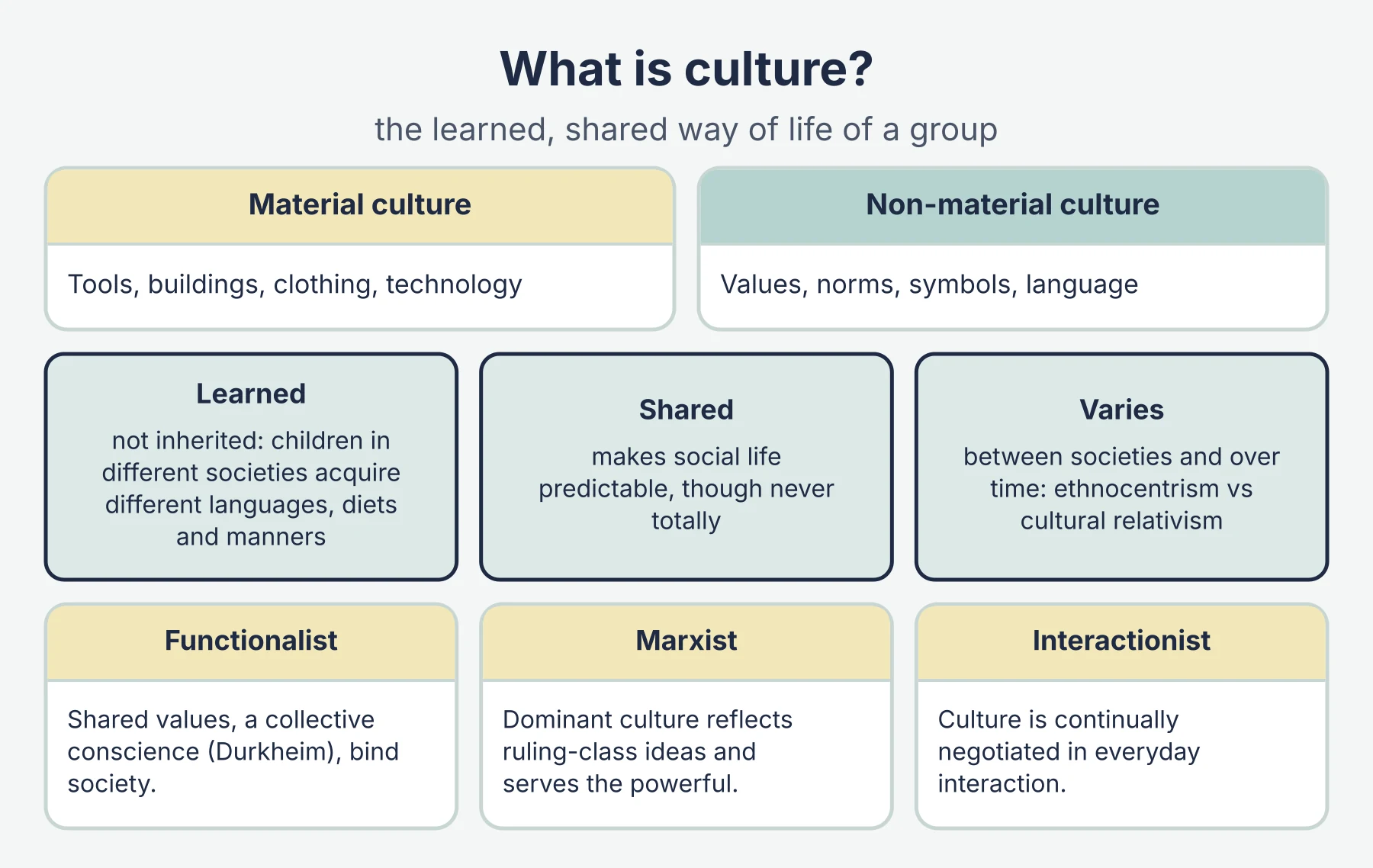
Culture is the learned, shared way of life of a group: its language, beliefs, customs, knowledge, skills and the objects it produces. Sociologists sometimes separate material culture (tools, buildings, clothing, technology) from non-material culture (values, norms, symbols, language). Three features matter in answers:
- Culture is learned, not inherited. Children raised in different societies acquire different languages, diets and manners, which shows behaviour is socially, not biologically, shaped.
- Culture is shared, which makes social life predictable, although sharing is never total.
- Culture varies between societies and over time. Ethnocentrism is judging other cultures by the standards of your own; cultural relativism is understanding a practice in its own context.
Perspectives on culture. Functionalists, following Émile Durkheim, stress shared values (a collective conscience) that bind society together. Marxists argue the dominant culture reflects ruling-class ideas, so it serves the powerful. Interactionists see culture as continually negotiated in everyday interaction.
Norms and values
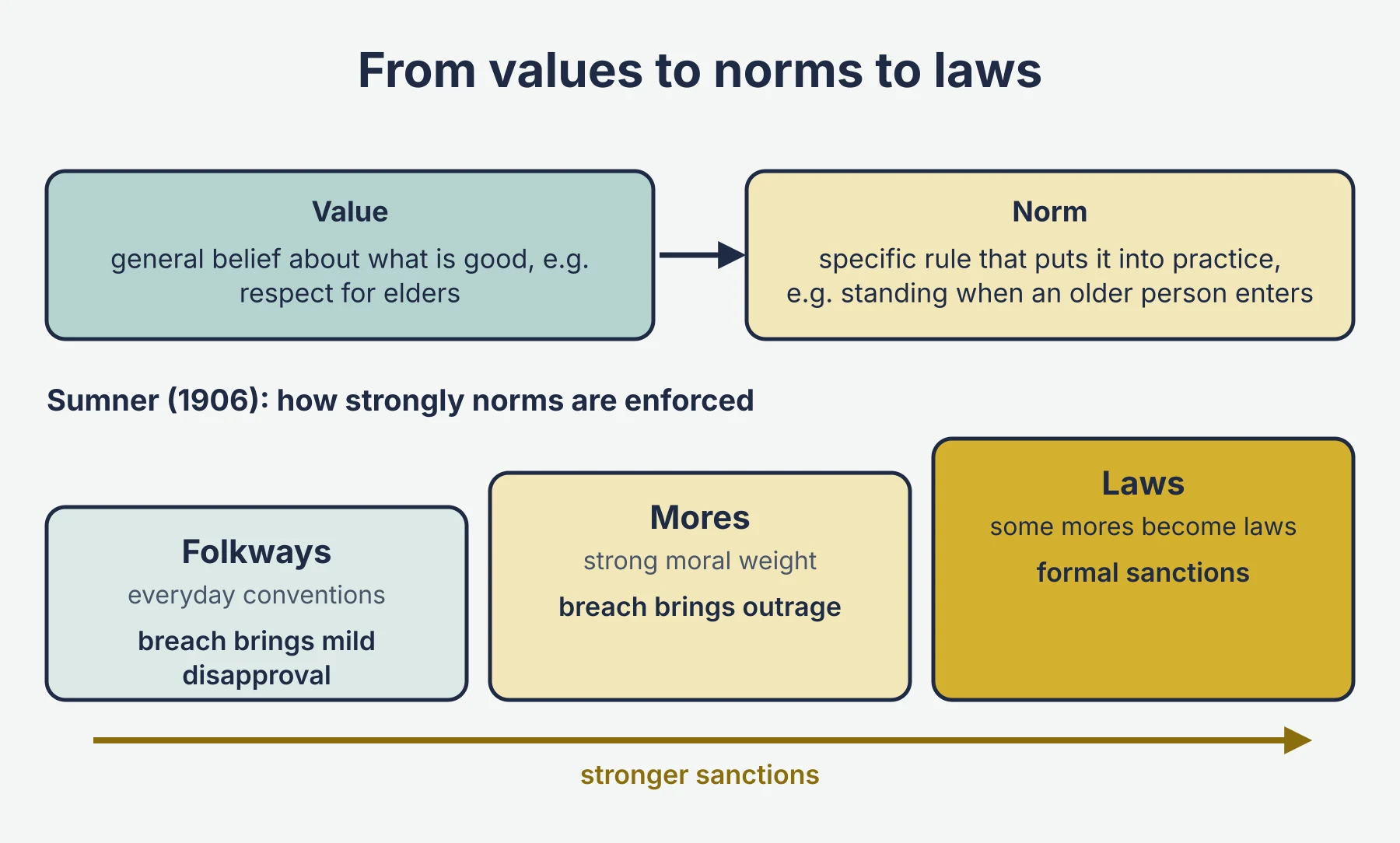
Values are general beliefs about what is good, right and worth striving for, such as respect for elders, individual achievement or religious devotion. Norms are specific rules of behaviour that put values into practice: a value of respect for elders may produce norms such as standing when an older person enters a room.
William Graham Sumner (Folkways, 1906) distinguished folkways, everyday conventions whose breach brings mild disapproval, from mores, norms with strong moral weight whose breach brings outrage. Some mores become laws, backed by formal sanctions. Norms vary: what is polite dress or greeting in one society may be offensive in another, and norms change, as shown by shifting expectations about women’s employment or smoking in public.
Roles and status
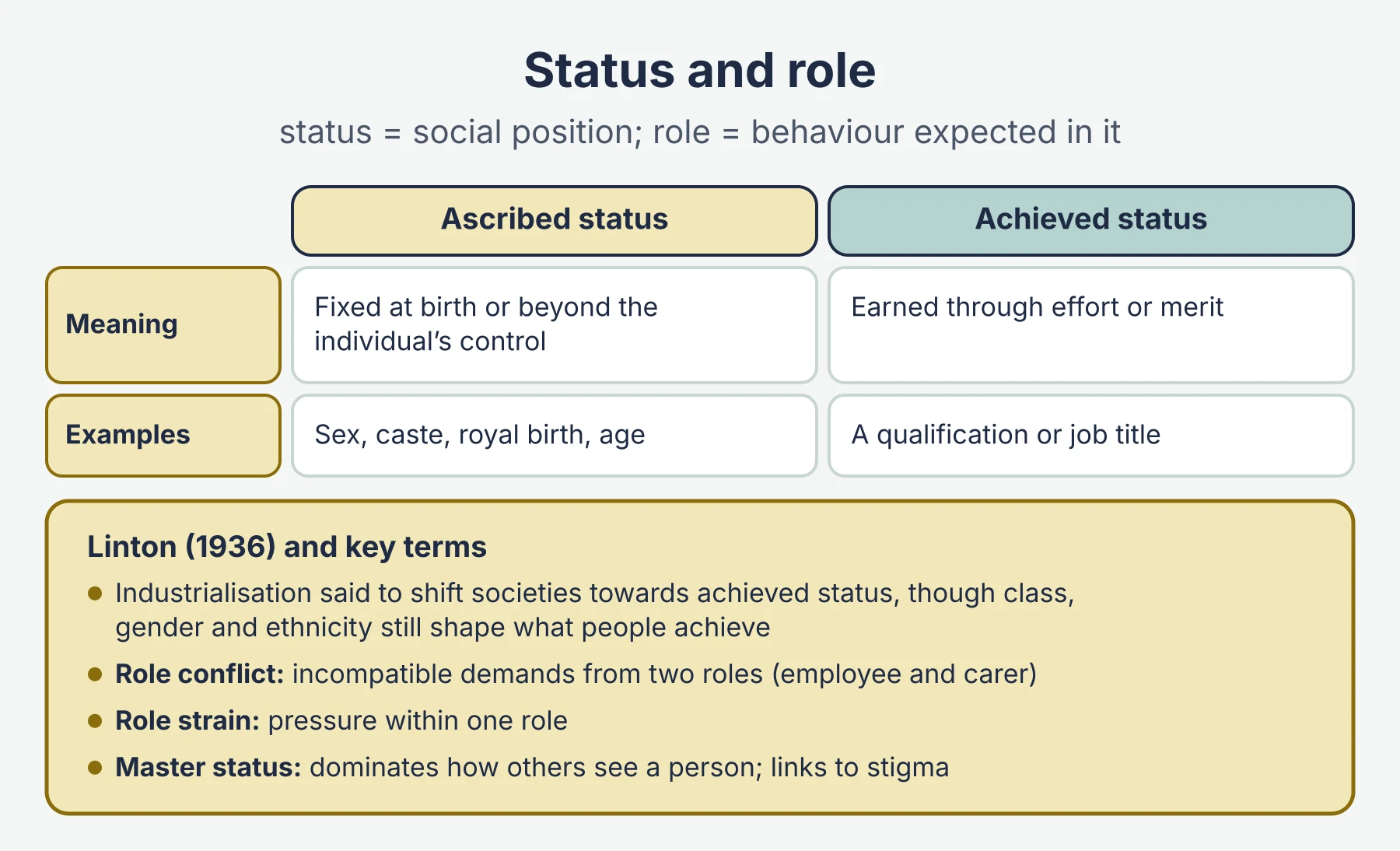
A status is a social position; a role is the set of behaviours expected of someone in that position. Ralph Linton (The Study of Man, 1936) distinguished:
- Ascribed status: fixed at birth or beyond the individual’s control, such as sex, caste, royal birth or age.
- Achieved status: earned through effort or merit, such as a qualification or job title.
Industrialisation is often said to shift societies from ascribed towards achieved status, although class, gender and ethnicity still shape what people can achieve. Everyone holds many statuses at once, which can produce role conflict (incompatible demands from two roles, such as employee and carer) and role strain (pressure within one role). A master status is one that dominates how others see a person, a concept that links to stigma in 3.1.2.4.
Stereotypes
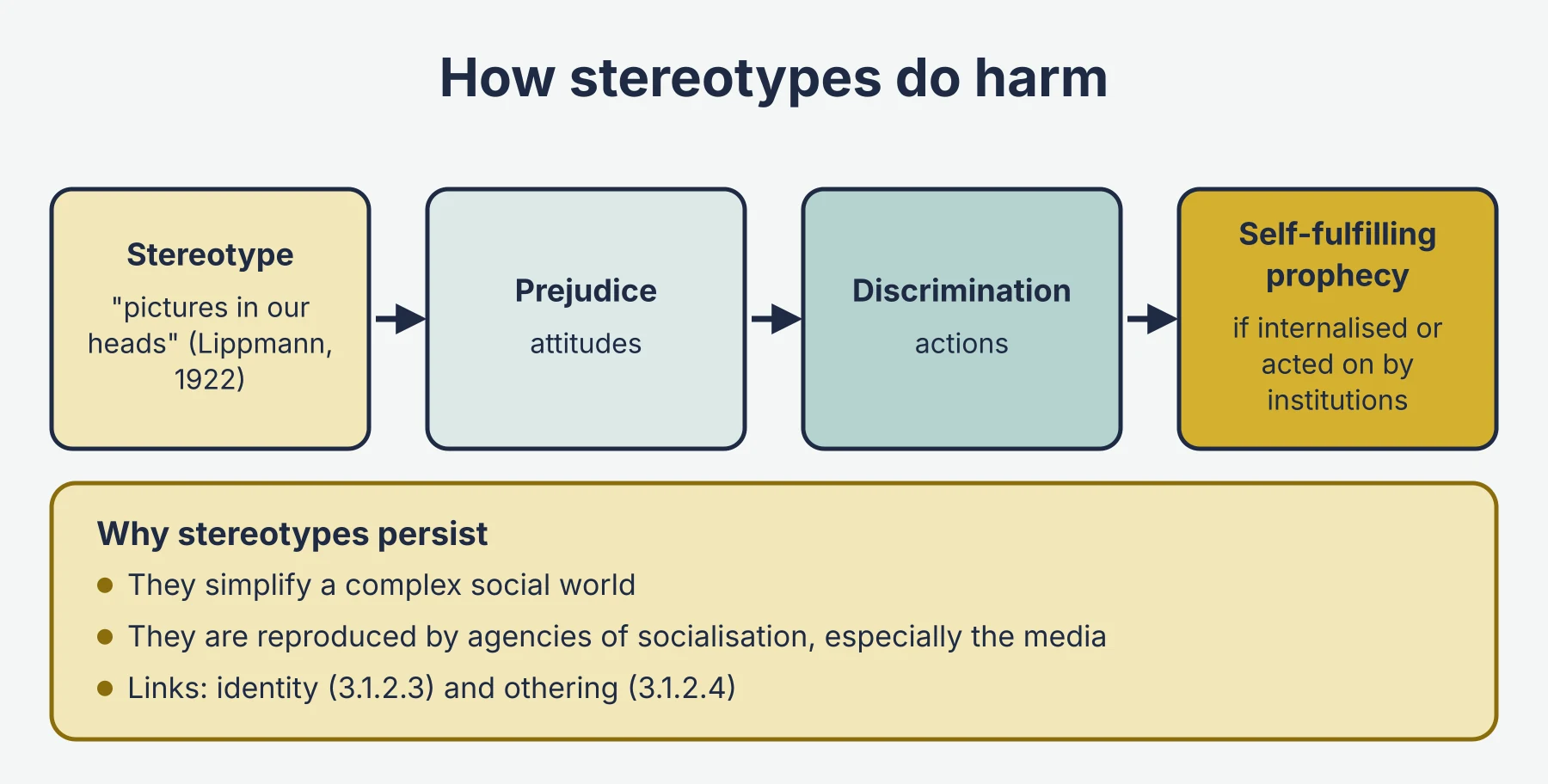
A stereotype is an oversimplified, generalised image of a group, applied to all its members. The journalist Walter Lippmann popularised the term in Public Opinion (1922), describing stereotypes as “pictures in our heads”. Stereotypes:
- simplify a complex social world, which is why they are persistent;
- are often negative and can justify prejudice (attitudes) and discrimination (actions);
- can become self-fulfilling prophecies if people internalise them or institutions act on them;
- are reproduced by agencies of socialisation, especially the media.
Stereotypes link this section to identity (3.1.2.3) and to othering (3.1.2.4).
Subcultures, including ethnic groups in multicultural societies
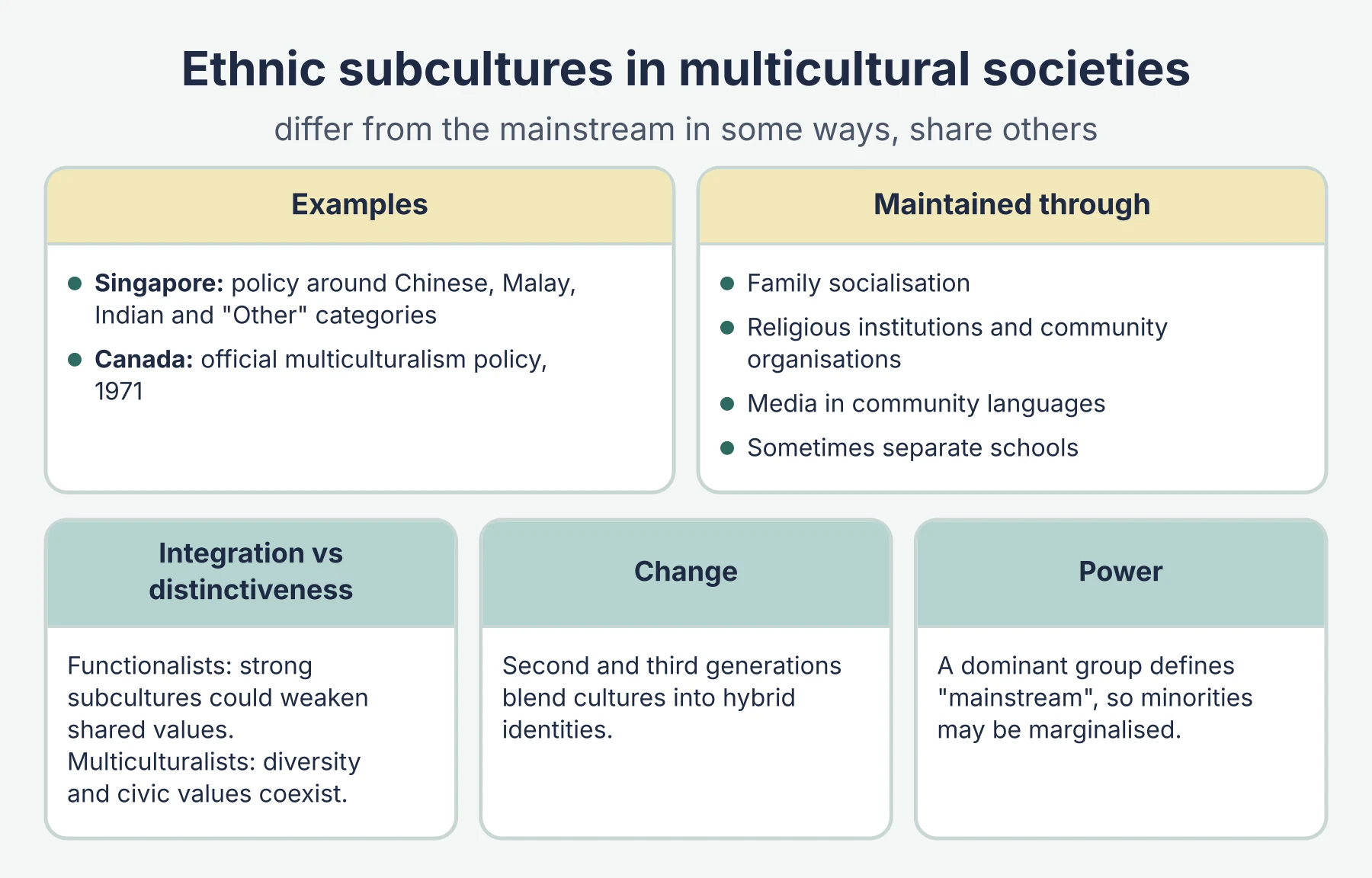
A subculture is a group whose norms and values differ in some ways from the mainstream while sharing others. Examples include youth subcultures, occupational subcultures and religious communities. The specification highlights ethnic groups in multicultural societies: societies where several ethnic groups live together, each keeping distinctive languages, religions, festivals, foods or family practices.
Examples include Singapore, whose state has long organised policy around Chinese, Malay, Indian and “Other” categories, and Canada, which adopted an official multiculturalism policy in 1971. Ethnic subcultures are maintained through family socialisation, religious institutions, community organisations, media in community languages and, sometimes, separate schools.
Debates to use in evaluation:
- Integration vs distinctiveness: functionalists worry that strong subcultures could weaken shared values; multiculturalists argue diversity and shared civic values can coexist.
- Change: second and third generations often blend cultures, producing hybrid identities (3.1.2.3).
- Power: conflict theorists note that a dominant group defines what counts as “mainstream”, so minority subcultures may be marginalised.
The sociological imagination (Mills)
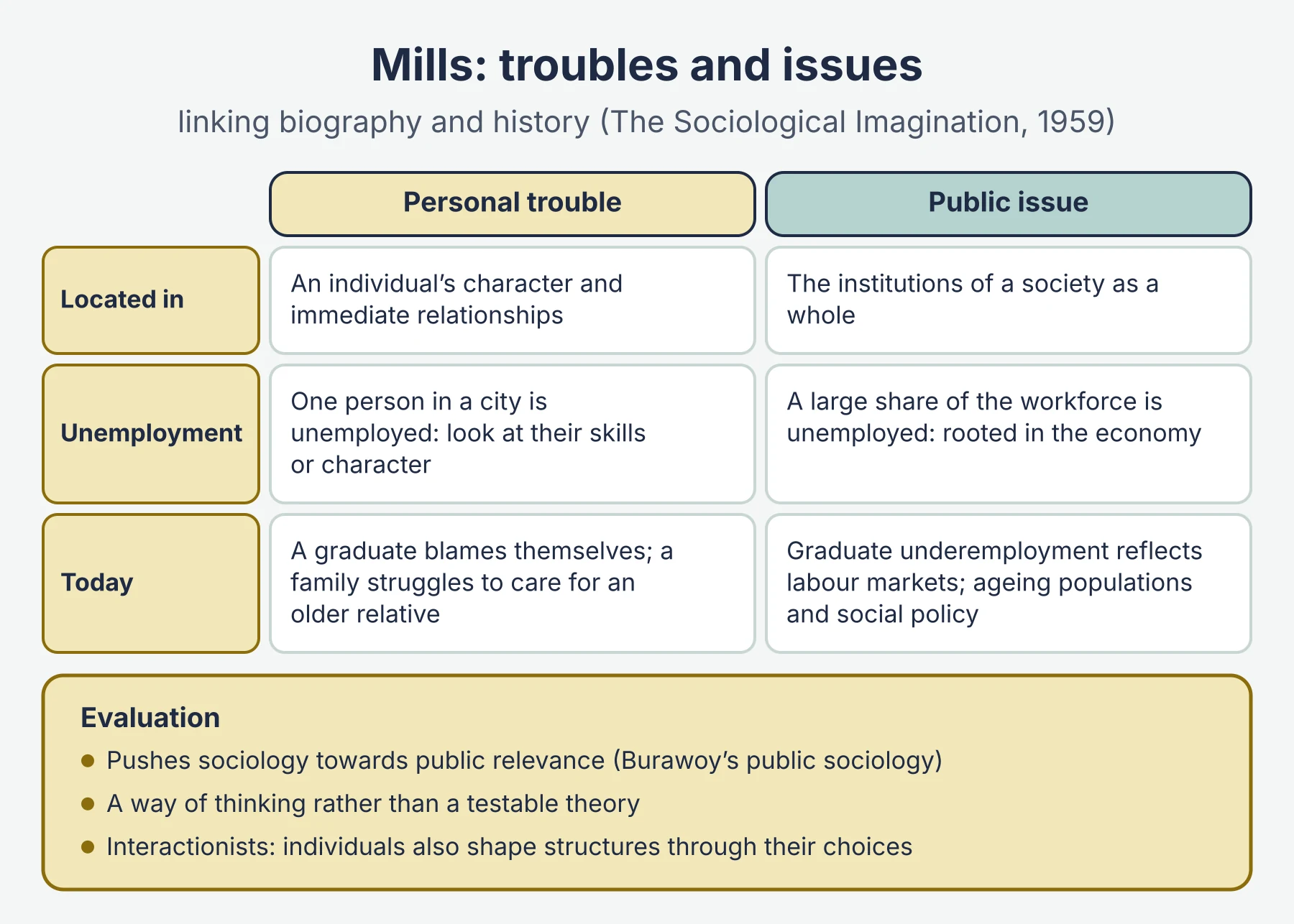
C. Wright Mills, in The Sociological Imagination (1959), argued that people experience their lives as private matters, but that these lives are shaped by history and social structure. The sociological imagination is the ability to see the link between biography and history, between personal troubles and public issues.
- Personal troubles occur within an individual’s character and immediate relationships, and are solved, if at all, within that milieu.
- Public issues concern the institutions of a society as a whole and can only be explained and addressed at that level.
Mills’s best-known example is unemployment: if one person in a city is unemployed, that is a personal trouble, and we look at their skills or character; if a large share of a nation’s workforce is unemployed, that is a public issue rooted in the economy. He applied the same logic to divorce, war and urban life.
Applying Mills today. A graduate unable to find work in their field may blame themselves, but widespread graduate underemployment reflects the structure of labour markets. A family struggling with care for an older relative faces a trouble that, across a society, reflects ageing populations and social policy.
Evaluation. Mills was a radical critic of American power elites, and his idea pushes sociology towards public relevance, which links to Burawoy’s public sociology in 3.1.3.5. Critics note that the idea is a way of thinking rather than a testable theory, and interactionists would add that individuals also shape structures through their choices.
Worked example: annotated 8-mark answer
Explain two ways in which norms differ from values.
Generality. Values are broad beliefs about what is desirable, such as respect for elders, whereas norms are specific rules for behaviour, such as greeting older relatives first (define and contrast). Norms put values into practice, so one value can generate many norms, which can differ between societies that share the value (develop).
Sanctions. Norms are directly enforced by sanctions: breaking a folkway brings mild disapproval, breaking a more brings strong condemnation (Sumner) (evidence). Values are not broken in the same way; people may hold a value but fail to live up to it, which shows the gap between belief and behaviour (analysis).
Common mistakes
- Using norms and values interchangeably.
- Treating role and status as the same: status is the position, role the expected behaviour.
- Describing Mills without naming both personal troubles and public issues.
- Writing about subcultures without the specification’s focus on ethnic groups in multicultural societies.
- Assuming culture is entirely shared and fixed.
Exam technique
Short definition questions are easy marks if you give a precise definition and an example from a named society. In 8-mark explain questions, develop each point with a consequence. In 20-mark evaluate questions, compare functionalist, Marxist and interactionist readings and finish with a judgement.
Related resources
-
Practice questions
OxfordAQA International A-Level Sociology (9690): Individuals and Society – Practice Questions
Original OxfordAQA 9690 Unit 2 style questions on culture, norms and values, roles and status, stereotypes, ethnic subcultures and Mills, with answers.
Sociology · OxfordAQA · AS Level
Try questions -
Revision notes
OxfordAQA International A-Level Sociology (9690): Individuals and Society – Revision Notes
Revision notes for OxfordAQA 9690 section 3.1.2.1: culture, folkways and mores, ascribed and achieved status, stereotypes, subcultures and Mills.
Sociology · OxfordAQA · AS Level
Revise topic -
Revision notes
OxfordAQA A-Level Sociology (9690): Individuals, Socialisation and Social Identities — Revision Notes
Revision notes for OxfordAQA 9690 sections 3.1.2.1-3.1.2.3: culture, Mills's sociological imagination, socialisation, Mead, Goffman and identities.
Sociology · OxfordAQA · AS Level
Revise topic
Related articles
Get free revision emails (optional)
Occasional emails with practice questions, worked explanations and links to free resources for the qualification and subjects you choose. No spam, and you can unsubscribe from any email. The free tools on this site never need an email.