
Revision Notes
OxfordAQA International A-Level Sociology (9690): Social Identities and Social Change – Revision Notes
Revision notes for OxfordAQA 9690 section 3.1.2.3: bases of identity, Fanon, Goffman, Zuboff, hybrid identities, diasporas, masculinities and consumption.
- Subject
- Sociology
- Level
- AS LEVEL
- Topic
- Unit 2 – Exploring Sociology
- Author
- Marlbridge Academic Team
- Updated
- Reviewed by
- Naqiya Yousaf (what this means)
Aligned to OxfordAQA A Level Sociology (9690), Version 1.1 (new qualification). Official specification .
Syllabus page (what it covers and how it is assessed): OxfordAQA A Level Sociology.
Syllabus points this page covers
9690 (AS Level)
- 3.1.2.3 Social identities and social change
Found an error? Report a correction.
Need help with this topic? Request a free trial class for A Level Sociology (9690).
These notes condense 3.1.2.3 Social identities and social change in OxfordAQA International AS/A level Sociology (9690), Unit 2 Section A. Core idea: identities are socially constructed through socialisation, rest on seven named bases, and are being reshaped by changing gender norms, migration, online life, consumption and globalisation.
Full explanation: social identities and social change study guide.
Specification checklist
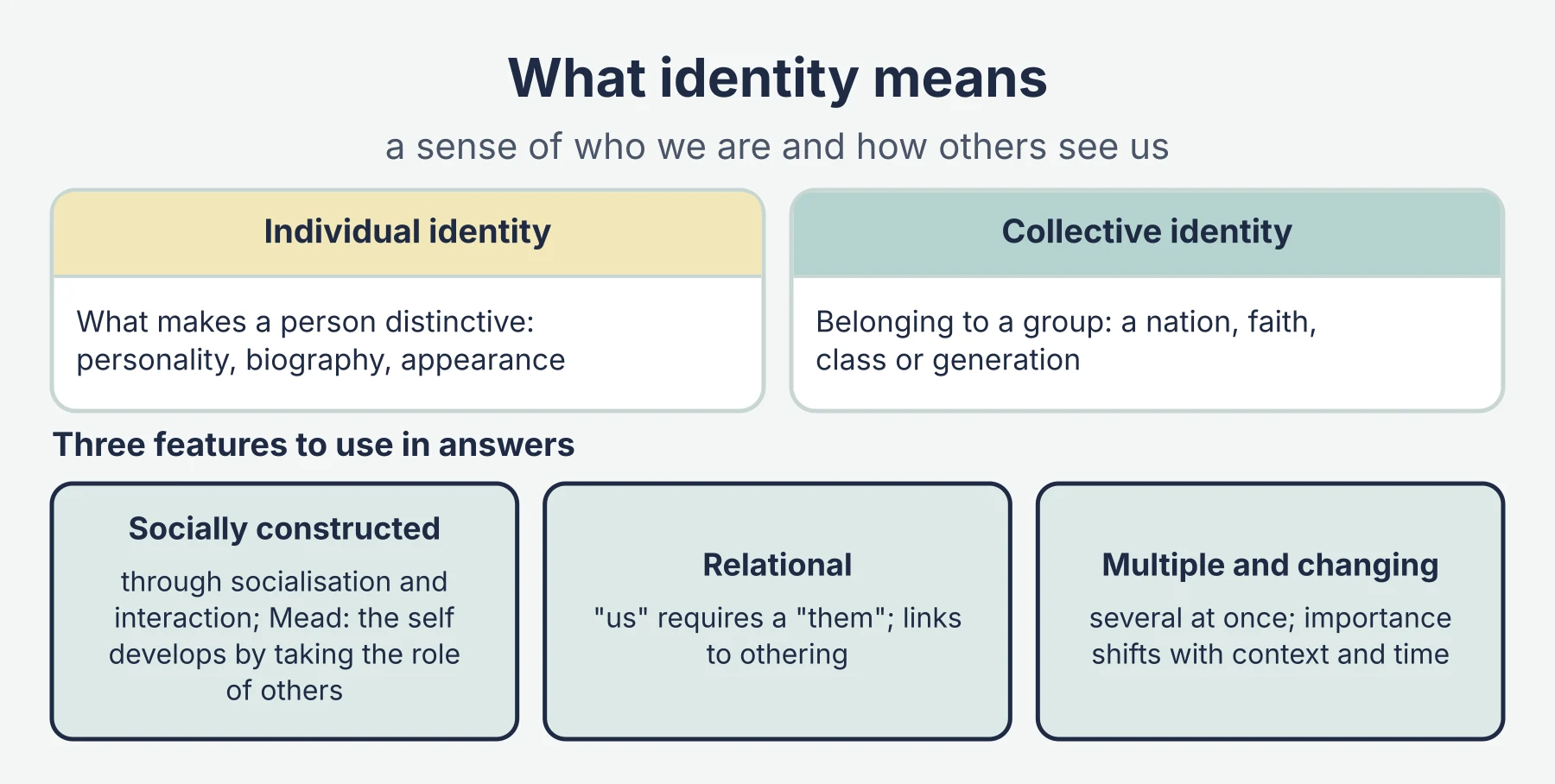
- Individual and collective identities.
- Social construction of identities through socialisation.
- Bases: age and generation/cohort; sex and gender; race and ethnicity; social class; religion; ability/disability; nationality.
- Social change: gender identities (masculinity, femininity); hybrid ethnic identities and diasporas; online identities (social media, virtual communities); consumption and globalisation.
Key terms
| Term | Definition |
|---|---|
| Individual identity | What makes a person distinctive |
| Collective identity | Sense of belonging to a group |
| Cohort | People born in the same period who share formative experiences |
| Gender | Socially constructed masculinity and femininity |
| Performativity | Gender created through repeated acts (Butler, 1990) |
| Ethnicity | Shared culture, history, and often language or religion |
| Class consciousness | Awareness of shared class position and interests |
| Social model of disability | Disability caused by social barriers, not impairment (Oliver) |
| Spoiled identity | Identity discredited by stigma (Goffman, 1963) |
| Imagined community | A nation as a community of people who will never all meet (Anderson, 1983) |
| Banal nationalism | Everyday reminders of nationhood (Billig, 1995) |
| Hegemonic masculinity | Dominant, culturally honoured masculinity (Connell) |
| Hybrid identity | Identity combining more than one culture |
| Diaspora | Dispersed population keeping ties to a homeland |
| Impression management | Controlling how others see us (Goffman, 1959) |
| Surveillance capitalism | Profiting from data on users’ behaviour (Zuboff, 2019) |
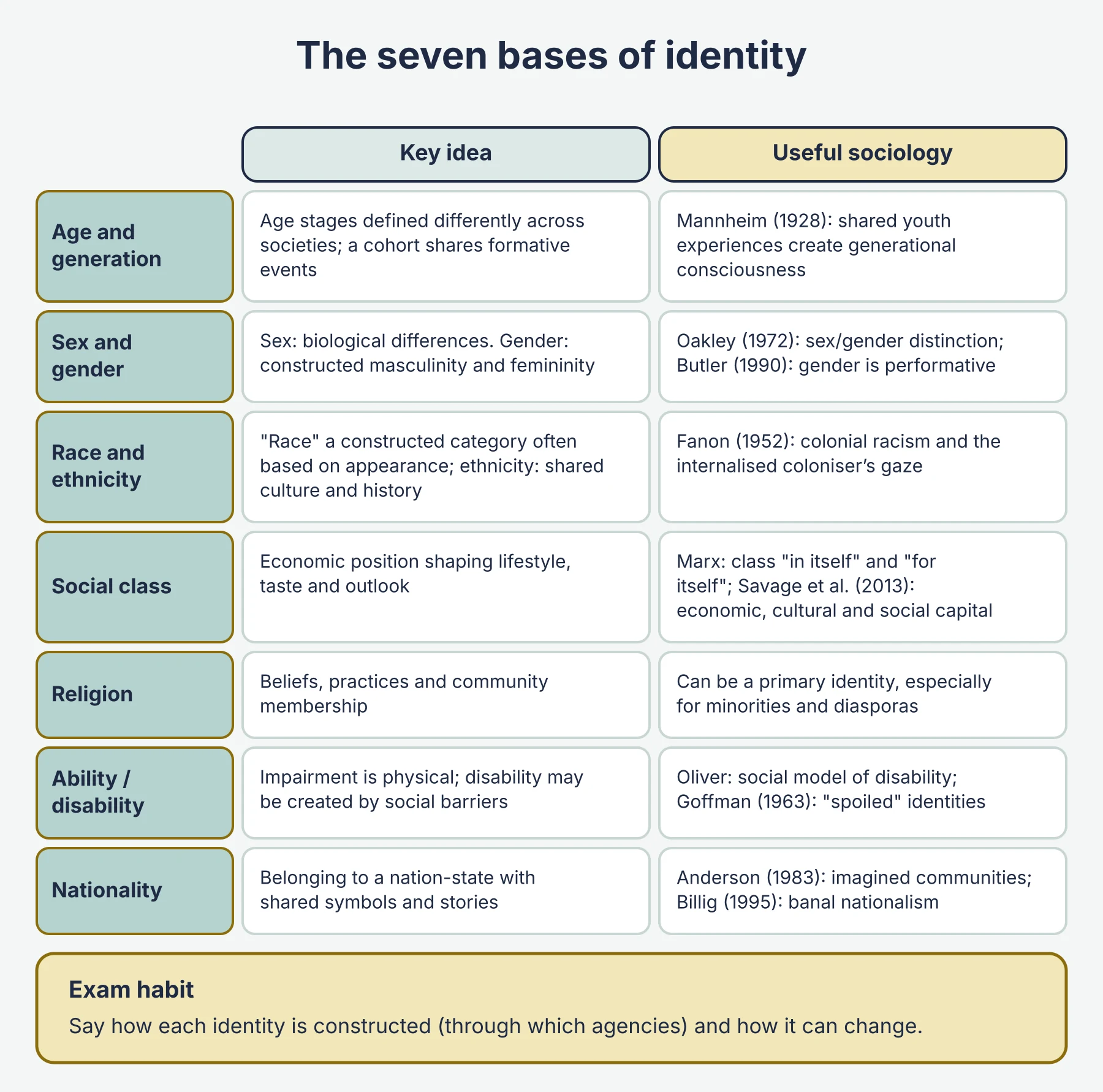
Bases of identity: one line and one name each
| Basis | Point | Name |
|---|---|---|
| Age/generation | Shared youth experiences create generational consciousness | Mannheim (1928) |
| Sex/gender | Gender is social and performed | Oakley (1972); Butler (1990) |
| Race/ethnicity | Colonial racism shapes self-image | Fanon (1952) |
| Social class | Economic, cultural and social capital | Savage and colleagues (2013) |
| Religion | Primary identity especially for minorities and diasporas | Credit any relevant study |
| Ability/disability | Social barriers create disability; stigma management | Oliver; Goffman (1963) |
| Nationality | Nations imagined and reproduced daily | Anderson (1983); Billig (1995) |
Social change
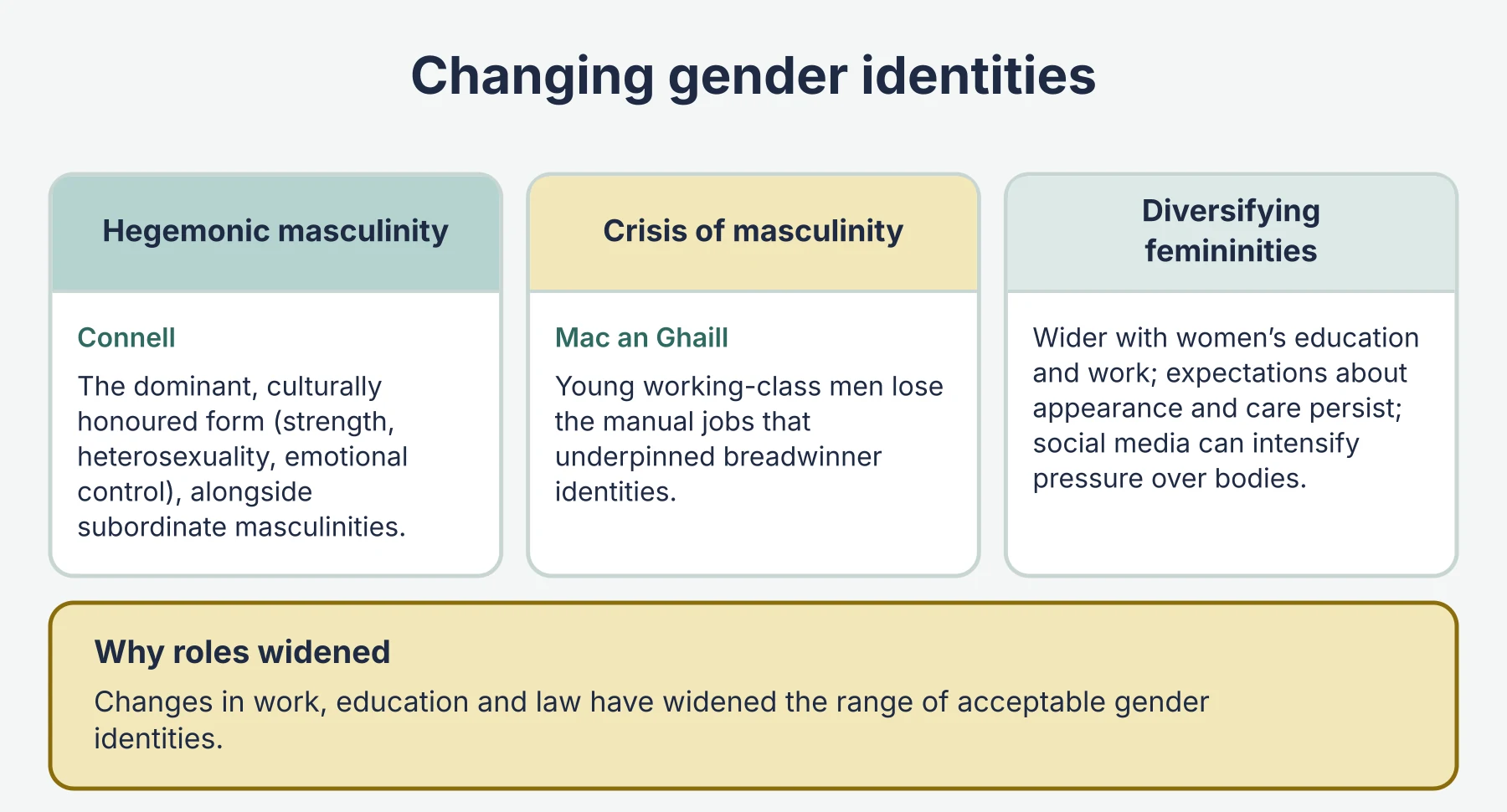
- Gender: Connell’s hegemonic masculinity; Mac an Ghaill’s crisis of masculinity as manual jobs decline; wider range of femininities; persistent appearance pressures.
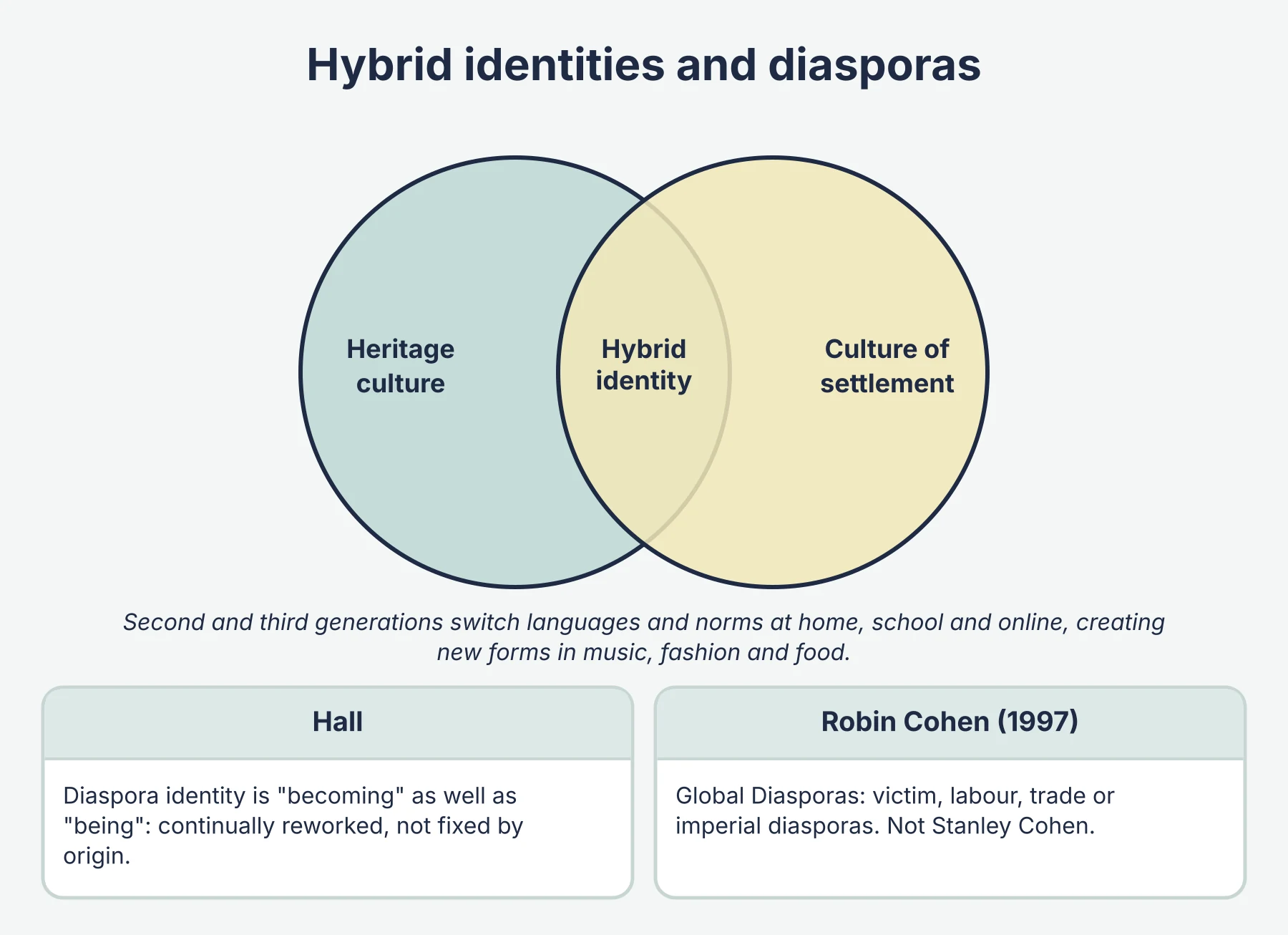
- Hybrid identities and diasporas: Stuart Hall: identity as “becoming” as well as “being”; Robin Cohen (1997) types of diaspora; code-switching between cultures.
- Online identities: Goffman’s impression management applied to profiles; virtual communities give support; Zuboff: platforms harvest data and steer behaviour.
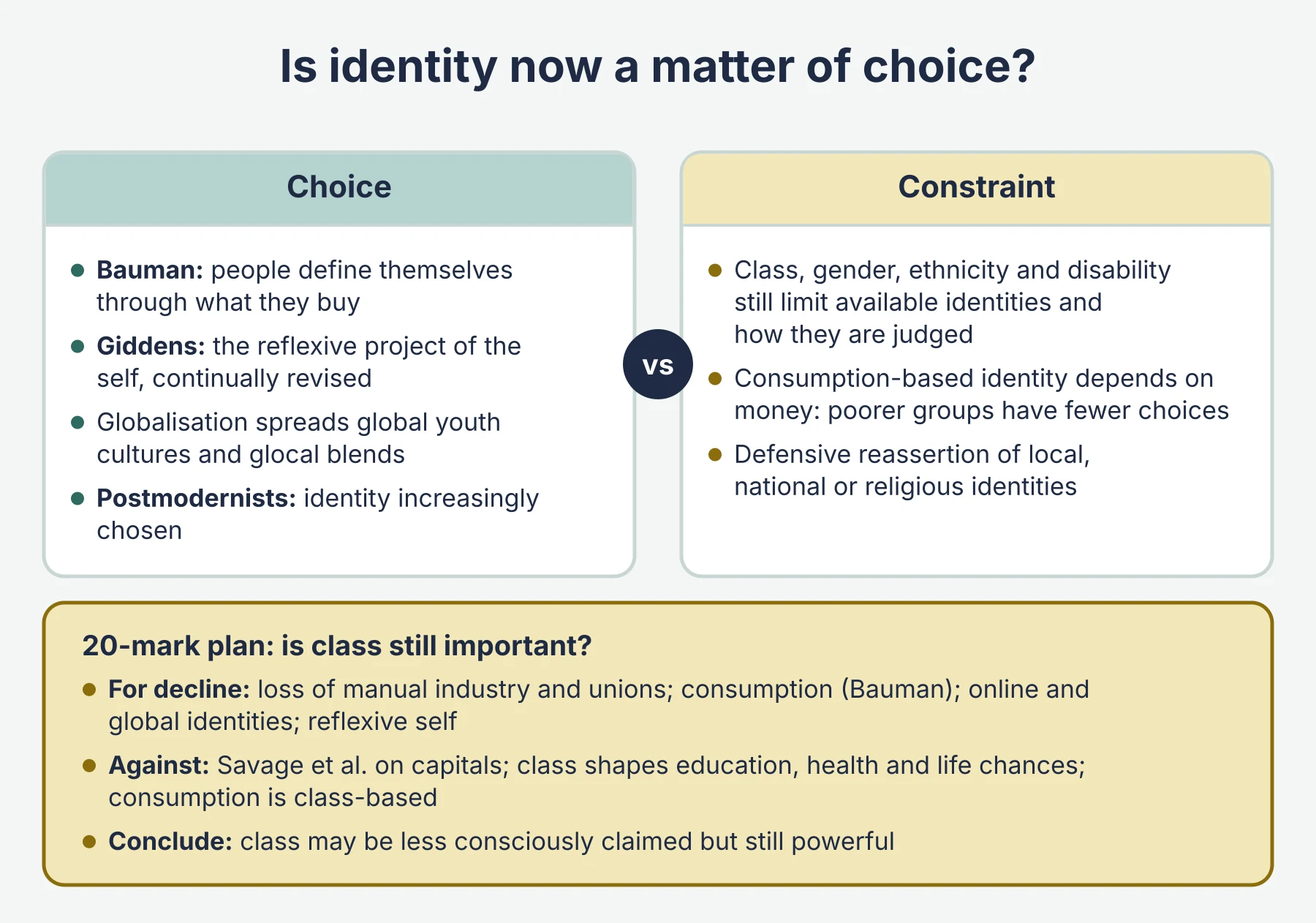
- Consumption and globalisation: Bauman: identity through consumption; Giddens: reflexive project of the self; global youth cultures, glocal blends, defensive local identities.
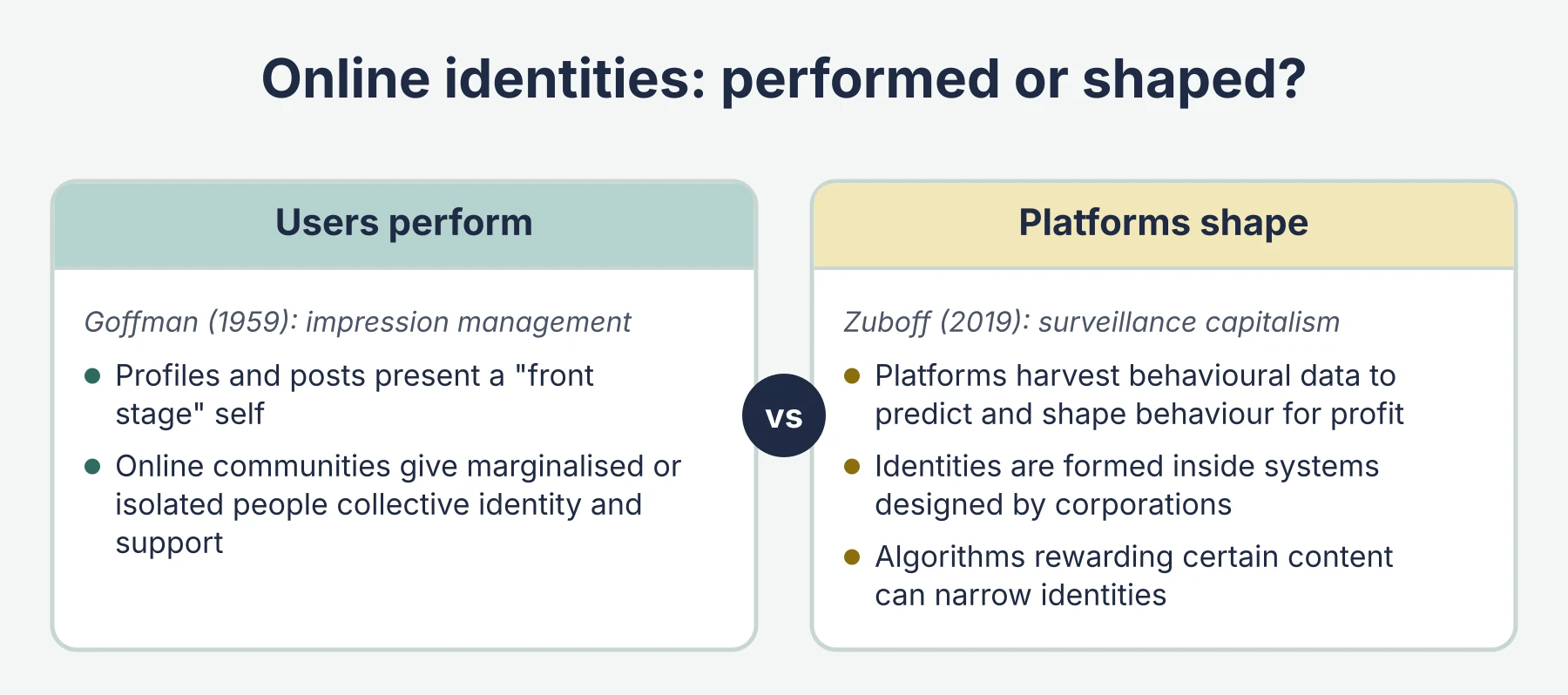
Choice vs constraint
| Choice view | Constraint view |
|---|---|
| Postmodernists: identities pick-and-mix | Class, gender, ethnicity and disability limit options |
| Online spaces allow experimentation | Platforms and algorithms shape what is visible |
| Consumption expresses self | Consumption depends on income |
| Hybridity shows creativity | Racism and othering still impose labels |
Perspectives on identity
| Perspective | View |
|---|---|
| Functionalist | Shared identities (national, religious) integrate society |
| Marxist | Consumer and national identities can distract from class interests |
| Feminist | Gender identities are constructed to reproduce patriarchy, but can be challenged |
| Interactionist | Identities are built and managed in interaction (Mead, Goffman) |
| Postmodernist | Identities are fluid, multiple and increasingly chosen |
Evaluation lines to reuse
- “Hybrid identities show creativity, but racism and othering still impose labels from outside.”
- “Online spaces widen choice, yet Zuboff shows the platforms themselves shape what users become.”
- “Weaker class consciousness does not mean class no longer shapes life chances.”
Linking to other sections
- 3.1.2.2: identities are constructed through the same agencies of socialisation.
- 3.1.2.4: stigmatised identities and othering show how identities are policed.
- 3.1.1.3: diasporas and transnational families reappear in the Families topic.
- 3.1.2.5: patterns of offending and victimisation by gender, class, age and ethnicity rest on these identities.
Exam traps
- Sex and gender treated as the same.
- Race and ethnicity confused.
- Stanley Cohen (moral panics) confused with Robin Cohen (diasporas).
- Online identity described only positively.
- No named society in extended answers.
Self-test
- Distinguish individual from collective identity.
- What is a cohort?
- What did Butler mean by performativity?
- What did Fanon argue in Black Skin, White Masks?
- What is the social model of disability?
- What is banal nationalism? Give an example.
- Define hegemonic masculinity.
- What is a hybrid identity?
- How can Goffman’s work be applied to social media?
- What is Zuboff’s criticism of platforms?
- What did Giddens mean by the reflexive project of the self?
- Give one constraint on consumption-based identity.
Answers
- Individual: what makes a person distinctive; collective: belonging to a group.
- People born in the same period who share formative experiences.
- Gender is created through repeated acts rather than expressing a fixed inner essence.
- Colonial racism led colonised Black people to see themselves through the coloniser’s eyes.
- Disability is created by social and physical barriers, not by impairment itself.
- Everyday reminders of nationhood, such as flags on buildings or national weather maps.
- The dominant, culturally honoured form of masculinity (Connell).
- An identity combining elements of more than one culture.
- Users manage impressions, presenting a curated front-stage self.
- They collect behavioural data to predict and shape behaviour for profit.
- Individuals continually construct and revise their identity in late modernity.
- It depends on income, so poorer people have fewer choices.
Practise next: social identities and social change practice questions | Exploring Sociology study guide
Related resources
-
Study guides
OxfordAQA International A-Level Sociology (9690): Socialisation
Study guide to OxfordAQA 9690 section 3.1.2.2: primary, secondary and re-socialisation, agencies and their methods, and four perspectives on socialisation.
Sociology · OxfordAQA · AS Level
Read guide -
Practice questions
OxfordAQA International A-Level Sociology (9690): Socialisation – Practice Questions
Original OxfordAQA 9690 Unit 2 style questions on types and agencies of socialisation, their methods and four perspectives, with full mark schemes.
Sociology · OxfordAQA · AS Level
Try questions -
Revision notes
OxfordAQA International A-Level Sociology (9690): Socialisation – Revision Notes
Revision notes for OxfordAQA 9690 section 3.1.2.2: types of socialisation, six agencies and their methods, and four perspectives including Mead.
Sociology · OxfordAQA · AS Level
Revise topic
Related articles
Get free revision emails (optional)
Occasional emails with practice questions, worked explanations and links to free resources for the qualification and subjects you choose. No spam, and you can unsubscribe from any email. The free tools on this site never need an email.