
Study Guides
OxfordAQA International A-Level Sociology (9690): Social Control
Study guide to OxfordAQA 9690 section 3.1.2.4: sanctions, stigma and othering, punishment, policing, surveillance, Althusser, Gramsci and four perspectives.
- Subject
- Sociology
- Level
- AS LEVEL
- Topic
- Unit 2 – Exploring Sociology
- Author
- Marlbridge Academic Team
- Updated
- Reviewed by
- Naqiya Yousaf (what this means)
Aligned to OxfordAQA A Level Sociology (9690), Version 1.1 (new qualification). Official specification .
Syllabus page (what it covers and how it is assessed): OxfordAQA A Level Sociology.
Syllabus points this page covers
9690 (AS Level)
- 3.1.2.4 Social control
Found an error? Report a correction.
Need help with this topic? Request a free trial class for A Level Sociology (9690).
Section 3.1.2.4 Social control in OxfordAQA International AS/A level Sociology (9690) is examined in Unit 2 Section A. It is one of the most concept-heavy parts of the course. The specification lists formal and informal control; positive and negative sanctions; consensus and conflict views; “Stigmatised identities; othering”; agencies of informal control (families, schools, peers, media, religion, workplace) and formal control (“government/laws; police and other enforcement agencies; criminal justice system”); “Aims and types of punishment”; “Crime prevention: types of policing, surveillance”; “Repressive and ideological state apparatuses, interpellation; hegemony”; and functionalist, Marxist, feminist and social action/interactionist perspectives. Goffman, Stanley Cohen and Zuboff, named for 3.1.2, all help here. The unit overview is in the Exploring Sociology study guide.
Formal and informal control, and sanctions
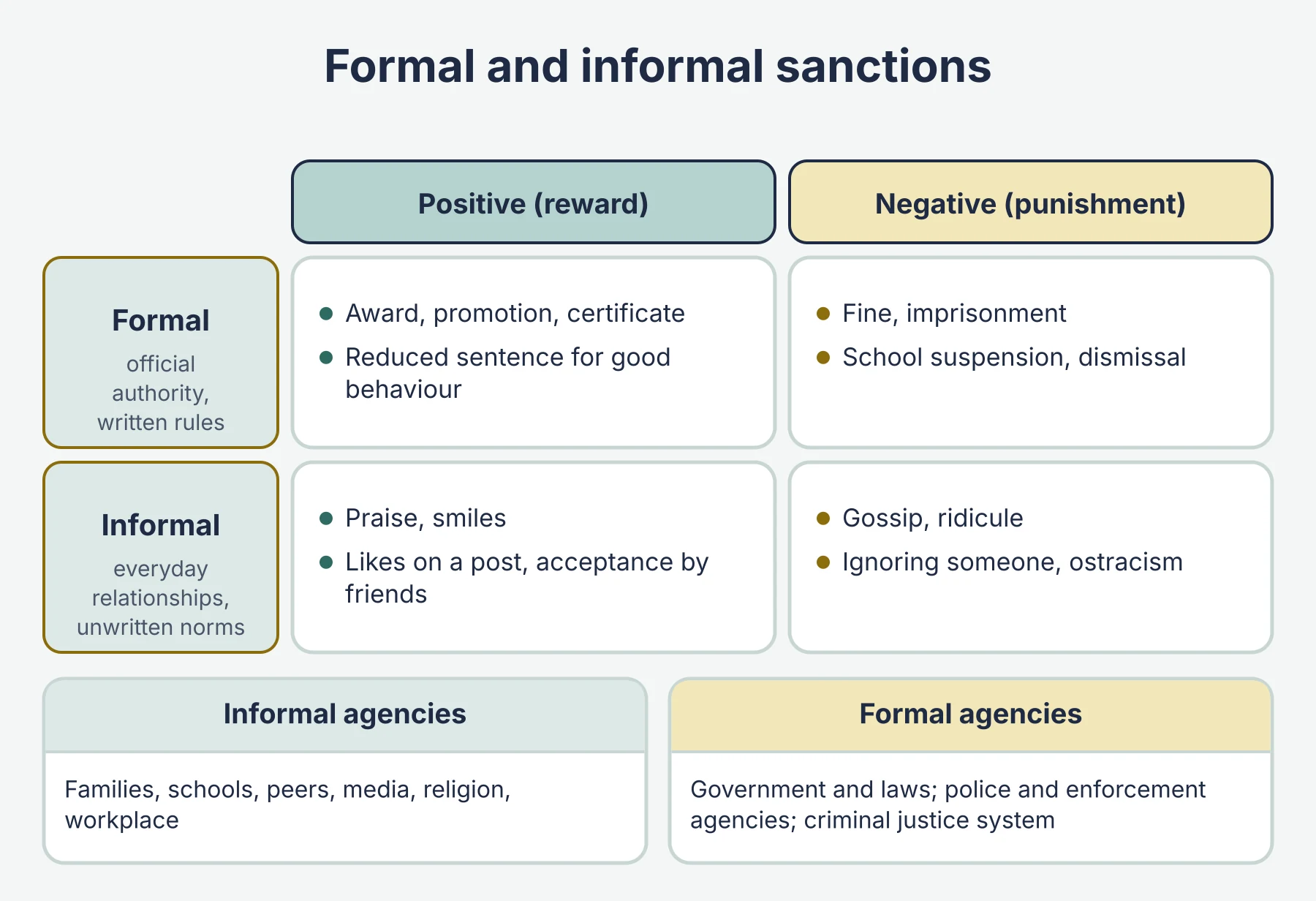
Social control is the set of processes that encourage people to conform to norms. Formal control is exercised by bodies with official authority to enforce written rules; informal control comes from everyday relationships and unwritten norms.
Sanctions can be crossed with this distinction to make a four-cell grid, a quick way to generate examples:
| Positive (reward) | Negative (punishment) | |
|---|---|---|
| Formal | Award, promotion, certificate, reduced sentence for good behaviour | Fine, imprisonment, suspension from school, dismissal |
| Informal | Praise, smiles, likes on a post, acceptance by friends | Gossip, ridicule, ignoring someone, ostracism |
Agencies. Informal: families (parental approval), schools (teacher praise, detentions), peers (acceptance or exclusion), media (shaming of public figures), religion (community expectations, ideas of sin), workplace (colleagues’ approval, appraisal). Formal: government and laws, police and other enforcement agencies (customs, regulators), and the criminal justice system (courts, prisons, probation).
Consensus and conflict views
- Consensus (functionalist) views see control as protecting shared values that benefit everyone.
- Conflict views (Marxist and feminist) see control as protecting the interests of powerful groups.
Stigmatised identities and othering
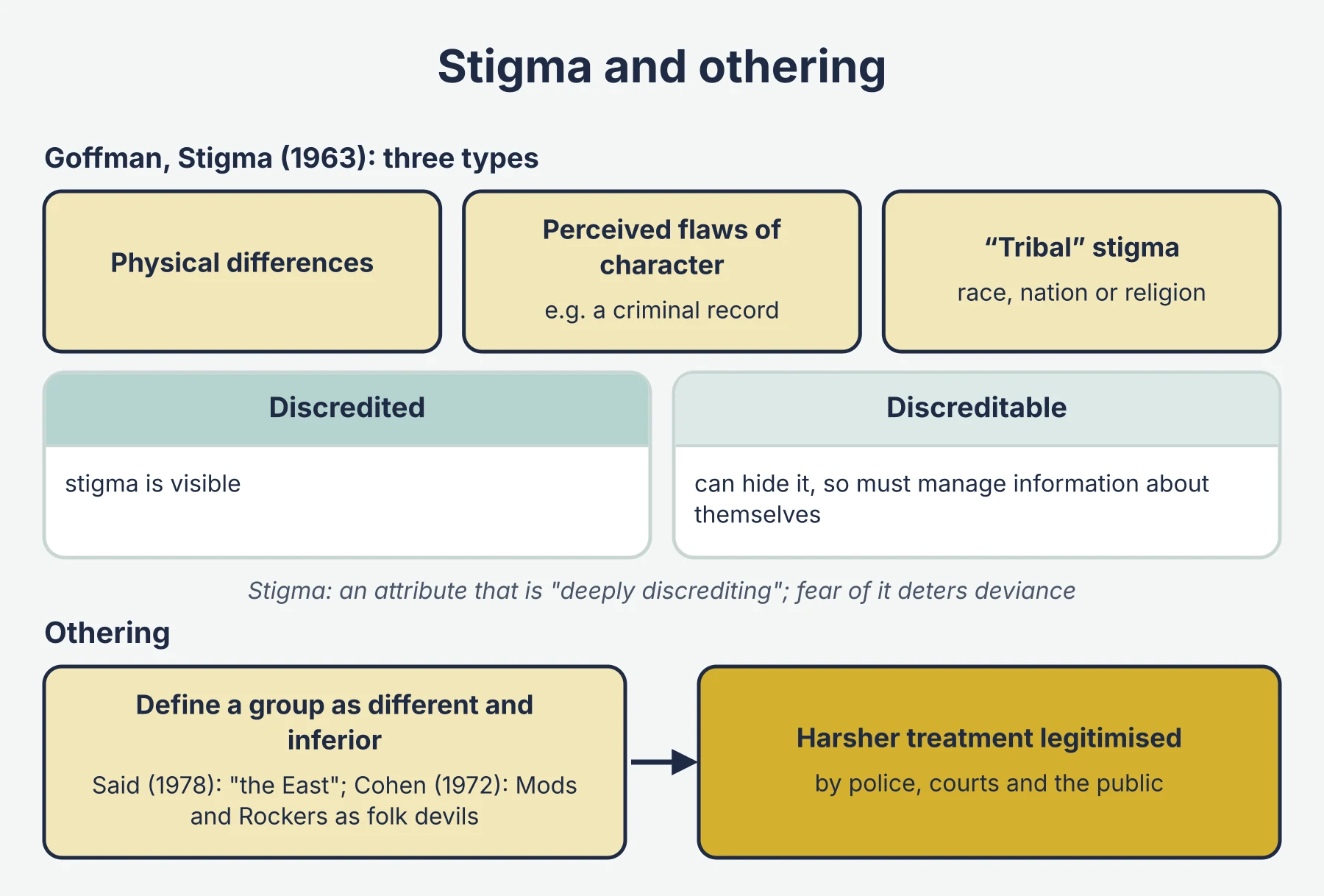
Erving Goffman’s Stigma (1963) defines stigma as an attribute that is “deeply discrediting”, reducing a person from a whole person to a “tainted, discounted one”. He described three types: physical differences, perceived flaws of character (for example a criminal record) and “tribal” stigma of race, nation or religion. He distinguished the discredited, whose stigma is visible, from the discreditable, who can hide it and must manage information about themselves. Stigma is a form of informal control: fear of stigma deters deviance, and those stigmatised face exclusion.
Othering is defining a group as fundamentally different from, and inferior to, “us”. Edward Said’s Orientalism (1978) showed how Western writing constructed “the East” as exotic and backward, justifying colonial rule. Stanley Cohen’s Folk Devils and Moral Panics (1972) showed how media reaction to clashes between Mods and Rockers in 1960s England turned young people into folk devils, leading to calls for tougher control. Othering legitimises harsher treatment of the othered group by police, courts and the public.
Aims and types of punishment
| Aim | Meaning | Typical forms |
|---|---|---|
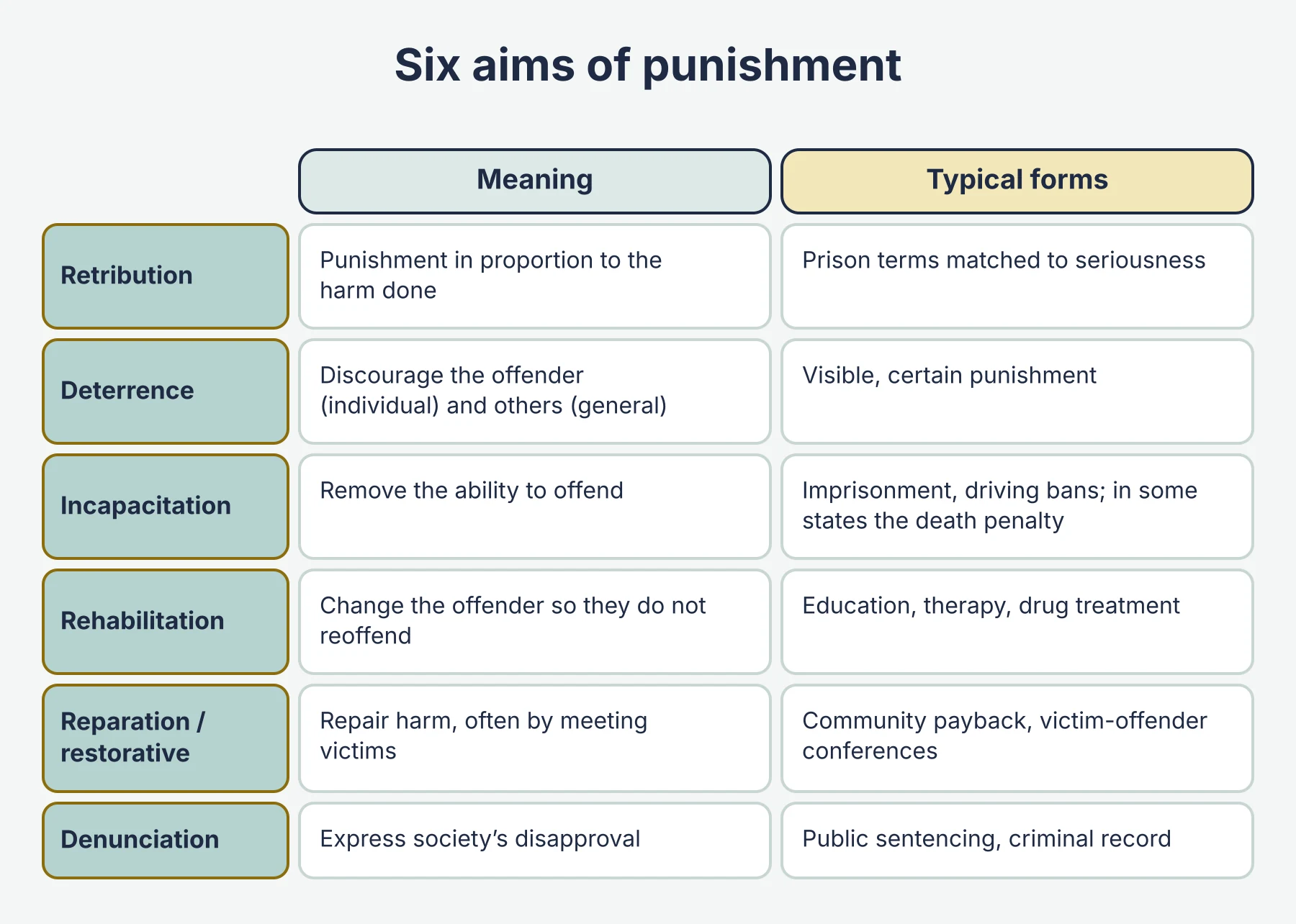
| Retribution | Offenders deserve punishment in proportion to the harm done | Prison terms matched to seriousness |
| Deterrence | Discourage the offender (individual) and others (general) from offending | Visible, certain punishment |
| Incapacitation | Remove the ability to offend | Imprisonment, driving bans, in some states the death penalty |
| Rehabilitation | Change the offender so they do not reoffend | Education, therapy, drug treatment |
| Reparation / restorative justice | Repair harm, often by meeting victims | Community payback, victim-offender conferences |
| Denunciation | Express society’s disapproval | Public sentencing, criminal record |
Types of punishment include fines, community sentences, probation, imprisonment, corporal punishment and capital punishment; their use differs sharply between societies.
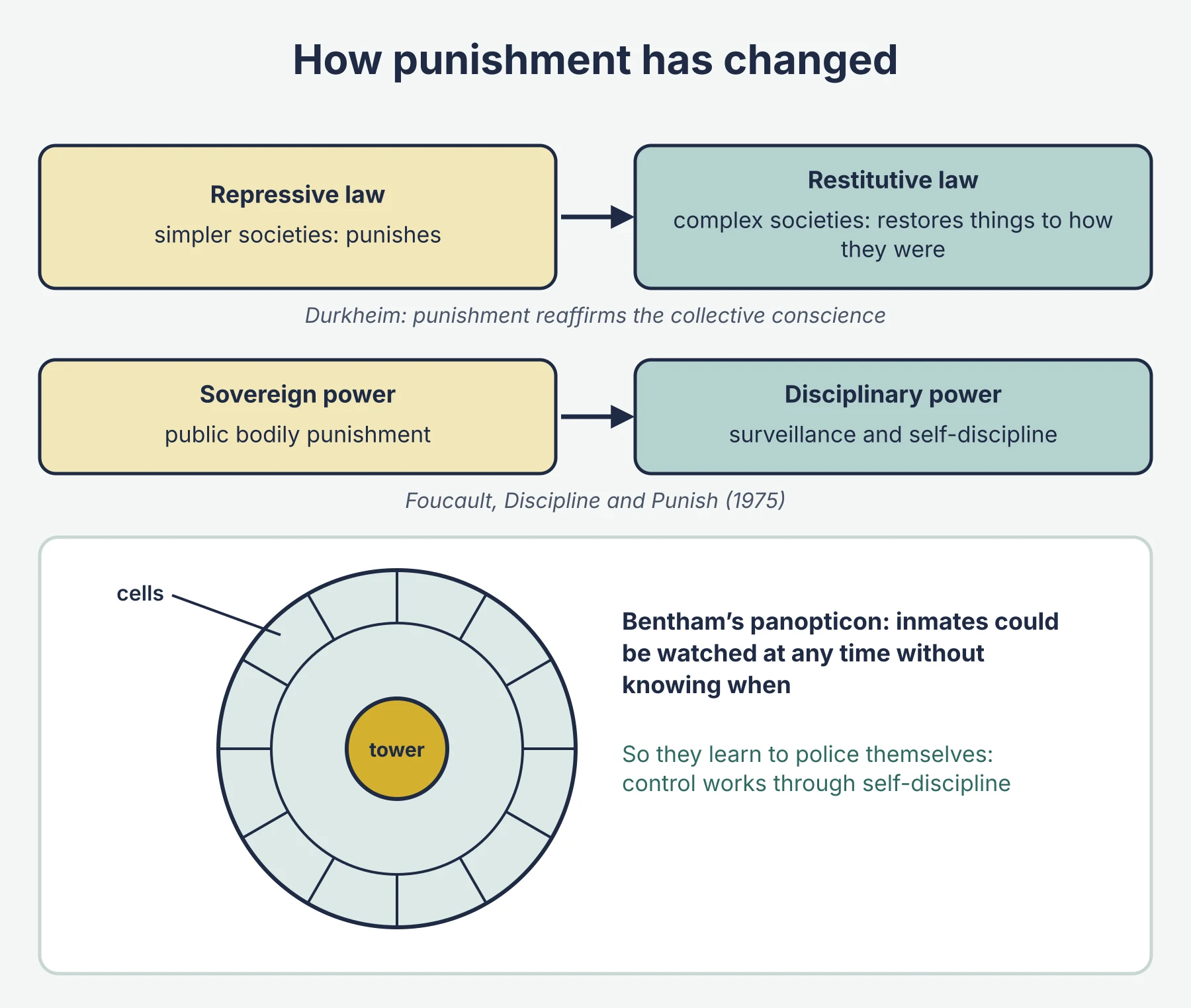
Durkheim argued punishment’s main function is to reaffirm the collective conscience, uniting law-abiding citizens against the offender. He contrasted repressive law in simpler societies, which punishes, with restitutive law in complex societies, which aims to restore things to how they were. Michel Foucault (Discipline and Punish, 1975) traced a shift from sovereign power, displayed through public bodily punishment, to disciplinary power, which works through surveillance and self-discipline. He used Jeremy Bentham’s design for a panopticon prison, where inmates could be watched at any time without knowing when, so they learn to police themselves.
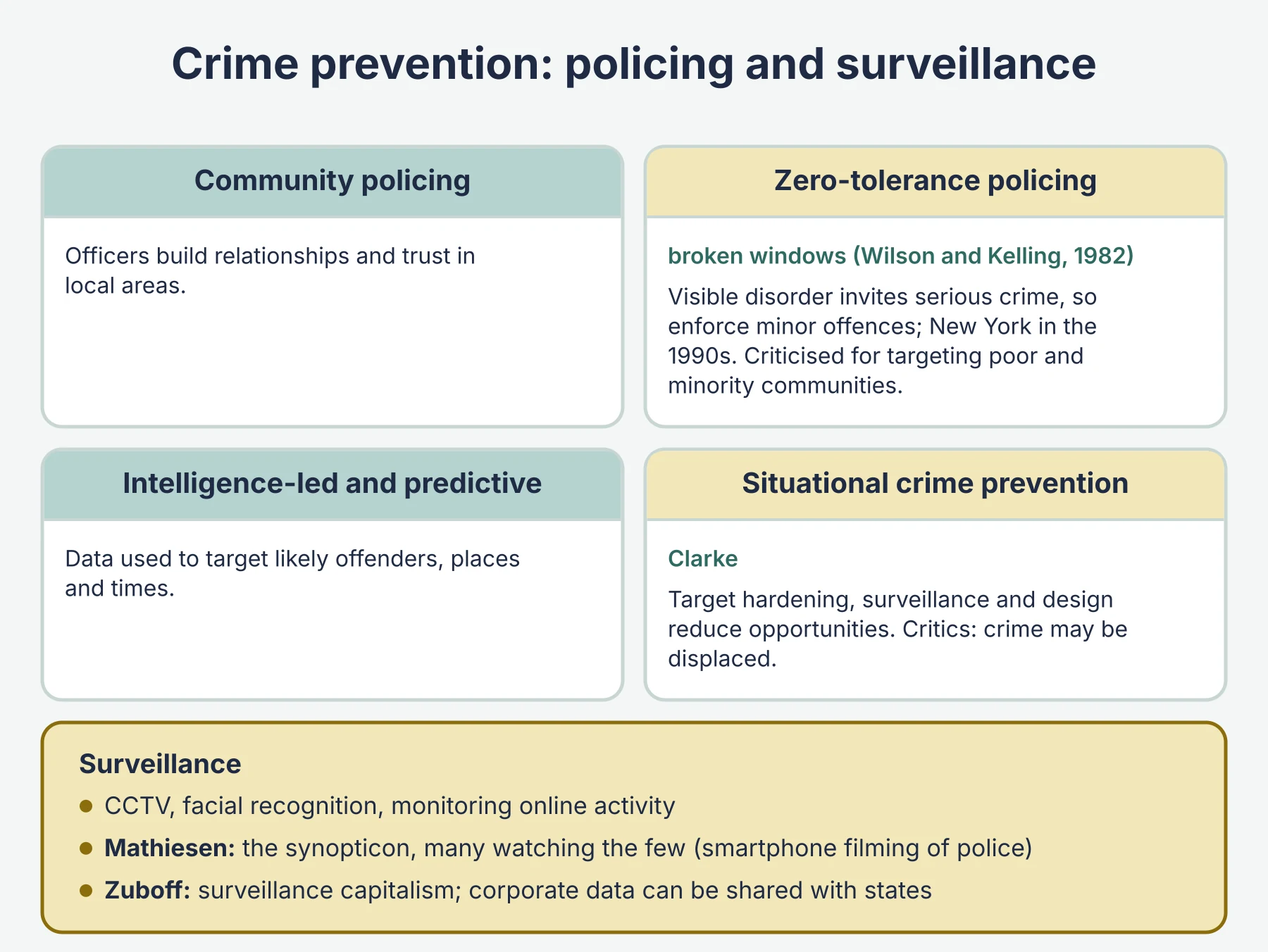
Crime prevention: policing and surveillance
Types of policing
- Community policing: officers build relationships and trust in local areas.
- Zero-tolerance policing: strict enforcement of minor offences, based on James Q. Wilson and George Kelling’s broken windows argument (1982) that visible disorder invites more serious crime; associated with New York in the 1990s, and criticised for targeting poor and minority communities.
- Intelligence-led and predictive policing: using data to target likely offenders, places and times.
Situational crime prevention, associated with Ronald Clarke, reduces opportunities for crime through target hardening (locks, barriers), surveillance and design. Critics say crime may simply be displaced elsewhere.
Surveillance ranges from CCTV and facial recognition to monitoring of online activity. Thomas Mathiesen’s synopticon describes the many watching the few, for example through media and smartphone filming of police. Shoshana Zuboff’s surveillance capitalism extends the debate to corporations collecting behavioural data, which can be shared with states.
State apparatuses, interpellation and hegemony
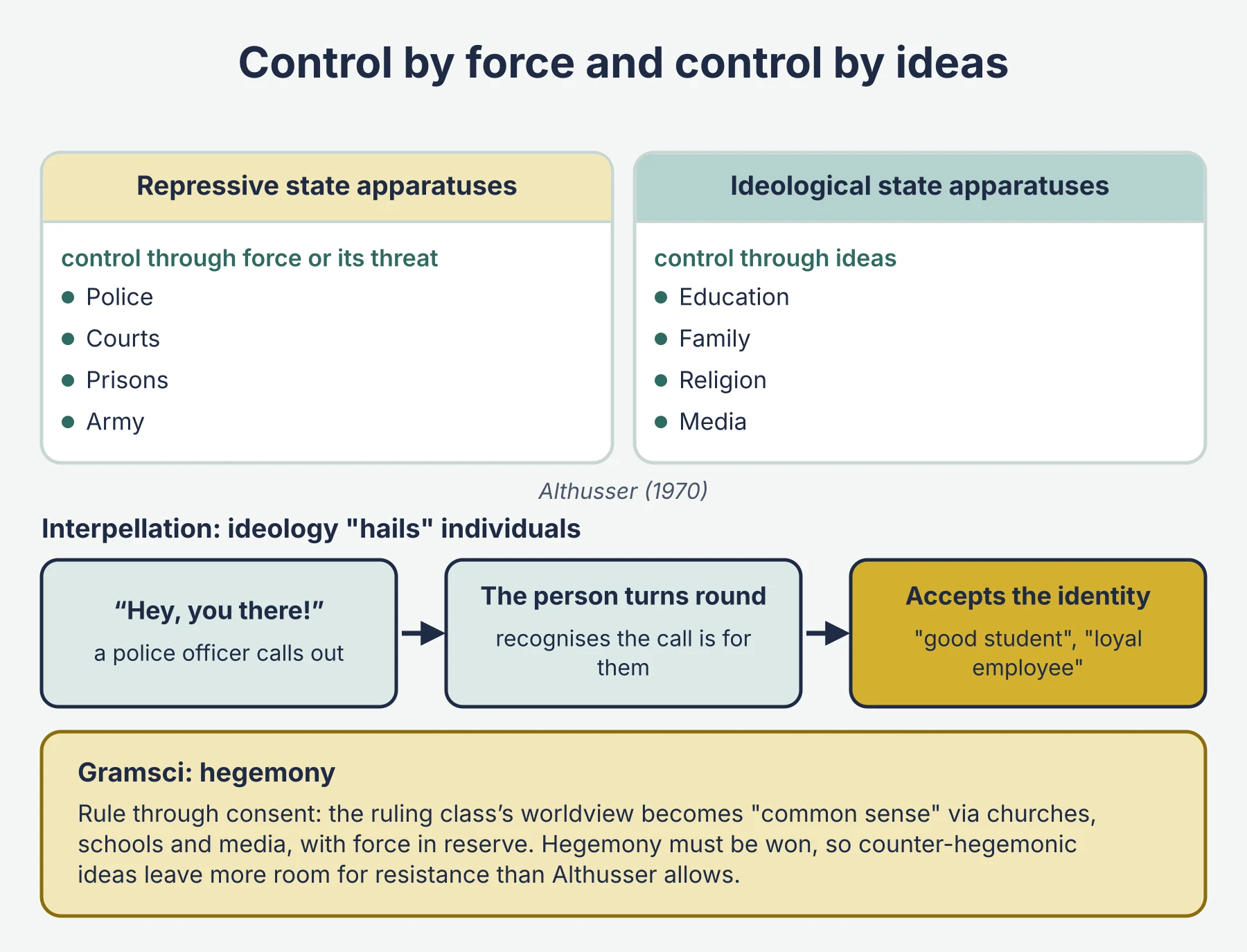
Louis Althusser (1970) distinguished:
- Repressive state apparatuses (RSAs), which control through force or its threat: police, courts, prisons and army.
- Ideological state apparatuses (ISAs), which control through ideas: education, family, religion, media.
Interpellation is Althusser’s term for the way ideology “hails” individuals and turns them into subjects who recognise themselves in the role offered. His example is a police officer calling out “Hey, you there!”: the person who turns around has recognised that the call is addressed to them. Ideology works when people accept identities, such as “good student” or “loyal employee”, as their own.
Antonio Gramsci’s concept of hegemony describes rule through consent rather than force: the ruling class wins acceptance for its worldview as “common sense”, through civil society (churches, schools, media). Force remains in reserve. Because hegemony must be won, it can be challenged by counter-hegemonic ideas, which gives more room for resistance than Althusser’s model.
Perspectives on social control
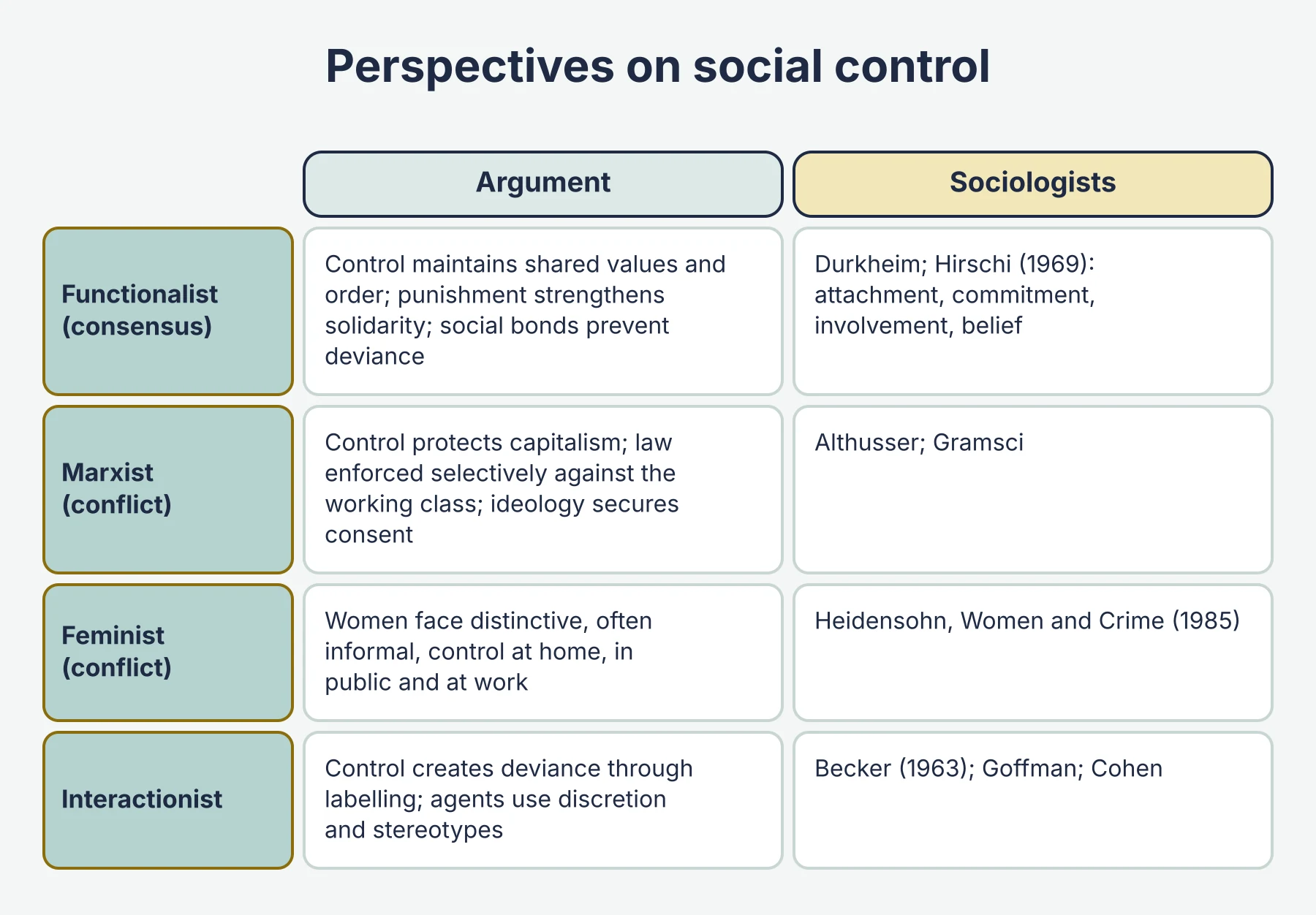
| Perspective | Argument | Sociologists |
|---|---|---|
| Functionalist | Control maintains shared values and order; punishment strengthens solidarity; strong social bonds prevent deviance | Durkheim; Travis Hirschi’s social bond theory (1969): attachment, commitment, involvement, belief |
| Marxist | Control protects capitalism; the law is enforced selectively against the working class; ideology secures consent | Althusser; Gramsci |
| Feminist | Women face distinctive, often informal, control at home, in public and at work, which limits their freedom | Frances Heidensohn’s Women and Crime (1985) |
| Social action / interactionist | Control creates deviance through labelling; agents of control use discretion and stereotypes | Howard Becker’s Outsiders (1963); Goffman; Stanley Cohen |
Worked example: annotated 8-mark answer
Explain the difference between repressive and ideological state apparatuses.
Method of control. Repressive state apparatuses, such as police, courts and prisons, control people through force or the threat of force (define). Ideological state apparatuses, such as schools, the family, religion and media, control through ideas that make inequality seem natural (contrast). Althusser argued that ISAs are more important in stable capitalist societies because they secure obedience without visible coercion (analysis).
Visibility and interpellation. RSAs are visible and can provoke resistance, whereas ISAs work through interpellation, as people accept identities such as “hard-working employee” as their own (develop). This means people may police themselves, so control seems voluntary (consequence).
Common mistakes
- Confusing informal control with positive sanctions: informal sanctions can be negative.
- Attributing hegemony to Althusser or interpellation to Gramsci.
- Listing aims of punishment without types, or vice versa.
- Describing stigma without Goffman’s terms (discredited, discreditable, spoiled identity).
- Forgetting the feminist perspective, which the specification names.
Exam technique
Use the four-cell sanctions grid to generate examples quickly. In evaluation questions, set consensus views against conflict views and add the interactionist point that control can create the deviance it targets. Apply concepts to a named society: its policing model, punishments or surveillance systems.
- Social control revision notes
- Social control practice questions
- What control responds to: deviance, harm and crime study guide
Related resources
-
Practice questions
OxfordAQA International A-Level Sociology (9690): Social Control – Practice Questions
Original OxfordAQA 9690 Unit 2 style questions on stigma, othering, punishment, policing, surveillance, state apparatuses and hegemony, with answers.
Sociology · OxfordAQA · AS Level
Try questions -
Revision notes
OxfordAQA International A-Level Sociology (9690): Social Control – Revision Notes
Revision notes for OxfordAQA 9690 section 3.1.2.4: sanctions, Goffman's stigma, othering, punishment, policing, surveillance, RSAs, ISAs and hegemony.
Sociology · OxfordAQA · AS Level
Revise topic -
Study guides
OxfordAQA International A-Level Sociology (9690): Social Identities and Social Change
Study guide to OxfordAQA 9690 section 3.1.2.3: socially constructed identities, seven bases of identity, and changing gender, ethnic and online identities.
Sociology · OxfordAQA · AS Level
Read guide
Related articles
Get free revision emails (optional)
Occasional emails with practice questions, worked explanations and links to free resources for the qualification and subjects you choose. No spam, and you can unsubscribe from any email. The free tools on this site never need an email.