
Study Guides
OxfordAQA International A-Level Sociology (9690): The Great Divergence
Study guide to OxfordAQA 9690 section 3.2.1.1: imperialism, enslavement, Polanyi and Braudel on capitalism, why Europe industrialised, legacies and development.
- Subject
- Sociology
- Level
- A LEVEL
- Topic
- Unit 3 – People and Development
- Author
- Marlbridge Academic Team
- Updated
- Reviewed by
- Naqiya Yousaf (what this means)
Aligned to OxfordAQA A Level Sociology (9690), Version 1.1 (new qualification). Official specification .
Syllabus page (what it covers and how it is assessed): OxfordAQA A Level Sociology.
Syllabus points this page covers
9690 (A Level)
- 3.2.1.1 The Great Divergence
Found an error? Report a correction.
Need help with this topic? Request a free trial class for A Level Sociology (9690).
Section 3.2.1.1 The Great Divergence opens Unit 3 People and development in OxfordAQA International AS/A level Sociology (9690). The specification asks “How a gap developed between countries that developed quickly and those that have developed more slowly”, then lists imperialism (“the European empires; exploration and trade; enslavement; colonialism; neocolonialism”); industrialisation, urbanisation and capitalism; reasons why Europe industrialised (“modernisation theory; the Protestant work ethic (Weber); dependency theory; enslavement”); legacies of colonialism and enslavement; and factors associated with development, from life expectancy to democracy. The named sociologists for 3.2.1 are Bello, Braudel, Frank, Polanyi, Rodney and Sachs. The Unit 3 study guide summarises the main explanations (Rostow, Weber, Frank, Rodney, Williams, Pomeranz); this guide goes deeper into the history, the named sociologists and how to argue about them.
Unit 3 is assessed by a 1 hour 30 minute exam of 50 marks with short and extended response questions. Selected extended answers require examples from your own society or one you know.
What the “gap” is, and why it matters
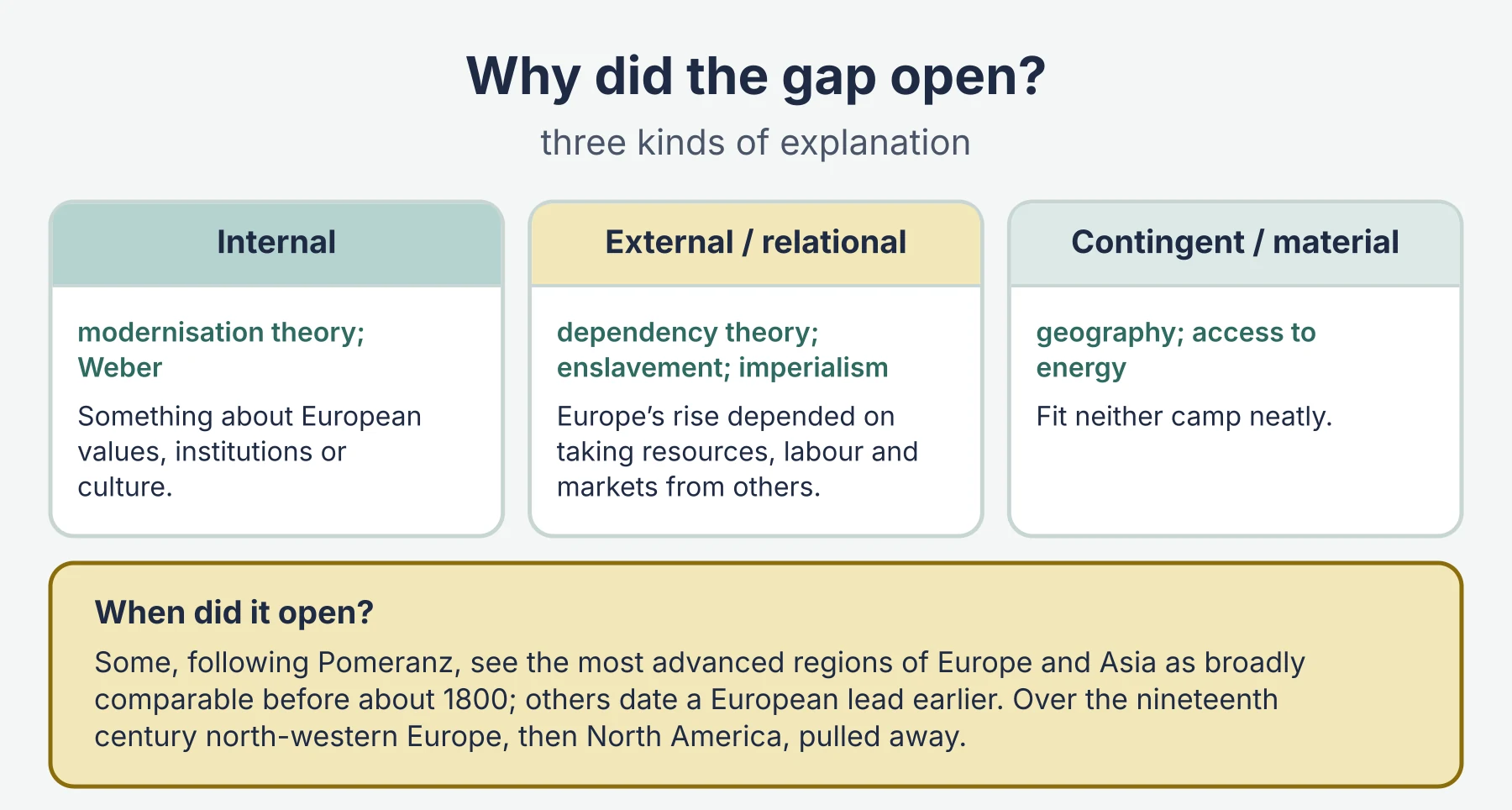
Historians disagree about how far ahead Europe already was before about 1800: some, following Pomeranz, see the most advanced regions of Europe and Asia as broadly comparable, while others date a European lead earlier. Either way, over the nineteenth century industrial societies in north-western Europe and later North America pulled away in output, income and military power. The sociological question is not only when the gap opened but why, and whether the same processes still keep it open. Two broad families of answers compete:
- Internal explanations: something about European values, institutions or culture (modernisation theory, Weber).
- External or relational explanations: Europe’s rise depended on taking resources, labour and markets from others (dependency theory, enslavement, imperialism).
Strong answers also use contingent or material explanations, such as geography and access to energy, which fit neither camp neatly.
Imperialism: from trade to rule
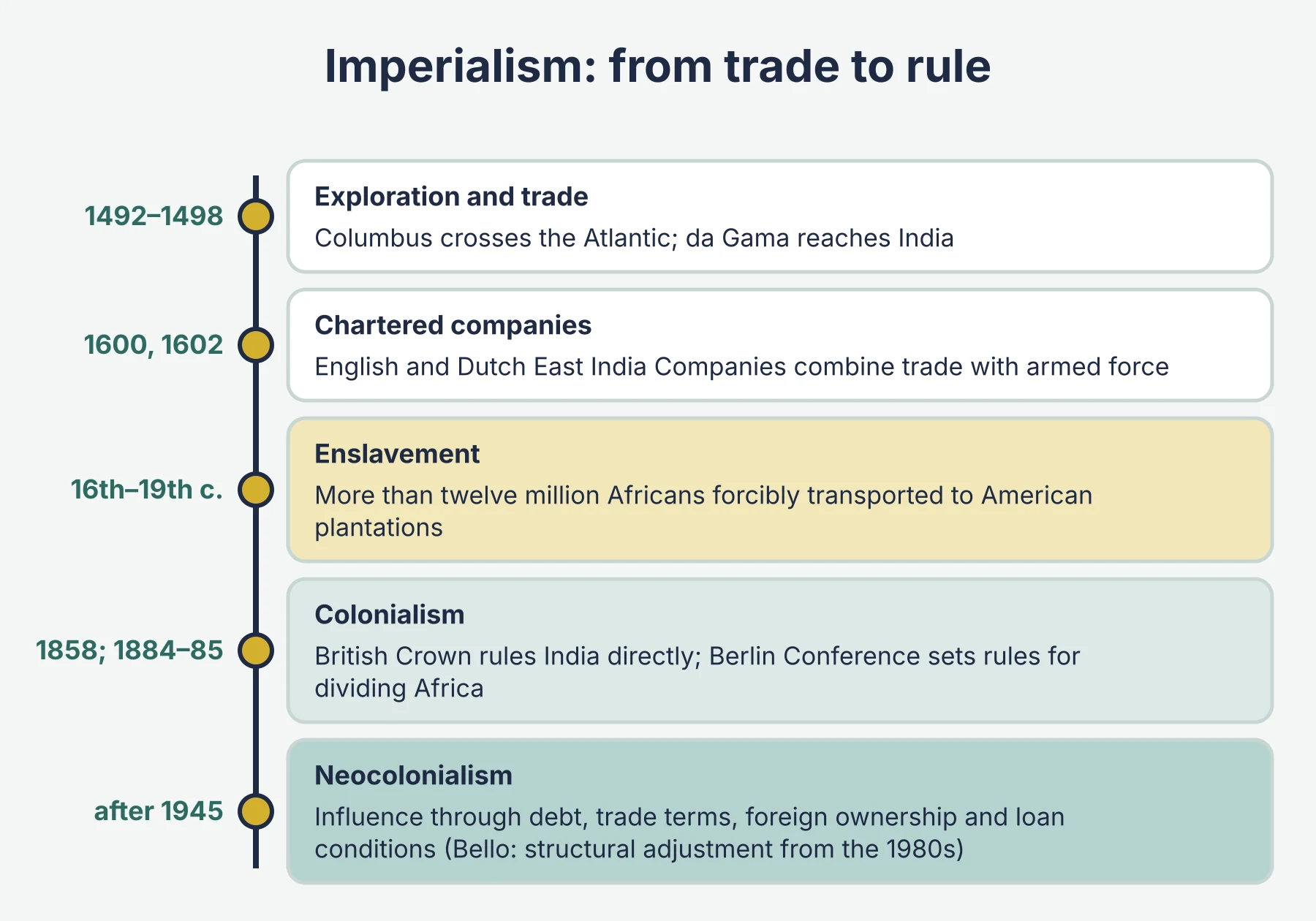
Exploration and trade. Portuguese voyages around Africa, Columbus’s crossing of the Atlantic in 1492 and Vasco da Gama’s arrival in India in 1498 opened sea routes controlled by European states. Chartered trading companies followed, such as the English East India Company (founded 1600) and the Dutch East India Company (1602), combining trade with armed force.
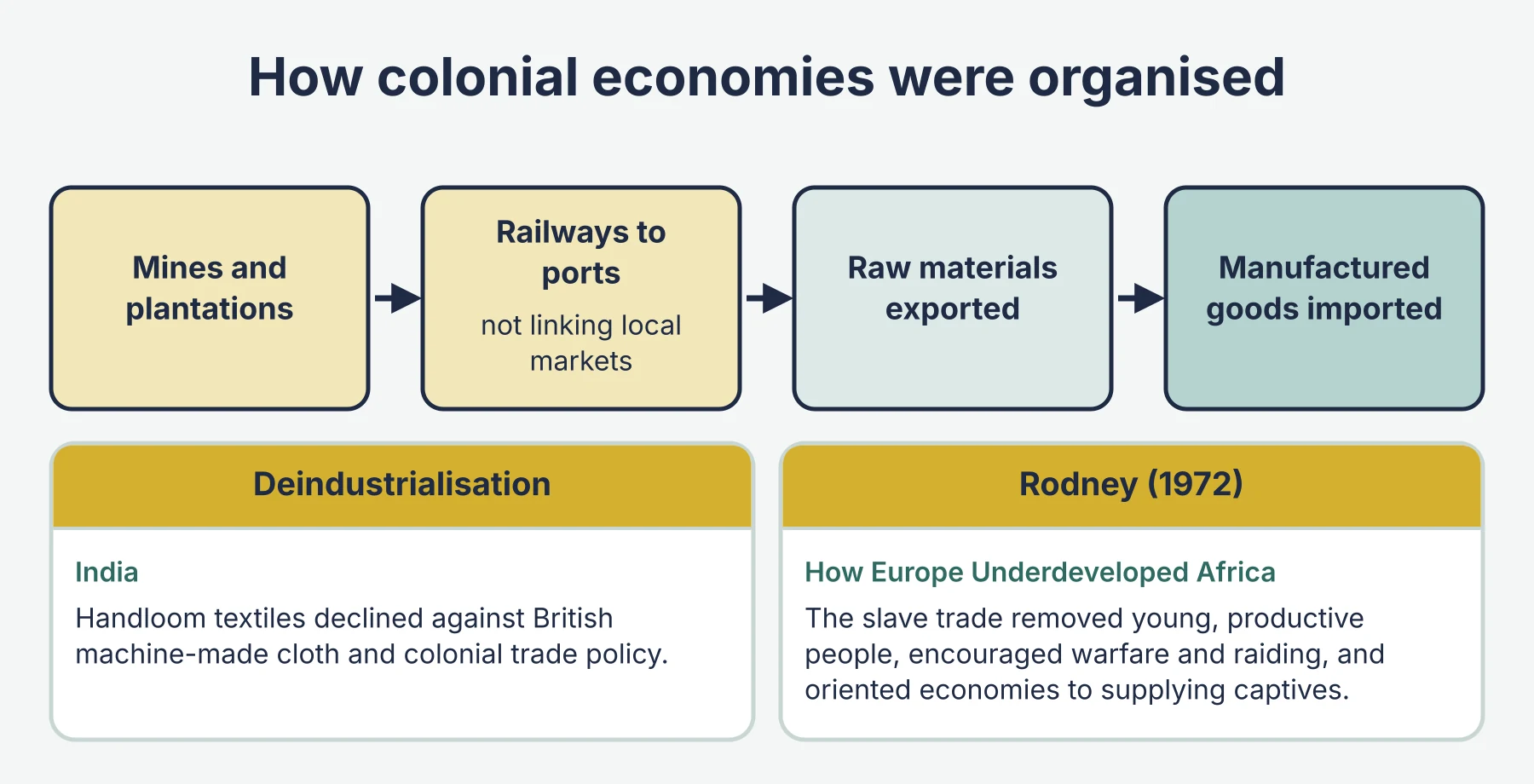
Enslavement. The Atlantic trade forcibly transported more than twelve million Africans to the Americas between the sixteenth and nineteenth centuries, to work on plantations producing sugar, tobacco and cotton for European markets. Walter Rodney (How Europe Underdeveloped Africa, 1972) argued that the trade removed young, productive people, encouraged warfare and raiding, and oriented African economies towards supplying captives rather than developing production.
Colonialism. Direct rule extended across Asia and Africa, especially in the nineteenth century. After 1858 the British Crown ruled India directly, and the Berlin Conference of 1884–85 set rules for European powers dividing Africa. Colonial economies were typically organised to export raw materials and import manufactured goods. Railways often ran from mines and plantations to ports rather than linking local markets. India’s handloom textile industry declined in the face of British machine-made cloth and colonial trade policy, a process historians describe as deindustrialisation.
Neocolonialism. After formal independence, mostly after 1945, influence continued through debt, trade terms, foreign ownership and conditions attached to loans. Walden Bello, a named sociologist, has argued that structural adjustment programmes imposed by the International Monetary Fund and World Bank from the 1980s opened poorer economies to foreign competition on unequal terms.
Industrialisation, urbanisation and capitalism
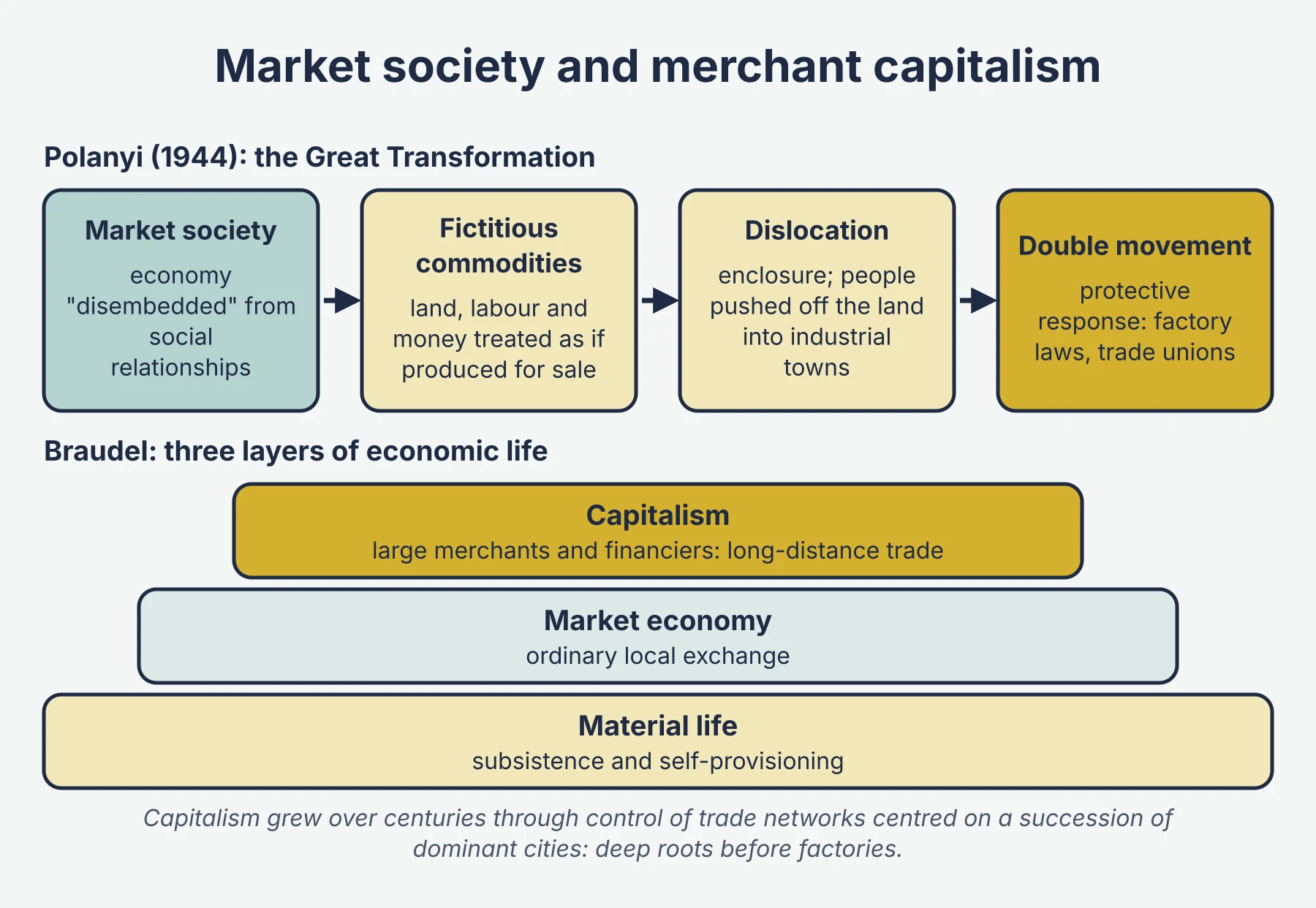
Karl Polanyi (The Great Transformation, 1944) argued that nineteenth-century Britain created something historically new: a market society, in which the economy was “disembedded” from social relationships and land, labour and money were treated as commodities. Polanyi called these fictitious commodities, because they are not produced for sale; treating them as if they were, through enclosure of common land and the creation of a wage-labour market, caused great social dislocation, as people were pushed off the land into growing industrial towns. Society responded with a protective double movement, such as factory laws and trade unions.
Fernand Braudel (Civilization and Capitalism, 15th–18th Century) distinguished three layers of economic life: everyday material life (subsistence and self-provisioning), the market economy of ordinary local exchange, and, at the top, capitalism, the domain of large merchants and financiers able to dominate long-distance trade. For Braudel, European capitalism grew over centuries through control of trade networks centred on a succession of dominant cities, which helps explain why the divergence had deep roots before factories appeared.
Urbanisation accompanied industrialisation: people moved from rural areas to towns for factory work, creating crowded cities with high death rates before public health reforms. Comparisons with today’s rapidly urbanising societies are useful in exams, but note that many cities in less developed countries have grown without equivalent industrial employment.
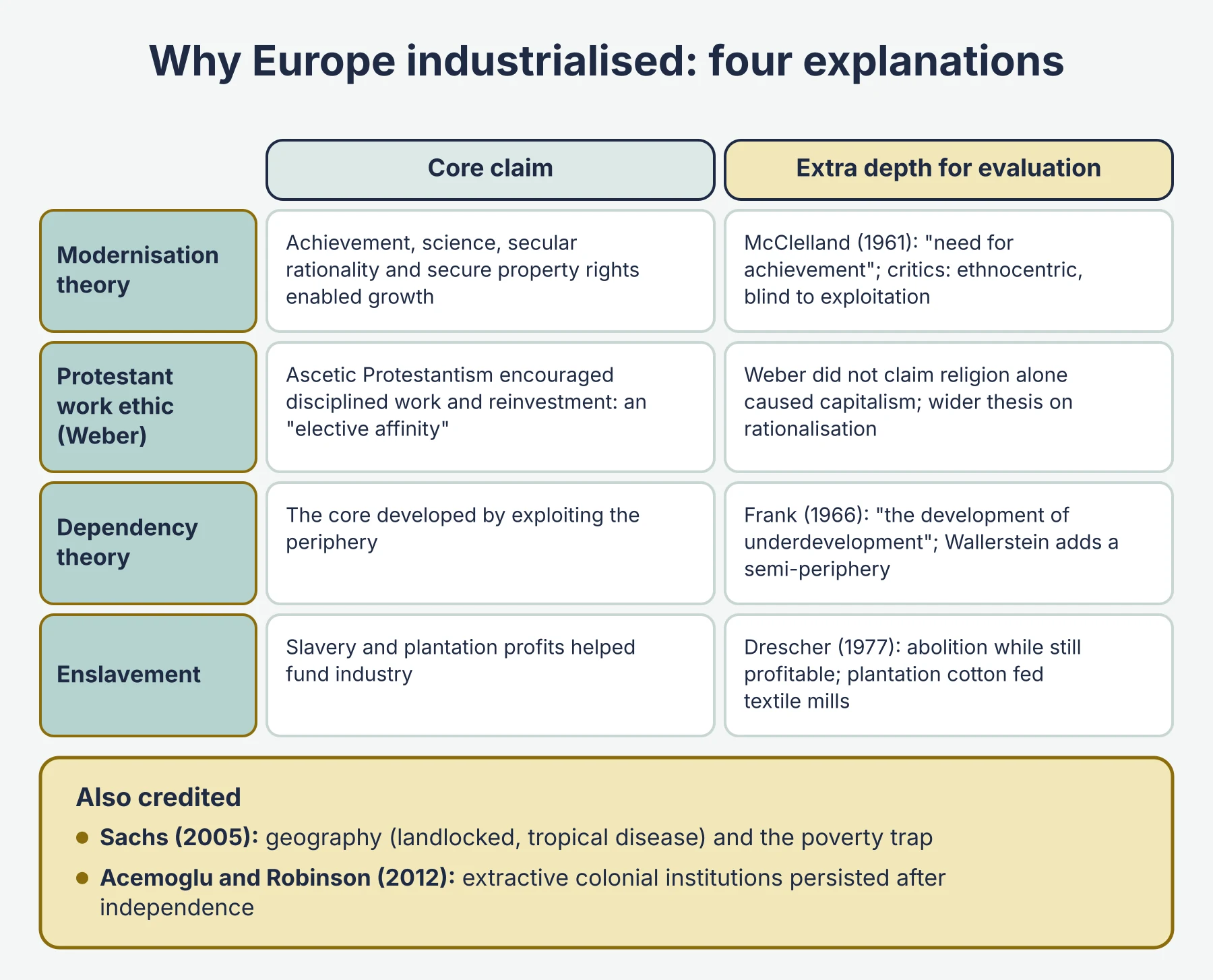
Why Europe industrialised: deepening the four explanations
| Explanation | Core claim | Extra depth for evaluation |
|---|---|---|
| Modernisation theory | Internal values and institutions (achievement, science, secular rationality, secure property rights) enabled growth | David McClelland’s The Achieving Society (1961) linked growth to a cultural “need for achievement”; critics call such accounts ethnocentric and blind to exploitation |
| Protestant work ethic (Weber) | Ascetic Protestantism encouraged disciplined work and reinvestment, an “elective affinity” with capitalism | Weber did not claim religion alone caused capitalism; his wider thesis is about rationalisation of economic, legal and bureaucratic life |
| Dependency theory | The core developed by exploiting the periphery | Andre Gunder Frank’s phrase “the development of underdevelopment” (1966); Immanuel Wallerstein’s world-systems theory adds a semi-periphery and treats the world economy as one system |
| Enslavement | Profits from slavery and plantation trade helped fund industry | Seymour Drescher (Econocide, 1977) argued Britain abolished the slave trade while it was still profitable, challenging purely economic accounts of abolition; others stress plantation cotton as an input to textile factories |
Other explanations credited when used relevantly: Jeffrey Sachs (The End of Poverty, 2005) stresses geography, such as being landlocked or carrying a heavy tropical disease burden, and argues that poor countries can be caught in a poverty trap without outside investment. Daron Acemoglu and James Robinson (Why Nations Fail, 2012) argue that colonial powers built extractive institutions in some colonies, which persisted after independence.
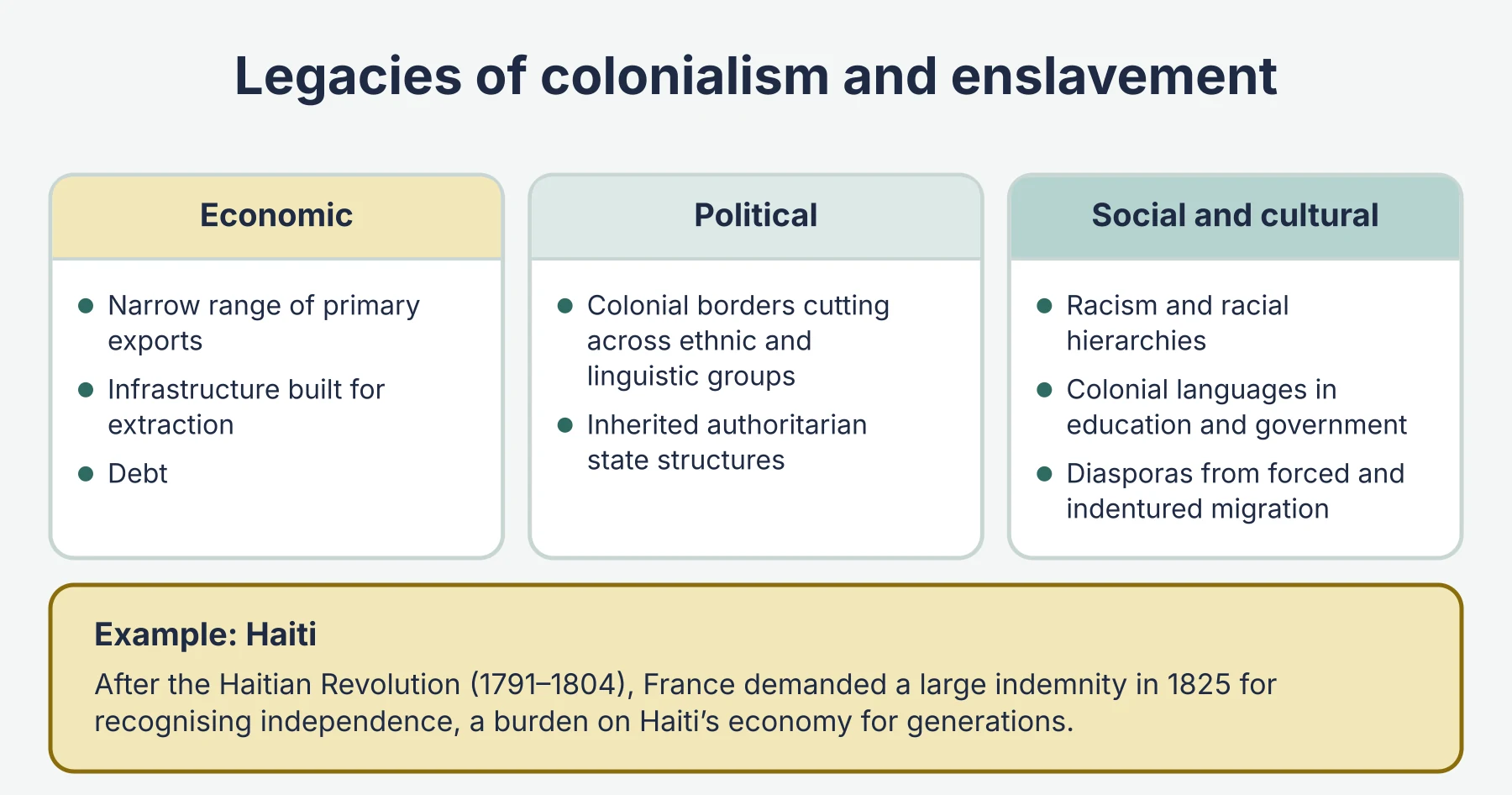
Legacies of colonialism and enslavement
- Economic: dependence on a narrow range of primary exports; infrastructure built for extraction; debt.
- Political: borders drawn by colonial powers that cut across ethnic and linguistic groups; authoritarian state structures inherited from colonial administration.
- Social and cultural: racism and racial hierarchies; colonial languages dominating education and government; diasporas created by forced and indentured migration.
- Example: after the Haitian Revolution (1791–1804), France demanded a large indemnity in 1825 for recognising Haitian independence, a burden that weighed on Haiti’s economy for generations.
Factors and changes associated with development
The specification lists life expectancy; living standards, greater affluence and reduced poverty; education; health; rights of women and other groups; human rights; and democracy. Amartya Sen’s Development as Freedom (1999) argues development should be judged by people’s capabilities, their real freedom to live lives they value, not income alone. This lets you question whether rapid economic growth always counts as development, for example where it occurs without political rights or with growing inequality.
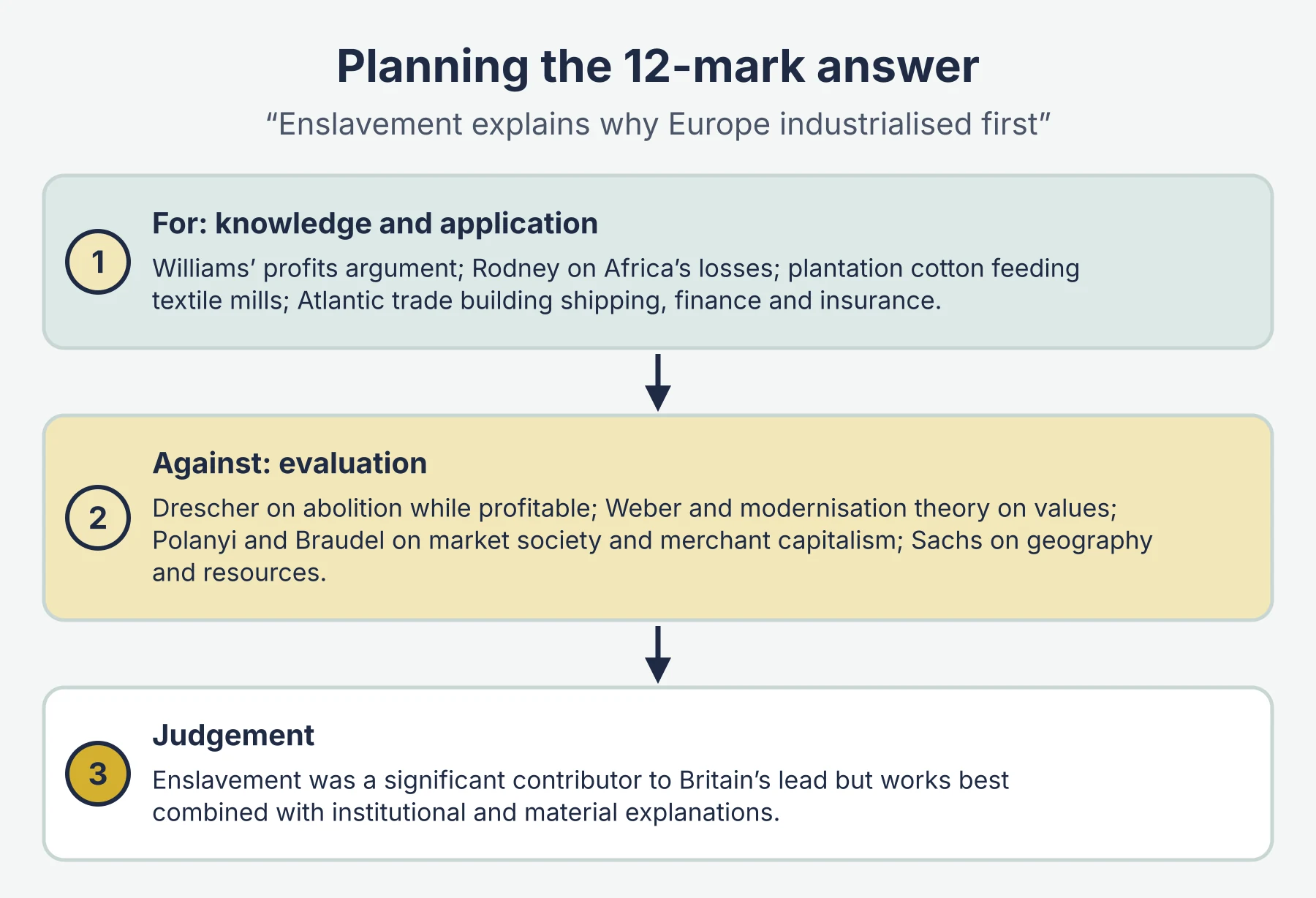
Worked example: annotated 12-mark plan
Evaluate the view that enslavement explains why Europe industrialised first.
- For: Williams’ profits argument; Rodney on Africa’s losses; plantation cotton feeding textile mills; Atlantic trade building shipping, finance and insurance (knowledge and application).
- Against: Drescher’s evidence that abolition came while the trade was profitable; Weber and modernisation theory stress values; Polanyi and Braudel stress the long rise of market society and merchant capitalism; Sachs and others stress geography and resources (evaluation).
- Judgement: enslavement was a significant contributor to Britain’s lead but works best combined with institutional and material explanations (conclusion).
Common mistakes
- Treating colonialism and neocolonialism as the same thing.
- Calling Weber a dependency theorist.
- Naming Polanyi or Braudel without their concepts (fictitious commodities, double movement; layers of economic life).
- Measuring development by income alone when the specification lists social and political factors.
- Giving only one explanation in a question that invites comparison.
Exam technique
Short questions reward precise definitions with a historical example. Extended answers reward setting internal against external explanations, using at least one named sociologist from the specification list, and applying to a named society’s colonial history or development path.
Related resources
-
Practice questions
OxfordAQA International A-Level Sociology (9690): The Great Divergence – Practice Questions
Original OxfordAQA 9690 Unit 3 style questions on imperialism, enslavement, Polanyi, why Europe industrialised and legacies of colonialism, with answers.
Sociology · OxfordAQA · A Level
Try questions -
Revision notes
OxfordAQA International A-Level Sociology (9690): The Great Divergence – Revision Notes
Revision notes for OxfordAQA 9690 section 3.2.1.1: imperialism, enslavement, Polanyi, Braudel, Rodney, Frank, Weber, Sachs, legacies and development factors.
Sociology · OxfordAQA · A Level
Revise topic -
Study guides
OxfordAQA International A-level Sociology (9690): What is meant by globalisation?
Study guide to OxfordAQA 9690 section 3.2.1.2: defining globalisation, its cultural, political and economic forms, how far it has gone and the global and local.
Sociology · OxfordAQA · A Level
Read guide
Related articles
Get free revision emails (optional)
Occasional emails with practice questions, worked explanations and links to free resources for the qualification and subjects you choose. No spam, and you can unsubscribe from any email. The free tools on this site never need an email.