
Revision Notes
OxfordAQA International A-Level Sociology (9690): The Great Divergence – Revision Notes
Revision notes for OxfordAQA 9690 section 3.2.1.1: imperialism, enslavement, Polanyi, Braudel, Rodney, Frank, Weber, Sachs, legacies and development factors.
- Subject
- Sociology
- Level
- A LEVEL
- Topic
- Unit 3 – People and Development
- Author
- Marlbridge Academic Team
- Updated
- Reviewed by
- Naqiya Yousaf (what this means)
Aligned to OxfordAQA A Level Sociology (9690), Version 1.1 (new qualification). Official specification .
Syllabus page (what it covers and how it is assessed): OxfordAQA A Level Sociology.
Syllabus points this page covers
9690 (A Level)
- 3.2.1.1 The Great Divergence
Found an error? Report a correction.
Need help with this topic? Request a free trial class for A Level Sociology (9690).
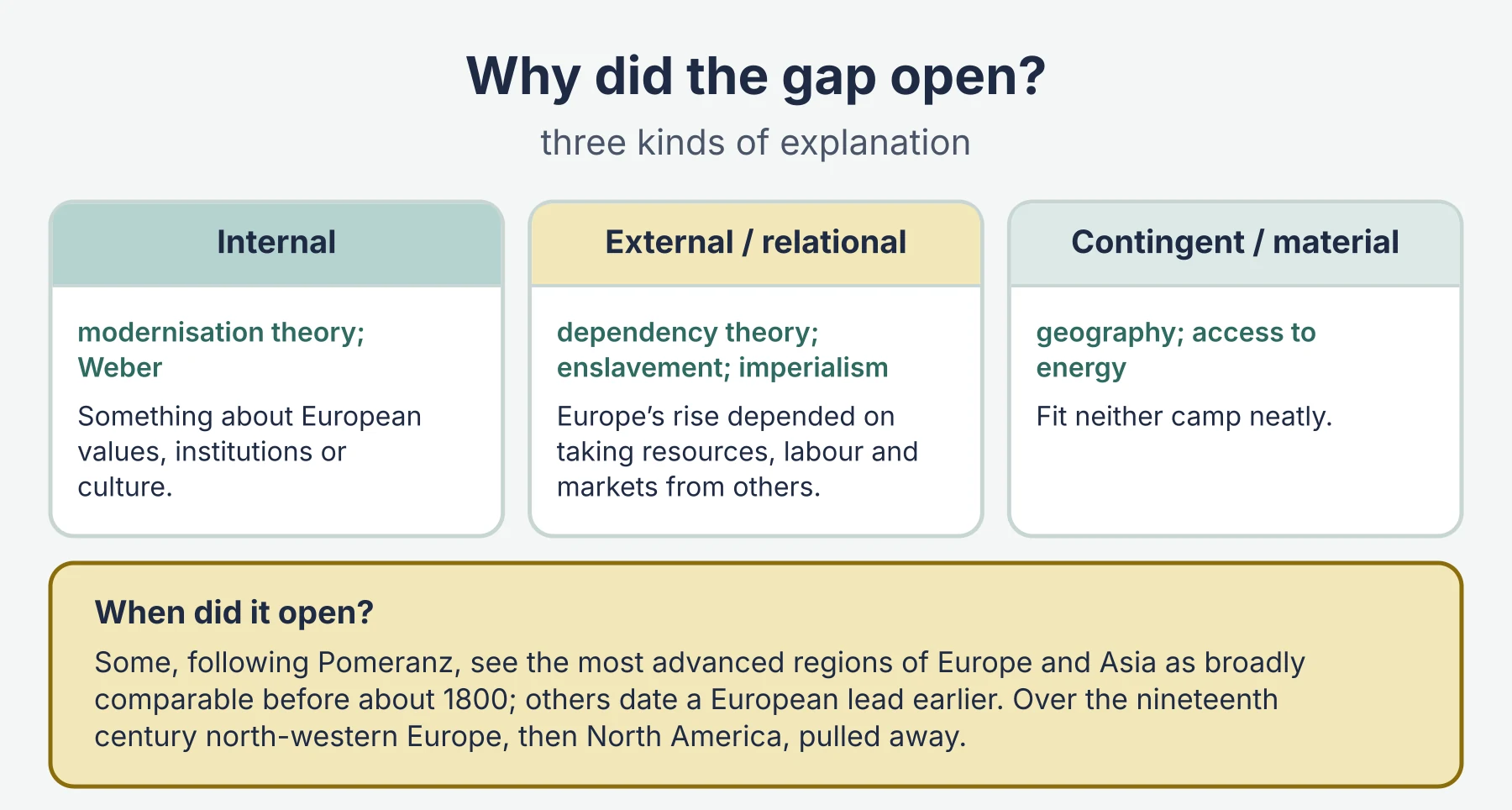
These notes condense 3.2.1.1 The Great Divergence in OxfordAQA International AS/A level Sociology (9690), assessed in the Unit 3 exam (1 hour 30 minutes, 50 marks, short and extended response questions). Core idea: during the nineteenth century some countries, led by north-western Europe, developed much faster than others; sociologists explain the gap through internal values and institutions, through exploitation of other regions, or through a mix of both, and judge development by more than income.
Full explanation: the Great Divergence study guide.
Specification checklist
- How a gap developed between countries that developed quickly and those that developed more slowly.
- Imperialism: the European empires; exploration and trade; enslavement; colonialism; neocolonialism.
- Industrialisation, urbanisation and capitalism.
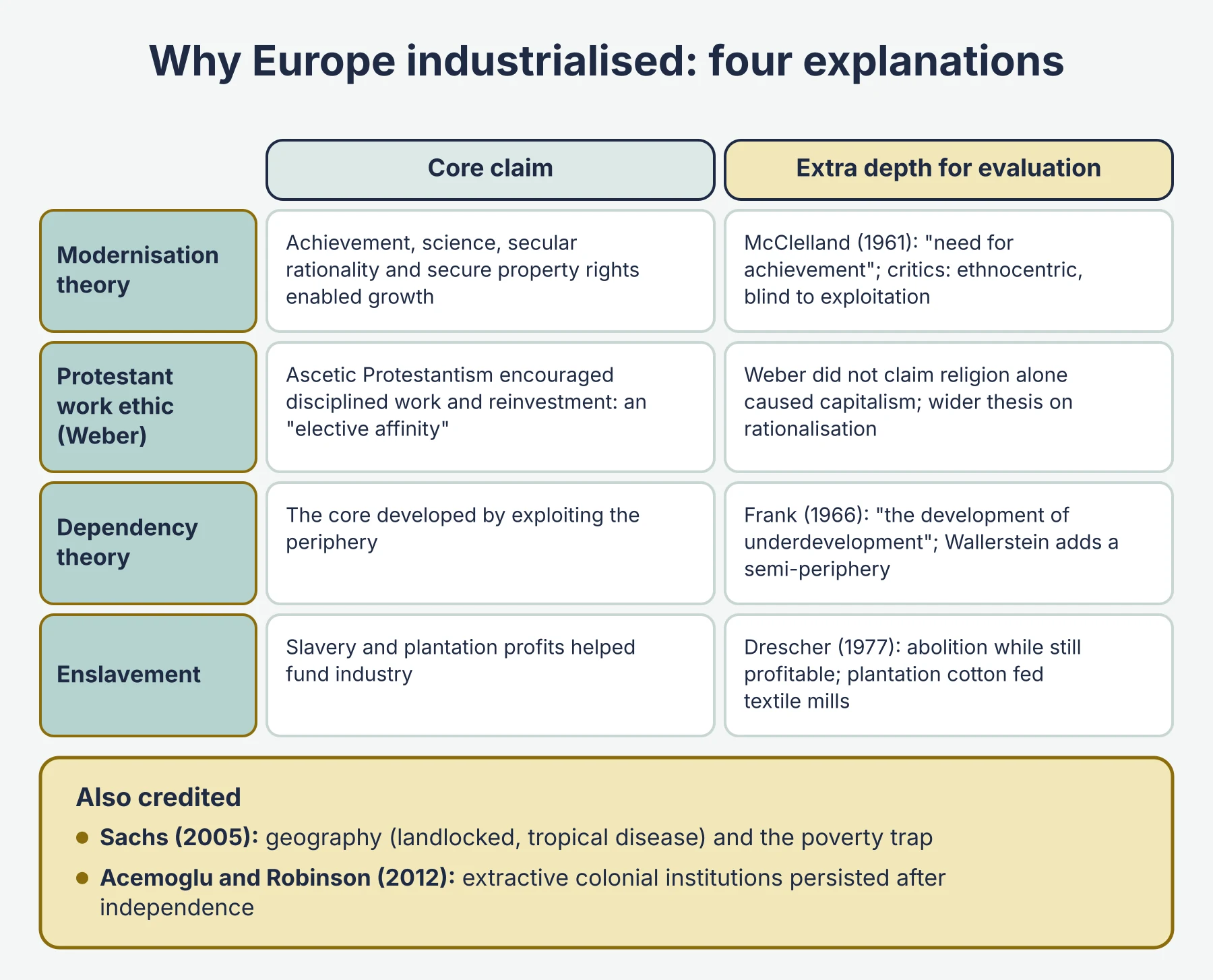
- Reasons why Europe industrialised: modernisation theory; the Protestant work ethic (Weber); dependency theory; enslavement.
- Legacies of colonialism and enslavement; neocolonialism.
- Development factors: life expectancy; living standards, affluence, reduced poverty; education; health; rights of women and other groups; human rights; democracy.
- Named sociologists for 3.2.1: Bello, Braudel, Frank, Polanyi, Rodney, Sachs.
Key terms
| Term | Definition |
|---|---|
| Great Divergence | The widening gap between fast- and slow-developing countries from the nineteenth century |
| Imperialism | Extending a state’s power over other territories |
| Colonialism | Direct rule of a territory and extraction of its resources and labour |
| Neocolonialism | Indirect control after independence, through debt, trade and investment |
| Enslavement | Treating people as property and forcing them to work |
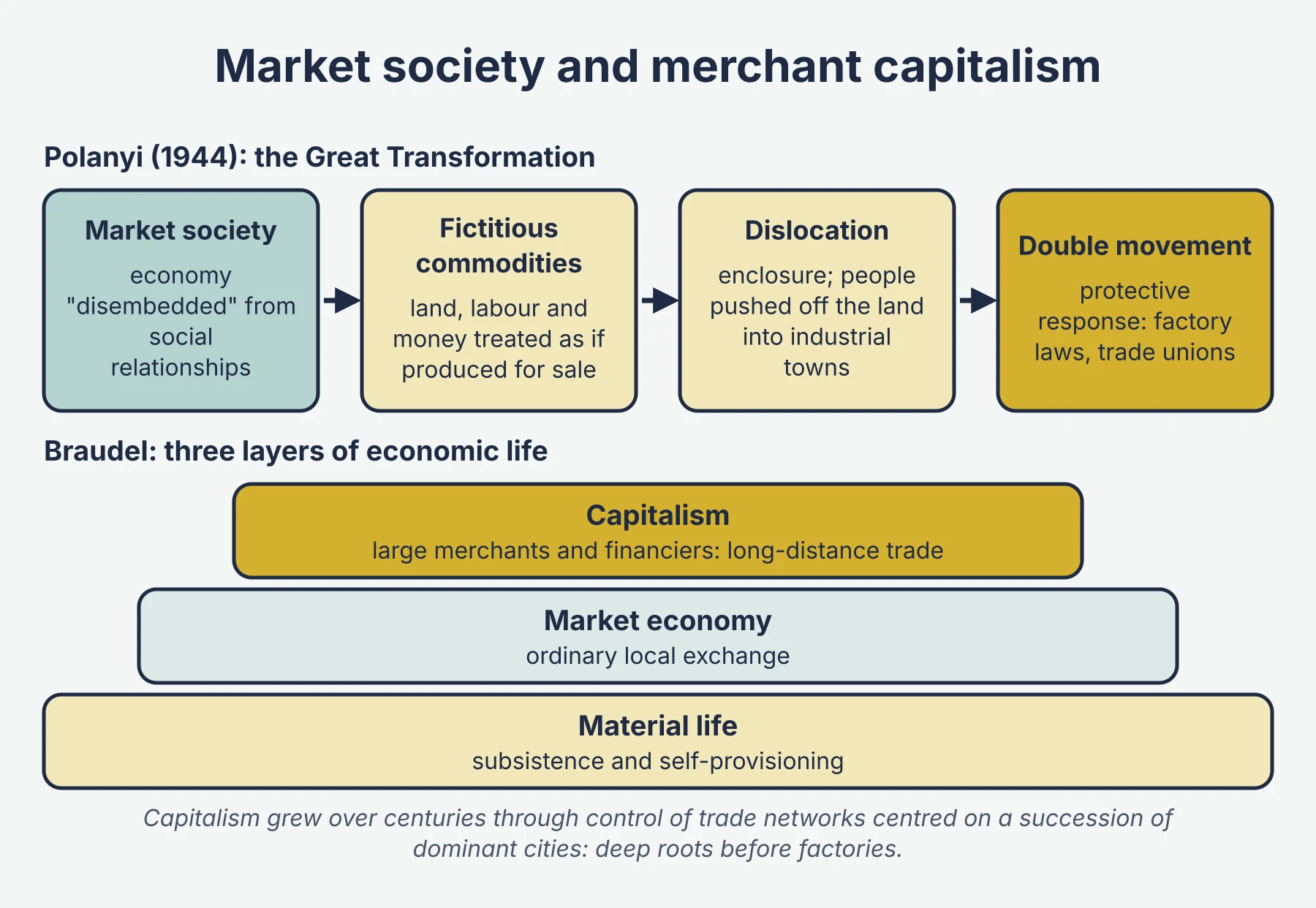
| Market society | Polanyi: society in which economic life is “disembedded” and run by markets |
| Fictitious commodities | Polanyi: land, labour and money, treated as goods though not produced for sale |
| Double movement | Polanyi: society’s protective reaction against market expansion |
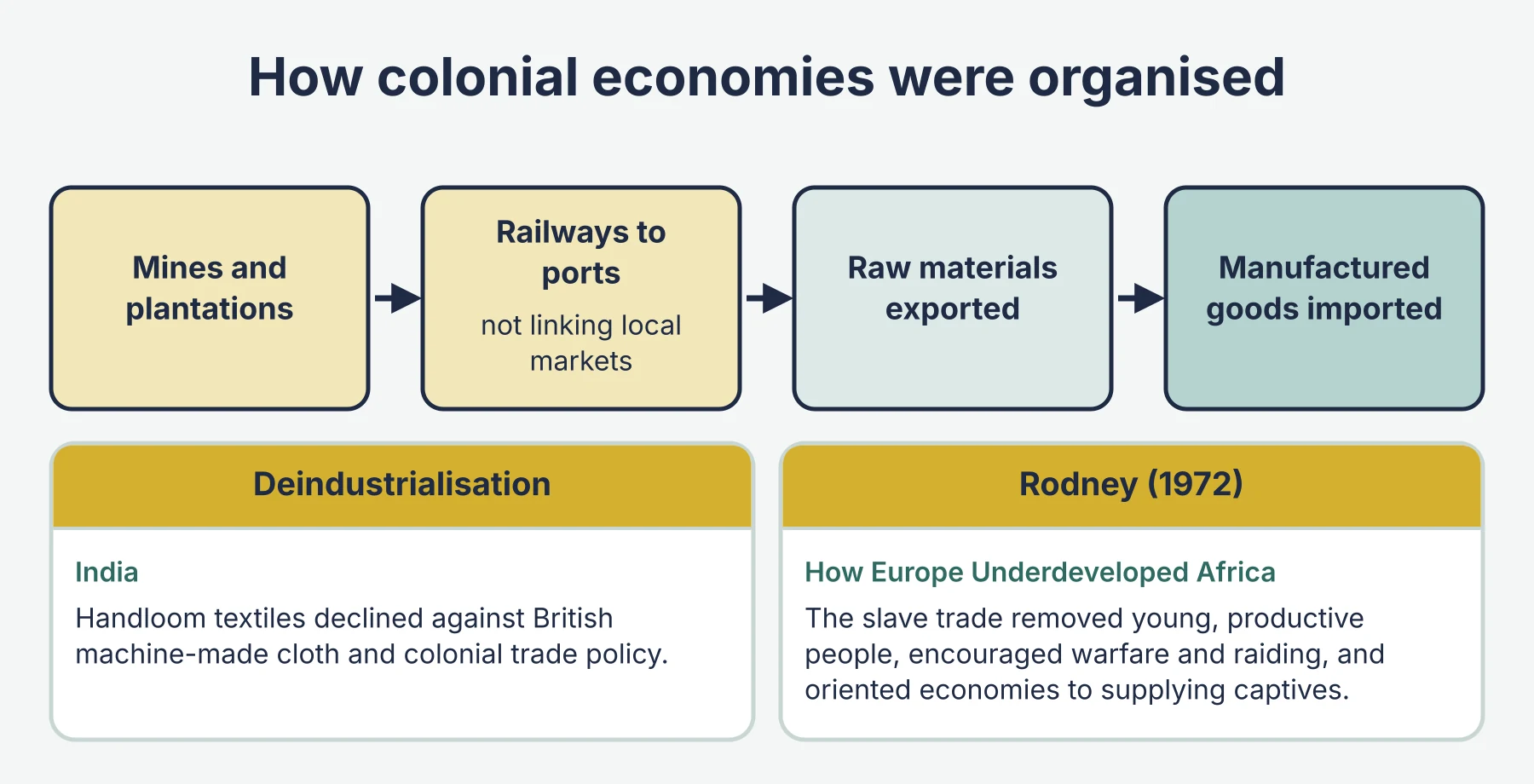
| Deindustrialisation (colonial) | Decline of local manufacturing under colonial competition, as with Indian handloom textiles |
| Poverty trap | Sachs: poverty prevents the investment needed to escape poverty |
| Extractive institutions | Acemoglu and Robinson: institutions built to extract wealth for a narrow elite |
| Capabilities | Sen: people’s real freedoms to live lives they value |
Timeline to anchor examples
| Date | Event |
|---|---|
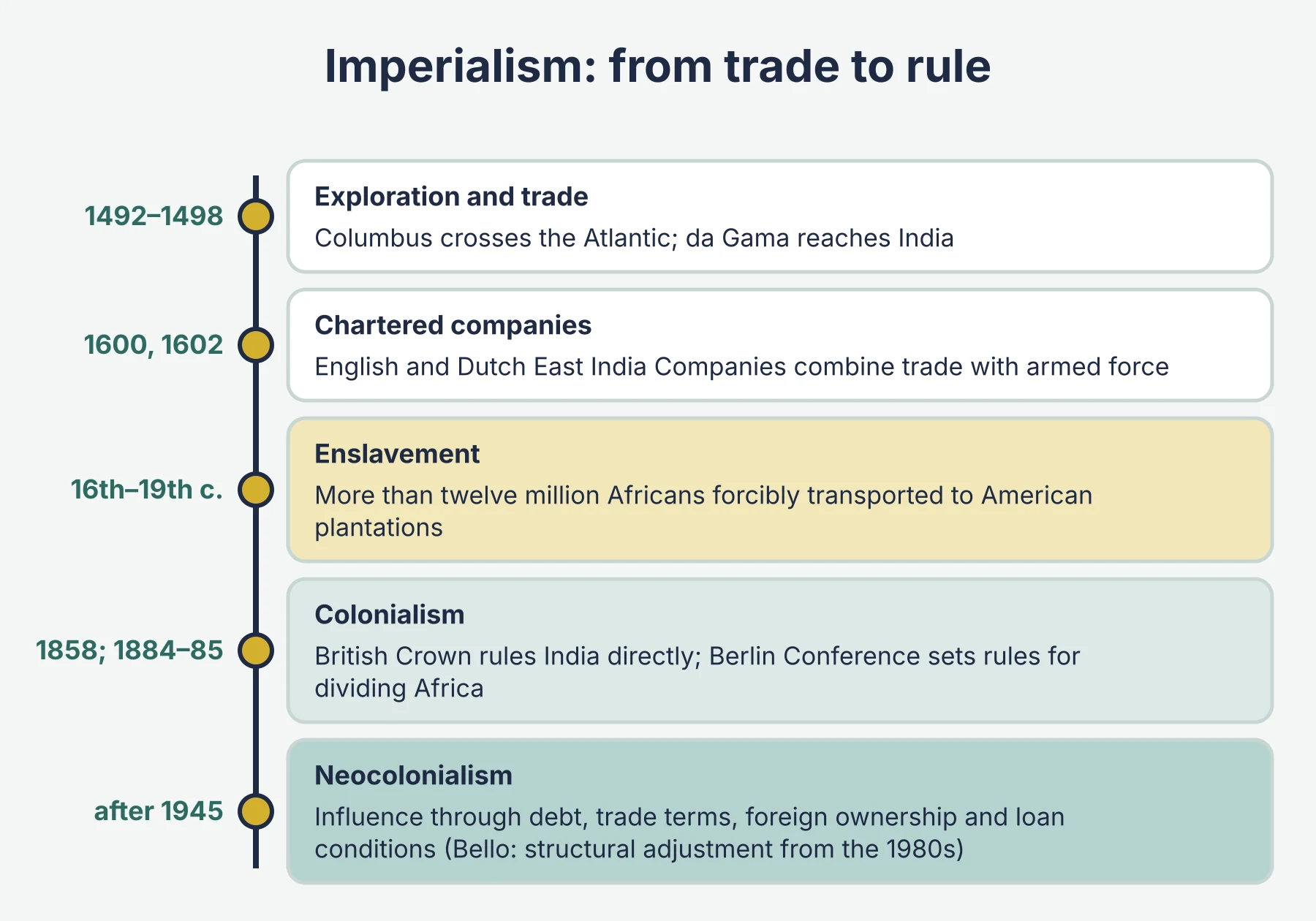
| 1492, 1498 | Columbus crosses the Atlantic; da Gama reaches India by sea |
| 1600, 1602 | English and Dutch East India Companies founded |
| Sixteenth to nineteenth centuries | Atlantic trade forcibly transports more than twelve million Africans |
| 1791–1804 | Haitian Revolution; France later demands an indemnity (1825) |
| 1858 | British Crown takes direct rule of India |
| 1884–85 | Berlin Conference on the division of Africa |
| After 1945 | Decolonisation; neocolonialism debates |
| 1980s onwards | Structural adjustment programmes, criticised by Bello |
Named sociologists
| Name | Idea for this section |
|---|---|
| Polanyi (1944) | Market society; fictitious commodities; double movement |
| Braudel | Three layers: material life, market economy, capitalism; long-run merchant capitalism |
| Rodney (1972) | The slave trade and colonialism underdeveloped Africa |
| Frank (1966) | “The development of underdevelopment”; metropolis and satellite |
| Sachs (2005) | Geography, disease and the poverty trap |
| Bello | Neocolonial effects of structural adjustment; deglobalisation |
Other useful names: Weber (Protestant ethic, rationalisation); McClelland (1961, need for achievement); Wallerstein (world-systems); Williams and Drescher (slavery and industry debate); Acemoglu and Robinson (2012); Sen (1999).
Explanations compared
| Explanation | Type | Strength | Weakness |
|---|---|---|---|
| Modernisation theory | Internal | Explains role of science, enterprise, institutions | Ethnocentric; ignores exploitation |
| Weber | Internal | Links culture and economy | Capitalism also grew elsewhere; not a single cause |
| Dependency theory | External | Explains why the gap opened alongside empire | Some ex-colonies grew fast; treats periphery as passive |
| Enslavement | External | Shows violence behind accumulation | Drescher: abolition despite profitability |
| Geography (Sachs) | Material | Explains persistent disadvantages | Can seem determinist |
| Institutions | Mixed | Links colonial rule to later outcomes | Hard to measure |
Legacies
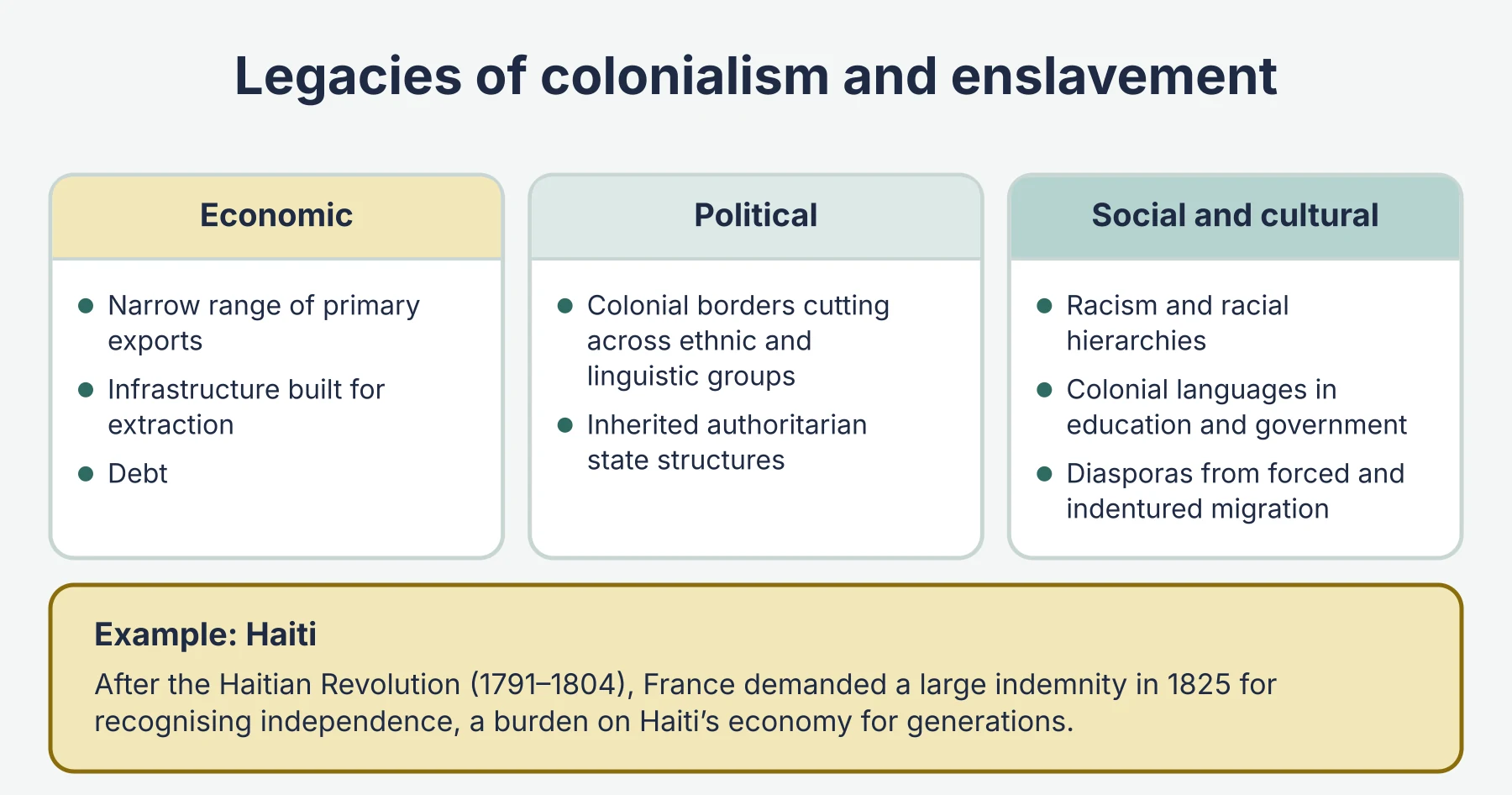
- Economic: primary-export dependence, extractive infrastructure, debt.
- Political: colonial borders, inherited authoritarian structures.
- Social: racism, colonial languages, diasporas.
Evaluation lines to reuse
- “Internal explanations such as Weber’s explain why enterprise was valued, but not where the land, labour and raw materials came from.”
- “Rapid growth in some former colonies weakens dependency theory, but those cases often involved strong states and favourable Cold War alliances.”
- “Polanyi shows market society was built by enclosure and state action, not by values alone.”
Exam traps
- Colonialism and neocolonialism used interchangeably.
- Weber described as a dependency theorist.
- Polanyi or Braudel named without concepts.
- Development measured only by income.
- No named society in extended answers.
Self-test
- Define the Great Divergence.
- Name two European trading companies and their founding years.
- What did Rodney argue?
- What are Polanyi’s fictitious commodities?
- What is the double movement?
- Name Braudel’s three layers of economic life.
- What did Frank mean by “the development of underdevelopment”?
- What did McClelland argue?
- How does Drescher challenge the link between slavery and industrialisation?
- What is Sachs’s poverty trap?
- Give two legacies of colonialism.
- How does Sen define development?
Answers
- The widening gap between fast- and slow-developing countries from the nineteenth century.
- English East India Company (1600); Dutch East India Company (1602).
- The slave trade and colonialism drained Africa’s people and wealth and distorted its economies.
- Land, labour and money, treated as commodities though not produced for sale.
- Society’s protective reaction against market expansion, such as factory laws.
- Material life, the market economy and capitalism.
- Rich countries’ development and poor countries’ underdevelopment are produced by the same process.
- Economic growth depends on a cultural “need for achievement”.
- He argued Britain abolished the slave trade while it was still profitable.
- Poverty prevents the investment needed to escape poverty, so outside help is needed.
- Primary-export dependence; colonial borders; racism; debt.
- As expanding people’s capabilities, their real freedom to live lives they value.
Practise next: the Great Divergence practice questions | Unit 3 study guide
Related resources
-
Study guides
OxfordAQA International A-level Sociology (9690): What is meant by globalisation?
Study guide to OxfordAQA 9690 section 3.2.1.2: defining globalisation, its cultural, political and economic forms, how far it has gone and the global and local.
Sociology · OxfordAQA · A Level
Read guide -
Practice questions
OxfordAQA International A-level Sociology (9690): What is meant by globalisation? – Practice Questions
Original OxfordAQA 9690 practice questions on the meaning, types and extent of globalisation and the global and the local, with mark-scheme answers.
Sociology · OxfordAQA · A Level
Try questions -
Revision notes
OxfordAQA International A-level Sociology (9690): What is meant by globalisation? – Revision Notes
Revision notes for OxfordAQA 9690 section 3.2.1.2: definitions, types and extent of globalisation, the three views, winners and losers, and glocalisation.
Sociology · OxfordAQA · A Level
Revise topic
Related articles
Get free revision emails (optional)
Occasional emails with practice questions, worked explanations and links to free resources for the qualification and subjects you choose. No spam, and you can unsubscribe from any email. The free tools on this site never need an email.