
Revision Notes
OxfordAQA International A-level Sociology (9690): What is meant by globalisation? – Revision Notes
Revision notes for OxfordAQA 9690 section 3.2.1.2: definitions, types and extent of globalisation, the three views, winners and losers, and glocalisation.
- Subject
- Sociology
- Level
- A LEVEL
- Topic
- Unit 3 – People and Development
- Author
- Marlbridge Academic Team
- Updated
- Reviewed by
- Naqiya Yousaf (what this means)
Aligned to OxfordAQA A Level Sociology (9690), Version 1.1. Official specification .
Syllabus page (what it covers and how it is assessed): OxfordAQA A Level Sociology.
Syllabus points this page covers
9690 (A Level)
- 3.2.1.2 What is meant by globalisation?
Found an error? Report a correction.
Need help with this topic? Request a free trial class for A Level Sociology (9690).
These notes condense content point 3.2.1.2 What is meant by globalisation? of OxfordAQA International A-level Sociology (9690), Version 1.1, assessed in the Unit 3 People and development exam. For full explanations and annotated answers, read the globalisation study guide; for the whole unit, the Unit 3 revision notes.
What the specification lists
- Different types of globalisation: cultural, political and economic.
- Cultural: languages; religious beliefs; popular culture; the internet and global communication; the global village; cultural imperialism.
- Political: democracy, human rights and gender equality.
- Economic: global spread of capitalism and global trade; transnational corporations; global activism.
- The extent to which each type has happened and is happening.
- Theoretical views: neo-liberal (positive globalist); negative globalist; transformationalist.
- Benefits and harms for different countries and people.
- The global and the local, how the local survives, glocalisation.
Core recall
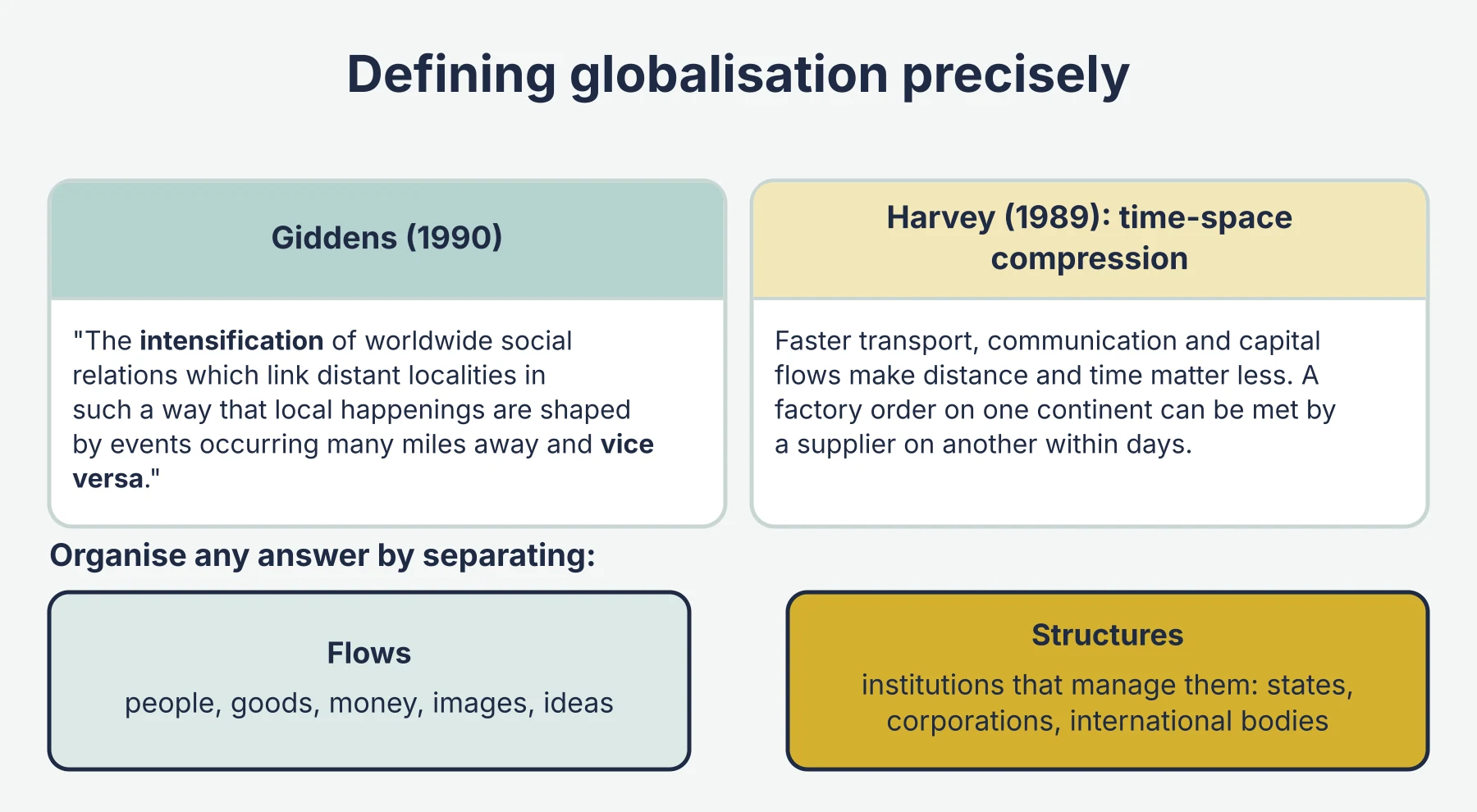
Two definitions to quote
- Giddens (1990): “the intensification of worldwide social relations which link distant localities” so that local events are shaped by distant ones “and vice versa”.
- Harvey (1989): time-space compression, as faster transport, communication and money flows shrink the effect of distance.
Cultural globalisation
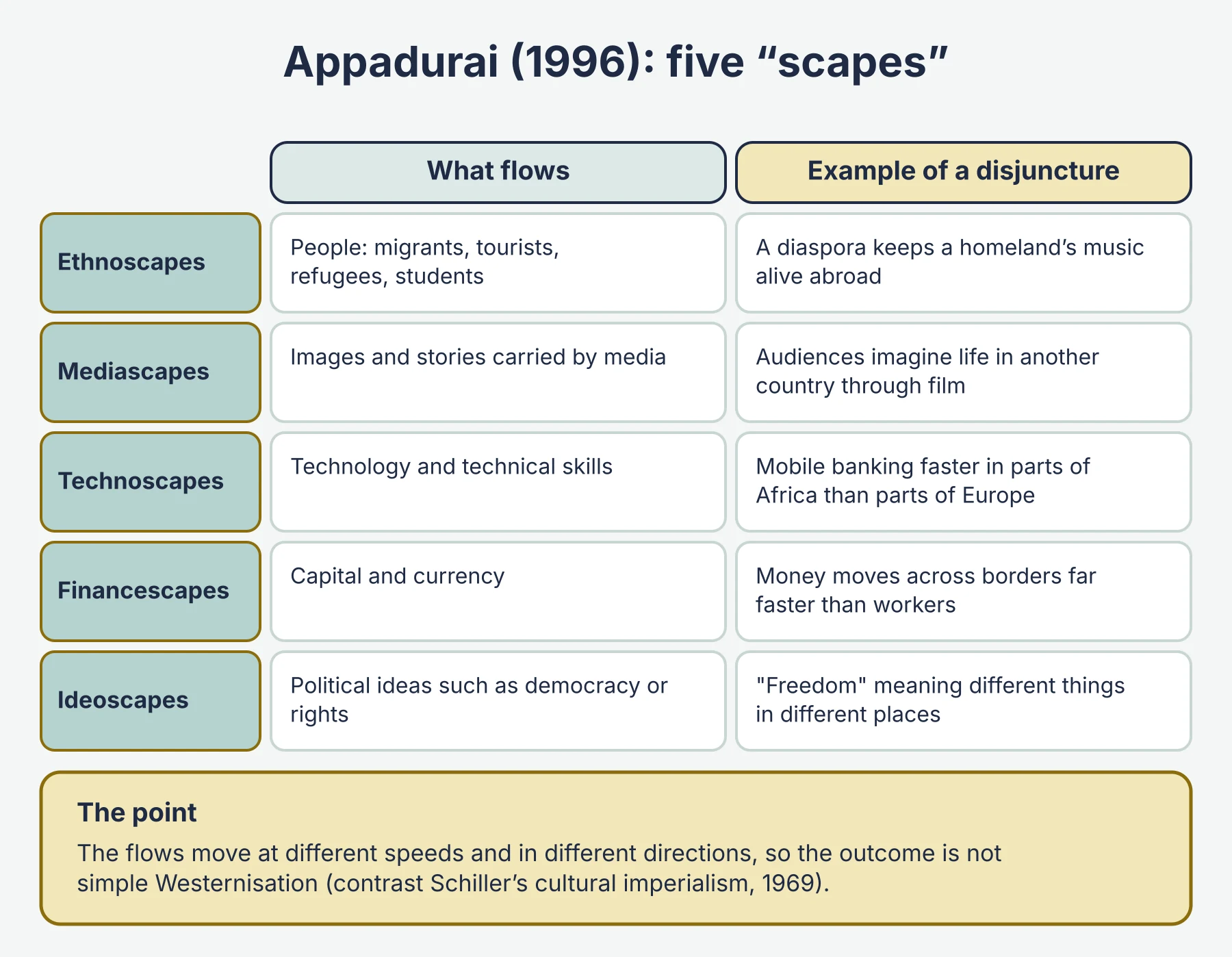
- Appadurai (1996): five uneven flows or “scapes”: ethno-, media-, techno-, finance- and ideoscapes. Uneven flows mean outcomes are mixed, not simple Westernisation.
- Schiller (1969): cultural imperialism through US media corporations exporting commercial values.
- Giddens (1999): fundamentalism as a defensive reaction produced by globalisation.
- Languages: English dominant in business, science and online; many small languages endangered; digital media also help minority languages.
Political globalisation
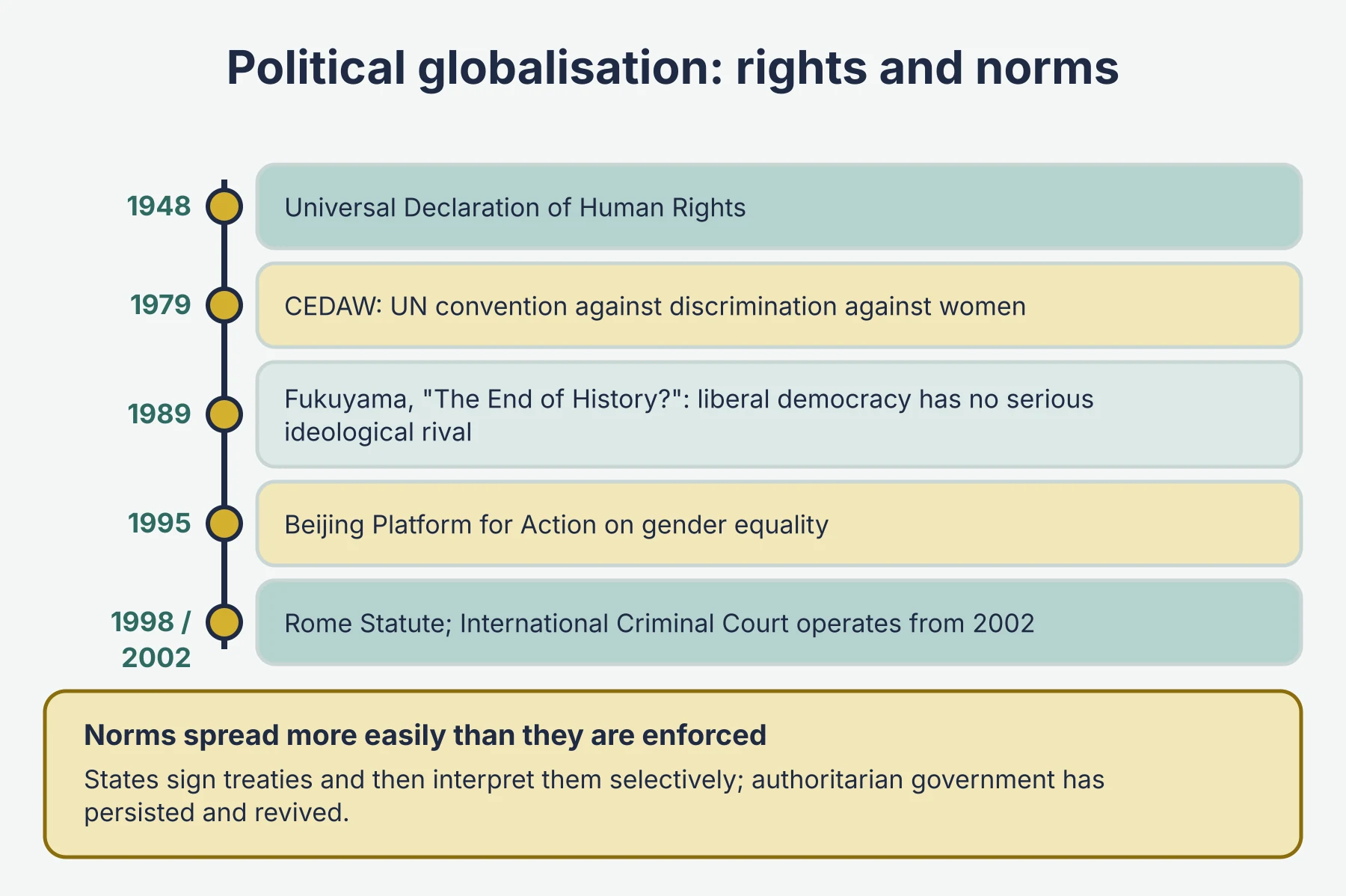
- Universal Declaration of Human Rights (1948); International Criminal Court (Rome Statute 1998, working from 2002).
- CEDAW (1979) and the Beijing Platform for Action (1995) on gender equality.
- Fukuyama (1989): liberal democracy without ideological rivals. Counter: authoritarian governments persist and revive.
- Norms spread more easily than they are enforced.
Economic globalisation
- China’s reforms (1978), the end of the Soviet bloc (1989 onwards), China joins the WTO (2001).
- Global supply chains: design, assembly and sale in different countries.
- Global activism: Seattle WTO protests (1999); World Social Forum (2001, “another world is possible”).
The extent debate
| Position | Claim | Key evidence |
|---|---|---|
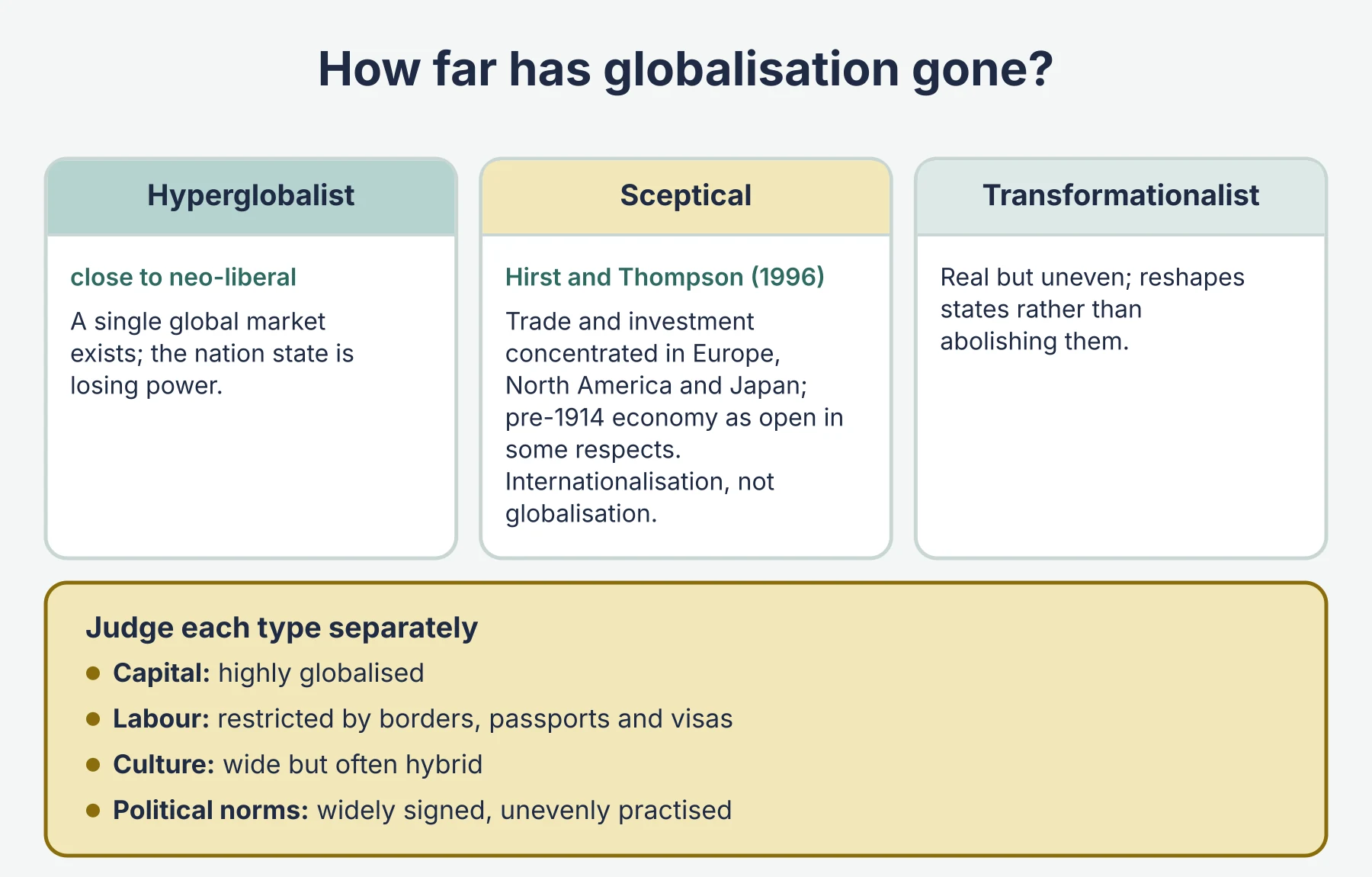
| Hyperglobalist / neo-liberal | One global market; state power declining | Capital moves instantly; global brands everywhere |
| Sceptic (Hirst and Thompson, 1996) | Internationalisation, not globalisation; states still strong | Trade concentrated in rich regions; pre-1914 openness comparable |
| Transformationalist | Real but uneven; reshapes states | States share power with corporations and international bodies |
Judge each type separately: capital and goods most globalised, people least (borders, passports, visas), culture wide but hybrid, political norms signed but unevenly practised.
Winners and losers
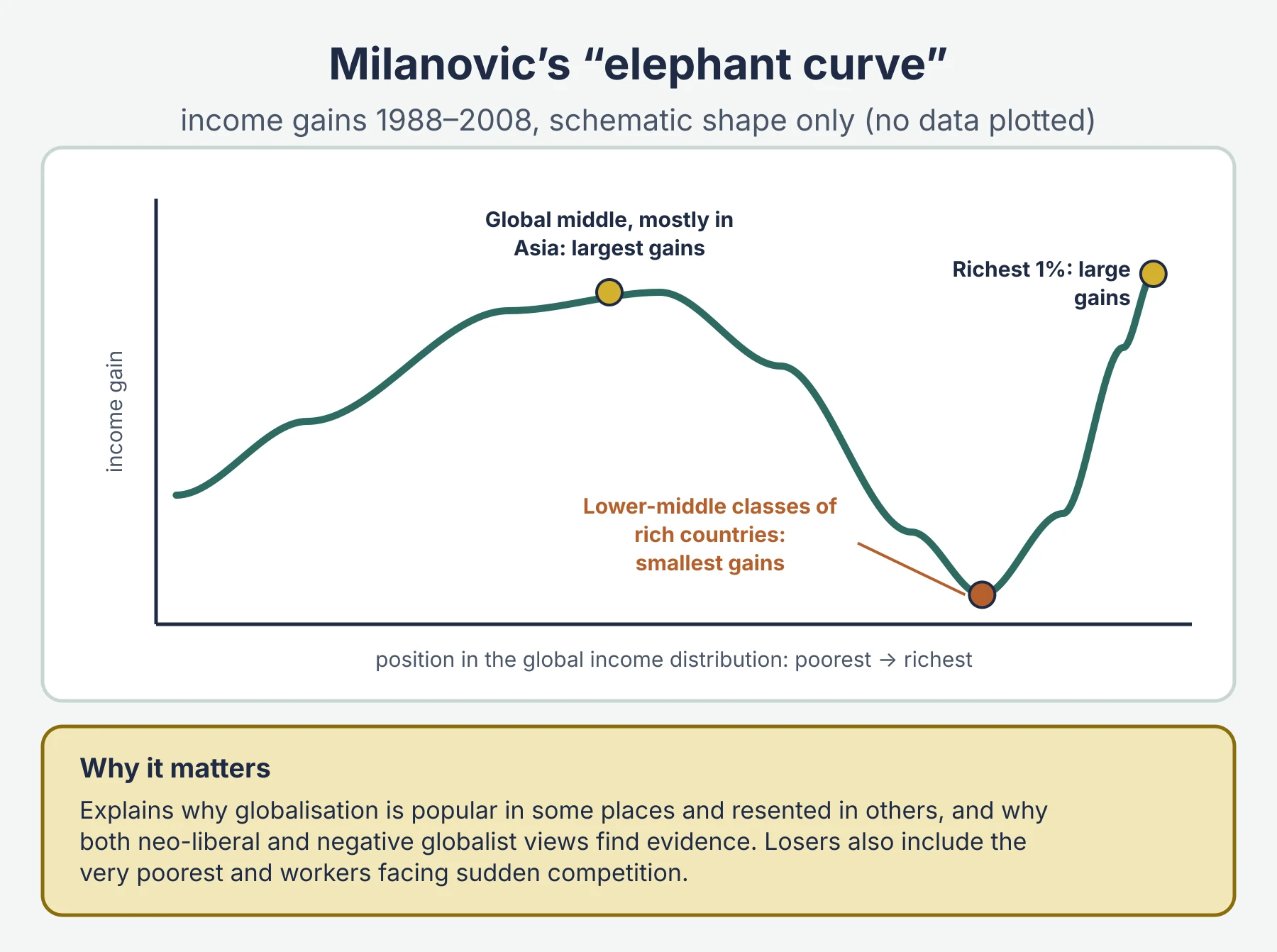
- Milanovic’s “elephant curve” (2016), world incomes 1988 to 2008: biggest gains for the global middle (mostly Asia) and the global top 1 per cent; smallest for the lower-middle classes of rich countries.
- The very poorest often lack the infrastructure and skills to join global markets.
The global and the local
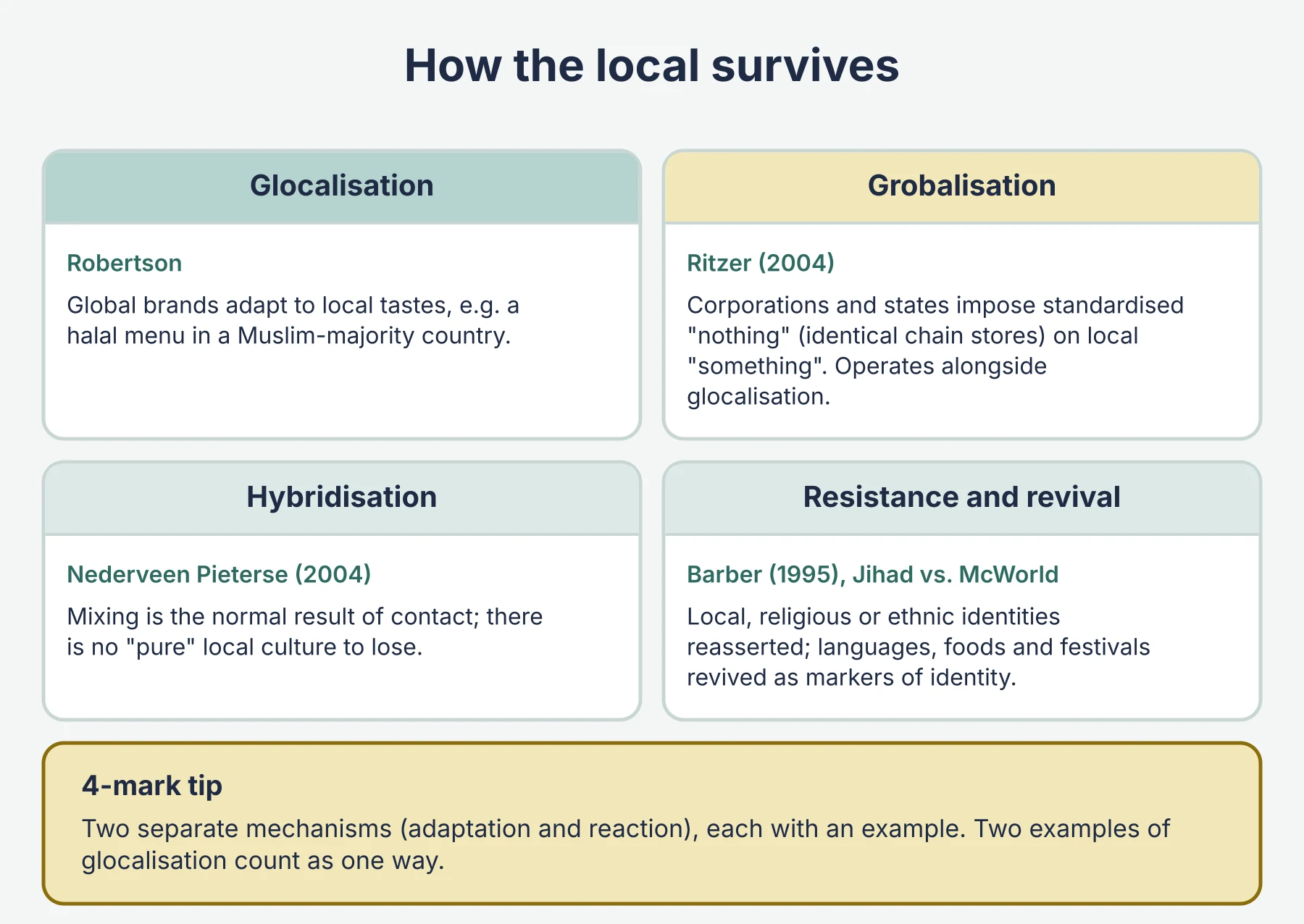
- Glocalisation (Robertson): global products adapted locally.
- Grobalisation (Ritzer, 2004): corporations and states imposing standard forms; “nothing” (centrally designed) versus “something” (locally rooted).
- Hybridisation (Nederveen Pieterse, 2004): mixing is normal; no “pure” local culture.
- Barber (1995), “Jihad vs. McWorld”: consumer capitalism versus reassertion of local, ethnic or religious identity.
Key terms
| Term | Definition |
|---|---|
| Globalisation | Growing interconnection of societies so distant events shape local life, and the reverse |
| Time-space compression | Shrinking effect of distance and time through faster flows (Harvey) |
| Global village | McLuhan’s image of electronic media linking the world like one community |
| Cultural imperialism | Domination of local cultures by Western, especially American, media and consumer culture |
| Glocalisation | Adapting global products or ideas to local cultures |
| Grobalisation | Imposition of standardised forms by corporations and states (Ritzer) |
| Hybridisation | Mixing of cultures into new forms |
| Internationalisation | Increased exchange between nation states that remain the main actors (sceptics’ term) |
| Global activism | Campaigning organised across borders, often against corporate power |
| Positive globalist | Neo-liberal view that free markets spread prosperity |
| Negative globalist | View that globalisation is real and deepens inequality |
| Transformationalist | View that globalisation is real but uneven and reshapes rather than ends states and cultures |
Exam traps
- Sceptic is not the same as negative globalist. Sceptics doubt the extent; negative globalists accept the extent and condemn the effects.
- Glocalisation needs adaptation. A global chain simply being present in your city is not glocalisation.
- “Extent” needs comparison. Saying “globalisation has gone very far” without separating capital, goods, people, culture and politics will not reach the top band.
- Do not treat cultural imperialism as settled. Pair it with hybridisation or multi-directional flows.
- Name the type. “Globalisation causes inequality” is too vague; say which flow causes which effect for whom.
- Own-society examples. Selected extended questions require them; prepare one example per type.
Self-test
- Give Giddens’s definition of globalisation in your own words.
- What did Harvey mean by time-space compression?
- Name three of Appadurai’s five scapes.
- Which sociologist linked fundamentalism to globalisation?
- Give two examples of political globalisation linked to gender equality.
- What did Hirst and Thompson argue?
- Why is labour less globalised than capital?
- Describe the shape of Milanovic’s elephant curve.
- Distinguish glocalisation from grobalisation.
- What does hybridisation suggest about “local” culture?
- Give one event that shows global activism.
- How does a negative globalist differ from a sceptic?
Answers
- Social relations across the world have intensified, so that distant events shape what happens locally, and local events can affect distant places.
- Faster transport, communication and money flows mean distance and time have less effect on social and economic life.
- Any three of: ethnoscapes, mediascapes, technoscapes, financescapes, ideoscapes.
- Giddens (Runaway World, 1999).
- CEDAW (1979); the Beijing Platform for Action (1995).
- Trade and investment are concentrated among a few rich regions, the pre-1914 world economy was comparably open, and states remain powerful, so the world shows internationalisation rather than true globalisation.
- Money can cross borders instantly, but people need passports and visas and face immigration controls.
- Large gains for the global middle (mostly in Asia) and the global top 1 per cent; the smallest gains for the lower-middle classes of rich countries, between 1988 and 2008.
- Glocalisation adapts global products to local cultures; grobalisation is the imposition of standardised forms by corporations and states.
- Cultures have always mixed, so there is no pure local culture to be destroyed; contact produces new blends.
- The 1999 Seattle protests against the WTO, or the World Social Forum from 2001.
- A negative globalist accepts that globalisation has gone far and argues it harms many people; a sceptic doubts it has gone as far as claimed.
Practise applying these with the globalisation practice questions.
Related resources
-
Study guides
OxfordAQA International A-level Sociology (9690): Who is involved in globalisation?
Study guide to OxfordAQA 9690 section 3.2.1.3: the roles of states, TNCs, UN and transnational agencies, NGOs, grassroots movements, indigenous peoples and aid.
Sociology · OxfordAQA · A Level
Read guide -
Practice questions
OxfordAQA International A-level Sociology (9690): Who is involved in globalisation? – Practice Questions
Original OxfordAQA 9690 practice questions on states, TNCs, international agencies, NGOs, indigenous peoples and development aid, with mark-scheme answers.
Sociology · OxfordAQA · A Level
Try questions -
Revision notes
OxfordAQA International A-level Sociology (9690): Who is involved in globalisation? – Revision Notes
Revision notes for OxfordAQA 9690 section 3.2.1.3: states, TNCs, IMF, World Bank, WTO, UN agencies, NGOs, grassroots movements, indigenous peoples and aid.
Sociology · OxfordAQA · A Level
Revise topic
Related articles
Get free revision emails (optional)
Occasional emails with practice questions, worked explanations and links to free resources for the qualification and subjects you choose. No spam, and you can unsubscribe from any email. The free tools on this site never need an email.