
Revision Notes
OxfordAQA International A-level Sociology (9690): Who is involved in globalisation? – Revision Notes
Revision notes for OxfordAQA 9690 section 3.2.1.3: states, TNCs, IMF, World Bank, WTO, UN agencies, NGOs, grassroots movements, indigenous peoples and aid.
- Subject
- Sociology
- Level
- A LEVEL
- Topic
- Unit 3 – People and Development
- Author
- Marlbridge Academic Team
- Updated
- Reviewed by
- Naqiya Yousaf (what this means)
Aligned to OxfordAQA A Level Sociology (9690), Version 1.1. Official specification .
Syllabus page (what it covers and how it is assessed): OxfordAQA A Level Sociology.
Syllabus points this page covers
9690 (A Level)
- 3.2.1.3 Who is involved in globalisation?
Found an error? Report a correction.
Need help with this topic? Request a free trial class for A Level Sociology (9690).
These notes condense content point 3.2.1.3 Who is involved in globalisation? of OxfordAQA International A-level Sociology (9690), Version 1.1, assessed in the Unit 3 exam. Full explanations and a model answer are in the study guide on who is involved in globalisation; the Unit 3 revision notes cover the rest of the unit.
What the specification lists
The roles in globalisation of nation states (more and less developed), transnational corporations, transnational and UN agencies, NGOs, grassroots movements and indigenous peoples; and arguments for and against development aid.
Three questions to ask of every actor: what resources does it have, whose interests does it serve, and who holds it to account?
Core recall: actors
| Actor | Resources and role | Key evidence or thinker | Main criticism |
|---|---|---|---|
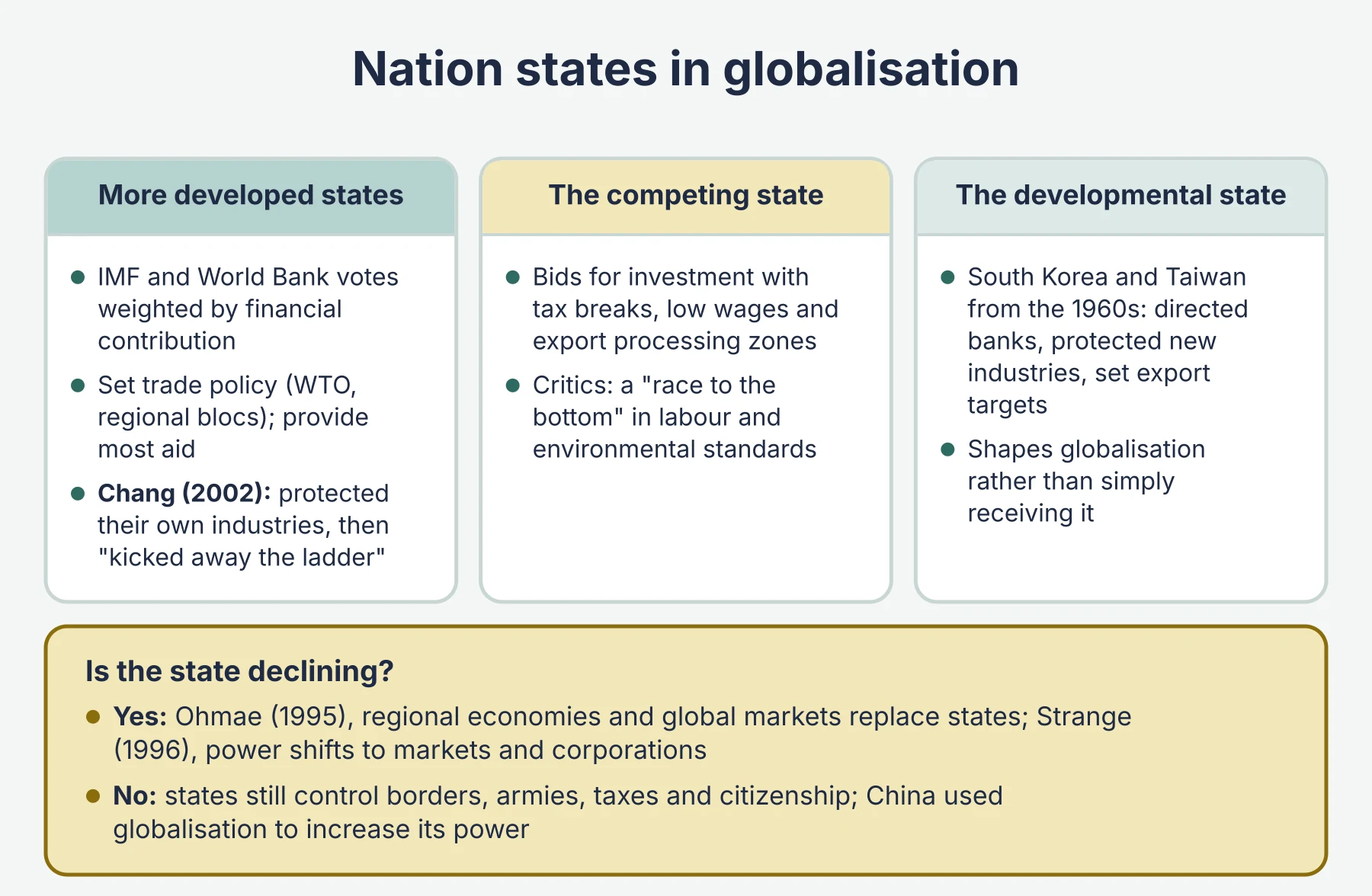
| More developed states | Write trade and lending rules; weighted votes at IMF and World Bank; give aid | Chang (2002): rich states “kicked away the ladder” of protection they once used | Rules serve donor and creditor interests |
| Less developed states | Compete for investment, or direct development | Export processing zones; developmental states (South Korea, Taiwan) | “Race to the bottom” on wages and standards |
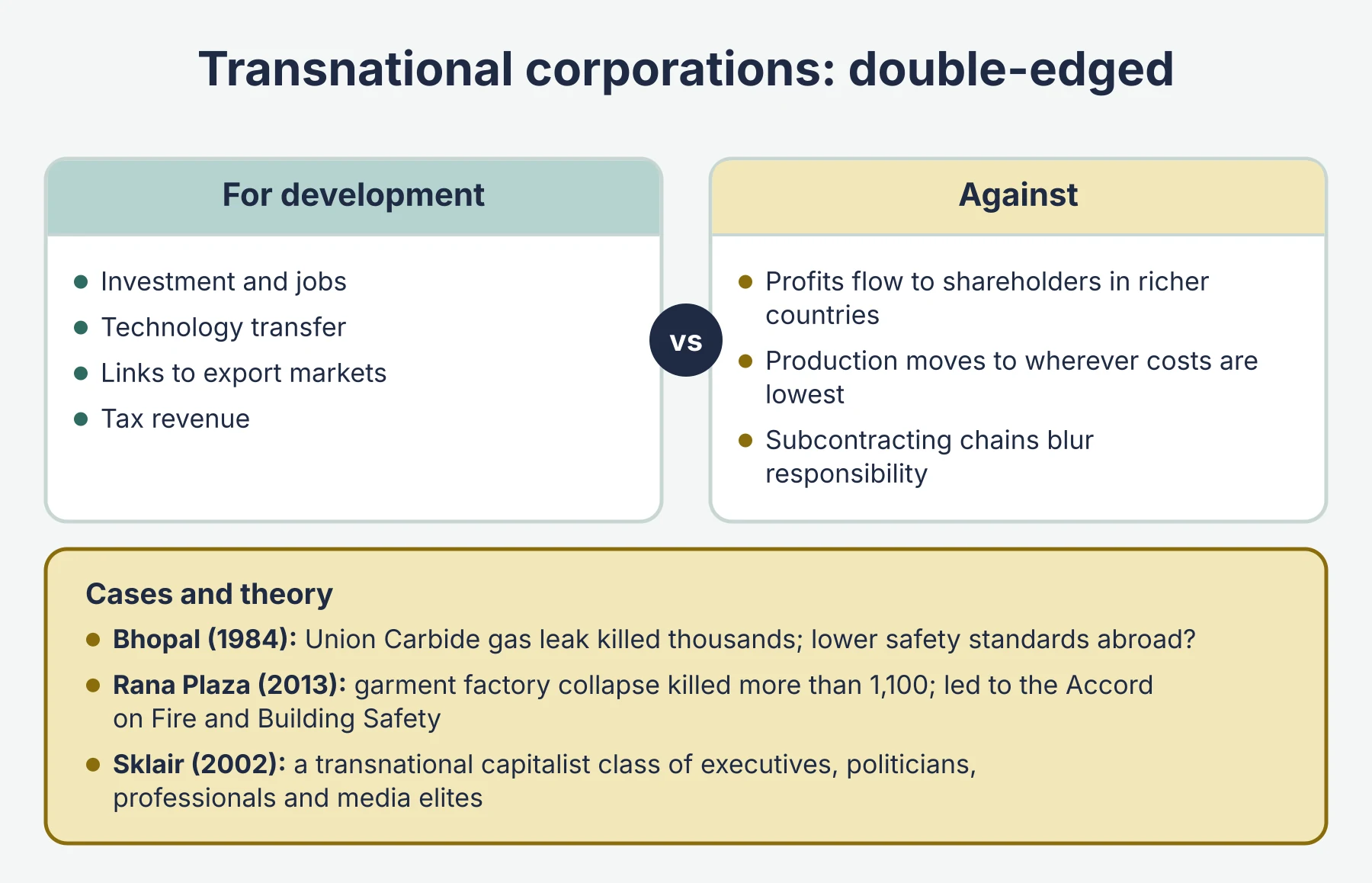
| TNCs | Investment, jobs, technology, export links | Sklair: transnational capitalist class; Bhopal (1984); Rana Plaza (2013) | Profit repatriation; blurred responsibility in subcontracting |
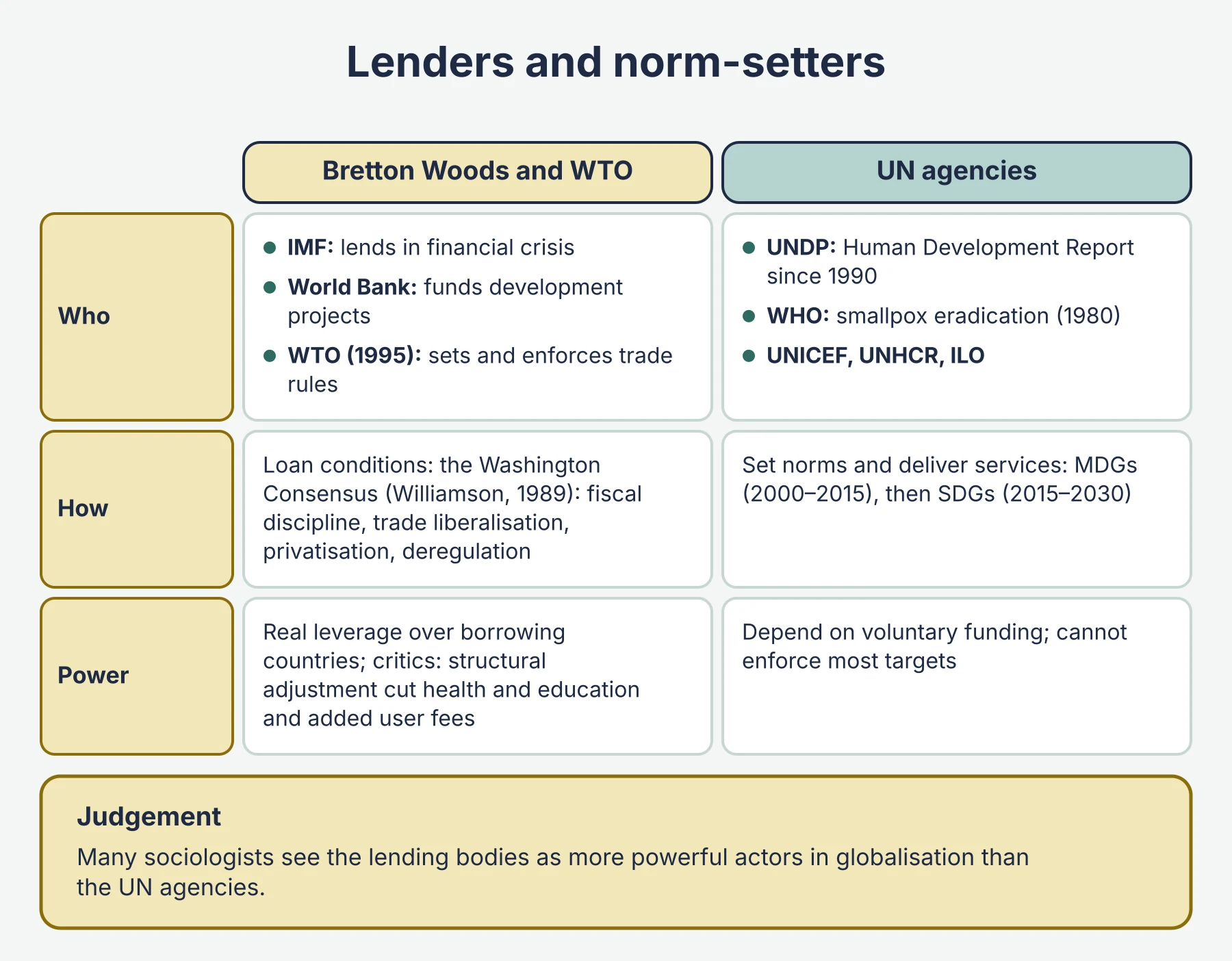
| IMF and World Bank | Loans with conditions | Washington Consensus (Williamson, 1989); structural adjustment | Spending cuts and user fees hit health and education |
| WTO (1995) | Sets and enforces trade rules | Replaced GATT | Rules favour those with most bargaining power |
| UN agencies | Set norms; deliver services | UNDP Human Development Report (from 1990); WHO and smallpox eradication (1980); MDGs then SDGs | Rely on voluntary funding; weak enforcement |
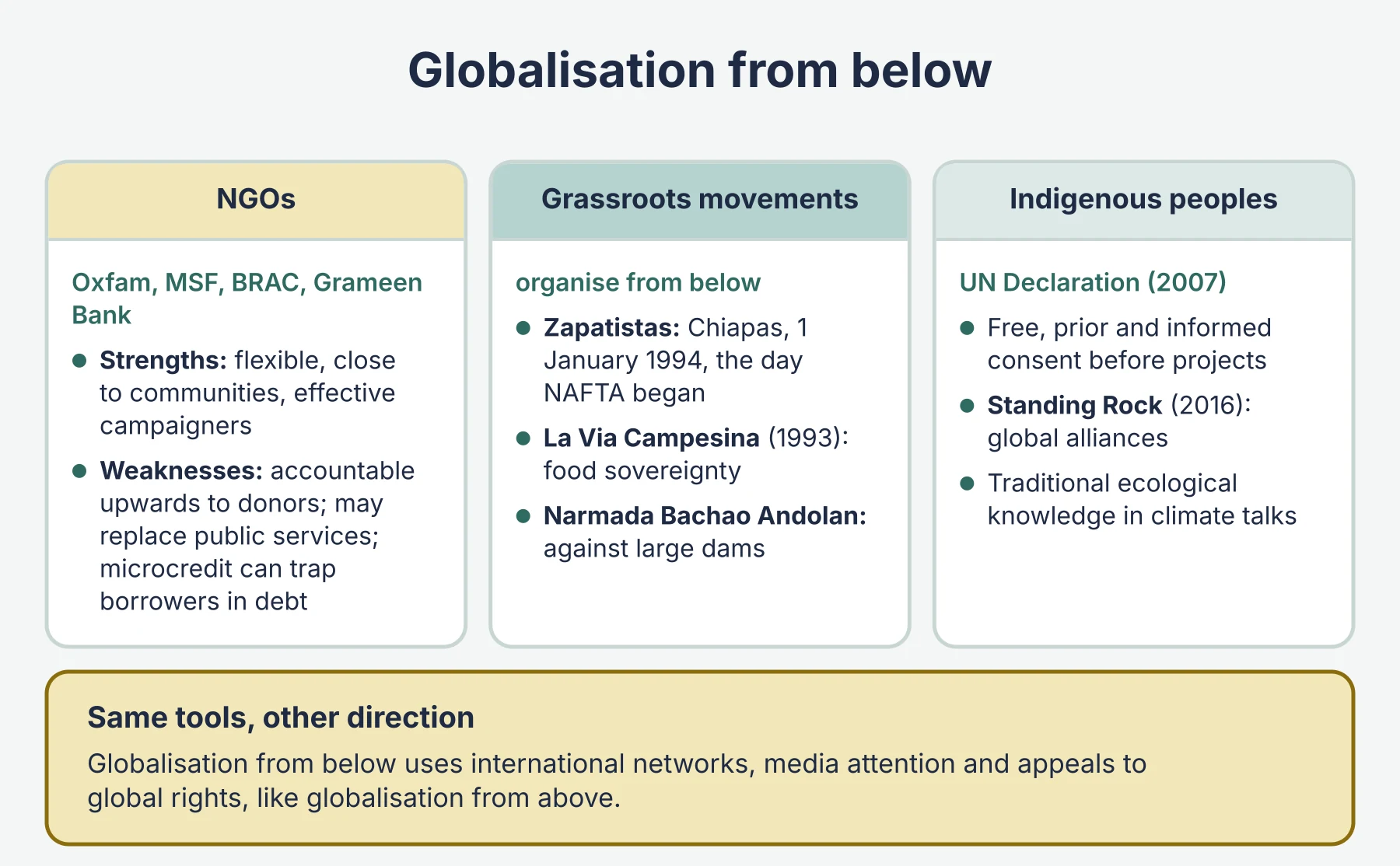
| NGOs | Flexible service delivery and campaigning | Oxfam (1942), MSF (1971), BRAC (1972); Grameen Bank and Yunus (Nobel 2006) | Accountable to donors, not recipients |
| Grassroots movements | Organise from below; use global networks | Zapatistas (1994); La Via Campesina (1993) and food sovereignty; Narmada Bachao Andolan | Few resources; can be repressed |
| Indigenous peoples | Defend land; contribute traditional knowledge | UNDRIP (2007): free, prior and informed consent; Standing Rock (2016) | Rights often ignored by states and firms |
The state debate
- Declining: Ohmae (1995), The End of the Nation State; Strange (1996), The Retreat of the State: power shifting to markets.
- Still strong: states control borders, armies, taxes and citizenship; China used globalisation to grow its power.
Core recall: aid
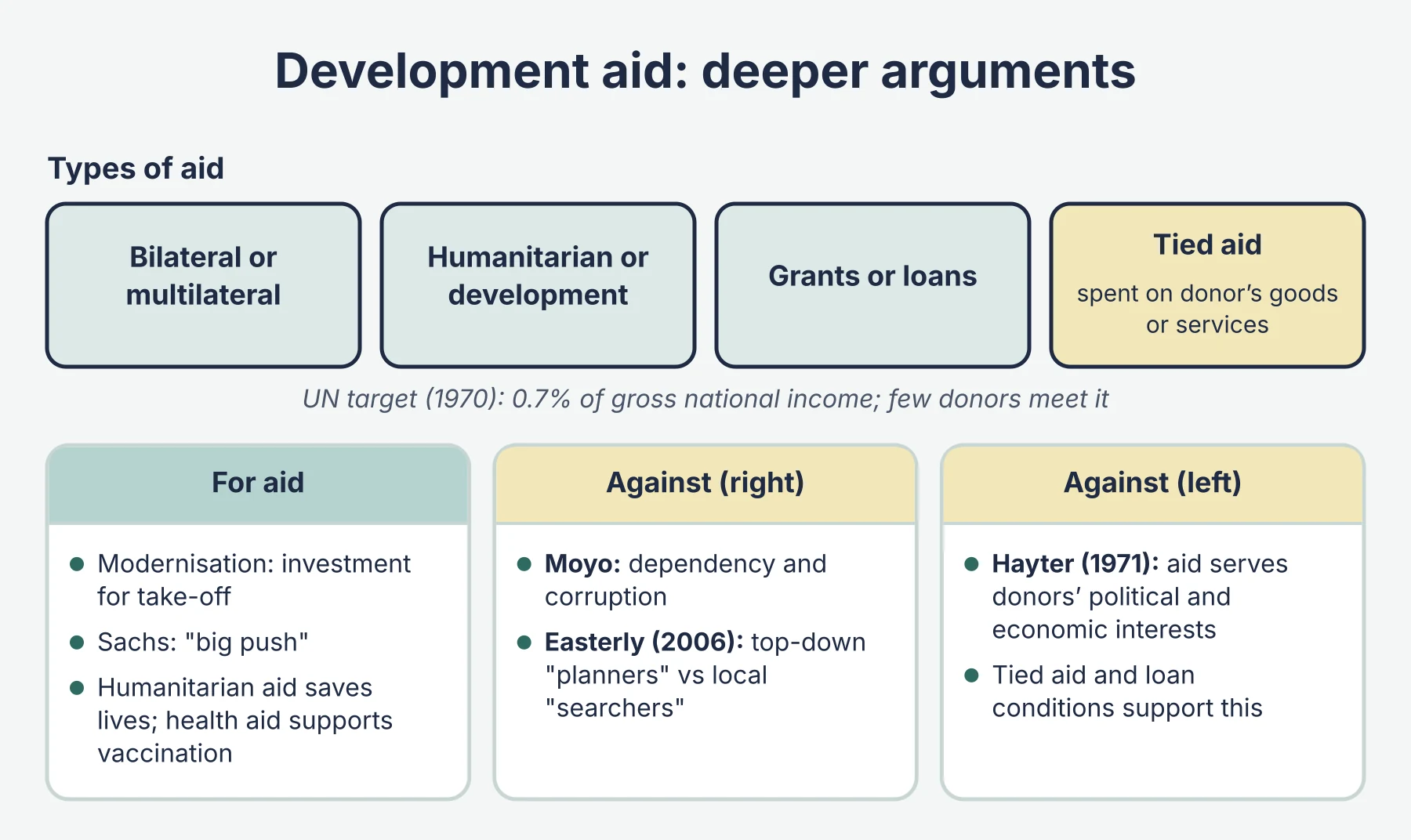
Types: bilateral or multilateral; humanitarian or development; grant or loan; tied (spent on donor goods) or untied. UN target (1970): 0.7 per cent of gross national income; few donors meet it.
| For aid | Against aid (right) | Against aid (left) |
|---|---|---|
| Modernisation: aid provides capital for take-off | Moyo: dependency and corruption | Hayter (1971): aid as imperialism |
| Sachs: “big push” out of the poverty trap | Easterly (2006): top-down “planners” fail; local “searchers” succeed | Tied aid and loan conditions serve donors |
| Emergency aid saves lives; health aid supports vaccination | Aid can weaken accountability to taxpayers | Aid can sustain dependency on the core |
Key terms
| Term | Definition |
|---|---|
| Transnational corporation | Firm with production or sales in more than one country |
| Export processing zone | Area with relaxed taxes and rules for export industries |
| Race to the bottom | Competition between states that lowers labour and environmental standards |
| Developmental state | State that directs investment and industry to drive growth |
| Structural adjustment | Loan conditions requiring cuts, privatisation and opening of markets |
| Washington Consensus | Policy package of fiscal discipline, liberalisation, privatisation and deregulation |
| Transnational capitalist class | Sklair’s global elite of executives, globalising politicians, professionals and media |
| NGO | Non-profit organisation independent of government |
| Microcredit | Small loans to poor people without collateral |
| Grassroots movement | Movement arising from affected communities |
| Food sovereignty | Right of communities to control their own food systems |
| Free, prior and informed consent | Indigenous peoples’ right to agree before projects affect their land |
| Tied aid | Aid that must be spent on goods or services from the donor |
Exam traps
- Lenders are not service agencies. The IMF and World Bank lend with conditions; UNICEF or UNHCR deliver services. Keep them apart.
- NGO is not grassroots. An NGO is a formal organisation; a grassroots movement grows from the community affected.
- Aid needs a type. Health aid, emergency aid and tied loans are judged differently.
- Less developed states are not passive. Developmental states show active roles.
- Cases need a point. Rana Plaza is evidence about subcontracting and accountability, not just a tragedy to mention.
- Name a judgement. Assess questions need a conclusion about which actor holds most power.
Self-test
- Why do the largest economies have most influence in the IMF?
- What did Chang mean by “kicking away the ladder”?
- Give one example of a developmental state.
- What is an export processing zone?
- Name the four broad elements of the Washington Consensus.
- What did Sklair mean by the transnational capitalist class?
- What happened at Rana Plaza and why is it used in this topic?
- Give one strength and one weakness of NGOs.
- What is food sovereignty and which movement campaigns for it?
- What principle does UNDRIP (2007) set out?
- What is tied aid?
- How does Easterly’s criticism of aid differ from Hayter’s?
Answers
- Voting power is weighted by each member’s financial contribution.
- Rich countries protected their industries while developing, then pressed poorer countries to open markets, denying them the same route.
- South Korea or Taiwan.
- An area with relaxed taxes and regulations to attract export industries.
- Fiscal discipline, trade liberalisation, privatisation and deregulation.
- A global elite of corporate executives, globalising politicians and professionals, and consumerist media elites with shared interests across borders.
- A building housing garment factories supplying Western brands collapsed in Bangladesh in 2013, killing more than 1,100 workers; it shows how subcontracting blurs TNC responsibility, and how global pressure produced a safety accord.
- Strength: flexible and close to communities. Weakness: accountable mainly to donors.
- The right of communities to control their own food systems; La Via Campesina.
- Free, prior and informed consent before projects affect indigenous land.
- Aid that must be spent on goods or services from the donor country.
- Easterly says top-down aid fails because planners ignore local knowledge; Hayter says aid serves donors’ political and economic interests.
Apply these with the practice questions on who is involved in globalisation.
Related resources
-
Study guides
OxfordAQA International A-level Sociology (9690): Demographic changes - migration and diasporas
Study guide to OxfordAQA 9690 section 3.2.1.4: explanations of migration, borders and visas, refugees, types of migrant, diasporas and climate-linked migration.
Sociology · OxfordAQA · A Level
Read guide -
Practice questions
OxfordAQA International A-level Sociology (9690): Demographic changes - migration and diasporas – Practice Questions
Original OxfordAQA 9690 practice questions on migration theories, borders, forced migration, migrant types, diasporas and climate change, with full answers.
Sociology · OxfordAQA · A Level
Try questions -
Revision notes
OxfordAQA International A-level Sociology (9690): Demographic changes - migration and diasporas – Revision Notes
Revision notes for OxfordAQA 9690 section 3.2.1.4: migration theories, borders and visas, refugees and forced migration, migrant types, diasporas and climate.
Sociology · OxfordAQA · A Level
Revise topic
Related articles
Get free revision emails (optional)
Occasional emails with practice questions, worked explanations and links to free resources for the qualification and subjects you choose. No spam, and you can unsubscribe from any email. The free tools on this site never need an email.