
Study Guides
OxfordAQA International A-level Sociology (9690): Who is involved in globalisation?
Study guide to OxfordAQA 9690 section 3.2.1.3: the roles of states, TNCs, UN and transnational agencies, NGOs, grassroots movements, indigenous peoples and aid.
- Subject
- Sociology
- Level
- A LEVEL
- Topic
- Unit 3 – People and Development
- Author
- Marlbridge Academic Team
- Updated
- Reviewed by
- Naqiya Yousaf (what this means)
Aligned to OxfordAQA A Level Sociology (9690), Version 1.1. Official specification .
Syllabus page (what it covers and how it is assessed): OxfordAQA A Level Sociology.
Syllabus points this page covers
9690 (A Level)
- 3.2.1.3 Who is involved in globalisation?
Found an error? Report a correction.
Need help with this topic? Request a free trial class for A Level Sociology (9690).
This guide covers content point 3.2.1.3 Who is involved in globalisation? of the OxfordAQA International A-level Sociology (9690) specification, Version 1.1, assessed in the Unit 3 People and development exam. The specification lists “the roles in globalisation of: nation states, including those that are more developed and those that are less developed; transnational corporations; transnational and United Nations (UN) agencies; non-governmental organisations (NGOs); ‘grassroots’ movements; indigenous peoples”, and “arguments for and against development aid”.
The Unit 3 People and development study guide introduces each actor in a line or two. This page explains how each one exercises power, with cases and evaluation you can use in extended answers. Use it with the revision notes on who is involved and the practice questions on who is involved.
A way to organise this content
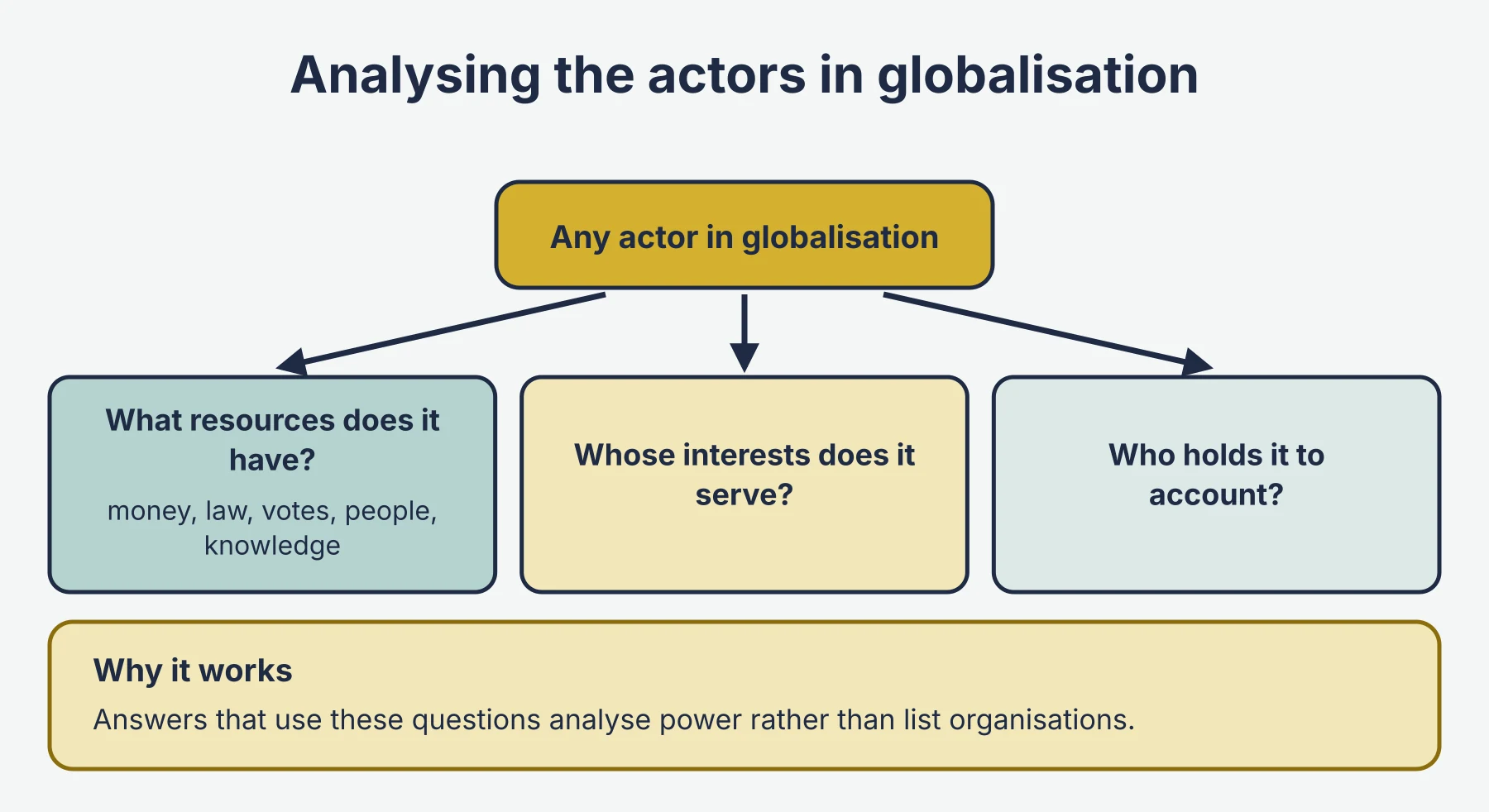
For every actor, ask three questions: what resources does it have (money, law, votes, people, knowledge), whose interests does it serve, and who holds it to account? Answers that use these questions analyse power rather than list organisations.
Nation states
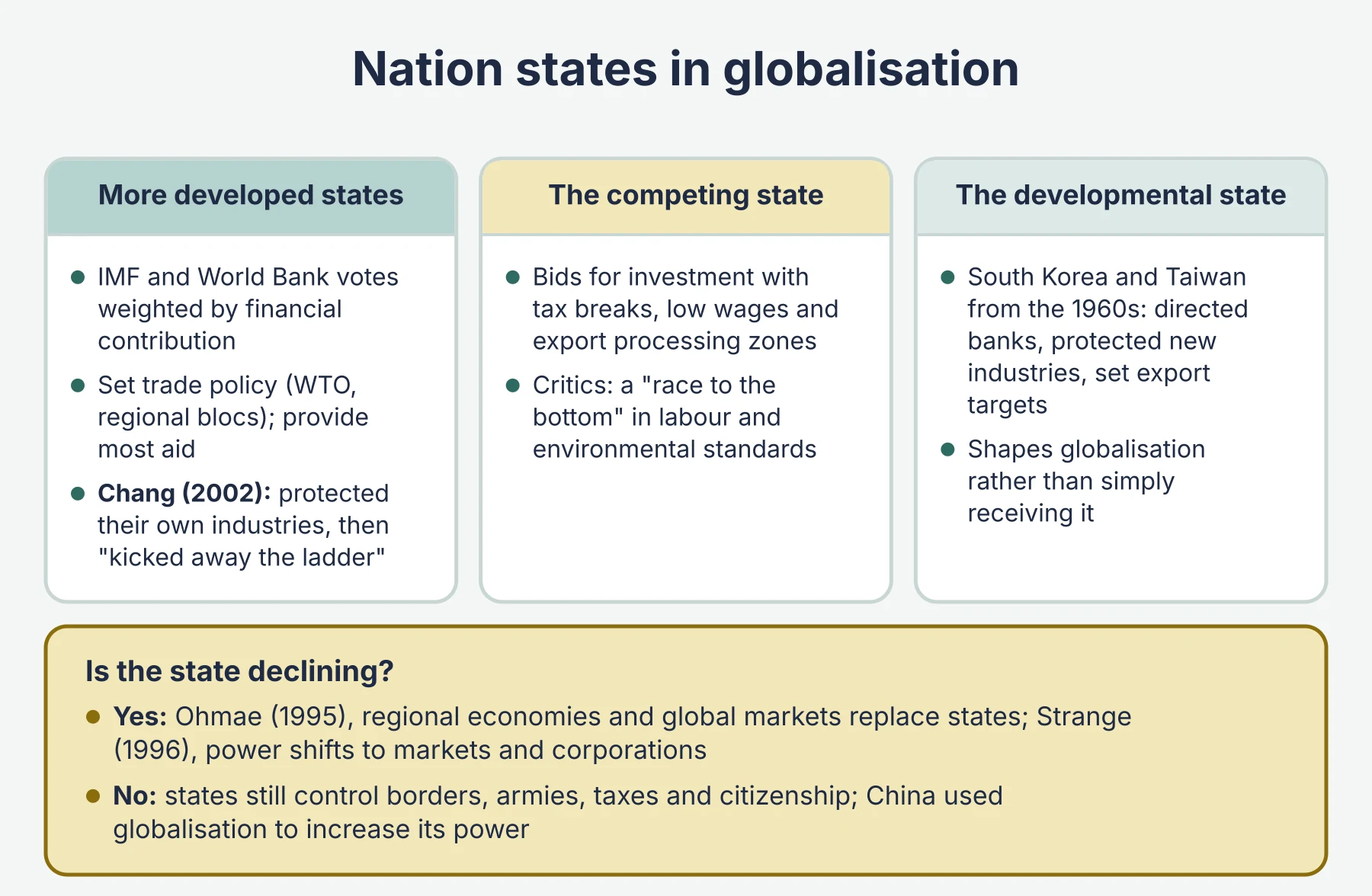
More developed states. Rich states write many of the rules of the global economy. Voting power in the International Monetary Fund and the World Bank is weighted by each member’s financial contribution, so the largest economies have the most influence. Rich states also set trade policy through bodies such as the World Trade Organization and through regional blocs, and they provide most aid. Ha-Joon Chang (Kicking Away the Ladder, 2002) argued that today’s rich countries protected their own industries with tariffs while they industrialised, then pressed poorer countries to open their markets, denying them the same route.
Less developed states. Two contrasting roles appear in the literature.
- The competing state: governments bid for foreign investment with tax breaks, low wages and export processing zones (areas with relaxed taxes and regulations for export industries). Critics call this a “race to the bottom” in labour and environmental standards.
- The developmental state: governments such as South Korea and Taiwan from the 1960s directed banks, protected new industries and set export targets. This shows less developed states can shape globalisation rather than simply receive it.
Is the state declining? Kenichi Ohmae (The End of the Nation State, 1995) argued that regional economies and global markets were replacing states. Susan Strange (The Retreat of the State, 1996) argued that power had shifted from states to markets and corporations. Against both, states still control borders, armies, taxes and citizenship, and states such as China have used globalisation to increase their power.
Transnational corporations (TNCs)
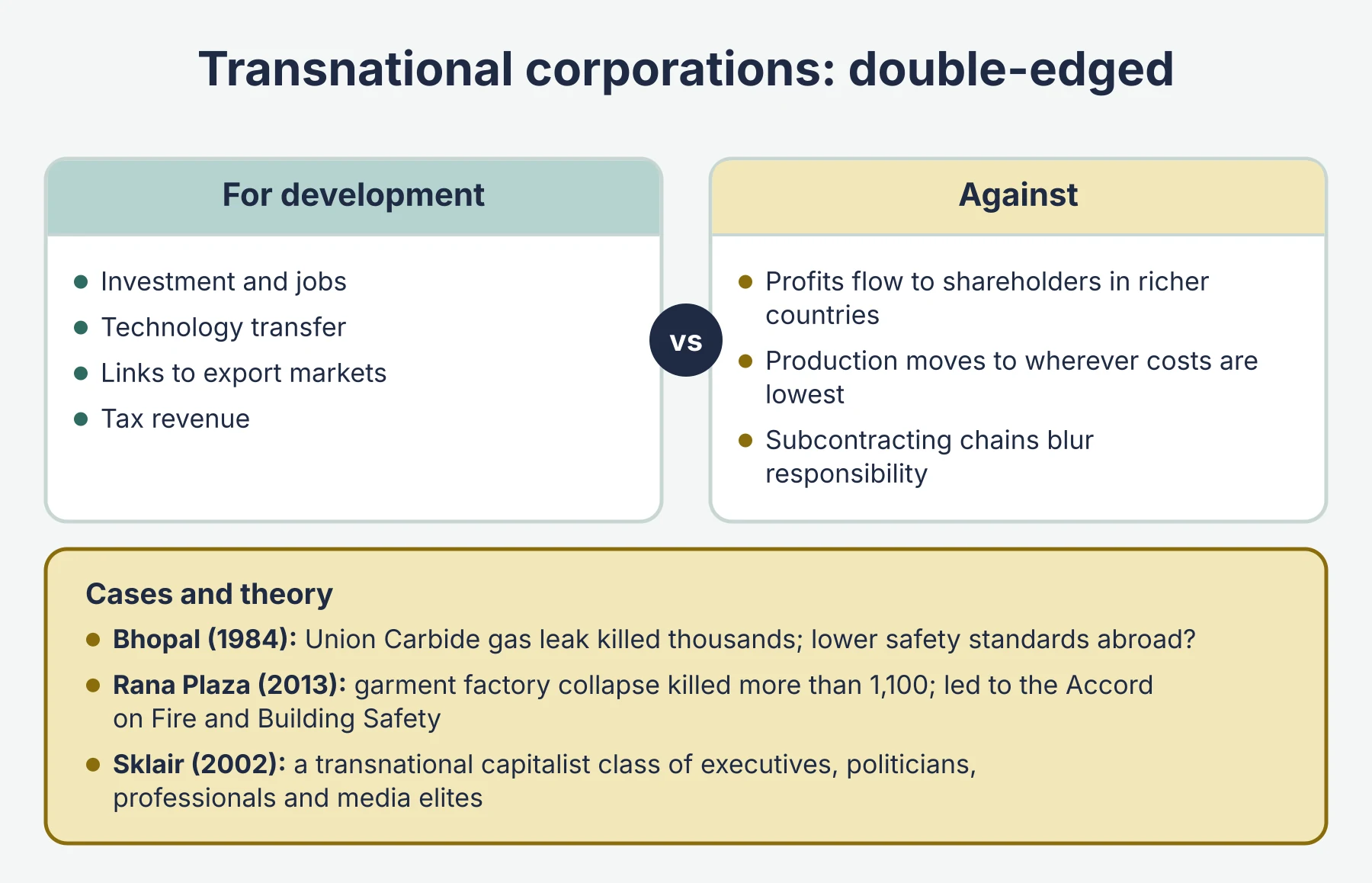
TNCs are firms that operate production or sales in more than one country. Their role is double-edged.
- For development: investment, jobs, technology transfer, links to export markets and tax revenue.
- Against: profits flow back to shareholders in richer countries; firms can move production to wherever costs are lowest; subcontracting chains blur responsibility.
Two cases show what is at stake. The Bhopal disaster in India (1984), a gas leak at a Union Carbide pesticide plant, killed thousands of people and raised questions about whether TNCs apply lower safety standards abroad. The Rana Plaza collapse in Bangladesh (2013), a building housing garment factories that supplied Western brands, killed more than 1,100 workers. It led to the Accord on Fire and Building Safety, signed by many brands and trade unions, which supporters cite as evidence that global pressure can change TNC behaviour.
Leslie Sklair (Globalization: Capitalism and its Alternatives, 2002) argued that a transnational capitalist class of corporate executives, globalising politicians and professionals, and consumerist media elites now pursues shared interests across borders. This is a Marxist reading: TNCs are not just firms but part of a global ruling class.
Transnational and UN agencies
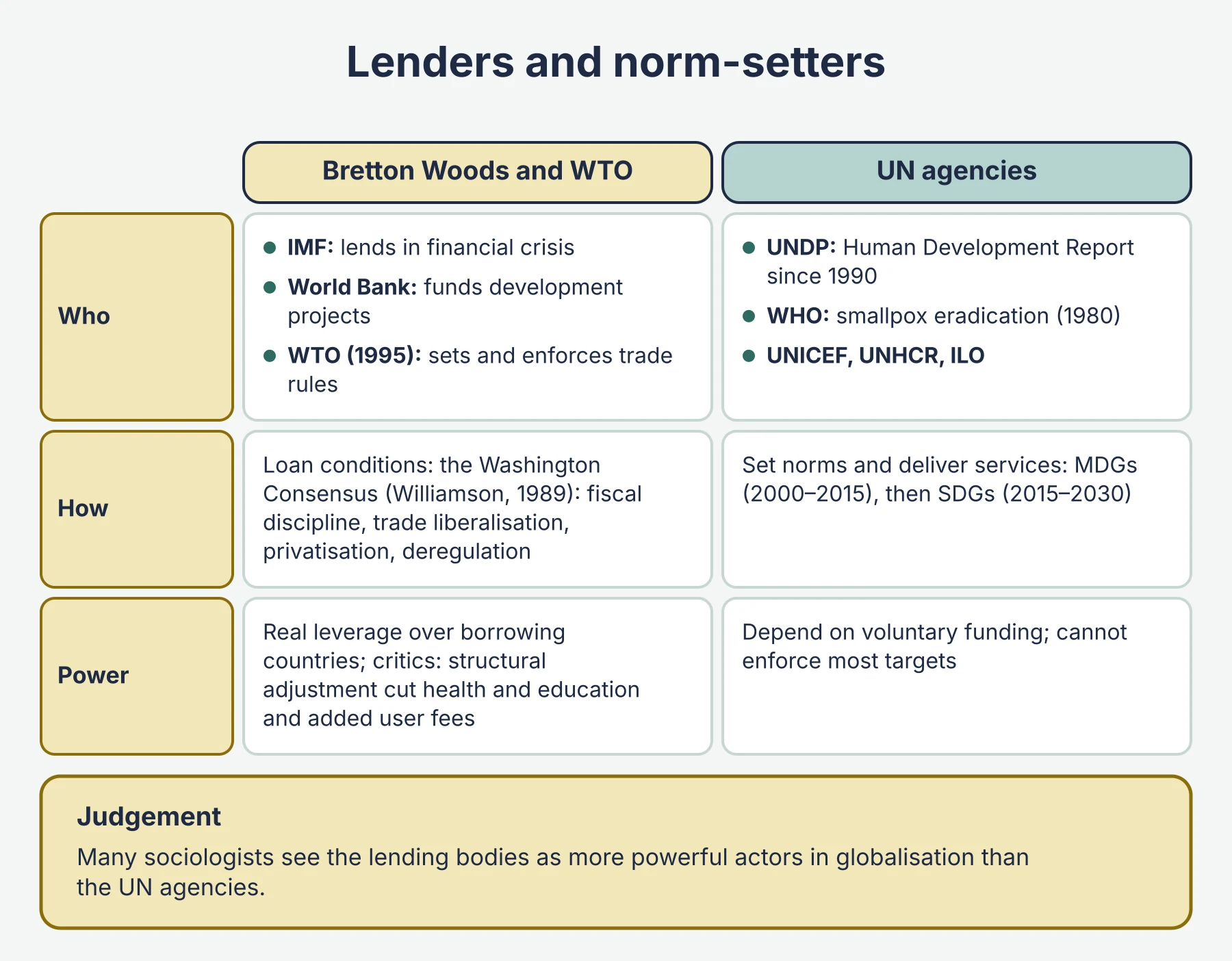
The Bretton Woods institutions (set up after the 1944 conference): the IMF lends to countries in financial crisis; the World Bank funds development projects. In the 1980s and 1990s both attached conditions to loans. John Williamson (1989) summarised the policy package as the Washington Consensus: fiscal discipline, trade liberalisation, privatisation and deregulation. Critics argue the resulting structural adjustment cut health and education spending and introduced user fees for public services.
The WTO (1995, replacing the General Agreement on Tariffs and Trade) sets and enforces trade rules between members.
UN agencies play a different role, mostly setting norms and delivering services:
- The UN Development Programme publishes the Human Development Report, which since 1990 has measured development through health, education and income.
- The World Health Organization led the campaign that eradicated smallpox, declared in 1980.
- UNICEF (children), UNHCR (refugees) and the International Labour Organization (labour standards) work across borders.
- The Millennium Development Goals (2000 to 2015) were followed by the Sustainable Development Goals (2015 to 2030).
Evaluation: UN agencies depend on voluntary funding and cannot enforce most of their targets, while the IMF and World Bank have real leverage over borrowing countries. This is why many sociologists see the lending bodies as more powerful actors in globalisation than the UN agencies.
Non-governmental organisations (NGOs)
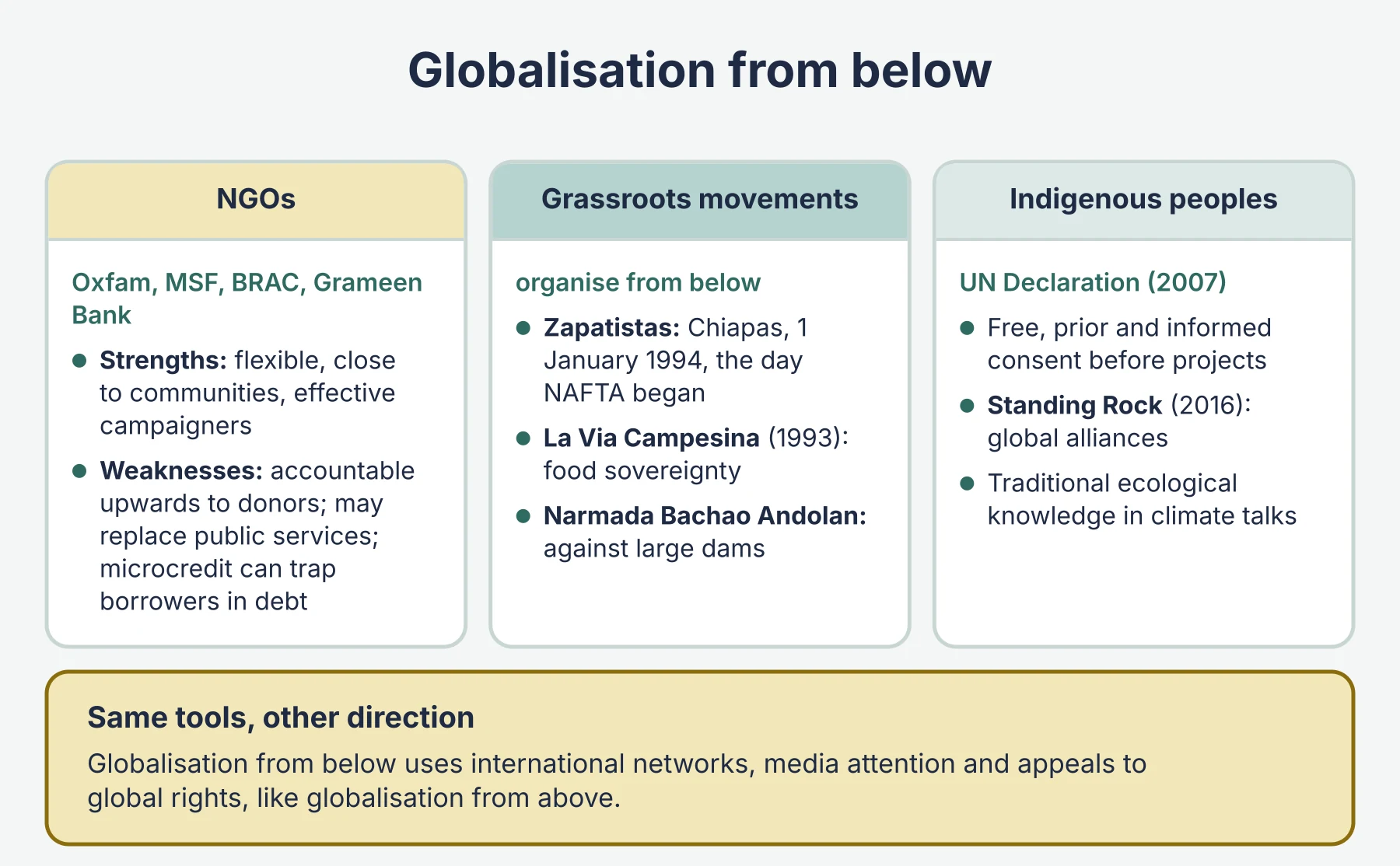
NGOs are non-profit organisations independent of government. Examples include Oxfam (founded 1942), Médecins Sans Frontières (1971), and BRAC, founded in Bangladesh in 1972 and now one of the largest NGOs in the world. Muhammad Yunus and the Grameen Bank shared the 2006 Nobel Peace Prize for microcredit: small loans to poor people, mostly women, without collateral.
- Strengths: flexible, close to communities, able to reach people states neglect, and effective campaigners (for example on debt relief).
- Weaknesses: they are accountable mainly upwards to donors rather than to the people they serve; they can replace public services instead of strengthening them; and critics of microcredit argue it can trap borrowers in debt without changing the wider economy.
Grassroots movements
Grassroots movements organise from below, often against states or corporations.
- The Zapatistas (EZLN) rose in Chiapas, Mexico, on 1 January 1994, the day the North American Free Trade Agreement came into force, linking indigenous land rights to opposition to neo-liberal trade.
- La Via Campesina (founded 1993) is an international movement of peasants and small farmers that campaigns for food sovereignty: the right of communities to control their own food systems.
- Narmada Bachao Andolan in India, associated with Medha Patkar, opposed large dams on the Narmada river that displaced villages.
These cases show that globalisation from below uses the same tools as globalisation from above: international networks, media attention and appeals to global rights.
Indigenous peoples
Indigenous peoples are often affected first by mining, logging, dams and pipelines on their land. The UN Declaration on the Rights of Indigenous Peoples (2007) sets out the principle of free, prior and informed consent before projects affect their land. The protests at Standing Rock in the United States (2016) against the Dakota Access Pipeline showed indigenous groups forming global alliances. Indigenous peoples are also actors in their own right, for example by promoting traditional ecological knowledge in climate negotiations.
Development aid: deeper arguments
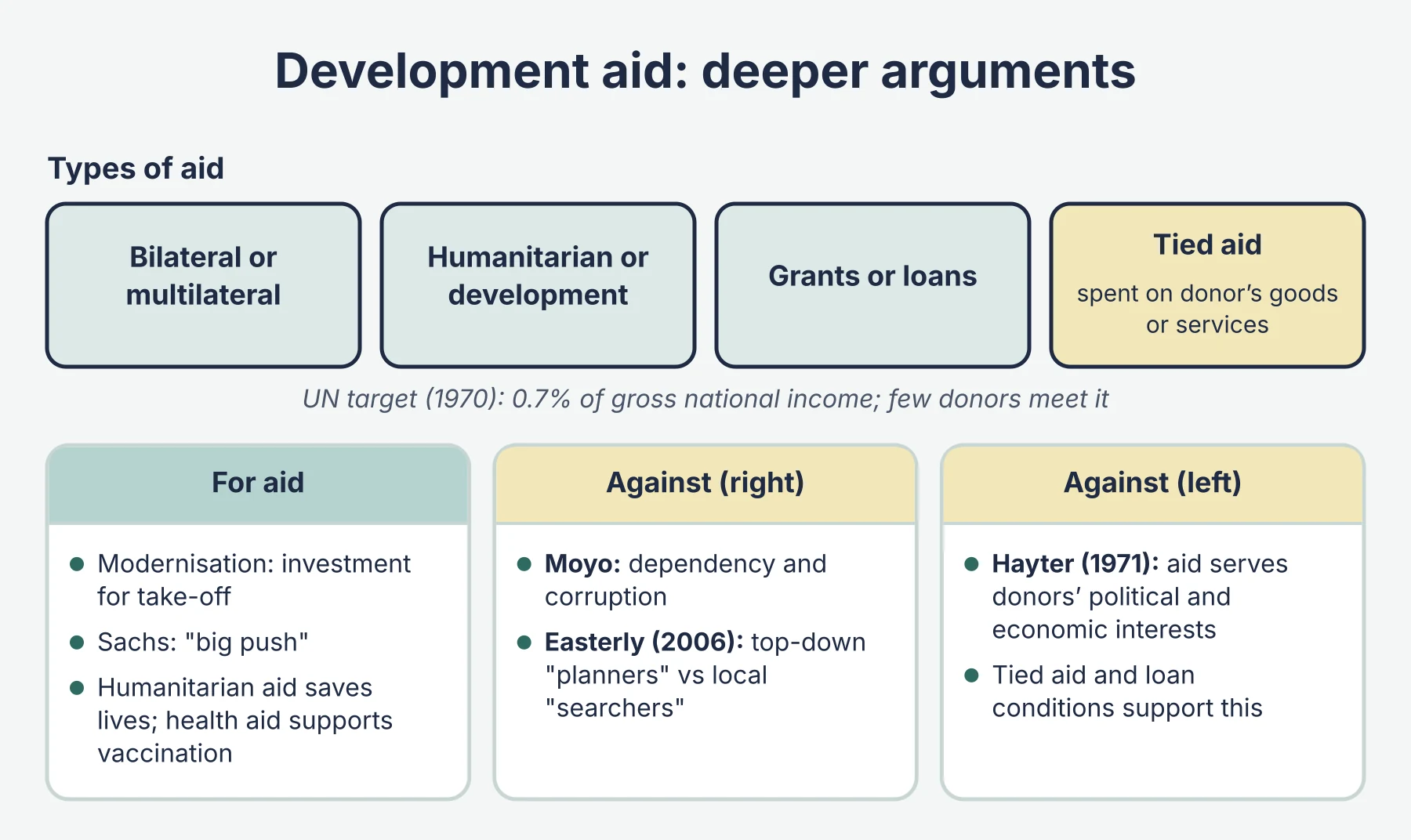
Distinguish the types before you evaluate: bilateral (government to government) and multilateral (through agencies); humanitarian (emergency) and development (long-term); grants and loans; and tied aid, which must be spent on goods or services from the donor country. In 1970 the UN set a target for rich countries to give 0.7 per cent of gross national income as aid; few donors meet it.
- For aid: modernisation theory sees aid as providing the investment needed for take-off; Sachs’s “big push” argument; humanitarian aid saves lives in disasters; health aid has supported vaccination and disease control.
- Against aid (right-leaning): Moyo argues aid breeds dependency and corruption; William Easterly (The White Man’s Burden, 2006) contrasts top-down “planners” with “searchers” who find what works locally.
- Against aid (left-leaning): Teresa Hayter (Aid as Imperialism, 1971) argued that aid serves donors’ political and economic interests. Tied aid and loan conditions support this dependency reading.
Annotated model answer
Extract from a 12-mark answer: Assess the role of transnational corporations in globalisation.
TNCs bring investment and jobs, and export work in garment factories has given many young women their first wage [knowledge, positive role]. In my society, foreign-owned factories in export zones pay more than farm work [application]. However, Rana Plaza in 2013 showed how subcontracting lets brands avoid responsibility for unsafe buildings [analysis of mechanism]. Sklair would see this as the transnational capitalist class shaping rules in its own interest, yet the safety accord that followed shows that unions, NGOs and consumers can push back, so TNC power is real but contested [evaluation, two views].
Common mistakes
- Treating the IMF, World Bank, WTO and UN agencies as one body. Separate lenders, rule-setters and service agencies.
- Calling every charity a grassroots movement. NGOs are formal organisations; grassroots movements arise from affected communities.
- Writing “aid is good” or “aid is bad” without saying which type of aid.
- Describing actors without assessing their power or accountability.
- Forgetting that less developed states can be active, as in the developmental state.
Exam technique
Outline questions on actors need a role plus an example. Explain questions need a mechanism (“loan conditions required spending cuts, so…”). For assess and evaluate, compare at least two actors or two views, and end with a judgement about who holds most power. Use own-society examples, such as a foreign company, an NGO or a local movement you know about, where the question asks.
Where next
For the types and extent of globalisation itself, see what is meant by globalisation. Debt, conflict and inequality as barriers are covered in obstacles to progress.
Related resources
-
Practice questions
OxfordAQA International A-level Sociology (9690): Who is involved in globalisation? – Practice Questions
Original OxfordAQA 9690 practice questions on states, TNCs, international agencies, NGOs, indigenous peoples and development aid, with mark-scheme answers.
Sociology · OxfordAQA · A Level
Try questions -
Revision notes
OxfordAQA International A-level Sociology (9690): Who is involved in globalisation? – Revision Notes
Revision notes for OxfordAQA 9690 section 3.2.1.3: states, TNCs, IMF, World Bank, WTO, UN agencies, NGOs, grassroots movements, indigenous peoples and aid.
Sociology · OxfordAQA · A Level
Revise topic -
Study guides
OxfordAQA International A-level Sociology (9690): Demographic changes - migration and diasporas
Study guide to OxfordAQA 9690 section 3.2.1.4: explanations of migration, borders and visas, refugees, types of migrant, diasporas and climate-linked migration.
Sociology · OxfordAQA · A Level
Read guide
Related articles
Get free revision emails (optional)
Occasional emails with practice questions, worked explanations and links to free resources for the qualification and subjects you choose. No spam, and you can unsubscribe from any email. The free tools on this site never need an email.